Latest News and Comment from Education

Wednesday, August 22, 2018

It's time to address the hidden agenda of school dress codes

It's time to address the hidden agenda of school dress codes

It’s time to address the hidden agenda of school dress codes


Dress code policies have always been prevalent in schools. Normally, what children can and cannot wear in schools is explicitly noted in school policies or implicitly implied by broader cultural and societal norms.
The issue of the vast and sometimes exhaustive list of dress code policies of what cannot be worn has not had any resolution across localities and countries.
The problem with trying to develop a set of guidelines for school dress code policies is that the implementation or restriction of dress is just not about the clothes that kids wear. Dress code policies are mired in larger contested debates that have to do with gender identity, race and sexuality, reflective of a broader public discourse .
How school educators and policymakers set parameters of dress in schools creates a highly emotional and volatile debate with little consensus or resolution.
Most obviously, the nature of many dress code violations interconnects to issues of gender and sexual identity. The vast majority of cases have targeted girls and LGBTQ youth on the basis that what one might wear reveals too much — that it’s sexually suggestive, distracting for other students or offensive to the local and cultural norms of the community.

Shaming

Those who are not part of the “norm,” particularly those children whose self-identity goes beyond traditional gender types, are more susceptible to stricter dress code infractions than those policies that privilege the status quo. Similarly, girls have taken the brunt of dress codes.
Tank tops, spaghetti straps, bare shoulders, cleavage or no cleavage, shorts that are too short, midriff, shirts/pants regulations are indicative of the multiple infractions that shame girls. The list is exhaustive.
The infractions for noncompliance exacerbate the shaming of girls’ self-perception of their worth. And yet it points to the basic assumption that girls’ bodies are shameful — something that is to be covered, evaluated or objectified.
And when their bodies are not covered, it supposedly sends a clear message that girls are at fault should something wrongful be done to them; they somehow deserved such a fate.
This narrative, whether intended or not, plays to the broader social movements beyond simply that of dress codes. Dress code policies mask broader issues such as one’s right to their own bodies.
Dress codes minimize the increasing public outcries over sexual harassment and assault that have been made so public with the explosion of the #MeToo movement. Conversations around issues of systemic racism or discrimination are also further cloaked.
Forms of dress may be curtailed in schools when they challenge dominant religious views. When schools or boards ban particular types of religious dress, a clear and real danger of undermining religious minorities exists. They may feel a broader form of systemic discrimination lurking behind this ban.
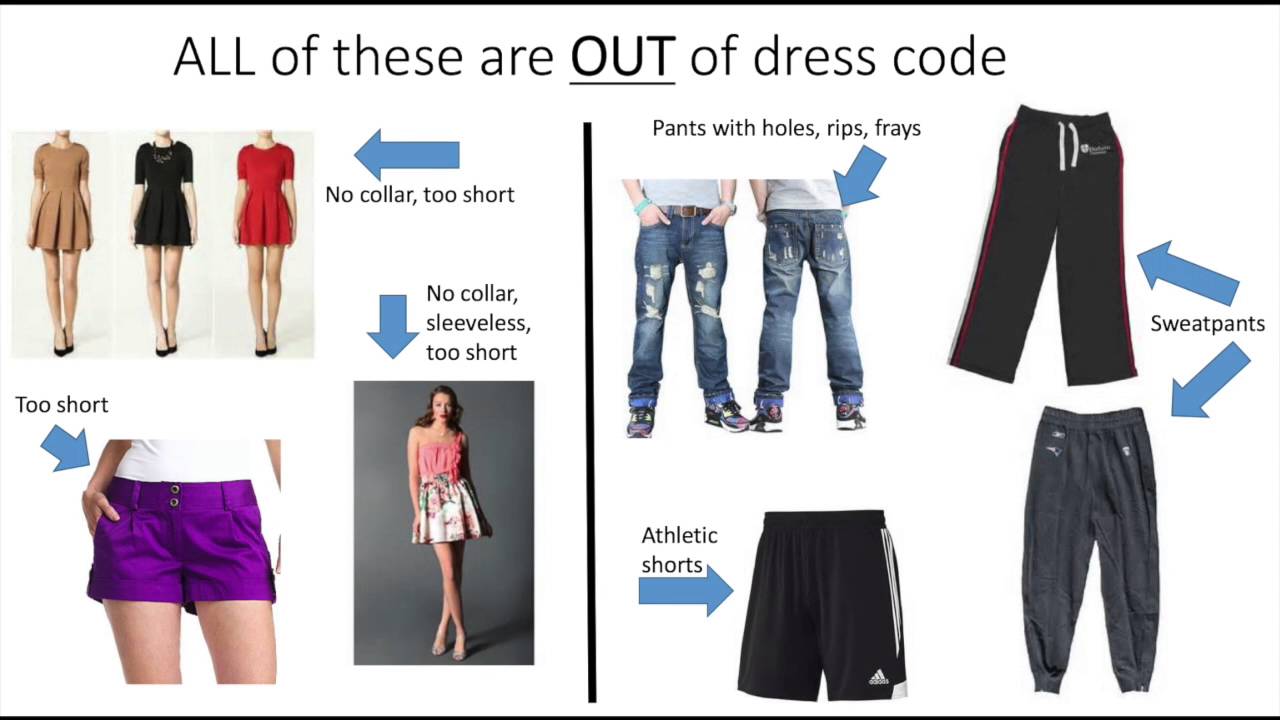
Image result for school dress codes


Creating inclusive, body-positive dress codes

If schools are going to remove this shackle of the perpetual dress code wars in schools, let educators and policymakers call it for what it is – a diversion behind the more significant Continue reading: It's time to address the hidden agenda of school dress codes

Betsy DeVos to Create Permanent Underclass With Rollback of For-Profit College Rules - Rewire.News

Betsy DeVos to Create Permanent Underclass With Rollback of For-Profit College Rules - Rewire.News

Betsy DeVos to Create Permanent Underclass With Rollback of For-Profit College Rules
Make no mistake, these efforts are being driven by greed, plain and simple.


Betsy DeVos gets a lot of notice for her terrible anti-trans stances and her lessening of protections for victims of campus assault. Less reported is how she is also making moves to create a perpetually indebted and undereducated underclass. It’s a quieter way of undermining education in America, but it’s no less dangerous: the propping up of for-profit colleges that fail to provide a meaningful education but do a great job at taking student money and rolling back Obama-era protections for borrowers duped by those colleges.
At the same time, the Trump administration is working on other fronts to ensure that higher education is undermined by a profit motive. The president’s son-in-law Jared Kushner is now apparently overseeing a White House special office dealing with higher education.
Make no mistake, these efforts are being driven by greed, plain and simple. And, like with other policies under the Trump administration, these changes will have a negative disparate impact on people of color—and veterans.
Earlier this month, Education Secretary DeVos scrapped an Obama-era regulation that required for-profit schools to prove that their students were able to get actual decent-paying jobs after their course of study. Known as the “gainful employment” rule, for-profit colleges fought it every step of the way, including multiple lawsuits. The rule packed quite a punch: Schools that were doing nothing but saddling students with debt could see their federal funding revoked.

Federal funding is vital to the for-profit college scheme. It takes public dollars and diverts them to private companies and leaves students on the hook. Roughly 200 for-profit colleges get almost all their funding from the federal government. They’re also a large percentage of the schools that failed the requirements of the gainful employment rule.
The worst of the for-profit schools get students in the door by falsely claiming they have very high rates of post-school employment. Corinthian Colleges famously claimed placement rates as high as 92 percent for one of their accounting programs in Florida when the rate of placement was actually 12 percent. (And lest you think that was limited to that program, they also claimed an 85 percent placement rate for a medical assistant program in Los Angeles when the actual rate of placement was zero.) Under Obama, the federal government fined Corinthian $30 million for that fake job data, while the Consumer Financial Protection Bureau sued them for using those same imaginary placement rates to get students to take out expensive private loans as well.
If these for-profit schools had to follow the gainful employment rule as instituted under Obama, they’d stand to lose $5.3 billion in federal funding over the next ten years. Now, that money will continue to flow to for-profit schools regardless of whether they’re deceiving students or are genuinely able to place students in the jobs for which they are ostensibly trained.
Under the Obama administration, students also at least had a possibility of some recourse if they were Continue reading: Betsy DeVos to Create Permanent Underclass With Rollback of For-Profit College Rules - Rewire.News

Tuesday, August 21, 2018

Study: Minorities Labeled Learning Disabled Because of Social Inequalities | Education News | US News

Study: Minorities Labeled Learning Disabled Because of Social Inequalities | Education News | US News

Study: Minorities Labeled Learning Disabled Because of Social Inequalities
Researchers believe that socioeconomic inequalities contribute to racial minorities being classified as learning disabled.
Related image

THE HIGH NUMBER OF racial minorities placed in special education for learning disabilities is largely because of social injustices separate from schools, not racially biased educators, according to a new study.

The study by Portland State University published in The Sociological Quarter used a statistical method to compare kids with comparable academic levels and socioeconomic status and found that racial minorities are actually less likely than white children to be labeled as having a learning disability, according to a press release from the university.

Dara Shifrer, lead author of the study and sociology professor in the university's College of Liberal Arts and Sciences, believes a student's socioeconomic status is a strong indicator of academic performance, which is often used to diagnose learning disabilities. Because African-American and Hispanic students are often at a socioeconomic disadvantage compared to white students, they may not perform as well, leading to a learning disabled diagnosis.

However, according to the study, classifying the lack of achievement as a disability "fails to address the social causes behind the achievement gap." The study also states that misguided classifications can occur because of language differences and immigration history.

Wrongly placing racial minorities in special education is a problem because there is no evidence that special education improves a student's outcome. However, a disability label stigmatizes students and can limit future opportunities, researchers say.

Study: Minorities Labeled Learning Disabled Because of Social Inequalities | Education News | US News


Related image

OPINION: Good teachers use the N-word

OPINION: Good teachers use the N-word

OPINION: Good teachers use the N-word

But it's how they use it that makes all the difference
Omarosa Manigault Newman, the senior White House staffer turned author, said recently during her book tour that she had heard a tape of President Donald Trump using the N-word during his time on the reality show The Apprentice. Trump denied the existence of any such tape, tweeting, “I don’t have that word in my vocabulary and never have. She made it up.”
Whether such a tape exists or not, would such a recording tell us anything we don’t already know? We already have plenty of evidence of the president’s bigotry and racism. From his taking out a one-page ad in The New York Times to call for the death penalty for the Central Park Five in 1989 before they were eventually exonerated, to his equating of torch-toting neo-Nazis and Confederate sympathizers with anti-racist protesters in Charlottesville last year, and instituting a travel ban for those from certain Muslim-majority nations, and proposing a border wall with Mexico, and his gross labeling of Mexican immigrants as rapists and murderers (I could go on), his actions have betrayed his words. It’s a safe assumption that he has used the word before.

The day after Manigault Newman’s revelation, on the comedy news program The Daily Show, correspondent Roy Wood Jr. eloquently and hilariously explained the situation using muscular movie star Dwayne “The Rock” Johnson, saying, “I don’t need footage of the Rock in the gym to know if he works out!”
Likewise, we don’t need tapes to know Trump — or other past presidents for that matter — used the word; we have public policy to show it. Government-backed slavery, redlining that kept black people from getting low-interest loans and a three-strikes policing policy that led to the mass incarceration of black people speak volumes about what federal leaders believed, and said, behind closed doors. Nevertheless, if a tape surfaces of Trump using the N-word, how should teachers respond to the media storm that would surely follow?
To be clear, educators hear and use the N-word everyday. They say it as a slur, or a term of endearment, or they teach it within the text of assigned readings. Students spew it in the hallways, on the way to and from school, on buses and in sports practice. It proliferates in pop culture: in music, in movies and in slang. It’s so ubiquitous that Continue reading: OPINION: Good teachers use the N-word


Image result for the N-word

Dana Goldstein: How Do You Get Better Schools? Take the State to Court, More Advocates Say - The New York Times

How Do You Get Better Schools? Take the State to Court, More Advocates Say - The New York Times

How Do You Get Better Schools? Take the State to Court, More Advocates Say


By his own account, Alejandro Cruz-Guzman’s five children have received a good education at public schools in St. Paul. His two oldest daughters are starting careers in finance and teaching. Another daughter, a high-school student, plans to become a doctor.

But their success, Mr. Cruz-Guzman said, flows partly from the fact that he and his wife fought for their children to attend racially integrated schools outside their neighborhood. Their two youngest children take a bus 30 minutes each way to Murray Middle School, where the student population is about one-third white, one-third black, 16 percent Asian and 9 percent Latino.

“I wanted to have my kids exposed to different cultures and learn from different people,” said Mr. Cruz-Guzman, who owns a small flooring company and is an immigrant from Mexico. When his two oldest children briefly attended a charter school that was close to 100 percent Latino, he said he had realized, “We are limiting our kids to one community.”

Now Mr. Cruz-Guzman is the lead plaintiff in a lawsuit saying that Minnesota knowingly allowed towns and cities to set policies and zoning boundaries that led to segregated schools, lowering test scores and graduation rates for low-income and nonwhite children. Last month, the state’s Supreme Court ruled the suit could move forward, in a decision advocates across the country hailed as important.

The case is part of a wave of lawsuits over the quality of schools in more than a half-dozen states. The suits could serve as road maps for advocates in other states amid a nationwide teachers’ movement and a push in some state legislatures for more school funding.

The legal complaints have different areas of focus — from school funding to segregation to literacy — but all of them argue that the states are violating their constitutions by denying children a quality education.

Such lawsuits were filed in past decades, but the recent cases show a renewed energy for using the courts to fight for better education, and they may signal an end to a period when many courts, after the last recession, seemed unwilling to require states to spend more money on schools.

“The courthouse doors are in effect open again,” said David Sciarra, executive director of the Education Law Center, which has argued school funding cases in New Jersey and has filed amicus briefs in several of the current cases. “What we’re seeing are the beginnings of a broader conversation about what the right to an education should look like.”

Advocates are focused on state courts because of roadblocks at the federal level: A 1973 Supreme Court decision found that unequal school funding was not a violation of the United States Constitution, which does not Continue Reading: How Do You Get Better Schools? Take the State to Court, More Advocates Say - The New York Times

Monday, August 20, 2018

Healthy Kids Survey Results - Year 2018 (CA Dept of Education)

Healthy Kids Survey Results - Year 2018 (CA Dept of Education)

State Superintendent Torlakson Announces Results of Healthy Kids Survey at Public Schools


SACRAMENTO—State Superintendent of Public Instruction Tom Torlakson announced today that alcohol, tobacco, and other drug use continues to decline among middle and high school students, and improvements have occurred in indicators of pupil engagement, school climate, and mental health among high school students, according to the 2015–17 Biennial State California Healthy Kids Survey.
The survey assesses how well schools are meeting students’ needs for school safety, drug and alcohol prevention, mental health, and other factors that influence learning and positive development.
Conducted every two years since 1985, the survey provides insights for educators and health professionals about how to improve services for students.
The California Department of Education (CDE) and the California Department of Health Care Services (DHCS) coordinated the survey of a representative, random sample of seventh, ninth, and eleventh graders statewide.
"This is the largest statewide survey in the nation to identify the needs of adolescents and how well our schools are meeting those needs. It increases our understanding of how students feel about school and how they rank their school environment," said Torlakson, who started his career as a high school science teacher and coach.
"The more we can meet the needs of the whole child, including their social and emotional health and mental health needs, the more we can help them succeed on their way to 21st century careers and college. The improvements in academic motivation and school climate indicators suggest that the state’s requirement that school districts address these factors as part of their Local Control and Accountability Plans (LCAP) may already be working. However, most of these school climate improvements occurred among seventh graders, pointing to the need to enhance our efforts in high schools to address this LCAP priority."
DHCS Director Jennifer Kent added, "The California Healthy Kids Survey helps behavioral health agencies, school-based health programs, and community organizations harness support for youth prevention programs, and helps to justify the sustainability of these programs over time by showing real prevention successes to funders and stakeholders."
The survey results have indicated a general decreasing trend in alcohol and marijuana use since 2011–13. Current use of alcohol, binge drinking, and marijuana use among eleventh graders decreased by four points. Lifetime marijuana use dropped by seven points. Nevertheless, use of marijuana was reported by 17 percent of eleventh graders, only six percentage points lower than for alcohol.
“We must continue to be diligent in our efforts to prevent, or at least limit, marijuana use in light of the potential effect of the legalization for adults as a result of the passage of Proposition 64 two years ago,” Torlakson said. 
The results also show pronounced improvements in all grades in academic motivation (by seven points in seventh grade) and across indicators of bullying and victimization at school. Experiencing any harassment is down more than six points in 9th grade, to 31 percent.
Among seventh graders, but not among high school students, there were also increases in school connectedness and perceived safety.  Perceived school safety even declined in eleventh graders by more than four points. Only six in ten high school students now feel their school is safe or very safe.
Also noteworthy, two indicators of mental health—chronic, debilitating sadness and suicide contemplation—both improved among ninth and eleventh graders after showing little change in the last survey. It is still disturbing that three in ten high school students appear to suffer from chronic sadness and about one-sixth have contemplated suicide. 
 “Although, overall, there are many positive survey findings, our state’s high schools clearly need to do more to be safer, more supportive, and more engaging,” Torlakson added.
CDE and DHCS are working together to ensure even further improvements over the next two years. Educators, prevention specialists, youth service providers, and health agencies will collaboratively focus more attention to better meet the needs of youth and help them thrive and succeed.
Survey results are available at the 16th Biennial Statewide SurveyExternal link opens in new window or tab. (PDF) website.
# # # #
Tom Torlakson — State Superintendent of Public Instruction
Communications Division, Room 5602, 916-319-0818, Fax 916-319-0100


Healthy Kids Survey Results - Year 2018 (CA Dept of Education)


Teachers in the US are even more segregated than students #educlor

Teachers in the US are even more segregated than students

Teachers in the US are even more segregated than students


Editor's Note: 
This post is part of "Teacher diversity in America," a series from the Brown Center on Education Policy that examines minority underrepresentation among public educators in the U.S.
An increasing amount of evidence shows that alignment in the racial or ethnic identity of teachers and students is associated with a range of positive student outcomes, from test scores to disciplinary actions to teacher expectations. Due to the underrepresentation of teachers of color in the current workforce, minority students stand to disproportionally benefit from efforts to increase teacher diversity.
With this evidence, it is easy for many practitioners and policymakers to take a next logical step, concluding that, because minority students tend to benefit uniquely from diverse teachers, teachers of color will be most beneficial in schools serving large numbers of minority students. Thus, any new teachers of color are often steered (whether covertly or overtly) toward high-minority schools. Taken to an extreme, given the tenacious grip of racial segregation on America’s schools, we could have a school system where the teacher workforce is every bit as diverse as its students—and perhaps every bit as segregated.
In addition to the risk of creating a racially segregated workforce, the logical leap above is misguided for at least two reasons. First, it ignores the evidence showing that teachers of color benefit white students—perhaps not always through test scores, but through pro-social beliefs and attitudes. Second, schools serving large numbers of minority students already tend to have the most racially diverse workforces, while many students of color in predominantly white schools have virtually no exposure to teachers of color.
As districts and states across the country pursue racial and ethnic diversity among teachers, we should pay attention to how teachers of color are distributed to avoid creating another layer of school segregation.
As districts and states across the country pursue racial and ethnic diversity among teachers, we should pay attention to how teachers of color are distributed to avoid creating another layer of school segregation. After briefly contextualizing segregation and its manifestations in schools, we report our findings that teachers are even more segregated than students in the U.S., suggesting the need for a new framework around the hiring of nonwhite teachers.

MANY TYPES OF SEGREGATION


School segregation does not exist in a vacuum, but is part of an interconnected structure of segregation that extends to residence and employment. Residential segregation can be primarily attributed not to self-segregation of minority racial groups but instead to decades of federal policy that prevented nonwhite families from acquiring mortgages, redlining practices, the strategic placement of interstates and highways throughout the 20th century, and individual actions of white families. Employment segregation takes the form of predominantly white jobs having an average salary four times higher than that of heavily black or Hispanic jobs. Furthermore, a 2017 meta-analysis of callback rates for fake resumes with racially coded names reveals the continued presence of simple employment discrimination.


Each of these factors significantly influences the racial segregation of Continue reading: Teachers in the US are even more segregated than students
Big Education Ape: Black Lives Matter in Our Schools: Developing an Anti-Racist Pedagogy – I AM AN EDUCATOR - http://bigeducationape.blogspot.com/2018/08/black-lives-matter-in-our-schools.html
T4BL_BookCover

Elizabeth Warren questions the hiring of for-profit-college officials at the Education Department - The Washington Post

Elizabeth Warren questions the hiring of for-profit-college officials at the Education Department - The Washington Post

Elizabeth Warren questions the hiring of for-profit-college officials at the Education Department


Updated with response from Education Department.
Sen. Elizabeth Warren (D-Mass.) is asking Education Secretary Betsy DeVos to explain the hiring of two officials with ties to the for-profit-college industry, questioning their roles and potential conflicts of interest.
Warren, a member of the Senate Committee on Health, Education, Labor and Pensions, sent a letter to DeVoson Friday raising concerns about Robert S. Eitel and Taylor Hansen. Eitel, as first reported in the New York Times, has taken unpaid leave from Bridgepoint Education, an operator of for-profit colleges where he works as an attorney, to serve as a special assistant to DeVos. Hansen, a former lobbyist at the Association of Private Sector Colleges and Universities (now called Career Education Colleges and Universities), told ProPublica that he was hired on a temporary basis at the department.
Their appointments come as the Education Department has extended the deadline for career schools and community colleges that provide vocational training to submit appeals under the gainful employment rule. The controversial regulation threatens to withhold federal financial aid from institutions whose graduates are unable to earn enough to repay their student loans.

For-profit colleges have lobbied against the rule for years, arguing that it unfairly targets the sector and would ultimately hurt the low-income students they educate. Their protests fell on deaf ears during the Obama administration, but the Trump administration and congressional Republicans have taken up the cause with promises to roll back the rule.
In her letter, Warren questions the timing of the extension and Hansen’s hiring because he lobbied against the gainful rule, according to the Senate Office of Public Records Lobbying Disclosure databases. She said his “recent employment history clearly calls into question his impartiality in dealing with higher education issues at the Department of Education, and raises alarming conflicts of interest concerns.”

Hansen, she added, also may have other conflicts of interest related to the student loan program because his father, Bill Hansen, is president of United Student Aid Funds, a company that collects education debt. The Continue reading: Elizabeth Warren questions the hiring of for-profit-college officials at the Education Department - The Washington Post


Schools are using AI to track their students — Quartz

Schools are using AI to track their students — Quartz
Schools are using AI to track what students write on their computers


Over 50 million k-12 students will go back to school in the US this month. For many of them using a school computer, every word they type will be tracked.
Under the Children’s Internet Protection Act (CIPA), any US school that receives federal funding is required to have an internet-safety policy. As school-issued tablets and Chromebook laptops become more commonplace, schools must install technological guardrails to keep their students safe. For some, this simply means blocking inappropriate websites. Others, however, have turned to software companies like GaggleSecurly, and GoGuardian to surface potentially worrisome communications to school administrators.
These Safety Management Platforms (SMPs) use natural-language processing to scan through the millions of words typed on school computers. If a word or phrase might indicate bullying or self-harm behavior, it gets surfaced for a team of humans to review.
In an age of mass school-shootings and increased student suicides, SMPs can play a vital role in preventing harm before it happens. Each of these companies has case studies where an intercepted message helped save lives. But the software also raises ethical concerns about the line between protecting students’ safety and protecting their privacy. 
“A good-faith effort to monitor students keeps raising the bar until you have a sort of surveillance state in the classroom,” Girard Kelly, the director of privacy review at Common Sense Media, a non-profit that promotes internet-safety education for children, told Quartz. “Not only are there metal detectors and cameras in the schools, but now their learning objectives and emails are being tracked too.”

The debate around SMPs sits at the intersection of two topics of national interest—protecting schools and protecting data. As more and more schools go one-to-one, the industry term for assigning every student a device of their own, the need to protect students’ digital lives is only going to increase. Over 50% of teachers say their schools are one-to-one, according to a 2017 survey from Freckle Education, meaning there’s a huge market to tap into.
But even in an age of student suicides and school shootings, when do security precautions start to infringe on students’ freedoms?

Safety, managed

The most popular SMPs all work slightly differently. Gaggle, which charges roughly $5 per student annually, is a filter on top of popular tools like Google Docs and Gmail. When the Gaggle algorithm surfaces a word or phrase that may be of concern—like a mention of drugs or signs of cyberbullying—the “incident” gets sent to human reviewers before being passed on to the school. Securly goes one step beyond classroom tools and gives schools the option to perform sentiment analysis on students’ public social media posts. Using AI, the software is able to process thousands of student tweets, posts, and status updates to look for signs of harm. 
Kelly thinks SMPs help normalize surveillance from a young age. In the wake of the Cambridge Analytica scandal at Facebook and other recent data breaches from companies like Equifax, we have the opportunity to teach kids the importance of protecting their online data, he said.
“There should be a whole gradation of how this [software] should work,” Daphne Keller, the director of the Stanford Center for Internet and Society (and mother of two), told Quartz. “We should be able to Continue reading: Schools are using AI to track their students — Quartz