Latest News and Comment from Education

Wednesday, July 11, 2018

Arne Duncan's Unlearned Lessons: Review of "How Schools Work" by Arne Duncan - As reviewed by Frederick M. Hess

Arne Duncan's Unlearned Lessons: Review of "How Schools Work" by Arne Duncan - Education Next : Education Next
Arne Duncan’s Unlearned Lessons
A window into why the left-right school-reform coalition unraveled


How Schools Work:
An Inside Account of Failure and Success from One of the Nation’s Longest-Serving Secretaries of Education
by Arne Duncan
Simon & Schuster, 2018, $26.99; 256 pages.
As reviewed by Frederick M. Hess
When Arne Duncan was named the ninth U.S. secretary of education in early 2009, the National Assessment of Educational Progress (NAEP) had shown a decade of substantial growth, efforts to launch the Common Core and reform teacher evaluation were getting under way with ample support and little opposition, and education seemed a bipartisan bright spot in an increasingly polarized political climate.
Seven years later, when Duncan stepped down, NAEP scores had stagnated, the Common Core was a poisoned brand, research on new teacher-evaluation systems painted a picture of failure, and it was hard to find anyone who would still argue that education reform was a bipartisan cause. It would be ludicrous to say any of this was Duncan’s “fault,” but it’s fair to say that his self-certitude, expansive view of his office’s role, and impatience with his critics helped bring the great school-reform crackup to pass.
Now, Duncan has written a book about his years in education. It could have been a meditation on why things went awry, what he’s learned, and how all this should inform school improvement in the years ahead. That would have been a book well worth reading. Or Duncan might have really taken on the skeptics, answering their strongest criticisms and explaining why the path he chose was the best way forward. Instead, Duncan has opted to pen a breezy exercise in straw men and self-congratulation, while taking credit for “chang[ing] the education landscape in America.” The narrative follows Duncan from his time as a Chicago schools central-office staffer, to his tenure as superintendent in Chicago, to his service in Washington during the early years of President Barack Obama’s first term (skipping the second half of Duncan’s time in Washington), before closing with his thoughts on gun violence and an eight-point education agenda.

Throughout, Duncan comes across as a nice, extraordinarily confident guy who really likes basketball and has no doubts about how to fix schools or second thoughts about his time in Washington. And readers will be enamored with his mother and role model, Sue Duncan, who is omnipresent in Duncan’s tale. Indeed, the book exudes an earnest Leave It to Beaver charm, including Duncan’s repeated insistence that employees should just “call me Arne.” He shares touching profiles of schools and educators and moving accounts of his experiences with the families of students killed by gun violence. He shows admirable verve in describing his success working with a Chicago school system lawyer to find a contractual workaround to make an afterschool program logistically feasible, and his later willingness, as superintendent, to give “Freakonomics” researcher Steven Levitt access to the city’s test data in order to flag teacher cheating.

For all that, much of the volume reads more like campaign literature than the exercise in straight talk that he promises. Duncan calls for doubling or tripling the amount America spends on education, avers that “the vast majority of teachers are heroes who are defying the odds,” and courageously insists that—no what matter what others say—“[w]e must believe in free, high-quality public education.”

When it comes to more substantive questions, Duncan suffers from the tendency to divide the world into those who are “for the kids” and those who are not. He writes that, as a young Chicago Public Schools official, “I didn’t feel beholden to the office I worked for but instead to kids first.” When he agreed to serve as secretary of education, he reports, President-elect Obama told him, “Just do what you think is right for kids and let me worry about the politics.” Duncan relates a personal call with new Ohio governor John Kasich, during which Duncan tells Kasich, “I’m here for you, to help your kids. . . . [B]elieve me when I say that I have zero interest in politics.”
In Duncan’s telling, he has spent a career facing off against those who didn’t share his commitment to the kids, battling the “vested interests that are resistant to change and absolutely beholden to the status quo.” While he Continue reading: Arne Duncan's Unlearned Lessons: Review of "How Schools Work" by Arne Duncan - Education Next : Education Next


Another Ugly Charter School: American Leadership Academy founder nets millions on deals with school

American Leadership Academy founder nets millions on deals with school

Arizona charter school founder makes millions building his own schools


When Glenn Way moved to the East Valley at the end of the Great Recession, he might have been looking for a fresh start.
The charter school operator was deep in debt to the IRS, had sought bankruptcy protection, and recently resigned from the Utah Legislature after his wife filed a protective order against him, public records show.
Arizona offered other opportunities for someone in his line of work:A more lightly regulated charter school industry that's well-funded. 
At his American Leadership Academy, which he launched in June 2009, he promised students would find"the best educational experience ... in a moral and wholesome environment."
Thanks partly to Arizona's favorable charter school laws and lucrative no-bid contracts with ALA, Way would find new wealth.
The schools, which have made patriotism central to their brand, including white, or blue student apparel, have been a hit in the conservative East Valley. American Leadership — which bears the same name as a charter school Way and his wife, Shelina, operated in Spanish Fork, Utah — has over nine years grown to a dozen campuses with 8,354 students in Florence, Gilbert, Mesa, Queen Creek and San Tan Valley.
Way's own development and finance companies bought the land and then built most of the school buildings. Then, they sold or leased them to American Leadership Academy, where Way, until last year, was board chairman.
An Arizona Republic review of property records shows that during ALA's nine-year expansion, businesses owned by or tied to Way made about $37 million on real estate deals associated with the schools— funded largely by the Arizona tax dollars allocated Continue reading: American Leadership Academy founder nets millions on deals with school


DeLauro, Weingarten vow ongoing fight for unions - New Haven Register

DeLauro, Weingarten vow ongoing fight for unions - New Haven Register

DeLauro, Weingarten vow ongoing fight for unions

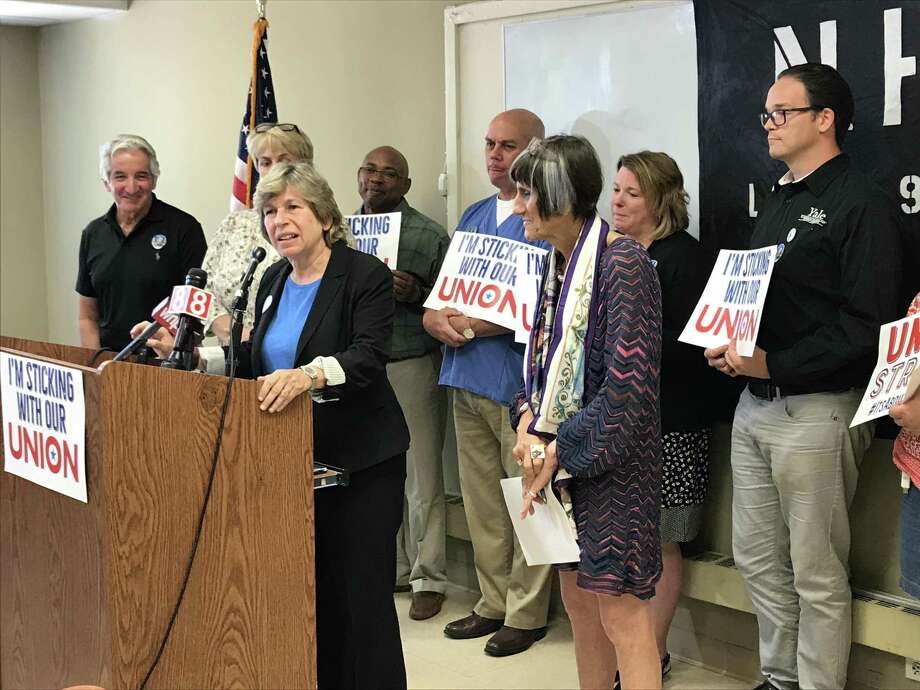
American Federation of Teachers President Randi Weingarten speaks during a press conference in New Haven Tuesday. U.S. Rep. Rosa DeLauro, D-3, is at right. Photo: Brian Zahn / Hearst Connecticut Media


NEW HAVEN — U.S. Rep. Rosa DeLauro, D-3, said Tuesday that the country’s labor movement must emerge stronger after last month’s Supreme Court ruling in Janus v. AFSCME Council 31, which allows public sector employees not to pay fees to the unions that serve them.
DeLauro was joined by American Federation of Teachers President Randi Weingarten and local and state union officials at the AFT Local 933 headquarters on Chapel Street to announce a need for stronger legislation to protect unions, taking the health of unions out of the hands of the courts.
The Janus decision “tips the balance against state and municipal workers,” DeLauro said. “It’s not just union workers or public sector workers who suffer. Every working person suffers.”
Supporters of the ruling, however, have said it’s a positive one for workers.
Danbury Mayor Mark Boughton, for instance, the endorsed Republican candidate for governor, told Hearst Connecticut Media last week the ruling is a victory for people across Connecticut.
But Weingarten pointed to President Donald Trump’s nomination of Judge Brett Kavanaugh to the Supreme Court Monday as evidence that the judiciary is and will remain hostile toward working class people.
“This is the day after President Trump nominated a judge for justice who actually does not believe the president’s executive powers should be checked,” she said. “The rule of law is really at risk and the judge who is soon to be retired (Justice Anthony Kennedy) put us on that path.”
Weingarten said the Janus ruling overturns 41 years of precedent and attempts to strip working people of their voice. She said the First Amendment was “weaponized” against the rights granted to states in the Tenth Amendment of the Constitution.
Several of the speakers at the press conference said the court case decision was backed by million-dollar campaigns from Continue reading, watch video: DeLauro, Weingarten vow ongoing fight for unions - New Haven Register

Tuesday, July 10, 2018

Does A Justice Kavanaugh Mean That Blaine Amendments Are History?

Does A Justice Kavanaugh Mean That Blaine Amendments Are History?


Last night, President Trump nominated Brett Kavanaugh to the Supreme Court. I’ll leave it to the legal scholars to assess the broad implications of a potential Justice Kavanaugh, but I do want to look at a narrow issue that may come before the court during his tenure: Blaine Amendments.
Blaine Amendments are provisions in 38 state constitutions that bar public aid to religious organizations. They get their name from James G. Blaine, a congressman and later senator and presidential nominee from Maine who unsuccessfully attempted to amend the U.S. constitution in 1875 to include “anti-aid” language onto the end of the first amendment. Where he failed at the federal level, he and his ideological fellow travelers were successful at the state level. As a result, Blaine Amendments frequently act as state-level barriers against school choice.
It is important to note that while their language might look harmless in today’s light, at their inception, Blaine Amendments were designed to try and stamp out Catholic schools. Their use of the word “sect” or “sectarian” is the tell. Public schools at that time were nominally Protestant, with students singing hymns and reading the King James Bible in class. That was “nonsectarian” instruction. “Sectarian” meant Catholic. Interestingly, in the court’s recent 7-2 decision in Masterpiece Cakeshop, the court ruled that states have a duty “not to base laws or regulations on hostility to a religion or religious viewpoint.” I'm no lawyer, but to me, Blaine Amendments do just that.
Historians debate as to whether Blaine himself was an anti-Catholic bigot or if he was simply trying to ride a wave of anti-Catholic bigotry to get himself into the White House. Either way, Blaine Amendments have a clear origin in Know-Nothingism, Nativism, anti-immigrant, and anti-Catholic ideology. It is a cruel irony that many of those who decry nativism and anti- Continue reading: Does A Justice Kavanaugh Mean That Blaine Amendments Are History?


More On The Blaine Amendments

Big Education Ape: The Public Should Pay Only for Public Schools, not Religious Schools | Diane Ravitch's blog - https://bigeducationape.blogspot.com/2017/04/the-public-should-pay-only-for-public.html

Big Education Ape: Blaine Amendments Protect Religious Liberty, Prohibit Establishing Religion via School Vouchers | janresseger - https://bigeducationape.blogspot.com/2017/04/blaine-amendments-protect-religious.html

Big Education Ape: The Testing of States’ Blaine Amendments– No Public Funding of Religious Schools | deutsch29 - https://bigeducationape.blogspot.com/2017/03/the-testing-of-states-blaine-amendments.html

Big Education Ape: Blaine Amendment Challenge in Limbo at the US Supreme Court | deutsch29 - https://bigeducationape.blogspot.com/2017/03/blaine-amendment-challenge-in-limbo-at.html

Big Education Ape: Ravitch: Why the Supreme Court should not force the public to pay for religious schools - The Washington Post - https://bigeducationape.blogspot.com/2017/04/ravitch-why-supreme-court-should-not.html

Big Education Ape: The Blaine Game | Blue Cereal Education - https://bigeducationape.blogspot.com/2016/12/the-blaine-game-blue-cereal-education.html

Big Education Ape: How a Supreme Court Ruling on Playground Covering May Open the Door to School Vouchers - https://bigeducationape.blogspot.com/2017/03/how-supreme-court-ruling-on-playground.html

Big Education Ape: The Beginning of the End for Blaine? | Jay P. Greene's Blog - https://bigeducationape.blogspot.com/2017/06/the-beginning-of-end-for-blaine-jay-p.html

A dig through Kavanaugh’s record on education finds plenty of material - POLITICO

A dig through Kavanaugh’s record on education finds plenty of material - POLITICO

A dig through Kavanaugh’s record on education finds plenty of material


WHAT KAVANAUGH MEANS FOR EDUCATION: D.C. Circuit Judge Brett Kavanaugh, President Donald Trump’s pick to replace Justice Anthony Kennedy on the Supreme Court, has considered some of the most contentious issues in education throughout his lengthy legal career. He’s written on school prayer, the separation of church and state, and affirmative action.

— Kavanaugh highlighted his connection to education during his speech Monday night, describing himself as a teacher’s son who tutors area children. He talked about his mother. "In the 1960s and ‘70s, she taught history at two largely African-American public high schools in Washington, D.C., McKinley Tech and H.D. Woodson," he said. "Her example taught me the importance of equality for all Americans."

— Kavanaugh has tutored at Washington Jesuit Academy, where he sits on the board of directors, and at J.O. Wilson Elementary School, according to the D.C. Circuit Court of Appeals website. He went to high school at Georgetown Prep — which Justice Neil Gorsuch also attended — and is a graduate of Yale College and Yale Law School.

— Here’s a breakdown of Kavanaugh's education record, dug up by Pro’s Michael Stratford:

— School prayer and religious freedom: Kavanaugh wrote an amicus brief in December 1999 in favor of a Texas high school’s policy allowing the use of a public address system for student-led and student-initiated prayers at school football games. The amicus brief, on behalf of Oklahoma Republican Reps. Steve Largent and J.C. Watts, argued that the policy passed constitutional muster — an argument the Supreme Court rejected. In a 6-3 ruling, the court declared the school policy allowing prayer unconstitutional under the First Amendment’s Establishment Clause.

— Affirmative action: Kavanaugh in 1999 co-wrote an amicus brief on behalf of the Center for Equal Opportunity, a group that opposes race-based affirmative action in college admissions. The brief argued that a Hawaii law allowing only Native Hawaiians to vote in elections for the Office of Hawaiian Affairs was unconstitutional in prohibiting people from voting because of their race. (The Supreme Court agreed with that argument in a 7-2 decision.) When asked about the brief and its implications for affirmative action in 2004 as part of his confirmation for the D.C. Circuit Court, Kavanaugh said: “The Supreme Court has decided many cases on affirmative action programs and, if confirmed, I would faithfully follow those precedents.”

— School choice: Kavanaugh said during his 2004 Senate confirmation hearing that he had previously served as the co-chairman of the Federalist Society’s “School Choice Practice Group.” Kavanaugh also said, in response to written questions, that he had “worked on school choice litigation in Florida for a reduced fee.” He didn’t provide additional details about that matter. On private school Continue reading: A dig through Kavanaugh’s record on education finds plenty of material - POLITICO

Monday, July 9, 2018

Behind the $35 Million Gift to Launch a Charter School in a Struggling City — Inside Philanthropy

Behind the $35 Million Gift to Launch a Charter School in a Struggling City — Inside Philanthropy

Behind the $35 Million Gift to Launch a Charter School in a Struggling City


The Charles Stewart Mott Foundation recently pledged $35 million to build and launch a charter school in Flint, Michigan. The K-8 school eventually will be located on the grounds of the Flint Cultural Center and enroll up to 650 students, who will have access to the institution's offerings, including the art and music museums, the public library and the planetarium.
It’s a large gift from a funder that doesn’t see itself as a backer of the charter movement. But the opportunity presented to help create the Flint Cultural Center Academy was too promising to pass up, said Neal Hegarty, the foundation’s vice president of programs.
“To be clear, the foundation isn’t supporting a charter school movement in Flint,” Hegarty said. “We’re supporting the development of a specific charter school that will enable students to benefit from the expertise and amenities available through the Cultural Center institutions. There’s nothing else like it in our region, and we think kids in Flint and Genesee County deserve to have that kind of unique learning opportunity.”
As we've reported, Mott is best known within K-12 circles for investing in after-school programs. It's been a pioneering leader in this space for decades and remains a stalwart after-school funder. In turn, this work is part of a broader education portfolio that also includes youth engagement, which the foundation defines as supporting meaningful ways for kids to participate in school, communities and economies. The access students at the new charter school will have to the neighboring cultural institutions fits with that goal.
At first glance, $35 million seems like a large gift. And it is—it’s more than half the funds Mott as put into Flint’s education system since 2016—but it’s proportionate to the costs of building a school from the ground up, Hegarty said. The gift covers the price of designing, building and outfitting the school. The foundation wanted to cover the full cost, so that Flint’s cultural institutions wouldn’t have to find additional donors.
The school will join the city’s robust charter ecosystem. More than half of Flint’s students attend charter schools, according to numbers released by the National Alliance for Public Charter Schools in 2017. At 55 percent in charter schools, Flint beat out neighboring Detroit for the highest percentage of students enrolled in charters. Nationally, the city is second only to New Orleans, which replaced its traditional public school district entirely with charter schools following Hurricane Katrina.
Hegarty attributes the high enrollment to a few different factors, including state-level policies, family preference and fall-out from the water crisis. Despite the higher than usual charter enrollment, Mott doesn’t prioritize charters in its Flint-based education giving, he said.
“In Flint, the Mott Foundation is working to strengthen the entire education continuum—from cradle to college and career. We support educational opportunity in many different forms, including early childhood Continue reading: Behind the $35 Million Gift to Launch a Charter School in a Struggling City — Inside Philanthropy
Image result for charter schools are for poor people


Does school choice give African American and Latinx families more voice? | Cloaking Inequity

Does school choice give African American and Latinx families more voice? | Cloaking Inequity

DOES SCHOOL CHOICE GIVE AFRICAN AMERICAN AND LATINX FAMILIES MORE VOICE?

Are African American and Latinx families better served by charters? Is there voice better represented than in public schools? A new report from researchers at Annenberg and UTLA finds that charter schools with more poor students actually have lower parent representation on governing boards. Here is the official press release for the report entitled, Whose Schools? Community Representation and Transparency in Charter School Governance in Los Angeles:

Are privately operated charter schools accountable to the public that funds them and the parents who entrust their children to them? That fundamental question drives a new report, “Whose Schools? Community Representation and Transparency in Charter School Governance in Los Angeles,” that looks at the makeup of 224 charter governing boards within LAUSD boundaries and reviews the incidences of meaningful parent representation.
Among the findings:
 
•       Charter schools with fewer students in poverty have greater parent representation on governing boards.
•       10 out of 12 charter schools with majorities of African American students have no parental representation on governing boards.
•       Corporations have a disproportionate influence on charter school governance, with 31% of board members identified as corporate professionals. Half of those come from the financial sector.
•       None of the nine Charter Management Organizations operating more than five schools each has a designated parent representative in a governing role.
•       Many charter schools hold meetings during hours or at locations that make meaningful participation difficult for working parents.
The report makes a number of policy recommendations to enhance representation and strengthen the voice of parents and the community, including requiring charter governing boards to include parents of current students on the board, instituting a method to recall board members, and requiring board meetings to be scheduled so that they are accessible to parents.
Greater parent representation would ensure oversight from those involved with the school on a daily basis and help guard against unethical or illegal behavior. Recent local scandals—including the FBI raid of Celerity and the conflict-of-interest charges against LAUSD School Board member Ref Rodriguez, founder of the PUC charter chain—underscore the need for greater accountability and transparency in the publically funded, privately operated charter sector.
The issues outlined in the “Whose Schools?” report are part of a larger group of problems driven by the rapid, unregulated expansion of charter operators in the Los Angeles Unified School District. Other serious issues that call out for increased accountability of charters include overly punitive student discipline policies, practices that push out high-need students, and funding and building patterns that destabilize neighborhood public schools.
The report was authored by Leigh Dingerson (Policy Director, Alliance to Reclaim Our Schools), Grace Regullano (Strategic Research Director, UTLA), and Ed Gutierrez (Research Specialist, UTLA).
The California NAACP also weighed in on the findings in the report.
Screen Shot 2018-07-05 at 8.36.18 PM
Not incidenteally, school choice and self-determination a topic that we will take up in our upcoming article in the Journal of Law and Inequality. 
Vasquez Heilig, J., Nelson, S., & Kronzer, M. (in press). Does the African American Need Separate Charter Schools? Law & Inequality: A Journal of Theory and Practice, 36(2), 1-21.
Here is a sneak peak…
Screen Shot 2018-07-05 at 8.43.24 PM
Stay tuned…
Check out and follow my YouTube channel here.
Twitter: @ProfessorJVH
Click here for Vitae.

Does school choice give African American and Latinx families more voice? | Cloaking Inequity


Saturday, July 7, 2018

Charter Schools of San Diego County | tultican

Charter Schools of San Diego County | tultican

Charter Schools of San Diego County


The California charter school law is doing serious harm to public schools. Few counties in the state have been more impacted by charter schools than San Diego County. This past school year 75,473 of the 508,169 publicly financed students enrolled in charter schools. In other words, 14.9% of San Diego’s students attended privatized schools and in the San Diego Unified School District, that percentage was greater than 17%.
San Diego’s charter school students attended one of the county’s 129 active charter schools some of which will close their doors next year. In the past five years, more than one out six charter schools – a total of 27 schools – went out of business. This presents an additional financial burden to public schools because they must be ready to take in all students from failed charter schools at any time. Charter schools typically do not add students during a school year.

When students from the public system exit to the privatized charter school system, the cost to the district schools is substantially more than just the loss of state daily attendance money. A recent study that Professor Gordon Lafer did for In The Public Interest is the third major report in five years to demonstrate this point. Professor Lafer noted:
“As the charter industry has grown, public officials across the country have become increasingly concerned with the sector’s impact on public school districts. A 2013 report from Moody’s Investors Service, for instance, warned that charter expansion threatened school districts’ viability in a growing number of cities, as ‘charter schools … pull students and revenues away from districts faster than the districts can reduce their costs.’ In response, a series of studies have been carried out by both academic scholars and consulting firms aimed at the same question that this report seeks to address. … in every case, studies found that charter growth has caused school districts to suffer much more in lost revenue than they are able to make up in reduced expenses—resulting in large net shortfalls for district students.” (emphasis added)
Lafer’s study also looked specifically at the effects of charter school enrollment on San Diego Unified School District (SDUSD). He described the nature of data Continue reading: Charter Schools of San Diego County | tultican


Friday, July 6, 2018

Big-name billionaire charter school backers donate to California and other key governor races

Big-name charter school backers donate to California and other key governor races

Big-name charter school backers donate to California and other key governor races


Prominent charter school supporters are dishing out campaign money, as key gubernatorial races in several states have now begun in earnest.
June primary contests set up a number of state battles for governor in the midterm elections this November, with both Democratic and Republican candidates that could change how public resources flow into charter and private schools in the coming years.
Last week, Netflix CEO Reed Hastings and philanthropist Laurene Powell Jobs donated $29,200 each — the maximum amount — to Democrat Gavin Newsom’s campaign for California governor. It’s a sign that the potent charter forces in Golden State politics are pivoting toward the state’s lieutenant governor, who is widely considered a shoo-in to beat Republican businessman John Cox.
Many of the billionaire philanthropists who want to reshape America’s struggling school systems believe that charters — which are privately run but publicly funded schools — help breed better and different ways to educate students who struggle in traditional public schools, especially poor and minority children. Some also support allowing tax dollars to fund vouchers for families that pick private schools, which don’t have public oversight. Studies are mixed when considering how those programs result in academic gains.

Critics, notably teachers unions, reject both charters and vouchers as drains on the cash-starved schools that educate the vast majority of students. Public school advocates also loathe those programs for eroding the neighborhood schooling model that defines communities.
Newsom has said that successful charters would thrive under his leadership, but he would seek to temporarily pause charter school openings to consider transparency issues. The moratorium would be a halting sea-change — if even for a limited time — for California’s robust charter school movement, which has for years enjoyed expansions and developments.
Newsom previously said he was disappointed that Hastings, a prolific charter schools supporter in California, gave millions of dollars to one of his primary challengers, former Los Angeles Mayor Antonio Villaraigosa. Newsom on the campaign trail has mostly Continue Reading: Big-name charter school backers donate to California and other key governor races


In America, Schools Aren’t Required to Teach Kids to Read and Write - The Atlantic

Detroit's Right to Literacy Case and U.S. School Reform - The Atlantic

In America, Schools Aren’t Required to Teach Kids to Read and Write
A judge in Detroit has concluded that the Constitution doesn't require Michigan to ensure schools promote students’ literacy.


What to do when a school is infested with vermin, when textbooks are outdated, when students can’t even read? Perhaps the answer is sue the government.
That’s what seven students in Detroit have done. Their class-action suit filed against the state of Michigan asserts that education is a basic right, and that they have been denied it.
Usually, such education-equity cases wend their way through state courts, as all 50 state constitutions mandate public-education systems, while the country’s guiding document doesn’t even include the word education. But this case, Gary B. v. Snyder, was filed in federal court, and thus seeks to invoke the Constitution. And as of this week, it’s headed to the federal appeals court in Cincinnati.
The lawyers filing the suit—from the pro bono Los Angeles firm Public Counsel—contend that the students (who attend five of Detroit’s lowest-performing schools) are receiving an education so inferior and underfunded that it’s as if they’re not attending school at all. The 100-page-plus complaint alleges that the state of Michigan (which has overseen Detroit’s public schools for nearly two decades) is depriving these children—97 percent of whom are students of color—of their constitutional rights to liberty and nondiscrimination by denying them access to basic literacy. Almost all the students at these schools perform well below grade level in reading and writing, and, the suit argues, those skills are necessary to function properly in society. It’s the first case to argue that the U.S. Constitution guarantees the right to become literate (and thus to be educated) because other rights in the Constitution necessarily require the ability to read.

The case is a long shot. Late last week, the district-court judge in Detroit, Stephen J. Murphy, dismissed it. (The plaintiffs are appealing that dismissal.) Murphy essentially stated that he needed guidance from the Supreme Court if he were to weigh in on whether the students’ abysmal proficiency levels and learning conditions amount to a violation of the Constitution. He also concluded that the suit makes too many hard-to-prove causal claims. Even though Michigan subjects the predominantly black Detroit students to conditions to which it doesn’t subject, say, the predominantly white students of nearby Grosse Pointe, Murphy wrote, there isn’t enough evidence to suggest that the state is treating the former group differently because of their race and thus violating the equal-protection clause. Another obstacle: The federal judiciary has in grown particularly restrained on educational-rights issues in recent decades, in part because of the backlash from parents and othersopposed to integration efforts that followed the wave of school-desegregation Continue Reading: Detroit's Right to Literacy Case and U.S. School Reform - The Atlantic


Is It Time for Parents to Unionize?

Is It Time for Parents to Unionize?

Is It Time for Parents to Unionize?


Think of Alissa Quart’s new book, Squeezed: Why Our Families Can’t Afford America, as “What to Expect When You’re Expecting Under Late Capitalism.” Of the more than 50,000 books listed on Amazon under “Parenting,” few engage as deeply with the economic pressures today’s parents must navigate: precarious work, a shortage of high-quality, affordable daycare and rising costs of living combined with stagnant wages. 
Quart, the executive editor of the Economic Hardship Reporting Project, also profiles efforts to improve the lives of parents and care workers––and offers suggestions about what’s still to be done. She spoke with In These Times about the challenges of organizing parents, why we’re so attached to the fantasy of middle-class life and why she considers her book “radical self-help.”
ITT: I’m interested in the theme of self-blame that runs through Squeezed. You write that after your daughter was born, and it became clear that you and your husband’s freelance earnings weren’t going to be enough to raise her, you began to blame yourself. Why did you have that reaction?
AQ: I think we have a tendency to blame ourselves, or we blame others. It’s binary. You can see that tendency in the way some disenfranchised groups now blame immigrants, say, and then on the other side, there’s a lot of rhetoric of self-punishment in American culture that you’re responsible for your own success and if you don’t make it then there’s something wrong with you.
The self-blame and guilt discourse comes from conservatives but it also emanates off of a certain kind of bootstrap self-help, like Lean In.  “Why aren’t you asking for a Continue reading: Is It Time for Parents to Unionize?