Latest News and Comment from Education

Sunday, December 4, 2016

Step Aside, Betsy DeVos. You’re Not Extreme Enough: Featuring Asora Education. | deutsch29

Step Aside, Betsy DeVos. You’re Not Extreme Enough: Featuring Asora Education. | deutsch29:

Step Aside, Betsy DeVos. You’re Not Extreme Enough: Featuring Asora Education.


I had an interesting comment to my post, Betsy DeVos and Her 2015-16 School Choice YearbookHere is the comment, in part:
I, for one, would go much farther than DeVos and look for systems of schools that are mostly in the for-profit arena in which the subsidies toward low income families would be similar to what we do in the area of food. Think: Education Stamps.
The comment comes from David V. Anderson, who has a website, asoraeducation.com. An excerpt from the home page:
Asora’s Campaign To End K-12 Market Failure
Perhaps more important than Asora’s activities and plans in self-paced online instruction, we recognize that reforms will be few and relatively ineffective if the economic incentives for school improvement are absent. We believe that marketplace reforms can be done locally and most easily by private education providers. Asora’s NAEP proficiency estimation methodologies can be used to provide consumer information locally, which can be an important ingredient in marketplace reform. We believe that if the marketplace for education is healthy, most of the desired reforms will arise- almost automatically.
Allow me to offer some more excerpts from Asora’s numerous web pages. I won’t comment much. I’ll just let readers take it in.
Here’s an excerpt from a page entitled, School Ailments:
Market Failure
Most Americans regard K-12 schools as special institutions that are not part of our competitive free market economy. For that reason, most observers shy away from applying the lessons of economics on this important sector of our 
Step Aside, Betsy DeVos. You’re Not Extreme Enough: Featuring Asora Education. | deutsch29:

Drive Like Your Kids Live Here – redqueeninla

Drive Like Your Kids Live Here – redqueeninla:

Drive Like Your Kids Live Here 

img_6967


On the mourning [sic] after I was brought up short by this common lawn sign ~
It seemed to me then that few really comprehended the tragedy our children were experiencing. Parents got it, at least the “attached” ones; I had been sympathizing all day with multiple, numerous parents who had all been wide awake at four am rocking and comforting, holding children – even teenagers – who simply could not sleep. Inconsolable they trembled, they cried, they were just so fearful that sleep would never come. They seemed not to have developed the coping mechanism of maturity that enables sticking one’s head in the sand or underneath the covers and simply willing oblivion in the form of sleep.
I was always enamored of the parenting philosophy that exhorted not lying to children with false platitudes about “everything being OK” when reality dictates that no one knows what will be, OK or otherwise, and moreover, our children never were so dumb as to not know this. The prudent course, the philosophy urges, is to assert no untruths, just be there, rock in solidarity and sympathy, hold and touch and breath together.
By now I think it is clear to many the urgency and fear our children reflexively expressed that night. So many of us adults thought to count to ten, wait, give patience and forbearance a chance. Our children felt otherwise.
Time belies the wisdom of “maturity”, sometimes. The rogue’s gallery of advisers and actors is a searing signal of the pain to come, the nail in the coffin of America’s lower 99%, and all quite Drive Like Your Kids Live Here – redqueeninla:

Marie Corfield: A Tale of Two Education Systems: A New Jersey Story

Marie Corfield: A Tale of Two Education Systems: A New Jersey Story:

A Tale of Two Education Systems: A New Jersey Story


We see it time and again in our low-income/high minority, inner cities all across the country: public schools, the glue that holds neighborhoods together, are shuttered or flipped to charters, which don't take every child who arrives at their front door.


But not so in mostly wealthy, mostly White, suburban America. I live in Hunterdon County, NJ, one of America's wealthiest counties. About 15 minutes down the road from me is the tiny, gorgeously bucolic, rural, Delaware River town of Stockton. With a population of only 516, the median household income is $93,049, it's 96.5% White, and the median house value is $384,200. It's a .

With only 50 students, Stockton Borough School is New Jersey's oldest and smallest school, and the community doesn't want it to close. But because of declining enrollment, it's not exactly cost-effective to keep it open. But, after a packed community forum, former Stockton Borough Board of Education member, David L. Pasicznyk, wrote a letter to the school district:


"As you have undoubtedly noticed at the recent meeting at the Stockton Firehouse, where approximately 100 supporters turned out, the school is the glue that holds our community together. To have that many supporters (over 20-percent of the borough's population) show up at a mid-week evening meeting should be an indicator of the value that we, young and old, place on the school." 
Board President Dan Seiter told the audience Monday night that the board had heard the community's wish that the school remain open...
Superintendent Lou Muenker will work to create a committee made up of parents, residents of the entire district, teachers, staff and board members to look at ways to increase enrollment at the school, as well as make recommendations on the best use of the facility in the future. (emphasis mine) 
Don't get me wrong; I'm happy that the school will remain open at least another year. Hunterdon County has excellent schools, and I'm sure Stockton Borough School is one of them. I'm happy the school board is fulfilling the will of the people who want the very best for their children—and who are paying the bills.

School closings—no matter where they are—are disruptive. But, if you live in wealthy, White America, you stand a better chance of succeeding in keeping your neighborhood 
Marie Corfield: A Tale of Two Education Systems: A New Jersey Story:


Schooling in the Ownership Society: My investment tip for the DeVos era. Charter school real estate.

Schooling in the Ownership Society: My investment tip for the DeVos era. Charter school real estate.:

My investment tip for the DeVos era. Charter school real estate.

Clockwise from top left: the Coral Springs – Imagine School, Imagine At South Vero, Plantation – Renaissance Charter School, Championship Academy of Distinction Davie Campus, and Charter School Capital CEO Stuart Ellis

I'm thinking back to the time when hedge-fund school reformer Whitney Tilsonmocked me for suggesting that he and his investment group were profiteering from privately-run charter schools.
"Trying to make a killing in the charter school business"?! Yeah, that's right, the charter school business is so profitable that I'm telling all my friends in the hedge fund business that they're in the wrong business. My message: "If you really want to make a lot of money, start a charter school!" LOL!
Turns out I was spot-on and he was covering up. 

So this is the time of year I like to hand out more free investment advice to my readers. You're welcome. 

With the appointment of Betsy DeVos as Trump's education chief, charter school real estate profiteers and corporate reformers like Tilson are rubbing their hands together with glee. This is a great time to get into that market while stock prices are still relatively low. 

Charter School Capital, an academic investment group based in Portland, just scooped up five charter schools spread throughout Schooling in the Ownership Society: My investment tip for the DeVos era. Charter school real estate.:


Thanks to the Every Student Succeeds Act (ESSA), It’s a Year Too Late for Hand-Wringing over Charter Schools | Seattle Education

Thanks to the Every Student Succeeds Act (ESSA), It’s a Year Too Late for Hand-Wringing over Charter Schools | Seattle Education:

Thanks to the Every Student Succeeds Act (ESSA), It’s a Year Too Late for Hand-Wringing over Charter Schools

stranglovebombride
Last year, I wrote an open letter to Senator Patty Murray pleading with her to reconsider the lavish financial support charter schools were slated to receive in the soon to be re-authorized ESEA.
My argument:
The Supreme Court has found the Washington State Legislature in contempt for not fulfilling its duty to fully fund basic education.
The federal government made this situation even worst when it allowed aid to states to expire in 2012. This money was being used by states to keep our public schools running.
Given the precarious state of public school funding in Washington State, I’m confused by your willingness to includegenerous funding for charter schools in the ESEA.
Not only did the Supreme Court rule Washington State’s charter law unconstitutional, but charter schools have a track record for all kinds of financial scandals. Don’t believe me? Just google “charter school scandals” and take a look.
We can’t afford to have any dollars diverted from our classrooms. Any dollar lost to scandal is one not being spent on the 1 million public school students in Washington State.
The rest is history.
The ESEA sailed through Congress and with President Obama’s signature – became law as the ESSA.
In November, Patty Murray – supporter of the TPP and co-author of the ESSA – skated to another term with 59% of the vote.
The only kink was Trump’s victory and his selection of Betsy DeVos to be the new Secretary of Education. THAT was a buzz kill.
Suddenly, Democrats and progressives (whatever that means anymore) couldn’t stop talking about charters and the evils of privatization.
AWKWARD
Here’s the thing: Democrats are just as into charter schools as Republicans. The only difference is the language they use to sell the idea to their supporters. Democrats talk Thanks to the Every Student Succeeds Act (ESSA), It’s a Year Too Late for Hand-Wringing over Charter Schools | Seattle Education:


Students ask administration to declare Sac State a ‘sanctuary campus’ – The State Hornet

Students ask administration to declare Sac State a ‘sanctuary campus’ – The State Hornet:

Students ask administration to declare Sac State a ‘sanctuary campus’

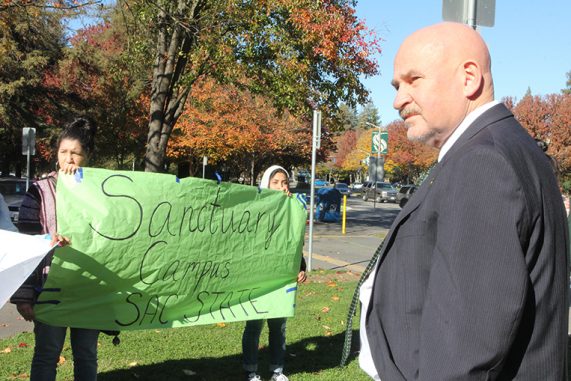
Sacramento State President Robert Nelsen, right, meets with protesters outside of his Sacramento Hall office on Thursday, Dec. 1 who want the campus declared a ‘sanctuary’ for undocumented students. (Photo by Rin Carbin)

About one dozen Sacramento State students marched from the Library Quad to Sacramento Hall on Thursday and spoke with President Robert Nelsen to advocate for undocumented students who fear they may face deportation following Donald Trump’s election to the U.S. presidency.
Denise Fernandez of Students for a Quality Education said that she wants Sacramento State declared a sanctuary campus for the undocumented — something that a July 29 memo sent from CSU Chancellor Timothy White to the CSU campus presidents said should not be done.
The memo states that “campus policies shall avoid use of the term ‘sanctuary,’ a term for which there is no standard definition or common understanding and which, if used, can lead to confusion and misunderstanding,” the memo stated. “Rather, utilizing terms such as ‘safe and welcoming’ is accurate.”
“The new president-elect has a lot of us living in uncertainty. We want the staff to say ‘Your feelings and concerns are heard; we will not allow ICE (U.S. Immigration and Customs Enforcement) to come here,’ ” Fernandez said.
While CSU campuses will not be declared as “sanctuar(ies),” the July memo does state that “CSU Police Departments will not honor ICE immigration hold requests, unless doing so is … required by law.”
Some people brought to the United States illegally while they were children are currently shielded from deportation by an Obama administration policy — Deferred Action for Childhood Arrivals, or DACA — that President-elect Trump said he would end.
The leaders of the CSU system, as well as of the University of California and the California Community Colleges, sent a letter to Trump on Tuesday asking him to reconsider.
When the marchers reached President Nelsen’s Sacramento Hall office, he went outside to speak with them.
“We’re working very close with the chancellor’s office to make sure that our campus is safe, that none of our students are endangered,” Nelsen said. “It is coming from the Republican side to pass legislation that will make DACA permanent. We need to make that big step, we need to work on that as well. I’m going to be there to support you.”
Nelsen told students experiencing distress over Trump’s victory or harassment from other students to seek Students ask administration to declare Sac State a ‘sanctuary campus’ – The State Hornet:
Image result for sanctuary campus
 Image result for sanctuary campus

Connecticut NAACP keeping education a top priority, including charter school concerns

Connecticut NAACP keeping education a top priority, including charter school concerns:

Connecticut NAACP keeping education a top priority, including charter school concerns

Image result for Regarding the NAACP Charter School Moratorium, the New York Times Misguides Itself


NEW HAVEN >> Racial disparities in employment, housing, health, law enforcement, and a new president, are all issues the NAACP continued to discuss throughout 2016. But starting a nationwide discussion on education, more specifically charter schools, was a top priority at the Connecticut NAACP’s annual state convention Saturday.
“The charter schools are in our communities, in no other place. They’re in the poor, minority districts. So we need to figure this thing out,” NAACP State Chairman Scot X. Esdaile told members attending the convention Saturday morning.
On Oct. 15, the NAACP national board called for a moratorium on charter school expansion and for the strengthening of oversight in governance and practice.
The board said it wanted charter schools to be subject to the same transparency and accountability standards as public schools, that public funds not be given to charter schools at the expense of the public school system, that charter schools stop expelling students that public schools have a duty to educate, and that charter schools stop “to perpetuate de facto segregation” of high performing children from children whose “aspirations may be high but whose talents are not yet as obvious.”
“We are moving forward to require that charter schools receive the same level of oversight, civil rights protections and provide the same level of transparency, and we require the same of traditional public schools,” Chairman Roslyn M. Brock said at the time in a statement. “Our decision today is driven by a long held principle and policy of the NAACP that high quality, free, public education should be afforded to all children.”
After the announcement, seven national special hearings on charter schools were set to take place in Los Angeles, Detroit, Memphis, New Orleans, Orlando, and the first was on Saturday at the Omni New Haven Hotel.
“We need to have our young people a the forefront, have that discussion to try to make the changes that are necessary,” Esdaile said.
On Saturday, a diverse group of panelists, from both sides of the charter school argument, made presentations to local, state, and national leaders, including members of the NAACP national board, and U.S. Sen. Richard Blumenthal, D-Conn.
“We want to hear from people,” Esdaile said.
“We hear what (charter school advocates) want, we hear what (charter school opponents), but what do we want?” Esdaile asked members. “That’s what we need to determine after hearing what everyone has to say.”
Doris J. Dumas, president of the NAACP Greater New Haven branch said while there are many issues communities of color face today, education is among the most important.
“It all starts with education. If we want to make our communities better, we need to start there,” Dumas Connecticut NAACP keeping education a top priority, including charter school concerns:


My Turn: If you want to see the perils of a school voucher system, look at Chile

My Turn: If you want to see the perils of a school voucher system, look at Chile:

My Turn: If you want to see the perils of a school voucher system, look at Chile


Upon hearing that President-elect Trump has picked billionaire Betsy DeVos, a school voucher advocate, to be secretary of education, I realized that I had to write publicly about my recent experiences teaching in Chile – a country that has had a voucher system for more than 35 years.
I firmly believe that a voucher system would destroy the very American ideals our public schools currently foster and protect.
As part of my sabbatical this past school year from John Stark Regional High School, I went to teach English in Chile after having been certified to teach English as a second language here in New Hampshire. For 4½ months, I taught public school students in grades five through 12.
Chile adopted its voucher system in 1980 with many of the same goals as today’s voucher advocates. However, due to the voucher system, Chile has three distinct school systems: public, semi-private and private. All students receive a voucher to attend public or the semi-private schools. Parents of students in fully private school must pay the entire tuition bill.
Public schools require only the voucher while the semi-private schools, which are often religious schools, charge fees on top of the voucher. The semi-private schools also have waiting lists and these schools can refuse students who are often more difficult to teach, those with disabilities and behavioral problems. The results are grim.
According to an article from the Washington Post, as of 2012 three-quarters of Chilean public school students are from the lower 40 percent of family incomes in the country while 90 percent of students attending private schools are from Chile’s top 60 percent of income-earning families. Only 10 percent of disadvantaged students use the vouchers to attend the semi-private schools.
But I’m not writing to summarize an article. I’m writing to tell you about what I saw.
The students attending the middle school where I taught, Manuel Blanco Encalada, came from poor families. Many of my students received public assistance for basic needs. The school had a disproportionate number of hearing-impaired and autistic students who were refused admission to the semi-private school. Chilean semi-private schools can pick and choose whom they take, and they take few students with learning challenges. With few resources to pay teachers, the average class size was 41. I had a student load of 277 students. A student I knew who attended a private school had classes of 30 students – none with learning or behavioral issues. This disparity is made possible by diverting public funds to the semi-private schools through the voucher system.
My classroom was heated only by a wood stove. When I ran out of wood, I was told I would have to buy my own. Public school teachers buy wood to heat their classrooms or parents donate it. The semi-private and private schools have modern heating systems. Basic supplies in my school were scarce, and the lights frequently went on and off, due to an aging electrical system. If you think this is unique to a South American country and would not happen here, think about the crumbling public schools in many of our own cities. A voucher system would only accelerate and amplify decay that is already occurring.
What shocked me the most was what the three-tiered system of education did to Chilean culture.
I met adults at my gym who told me they would never send their children to public schools because “those children don’t bathe.” My students were clean.
I lived with a host family whose 4-year-old went to a semi-private pre-kindergarten. His aunt is an assistant principal at a public elementary school, which he visited one day. When asked what he thought of the public school, he said the children were “desordenados,” which in Chile means undisciplined or unruly.
Where does a 4-year-old get an idea like this, especially when all 4-year-olds are undisciplined and unruly? Thirty-five years of vouchers have helped make Chile very classist – hardly an American value.
Former Florida governor Jeb Bush wrote of DeVos that she is an “outstanding pick” and “her allegiance is to families, particularly those struggling at the bottom of the economic ladder, not to an outdated public education model that has failed them from one generation to the next.” School vouchers don’t help the poor. They take resources away from public schools and their economically diverse students. Vouchers separate children by disability or class and magnify social disparities and prejudice. When people say vouchers will benefit the disadvantaged, don’t believe it. The past 35 years of Chilean history prove otherwise.
American public schools foster the American values of opportunity for all, inclusiveness and diversity. Voucher systems promote disparities and prejudice. Our children deserve something better; they deserve schools that reflect American values.
New Research: Vouchers— schools do the choosing – Cloaking Inequity - http://wp.me/p2D92I-2Ho via @ProfessorJVH
Image result for school voucher Chile

Timeline of Mayor Kevin Johnson's life in Sacramento | The Sacramento Bee

Timeline of Mayor Kevin Johnson's life in Sacramento | The Sacramento Bee:

Highs, lows, hoops and pie. Sacramento Mayor Kevin Johnson through the years


A timeline of important dates in the personal, athletic and political life of Kevin Johnson.

Kevin Johnson and his Mom, Georgia West, in 1975.
March 4, 1966: Kevin Johnson is born in Sacramento. His father dies when he is 3 years old, and Johnson is raised by his grandparents in Oak Park.
1983: Johnson leads the state of California in scoring as a senior on Sacramento High School’s basketball team.
1983-1987: Johnson attends and plays basketball at Cal.
June 22, 1987: Johnson is picked seventh by the Cleveland Cavaliers in the NBA draft. He is traded to the Phoenix Suns in February 1988.
July 19, 1996: A teenager named Mandi Koba tells Phoenix police that Johnson fondled her in his home. Koba was 16 at the time of the alleged encounter, and Johnson was 29. Johnson was never criminally charged, but The Bee later reported that he and Koba signed a draft confidential settlement agreement in 1997 worth $230,000.
May 16, 2000: Johnson retires from the NBA and returns to Sacramento.

March 3, 2003: Johnson’s nonprofit, St. Hope, is granted control of Sacramento High School by the Sacramento City Unified School District board. The agreement is finalized a few months later after a legal battle.
March 5, 2008: Johnson announces he will challenge two-term Mayor Heather Fargo for City Hall’s top post.
Nov. 4, 2008: After a sometimes ugly campaign in which Johnson’s opponents highlighted sexual misconduct allegations against him, the former NBA star is elected 55th mayor of Sacramento, defeating Fargo in a landslide.
Mayor elect Kevin Johnson embraces supporters following his speech at the election night party at Zocalo in Midtown Sacramento in November 2008.
Nov. 25, 2008: Johnson holds an inauguration gala at Memorial Auditorium, a departure from the traditional low-key swearing-in at City Hall.
Dec. 11, 2008: Less than two weeks into his term, Johnson proposes his first strong-mayor plan to greatly increase his office’s power.

Continue your walk down KJ memory lane: Timeline of Mayor Kevin Johnson's life in Sacramento | The Sacramento Bee:


Marie Corfield: 75 Reasons Betsy DeVos is Wrong for Public Education

Marie Corfield: 75 Reasons Betsy DeVos is Wrong for Public Education:

75 Reasons Betsy DeVos is Wrong for Public Education


Still don't know who Betsy DeVos is or why she would be the worst Secretary of Education in this modern era? Look no further. Compiled by eduator/activist/blogger, Jonathan Pelto, the following is only a partial list of posts written by members of the Education Bloggers Network about her since Donald Trump announced her nomination.  

Granted, I'm sure you have better things to do on a Sunday afternoon than read through every single one of these, but even if you pick a few, you will find that she is about as swampy a swamp creature as an alligator—and just as dangerous. 

Unless the US Senate blocks her nomination, this pro-voucher, pro-charter, pro-religious-education-on-the-taxpayer-dime, billionaire, Washington insider who has no degree in education, no teaching experience, nor any experience working in a public K-12 environment, who never attended pubic school (nor have any of her children) will make Arne Duncan look like Fred Rogers.

I could go on, but far too many great minds have already written a boatload. So, sit back, grap a cup of coffee (or a bottle of Xanax), and browse. Then call your US Senators and demand they vote No on her nomination.


From Alan Singer

From A View From the Edge
Redefining Our Definitions

From A View From the Edge

From A View From the Edge

From Badass Teachers Association
The DeVostater: Public School Advocates Unite! by Dr. Michael Flanagan

From Badass Teachers Assocation


State finally inks plan to combat rampant school absenteeism | OregonLive.com

State finally inks plan to combat rampant school absenteeism | OregonLive.com:

State finally inks plan to combat rampant school absenteeism

Image result for rampant school absenteeism


Oregon education officials laid out their plans late Thursday for how to fight chronic absenteeism, a rampant problem in schools and a prime reason the state has one of the nation's worst graduation rates.
In a report required by the Legislature, the Oregon Department of Education and Gov. Kate Brown's Chief Education Office said they would deploy a team of on-the-ground experts to help the 30 percent of schools with sky-high absenteeism do better. They also call for more attention from the top.
But training and deploying those 20 coaches, along with other fixes laid out in the report, would first require the state to commit the resources to make it happen. That includes an estimated $7 million a year in funding, half of which would go to hire the coaches.
Gov. Kate Brown, who'd been briefed on the request for that money, did not specifically recommend any in her proposed $20.6 billion state budget Thursday.
Chronic absenteeism is defined as missing at least 10 percent of the school year. At the 350 Oregon schools with absenteeism crises, at least one in five students misses that much. The Oregonian/OregonLive first chronicled the depth, causes and impacts of that problem in a February 2014 special report, Empty Desks.
Missing that much school in kindergarten and first grade can mean never learning to read well. Missing that much in high school is a sure statistical sign that a student is unlikely to earn enough credits to graduate.
Only a handful of states have as big a chronic absenteeism problem as Oregon's, and there is no evidence it's substantially improved since the problem was first reported on a school-by-school basis in fall 2013.
Framers of the plan say they expect at least 80 percent of Oregon schools to have fewer than 10 percent of their students be chronically absent. Currently, just one in five schools meet that test.
On the flip side, they say it's reasonable to expect Oregon would have only about 3 percent of its schools, or fewer than 40, with at least 20 percent of their students missing so much school. Right now, 30 percent of all schools do.
Backed by new data tools and expertise from the two education agencies, the 20 attendance coaches would help those schools examine in detail what is going wrong not only at the school but also with families it servesThey then would make a customized plan to reverse those patterns.
Though Brown hasn't specifically recommended funding the coaches, she did recommend that her "education innovation officer," Colt Gill, be given a $20 million "graduation equity fund." A spokeswoman said Friday that Brown intends for Gill to devote some of it to fighting chronic absenteeism.
"Strategies for addressing attendance are essential to the governor's goal of improving graduation outcomes," spokeswoman Melissa Navas said.
The report also calls for the state to commit resources that don't cost money, including use of the bully pulpit.
Brown, Gill, state schools chief Salam Noor and Lindsey Capps, Brown's chief education officer, should all make the most of their influence in speeches, emails, State finally inks plan to combat rampant school absenteeism | OregonLive.com: