Latest News and Comment from Education

Tuesday, November 22, 2016

The results from Georgia— Victory in the Battle Against a State Takeover District - Network For Public Education

The results from Georgia— Victory in the Battle Against a State Takeover District - Network For Public Education:

The results from Georgia— Victory in the Battle Against a State Takeover District

lelection


by Bertis Downs – Athens, GA parent and Network for Public Education Board Member and Janet Kishbaugh – Atlanta, GA parent and Public Education Matters- Georgia Member

 For those of us who support public education, a real bright spot in the November 2016 election was the defeat of Amendment 1 in Georgia. Amendment 1 proposed to allow the state to create a state-wide “Opportunity School District” (OSD) that would take over and privatize so-called “failing schools,” patterned after similar districts in Louisiana, Tennessee and Michigan.

The Amendment was backed by dark money from wealthy education reformers and companies seeking to do business in Georgia, all hidden behind a legal structure created at the Governor’s behest. The ballot measure itself was so deceptively worded that the opposition filed a class action suit on behalf of all Georgia voters claiming it effectively disenfranchised voters. From the start, it was clear that if the tricky ballot language was all voters read and knew when they entered the voting booth, we would lose badly.
The early polling showed that the language sounded great to most people, but the law wasn’t great for those who support democratically-accountable public schools. So our task for months was to relentlessly inform people of the real facts of the saccharinely-worded preamble and amendment that talked about “improving student performance” and “increasing community involvement.” The proposal would have taken over high-poverty, minority schools; silencing parents and community members in unprecedented ways.
Amendment 1 represented such an extraordinary power grab that a very effective and organized opposition formed and began working together in earnest more than a year ago. The coalition included a diverse group of organizations and individuals from across the state: teachers’ groups like the Georgia Association of Educators (GAE), the Georgia Federation of Teachers (GFT) and the Professional Association of Georgia Educators (PAGE); parent organizations like the Georgia PTA; community organizations like Concerned Black Clergy, the NAACP, and Public Education Matters Georgia; and official and unofficial social media groups including T.R.A.G.I.C. and Better Georgia.
To show the diversity of the group, on the day that the Vote “NO” yard signs were made available, the first two phone calls requesting them in bulk came from a Democratic committee chair and from a tea party official.
The coalition became the campaign to Keep Georgia Schools Local. The goal was to turn “no-information” or “low-information” voters The results from Georgia— Victory in the Battle Against a State Takeover District - Network For Public Education:

Public school teachers worry for their profession under a Trump presidency

Public school teachers worry for their profession under a Trump presidency:

Public school teachers worry for their profession under a Trump presidency

The president-elect has called teachers “stupid.”

Image result for Public school teachers worry for their profession under a Trump presidency
President-elect Donald Trump once called teachers “stupid” and sharply criticized teachers unions. Members of his family have minimized sexual harassment and suggested that teaching kindergarten would be a good job for someone who does not “belong in the workforce.” Now he is preparing to take over the U.S. Department of Education, and many teachers are worried about the consequences for their jobs.
Throughout his campaign, Trump offered scant details on how he would try to steer federal education policy. But he has hinted that major cuts could be coming to the Department of Education, and he has a long track record of making dismissive or demeaning comments about teachers.
Trump said teachers had very little intelligence in a 1997 legal deposition.
“I assumed that the people essentially teaching the kids were not stupid. They turned out to be very stupid,” Trump said.
He also wrote in The Art of The Deal that he once hit his music teacher for “not knowing anything about music.” In his 2000 book, The America We Deserve, he suggested that teachers unions are harmful to the public education system. He wrote:
Defenders of the status quo insist that parental choice means the end of public schools. Let’s look at the facts. Right now, nine of ten children attend public schools. … When teachers’ unions say even the most minuscule program allowing school choice is a mortal threat, they’re saying: If we aren’t allowed to keep 90% of the market, we can’t survive.
His son Donald Trump, Jr. echoed his father’s comments last summer and said Democrats care more about saving teachers’ jobs than they do about providing students a good education. During a a 2013 appearance on the radio show Opie and Anthony, Trump, Jr. also suggested that teaching kindergarten was a job for women who weren’t tough enough to deal with sexual harassment in other workplaces.
“If you can’t handle some of the basic stuff that’s become a problem in the workforce today, then you don’t belong in the workforce. Like, you should go maybe teach kindergarten,” Trump, Jr. said.
His remarks implied that kindergarten teachers don’t get harassed, that women should just learn to live with sexual harassment in the workplace, and that being a kindergarten teacher is not a real job, Madeline Will wrote in Public school teachers worry for their profession under a Trump presidency:

CURMUDGUCATION: Dear Dan Rather

CURMUDGUCATION: Dear Dan Rather:

Dear Dan Rather

Dear Dan:

I just noticed your post on Facebook in which you said


 Some disasters hit us with a sudden and unexpected fury like 9/11 or Hurricane Katrina. But some boil beneath the surface wreaking destruction without enough of us paying attention.


If you want to see the hair on the back of my neck stand up in anger ask me about one such disaster - our support for public education. 

Please excuse me as I vent for a moment but If you aren't troubled by the state of public education in America - from kindergarten through college - you should be. If you really believe in making America great you should double down on the best investment in our social compact. I regret to say that Donald Trump, his close advisors, and many in Congress seem to be charting a course in the exact opposite direction. 

I don't understand why public education has become such a polarizing issue. It wasn't that way when I was growing up or even for much of my life. But take my home state of Texas, where a Republican state legislature has set about to willfully and systematically decimate the state"s schools and public universities with cuts and politicized curricula on issues like history and science. 

Now I read today that 70 percent of high school students aren't ready for college. 70 percent! Please check the story below from The Dallas Morning News in which business leaders in low-tax, pro-business Texas say the lack of spending on public schools is a long term recipe for disaster, or as 
CURMUDGUCATION: Dear Dan Rather:

Spotlight on CEJ: More Powerful Together | Schott Foundation for Public Education

Spotlight on CEJ: More Powerful Together | Schott Foundation for Public Education:

Spotlight on CEJ: More Powerful Together |

In honor of #GivingTuesday on November 29th, the Schott Foundation has reached out to some of our grantee partners to get the low-down on what they do, who they’re doing it for, and the challenges that they handle like rockstars every day.
The Schott Foundation has partnered with CEJ for several years, supporting their policy advocacy work with New York City parents around the Community Schools Initiative.
Today, we’re catching up with Natasha Capers, Coordinator.
WHO: NYC Coalition for Educational Justice (CEJ)
WHERE: New York City
WHAT: Education, parent and youth organizing
THEIR FICTIONAL CHARACTER OF CHOICE: Voltron
SF: Tell us about the organization – how did it get started, and why?
NC: The Coalition for Educational Justice is a citywide coalition of public school parents and community organizations in low-income communities of color who have come together to hold the NYC Department of Education accountable for providing an excellent and equitable education to all children – especially those constituencies that have historically been deprived of high-quality education. CEJ was founded in 2006, when parent organizers in various neighborhoods across the city realized that, in order to make real changes in their neighborhood schools, they needed to have the power to influence citywide education policy. Since then, CEJ has grown to be NYC’s largest parent-led organization and one of the country’s most effective in supporting and winning public school policies that advance equity and excellence. CEJ is run by parents, for parents, and we’ve won concrete policy changes by training and supporting hundreds of low-income parents of color to become leaders for their children, for their schools and for the city.
So what does CEJ do?
CEJ works to ensure a high-quality education for children throughout NYC, especially in low-income, immigrant communities and communities of color. We work to impact citywide education issues and policies that directly affect these communities. We believe that racial justice and education justice are inextricably linked, and that one cannot be achieved without the other.
What are your core activities?
CEJ is currently working to advance College Ready Community Schools, which are local schools that are the hub of their neighborhoods and strengthen the entire community by combining top-quality, culturally-responsive academics with on-site health and social services and deep engagement with families to ensure that children are physically, emotionally and socially prepared to learn. To achieve that, CEJ is working closely with the administration on the city’s Community Schools Initiative, which CEJ was influential in creating, as well as organizing community school parents to ensure high-quality implementation of the initiative.
CEJ’s second major campaign is around transformative parent engagement, which is a method of parent engagement that sees families as experts on their children and their community; develops families’ skills, knowledge and confidence as partners in academic achievement; engages parents in meaningful decision-making about their children’s education; and actively builds the skills of school staff to engage effectively with families. CEJ has been promoting several research-based models of parent engagement, which, due to CEJ’s work, are now being implemented in several dozen schools across the city. We’re also working to reform the city’s central family engagement unit to be more effective.
CEJ’s member organizations build strong neighborhood-based committees of parents who meet weekly or monthly to discuss issues they are facing in their local schools and work together to address them. Those local committees then come together through CEJ to impact the citywide policies that affect all of them collectively.
In order to fight and win successful policy campaigns, CEJ trains and supports parents in local member organizations and citywide to be leaders for education justice, through building their skills in community organizing, education policy, public speaking, meeting facilitation, advocacy with elected officials, event planning and much more.
What challenges do you face?
The challenges facing CEJ are mostly the challenges that face public education generally: the historical neglect of schools in low-income communities of color, and the poverty, racism and other oppressions that plague people’s lives and deprive them of the time and resources necessary to fight for their children’s education and schools.
“They want their children to leave high school ready for success in higher education and careers, but also as whole, healthy people who are proud of their community and prepared to be leaders for social justice and a better world.”
Despite the desperate need for a greater coalition of groups doing education organizing, the inadequate funding of community organizing also makes it difficult for community-based organizations to take on this work.
What do your program participants care most about?
CEJ is led by and for public school parents in low-income communities of color, whose neighborhood schools have traditionally been deprived of the resources, expertise and political will necessary to provide a high-quality education to all children. CEJ parents care about a well-rounded, culturally-responsive college and career preparatory education for all children, but especially those who have been targeted by racism, poverty and xenophobia. They want their children to leave high school ready for success in higher education and careers, but also as whole, healthy people who are proud of their community and prepared to be leaders for social justice and a better world. 
What’s the most fulfilling part of this work? 
The most fulfilling part is the work we do around leadership development – watching leaders who would not speak up or think of themselves as leaders undertake a transformation where they are leading press conferences or running workshops and facilitating meetings with City Council members is beyond amazing. And to see parent leaders transition into staff roles at CEJ or the Department of Education has added a new level of development that has been incredible.
So – why Voltron?
Voltron was a 1980s cartoon, in which there are five robot lions that fight evil. While they are powerful on their own, they join together to become even more powerful by creating a giant robot called Voltron. CEJ is Voltron: all of our member groups come together from across the city to fight the fights that are too big to tackle individually, and together we can defeat evil educational policies and achieve educational justice.
Thank you, Natasha!

#GivingTuesday is a chance for all to support incredible work happening around the country. Don’t forget to keep CEJ in mind on November 29th. ALL DONATIONS WILL BE MATCHED BY 50% BY THE NORTH STAR FUND.
Check out CEJ’s website, and follow them on Facebook and Twitter to keep up-to-date!
Spotlight on CEJ: More Powerful Together | Schott Foundation for Public Education:

Undocumented Sacramento State students strategize about how to avoid being deported | The Sacramento Bee

Undocumented Sacramento State students strategize about how to avoid being deported | The Sacramento Bee:

How to avoid being deported under Trump? Sac State students strategize

A panel participating in the summit for undocumented students at California State University, Sacramento on Monday, November 21.
A panel participating in the summit for undocumented students at California State University, Sacramento on Monday, November 21. Erica Perez, California State University, Sacramento

Read more here: http://www.sacbee.com/news/local/education/article116345168.html#storylink=cpy

More than 500 undocumented students and their advocates from around California gathered at Sacramento State on Monday to discuss how they could avoid deportation under the administration of the incoming president, Donald Trump.
Along with the 11 million undocumented immigrants throughout the country, another 750,000 young people granted temporary work permits under President Barack Obama’s Deferred Action for Childhood Arrivals program may be at risk, said Pulitzer Prize-winning journalist Jose Antonio Vargas, an undocumented Filipino activist.
Vargas called Trump’s pick for attorney general, Alabama Sen. Jeff Sessions, “the most anti-immigrant senator in history ... Trump isn’t kidding around.”
“I’m not hiding from Donald Trump – I’m not ready to go down without a fight,” Vargas said in his keynote speech at Sacramento State’s Keeping the Dream Alive Summit.
Vargas and other speakers, including a panel of undocumented and DACA students, called for all undocumented students to enroll in courses and get support from their peers at Sacramento State, which established one of California’s first Dreamer Resource Centers to help them get everything from scholarships and financial aid to legal advice.
“I am astounded by the resilience of these students and their willingness to come out,” said Resource Center program director Norma Mendoza, 27, herself a beneficiary of DACA, which allows undocumented students without criminal records to remain in the country with work permits. “They’ve been in the reactive mode, now they need to organize and start to plan. They have some weight. They have two months.”
Mendoza and others said these young people brought to the United States as children, often called dreamers, deserve a pardon from President Barack Obama, who authorized DACA in 2012 and promised that those who qualified would not face deportation. “Many folks were reluctant to apply. They said, ‘The government doesn’t know I’m here,’ and the government said ‘don’t worry,’ ” Mendoza said. “What’s to stop immigration from going after their files and coming to your home?”
Some members of Congress last week called on Obama to use pardons to try to keep DACA recipients from being deported, a strategy whose effectiveness legal experts debate. According to the Los Angeles Times, the Obama administration signaled that such a pardon would not be forthcoming because the White House does not believe it would confer legal status on the recipients.
In the absence of a pardon, universities need to consider destroying all files of DACA recipients “so they cannot be found,” said Rhonda Rios Kravitz, CEO of Alianza, a Sacramento-based organization dedicated to immigration reform and the protection of undocumented students.
Universities and colleges must also provide more legal resources and set aside work-studyUndocumented Sacramento State students strategize about how to avoid being deported | The Sacramento Bee:

Garcetti doubles down on LA being sanctuary city for immigrants | abc7.com

Garcetti doubles down on LA being sanctuary city for immigrants | abc7.com:

GARCETTI DOUBLES DOWN ON LA BEING SANCTUARY CITY FOR IMMIGRANTS


Los Angeles Mayor Eric Garcetti said the Southland would remain a sanctuary city for immigrants and backed those statements up when meeting with concerned students and officials on Monday.

Garcetti met with students from the Los Angeles Unified School District and city leaders who were concerned about President-elect Donald Trump's immigration plans.

After numerous student walkouts and protests, the mayor hoped to quell some of the uncertainty many have felt following the election.

"A lot of them are scared for their families. If their parents are undocumented, etcetera, they're scared about what's going to happen," student Sydney Ross explained.

Garcetti's stance comes despite Trump's press secretary Reince Preibus calling for local governments to abide by federal law.

"The idea that a city would decide to ignore federal law and then want the federal government to help them anyway, it's an inconsistent position for those local governments to continue to engage in," Preibus stated.

The mayor echoed past statements that Los Angeles would not act as the immigration police.

"Immigration is the responsibility of our federal government. We've been very clear it's not the responsibility of LAPD," Garcetti said. "We participate all the time with our federal immigration authorities and we will continue to do so. We just require, as the courts have decided, that there be a warrant."

In regards to the potential threat of federal funds being pulled from the city, Garcetti said he believed such a move would have far-reaching nationwide implications because the money helps fund the Port of Los Angeles and Los Angeles International Airport.

"I think anything that would take away federal aid would cause social, economic and security problems," the mayor stated. "So I'm hoping that we can have those conversations separate and without threats."

Students said after Monday's meeting they felt more confident that their friends and families would remain protected in the city.

"This is a safe space. Los Angeles is a safe space. LAUSD is a safe space. People come here and they want to feel safe and Los Angeles is going to make sure that despite what happens they're going to continue to uphold that," student Maude Tipton said.


Garcetti doubles down on LA being sanctuary city for immigrants | abc7.com:

Trump could reverse Obama’s actions on college sex assault, transgender rights - The Washington Post

Trump could reverse Obama’s actions on college sex assault, transgender rights - The Washington Post:

Trump could reverse Obama’s actions on college sex assault, transgender rights


President Obama has wielded civil rights enforcement powers aggressively in the education arena for the past eight years, pushing colleges to toughen policies on sexual assault and schools to eliminate racial bias in student discipline. His administration also declared that transgender students must be allowed to use bathrooms consistent with their gender identity — a question now before the Supreme Court.
President-elect Donald Trump could reverse much of that, if he chooses, after he takes office in January.
With the stroke of a pen, Trump or his senior officials could revise or rescind Obama administration statements on transgender rights and sexual assault. The Trump administration and a Republican Congress also could starve civil rights enforcement funding, slowing hundreds of open investigations and narrowing their scope.
Republican lawmakers have repeatedly criticized the U.S. Education Department’s Office for Civil Rights, accusing it of overstepping its legal authority. They say they want OCR to give more deference to colleges and local schools. With political control in Washington, they might be able to rein it in.
“Whoever is selected to lead OCR must restore its daily operations to their original construct and stop the unchecked regulatory overreach,” said Sen. James Lankford (R-Okla.). The office “should be a valuable asset to our nation rather than a dreaded regulatory bully.”
Trump said relatively little about education during the campaign and even less about the intersection of civil rights and schools. At one point he asserted that the Education Department“is massive and it can be largely eliminated.” Whether that was just campaign hyperbole remains to be seen. The GOP platform was more specific, attacking “bureaucrats” in the Obama administration for interpreting a federal law barring sex discrimination, Title IX, to include protections related to “sexual orientation or other categories.”
“Their agenda has nothing to do with individual rights; it has everything to do with power,” the platform stated. “They are determined to reshape our schools — and our entire society — to fit the mold of an ideology alien to America’s history and traditions.”
The Trump transition team did not respond to requests for comment.
Education Secretary John B. King Jr. has strongly defended OCR. In February, he told Congress that the office “has been actively protecting the rights of all students through comprehensive strategies,” including efforts to stop bullying, harassment and sexual assault. On Thursday, King told reporters it was “crucial” for any future secretary to “have a strong commitment to the historical goal of the department in protecting students’ civil rights.”
One of the department’s largest units, the Office for Civil Rights had about 540 employees in 2015 at its headquarters and 12 regional offices. Its mission is to enforce laws barring discrimination on the basis of race, sex, national origin, disability and age. The staffing level has shrunk 24 percent since 2000, even as complaints have risen. In fiscal 2015, OCR fielded more than 10,000 complaints and opened more than 3,000 investigations.
College sexual assault
Some of OCR’s highest-profile investigations have scrutinized how colleges and universities respond to sexual violence.
The Obama administration in 2011 advised colleges in a guidance letter that sexual violence is a Trump could reverse Obama’s actions on college sex assault, transgender rights - The Washington Post:

Do NOLA Test Score Increases Demonstrate Real Learning Gains? - Living in Dialogue

Do NOLA Test Score Increases Demonstrate Real Learning Gains? - Living in Dialogue:

Do NOLA Test Score Increases Demonstrate Real Learning Gains?


By John Thompson.
Author’s Note: This post was drafted before the election, but held until after the anticipated defeats of Donald Trump and Massachusetts’s State Question 2. The assumption was that the timing would be right for a balanced discussion of the actual record of choice-driven reforms. Now, both Trump and true believers in scaling up charters plan to ramp up their reality-free agendas. Regardless, even in the age of Trumpism, educators need evidence—based analyses of the actual outcomes of market-driven reforms.
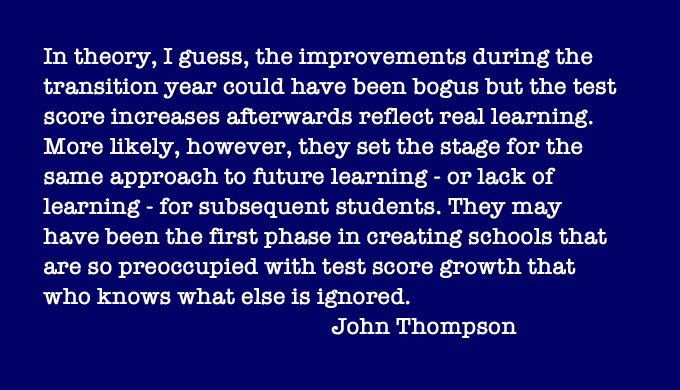
If test-driven, competition-driven school reform has taught us anything, it is this: When schools post gains in state test scores, those numbers may mean something or they may mean nothing. Some of those bubble-in increases might be evidence of meaningful learning – just as they might mean that teach-to-the test has taught students destructive habits that will undermine their futures in college and post-school life.
By now, scholars should forsake the use of the terms “student achievement” and “student performance” when talking about test score “outputs.” Especially in schools and systems that focus on bubble-in accountability, the jury is in and sharp increases on graphs displaying test score boosts do not show that students are getting better educations. Researchers should accept the burden of proving that test score growth is evidence of increased learning or school improvement before saying that they are evidence of policies that are beneficial to students.
The latest report by the Education Research Association on New Orleans school reform, Extreme Measures: When & How School Closures & Charter Takeovers Benefit Students, is consistent with the solid research that informs its previous scholarship.  And it includes the important qualifying statement that, “prior evidence suggests that schools that are effective in generating high test scores are not consistently more effective with other student outcomes.” When the ERA released its landmark “What Effect Did the Post-Katrina Reforms Have on Student Outcomes?, however, a diverse variety of scholars participated in the discussion of its findings. Fewer dissenting opinions were expressed when the new paper was released.
As with the case with the ERA’s “What Effect Did the Post-Katrina Reforms Have on Student Outcomes?”, by Doug Harris and Matthew Larsen, a graph that illustrates the NOLA trend line in test score growth presents the central argument. Harris and Larsen showed that New Orleans test score growth was increasing Do NOLA Test Score Increases Demonstrate Real Learning Gains? - Living in Dialogue:


A 9 to 5 School Day: Are Longer Hours Better for Students and Educators?

A 9 to 5 School Day: Are Longer Hours Better for Students and Educators?:

A 9 to 5 School Day: Are Longer Hours Better for Students and Educators?

longer school days

In 2004, Kuss Middle School in Fall River, Massachusetts, was labelled a Level 4 or “chronically underperforming” school, a lowly status that made it the focus of increased oversight and intervention. By 2013, however, Kuss, along with other struggling schools in this high-poverty district, had pushed its ranking all the way to Level 1. Whereas many interventions can impose punitive measures that divide communities, the improvement in student achievement at Kuss has been credited in no small part to longer school days or extended learning time (ELT) – a reform championed by many school officials, educators, parents, and community leaders.
“We’ve seen schools that have added as many as 90 minutes to their day improve quite dramatically,” says Rebecca Cusick, a fourth-grade teacher and president of the Fall River Educators’ Association.
Massachusetts has been a leader in ELT for more than a decade. In 2005, the state legislature created the Massachusetts Expanded Learning Time Initiative and approved major funding to support high-poverty schools that lengthened the school year. The initiative currently supports 19 schools and more than 10,000 students. Individual models may differ, but the schools have all lengthened their calendars by approximately 300 hours annually. For a school on a typical 180-day calendar, this translates to roughly 90 minutes of additional classroom time daily. The extra time is used for core subject instruction, teacher professional development, and student engagement activities.
Schools are provided with more “comprehensive educational experiences as well as more informal play time and social development opportunities that too many schools today are not able to provide simply because they don’t have enough time to do so,” explains Jennifer Davis, co-founder and president of the National Center on Time & Learning (NCTL).
The popularity of longer school days got a major boost in 2013 with a joint program between NCTL, the U.S. Department of Education and the Ford Foundation called the “Time Collaborative.” This three-year initiative involved 40 schools in the states of Colorado, New York, Connecticut, Massachusetts, and Tennessee. Outside of major projects like this, more school districts across the country are also stretching the school day, although in less ambitious ways.
But the shift to longer school days comes with pitfalls or, at least, unmet expectations. And even those educators who are in schools that have successfully implemented ELT initiatives will be the first to issue a warning – a longer school day is not for everyone.

Longer School Days: Weighing the Pros and Cons
Currently, around 1,500 schools across the country have extended learning hours, a A 9 to 5 School Day: Are Longer Hours Better for Students and Educators?:

Today is a day to remember that Malloy and the Legislature STOLE Connecticut’s school seat belt money! - Wait What?

Today is a day to remember that Malloy and the Legislature STOLE Connecticut’s school seat belt money! - Wait What?:

Today is a day to remember that Malloy and the Legislature STOLE Connecticut’s school seat belt money!

Image result for 6 students in ICU after school bus driver charged in crash that killed Woodmore Elementary students


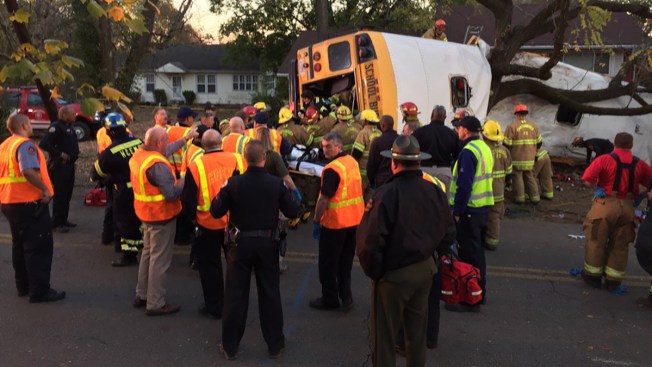
Five students are confirmed dead in the Woodmore Elementary School bus crash and six remain in critical condition this morning.
Three of the students killed were in fourth grade, one was in first grade and another in kindergarten, according to Hamilton County Schools Interim Superintendent Kirk Kelly.
Descriptions from the crash scene appear to confirm that the death and injury toll would have been significantly reduced if children were wearing seat belts.  However, in Tennessee only school buses transporting special education students are required to have seats belts.
By comparison, school buses in California, Florida, Louisiana, New Jersey and New York must be equipped with seat belts and Texas requires that all school buses purchased after 2010 must be fitted with seat belts.
As Tennessee newspapers are now reporting, State Representative Joe Armstrong, D-Knoxville, “led an unsuccessful effort to require seat belts on Tennessee school buses last year after two students and a teacher’s aide died in a bus crash in Knoxville. Many lawmakers opposed the proposal, saying it was too expensive.”
But seat belts work…
According to a 2010 study conducted by the University of Alabama, seat belts work.  The three year tracking study found,
  • Students are six to eight times safer riding to school in a school bus than riding to school in their parents’ cars.
  • The addition of seat belts would make already-safe school buses even safer.
  • Based on 170,000 observations of pupils in pilot-project buses, the average seat belt- use rate was 61.5%.
  • Adding seat belts increases the thickness of seat-backs, leading to fewer rows of seats.
School bus seat belts might have made a huge difference in yesterday’s fatal school bus Today is a day to remember that Malloy and the Legislature STOLE Connecticut’s school seat belt money! - Wait What?:

Schools as Foundations of Democracy - Bridging Differences - Education Week

Schools as Foundations of Democracy - Bridging Differences - Education Week:

Schools as Foundations of Democracy

Image result for big education ape Democracy deb

Deborah Meier continues her conversation with Harry Boyte. To read their full exchange, please visit here.
Dear Harry and friends,
We get back—in your last letter—to an underlying theme that runs through our discourse! Election vs. citizen action. Actually, Harry, I suspect we'd really both agree that we don't have to choose between them. You can't win in elections if you don't have deep roots and connections with potential voters—especially if your goals are to empower "the people".
There's a considerable unfortunate tendency among the 18-21 crowd to prefer the latter (citizen action) over the former (election), and to simply not vote and then protest the results. I suspect it's an exaggeration, but a recent news story claimed that three-fourths of the protesters arrested in Portland hadn't voted, and that about half of the demonstrators hadn't. While disdain for electoral politics is dangerous, it's entirely understandable for two reasons: the kind of elections practiced in schools are clearly a bad charade, and the November ones don't seem to make much difference to too many people who see them as a struggle between elites.
The absence of powerful, people-based political activity has unbalanced an already unbalanced power structure. The only thing available to "the people" who don't have a lot of wealth is the power of numbers, organized numbers, who over time have developed a trust in each other so that they can act in ways that counter money-power. That, of course, also means that they need money, but the gap is filled, ideally over-filled, by actual human beings who man telephones, canvass, talk to friends, encourage each other, etc., etc., etc. And not only every two or four years, but over issues closer to home as well. The big new factor in American politics since the New Deal was the growth of the union government. It was a smart move by the Democrats (Dixiecrats must have gone along?) to pass the Wagner Act that made organizing unions on a grand scale feasible.
Unions were where people didn't just vote, but talked and talked and talked, and argued. The union provided information not available in daily press (which were then—maybe still?—largely Republication or conservative Democrat). They were in a position to quickly get the word out when outrageous misstatements of fact occurred—not only to their membership but through their media and research departments.
They were also a continuous year-round year after year institution whereas many other people's movements were focused on particular evils and went out of business or became quiescent when that struggle was over. Unions didn't have ways to fund themselves easily during the dry months or years when their issues weren't on the top of the agenda. Unions were built into America's economy for a time and the dues check-off was important as well—since business has little trouble deducting political "dues" from its side of the fence. Citizens United has blown this catastrophe up in ways we never anticipated.
In some countries the labor movement and its allies had a political party—which was what socialists like me used to demand. I didn't happen, in part, because working people assumed the Democratic Party was a stand-in for that. The Democrats, of course, were until WWII, hardly a bastion of civil rights activists given the alliance with the South and the absence of voting rights by so many blacks.
What was forgotten for a time was that racism was an element among Northern whites. (Note: NYC is as racially segregated as it was 60 years ago.) It was a fringe element we thought, just as anti-semitism may have been a fringe element in Germany in the 20s, and would inevitably die out. We may be right about anti-semitism (I wouldn't count on it) but we were wrong about racism, and all those anti-foreigner, yellow hordes, dirty x's and y's that sort of went away after World War II. Sort of.
We need to rebuild, reconstruct alliances and to do that we need to build a mass equivalent of the Labor movement of yore. Maybe it's even possible to rebuild the labor movement that is left.
I think schools can play a powerful role but I've come to believe it for somewhat different reasons. I still think pedagogy and curriculum matter. But even more important I now think is the setting that kids spend those 12 years in. Does it celebrate democracy or authoritarianism? Is it friendly to non-mainstream people and ideas? Is it a place where young people witness (ideally experience) democratic life at least? Amongst the adults? We progressives—and probably most others too—have long known that telling is not as powerful as experiencing.
Where in the world do the young experience the complexity of democracy, the the-offs, an understanding of how important collective decisions might be made? Nowhere.
If schools can't be adult democracies, at the very least, why do we think it would work on a larger scale?
Image result for big education ape Democracy deb

Fast ForWord Computer Reading Program is KindaSlow!

Fast ForWord Computer Reading Program is KindaSlow!:

Fast ForWord Computer Reading Program is KindaSlow!

Misinformation and the Spread of Fake News

When technology fails, shouldn’t there be accountability–like real teachers?
In Gainesville, Florida, home of the prestigious University of Florida, the Alachua School District spent $1.9 million on a reading computer program called Fast ForWord.
But children who did Fast ForWord  did worse than children not participating in the program!
Will the company Scientific Learning pay the money back to the district? No. Alachua will continue Fast ForWord because they claim there were some gains for certain children.
Yet, according to The Gainesville Sun, outside studies by the U.S. Institute of Education Sciences, an evaluation branch of the Education Department, indicate Fast ForWord has no apparent effects on reading fluency, and only mixed effects on comprehension.
Another study in the Journal of Child Psychology and Psychiatry, and Allied Fast ForWord Computer Reading Program is KindaSlow!:

Neutrality is Dangerous - Badass Teachers Association

Badass Teachers Association:

Neutrality is Dangerous

By:  Ferial Pearson 


This week, I've spoken on a panel at the ADL about Islamophobia, talked with the mayor about the needs of the LGBTQIA+ community, and presented to over 40 school librarians about Culturally Responsive Teaching, and there was one thing that came up all three times.
Neutrality is dangerous, irresponsible, and just plain bad. There is no "other side" to justice and equity that deserves representation.
Yes, everyone has a right to their opinions and beliefs. Absolutely. But when those beliefs and actions manifest themselves into words and actions that are psychologically, emotionally, and even physically damaging, then the people spouting those opinions through those words and actions should be ready and willing to suffer the repercussions and consequences of those actions.
There are protests whose purposes are to highlight injustice, pain, danger, and bigotry, to mourn and grieve together, and to show solidarity to those who are hurting. And then there are protests that espouse injustice, pain, danger and bigotry. One of those should be given airtime and space. The other should be shut down.
For example, there have been students even here in our city who have been protesting against the president elect. Students who are in pain, who are scared, who have experienced oppression and discrimination. They are being brave. And then there are students who protest these protestors with chants of "build the wall" and other such rhetoric that is designed to be painful and bigoted. I hope you can see how administration and teachers should NOT be neutral, because one of these sides is causing psychological damage to the other, and the other one is not. It's not about politics; it's about safety, acceptance, respect, and modeling what equity looks like.
We who belong to marginalized groups and identities do not appreciate the neutrality of those in power when our very existence is being challenged. Now, more than ever, but to be sure it's been this way forever.
If you are neutral in situations of injustice, you have chosen the side of the oppressor. If an elephant has its foot on the tail of a mouse and you say that you are neutral, the mouse will not appreciate your neutrality. - Desmond Tutu

About Ferial Pearson 
Ferial Pearson was born and raised in Nairobi, Kenya. She is the oldest of four girls and the first in her immediate family to go to college. After graduating from Peponi School in 1997, she left Africa to attend Gustavus Adolphus College in Saint Peter, Minnesota, where she earned her Bachelor's degree in 2001 in Communication Arts Literature Teaching, and where she met her husband, Daniel. She was offered the opportunity to teach in Omaha at Omaha South High School, where she taught English and Reading for ten years. During her time there, she also served as the Gay Straight Alliance and Unity Club sponsor, and received national awards for her work with students and in the community. These included the National Education Association's Virginia Uribe Award for Creative Leadership in Human Rights in 2012, the Gay Lesbian Straight Education Network's Educator of the Year Respect Award in 2011, and she was the Nebraska representative and finalist for the National Council of Teachers of English Academic Freedom Award in 2012. Locally, she has been awarded the 2011 Omaha Education Association's Human Relations Award, the 2012 Promising Professional Award from the University of Nebraska at Omaha, and RESPECT's 2011 Anti-Bullying Award. Most recently, she was awarded a TOYO (Ten Outstanding Young Omahans) Award in 2014. She also earned her Master's degree in Curriculum and Instruction with a Graduate Certificate in Urban Instruction from the University of Nebraska at Omaha in 2009. Ferial left Omaha South High School to work as a Talent Advisor for the Avenue Scholars Foundation and taught for them at Ralston High School for two years until 2013, during which time she created the Secret Kindness Agents project, which became the subject of a book, a TEDx Talk, and now the focus of her dissertation. She currently is an Instructor at the University of Nebraska at Omaha in the Teacher Education Department, and is working on her doctorate in Educational Leadership. This year, she was the recipient the Kennedy Center’s Stephen Sondheim Inspirational Teacher award. She lives in Ralston, Nebraska with her husband Daniel, son Ilahi, and daughter Iman. Badass Teachers Association:

Trump's Search For Education Secretary Narrows To Two Candidates - BuzzFeed News

Trump's Search For Education Secretary Narrows To Two Candidates - BuzzFeed News:

Trump’s Search For Education Secretary Narrows To Two Candidates

Republican megadonor Betsy DeVos would be the conventional choice, while school reformer Michelle Rhee would be the “fuck you” candidate for teachers unions.


President-elect Donald Trump’s search for a secretary of education has narrowed to two candidates, the school reformer Michelle Rhee and Republican megadonor Betsy DeVos, according to two people familiar with the search process.
DeVos is in most ways a conventional choice for the position: a longtime advocate of alternatives to the public school system, with close ties to many on Capitol Hill, she is closely aligned to Republican education officials like Sen. Lamar Alexander and serves on the board of Jeb Bush’s education foundation. She has also proclaimed herself an opponent of the Common Core education initiative, which Trump often denounced at his rallies with promises of a “repeal,” though she initially supported the standards.
“Rationally, she’s the one that makes sense for Republicans,” said one school choice advocate who has worked closely with both DeVos and Rhee. “She’s much more aligned policy-wise. And she’s a get-things-done type person — she’s got a team of people and she can work very quickly to get a bill through.”
 But Rhee may hold a strong allure for Trump, who sometimes deviates from the Republican orthodoxy in education and has embraced controversial picks in many of his early cabinet positions.

The former chancellor of Washington, DC, public schools, Rhee is an unconventional pick. She’s a former Democrat and a polarizing firebrand who made a name for herself by fighting teachers unions and advocating fiercely for the expansion of charter schools.
“If you’re just trying to send a message with your pick — if you want to say ‘fuck you’ to teachers unions — then [Rhee] is the right choice. That may be what Trump wants to do,” said the education advocate.
“Michelle is a lightning rod, and that’s something he likes — he likes people who stir things up and make a lot of noise.”
Both Rhee and DeVos met with Trump this weekend at his golf course in New Jersey.
Many conservatives have rallied around DeVos, said one Republican operative, in part because she is aligned ideologically on key issues like the promotion of school vouchers. But they also support DeVos because of several black marks on Rhee’s record: Rhee is a supporter of the Common Core, and her husband, Kevin Johnson, is a prominent Democratic politician.
Trump campaigned on a promise to repeal the Common Core — though it is not a federal law. The conservative Federalist proclaimed, “Michelle Rhee Would Be a Terrible Choice for Education Secretary,” largely because of her Common Core stance.
But DeVos may have a few black marks of her own, making her unlikely to please Trump’s most ardent right-wing supporters. Though she now says she’s opposed to the Common Core, she once advocated for it alongside Jeb Bush, one of Trump’s biggest foes. And as a DC insider and large-scale donor to the Trump campaign, her hiring may be a liability for an administration that has promised to “drain the swamp” of Washington.
Molly Hensley-Clancy is a business reporter for BuzzFeed News and is based in New York. She covers the intersection of business and education.
Contact Molly Hensley-Clancy at molly.hensley-clancy@buzzfeed.com.

Where Donald Trump Stands on School Choice, Student Debt and Common Core - The New York Times

Where Donald Trump Stands on School Choice, Student Debt and Common Core - The New York Times:
Where Donald Trump Stands on School Choice, Student Debt and Common Core


When it comes to predicting how President-elect Donald J. Trump’s administration will affect America’s schools and universities, education experts say they are struggling to read the tea leaves.
“The fundamental issue is that nobody really knows what the Trump administration is about” on education, said Frederick M. Hess, a conservative education policy expert. At a panel discussion in Washington last week, he joked that Mr. Trump’s trademark educational achievement thus far, creating the controversial Trump University, placed him in history alongside another president, Thomas Jefferson, the founder of the University of Virginia.
“He’s been all over the map on a number of these questions,” Mr. Hess, the director of education policy studies for the American Enterprise Institute, said during a panel discussion on Wednesday at the Shanker Institute, an education nonprofit.
Mr. Hess is among education experts and policy makers who, since the election, have been trying to figure out what a Trump administration might do for education — starting with whether there will even be a federal Department of Education. Mr. Trump suggested during the campaign that the agency might be on the chopping block, though the statement seemed more like a sound bite than a policy pronouncement.
On the campaign trail, Mr. Trump’s statements on education were largely like that: a series of short clips, some seemingly contradictory. And it is not clear whether his policies will hew closely to the Republican agenda or fall more in line with his populist streak.
Mr. Trump’s signature education proposal — to provide $20 billion in federal money to allow low-income students to select private or charter schools — is one area where he seems to be borrowing policy from Vice President-elect Mike Pence. As governor of Indiana, Mr. Pence championedschool choice and favored a smaller federal role in education.
While arguing that Mr. Trump should be taken seriously on education because he wants to cut college costs and improve schools, Mr. Hess said Mr. Trump’s pronouncements so far were not based on fully formed policy.
“The $20 billion figure for school choice came out of nowhere,” Mr. Hess said. “You know that Mr. Trump has been all over the place on student loans.”
A number of names have been floated as possible choices for education secretary. Mr. Trump met over the weekend with Michelle Rhee, a former District of Columbia schools chancellor, a Democrat who reversed her opposition to school vouchers in 2013 and has supported Common Core standards.
Another possible candidate is Williamson M. Evers, an education expert at the Hoover Institution, a think tank. Mr. Evers was a senior adviser at the Education Department during President George W. Bush’s administration.
Mr. Trump’s office has not responded to requests for interviews on his education priorities, but he and people close to him have dropped a few clues. Here is an overview of what America’s schools and universities might expect during the Trump administration:

K-to-12 Education

SCHOOL CHOICE In a speech at a Cleveland charter school in September, Mr. Trump rolled out the banner element in his education plan — the $20 billion program to promote “school choice.” Along with the federal money, states also would be encouraged to kick dollars into a pool so that low-income children could select their schools, including private and Where Donald Trump Stands on School Choice, Student Debt and Common Core - The New York Times: