Latest News and Comment from Education

Thursday, August 4, 2016

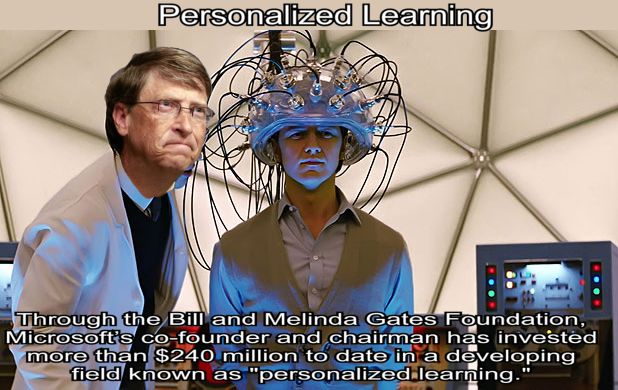
Personalized Learning, Surveillance and Counterinsurgency within the State-Finance Matrix Badass Teachers Association

Badass Teachers Association:

Personalized Learning, Surveillance and Counterinsurgency within the State-Finance Matrix

 pjimage (1)

by Timothy Scott, Massachusetts BAT Activist

originally published on his blog:  https://narrativedisruptions.wordpress.com/surveillance-counterinsurgency-and-schooling-within-the-state-finance-matrix/


The Role of Big Data, EdTech 
and Militarized Austerity within 
America’s Authoritarian Democracy 

by Timothy Scott

The state-finance matrix defined: Influenced by David Harvey’s notion of the state-financenexus, the state-finance matrix is a highly disciplined environment where state power structures and technologies facilitate and protect the activities and interests of finance capitalism over all else. This matrix provides an insulated environment for financialization via securitization, which simply described, is a process where financial institutions bundle together (illiquid) financial assets – primarily loans – and transform them into (liquid) tradable securities that can be expeditiously bought and sold in secondary financial markets. Within this globalized environment, digital securities trading – including “fictitious” trading and hedging and speculating in derivative markets – generates “phantom wealth”; whereby the exchange of capital, money and currency is detached from material or labor value. In the twenty-first century, debt is the new global currency and is a primary source of (intangible) wealth accumulation.

Rebooting the System for a New Age

Writing in Forbes Magazine in 2013, technology entrepreneur Naveen Jain made an assessment of the historical origins of mass public education by pointing out that, “Our education system was developed for an industrial era.” Jain went on to explain that the U.S. education system,

…today uses the mass production style manufacturing process of standardization. This process requires raw material that is grouped together based on a specific criteria. Those raw materials are then moved from one station to another station where an expert makes a small modification given the small amount of time given to complete their task. At the end of the assembly line, these assembled goods are standardized tested to see if they meet certain criteria before they are moved to the next advanced assembly line.

Jain makes this point not as a critique of education serving the interests of capitalism through the application of the scientific management model of production (Taylorism) to schooling. On the contrary, he does so to make a case that current education reform policies are a continuation of the original mission of U.S. public education as an instrument of social control, yet only being modernized to bolster financialized capitalism. As Jain puts it, “Our education system is not broken, it has just become obsolete.” He goes on to explain: 

When I think of all the tremendous, seemingly impossible feats made possible by entrepreneurs, I am amazed that more has not been done to reinvent our education system. I want all entrepreneurs to take notice that this is a multi-hundred billion dollar opportunity that’s ripe for disruption.

The means by which such financial “opportunities” reside by “reinventing” education are made more explicit when Jain goes on to claim, “Rethinking education starts with embracing our individuality…[j]ust think of the opportunities we can unlock by making education as addictive as a video game” by flipping the current model on its head and use “technology to focus on 
Badass Teachers Association:


Seattle Schools Community Forum: Washington's Latest Charter School Lawsuit Filed

Seattle Schools Community Forum: Washington's Latest Charter School Lawsuit Filed:

Washington's Latest Charter School Lawsuit Filed


The Associated Press is reporting that a lawsuit has been filed in King County Superior court over the new charter school law passed by the Legislature in the spring.

Teachers unions, parents and other groups filed a lawsuit Wednesday over Washington’s new charter school law, a measure that was enacted last spring after the state Supreme Court struck down the old law. 
The group includes the Washington Education Association, League of Women Voters, El Centro de la Raza and several labor unions.   

The lawsuit contends that the the Legislature did an end run around the previous ruling by finding new public dollars for charter school support instead of the money coming from the General Fund. 
In what can only be termed late-to-the-party, Senator Joe Fain, R-Auburn, who could not fall over himself more to support charter school legislation, had this to say:


“The union is right about one thing,” Fain said. “The state has an unmet duty to a million kids that are in both traditional and charter public schools. A solution to McCleary will provide better equality and opportunity to students no matter what kind of public school they attend.” 
Where was his voice during the legislative session?  Where was the voice of a single charter school on McCleary? 

He also said this:


“There is nothing in the law, the Constitution or the previous court Seattle Schools Community Forum: Washington's Latest Charter School Lawsuit Filed:

If Trump Drops Out, Will There Be Any Reason to Vote For Clinton? | gadflyonthewallblog

If Trump Drops Out, Will There Be Any Reason to Vote For Clinton? | gadflyonthewallblog:

If Trump Drops Out, Will There Be Any Reason to Vote For Clinton?

hillary-clinton-donald-trump-getty-images-640x480
Rumor has it Donald Trump may be dropping out of the Presidential race.
We’ve heard these speculations before, but after kicking a crying baby out of one of his rallies, even his staunchest supporters are scratching their heads.
Does this guy even want to be President of the United States?
Only a few weeks ago a story was circulating that Donald Jr. was calling up potential Republican running mates asking if they wanted to run both domestic and foreign policy while his dad handled “Making America Great Again.”
From the very beginning of this unlikely Presidential run, people have questioned all kinds of things about the Trump campaign – chief among them was this: Is he serious!?
Donald Trump is the Republican standard barer – Isn’t he more of a Democrat? Isn’t he actually friends with his supposed Democratic challenger, Hillary Clinton? Didn’t he actually donate money to her first Presidential bid in 2008? Is he just a false flag for Clinton – someone so odious he’ll rally people to vote FOR HER rather than for him?
I have no idea whether this will actually come to pass. Win the nomination and then drop out? Anything is possible when you’re running a reality TV star for the highest office in the land. But it begs the question – what happens if he really does it? What happens if Trump drops out?
Certainly the Republicans will find SOMEONE to run in his stead. Maybe it will be his running mate, Mike Pence. Maybe the party elders will pick one of the usual suspects If Trump Drops Out, Will There Be Any Reason to Vote For Clinton? | gadflyonthewallblog:

CURMUDGUCATION: Milton Friedman's Vision

CURMUDGUCATION: Milton Friedman's Vision:

Milton Friedman's Vision


The Friedman Foundation for Choice in Education has a new name-- EdChoice.

The organization considers the change of their "brand" in the pages of its blog.  Milton and Rose Friedman are both currently dead, but they apparently left a plan for making sure the group outlived them and kept its focus on its mission, not its deceased beneficiaries.  They remain committed to choice, but 

We don’t just want more choice, we want better and bigger choice. And using what we already know works, we will usher in a new era of educational choice programs built to serve every student and ensure that all families have the opportunity and access to schooling that meets their needs.


As for their organizational qualities, they are smart and dedicated. They are 100% for all-out "unencumbered" school choice. They are proud to not be "not some stuffy think tank." Beyond that they are going to be lobbying hard for those all-choice policies.

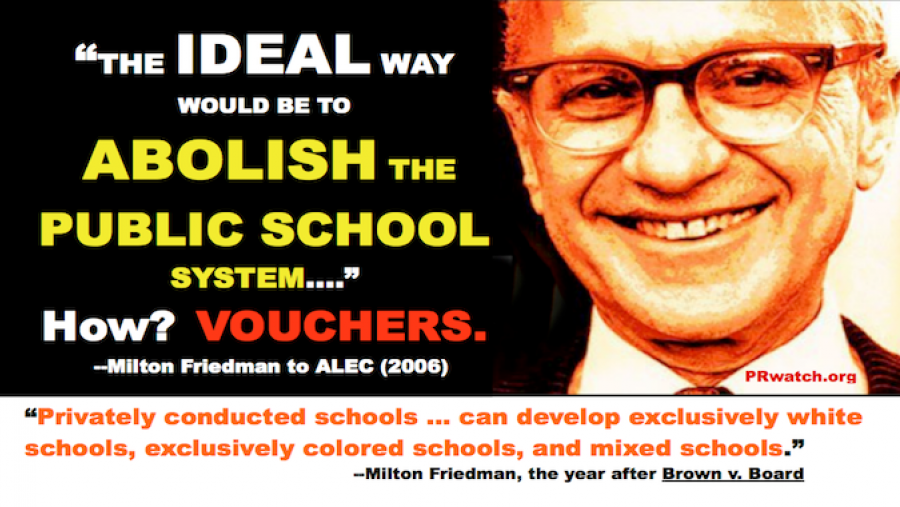
But the end of the Friedman name as a choice-promotion brand seems like a good time to look at Friedman's vision, a vision that has drive much of the charter industry for years.

In 1995, Milton Friedman contributed this op ed to the Washington Post. It now lives on the CATO website, and from the moment it spools out its title, it's clear we're seeing the big plan.

Public Schools: Make Them Private is one big spoiler alert of a title, because that's exactly what 
CURMUDGUCATION: Milton Friedman's Vision:

Foundations Unfiltered – EduShyster

Foundations Unfiltered – EduShyster:
Foundations Unfiltered


Megan Tompkins-Stange spent five years conducting confidential interviews with insiders at some of the foundations most involved in education reform. What they told her will surprise you. Or not… 
EduShyster: You spent five years interviewing insiders at some of the foundations most involved in education reform, and your new book Policy Patrons allows readers to *listen in* on conversations that are, let’s just say, enlightening. I want to give readers a taste by jumping right into a Gates Foundation official’s take on the chummy relationship between the foundation and the Obama administration—or as one Obama staffer describes it in a telling slip of the tongue, the Gates administration. 
mst7
Megan Tompkins-StangeI think this is one of the more interesting quotes in the book, because it’s quite self-reflective. On the one hand, the source is acknowledging that the close coupling between Gates and the Department of Education under Arne Duncan was great because it pushed their agenda forward. But on the other hand, they’re acknowledging that it’s somewhat problematic in terms of democratic legitimacy. It was my sense that most of the people I talked to hadn’t engaged—at an organizational level—with the larger question of *What’s our role in a liberal democracy?* or *Is this the right thing for us to do as a foundation?* They were so focused on the work—they talked about *We’re changing things; we’re moving the policy, look at all these things we’ve accomplished.* The democracy part of it was not really a part of the equation in terms of their day-to-day discussions. It was more about, *How do we get the elites who can really move this policy on board?* But it seems like that is changing now in a few contexts.
EduShyster: I should point out that your book isfilled with quotes like the one above. In fact, *heavy on hubris* might be an accurate way to describe its contents. We overhear the Broad folks reveling in their success in New Orleans and the failure of the opt out movement, and Team Gates crowing over, well, everything. But both have ended up getting some comeuppance of late—Gates over the Common Core and Broad over Eli Broad’s charter expansion plan in Los Angeles. 
Tompkins-StangeI think what we’re seeing, with Gates and Broad in particular, is that they started from the point of view that *If you apply capital to X problem then Y solution will happen.* For example, if you make a vaccine available, disease will be eradicated. But that worldview hasn’t translated well to Foundations Unfiltered – EduShyster:


U.S. Supreme Court blocks transgender bathroom choice for now | Reuters

U.S. Supreme Court blocks transgender bathroom choice for now | Reuters:

U.S. Supreme Court blocks transgender bathroom choice for now

Student Gavin Grimm, who was barred from using the boys' bathroom at his local high school in Gloucester County, Virginia, U.S. is seen in an undated photo. Grimm was born a female but identifies as a male.  Crystal Cooper/ACLU of Virgina/Handout via REUTERS
Student Gavin Grimm, who was barred from using the boys' bathroom at his local high school in Gloucester County, Virginia, U.S. is seen in an undated photo. Grimm was born a female but identifies as a male. Crystal Cooper/ACLU of Virgina/Handout via
REUTERS


A Virginia school board may temporarily block a student who was born a girl from using the boys' bathroom while a legal fight over transgender rights proceeds on appeal, the U.S. Supreme Court said on Wednesday.
The case is the first time the fight over transgender bathroom rights has reached the Supreme Court. The subject arrived in the heat of a U.S. presidential election in which the makeup of the court is a central issue.
In a brief order, the country's highest court put on hold an order from a lower court that had permitted the high school student to use the bathroom of his choice.
Last year, the American Civil Liberties Union sued on behalf of Gavin Grimm, 17, to challenge the Gloucester County School Board's bathroom policy, which requires transgender students to use alternative restroom facilities.
A lawyer for Grimm, Joshua Block, said he and his client were disappointed by the order and "disappointed that Gavin is going to have to begin another school year being stigmatized and separated from his peers as a result of this policy."
The school board in coastal Gloucester County, about 140 miles (225 km) south of Washington, D.C., welcomed the decision.
"The board continues to believe that its resolution of this complex matter fully considered the interests of all students and parents in the Gloucester County school system," the board said in a statement.
The eight-member Supreme Court voted 5-3 to stay the lower court's order. Justices Ruth Bader Ginsburg, Sonia Sotomayor and Elena Kagan would have denied the school board's request that it be able to block a student from exercising choice in use of a bathroom, according to the order.
The order was not a final ruling on the subject. Instead, it rewound the fight to where it was in April before a federal appeals court in Richmond, Virginia, ruled in Grimm's favor.
That ruling by the 4th U.S. Circuit Court of Appeals was the first by an appeals court to find that transgender students are protected under federal laws that bar sex-based discrimination.
In court papers last month, the school board's lawyers said the 4th Circuit wrongly deferred to the view of President Barack Obama's administration that prohibitions on sex discrimination under federal law also apply to gender identity.
In May, the Obama administration directed public schools nationwide to allow transgender students to use bathrooms that correspond to their gender identity or risk losing federal funding. So far, 23 states have sued to block the directive.
Justice Stephen Breyer, of the Supreme Court's liberal wing, joined with its most conservative members in temporarily siding with the school board.


Breyer wrote in a one-sentence explanation that he did so as a courtesy to preserve the status quo until the Supreme Court has a chance to consider the subject more fully.U.S. Supreme Court blocks transgender bathroom choice for now | Reuters:

Here’s How Much Your Kid’s Teacher Is Shelling Out for School Supplies | MONEY

Here’s How Much Your Kid’s Teacher Is Shelling Out for School Supplies | MONEY:

Here’s How Much Your Kid’s Teacher Is Shelling Out for School Supplies

classroom decorations

And you thought what you had to pay was bad

Parents might be getting sticker shock when they see the list of required supplies their kids’ school mails out, but chances are, teachers are looking at even bigger bills for their classrooms right about now.
The Education Market Associationsays that virtually all teachers wind up paying out of pocket for supplies, and it’s not chump change, either. On average, most spent nearly $500 last year, and one in 10 spent $1,000 or more. All told, a total of $1.6 billion in school supply costs is shifted from parents — or, increasingly, from cash-strapped districts — onto teachers themselves.
“What we know from our site coordinators who work alongside teachers is that these educators are often digging into their own pockets to stock their classrooms with basic supplies,” said Gary Chapman, executive vice president for the national network of Communities in Schools, a nonprofit group that helps low-income kids stay in school. “Increasingly, it’s also including items that teachers themselves need to do their jobs, like cleaning supplies, trash bags, and poster boards,” he said.
So if you’re wondering why that list you got in the mail included a grab bag of items like wet wipes, spray cleaner, and even reams of copier paper, the answer is that school districts, many facing tighter budgets, have effectively outsourced the financial obligation by requesting that parents pony up for these supplies.
“Most states provide less support per student … than before the Great Recession,” a report published earlier this year by the Center for Budget and Policy Priorities found. “Some states are still cutting eight years after the recession took hold.”
For teachers in lower-income districts, the burden can be even higher. Within the past year, Communities in Schools conducted a survey of 700 teachers and found that more than 90% have to buy school supplies to help low-income kids whose parents can’t afford even basic things like pens and notebooks.
And that number of struggling families is surprisingly high, according to areport published last year by the National Education Association. “For the first time in recent history, more than 50 percent of all children attending public schools live in poverty, and the number of homeless children in public schools has doubled since before the recession,” the report noted.
When the Huffington Post asked teachers last year to tweet how much they spent on their classrooms, many respondents said several hundred dollars — and a few said as much as several thousand dollars, so even the $500 average reported by the Education Market Association might be low.Here’s How Much Your Kid’s Teacher Is Shelling Out for School Supplies | MONEY:

Here Are the School Supplies You Need in 2016


Much criticism, no consensus on how to fix charter school oversight | EdSource

Much criticism, no consensus on how to fix charter school oversight | EdSource:

Much criticism, no consensus on how to fix charter school oversight


There was widespread agreement at a legislative hearing Wednesday on a lack of clarity and consistency in how the state’s charter schools are approved and overseen.
But school and county district officials and charter school leaders characterized the problems very differently and disagreed over how to fix them.
Charter schools, which receive public funding and are managed, with few exceptions, by nonprofit boards of directors, are free from a number of regulations governing the state’s school districts. There are more than 1,200 charters in California – double the number a decade ago – and this fall they will educate an estimated one of 10 public school students.
Testifying before the Senate Education Committee, district leaders argued that the vagueness of the state’s charter school law and regulations fostered inequalities and a lack of accountability. They complained that charter schools aren’t required to publish financial reports and contact information for board members, many of whom live distant from the school they serve. They said that charter schools can suspend and expel students without an appeals process required of district schools, and many enroll fewer proportions of English learners and disabled students, who are more expensive to educate.
While district schools must provide school lunches to students, charters are exempt from the federal government’s school lunch requirement, and 18 percent of the state’s charters don’t offer meals. That’s a disincentive for low-income students to enroll, said Silke Bradford, who directs charter oversight for the 37 charters that operate in the Oakland Unified School District.
And unlike school districts, the state’s charter schools don’t have their annual LCAP, a comprehensive budget and planning Much criticism, no consensus on how to fix charter school oversight | EdSource:


He’s 77, frail and lives in Pennsylvania. Turkey says he’s a coup mastermind. - The Washington Post

He’s 77, frail and lives in Pennsylvania. Turkey says he’s a coup mastermind. - The Washington Post:

He’s 77, frail and lives in Pennsylvania. Turkey says he’s a coup mastermind.

U.S.-based cleric Fethullah Gulen at his home in Saylorsburg, Pa. (Charles Mostoller /Reuters)

 It was a weekday night in the Poconos, quiet but for the sound of cicadas in the wooded hills of rural Pennsylvania. In the secluded compound where he preaches nonviolence, tolerance and the value of education, Fethullah Gulen sat in a well-lighted room, handing out candy to children.
Half a world away in his native Turkey, the 77-year-old Muslim cleric with a global following had just been accused of orchestrating the bloody July 15 coup attempt that left more than 200 people dead and a major U.S. ally in chaos.
Gulen’s many adherents and admirers have dismissed the allegations, which he has denied, as the ravings of a paranoid Turkish government and an attempt by its president, Recep Tayyip Erdogan, to rid himself once and for all of a former ally whose popularity challenges his increasingly autocratic rule.
Critics say Gulen is a conniving leader of what Turkish government lawyer Robert Amsterdam calls a “cult,” bent on taking over Turkey. They charge that the international network of universities, hospitals, charities, business associations, news outlets and schools — more than 1,000 of them spread across more than 150 countries — over which, they say, he presides, is little more than a front for the spread of what Erdogan’s government has labeled a “deviant religious ideology.”
Since the coup attempt, the Turkish government has arrested more than 10,000 people and dismissed nearly 70,000 from their jobs. It has set up a hotline for people to call if they suspect someone of being a Gulenist.
Turkish officials have accused the United States of harboring Gulen and suggested U.S. involvement in the aborted coup. The government in Ankara has asked for Gulen’s extradition as both a legal matter and a profession of loyalty and respect.
A Justice Department team is sifting through what U.S. officials say are some 85 boxes of evidence that Turkey says describes the infiltration of Gulenists into every part of Turkish society, including the judiciary, the police and the military faction that launched the coup attempt, and proves Gulen’s direct role as mastermind of the plot.
Turkey sees the matter of Gulen’s extradition as one of trusting a NATO member and a leading partner in the fight against the Islamic State. “For God’s sake, we’re talking about a country that has been a loyal ally to the United States for 60 years,” Serdar Kilic, Turkey’s ambassador to the United States, said in an interview. “They have to give unreserved support to Turkey.
“Imagine if a group of generals had decided that Obama was not taking the right course of action in Syria or in Europe or wherever,” he said, and had commandeered aircraft to bomb Congress, ordered civilians to be shot at, taken the military chief of staff hostage, and come within 15 minutes of trying to kidnap or assassinate the president — all of which happened during the coup attempt. What, Kilic asked, would the immediate U.S. reaction be?
At the very least, he said, Turkey deserved the “benefit of the doubt” from the U.S. government.
The United States, which spent years trying to send Gulen home after his 1999 arrival here as a tourist before a court granted him a green card, says the process is a legal one in which politics — and alliances — have no role.
“President Erdogan and Turkey have a strong belief that Mr. Gulen, who is in Pennsylvania, who is a legal resident of the United States, is somehow behind some of these efforts,” President Obama said a week after the coup attempt.
“We have a process here in the United States for dealing with extradition requests made by foreign governments,” Obama said. “It’s governed by treaties, governed by laws, and it is not a decision that I make but rather a decision that our Justice Department and investigators and courts make alongside my administration in a very well-structured and well-established process.”
Gulen denies involvement. “If one-tenth of this accusation is correct . . . let them take me away, He’s 77, frail and lives in Pennsylvania. Turkey says he’s a coup mastermind. - The Washington Post:

Wednesday, August 3, 2016

Schools Matter: ESSA: Vermont State Board of Ed Letter to John B. King

Schools Matter: ESSA: Vermont State Board of Ed Letter to John B. King:

Schools Matter: ESSA: Vermont State Board of Ed Letter to John B. King


 Vermont State Board of Education
219 North Main Street, Suite 402
Barre, VT 05641

July 2016

John B. King, Jr., Secretary of Education
U.S. Department of Education
400 Maryland Avenue, SW
Washington, D.C. 20202

Re: Comments on Proposed Rules and Regulations

Dear Secretary King,

The Vermont State Board of Education thanks you for the opportunity to respond to the ESSA
proposed rules. Our Board is proud to represent a state where the people support a strong state
funding system, enjoy schools that foster high student performance and register narrow equity
gaps as compared with the nation. Nevertheless, the opportunity gap is our most pressing
concern and is the number one goal in our strategic plan.

With these traditions and values in mind, we have strong concerns and reservations about
ESSA. Fundamentally, if we are to close the achievement gap, it is imperative that we
substantively address the underlying economic and social disparities that characterize our
nation, our communities and our schools. With two-thirds of the score variance attributable to
outside of school factors, test scores gaps measure the health of our society more than the
quality of the schools.

Consequently, the continuation of a test-based, labeling and “assistance” model (broadly seen
as punishment) has not only proven ineffective, but has had a corrosive effect on the confidence
of the people. The encouragement of privatization has been harmful to local democracy, has
further segregated a too fragmented nation and has diluted rather than focused valuable
resources.

Regarding the draft regulations, we think they go well beyond the role of the federal
government as specified in ESSA. The regulations need to be brought into conformity with the
parameters authorized in law.

We share comments on several specific elements of law and rule:


Education and Accountability is More Than Test Scores: The Narrowness of the Measures – The plan relies on what we can easily measure, rather than on what is important. By requiring that test scores in two subjects and graduation rates be given preferential weight, we discourage schools from supporting truly broad opportunities to learn and the skills necessary for a healthy society. In a world where violence and terrorism command the news, the education of our youth to participate in a Schools Matter: ESSA: Vermont State Board of Ed Letter to John B. King:


Get 20% Off w/code: RLEGEN16

Work Hard, Be Hard: Journeys through "No Excuses" Teaching

CURMUDGUCATION: King's No Excuses

CURMUDGUCATION: King's No Excuses:

King's No Excuses


Well, of course it was about no excuses for the students. That as pretty much the whole point. It's the kind of setting Those People need. "We don't a care if you're poor or dyslexic or homeless or just plain not very bright. We are going to demand that you succeed." That's what Those Children need, and it's what No Excuses schools have always promised and demanded. So the first part of this quote is baloney, one more attempt to revise history and avoid having to defend the indefensible.

No excuses for educators has certainly part of the landscape, with teachers and principals have been told, from the first days of No Child Left Behind, that no excuses would free them from the punishment that will be meted out for those students who don't get above-average test scores.

Who gets all excuses? Elected officials and education bureaucrats. Does a school have too few resources, old materials, crumbling building problems? Then clearly the school is to blame. The teachers are at fault for not getting their students to pass the Big Standardized Test-- if they had done that, the school would no longer be poor, or something like that. 

But the legislators fail to get schools the resources they need (or even actively oppose such a thing)-- those guys get all the excuses they want. Are there stupid laws getting in the school's way? That's not the lawmakers' fault. Is the school chronically underfunded? That's not the legislature's fault. Are schools stuck in a morass of foolish rules and regulations because the feds laid down the law? Is there an expensive mess that erupted from the federal force-feeding of 
CURMUDGUCATION: King's No Excuses:


Big Education Ape: Judge calls evaluation of N.Y. teacher ‘arbitrary’ and ‘capricious’ in case against new U.S. secretary of education - The Washington Post -http://bigeducationape.blogspot.com/2016/05/judge-calls-evaluation-of-ny-teacher.html

Stop trying to reform the reforms; adopt an education philosophy centered on black and brown people

Stop trying to reform the reforms; adopt an education philosophy centered on black and brown people:

Stop trying to reform the reforms; adopt an education philosophy centered on black and brown people
A system rooted in those who need change the most

The scant mention of Democrats’ official platform on K-12 education on the main stage at the Democratic National Convention last week was clearly a political effort to distance the party from the fray.
Democratic presidential nominee Hillary Clinton has backed off many hallmarks of the accountability era that started with the passage of No Child Left Behind in 2001 under the first George W. Bush administration and ended when that law was replaced with the Every Student Succeeds Act last year. Many approaches, like teacher evaluation, simply did not work and caused irreparable harm to teachers and children. Others, like charter expansion and school closures, did not live up to the promise Clinton hoped for.
In 2014, Bill Clinton forecast his wife’s evolution when he said that charter schools have not held up their “original bargain.” Hillary Clinton the following year doubled down on her husband’s remarks,stating, “Most charter schools … don’t take the hardest-to-teach kids. And if they do, they don’t keep them.” Leading up to the DNC, reform-friendly language was scrubbed from the official platform. And Randi Weingarten, president of the American Federation of Teachers, said in her remarks at the DNC (pdf) that Hillary Clinton will “reset education policy to focus on skills like creativity and critical thinking, not more testing.”Stop trying to reform the reforms; adopt an education philosophy centered on black and brown people