Latest News and Comment from Education

Thursday, June 16, 2016

Teacher Uses Settlement Proceeds To Fund Activists, Organizations | I AM AN EDUCATOR

Teacher Uses Settlement Proceeds To Fund Activists, Organizations | I AM AN EDUCATOR:

Teacher Uses Settlement Proceeds To Fund Activists, Organizations
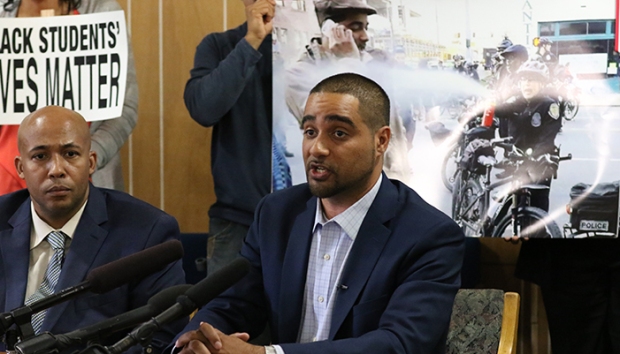
BEM_PressConferencePic
History teacher Jesse Hagopian talks about his $100,000 settlement with the City of Seattle after being pepper-sprayed by a police officer last year. Hagopian is using the proceeds from the settlement to fund youth activists and community-based organizations. Staff Photo/Chris B. Bennett.
By Chris B. Bennett
The Seattle Medium
Jesse Hagopian, a community activist and history teacher at Garfield High School, recently reached a $100,000 settlement with the City of Seattle for an incident in which he was pepper-sprayed, without provocation, by a Seattle Police officer after he gave a speech at a community rally on Martin Luther King, Jr. Day in 2015.
At the time of the incident, Hagopian was on the phone with his mother– arranging plans for a ride to his two-year-old son’s birthday party — when Seattle police officer Sandra Delafuente assaulted him with pepper-spray.
“That day was deeply painful, and not only because of the burning in my ears, nostrils, and swollen eyes,” said Hagopian. “What hurt the most was the fear that I brought to my two sons who were deeply troubled watching me writhe in pain and pour milk on face to try to sooth the burning.”
The pepper-spray assault was caught on video and garnered millions of views online and was the subject of national and international news stories. As a result of the video, Hagopian was able to show that the incident was unwarranted.
“It is deeply disappointing that we are in this place again that we see how protestors and peaceful marchers are treated by the Seattle Police Department,” said Attorney James Bible, whose law firm represented Hogapin in his claim against the City. “I think the question that should be posed by many is what would happen if there, in fact, was no video in this particular case. We’d be stuck with nothing but the narrative of law enforcement and what we know now is that the narrative of the law enforcement rarely, if ever, matches the video that we’re able to capture and gather on occasion.”
Hagopian, to his credit, has turned the incident into an opportunity to support people who are making a difference in the Seattle area, as he is providing money from the settlement to support the work of groups and individuals to improve the plight of people of color.
At a press conference held Monday at the NAACP office, Hagopian announced the establishment of his Black Education Matters Scholarship for student activist. Hagopian presented three high school students – Marcelas Owens, Ifrah abshir and Ahlaam Ibraahim – with $1,000 to use in order to continue their work in the community.
Marcelas Owens has been on the recognized for her work both locally and nationally on healthcare and transgender issues.
Ahlaam Ibraahim hosts an annual Islamophobic event to educate people who may be afraid of Muslim people due to media bias. In addition, she also uses social media to address bad things Teacher Uses Settlement Proceeds To Fund Activists, Organizations | I AM AN EDUCATOR:


CURMUDGUCATION: Eli Broad's Bloodless Coup

CURMUDGUCATION: Eli Broad's Bloodless Coup:
Eli Broad's Bloodless Coup
I don't think there's ever been anything like it.


Well, maybe Teapot Dome, kind of. Back in the early 1920s, the feds had special oil reserves set aside for the Navy. One was near Teapot Dome in Wyoming, and during the administration of Warren G. Harding, some folks engineered the oil reserves at Teapot Dome being handed off to the department of the interior. But since Secretary Albert Bacon Fall had been fully bought by Sinclair Oil, he quickly and quietly turned over what was supposed to be a public national resource to a private company in a secret-ish no-bid process that let the oil go for so little money that it could hardly be called selling it.

Imagine. There was a time when that sort of thing, with public officials bought and corrupted by private interests giving away public resources, was actually shocking.

But now it's 2016, and if Eli Broad wants to just go ahead and take over a public school system, he can just go ahead and do it in plain sight.

This, of course, is not new. Broad long ago decided that education would be better run by people with a business background, not an education one, and so he set up Broad Academy, a-- school? program? thingy?-- that finds the Right People, puts them through some edu-business training, and declares that they are fit to be superintendents because Eli Broad says they are. It is an amazing piece of ballsiness, as if I set up an Officer's Training School in my back yard and started issuing certificates declaring my graduates were First Lieutenants in the US Army. Well, it would be like that if I were really, really rich and well-connected and managed to convince the US Army to let my trained "officers" actually take command. But this is the guy who literally wrote the book about how to shut down a public school system and replace it with privately operated charters. 

Broadies have been put in place in districts all around the country. And what we saw in Kansas City, when Broad picked up the phone and told John Covington that he was going to Detroit, is that the 
CURMUDGUCATION: Eli Broad's Bloodless Coup:


Wisconsin Faculty Fighting the Destruction of Public Higher Education

Wisconsin Faculty Fighting the Destruction of Public Higher Education:

Wisconsin Faculty Fighting the Destruction of Public Higher Education

Scott_Walker_HigherEd_Cuts
A faculty vote of “no-confidence” is the nuclear option on campus— the “delete your account” of academia. It says publicly, loudly, and collectively that professors no longer believe their president or other leaders can give students what they need.
This spring, an unprecedented wave of thousands of faculty on University of Wisconsin (UW) campuses, plus the 13 two-year UW System Colleges, have voted no-confidence in UW System President Ray Cross and Board of Regents. Fed up with devastating state budget cuts, attacks on tenure and shared governance, and also what they see as the systematic demolition of one of the world’s finest public universities for political purposes, they have said enough is enough.
“By voting no confidence, we protest the intentional destruction of our internationally recognized university system,” UW-Milwaukee professor Rachel Ida Buff told the Milwaukee Journal Sentinel.
In Milwaukee, the largest meeting of  UWM faculty in decades or possibly ever—nearly 300 people—voted unanimously in May. Their vote was preceded by the initial action at UW-Madison, the system’s flagship university, and also UW-River Falls and UW-La Crosse, and then quickly followed by similar censures on other campuses. “This resolution is an expression of frustration…over what has happened to public higher education [here] over the past year, 18 months, whatever,” said Mitch Freymiller, University of Wisconsin-Eau Claire Senate chair, to Wisconsin Public Radio.
Meanwhile, key UW faculty members have thrown up their hands at Wisconsin Gov. Scott Walker—the architect of these university “reforms”—and quit UW altogether. “At my new university in another state, I will have stronger tenure protections than I now have here. I will earn about 50 percent more than my current salary for the Wisconsin Faculty Fighting the Destruction of Public Higher Education:


Orlando - Network For Public Education

Orlando - Network For Public Education:

Orlando
NPE Orlando Home Featured


 The Network for Public Education joins the BATs in expressing our deep sorrow for those killed in Orlando and urge educators to fight for LGBT inclusion and tolerance in our schools.

Click HERE to read the statement.

The Sacramento city voters have spoken - Opinions

Sacramento News & Review - The Sacramento city voters have spoken - Greenlight - Opinions - June 16, 2016:

The Sacramento city voters have spoken

The Sacramento Metropolitan Chamber of Commerce and city council should listen
Jeff vonKaenel is the president, CEO and majority owner of the News & Review newspapers in Sacramento, Chico and Reno.


The Sacramento city voters have spoken. Darrell Steinberg will be our new mayor, and city council members Allen Warren, Steve Hansen, Eric Guerra and Larry Carr all will be returning.

None of the city council races were seriously contested. No one even ran against Guerra. Despite a long list of mayoral candidates including Tony “The Tiger” Lopez and fighting single mom Councilwoman Angelique Ashby, Steinberg won in a landslide, capturing 59 percent of vote.

While the Sacramento council will be the same, it will be a whole new ballgame with Steinberg replacing disgraced Mayor Kevin Johnson. While reasonable people can agree or disagree about the arena or the strong-mayor initiative, anyone who has listened to the police-recorded transcript of Johnson talking with Phoenix teenager Mandi Koba will probably agree that a 10-foot pole should be kept between him and their underage daughter. And it appears there are numerous other women who wish a similar pole had been placed between them and Mr. Johnson.

Now that we have a new mayor, the new mayor and council should appoint the new city manager. In a puzzling and petty move, Johnson led an effort to replace City Manager Sacramento News & Review - The Sacramento city voters have spoken - Greenlight - Opinions - June 16, 2016:

Teacher Unions Are ‘Bargaining for the Common Good’

Teacher Unions Are ‘Bargaining for the Common Good’:

Teacher Unions Are ‘Bargaining for the Common Good’

Unions across the country are expanding their focus to the broader community.

AP Photo/Elaine Thompson
Teachers at West Seattle Elementary School begin walking a picket line Wednesday morning, September 9, 2015, in Seattle after last-minute negotiations over wages and other issues failed to avert a strike in Washington state's largest school district. 

This week, the Los Angeles school board voted to approve a new bargaining agreement with UTLA, the city’s teachers union. Local community organizations—like Los Angeles Alliance for a New Economy, Alliance of Californians for Community Empowerment, InnerCity Struggle, and the Advancement Project—hailed the “groundbreaking” agreement for directing more resources towards students in high-needs schools. Some specific items UTLA bargained for included hiring a Pupil Services and Attendance counselor for high-poverty high schools, and hiring a new teacher for the 55 most needy elementary schools in order to reduce class size. Union members voted overwhelmingly in support of this new contract a week earlier.
“We commend UTLA’s innovative leadership in leveraging its bargaining power to deliver real and impactful investments for low income communities of color,” said John Kim, the Advancement Project’s executive director, in a statement.
UTLA’s president, Alex Caputo-Pearl, said in an interview that his union sees collective bargaining as an important tool available to fight for equity and justice. “A lot of people consider teacher union contract negotiations to be about narrower issues like salaries, benefits, and work rules—and all of those are important and we deal with those—but we’re using these agreements to expand what the union goes to the table for.” Caputo-Pearl says UTLA can ultimately be a vehicle to push for collaborative policy alongside community organizations. “We’re bargaining for the common good,” he declared.
This idea of “bargaining for the common good”—and working in partnership with local allies—is not a new idea for labor unions, but its potential has never been fully realized, and past efforts have not gone deep enough. One major obstacle has been that labor law tries to limit unions to bargaining just over issues of wages and benefits.
“Unions have been significantly hobbled by the legal regime, and a lack of imagination to challenge it,” says Stephen Lerner, a longtime labor organizer.
But now, partly because of the historic action the Chicago Teachers Union took in 2012, when its members went on strike not just for themselves, but also for increased public services for the broader community, more and more unions have started to reconsider their fundamental roles and responsibilities. By expanding their bargaining demands beyond wages and benefits, unions are recognizing that they can more fully support, and engage their community partners—and get those community groups to support them in return.
“I think there’s a growing feeling that if you operate within the confines of the law, you restrict the things that potentially give you power,” says Lerner. “We have to be willing to go beyond what the law allows.”
In 2014, leaders from public sector unions and community organizations gathered Teacher Unions Are ‘Bargaining for the Common Good’:

Were Common Core’s ELA Standards written by charlatans? Sure seems so.  | NewBostonPost

Were Common Core’s ELA Standards written by charlatans? Sure seems so.  | NewBostonPost:

Were Common Core’s ELA Standards written by charlatans? Sure seems so. 


To bypass statutes forbidding the federal government to develop national standards, two private organizations—the National Governors Association (NGA) and the Council of Chief State School Officers (CCSSO)—in coordination with Achieve, Inc., a private organization established by the NGA and business officials in 1996, agreed to develop Common Core’s standards. Expenses for managing the project were defrayed by the Bill and Melinda Gates Foundation, another private organization. In the absence of information from all these private organizations, it seems that Achieve, Inc. and the Gates Foundation selected most of the key personnel to write the standards. We do not know why.
The “lead” writers for the grade-level English language arts (ELA) standards, David Coleman and Susan Pimentel, had never taught reading or English in K-12 or at the college level. Neither has a doctorate in language or literature. Neither had ever published serious work on K-12 curriculum and instruction. Neither had produced literary scholarship or research in education. In 2010, they were virtually unknown to the entire field of English and reading educators and higher education faculty in rhetoric, speech, composition, and literary study. The absence of relevant professional and academic credentials in the “chief architects” of Common Core’s ELA standards helps to explain their major flaws, including:
1.  Most of Common Core’s college-readiness and grade-level reading standards are content-free skills. For example, one “anchor” standard is: “Analyze how and why individuals, events, and ideas develop and interact over the course of a text.” The grades 11/12 standard “clarifying” this anchor standard is: “Analyze a complex set of ideas or sequence of events and explain how specific individuals, ideas, or events interact and develop over the course of the text.” This so-called standard is really a free-floating skill because it can be applied to “The Three Little Pigs” or to Moby-Dick.
Why does this matter? It matters because skill training in the absence of significant literary/historical content doesn’t prepare kids for college, career, or critical thinking.
2.  Common Core’s ELA standards stress writing more than reading at every grade level. Every experienced teacher knows the foundation for good writing is good reading. Students need to spend far more time in and outside of school reading in order to improve reading and writing in every subject. Common Core’s lead writers got it exactly backwards.
3.  Common Core’s writing standards are inappropriate at many grade levels. Most elementary children have little understanding of what “claims,” “relevant evidence,” and academic “arguments” are. How did this get by the hundreds of state department of education reviewers?
4.  Common Core expects English teachers to spend at least half of their reading instructional time at every grade level on informational texts. Common Core lists 10 reading standards for informational texts and 9 standards for literary texts at every grade level, reducing literary study in the English class, in effect, to less than 50 percent. However, English teachers are not trained, either by Were Common Core’s ELA Standards written by charlatans? Sure seems so.  | NewBostonPost:


Charter Schools Break the Rules and Don't Seem to Care

Charter Schools Break the Rules and Don't Seem to Care:
Charter Schools Break the Rules and Don’t Seem to Care


Charters schools, when first proposed in the late 1980s, were envisioned as a way for public school systems to experiment with educational options. Some still play this role. However over the last two decades charter schools have largely evolved into a way to make money from public dollars, either through for-profit charter school corporations or for well-paid CEOs of supposedly not-for profit charter school networks.
Thanks to big pushes by the Bill and Melinda Gates, Walton Family, and Broad foundations, California now has over 1,200 charters schools enrolling about seven percent of the state’s students. That includes about sixteen percent of the students in Los Angles and twenty-five percent in Oakland. The number keeps growing even though there is no proof that charters perform better than regular public schools. Three recent stories about Charter Schools and the school deform movement should make readers ask, “Is this what they mean by school reform?”
Alliance College-Ready Public Schools (Alliance), the largest charter school chain operating in Los Angles, California faces an investigation for using public funds to while trying to defeat a teacher-led union drive at its schools. A special committee of the California Legislature ordered the state auditor to investigate Alliance and the California Charter Schools Association (CCSA). The charter chain, which serves 11,000 students in 27 taxpayer-funded but privately operated schools, has received hundreds of millions of dollars in public funds. The committee wants to know how much public money was diverted into the fight against teachers who wanted to unionize and how CCSA acquired contact information for students and their families that they used in the anti-union campaign. The anti-union campaign reportedly included illegal surveillance of union activists, interference with meetings, phone calls to parents attacking teachers involved in the campaign, blocking teacher emails, and retaliation against organizers. State Senator Tony Mendoza (D), who initiated the move against Alliance charged, “The purpose of those funds is to educate children inside the classroom — not to intimidate teachers and parents.”
Teachers organizing the union drive at Alliance filed legal complaints with the California Public Employment Relations Board (PERB). Following a review of the charges, PERB attorneys filed four unfair labor practice complaints against Alliance and Los Angeles County Judge James Chalfont issued two restraining orders against the anti-union activities.
Groups associated with the California Charter Schools Association (CCSA) are pouring money into legislative campaigns trying to elect a pro-charter majorityCharter Schools Break the Rules and Don't Seem to Care:


Wednesday, June 15, 2016

CURMUDGUCATION: Houston Slams VAM (Plus: All About SAS)

CURMUDGUCATION: Houston Slams VAM (Plus: All About SAS):

Houston Slams VAM (Plus: All About SAS)


As a Pennsylvanian teacher, I am paying particular attention to the news from Houston, where VAM just suffered another well-deserved loss. I'll get to that in a second, but let me set the stage and tell you a little story of how we arrived here.

Houston and Reformsters 

The Houston Independent School District has always been out in front of education reformsterism. It was Houston where Superintendent Rod Paige performed the "Texas Miracle" of  raising test scores even for non-wealthy, non-white students. The Texas Miracle became part of the justification for the test-driven baloney of No Child Left Behind, and Rod Paige was whisked to Washington to employ his miracle-inducing powers as George Bush's Secretary of Education.

Only, there was no Texas Miracle. Houston was not an example of how test-centered accountability could create excellence; instead, it was an example of Campbell's Law, of how using bad measure as proxy for a complex social behavior just leads to increasing corruption (aka gaming, spinning and cheating) of that measure. Houston schools had pushed low-scoring students out the door, or held them back a year and then leapfrogged them over the testing grade.

Fast forward a few years, and we find HISD signing on with SAS to use their nifty Value-Added instrument called EVAAS.

The SAS Story 

SAS has been in the analytics for a while ("Giving you the power to know since 1976"). FounderJames H. Goodnight was born in 1943 in North Carolina. He earned a Masters in statistics; that combined with some programming background landed him a job with a company that built 
CURMUDGUCATION: Houston Slams VAM (Plus: All About SAS):

L.A. education reform group names board, signals shift from charter-school-only focus - LA Times

L.A. education reform group names board, signals shift from charter-school-only focus - LA Times:

L.A. education reform group names board, signals shift from charter-school-only focus

Controversial group that began with the mission of rapidly expanding charter schools in Los Angeles has named its board of directors, come out with a plan and publicly defined its mission as supporting new, successful public schools of any kind.
The board for Great Public Schools Now mostly includes faces and groups that are familiar in the education reform wars of L.A., including representatives from the Eli and Edythe Broad Foundation and the Walton Family Foundation.
The chair of the nonprofit is retired banker Bill Siart, the only board member who had been previously announced. In 1997, Siart vied to become superintendent of L.A. Unified, losing out to insider Ruben Zacarias. Later, Siart founded ExED, a company that provides specialized office services to charter schools.
Nearly all the other board members are widely regarded as pro-charter, even though their backgrounds are diverse.
Charters are independently operated, free public schools that are exempt from some rules that govern traditional campuses. Most are nonunion.
Siart said he hopes L.A. Unified will work with the nonprofit to create superior schools.
“They have some very good schools — some magnet schools and traditional schools — that are performing well for kids,” he said, then added, “and they have other schools that don’t,” even after repeated turnaround efforts.
“A lot of turnarounds don’t turn around,” Siart said. “We need to see demonstrated success, not hope.”
The group’s glossy, 16-page plan identifies 10 low-income, low-achievement neighborhoods as areas of focus. Clustered in the east San Fernando Valley and south and east of downtown, they include Boyle Heights, Pacoima and South Gate. 
Although the plan is short on specifics, the group plans to announce its first grants L.A. education reform group names board, signals shift from charter-school-only focus - LA Times:

Tevlin: Plot twists in case of Minneapolis drama teacher's arrest - StarTribune.com

Tevlin: Plot twists in case of Minneapolis drama teacher's arrest - StarTribune.com:

Tevlin: Plot twists in case of Minneapolis drama teacher's arrest

Crystal Spring, a Washburn High School drama teacher, was arrested in May by Minneapolis police after she stopped to witness an altercation and was facing firing until Tuesday.
itemprop

It’s a plot you might see in a student theater production: A young white high school drama teacher on the way home from a long day stops to witness the arrest of a black man. Police tell her to move along; this is not your business.
The teacher, Crystal Spring, whose students perform self-written plays on social justice issues, continues to monitor the arrest to make sure the man’s rights are not violated. Police arrest the teacher for obstruction and disorderly conduct. The witnesses against her are three black employees of a fast-food restaurant, where the call to report the man originated.
While in the squad car, handcuffed next to the man she sought to protect, the man predicts the teacher would be let go because she is white. Instead, she is jailed, later placed on administrative leave and faced a likely firing.
Until Tuesday afternoon, when in advance of a planned rally at a school board meeting, Michael Thomas, Minneapolis Public Schools interim superintendent, issued the following statement:
“Crystal Spring has been removed from administrative leave and will be receiving an apology from all of us. It is imperative to be thorough when recommending the termination of an employee, and due diligence was not followed in this case. We will review our termination processes and are committed to making all necessary changes to prevent this from happening in the future.”
“It’s kind of a tragic comedy here,” said Jordan Kushner, Spring’s attorney.
Spring, a Washburn High School drama teacher and creator of the school’s lauded Black Box Theatre program, was arrested May 19 by police in south Minneapolis after she stopped to witness the altercation. Police say Spring ignored orders to move away, ran in the streets and yelled at officers. She spent the night in jail.
The Minneapolis Public Schools administration is normally about as nimble and fleet-footed as a team of oxen, but this time Steven Barrett, executive director of HR operations at MPS, quickly took the police report as gospel. In a letter, Barrett said the district was moving to fire Spring “ … due to concerns relating to conduct unbecoming a teacher.”
The letter continued: “You did not know the circumstances of why the police were taking someone into custody. Yet you determined that repeatedly confronting the police officers, and shouting accusations about the officers to potential witnesses to the police investigation, was necessary.”
Except Kushner said that didn’t happen. He said Spring twice obeyed orders to move and was only exercising her right to observe an incident between police and a citizen.
The Minneapolis school board was set to abruptly determine Spring’s fate at Tuesday’s board meeting, but an uprising of support from students and parents caused it to take the issue off the agenda and instead put Spring on Tevlin: Plot twists in case of Minneapolis drama teacher's arrest - StarTribune.com:


CURMUDGUCATION: PA: School Funding Emerges from Time Warp

CURMUDGUCATION: PA: School Funding Emerges from Time Warp:

PA: School Funding Emerges from Time Warp


Pennsylvania now has a formula for distributing education dollars to school districts.

You will notice that I didn't say "new formula." That's because, contrary to what rational human beings might assume, Pennsylvania hasn't had a formula for decades. Well, that's not exactly true. The formula has been Y times some-percent-usually-less-than-two of Y, with Y equalling "whatever you got last year." And this process, called "hold harmless" in PA, has been in place since around 1991. We fiddled with it a bit from 2008-2010, but it's only sort of an oversimplification to say that the foundation of our funding system has been 1991 enrollment figures.


That means if your enrollment has been increasing, your state funding has not increased to match it. Of course, it also means if enrollment has been dropping, your state funding hasn't dropped with it.

And it needs to be noted that since Pennsylvania ranks 44th in the percentage of state funding for public ed (36% overall), state funding is not critical for all districts. Districts that are able simply make up that difference locally. Districts that are not able just become increasingly poor and financially distressed. On top of that, add a mismanaged pension system that now has huge balloon payments come due, a charter reimbursement system that rips the guts out of public school funding, and an unregulated charter system that lets those charter claws reach the guts of even small rural districts. Also, a few years ago we totally used that stimulus money to replace the regular education budget funds, which meant that the end of stimulus funds left a huge hole in school funding. Oh, and last year when we couldn't settle a budget for nine months (ten, really, by the time we were done with the details)-- that didn't exactly help, either. Fun fact: back in 1971, the state was providing about 54% of public school funding. We've been in free fall ever since.

The effect is that the 36% figure is grossly misleading. A poor district like Reading gets 72% of its funding from the state; a rich district like New Hope-Solebury gets about 15%. That's not because Reading is getting so much more state money; that's because Reading is only able to kick in a small amount of local money.

The effect is also that we have major school finance crises in PA. This is how you get a district where teachers work for free or a district that considers closing down all its high schools or a district that is handed over to a bunch of political appointees to run. 

At any rate, Harrisburg has now developed a formula. It came up with the formula by surveying eighty public school districts and fourteen charters (because "Disproportionate Representation of and Care for Charters" is our middle name), then running the data through a bunch of politicians. It 
CURMUDGUCATION: PA: School Funding Emerges from Time Warp:

Stop Treating Public Schools as Society’s Whipping Boy | gadflyonthewallblog

Stop Treating Public Schools as Society’s Whipping Boy | gadflyonthewallblog:

Stop Treating Public Schools as Society’s Whipping Boy

The United States is no stranger to stupidity and ignorance.
A significant portion of the population doesn’t know basic science facts like that the Earth revolves around the sun.
We only learn history and geography by going to war or drone striking countries usually  filled with brown people.
And when it comes to basic math and English, just read the poorly spelled placards at our political conventions calling for more trickle down economics.
Heck! We’re the country that elected C-student George W. Bush President!
Twice!
And lest you think that was a fluke, Donald Trump, a xenophobic reality TV star with zero political experience, is the presumptive Republican candidate for the same office RIGHT NOW!
Yet whenever so-called intelligent people bring up these and countless other examples of American idiocy, they invariably simplify the blame.
We’re a country of more than 320 million people made up of various cultures, nationalities, ideologies, economic brackets and living in a wide range of geographic areas and circumstances. Yet we think the cause of our national ignorance somehow isn’t complex and multifaceted.
No. That would be too much for us to understand. Instead, we take the easy way out and put the blame squarely in one solitary place – public schools.
It’s always the school’s fault. That and those lazy, complacent teachers.


Republican Detroit Plan Invests Too Little, Fails to Regulate Out-of-Control Charter Sector | janresseger

Republican Detroit Plan Invests Too Little, Fails to Regulate Out-of-Control Charter Sector | janresseger:
Republican Detroit Plan Invests Too Little, Fails to Regulate Out-of-Control Charter Sector


To consider the Detroit Schools “rescue” plan passed by both houses of Michigan’s legislature last week and sent to Governor Rick Snyder for his signature, one can benefit from a review of some background:
  • Michigan is among the 22 states in which the governor and both houses of the legislature are dominated by Republican majorities.
  • According to Gary Miron in a 2013 report for the National Education Policy Center, Michigan is unique among the states in the number of charter schools managed by for-profit Education Management Organizations: “Michigan stands out as an anomaly with 79% of its charter schools operated by for-profit EMOs and another 10 of its charter schools operated by nonprofit EMOs.”
  • Even Robin Lake, of the pro-charter Center on Reinventing Public Education, expressed dismay after a trip to Detroit back in 2014: “Whose job is it to fix the problems facing parents in Detroit?  Our interviews with leaders in the city suggest that no one knows the answer.  It is not the state, which defers oversight to local education agencies and charter authorizers.  It is not DPS (Detroit Public Schools), which views charters as a threat to its survival.  It is not charter school authorizers, who are only responsible for ensuring that the schools they sponsor comply with the state’s charter-school law.  It is not the mayor, who thus far sees education as beyond his purview.  And it is not the schools themselves, which only want to fill their seats and serve the children they enroll.  No one in Detroit is responsible for ensuring that all neighborhoods and students have high-quality options or that parents have the information and resources they need to choose a school.  ‘It’s a free-for-all,’ one observer said. ‘We have all these crummy schools around, and nobody can figure out how to get quality back under control….’”
It seemed there was agreement in Michigan’s legislature about the need for some regulation of an out-of-control charter school sector, and the state senate had included in its plan a Detroit Education Commission whose purpose was to oversee the authorization and placement of charter schools in Detroit to ensure, for example, that schools remain available for children in all neighborhoods.  The Washington Post‘s Emma Brown explains why a Detroit Education Commission had been included in the Senate’s plan:  “Currently, charter schools can open with the approval of any one of a number of independent authorizers, such as universities, and there is little coordinated planning about which schools should be allowed to open and where they will be located.  Many Detroiters and state Democrats believe that any school rescue Republican Detroit Plan Invests Too Little, Fails to Regulate Out-of-Control Charter Sector | janresseger: