Latest News and Comment from Education

Tuesday, June 14, 2016

Charter School Industry “invests” more than $9 million in Connecticut lobbying - Wait What?

Charter School Industry “invests” more than $9 million in Connecticut lobbying - Wait What?:

Charter School Industry “invests” more than $9 million in Connecticut lobbying

Since taking office in January 2011, Governor Dannel Malloy has been able to count on the consistent and lucrative support of the charter school industry and their pro-charter school, pro-Common Core, pro-Common Core testing and anti-teacher corporate education reform allies.
In addition to being one of Malloy’s largest sources of campaign cash during his 2014 re-election campaign, the owners and operators of Connecticut’s charter schools, along with the corporate elite who support Malloy’s “education reform” initiatives have dumped more than $9 million into the lobbying effort to support Malloy’s agenda to undermine public education in Connecticut.
This lobbing frenzy makes the corporate education reform effort the most expensive lobbying campaign in Connecticut history.
Funneling money through a variety of different organizations and front groups, the charter school advocates have been able “transform” public education in Connecticut by promoting Malloy’s plans to divert hundreds of millions of dollars in scarce public funds to privately owned and operated charter schools.
While Malloy and the Democratic controlled General Assembly are instituting unprecedented cuts to public schools, thanks to the  “reformers” lobbying effort, more than $110 million in public dollars will be handed over to charter schools this year alone.
In addition, these groups have spent their millions pushing the Common Core and Common Core testing scheme, a program designed to label a vast number of Connecticut’s children, teachers and schools as failures.
The following chart highlights the Step Right Up, Buy Public Policy organizations that have lobbied on behalf of Malloy’s charter school and anti-public education agenda.
OrganizationLobbying Expenses
A Better Connecticut (ConnCAN front group) $2.3 million
ConnCAN $1.9 million
Families for Excellent Schools $1.8 million
GNEPSA (StudentsFirst/Michelle Rhee) $891,000
CT Council for Education Reform $349,000
Students for Education Reform $16,000
Achievement First $422,000
NE Charter School Network/Charter School Network $132,000
Bronx Charter School$35,000
CT Business & Industry Assoc. (CBIA) >$1.2 million
TOTAL$9 Million+
This past legislative session, these charter school and education reform entities spent in excess of $500,000 successfully persuading legislators to cut their own district’s public Charter School Industry “invests” more than $9 million in Connecticut lobbying - Wait What?:
Image result for big education ape malloy

BATs and Save our Schools Coalition for Action Statement on Orlando and LGBTQ Community Support Badass Teachers Association

Badass Teachers Association:

BATs and Save our Schools Coalition for Action Statement on Orlando and LGBTQ Community Support


Our thoughts are with the families and friends of the victims, as well as all members of the LGBTQ community and their allies. The echo of these shots have been heard across the country and around the world. It is a sound that will not soon be forgotten.


The recent tragedy in Orlando, Florida has highlighted the deprivation of tolerance that still exists in our society. The intersectionality of education with our societal issues is one that can not be ignored as we call upon fellow educators to recognize and embrace our role in shaping future generations towards creating an inclusive space that will be safe and free of oppression.


To provide an inclusive, safe environment in which all students can learn, it is imperative that the rights of members of the LGBTQ community be recognized and protected at all levels, student, educator, or school staff professional. As bullying initiatives have highlighted in recent years, safety is the number one right of all within a school. However, in spite of these efforts, members of the LGBTQ community are still being intimidated and harassed.


To strive for an environment that is inclusive for all students, we urge all educators to:
  • Include activities and lessons that teach and promote tolerance.
  • Work to make school bullying policies include language that specifically protects gender nonconforming students.
  • Create/build/support a GSA club at school.
  • Offer students the support they need to make their preferred gender identity known. Use their preferred pronoun and name while also respecting their privacy rights and possible need for confidentiality.
  • Advocate for diversity training for all members of the staff and administration.
  • Work to make sure all after school activities and events are inclusive.
  • Advocate for the designation of gender neutral restrooms.


To strive for an environment that is inclusive for all staff, we urge all educators to:Badass Teachers Association:

CURMUDGUCATION: TeachLivE: Robot School in the Uncanny Valley

CURMUDGUCATION: TeachLivE: Robot School in the Uncanny Valley:

TeachLivE: Robot School in the Uncanny Valley


A few days ago, I quoted Thomas Kane's bizarre observation about teacher training:

Surgeons start on cadavers, not on live patients.

I observed that it would be hard for teachers to start working with cadavers, but a couple of regular commenters reminded me that, in fact, there are teachers out there working on not-exactly-live students. Ladies and gentlemen, it's TeachLivE


This particular example comes from Pace University School of Education (a reasonably reputableschool), but TeachLivE is actually a product of the University of Central Florida. TeachLivE bills itself as " a mixed-reality teaching environment supporting teacher practice in classroom management, pedagogy and content" and I have to take my hat off to the word "mixed-reality" because it seems so useful when discussing education reform.

But UCF was creating this Classroom of the Living Dead all the way back in 2008. Today they boast a presence in 85 different programs.

How does it work, exactly? Well, EdSurge actually did a review of the program, and that yields a few interesting details (though the undated review is from 2013 when TeachLivE was in 37 
CURMUDGUCATION: TeachLivE: Robot School in the Uncanny Valley:


New Insights on Teachers' Ed-Tech Ambitions, Abilities Revealed in Survey - Market Brief

New Insights on Teachers' Ed-Tech Ambitions, Abilities Revealed in Survey - Market Brief:

New Insights on Teachers’ Ed-Tech Ambitions, Abilities Revealed in Survey

How teachers use technology
Many companies trying to find a market in K-12 schools face a question that fills them with anxiety, if not outright dread: How much technology can teachers handle?
That question can prove critical to whether an ed-tech provider will succeed or fail.
If technology is seamless and easy for educators to manage, it can clear the path for a digital provider. If it overwhelms them, the odds for companies’ get much longer, right out of the gate.
new survey conducted by the Education Week Research Center offers ed-tech providers insight on how educators think about technology and its uses in classrooms. The results will probably prove both encouraging and dismaying to companies.
First, the uplifting news: A majority of K-12 educators responding to the survey, published in this year’s special report Technology Counts, see themselves as willing to take chances on classroom technology. Twenty-four percent describe themselves as risk-takers, and 47 percent see themselves as early-adopters when it comes to using technology.
That’s a finding that contrasts with some of the stereotypes of educators–that they’re instinctively resistant to trying out new digital tools.
Many teachers also see themselves as important decisionmakers when it comes to  what technology ends up getting usedNew Insights on Teachers' Ed-Tech Ambitions, Abilities Revealed in Survey - Market Brief:

Langston League Aims To Form New Coalition Of Black Male Scholars From Creative Writing To Technology

Langston League Aims To Form New Coalition Of Black Male Scholars From Creative Writing To Technology:

Langston League Aims To Form New Coalition Of Black Male Scholars From Creative Writing To Technology


 On the steps of Langston Hughes’ abandoned Harlem-based home grew a new idea that will change the course of a young black man’s future. Erica Buddington, an educator and scholar from New York, sat on those steps of the famed poet’s home everyday for lunch, alone, with her thoughts on how to make kids love to learn again. One day while enjoying her afternoon meal, an unnamed caretaker of Hughes’ 127th and 5th Avenue property interrupted her routine. After noticing Buddington’s daily pattern for quite some time, he asked her if she’d like to see inside of the historic building, which hasn’t been opened for years. She swiftly obliged, not knowing that her curiosity would act as a catalyst in fufilling her dreams. As she marveled at the decoration and inner structure of Hughes’ abode, an image began to project in her mind with every step she took.

“I don’t know how or why this began to happen in my mind, but I just started seeing little boys running around with notebooks and doing creative writing with letterman jackets,” the Hampton University graduate said. “As I walked out, I called my friend and I told her about the experience. I said, ‘I can’t wait until I can start a school that’s like a league of little Langstons.’ And she said, ‘You should call it the Langston League.’”
With a central focus on educating black and brown boys in the fields of creative writing to technology over the course of six weeks (July 5-August 5), Langston League presents an updated curriculum that helps kids learn at their own pace and on subjects that actually interest them. With outlets that’ll analyze lyrics from hip-hop’s more pensive artists like J. Cole, to how the genre correlates to movements within the country like the Black Lives Matter organization, Langston League marries “cultural relevancy” to real-life topics without neglecting the National Common Core standards that aide in preparation for state testing.
Under the theme “Renaissance & Revolution,” young scholars will also sharpen their comprehension and analytical skills through historic passages from Martin Luther King Jr. and other activists/artists, receive a course on how to use and eventually master Photoshop, Illustrator and Final Cut Pro, and to critically dissect lyrics from today’s top rappers that’ll probably make Genius take their crowdsourcing talents to the classroom.
“It’s very rare that you walk into an organization that has a National Common Core background, an educative background and who understands the different learning styles in the classroom, and also is able to build a bridge with the cultural relevancy because they Langston League Aims To Form New Coalition Of Black Male Scholars From Creative Writing To Technology:

Charter battle pits Democrats against Baker, each other

Charter battle pits Democrats against Baker, each other:

Charter battle pits Democrats against Baker, each other

BOSTON — Gov. Charlie Baker's name was absent from the lips of nearly all but one speaker at the state Democratic Party’s convention two weeks ago, and that speaker was state AFL-CIO president Steve Tolman.
Tolman connected Baker to well-heeled financial interests that, he said, are behind efforts to increase the number of charter schools in the commonwealth. At face value, the tweak makes sense, as Baker has planted his flag in support of a measure to raise the cap on charter schools ahead of its appearance on November's ballot.
Story Continued Below
“The money behind this charter school campaign is from the same donors who finance the Republican Governors Association, Chris Christie, Scott Walker, and Charlie Baker,” Tolman told the 2,500 Democrats in Lowell.
Many hoisted yellow signs reading “Save Our Public Schools" during the speech.
“They are corporate Wall Street billionaires and conservative think tanks who also support right wing campaigns all over the country," he said. "They are here in Massachusetts and they want to convince people that they have Massachusetts students’ best interest in mind in their quest to lift the cap on charter schools.”
After the convention, the pro-charter Democrats for Education Reform fired back in a statement.
“Some speakers at today's State Democratic Party Convention defied the party platform, President Barack Obama, and the majority of Democratic voters who consistently voice support for expanding charter schools in areas where more school options are needed,” said state director Liam Kerr. “Muddling the Party's long history on school reform may be good for slogans on signs and stickers, but it's bad for kids.”
Tolman reemphasized his comments on Friday, telling POLITICO Massachusetts that organizations like Democrats for Education Reform have been "made up to look like we’ve been split apart as Democrats.”
That led Kerr to fire back: "Is Steve Tolman unable or just unwilling to read the Democratic Party platform?"
If Democrats are trying to find weak points in Baker’s armor, assailing his position on the charter school cap is a risky place to start. Because, as the backbiting after the state convention showed, the party is not exactly of one mind on charter schools.
Polling shows a divide between union-based opposition to charters and support for the schools from low-income and minority communities. In a poll commissioned by the pro-charter Massachusetts Charter Public Schools Association in April, about 75 percent of Boston-based respondents said they would support the November ballot question to lift the charter cap. Support was especially strong


Read more: http://www.politico.com/states/massachusetts/story/2016/06/effort-to-battle-baker-on-charters-pits-democrats-against-each-other-102750#ixzz4BZ8pEK4I 
Follow us: @politico on Twitter | Politico on Facebook


The K-12 Records of Some Mentioned as Hillary Clinton Running Mates - Politics K-12 - Education Week

The K-12 Records of Some Mentioned as Hillary Clinton Running Mates - Politics K-12 - Education Week:

The K-12 Records of Some Mentioned as Hillary Clinton Running Mates


Unlike with presumptive GOP presidential nominee Donald Trump, it's pretty easy to find wonky details about Hillary Clinton's K-12 resume. So it will be relatively easy work to see, once the Democrats' presumptive nominee decides on a vice presidential running mate, where and how that running mate's record on education matches up with the former secretary of state's.
Who are some of the names being bandied about as potential Clinton running mates, and what have they done with respect to public schools? You can find out below.

JuliĆ”n Castro

Castro is U.S. Secretary of Housing and Urban Development. He joined forces with Secretary of Education John B. King Jr. and Secretary of Transportation Anthony Foxx earlier this month to write a "Dear Colleague" letter encouraging leaders in education, housing and transportation to take action to promote socioeconomic and racial diversity
DNC_CastroBlog-thumb-400x267-3949.jpg
For education leaders, the letter said, such action could include drawing school attendance boundaries that focus on providing "equal access to high-quality schools" and increasing the diversity of the surrounding communities; considering "safe passage" to schools when developing school sites; and work with transportation and housing communities to share more information about schools.
But in the education community, Castro is perhaps best known for his work to expand prekindergarten while mayor of San Antonio through an increase in the sales tax, which city voters approved in 2012. Castro spoke about the importance of education in a speech earlier the same year at the Democratic National Convention. Not every school district serving San Antonio students eagerly leaped aboard the pre-K expansion plan, however.
Castro also strove to increase access to higher education through his "Cafe College" initiative, which aims to provide various resources to help San Antonio students enter higher education.

Elizabeth Warren

One of the key words to know about Warren when it comes to education is "oversight." Elected to the U.S. Senate in 2012, the Massachusetts Democrat serves on the Senate Elizabeth-Warren-blog.jpgeducation committee and has contributed to the debate surrounding the Every Student Succeeds Act, which Warren voted for back in December. Specifically, she's been a major advocate for robust federal oversight when it comes to accountability and funding.
She and other Democratic senators wrote a letter making this case to the Education Department earlier this year.
But she might be best known for her strong views on student loans for higher education. For example, she's been highly critical of how the department has approached student-loan fraud, specifically with respect to Navient, the company formerly known as Sallie Mae that holds millions of loans to students.
And she wants the government to be a tougher watchdog when it comes to monitoring for-profit colleges

Bernie Sanders

Would Clinton pick her main rival for the Democratic nomination? If so, she'd be selecting a senator who, like Warren, serves on the Senate education committee. In fact, if Clinton wins the presidency and a few other pieces fall into place (not least of which would be Democrats taking control of the Senate), there's a chance Sanders could end up being the committee chairman.
In any event, you can find out some key elements of Sanders' education record from our 2016 election guideBernie-Sanders-blog.jpg
Like Warren, he voted for ESSA, but he gave a thumbs-down to the No Child Left Behind Act back in 2001. On the campaign trail, he proposed making public colleges and universities tuition-free. He's been a skeptic of standardized tests. And he's highlighted inequities in K-12 education—noting, for example, that black students are more likely to be suspended or taught by inexperienced teachers than their peers. 
Back in April, Jane Sanders, the candidate's wife, gave an interview to The Nation magazine in which she emphasized the need for teachers to be paid more, and the support they both shared for teachers' unions. 

Tim Kaine

Thumbnail image for Tim-Kaine-blog.jpgThe Democratic senator from Virginia is a big fan of career and technical education. In fact, he introduced an amendment making career and technical eduation a core subject
to the Senate's reauthorization of the Elementary and Secondary Education Act—ultimately, that provision became part of ESSA.
He also praised ESSA for including a provision allowing states to use Title IV money to teach students about safe relationships.
Kaine also served as the Democratic governor of Virginia from 2006 to 2010. Not long before he left office, he ordered a review of minority students' participation in gifted academic programs. At the time, Kaine expressed concern that they were underrepresented in such programs.
"[I]t's critical we assess any disproportionate barriers to enrollment so we can ensure students of all backgrounds have the opportunity to participate," Kaine said in a statement in 2009.

Sherrod Brown

The Ohio Democratic senator doesn't have a particularly lengthy K-12 resume compared to others. In 2012, he was part of a group of Democratic and Republican lawmakers who urgedSherrod-Brown-blog.jpg President Barack Obama's administration not to forget about rural schools when awarding money from the Race to the Top competitive-grant program.
In 2011, Brown co-authored the "Ready for Schools Act" with former North Carolina Democratic Sen. Kay Hagan. The idea of the bill was "preparing elementary schools to educate all children."
"A 'ready' elementary school has school principals and educators who understand and use developmentally appropriate curricula, assessments, and teaching practices; involves and engages families; and works cooperatively with the early-childhood programs for younger children to create a positive transition into the early grades of school," a press release announcing the bill stated.
Among other things, the bill aimed to create a "positive environment" for children and classroom experiences that catered to the needs of each individual student. It also sought appropriate assignments for teachers and principals based on their degrees and certification.
Photos: San Antonio Mayor JuliĆ”n Castro addresses the Democratic National Convention in Charlotte, N.C., in 2012. J. Scott Applewhite/AP; Sen. Elizabeth Warren, D-Ma.,  questions witnesses in April during a Senate Specials Committee on Aging. Manuel Balce Ceneta/AP-File; Sen. Bernie Sanders, I-Vt., smiles as he is asked about running for president during a news conference on Capitol Hill in Washington last year. Carolyn Kaster/AP; Sen. Sherrod Brown, D-Ohio speaks to members of the media after his meeting in April with Judge Merrick Garland, President Barack Obama's choice to replace Antonin Scalia on the Supreme Court. Sait Serkan Gurbuz/AP-File; Sen. Tim Kaine, D-Va., gives a 'thumbs-up' as he takes his seat at the head table for the National Prayer Breakfast in Washington in February. Pablo Martinez Monsivais/AP-File.The K-12 Records of Some Mentioned as Hillary Clinton Running Mates - Politics K-12 - Education Week:

Don't miss another Politics K-12 post. Sign up here to get news alerts in your email inbox.
Follow us on Twitter at @PoliticsK12.


Springfield School Board urges parents to OK student ‘opt-out’ of state Smarter Balanced tests | Local | Eugene, Oregon

Springfield School Board urges parents to OK student ‘opt-out’ of state Smarter Balanced tests | Local | Eugene, Oregon:

Springfield School Board urges parents to OK student ‘opt-out’ of state Smarter Balanced tests

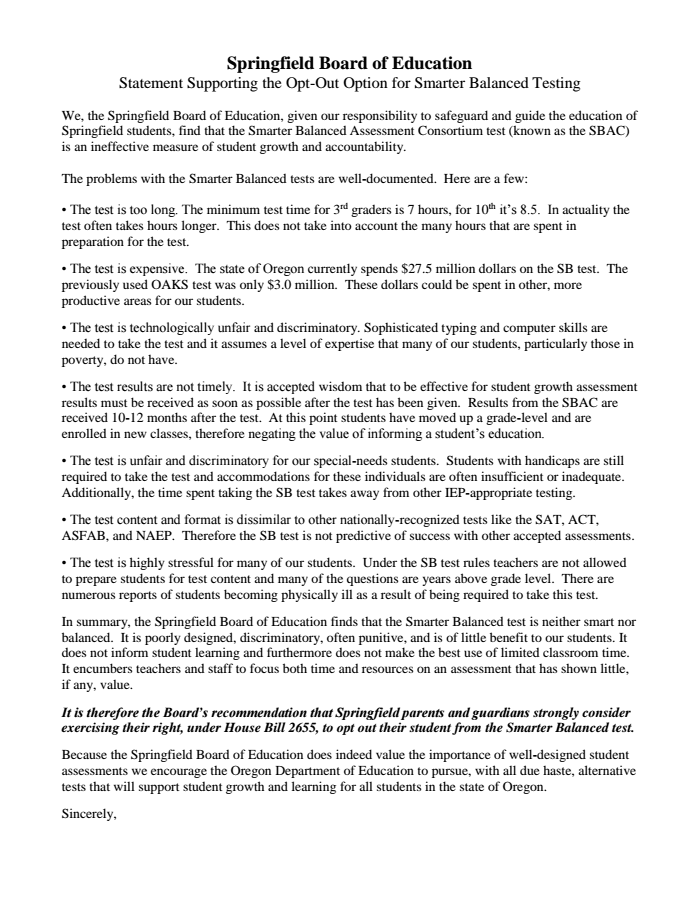
The Springfield School Board on Monday evening urged parents and guardians to allow their children to opt out of the state-mandated Smarter Balanced Assessment Consortium test.
Calling the test an “ineffective measure of student growth and accountability,” the five-member board unanimously approved a statement recommending that parents and guardians “strongly consider exercising their right” under state law to “opt out their student from the Smarter Balanced test.”
The test is designed to assess students’ knowledge of the Common Core standards, a set of learning goals for each grade level that most states, including Oregon, have adopted.
Board Chairman Jonathan Light said the test was never created for students’ benefit.
“It was designed to compare districts and teachers, not to help students learn,” he said. “As a board member, I just don’t feel like it’s OK to encourage our students to participate in something that doesn’t help them in any way.”
Light said he wants other districts to follow suit.
“I really feel like school boards have to stand up for what’s right for their students,” Light said. “We all need to come together and say something. If we could all do it, it would make a huge difference.”
A state law passed last June gives parents the right to opt out their children for at least the next six school years. It requires schools to notify parents and students of that right at the start of each year.
Before last June, parents could opt their children out of the test only because of a disability or religious reasons.
The board’s statement contains a list of what it described as problems with the Smarter Balanced test. They include the test Springfield School Board urges parents to OK student ‘opt-out’ of state Smarter Balanced tests | Local | Eugene, Oregon:


 DOCUMENT

TEXT
Zoom
p. 1
«
Page 1 of  1
»
Springfield-School-Board-Opt-Out-Statement
Contributed by: Chris Frisella, The Register-Guard