Latest News and Comment from Education

Sunday, May 29, 2016

Mike Klonsky's SmallTalk Blog: Congrats to the MORE/New Action Caucus

Mike Klonsky's SmallTalk Blog: Congrats to the MORE/New Action Caucus:

Congrats to the MORE/New Action Caucus

A SmallTalk Salute goes out to the social-justice activists within the York teachers union who have been fighting for years to democratize the UFT. Latest election results show the MORE/New Actioncandidates swept the seven high school teacher seats on the union’s Executive Board.

“Teachers now have a real voice in the United Federation of Teachers, and that voice will not be silenced." says new board member, teacher Arthur Goldstein.


The Caucus' goals are clear and progressive:
  • Enforce Our Contract and Organize for a Just Contract in 2018 
  • Defend Public Education
  • Combat Systemic School Segregation and Racism
  • Support Opt Out and Oppose Common Core, Danielson Evaluations and High Stakes Testing
  • Make the UFT a Democratic,Transparent and Accountable Union
The vote totals show big gains for the activists over previous elections in a union, the largest Mike Klonsky's SmallTalk Blog: Congrats to the MORE/New Action Caucus:

Saturday, May 28, 2016

Gates Foundation Blames Teachers For Common Core Failures, Vows To Fight On - Truth Kings

Gates Foundation Blames Teachers For Common Core Failures, Vows To Fight On - Truth Kings:

Gates Foundation Blames Teachers For Common Core Failures, Vows To Fight On


The Bill and Melinda Gates Foundation donated tens of millions of dollars in the creation and mandatory implementation of Common Core educational standards.
But over the past 5 plus years, massive efforts, which the Gates Foundation terms as “grass roots efforts,” have plagued the fledgling government program. Most parents and teachers despise it. But to Bill and Melinda Gates, that’s not going to stop them from further pushing it. In fact, according to a new article published on Daily Caller citing an announced released by the Foundation, they intend to ramp up their efforts over the matter.
“Unfortunately, our foundation underestimated the level of resources and support required for our public education systems to be well-equipped to implement [Common Core,]” Desmond-Hellman says in the letter. “We missed an early opportunity to sufficiently engage educators – particularly teachers – but also parents and communities so that the benefits of the standards could take flight from the beginning.”
The Foundation clearly admits that the program is a failure, but in the same breath, they announce intentions of pushing the program more. They blame “grassroots campaigns,” as a way to marginalize the massive efforts against Common Core, many of which have led to absolute reversals in state policies.
The Gates Foundation is now dedicating a deep financial resources to facilitating the development of Common Core-aligned curricula and instructional materials to teacher who were previously reluctant to accept the standard. This is a disturbing approach. No where in the announcement does it mention meeting with teachers or parents. It instead moves to a plan to Gates Foundation Blames Teachers For Common Core Failures, Vows To Fight On - Truth Kings:


Turtle Learning: MAY IS ASIAN AMERICAN HERITAGE APPRECIATION MONTH - LARRY ITLIONG AND PHILIP VERA CRUZ - IT STARTED IN ASPARAGUS FIELDS

Turtle Learning: MAY IS ASIAN AMERICAN HERITAGE APPRECIATION MONTH - LARRY ITLIONG AND PHILIP VERA CRUZ - IT STARTED IN ASPARAGUS FIELDS:

MAY IS ASIAN AMERICAN HERITAGE APPRECIATION MONTH - LARRY ITLIONG AND PHILIP VERA CRUZ - IT STARTED IN ASPARAGUS FIELDS


  I have always wanted to write inspiring little books for middle school students (to give them hope in this tough world) about unknown heroes of our country and our world.  The first I thought about was Charlotta Bass, the first African American woman to own her own newspaper. Then I thought about Philip Veracruz and Larry Itliong - unknown heroes of people who work in the fields.  It was Filipinos who organized first in the fields.  Who knew?  Did you?
   [ONE OBSERVATION AFTER ALL MY READING ABOUT LARRY ITLIONG AND PHILIP VERA CRUZ - THERE ARE EVIDENCES OF A DIVISION BETWEEN THEM, AND PEOPLE TAKING SIDES ABOUT THE TRUE STORY. SOME FEEL LARRY ITLIONG DID ALL THE WORK, SOME PHILIP VERA CRUZ.  I think one was the fighter and the other the philosopher.  I HOPE THAT PEOPLE WILL SEE THIS AS A STORY OF TWO HEROES WHO WERE INSTRUMENTAL IN WINNING RIGHTS FOR PEOPLE IN THE FIELDS.]
   Philip Vera Cruz was a Vice President of the Farmworkers union, the highest ranking Filipino in the union.  My friend Kent Wong:  "Although I was active with the United Farm Workers, Philip had to teach me that it was the Filipino Americans who first organized a farmworkers union in the San Joaquin Valley. He proudly shared the story of how the Filipino Americans launched the historic Delano grape strike. He explained that the establishment of the United Farm Workers Union was a merger between two separate unions, one representing Filipino American workers and the other with a primarily Mexican membership."


   Larry Itliong -  "An unsung hero, hard around the edges, Larry Itliong never bragged about his work and always put the cause above everything else, says San Francisco State University history professor Dawn Mabalon. Before he moved north to Delano, Itliong spent the spring of 1965 fighting alongside grape workers in the Coachella Valley to raise their hourly pay from a meager $1.10 to $1.40. "  The workers - but only the Filipino workers - went out on strike. Latino workers kept on working and the owners took advantage of this.  "Itliong, along with other Filipino leaders like Philip Vera Cruz, Pete Velasco, and Andy Imutan, realized that if they were going to win the strike, they could not proceed alone. Together, with Itliong as regional director, these men led and organized the Agricultural Workers Organizing Committee (AWOC). They reached out to Chavez and Huerta, who had formed the mostly-Chicano National Farm Workers Association (NFWA)."


   "After several years of unsuccessful picketing, the movement called for a national boycott of table grapes. It was at this point that Delano attracted international 
Turtle Learning: MAY IS ASIAN AMERICAN HERITAGE APPRECIATION MONTH - LARRY ITLIONG AND PHILIP VERA CRUZ - IT STARTED IN ASPARAGUS FIELDS:

CURMUDGUCATION: ESSA: Regulatory Baloney

CURMUDGUCATION: ESSA: Regulatory Baloney:
ESSA: Regulatory Baloney


Legislators write and pass laws. But the laws they create are sometimes vague and sometimes contradictory, a weird quilt of intentions and tissue. So it falls to other parts of the government to turn laws into regulations. And that's where we are now with the Every Student Succeeds Act (the latest version of the Big Bunch O'Federal Education Laws, the sequel to No Child Left Behind).

Many eyes (not all eyes, unfortunately-- it would be great if all eyes were paying attention, but eyes have been diverted by the dumpster fires that are our primary season, among other things) have been watching John King and the Department of Education, because it's at this stage of the game that King gets to "interpret" ESSA to suit his own ideas of what it ought to say.

This is what Arne Duncan was talking about last December when he told Politico that the USED lawyers were smarter than the members of Congress, and this is what Lamar Alexander has been talking about in his scorching calls to war against John King's USED. Alexander has been crystal clear-- if King tries to turn himself into America's School Superintendent, Alexander is going to come after the secretary with every garden tool in the Congressional woodshed.

The USED is trumpeting its move away from the narrow definition of school achievement based on a single Big Standardized Test, with a new "holistic" approach that allows for four factors:

the proposed regulations build on the statutory language by ensuring the use of multiple measures of school success based on academic outcomes, student progress, and school quality, reinforcing that 
CURMUDGUCATION: ESSA: Regulatory Baloney:

20th Street Elementary parents protest potential change in school management - LA Times

20th Street Elementary parents protest potential change in school management - LA Times:

20th Street Elementary parents protest potential change in school management


 Not every parent at 20th Street Elementary School wants new leadership for their kids’ school. 

About 30 mothers gathered in front of the Los Angeles campus Friday morning with signs in English and Spanish, protesting a potential agreement that would give some control of school operations to the Partnership for Los Angeles Schools, a nonprofit that specializes in improving low-performing schools, often in under-resourced neighborhoods.
A different group of parents threatened to sue the Los Angeles Unified School District in March, after the district rejected a petition that 58% of parents at the school signed to invoke the state's “parent trigger law,” which allows parents to take control of low-performing schools.  
To avoid a lawsuit, the district may agree to allow the partnership to take over school operations, which L.A. School Report first reported on Wednesday. The partnership runs 17 schools in L.A. Unified, including Roosevelt High School and Dolores Huerta Elementary.
Unlike an independent charter school, though, partnership schools are still Los Angeles Unified district schools, meaning the teachers are unionized and the district receives state money allocated for each student. Beyond the district resources, the partnership says it can fundraise for programs, enhancements and technology. 
“We are not as bad as other schools that have gotten this partnership,”said Karla Vilchis, a 20th Street parent with one daughter in transitional kindergarten and another who finished fifth grade at the school in 2013. Changes, she said, should come from “working together instead of attacking each other."20th Street Elementary parents protest potential change in school management - LA Times:

The Theft of the Tradition of Music in OUR Public Schools

The Theft of the Tradition of Music in OUR Public Schools:

The Theft of the Tradition of Music in OUR Public Schools

Elegant shot of a violin
How do politicians eliminate a school orchestra in this country and still sleep at night? How does a community adjust to such a theft when they tried so hard to keep the music playing?
The Loss of the Lafayette Elementary School String Orchestra
In 2013, Mayor Rahm Emanuel and Chicago politicians put an end to the popular Lafayette Elementary School String Orchestra. Little thought seemed to be given about the orchestra they shut down along with the school. Lafayette also had a respected program for students with autism.
As we end this school year, it is time for us as a city to begin the work of creating a deep and lasting change in our schools to ensure a better life for our children, a better Chicago workforce and a better future for our city. Everyone has a shared responsibility to ensure students have a safe and smooth transition to their new school in the fall and are on a path to a bright future. We owe them our very best.
A better life with no music? Who was she kidding? Not the community which came together to protest with a school sit-in.
Lafayette is in the Humboldt Park neighborhood. Ninety percent of the children there The Theft of the Tradition of Music in OUR Public Schools:


Page vs Screen: Technology in the Classroom isn’t Hobson’s Choice! (Dorian Love) | Larry Cuban on School Reform and Classroom Practice

Page vs Screen: Technology in the Classroom isn’t Hobson’s Choice! (Dorian Love) | Larry Cuban on School Reform and Classroom Practice:

Page vs Screen: Technology in the Classroom isn’t Hobson’s Choice! (Dorian Love)


Dorian Love teaches ICT and 8th grade English at Roedean, a private school in Johannesburg, South Africa. He says at his blog: “I am passionate about educational technology and critical thinking.” He wrote this post on May 12, 2016.
It seems to me that in any class I teach there are three distinct groups of students: one consisting of enthusiastic adopters of digital technologies; a second group of those comfortable enough with the technology, but rather less gung-ho about it; and finally a group which struggles with anything to do with a device, and is all at sea. I gave my grade 8 English class a writing task the other day, and told them they could submit digitally, or on paper. A large group reached immediately for their devices, but some put their tablets to one side, and took out pen and paper. Likewise, when it comes to reading, most of my students have a textbook, but a few use eBooks downloaded on their kindles.
This is, I believe, exactly what it should be. The introduction of technology in the classroom should never amount to an all or nothing affair. The research on the effects of reading and writing on page and screen is by no means conclusive, and with something as important as reading and writing, I believe we should be very cautious about any change. On the other hand so much reading and writing is done on devices these days, we would be ill-advised to ignore it. My common sense, unscientific intuition is that both page and screen form important modalities for literacy practices, and that we need to cultivate good habits in both.

RI Commissioner Wagner Stands Firm on Automated Scoring for the PARCC | Parent Coalition for Student Privacy

RI Commissioner Wagner Stands Firm on Automated Scoring for the PARCC | Parent Coalition for Student Privacy:

RI COMMISSIONER WAGNER STANDS FIRM ON AUTOMATED SCORING FOR THE PARCC

Parent Coalition for Student Privacy

Sheila Resseger, a retired teacher, education activist, and  a member of the PCSP, wrote the post below.  Her new blog is at https://resseger.wordpress.com/
On  April 5,  the Parent Coalition for Student Privacy, FairTest, Network for Public Education and other parent and teacher activistssent a letter to the State Education Commissioners from the PARCC and SBAC states.  I signed the letter as well.  We demanded these Commissioners inform us as to whether they plan to use computer scoring for the writing sections of these exams.
As research has shown, computers are unable to distinguish nonsense from coherent prose, and instead grade mostly on an essay’s length and how much arcane vocabulary is used.  Employing computers to score the Common Core exams is completely contrary to the supposed goal of these standards: to encourage critical thinking and writing skills; an article about this issue is here.
Later that day, Rhode Island Commissioner Ken Wagner met with our Council on Elementary and Secondary Education.  He was enthusiastic about the prospect of computer scoring of the PARCC constructed responses, and made many astonishing claims, including that research showed that computers scored writing as well or better than expert trained teachers.
(You can see the video, watch from about 11 minutes.)
He also falsely claimed that the SAT and Graduate Record Exam (GRE) used computer scoring. Yet on the GRE, every writing sample is scored by both a computer and a human being, and the College Board uses only human scorers on the SAT.
On May 17, 2016 the RI Board of Education met. Only two people commented during the Open Forum part of the meeting. A retired Providence high school English teacher spoke about her disapproval of the proposed revised regulations for high school graduation, with several diplomas offered of differing value, which would be discriminatory.  I spoke to critique Wagner’s enthusiastic endorsement of automated scoring of the PARCC constructed responses:
At the April 5, 2016 meeting of the RI Council on Elementary and Secondary Education, Commissioner Wagner was enthusiastic about the prospect of computer scoring of the RI Commissioner Wagner Stands Firm on Automated Scoring for the PARCC | Parent Coalition for Student Privacy:

English Language Proficiency Assessments for California (ELPAC) - Testing (CA Dept of Education)

English Language Proficiency Assessments for California (ELPAC) - Testing (CA Dept of Education):

English Language Proficiency Assessments for California (ELPAC)

The ELPAC will be the successor to the California English Language Development Test (CELDT). The CELDT is the current required state test for English language proficiency that must be given to students whose primary language is other than English.


 State and federal law require that local educational agencies administer a state test of English language proficiency (ELP) to eligible students in kindergarten through grade twelve. The California Department of Education (CDE) is transitioning from the CELDT to the ELPAC as the state ELP assessment by 2018. The ELPAC will be aligned with the 2012 California English Language Development Standards. It will be comprised of two separate ELP assessments: one for the initial identification of students as English learners (ELs), and a second for the annual summative assessment to measure a student’s progress in learning English and to identify the student's level of ELP.

The links and information below were developed for educators and others who are directly involved with the ELPAC.

ELPAC Updates

To receive updates on the latest information about the ELPAC, join the CDE’s ELPAC e-mail list by sending a blank e-mail to: subscribe-elpac@mlist.cde.ca.gov.

Educator Opportunities

There are four educator opportunities available during the 2016–17 school year. See the online application at the link below for more specific details. All meetings will be held in Sacramento.
Meeting
(Location: Sacramento)
DateTime
Commitment
Application
Deadline
Speaking Range Finding
October 2016
3–4 days
July 6, 2016
Speaking Range Finding
April/May 2017
3–4 days
January 6, 2017
Writing Range Finding
May/June 2017
3 days
January 6, 2017
Standard Setting
September/October 2017
4 days
March 10, 2017

The online application can be accessed here: ELPAC Educator Opportunities Application External link opens in new window or tab..

Transition to the ELPAC Information

Comparison Chart – This chart compares the current CELDT to its successor, ELPAC, as the state ELP assessment in 2018.
Transition Timeline – This timeline shows the transition from the CELDT to the ELPAC from 2015–16 to 2018–19.

ELPAC Blueprints

The task types (PDF) in the ELPAC blueprints (PDF) are designed to be aligned with California’s 2012 English Language Development Standards which were developed to correspond to the 2010 California Common Core State Standards. The task types and blueprints were approved and adopted by the State Board of Education on November 4, 2015.

Education Code

The administration of an ELP assessment is required by law. The current state test is the CELDT.

English Language Development Standards

Regulations

Contact the English Language Proficiency Assessments (ELPA) Office at elpac@cde.ca.gov for the most up-to-date information regarding the ELPAC regulations and the rulemaking process.

General Performance Level Descriptors (PLDs)

On January 13, 2016, the State Board of Education (SBE) approved the General Performance Level Descriptors which will be used to guide the development of domain and grade/grade span-specific PLDs in summer 2016. General PLDs (sometimes called policy definitions) provide generic descriptions of student performance level expectations, and are used to guide the development of the specific PLDs.

Contact Information

California Department of Education
Assessment Development and Administration Division
English Language Proficiency Assessments Office
Telephone: 916-319-0784
E-mail: elpac@cde.ca.gov
Questions:   English Language Proficiency Assessments Office | elpac@cde.ca.gov | 916-319-0784
Last Reviewed: Friday, May 27, 2016

Ohio: State Investigates Online Charter Schools: Better Late than Never | Diane Ravitch's blog

Ohio: State Investigates Online Charter Schools: Better Late than Never | Diane Ravitch's blog:

Ohio: State Investigates Online Charter Schools: Better Late than Never


 The Ohio Department of Education under John Kasich has not been known for vigilance when it comes to the virtual charter school industry. However, increased media attention to Ohio’s pockmarked charter sector has caused the state to look into its underperforming and highly profitable virtual charters.


What they discovered was ugly. Inflated enrollments. Lack of evidence that students participate in instruction for the required 5 hours a day. An industry that profits while students fail.
The investigation focused on the Electronic Classroom of Tomorrow (ECOT), owned by one of the state’s major contributors to Republican campaigns. William Lager has received nearly $1 billion in public funds since 2002. The money to pay for a failing online school was taken from Ohio’s public schools.
The New York Times wrote about ECOT a few days ago and pointed out that the online school has the largest proportion of students who fail to graduate of any high school in the nation. Only 20% finish on time.
Actually, it is worse than it appears. Stephen Dyer noted that ECOT accounts for 5% of the graduates in the state, but it accounts for more of the students who fail to graduate from high school than all the state’s districts combined!
This is a failing school! It should be closed.
The state may revise a regulation or two. Don’t expect anything dramatic, like shutting down the state’s lowest performing school, or basing pay on performance. That’s for public schools, not Ponzi schemes that contribute to Kasich and friends.Ohio: State Investigates Online Charter Schools: Better Late than Never | Diane Ravitch's blog:

How To Fix A Graduation Rate Of 1 In 10? Ask The Dropouts : NPR Ed : NPR

How To Fix A Graduation Rate Of 1 In 10? Ask The Dropouts : NPR Ed : NPR:

How To Fix A Graduation Rate Of 1 In 10? Ask The Dropouts

Hands joining graduate jigsaw puzzle pieces

On San Jose State University's lush inner-city campus, students in their graduation gowns pose with their families in front of ivy-covered buildings.

They're the lucky ones.

Just 10 percent of students graduate from this public university in four years. After six years, it's only a bit more than half.

Think about that — of 100 students who enrolled four years ago, only 10 will walk across the stage this year.

That sounds low, but you can find these kind of numbers at lots of universities in the U.S.

What's not typical is how San Jose State is tackling the problem.

Beyond Excuses

Up on the north side of campus, you'll find Marcos Pizarro on the second floor of Clark Hall. At 6 feet 2, he's nearly as tall as his tiny office is wide.

A professor of Mexican-American Studies, Pizarro has been at San Jose State for 17 years.

All that time, he says, he's heard the same explanation about why the graduation rate is so low. It goes like this: "Well, they're not as well prepared, and they have a lot of other commitments."

It's true, he adds, many students here do come from under-performing schools. Pizarro knows because he has taught in those schools.

And a lot of them work full-time jobs — both to pay for college and contribute to their families.

Yet, Pizarro adds, something else is true too: "They're amazing. They're really phenomenal." In class, he says, these students are some of the most engaged, motivated and insightful people he's worked with.

So, why aren't they graduating?

When Pizarro started looking at the data, he found that San Jose State's graduation rate is bad for all students. But for Latinos it's really bad. Just 4.5 percent graduate in four years. African-Americans do only slightly better.

Pizarro couldn't let this go. The more he thought about it, the more he realized he needed to talk to those students. Not the graduates. But the ones who left.

"We don't do exit interviews," Pizarro said. "It's not just us. Nobody does exit interviews with students."

Pizarro and a few colleagues got a grant, and they started calling up hundreds of San Jose State dropouts, with a focus on Latino and African-American students.

'I Was Depressed'

"A lot of times their first response is, 'Oh well, I kinda gave up.' Or, 'I didn'tHow To Fix A Graduation Rate Of 1 In 10? Ask The Dropouts : NPR Ed : NPR:


She Says: It's Time To Disrupt Substitute Teaching - Forbes

She Says: It's Time To Disrupt Substitute Teaching - Forbes:

She Says: It's Time To Disrupt Substitute Teaching

Substitute teaching. Admit it, when you see those words, your mind goes to spitballs, pranks and all sorts of disruption.
Well, social entrepreneur Jill Vialet has a very different type of disruption in mind for substitutes: She wants to disrupt the whole ideaof substitute teaching. She calls it “a big problem hiding in plain sight.” And she wants your help.
“If you described the way we do substitute teaching to an alien, they wouldn’t believe it,” says Vialet, whom Forbes named in 2011 as one of the top 30 leading social entrepreneurs.
A Field With an Image Problem
I heard Vialet speak a few months ago at the Encore.org annual conference in San Francisco, where she conceded that she’s up against a field with a serious image problem.
“Most people have negative memories about substitutes and bad jokes flooding their brain about them,” she said at the time, pitching attendees what has since evolved into Substantial, her new nonprofit initiative “redesigning how we recruit, train and support substitute teachers in order to maximize their time for teaching and learning.”
And, she insists, “we can’t afford to let substitute teaching continue as a bad joke.”
Here’s the enormity of the problem: Ten percent of teachers are substitutes at any given time, schools spend $4 billion a year on subs (1% of the K-12 budget) and school systems across the country face severe shortages of substitute teachers. Roughly 15% of sub openings aren’t being filled.
Who Can Be a Sub
One reason: The job of a substitute as it is today often isn’t highly valued. The pay is typically about $100 a day and to become a substitute, generally speaking, “you just need to have a B.A., pass a standardized test and not have TB or any felonies,” Vialet says. “Then, they send you right into a classroom.”
So what? “If we send people into classrooms unprepared and unsupported or can’t find people to do the jobs, we’re sending a message to kids that we don’t value them,” says Vialet.
But, she wondered, what if subs were brought in to convey their particular expertise and interest to the kids, rather than just assign busywork and wait for the bell to (thankfully) ring? In other words: turn substitute teaching into an She Says: It's Time To Disrupt Substitute Teaching - Forbes:

Friday, May 27, 2016

If NAEP “Proficient” Means “Grade Level Proficiency,” Then America’s Private Schools Are in Trouble | deutsch29

If NAEP “Proficient” Means “Grade Level Proficiency,” Then America’s Private Schools Are in Trouble | deutsch29:

If NAEP “Proficient” Means “Grade Level Proficiency,” Then America’s Private Schools Are in Trouble


Former TV anchor and current, privatizing reform conduit Campbell Brown believes that a student’s achieving the level “proficient” on the National Assessment of Educational Progress (NAEP) equates with that student being “at grade level” or (more precisely, according to her) having achieved “grade level proficiency.”
In a May 16, 2016, Slate interview, Brown said the following:
Two out of three eighth graders in this country cannot read or do math at grade level. We are not preparing our kids for what the future holds.
As she introduces an article written by Carol Burris, Washington Post education writer Valerie Strauss sums up the social media upheaval that ensued over Brown’s equating NAEP “proficient” with being “at grade level”:
Another day, another fight in the education world. This one is worth delving into because it is really not about who said what but about fundamental understandings — and misunderstandings — of standardized testing data and how it drives policy.
This one started when education activist Campbell Brown said that two-thirds of U.S. eighth graders are below grade level in reading and math. Tom Loveless, a former Harvard professor and teacher who researches student achievement, then tweeted that he has never seen data showing that, and asked Brown to explain her sourcing. She said that she was referring to proficiency rates on the National Assessment of Educational Progress.
NAEP, as the test is known, is sometimes referred to as “the nation’s report card” because it is seen as the most consistent measure of U.S. student achievement since the 1990s. It is administered every two years to groups of U.S. students in the fourth and eighth grades, and less frequently to high school students. When Loveless told her that NAEP proficiency scores do not refer to grade level, a social media fight ensued between Campbell and her critics.
In this post, Carol Burris, a former award-winning high school principal who got involved in the Twitter exchange, explains why the substance of this debate matters.
I asked Brown to comment about her statement that two out of three eighth graders cannot read or do math at grade level and why she thinks NAEP proficiency means grade level. She said in an emailed response, which you can see in full below, that “if I were trying to be completely and utterly precise then I would have specified ‘grade-level proficiency,’ instead of ‘grade level’ in the context of NAEP score,” and that “any reasonable person or parent” would understand what she meant.
The achievement level preceding “proficient” is “basic,” and it is “at or above basic” that the bulk of students’ scores tend to fall.
What Brown erroneously proposes is that NAEP “proficient” equals “grade level proficiency” and that not achieving NAEP “proficient”  equals “not at grade-level proficiency.”
If the above were true, then it is not only America’s public schools that one must If NAEP “Proficient” Means “Grade Level Proficiency,” Then America’s Private Schools Are in Trouble | deutsch29:


Will Democrats Sacrifice Public Education for the Sake of Party Unity? - Living in Dialogue

Will Democrats Sacrifice Public Education for the Sake of Party Unity? - Living in Dialogue:

Will Democrats Sacrifice Public Education for the Sake of Party Unity?

By Anthony Cody.
I noticed an interesting phenomenon on some progressive web sites over the past week or two. Even with the California and New Jersey primaries still looming a couple of weeks from now, the focus has shifted to supporting Clinton, and news of Sanders has been put on the back burner. A look at the front page of Crooks and Liars reveals a dozen stories about Trump, and a couple favorable to Clinton, including this breathless report of Bill Clinton “debating” a young Sanders supporter for thirty minutes. But no major stories about Sanders — not even the news of a possible Trump/Sanders debate. This web site has apparently decided that the election will be between Clinton and Trump, and no further coverage of the Sanders campaign is needed.
Politics is a team sport, and some have decided the time has come for the team to unite behind Clinton. So Sanders is not to be mentioned. Instead we focus on the issues both “teams” can all agree to disagree about. Transgender bathrooms. Guns. Gay marriage. Abortion. Voting rights. Immigration reform. Bashing Trump. These are ON the table for debate.
But what other issues are off the table because the Democratic Party “team” does not have a unified stance?
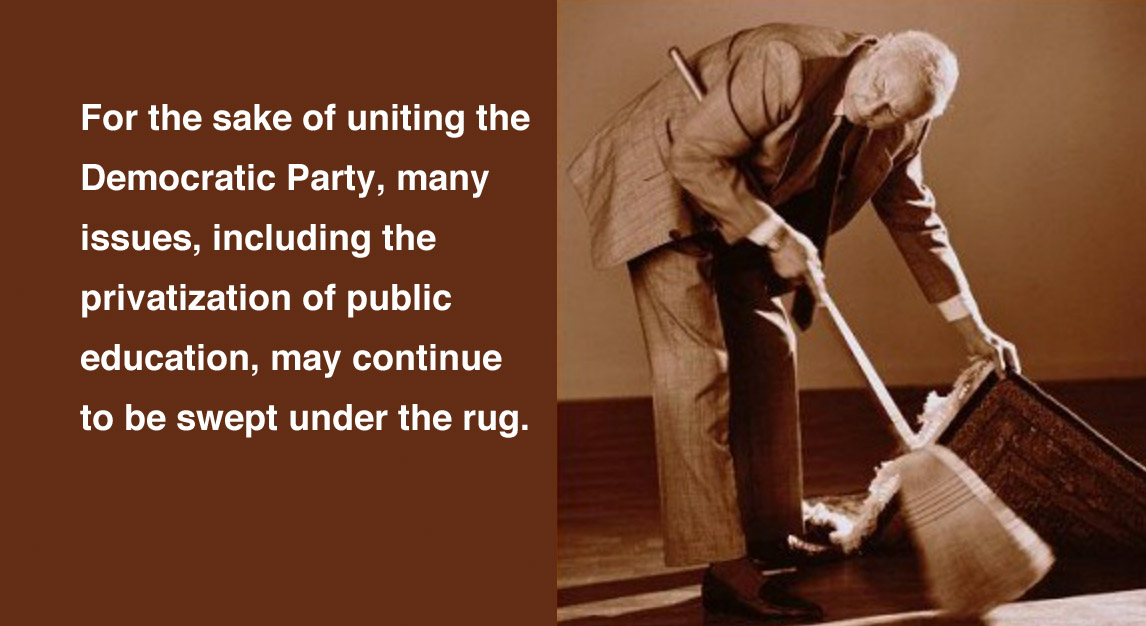
One of the things I have appreciated about the Sanders campaign has been the space it has opened up to question some “progressive” orthodoxies. We have seen moving videos of Berta Caceresmade prior to her tragic assassination, calling out Clinton’s support of a military coup in Honduras. In my view “progressives” should not support military coups in Latin America – but this issue will not be mentioned if Clinton becomes the nominee. We have heard questions raised about uncritical support for Israel – again, this will be off the table. Even the fracking that is destroying groundwater across the country and the world will be swept under the rug.
Of course the hallmark of the Sanders campaign has been his calling out Wall Street financiers and hedge funders, and if we get down to a Clinton/Trump race that will be greatly muted as well. The progressive focus will be on how scared we all should be of a Trump presidency.
This “progressive” team unity has left some other huge issues off the table. As I wrote last year, K-12 education has been largely ignored by progressives – even “bold” ones. Republicans regularly assail public Will Democrats Sacrifice Public Education for the Sake of Party Unity? - Living in Dialogue:


Reformers Now Attack Reformers with the Same Venom They Used on Teachers

Reformers Now Attack Reformers with the Same Venom They Used on Teachers:

Reformers Now Attack Reformers with the Same Venom They Used on Teachers


I’ve enjoyed the last months where I pushed away from the computer when tempted to blog on the education reform dispute of the day and focused on coalition-building in Oklahoma City, as well as big picture analyses such as Thomas Frank’s Listen, Liberal. But the open conflict among reformers prompted by Robert Pondiscio is too valuable to waste.
I’ve communicated with enough reformers to know that their coalition is fraying. They’ve pushed an edu-politics of destruction based on the punitive use of test results in order to keep score in their competition-driven movement. Now, it is obvious that value-added teacher evaluations and their one-size-fits-all micromanaging have failed. Many or most, however, are still committed to high-stakes testing in order to speed up their rushed effort to close schools in mass.
Other corporate reformers seem to believe they can use their (admittedly brilliant) high-dollar public relations campaigns to drive the expansion of charters. They’ve finally realized that parents are preoccupied with what’s best for their own children, not education policy. They are marketing to parents who can’t stop the damage that the extreme proliferation of choice does to children left behind in weakened neighborhood schools, but who ignore test scores and seek safe and orderly schools for their own kids.
(By the way, teachers have been forced to do the same thing. Reform imposed an irresolvable dilemma. We can’t just refuse to commit education malpractice and simply place our education values over the needs of our students to pass primitive high-stakes tests in order to graduate. So, to greater or lesser extents, we give into demands for nonstop remediation and try to minimize the amount of soul-killing, bubble-in malpractice that is required to keep our kids from ending up on the streets without a diploma.)
Being a classroom teacher, I always appreciated the way that my job forced me to make an extra effort to not judge patrons and other stakeholders who have different beliefs about education policy and other issues. Being a liberal in a conservative state, I’ve always sought compromise and incrementalism. And, that explains much of the reason why I feel more comfortable around conservative reformers as opposed to liberal and neo-liberal corporate reformers who demand that we progressives must all be “on the same page” in pushing “transformative” reform.
What I can’t grasp, however, is liberals who assail other liberals because we won’t use the stress of high stakes testing to overcome the stress produced by generational poverty. I still can’t understand civil rights advocates who condemn other civil rights advocates because we oppose school segregation as a means of reversing the legacies of segregation.
Had the technocrats spent more time in the inner city classroom, and in the homes, hospital rooms, the streets and, yes, the funerals of our kids, they’d have known we needed more “disruptive” innovation like we need another gang war. Had they shared the joy of teaching and learning for mastery that builds on the strengths of our kids, they would not have dumped reductionist behaviorism on children. But, because teachers saw things differently, we were condemned as the “status quo,” which accepted “Excuses!,” and renounced “High Expectations!”
School reform has always been as anger-driven as it has been output-driven and market-driven. Even so, Pondiscio’s hate-filled response to his erstwhile allies was shocking. It prompted a reply by Justin Cohen, who I believe has supported egregious policy errors, but who has belatedly acknowledged the nature of the Reformers Now Attack Reformers with the Same Venom They Used on Teachers: