Latest News and Comment from Education

Monday, February 29, 2016

Dr. Jill Stein is the Best 2016 Presidential Candidate, But Can She Win? | gadflyonthewallblog

Dr. Jill Stein is the Best 2016 Presidential Candidate, But Can She Win? | gadflyonthewallblog:

Dr. Jill Stein is the Best 2016 Presidential Candidate, But Can She Win?

GetAttachmentThumbnail
In 2008, I shook Barack Obama’s hand.
Yesterday Dr. Jill Stein gave me a hug.
Eight years ago, I was so inspired by Obama’s campaign speech in my hometown of Pittsburgh that I rushed forward along with the crowd to grab his hand. It was soft but firm with a tinge of moisturizer. Now I look at his incredibly regressive education policies and feel the need to scrub my palm.
This weekend in Philadelphia, I was at the United Opt Out Conference and saw Stein sitting in the audience.
I walked past the Green Party Presidential candidate the first time thinking I must be mistaken. Then her name tag removed all doubt.
“You’re Jill Stein!” I stuttered.
She smiled warmly, stood up and said, “You’re Steven Singer!”
I want to believe she knew who I was, but I was wearing a name tag, too.
We talked for a moment about what most of us were here for – education policy. She Dr. Jill Stein is the Best 2016 Presidential Candidate, But Can She Win? | gadflyonthewallblog:


Parents do What Teachers Can't: Opt Out of Standardized Test


Parents do What Teachers Can't: Opt Out of Standardized Test 


Message From An Anonymous Teacher in New York State

‘Work Hard, Be Hard’ and ‘Work Hard, Be Nice,’ dueling takes on KIPP - The Washington Post

‘Work Hard, Be Hard’ and ‘Work Hard, Be Nice,’ dueling takes on KIPP - The Washington Post:
‘Work Hard, Be Hard’ and ‘Work Hard, Be Nice,’ dueling takes on KIPP


Cambridge College education professor Jim Horn presents his new book, “Work Hard, Be Hard: Journeys Through ‘No Excuses’ Teaching,” as a necessary antidote to my 2009 book, “Work Hard. Be Nice: How Two Inspired Teachers Created the Most Promising Schools in America.”
We are polar opposites on the issue of KIPP, the nation’s largest charter school network, and charters in general. He says, correctly, that he and I “have maintained a prickly relationship over the past ten years by writing from contrasting perspectives about corporate education issues and education reform schools.”
The reasons for our differences are illuminated by the way we handle the same material in our books.
My book describes two young teachers, Mike Feinberg and Dave Levin, who through trial and error and the guidance of a magical Houston elementary school teacher named Harriett Ball found a way to raise the academic achievement of inner city children. It is a story of bottom-up school reform.
Horn offers the opposite, a top-down story in which “venture philanthropists and philanthrocaptitalists through equity bundlers, bond investors, and hedge funds” poured billions of dollars into “charter management organizations.”
For instance, Horn is suspicious of my account of the first major news article in 1994 about the new KIPP program in Houston. It was a 2,799-word story on the front page of the Houston Post. “Mathews offers no details as to how an obscure little program in its first year with forty-seven students was chosen for such coverage,” Horn said. He suggests the rapidly growing national Teach For America program, which Levin and Feinberg were a part of, pulled some strings.
This is puzzling because I explained in detail what produced the Houston Post article. Reporter Susan Bezse Wallace, then 24, had gotten a grant from the national Education Writers Association to do three stories — not about charter schools or TFA, but about male teachers in urban schools. The headline of her KIPP piece was “FEW GOOD MEN.” The other stories in the series were about a male state teacher of the year and a charismatic coach.
Another mystery not explained by me, Horn said, was “how KIPP cofounder, David Levin, who in 1995 was a third-year teacher from TFA without ‘Work Hard, Be Hard’ and ‘Work Hard, Be Nice,’ dueling takes on KIPP - The Washington Post:


Rhodes faces skepticism, defiance as he takes DPS the state’s largest school district

Rhodes faces skepticism, defiance as he takes DPS reins:

Rhodes faces skepticism, defiance as he takes DPS reins

2015 281619679-TDNBrd_11-06-2015_DETROIT_2_A001~~2015~11~05~IMG_Rhodes-03_2_.jpg
teven Rhodes, the retired United States Bankruptcy Judge who presided over the City of Detroit's historic bankruptcy case. Photos taken on Friday, October 23, 2015. (John T. Greilick, The Detroit News)
(Photo: John T. Greilick / Detroit News)


 Retired bankruptcy Judge Steven Rhodes’ appointment Monday as transition manager of Detroit Public Schools’ was greeted with a mix of hope, skepticism and defiance by stakeholders in the state’s largest school district.

Gov. Rick Snyder officially announced Rhodes, who presided over the city of Detroit’s trip through bankruptcy, as the new leader of DPS, which is in danger of running out of money in April.
Although some argue it’s a matter of semantics, Rhodes is not an emergency manager but will handle most, if not all, of the duties previously assigned to Darnell Earley, the emergency manager whose resignation took effect Monday.
Rhodes’ tenure is expected to run through July 1. By that date, the Snyder administration hopes to have won approval from state lawmakers for a $715 million plan to rescue and restructure DPS.
Ivy Bailey, interim president of the Detroit Federation of Teachers, expressed cautious optimism that Rhodes can improve conditions in DPS, which is struggling with millions of dollars in debt, low test scores and poor conditions in many of its school buildings.
“Rhodes has signaled support for local control and a willingness to listen to and work with educators, parents and the community,” she said. “This is in contrast to the approach of past school leaders, which included filing lawsuits against educators, banning health inspectors from hazardous public school buildings, and racking up a school debt of a half-billion dollars with no accountability.”
Teachers cited health and safety problems in some DPS schools, including water damage, rodent infestations and a lack of heating, for triggering a series of sickouts that closed dozens of schools between November and January.
Bailey said the DFT hopes to work with Rhodes but issued a warning.
“We will not stop fighting until school conditions improve, Lansing pays off the debt incurred under the state’s appointed emergency managers, classrooms are adequately resourced and our students get the high-quality education they deserve,” she said.
Percy Bates, a professor of education psychology at the University of Michigan and a critic of emergency management, questioned how much change Rhodes will be able Rhodes faces skepticism, defiance as he takes DPS reins:

The Obama Administration - and the Democratic Party's - War On Teachers - BK Nation

The Obama Administration - and the Democratic Party's - War On Teachers - BK Nation:

The Obama Administration — and the Democratic Party’s — War On Teachers

President Barack Obama shakes hands with Education Arne Duncan in the State Dining Room of the White House in Washington, Friday, Oct. 2, 2015, where the president announced that Duncan will be stepping down in December after 7 years in the Obama administration. Duncan will be returning to Chicago and Obama has appointed senior Education Department official, John King Jr., center, to oversee the Education Department. (AP Photo/Andrew Harnik)
By Mark Naison
The war on public-school teachers — and on public education general — continues to be one of the most disturbing aspects of the Obama administration’s seven-year tenure. With the President’s nomination of John King for the position of Secretary of Education, he reaches a new low.
Appointing Arne Duncan, someone with no teaching experience, as Secretary of Education, Barack Obama set the tone for his administration. Shortly after his election, he offered praise for the mass firing of teachers in Central Falls, Rhode Island, who refused to accept dramatic modifications of their contract to lengthen the school day.
The attack escalated with the unveiling of Race to the Top, which gave huge grants to states that rated teachers on the basis of test scores, closed schools designated as “failing” — again on the basis of test scores — and gave preference to charter schools over public schools. The Department of Education’s enthusiastic support for the Common Core Standards — formulated with little teacher input — and grants to Teach for America set the tone for national education policy.
Secretary Duncan attacked the nation’s public-school teachers as poorly trained, poorly qualified and in dire need of replacement by higher-achieving students from theThe Obama Administration - and the Democratic Party's - War On Teachers - BK Nation:

Phony School Reform Wilts, A New Education Story Takes Root | PopularResistance.Org

Phony School Reform Wilts, A New Education Story Takes Root | PopularResistance.Org:

Phony School Reform Wilts, A New Education Story Takes Root

Screen Shot 2016-02-29 at 3.29.19 PM
For years, our public schools have been burdened by a “reform” narrative that education is “failing,” and that only a regime of standardized testing and charter schools will make administrators and teachers more “accountable.” Politicians and pundits across the political spectrum have adopted this doctrine and now easily slip into the rhetoric that supports it without hesitation.
But recently, the pillars of the “reform” agenda have begun to crumble. The whole notion of a top-down mandate for reform coming from state capitals and Washington, D.C. is being regarded with a new degree of skepticism.
A new narrative is emerging and it’s coming from the ground up—from schools and communities where teachers, parents, and students are remaking the education policy landscape.
Over the next several weeks, the Progressive Education Fellows will be exploring this exciting movement for change in a series of posts at The Progressive and on our social media channels on Facebook and Twitter.
A big part of the progressive vision for education is taking shape in community schools—locally led schools that are taking progressive approaches to education, including restorative justice, culturally responsive teaching, locally based accountability, and social, emotional, and health services that address the whole child.
This way of teaching is a radical departure from doctrinaire, corporate reform. It is anchored in the American belief that every child has the innate ability to learn, that access to education opportunity is an inalienable right, and that it is incumbent on government to provide education opportunities as a common good, free and accessible to all.
What Happened To ‘Reform’?
The break-up of the reform faƧade started with the movement to boycott standardized testing. A mostly parent-led effort using Facebook pages and neighborhood meetings grew into a firestorm of resistance.
As the Associated Press reported in 2015, “This ‘opt-out’ movement remains scattered butPhony School Reform Wilts, A New Education Story Takes Root | PopularResistance.Org: 

Children are more than test scores: It’s time to RISE UP and TURN UP CT BATs and SOSers for Black, Brown and poor children

Children are more than test scores: It’s time to RISE UP and TURN UP CT BATs and SOSers for Black, Brown and poor children:

It’s time to RISE UP and TURN UP CT BATs and SOSers for Black, Brown and poor children


Readers, Dr. Fran Huckabee an Associate Professor from Texas Christian University was a panelist on media messaging at the United Opt Out Conference this past weekend. She spoke about dangerous truths and the contradiction of saying save our schools public schools while at the same time discussing the test and punish culture premeditating those same schools. We had lunch together, and she shared the amazing work she is doing around social justice and education. Trust me she is rising star in this movement to save our public schools. On the 4 hour drive home I kept thinking about the idea of thw dangerous truths of my childhood. There are two that define me, that transform me, two that made me the man, the brother, the husband, the father and the activist I am today. 
I am going to share two truths and one glorious and one dangerous. I am going to ask you click on a link for a 3 and half minute video clip of the man I have become, and ask you to join me in rising up and turning up for equity, for justice, for children. parents, teachers, and our public schools.

My two truths

My first truth is an glorious and easy to share. At the age of eight my grandfather wanted to go to Dr. King's March On Washington. He offered to drive people from Trenton New Jersey to Washington DC. He asked his pastor to say he was looking for company to go to DC. No one would go. He asked at the union hall. No one would go. He asked at the his VFW hall. No one would go. He asked my grandmother. She was afraid there would be trouble. She asked him not to go, but he explained he had to go. Grandma said no, but said you should and need to go. 
She called my mother, and they prayed together about this going to the March On Washington trip. I doubt people today understand that every soul that turned up for the March On Washington has similar stories. I am certain they all face moments where people they thought would go with them said no. My grandfather was 68 years old, and they were worried about his age and driving alone to DC. As Catholics Grandma and Momma prayed the rosary,. They asked the other Rosary 
Children are more than test scores: It’s time to RISE UP and TURN UP CT BATs and SOSers for Black, Brown and poor children:

Los Angeles area teachers stage “sickouts” over pay - World Socialist Web Site

Los Angeles area teachers stage “sickouts” over pay - World Socialist Web Site:

Los Angeles area teachers stage “sickouts” over pay

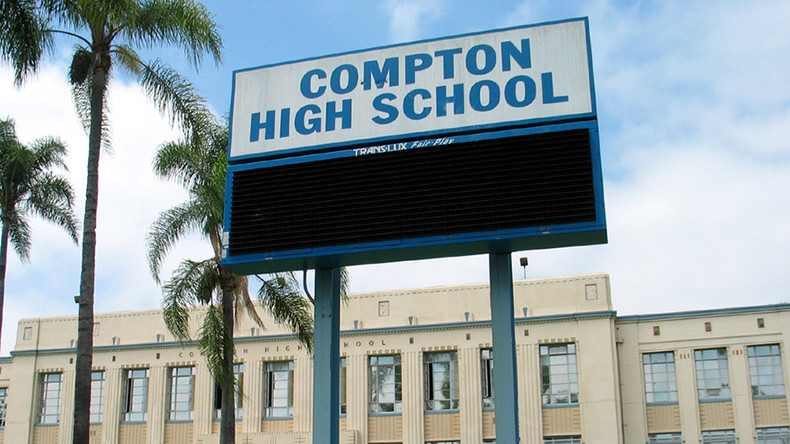
Teachers in the Compton Unified School District (CUSD), south of Los Angeles, stayed out of their classrooms twice last week as part of organized “sickouts” designed to protest low wages and bad working conditions.
On Monday, more than 200 CUSD teachers called out sick, including 44 at Compton High School alone, or nearly 50 percent of faculty currently working at that school. On Friday, ten of the district’s 37 schools were forced to close Friday because of a shortage of teachers.
There is no indication that the Compton Education Association (CEA) called the protests, and there is nothing on the union’s web site about them. It is likely rank-and-file teachers organized the sickouts independently of the union just like educators in Detroit did earlier this year. The district’s 1,200 teachers and other school employees are frustrated over stalled contract talks and angered that the CEA has kept them on the job without a contract since the last one expired in June 2015.
In an effort to regain control of the situation union officials called a rally at district headquarters Tuesday where they tried to identify themselves with the teachers’ grievances. “You need to put money into the classroom, where the students are and that should be the priority,” teachers union President Patrick Sullivan said at the rally.
The central issues in the current negotiations are over salary and medical benefits. The Compton Unified School District is offering teachers an insulting 2 percent salary increase, well below the 3.1 percent increase in the Consumer Price Index, according to the Bureau of Labor Statistics. The CEA has limited its wage demands to 5 percent.
Friday’s action was the fourth sickout organized by Compton teachers in the last three years alone. Last November, more than half of Compton high school teachers called in sick to protest recent school board elections and the passage of local Bond Measure S, meant to modernize schools at the Los Angeles area teachers stage “sickouts” over pay - World Socialist Web Site:


U.S. legislators give Obama’s education pick an astounding pass - The Washington Post

U.S. legislators give Obama’s education pick an astounding pass - The Washington Post:

U.S. legislators give Obama’s education pick an astounding pass


News emanating from the U.S. Senate these days centers on Republican determination not to give even a passing glance to any nomination that President Obama sends to fill the vacancy on the U.S. Supreme Court created by the recent death of Associate Justice Antonin Scalia. What got less attention was the astounding pass the Senate education committee just gave to Obama’s nominee as the new education secretary, John King.
During confirmation hearings late last week before the Senate Health, Education, Labor and Pensions Committee, Acting Education Secretary John King was not asked one single direct question about the tumultuous 3 ½ years he spent as the commissioner of education in New York state. Not by Republicans, and not by Democrats.
Nobody, apparently, was interested enough in asking him to explain the turmoil in New York education during his tenure. What turmoil? As blogger Peter Greene succinctly wrote, “Under King, Common Core implementation was a disaster, teacher evaluation was a disaster, testing was a disaster,massive data gathering was a disaster, and having public meetings to manage public reaction to the other disasters was a disaster.”
King’s program sparked the largest testing opt-out movement in the country, with some 20 percent of all students refusing to take the Common Core standardized tests mandated by the state last spring. New York Gov. Andrew Cuomo (D), who supported the principles of King’s reform, lost faith in his ability to lead the implementation. King left his job abruptly late last year — with some “goodbye and good riddance” messages, including one December 2014 newspaper editorial titled “Commissioner King’s Tone Deaf Legacy” — and was tapped by Arne Duncan, Obama’s long-time education secretary, U.S. legislators give Obama’s education pick an astounding pass - The Washington Post:

Schools Matter: Jay Mathews and KIPP Journalism

Schools Matter: Jay Mathews and KIPP Journalism:

Jay Mathews and KIPP Journalism


 by Jim Horn


Before my book on teaching in KIPP Model schools went on sale yesterday, Jay Mathews and the “No Excuses” charter empire were already at work.  In fact, Jay had already delivered to hisWashington Post editors a two-part response/review to my book.  Part 1 appeared yesterday.

Jay’s dubious assessment of Work Hard, Be Hard… may reassure KIPP’s corporate patrons, venture philanthropists, and the hedge funders that all is well in "No Excuses Land," but his remarks do nothing to shed light on the intent and content of my book, which was conceived and executed with the principal aim of allowing former No Excuses teachers to share their stories with the public. At the same time, I wanted to show that these grueling accounts of life inside "No Excuses" corporate charter schools reflect the realization of a paternalistic social vision and a hard-fisted privatization agenda that jointly constitute two of the greatest threats to democracy in our era.  

Because “No Excuses” charters are key to achieving this corporate-sponsored vision and mission, it is, indeed, important that Jay Mathews go all out to downplay my book and the importance of hearing former KIPP teachers’ shared experiences of life inside KIPP.  For if parents, policymakers, and prospective teachers come to understand the patronizing aims, draconian methods, and unhealthy outcomes of the KIPP Model charter schools, then a major tool of the education privatization and social control agenda could be jeopardized. 

Here is a the first clip from Jay’s Part 1 that requires a response:

I wish the book [Work Hard, Be Hard] were not so one-sided. In the great tradition of American polemics, Horn is entitled to his relentlessly anti-KIPP view. But he never satisfactorily explains how a charter network, if it is as harmful to teachers and children as he says, could attract nearly 70,000 students to 183 campuses in 20 states and the District.

I should first acknowledge my utter failure in this regard, for if there is anything I have learned from my years of sparring with the heavyweight champ of KIPP apologists, it is that there is no way to satisfactorily explain to Jay Mathews, at least, how the KIPP Model could reflect anything other than the spit-shined corporate image that he and the Washington Post editorial board have helped to carefully polish for the past decade. My book, however, explores in some measurable Schools Matter: Jay Mathews and KIPP Journalism:

Shameless Promotion Plus a 20 Percent Discount

Click the image to enlarge.  See promotion code in bottom right.  Thank you.  jh

Vergara v. California Appeal Underway: The Case that Will Yield No Winners | VAMboozled!

Vergara v. California Appeal Underway: The Case that Will Yield No Winners | VAMboozled!:

Vergara v. California Appeal Underway: The Case that Will Yield No Winners

In June of 2014, defendants in “Vergara v. California” in Los Angeles, California lost the case. Plaintiffs included nine public school students (backed by some serious corporate reformer funds as per Students Matter) who challenged five California state statutes that supported the state’s “ironclad [teacher] tenure system.” The prosecution’s argument was that students’ rights to a good education were being violated by teachers’ job protections…protections that were making it too difficult to fire “grossly ineffective” teachers. The prosecution’s suggested replacement to the “old” way of doing this, of course, was to use value-added scores to make “better” decisions about which teachers to fire and whom to keep around, as based on teachers’ causal impacts on students’ “data.”
This week, this case is being appealed, back in Los Angeles (see a recent Education Week article on the appeal here; see also the Students Matter website for daily appeal updates here). This, accordingly, is a very important case to watch, especially as many agree that this case will eventually end up in no lesser than the state’s Supreme Court.
On this note, though, I came across a great article, also in Education Week, this morning, capturing as per the article’s title, the “Five Reasons Vergara Is Still Unwinnable.” I already tweeted this one out, but for those of you not following us on Twitter, I didn’t want you to miss this one.
The author — Charles Taylor Kerchner, Research Professor at Claremont Graduate University — puts the key pieces of the case in context as well as under a fair and appropriate light, more specifically explaining why “this is a case that the plaintiffs can’t Vergara v. California Appeal Underway: The Case that Will Yield No Winners | VAMboozled!:

As protests rise over high-stakes tests, more students likely to opt out

As protests rise over high-stakes tests, more students likely to opt out:

As protests rise over high-stakes tests, more students likely to opt out

MICHAEL BRYANT / STAFF
Yard signs in Lower Merion urge parents to forgo student testing.

Last year, a small, angry band of parents and teachers in the Lower Merion School District took on a big challenge: convincing their neighbors that the intensifying emphasis on high-stakes standardized tests was harming their children's education.

This year's challenge: coming up with enough yard signs so converts to the cause can broadcast their displeasure with the coming Pennsylvania System of School Assessment, or PSSA, tests given in grades three through eight. Their opt-out message - "Our kids & schools are more than a score" - has popped up on curbsides around the affluent Main Line suburb.
Danielle Arnold-Schwartz, a Lower Merion teacher and local chapter leader of the national education activist group Parents Across America, said about 100 yard signs were snapped up for $1 each after a recent Villanova University screening of a documentary critical of high-stakes testing.
"There are people still asking for more," she said, "and it's not fully testing season yet."
The protest signs are a leading indicator that across the region, the parent-led push to opt out of standardized tests - whether the PSSAs, or Pennsylvania's controversial Keystone Exams, or New Jersey's year-old PARCC (Partnership for Assessment of Readiness for College and Careers) - may be nearing a tipping point.
Earlier this month, anti-testing advocates in Pennsylvania won a major victory when Gov. Wolf signed a bill delaying until 2019 the use of the Keystones as a graduation requirement - a two-year stay that local superintendents and schools boards overwhelmingly supported. The tests were to be part of new state standards in Language Arts, Algebra 1, and Biology.
Last year, about 4,500 students in Pennsylvania sat out achievement tests; in New Jersey, the opt-outs numbered 115,000, or 14 percent of the exam-taking pool. Activists predict those figures will spike upward when the next round of tests begins late next month and continues into April. Across the country, an estimated 640,000 opted out last year in the 14 states that reported, according to FairTest: National Center for Fair and Open Testing.
Perhaps more important are the signs that elected officials, from the White House on down, are listening to the swelling criticism that excessive testing, with weeks of preparatory drills, puts undue pressure on students, robs them of classroom time for real learning, and is an unfair measure of teacher and school performance.
In a video posted on Facebook last year, President Obama said too much testing "takes the joy out of teaching and learning." In December, he signed the Every Student Succeeds Act (ESSA), replacing the contentious No Child Left Behind law. ESSA gives states more leeway in how test results are used to evaluate students and teachers - although, like No Child, it allows for federal funds to be withheld from schools where participation falls under 95 percent.
Even Larry Wittig, Pennsylvania Board of Education chairman and a vocal supporter
Read more at http://www.philly.com/philly/education/20160228_As_protests_rise_over_high-stakes_tests__more_students_likely_to_opt_out.html#xrG3AuSTGZcyAhz4.99

CURMUDGUCATION: MA: Charters Hate Compromise

CURMUDGUCATION: MA: Charters Hate Compromise:

MA: Charters Hate Compromise

This morning's Boston Post reports that a "Bitter Fight Brewing over Mass. Charter School Expansion" (though it could also have been "Mass Charter Expansion"). And while the battle has not been "brewing" so much as "going on for a while now," the article centers on one question-- can the legislature come up with a compromise on increasing the number of MA charters, or will the whole mess end up as a ballot initiative in the fall?

Massachusetts jumped on the charter bus with real enthusiasm back in 2010 when they saw it as a way to grab some Race To The Trough money, but of course that money is no longer available, and local districts and taxpayers are noticing what charter school "hosts" everywhere notice-- that funding a new entoitlement for students to attend private school at public expense is costly.

The battle is playing out mostly in the Senate-- the charter-reformster industry has already purchased themselves a governor and a House of Representatives in Massachusetts.

Reporter David Scharfenberg suggests that in the past, charter legislation has been an area of compromise, but this time offers a different summation:

“It’s the pure charter play this time,” said Martha “Marty” Walz, a management and public affairs consultant who helped usher the 2010 bill into law as cochairwoman of the Legislature’s education committee.

The governor has tried to sweeten the pot by budgeting more money for the big pile used to re-imburse districts (temporarily) for the money sucked out by charters, but Senate President Stanley C. Rosenberg is moving above that, suggesting that legislators look at issues "from financing, to 
CURMUDGUCATION: MA: Charters Hate Compromise:

Moskowitz offers rare apology in private memo to staff | POLITICO

Moskowitz offers rare apology in private memo to staff | POLITICO:

Moskowitz offers rare apology in private memo to staff


Success Academy CEO Eva Moskowitz offered a rare, albeit brief, apology on behalf of her charter school network in a private memo to staff on Thursday night, a contrast to her publicly defiant stance in the wake of a recent spate of negative media coverage.
"No matter how you view it, this is a tragic situation for the scholar and her mother, and many of us are deeply sorry that we have let her down," Moskowitz said in the memo, responding to a New York Times report that the mother of a Success student who had her work paper torn up by a teacher has withdrawn her child from the school. The Times also reported that the child and her mother, Nadya Miranda, are homeless, and live in a family shelter. 
Much of the rest of the memo focused on criticizing the Times, an institution that has rivaled even Mayor Bill de Blasio's administration and the United Federation of Teachers recently as the prime subject of Moskowitz's scorn. But the apology is notable for its bluntness, and for the fact of an admission of responsibility.
In public, Moskowitz has responded to the Times story by lambasting the press, and in particular what she scornfully refers to the "paper of record." She has accused the Times of bias, and has commissioned her recently-hired group of media relations professionals at Mercury to send near-daily press releases calling on the paper to direct more coverage to problems in the city's district schools. Moskowitz offers rare apology in private memo to staff | POLITICO:

Fear of Deportation Is Driving Migrant Kids to Stay Home from School | VICE | United States

Fear of Deportation Is Driving Migrant Kids to Stay Home from School | VICE | United States:

Fear of Deportation Is Driving Migrant Kids to Stay Home from School

It was 6:30 AM when Wildin David Guillen-Acosta stepped outside his house in Durham, North Carolina, headed to school. The 19-year-old had just begun his second semester of senior year at Riverside High School, where teachers considered him an exemplary student and peers called him a leader. But that morning, Acosta never even made it down the street—two immigration agents waited in the driveway and commanded he get in their vehicle.
"The agents picked my son up in the driveway and asked him questions, and they didn't identify themselves until they got him in the car," Acosta's mother Dilsia Acosta told me in Spanish, recalling the incident on January 28. "He just wanted to go to school. He loved it there. He wanted to keep studying, to go to the university and become an engineer."
Acosta, a Honduran native who fled gang violence for the US at age 16, is among dozens of Central American youths around the nation who have recently been targeted for deportation on their way to class, to work, or to the store.
The arrests are part of the Department of Homeland Security's large-scale crackdown on Central American migrants, in reaction to a record number of women and children from Honduras, Guatemala, and El Salvador crossing the border. Immigration and Customs Enforcement officials conducted highly publicized raids on families in early January, and on Tuesday, Thomas Homan, the executive associate director of enforcement and removal operations for ICE, announced that the agency had created dozens of teams to continue apprehending and deporting Central Americans.
"Consistent with our laws and values, recent border crossers, including those apprehended as unaccompanied children, who are unable to establish they are eligible for relief and have exhausted appeals have been, and will continue to be, ICE removal priorities," Homan testified at a Senate Judiciary hearing on Tuesday.
But as ICE boasts about its strict enforcement tactics, it declines to acknowledge the jarring impact these raids have on US soil: Many students have simply stopped going to school.
Attendance dropped by one-third in several classes at Riverside High School the day after Acosta's arrest, according to Bryan Proffitt, the president of the Durham Educators Fear of Deportation Is Driving Migrant Kids to Stay Home from School | VICE | United States:

Letter Grades, Assigned by States to School Districts, Tell Us Little about Real Opportunity | janresseger

Letter Grades, Assigned by States to School Districts, Tell Us Little about Real Opportunity | janresseger:

Letter Grades, Assigned by States to School Districts, Tell Us Little about Real Opportunity

Ohio’s release last Friday of school district report cards that rate schools and school districts and assign letter grades for a range of calculations that remain incomprehensible to the general public has set me to thinking about opportunity.  The grades, after all, purport to rank and rate our state’s school districts according to their success or failure in serving all children. School district grades and ratings, however, are almost entirely abstract.  Experience is categorized, assigned numbers that become factors in algorithms, and described as a letter grade for each of a number of categories.
Consider instead what Mike Rose, the education writer and UCLA education professor, says about opportunity: “(I)’m interested… in the experience of education when it’s done well with the student’s well-being in mind.  The unfortunate thing is that there is nothing in the standard talk about schooling—and this has been true for decades—that leads us to consider how school is perceived by those who attend it.”  (Why School? p. 34) “(T)he creation of opportunity involves a good deal of thoughtful work on the part of the provider, and as well, demands significant effort on the part of the recipient… In this regard, I’m especially interested in what opportunity feels like. Discussions of opportunity are often abstract—as in ideological debate—or conducted at a broad structural level—as in policy deliberation.  But what is the experience of opportunity?  Certainly one feels a sense of possibility, of hope. But it is hope made concrete, specific, hope embodied in tools, or practices, or sequences of things to do—pathways to a goal.  And all this takes place with people who interact with you in ways that affirm your hope.” (Why School? pp. 13-14)
By contrast, the Plain Dealer covers last Friday’s release of school district grades and rankingsin the most abstract way—totally removed from any attention to the “experience” of attending school.  The newspaper covers the ratings almost as a sports competition—listing the top 20 school districts in Northeast Ohio and the top 20 school districts in the state.  All of them across the state are exurban, high income, and homogeneously white. They include the wealthiest outer ring suburbs of Cleveland, Toledo, Dayton, Cincinnati, Columbus, Lorain, Akron, and Youngstown.
Decades’ of research confirm that test scores primarily reflect the aggregate family wealth of a Letter Grades, Assigned by States to School Districts, Tell Us Little about Real Opportunity | janresseger:

Analytics.usa.gov: Now with Agency-Specific Dashboards| The US government's web traffic.

analytics.usa.gov | The US government's web traffic.:


Analytics.usa.gov: Now with Agency-Specific Dashboards

We’ve added agency-specific dashboards to analytics.usa.gov!
Analytics dashboard on Dept of Commerce at 9:40 am, Feb 18th 2016, showing 24,578 visitors.
Starting today, you’ll see a dropdown from the main analytics.usa.gov page that allows you to view the same dashboard, but filtered for websites that are administered by one of 10 specific agencies:

What Do These Pages Show Me?

These dashboard pages allow for greater insight into how the public interacts with specific agency websites as a complement to the aggregated view available atanalytics.usa.gov. In many cases, the information we see as a government-wide percentage does not perfectly mirror an individual agency’s data. For example, at the time of writing this post, the domestic vs. foreign traffic on the whole of participating Digital Analytics Program (DAP) sites is about 90% to 10%, respectively. But the VA specifically has a 99% to 1% ratio, while NASA has a 62% to 38% domestic to foreign visits ratio.
A chart showing the traffic on VA websites by countryA chart showing the traffic on NASA websites by country
The pages also allow you to see things like the most popular downloads at an agency-level. During tax season, the IRS contributes the majority of downloads in the “Top Downloads” section on analytics.usa.gov, which is logical since it is tax season. With agency dashboards, you can observe downloads at the agency level.

Why These Agencies? Are There More to Come?

The agencies included in this initial “batch” of dashboards volunteered to be part of the first release. They are not representative of total participation in DAP, which is currently at 45 agencies. In the future, we hope to continue to expand the number of agency-specific pages. If you’d like to see a dashboard for your agency, contact us.

Are the Dashboards Representative of All Agency Websites?

In most cases, no. The dashboards reflect only websites that participate in the Digital Analytics Program. You can see which sites are included in the data set for each agency by downloading the “Visits to all Domains in the Last 30 Days” .csv file from the “Download the Data” section. You can also get an idea of the level of participation of an agency at pulse.cio.gov. If you work on a federal website that you’d like to have participate in DAP, email us.
We think this level of data is valuable to gain a more clear understanding of the kinds of interaction the public has with the various different parts of the federal government, and what is important to them. We hope you feel the same!

Top Pages

People on a single, specific page now. Download the full dataset.