Latest News and Comment from Education

Tuesday, September 8, 2015

UTLA's Caputo-Pearl throws down debate challenge to Eli Broad - LA School Report

UTLA's Caputo-Pearl throws down debate challenge to Eli Broad - LA School Report:

UTLA’s Caputo-Pearl throws down debate challenge to Eli Broad


Ever since billionaire Eli Broad and a few other powerful figures in the school reform movement announced plans of a massive investment in new charter schools for LA Unified, the district’s teachers union has been aggressively mobilizing opposition to it.
That response took an interesting turn yesterday when Alex Caputo-Pearl, president of United Teachers Los Angeles (UTLA), challenged Broad to a public debate.
Caputo-Pearl even has a time and place picked out, telling KABC’s Adrienne Alperton her “Eyewitness Newsmakers” program that he wants to debate Sept. 20 at the grand opening ceremony of Broad’s new 120,000-square-foot, $140 million art museum, The Broad, in downtown Los Angeles.
While not entirely clear, Caputo-Pearl also suggested that UTLA would be staging a protest at the museum’s opening.
“I’ll be there, and I will have a bunch of my friends there, and I’d like to actually debate [Broad] publicly,” Caputo-Pearl said.
With the likelihood that Broad would be interested in such a debate at his star-studded gala running quite low, Caputo-Pearl followed up with a suggestion that showed while he may be joking about the gala, he is serious about wanting a public debate .
“We could do it on (Alpert’s) show if you want, about charter schools, about unregulated charter schools, about public school accountability,” he said. “So we’d like very much for that public debate to happen.”
The Broad Foundation did not respond to a message, seeking to learn if Broad had any interest in the debate.
Check out the attached YouTube video to see Caputo-Pearl’s full appearance on the show.UTLA's Caputo-Pearl throws down debate challenge to Eli Broad - LA School Report:

Seattle Schools Community Forum: Private Donors Set to Fund Charters if State Doesn't

Seattle Schools Community Forum: Private Donors Set to Fund Charters if State Doesn't:

Private Donors Set to Fund Charters if State Doesn't


From KPLU:

A network of donors will step up if necessary to keep Washington state's nine charter schools open through the school year, a leading charter advocate said Tuesday, even if public dollars stop flowing in the wake of a state Supreme Court decision voiding Washington's charter school law.

Tom Franta, who heads the Washington State Charter Schools Association, said his organization has reached out to a network of something like 50 donors — whom Franta declined to identify — that can help cover the estimated $14 million necessary to cover all nine schools' operating costs through the end of the year.

Here's some remaining mysteries:

- First Place Scholars never seems to get a mention in all these but they, too, are scheduled to open tomorrow (according to their Facebook page).
- how do nine schools need over a $1M each?  Most are under 300 students.

I spoke with the Charter Commission's Executive Director, Joshua Halsey, this morning.  He said that the Commission may be winding down its work if they have no funding.  Who then, would oversee these schools that remain open?  He said he didn't know the answer to that or even if it would be legal for them to stay open.  

The court's ruling — which held charter schools are not entitled to any public funding because they lack the oversight of elected boards — could potentially cut off state funding to the schools as soon as Sept. 24, according to the state's top charter official, Joshua Halsey.
  
But Franta says his organization is exploring legal maneuvers that would 
Seattle Schools Community Forum: Private Donors Set to Fund Charters if State Doesn't:

AFT's Randi Weingarten: Unions 'Still Matter'

AFT's Randi Weingarten: Unions 'Still Matter':

AFT's Randi Weingarten: Unions 'Still Matter'


Image: AFT's Randi Weingarten: Unions 'Still Matter'
Randi Weingarten, president of the American Federation of Teachers, speaks after a rally in front of the Chicago Public Schools headquarters on September 11, 2012 in Chicago, Illinois. (Getty Images)

Our union is our members, and on this Labor Day weekend, I couldn’t be prouder of the 1.6 million hardworking nurses, teachers, paraprofessionals, higher education faculty and public employees who work day in and day out to teach our kids, keep our families healthy and improve our communities. They deserve our thanks and our gratitude.

Even though, as we celebrate this Labor Day, the attacks on labor are unrelenting, it should go without saying that a robust American labor movement remains essential to our nation’s democracy and economy. Here’s the truth: Unions built the American middle class, and the benefits of being in a union continue to be undeniable. Union workers make an average of 30 percent more than nonunion workers; 92 percent of union workers have job-related health coverage, compared with 68 percent of nonunion workers; and union workers are more likely to have retirement security. And a new report from the Institute for Women’s Policy Research shows that a union contract significantly reduces the wage gap between men and women.

Our union has been on the forefront of advocating for great neighborhood public schools regardless of wealth or race. We have made incredible strides in turning around struggling schools and advancing our community schools agenda, and in pushing for better practices for safe patient handling and better staffing ratios for health professionals. And we will continue to press for hardworking Americans to have the right to collectively bargain so they can negotiate for the fair wages and benefits they deserve.

AFT members dedicate themselves every day to improving the lives of those they serve. We are a union that believes in creating a better future for ourselves, our families and our communities, which is why we champion fairness, democracy and economic opportunity. So on this Labor Day, thank you, sisters and brothers, for who you are, for having each other’s back and for having the community’s best interests at heart. We are our union."

Randi Weingarten is president of the American Federation of Teachers.


Read Latest Breaking News from Newsmax.com http://www.newsmax.com/Newsfront/weingarten-teachers-union-president/2015/09/04/id/673584/#ixzz3lBL61ntf
Urgent: Rate Obama on His Job Performance. Vote Here Now!


Is the Tennessee School Takeover Machine Running Out of Gas? | EduShyster

Is the Tennessee School Takeover Machine Running Out of Gas? | EduShyster:

Is the Tennessee School Takeover Machine Running Out of Gas?


Writer Andy Spears says that continued fallout from the Achievement School District’s takeover of a Nashville middle school could prompt legislators to put the brakes on the ASD.
By Andy Spears

Last year, I reported on the latest education reform gameThunderdomebeing played in Nashville. In this version of school disruptionorganized by the state’s Achievement School District (ASD)two schools compete for the privilege of being taken over by a charter operator. Yes, that’s right, two schools enter and everyone loses. Everyone, that is, except the charter operators.
thunderdome 2As reported, Neely’s Bend Middle School (grades 5-8) was the *winner* of last year’s Thunderdome fight for survival and is now in the process of being converted to a LEAD Public Schools charter grade-by-grade.
I bet you’re wondering what fun is in store now that Neely’s Bend has been declared the winner and is in the process of claiming its prize.
Well, for starters, last year’s principal, who many parents and teachers credit for creating a new attitude at the school, was reassigned. Additionally, only six of last year’s teachers are back for this year. That’s because as the process proceeds, teachers are *invited* to reapply for their jobs. In most conversions administered by the ASD, fewer than one in five teachers return to their school.
Of course, all of this disruption must be necessary, right? After all, Neely’s Bend was performing poorly and there was no hope of turning it around until a charter hero took it over and set it on the right path.
Turns out advocates for Neely’s Bend who claimed that the school was making impressive gains were right.
In fact, one of the reasons parents and teachers gave for wanting to keep their community school last year was that they believed Neely’s Bend was turning a corner on its own. The story they told was that the school, under new leadership and with a new attitude, was making impressive gains.
ASDTurns out, those advocates for Neely’s Bend were right. An analysis of recent test score data shows: *Neely’s Bend is showing a growth rate well above the district average and has posted consecutive years of growth in both Math and Science, with some pretty solid numbers in Science over the past two years.*
This data confirms what parents and teachers were saying back in December of 2014. So, this means the ASD will now put a stop to the conversion process and let the Is the Tennessee School Takeover Machine Running Out of Gas? | EduShyster:


Jersey Jazzman: Book Review: "The Prize" by Dale Russakoff

Jersey Jazzman: Book Review: "The Prize" by Dale Russakoff:

Book Review: "The Prize" by Dale Russakoff


Dale Russakoff’s The Prize – a chronicle of the education “reform” efforts in Newark, NJ that were supposed to be a model for the nation -- is as remarkable for what it doesn’t report as it is as for what it does.

Russakoff, formerly a reporter for the Washington Post, tells the story of the effort to remake Newark’s schools following a highly publicized donation in 2011 from Facebook CEO Mark Zuckerberg. The $100 million gift (which was nearly doubled by matching grants) provides a catalyst for Newark’s Mayor, Cory Booker, and New Jersey Governor Chris Christie to implement a series of changes in the city that are often referred to as “corporate education reform”: charter school expansion, teacher merit pay, and the closing or reconstitution of “failing” schools.

This trio, aided by NJ Education Commissioner Chris Cerf, take advantage of Newark’s status as a state-operated district to impose their agenda on the city’s schools. Confident that parental “choice” and promises of transformation will be enough to generate local support for their plans, they recruit a small army of consultants, pollsters, and advisers, all happy to get their share of Zuckerberg’s money.

While Russkoff does a good job of documenting the political plays and backroom deals that follow from the donation, she does miss a few critical details. Cerf, for example, had led a consulting firm, Global Education Advisors, just prior to his appointment as commissioner by Christie. GEA was the firm that drafted the initial plan for transforming Newark into a “portfolio” district of both charter and district schools.

At first, Cerf claimed that he was only minimally involved in drafting the blueprint; later, when confronted by the Star-Ledger (Newark’s hometown newspaper), he changed his story and admitted he had much more say than he originally let on. The potential conflict of interest, along with Cerf’s changing story, instantly called into question the credibility of
- See more at: http://jerseyjazzman.blogspot.com/2015/09/book-review-prize-by-dale-russakoff.html#sthash.3pUaN9ko.dpuf

The surprising things New York’s mayor said about Common Core and 4-year-olds - The Washington Post

The surprising things New York’s mayor said about Common Core and 4-year-olds - The Washington Post:

The surprising things New York’s mayor said about Common Core and 4-year-olds


Who is New York Mayor Bill de Blasio talking to about early childhood education?

De Blasio (D) was on MSNBC’s “Morning Joe” on Tuesday morning to talk about, among other things, his program to bring universal pre-kindergarten to families in his city. It wasn’t the plan that was surprising, but what he said about the Common Core State Standards for pre-K and about early childhood education in general.


Here’s what de Blasio said:

“To provide this quality of pre-K to every child takes real work. It takes choosing the right teachers, training them constantly. Look, we are using a Common Core curriculum at the pre-K level. I believe in Common Core . I think the question with Common Core always is are we providing the teacher training and support to actually live up to the quality of the curriculum.

But in the 21st century America, we need a rigorous curriculum. And at the age of 4, kids can learn in a way they can’t learn later. They are particularly receptive to learning. So we have a rigorous curriculum, highly-trained teachers. We are going to keep evaluating it and improving it.

But I can tell you this, the difference between a child who has had full day pre-K with the Common Core curriculum and one who hasn’t, that child in the first instance has such a leg up and a love of learning they go into the rest of their education with.”

Four-year-olds really need “rigorous” curriculum? (Many early childhood education experts don’t agree.)

Four-year-olds really need Common Core curriculum? (Ditto.)

“At the age of 4, kids can learn in a way they can’t learn later.” (The way kids learn best at the age of 4 is through structured play, not rigorous academic standards, experts say.)

Common Core curriculum sparks a love of learning in kids? (In some kids, perhaps, but from where does he get this information?)

“The question with Common Core always is are we providing the teacher training and support to actually live up to the quality of the curriculum.” (There are many, many questions surrounding the Common Core standards, which are not, actually, a curriculum. They are simply standards, around The surprising things New York’s mayor said about Common Core and 4-year-olds - The Washington Post:

#FightForDyett Mike Klonsky's SmallTalk Blog: North Side/South Side. The pot is boiling over. Hunger strikers ask Obama to intervene.

Mike Klonsky's SmallTalk Blog: North Side/South Side. The pot is boiling over. Hunger strikers ask Obama to intervene.:

North Side/South Side. The pot is boiling over. Hunger strikers ask Obama to intervene.


Labor Day at Dyett...We gathered in support of the hunger strikers, now in the 23rd day of their strike. We heard Jitu Brown's progress report along with a reading of the demands the strikers are making which include greater community decision-making in all things Dyett. They say they're hoping for a quick resolution with Rev. Jesse Jackson handling the negotiations with CPS.

That won't be easy. Negotiations in this city are basically warfare without guns. Remember, CEO Forrest Claypool is already on record refusing to negotiate with the hunger strikers. That's what led to a continuation of the strike in the first place.

He's also blown up the Board's negotiations with the CTU as his first act in office. This, just as Karen Lewis was reporting that they were thisclose to a contract agreement.

This is obviously a man with white entitlement issues. Doesn't work well with people of color.

But shit happens. Remember in 2005, even though he was campaign geniusMike Klonsky's SmallTalk Blog: North Side/South Side. The pot is boiling over. Hunger strikers ask Obama to intervene.:

Austin Beutner is out as L.A. Times publisher - LA Times

Austin Beutner is out as L.A. Times publisher - LA Times:

Austin Beutner is out as L.A. Times publisher


Tribune Publishing Co., parent of the Los Angeles Times, has fired Austin Beutner, the civic leader and former Wall Street investment banker who became publisher and chief executive of the newspaper last year.

Tribune executives met with Beutner on Tuesday morning.

A Tribune spokesman declined to comment on the firing or on who would succeed Beutner.

Within the past few weeks, Los Angeles philanthropist Eli Broad approached Tribune with an offer to purchase the Los Angeles Times and the San Diego Union-Tribune and operate the two papers as a separate company. The proposal was rejected.

Beutner had engineered Tribune’s purchase of the San Diego paper in May, part of a strategy to consolidate Southern California newspapers under common ownership as a way to reduce production and distribution costs and generate revenue for digital initiatives. The two papers comprised the newly formed California News Group under Beutner.

Beutner, 55, was named publisher of The Times in August 2014. In seeking to offset the decline of print advertising revenue, he launched multiple initiatives: email newsletters on topics such as the California drought, public events centered on Times journalism and coverage initiatives known as “verticals,” narrowly focused on such subjects as public education and California politics.

Beutner said these ventures were intended to develop an audience of regular, deeply engaged visitors to latimes.com, the paper’s website, in the belief that advertisers would pay more to reach passionate “communities of interest.”

Beutner surrounded himself with outside talent, often from the world of Los Angeles and national politics. His hires included Benjamin Chang, a former U.S. Foreign Service officer who had worked at the National Security Council; Johanna Maska, who served in the White House Press Office under President Obama; and Nicco Mele, an Internet strategist and entrepreneur who served as the digital advisor to former Vermont Gov. Howard Dean’s 2004 presidential campaign.

Chang was brought in to organize public events for The Times, Maska is vice president for communications and Mele is deputy publisher, responsible for various digital initiatives.

The Chicago Tribune, one of the newspapers within Tribune Publishing, reported Tuesday morning that leaders of the company were unhappy with the financial performance of The Times and with Beutner’s high-profile hires.

During Beutner’s 13 months as publisher, The Times won two Pulitzer Prizes — for cultural criticism and for feature writing — along with other national journalism awards for coverage of the California drought, the plight of Mexican farm workers and other stories. The California Newspaper Publishers Assn. awarded The Times its 2015 general excellence award.Austin Beutner is out as L.A. Times publisher - LA Times:

The new charter school scheme: This is how GOP and privatizers have bled Pennsylvania schools - Salon.com

The new charter school scheme: This is how GOP and privatizers have bled Pennsylvania schools - Salon.com:

The new charter school scheme: This is how GOP and privatizers have bled Pennsylvania schools

Teachers work for free in a school district bled by charter schools and state government neglect


The new charter school scheme: This is how GOP and privatizers have bled Pennsylvania schools


As schools across Pennsylvania open their doors for the new school year, there’s one district in the state where teachers will be hard at work even though they’re not likely to get paid.
The teachers are actually already on the job, having reported for work a week early as originally expected. But when the district’s administration announced it could not meet a scheduled payroll on September 9, a week after classes start, the teachers – along with janitors, nurses, and other school personnel – held an impromptu meeting and voted to temporarily forego pay.
The teachers are employed by the financially strapped school district of Chester Upland, located about 20 miles west of Philadelphia. Years of deliberate under-funding by the state, coupled with policies that favor the rapid expansion of publicly funded but privately operated charter schools, are bleeding the district. The dedication of committed and caring educators seems to be one of the few forces binding the shattered school community together.
“We aren’t broken,” says Dariah Jackson, one of the teachers working for no pay tells Salon in a phone interview. Jackson, a Special Education and Life Skills Support teacher in grades 3-5, says, “I’m in my classroom, as are my colleagues, ready for the students to walk through the door next week.”
When asked how long is “temporary” in their resolve to work with no pay, Jackson says, “No one has set a time limit for now. We have to be here for our students. They need a place to go.”
But while Jackson and her colleagues show their determination to meet the needs of the students, there are forces acting in Chester Upland, and across Pennsylvania, focused on anything but that.
School Breakage 101
“Chester Upland is broke,” explains Wythe Keever, spokesman for the Pennsylvania State Education Association. “Actually, they’re a lot worse off than broke,” he tells Salon. “They have an operating budget deficit in excess of $20 million that is expected by the end of the year to go beyond $40 million.”
“The school district is in danger of not existing,” says Jeff Sheridan, a spokesman for Pennsylvania Gov. Tom Wolf, in a report by Lyndsey Layton of The Washington Post.
What’s not helping for sure is an ongoing imbroglio over Pennsylvania’s state budget. Legislators and Wolf have been unable to come to an agreement on the state’s fiscal responsibilities, delaying budget completion for over 50 days. What’s the fight about?Education funding. The newly elected Democratic governor insists on increasing school funding and correcting unfair distributions – particularly those that go toonline “cyber” charter schools – while an entrenched Republican legislature continues to exhibit reluctance to adequately and fairly fund the state’s schools.
So school districts across the state are having to dig deeper into their own local resources to fund the reopening of schools. Districts like Chester Upland, that are heavily reliant on state aid, simply don’t have coffers to dig into.
But there are also long term “structural problems,” explains Keever.
As Layton recounts in her report, “Chester Upland’s financial problems date to 1994, when it was first classified by the state as being in ‘economic distress.” The district has been in and out of state receivership since.
“A similar financial collapse occurred in the district in 2012,” Layton continues, “and The new charter school scheme: This is how GOP and privatizers have bled Pennsylvania schools - Salon.com:

Article: Battle Scarred Schools | OpEdNews

Article: Battle Scarred Schools | OpEdNews:

Battle Scarred Schools


Elmwood Classroom with whiteboard material covering old blackboards
(image by Carl Petersen)   DMCA


-Martin Luther King, Jr.


It had been years since my sister and I had been back to the neighborhood where we grew up, but last month we had the chance. In New York for a family reunion, we took an afternoon to roam Rockland County for a trip back in time. We already knew that our childhood home had been bulldozed long ago as had the Nanuet Mall where we had spent many weekends as teenagers, so these would be visits to addresses rather than childhood shrines. However, the schools we attended are still standing, so these held the possibility of giving us physical connections to our youth. As we pulled up to Elmwood Elementary School, eagerness quickly turned to shock. My sister turned to my mother and asked, "How could you have sent us to such a dump?"


I know that my education was better than reflected in the current state of the district's facilities. While it is often true that the past is often looked at through rose colored glasses, this was not one of those times. In our day, Dr. Lillian Glogau ruled that school with an iron fist and would never have tolerated the abandoned state of the baseball field. What happened to the school yard full of playground equipment? The domes, slides, tunnels, see-saws and even the "big cheese" have all disappeared to be replaced by a few paved handball courts and one climbing apparatus. How is that possibly enough for a school full of children eager to blow off pent up energy on a spring day? When I think of the hours I spent looking out the Article: Battle Scarred Schools | OpEdNews:
 Carl Petersen

#FightForDyett Chicago's Hunger Strike for Dyett High Passes Day 22 - Living in Dialogue

Chicago's Hunger Strike for Dyett High Passes Day 22 - Living in Dialogue:

Chicago's Hunger Strike for Dyett High Passes Day 22


By Michelle Gunderson.
We sit under the trees at Dyett High School yet again on Sunday night. The Dyett 12 hunger strikers sit in a tight circle while a crowd of over a hundred of Chicago’s activists listen in. I know almost every face in this crowd. They are people who understand struggle and know what the word solidarity truly means.
It is day 22 of a hunger strike to re-open Dyett High School as an open enrollment school that is community supported and community sustained.
The activists are here to see what the hunger strikers are asking and to have their guidance in how to support them.
Last Thursday Rahm Emanuel, the mayor of Chicago, held a press conference to announce that a compromise had been made. Dyett High School would open as an open enrollment high school with an arts focus and a technology component. To many people this seemed as if the struggle was over. No one wants anyone hurt in this process, and many were hoping that the hunger strike had come to a victorious conclusion.
This was a decision, though, that was made without the hunger strikers or anyone affiliated with the Coalition for the Revitalization of Dyett High School.
As Dr. Robert Jones, one of the hunger strikers stated, “A group of folk I had never seen before were standing up at the Chicago Public Schools office telling us what our children’s school would be like.”
To be fair, no one has ever had a school closing reversed in Chicago. In addition, the hunger strikers were able to ward off the opening of a charter school or a contract school. These are tremendous wins.
But as Jitu Brown, one of the hunger strikers said, “Don’t give us crumbs and tell us it’s a cake.”
The hunger strikers make their decisions collectively, and they are continuing the hunger strike based on Chicago's Hunger Strike for Dyett High Passes Day 22 - Living in Dialogue:

Cerf, Christie’s man in Newark, tells principals to spend only 25 percent of approved budgets. | Bob Braun's Ledger

Cerf, Christie’s man in Newark, tells principals to spend only 25 percent of approved budgets. | Bob Braun's Ledger:

Cerf, Christie’s man in Newark, tells principals to spend only 25 percent of approved budgets.

The joke's on Newark--public schools can spend only 25 percent of their approved budgets.
The joke’s on Newark–public schools can spend only 25 percent of their approved budgets.


Newark’s public schools face an unprecedented financial crisis because of an edict from the state-controlled administration ordering all principals to freeze spending at 25 percent of their current budgets.
“It’s just not a cut of a few thousand or even tens of thousands of dollars for each school—right now, it’s a 75 percent cut in spending,” said a source close to the Newark school board who spoke anonymously because the source is not authorized to speak for the board.
This site reported earlier that a $15 million budget shortfall caused by the state administration would be made up of cuts ranging up to $400,000 or more per school. The cuts were confirmed by principals and by Newark Teachers Union President John Abeigon who cited the impact for a number of schools.
But the Newark school board source said the reductions in funds available to individual schools could be far worse. “I’m afraid they could be devastating,” the source said.
The reductions were ordered by Christopher Cerf, a charter school proponent and private business entrepreneur who once served as state education commissioner under Gov. Chris Christie. As commissioner, Cerf hired Cami Anderson, the state schools superintendent in Newark from 2011 until June of this year. Christie then fired Anderson and brought Cerf in as superintendent. He was then working for Amplify, a contractor with the Newark schools, and served as a member of the board of directors of the National Alliance of Public Charter Schools.
Charter schools will not be affected by the cuts. In fact, Newark’s charter schools Cerf, Christie’s man in Newark, tells principals to spend only 25 percent of approved budgets. | Bob Braun's Ledger:

Parents Across America Washington: Statement on the Supreme Court decision that charter schools are unconstitutional | Seattle Education

Parents Across America Washington: Statement on the Supreme Court decision that charter schools are unconstitutional | Seattle Education:

Parents Across America Washington: Statement on the Supreme Court decision that charter schools are unconstitutional


PAA


As Parents Across America Washington stated 3 years ago, the initiative and subsequent law is unconstitutional for the reasons stated in December, 2012. The State Supreme  Court decision of September 4, 2015 supports our interpretation and position.
Parents Across America of Washington, the local chapters of the national organization dedicated to the preservation of public education,  agree with the ruling that charter schools are not Common Schools per the Washington State Constitution on multiple counts.
  • 1.   The charter school law establishes a charter school commission comprised of politically appointed members with no election by, or accountability to, the general public. It  allocates authorization and accountability for charter schools to this commission, circumventing state-mandated oversight of our public schools by the Office of Superintendent of Public Instruction and local school boards and yet paid for by tax dollars. The creation of such a commission is in violation of state law which requires public oversight of all public schools. (See: Article III, Section 22, Superintendent of Public Instruction, Duties and Salary“The superintendent of public instruction shall have supervision over all matters pertaining to public schools, and shall perform such specific duties as may be prescribed by law.”)
  • 2.       Charter schools do not meet the definition of “common schools.” Since 1909, a “common school” has been defined as “one that is common to all children of proper age and capacity, free, and subject to, and under the control of, the qualified voters, of a school district.” Sch. Dist. No. 20, Spokane County v. Bryan, 51 Wn. 498, 99 P. 28 (1909). The state constitution also mandates a “general and uniform system of public schools.” Instead,  the charter school initiative would create an unequal subset of schools that would be granted exclusive rights and resources not accorded all schools and all children. These schools would be exempt from public oversight, violating state law that requires all public schools to be “common schools” and part of a “uniform system.” Subsequently, if charter schools are not “common,” then they do not qualify for state funding as stipulated in Article IX, Section 2, which states: “the entire revenue derived from the common school fund and the state tax for common schools shall be exclusively applied to the support of the common schools.”
  • 3.       The charter school law also violates state law as recognized by the McCleary decision of January 5, 2012 (McCleary v. State of Washington), which maintains that the state has a constitutionally mandated (Article IX, section 1) “paramount duty” to fully fund all of its public schools. I-1240 would divert funding from common schools to specific schools with unique rights, creating inequity, and further diluting already inadequate resources from our public (“common”) schools, which is in violation of this law.
As the extremely close election demonstrated (50.7 – 49.3%, despite the enormous financial advantage of the “Yes” campaign, which outspent both “No” campaigns by a margin of 17-1), clearly charter schools remain a divisive, controversial and unpopular concept in Washington State.  (See:http://vote.wa.gov/results/current/Initiative-Measure-No-1240-Concerns-creation-of-a-public-charter-school-system.html  Also: Map of votes for/against I-1240 http://seattletimes.wpengine.netdna-cdn.com/politicsnorthwest/files/2012/12/2012Initiative1240Precincts1.pdf)
Parents Across America of Washington finds the charter school law to be an extremely flawed, unconstitutional and undemocratic proposal which circumvents genuine public oversight, and is full of troubling loopholes and opportunities to divert public funding away from our existing schools to private enterprises for proposed outcomes that statistically are no better than existing public schools 83 percent of the time (See: CREDO Report by Stanford University’s Center for Research on Education Outcomes:http://credo.stanford.edu/reports/National_Release.pdf).
Therefore, as parents with children in Washington State public schools who will be affected by this unconstitutional law, and as supporters of public education, we agree with the Supreme Court of the State of Washington’s decision that charter schools are not “common schools” per the state constitution and therefore charter schools cannot receive public funding.
If there is a special session to be called by Governor Inslee, it should be to fund our public schools per the McCleary Act. Our state legislators are in contempt of court for not addressing the budgetary requirements set out by in the McCleary Act and once again closed the legislative session without producing a solution.
Sincerely,
Parents Across America, Washington State (Puget Sound, Tacoma, Spokane and Tri-Cities chapters).

Bill Gates has spent $440M to push charter schools: Here is the list of recipients | Seattle Education

Bill Gates has spent $440M to push charter schools: Here is the list of recipients | Seattle Education:

Bill Gates has spent $440M to push charter schools: Here is the list of recipients


Male Hand Holding Stack of Cash Over Clouds and Sky


To follow is a list of organizations and schools that have received grants from the Bill and Melinda Gates Foundation. The organizations and schools with figures shown relate to charter school promotional activity in Seattle and surrounding areas. For the amounts given to all other recipients, go to Google docs.
Stand for Children: $9,000,000 +/- (I got tired of counting and recounting)
Aspire
National Council of La Raza : $6,752,627
Community & Parents for Public Schools of Seattle (CPPS): $159,440 (per the Bill and Melinda Gates Foundation website , “Purpose: to develop a strategic plan for building a dynamic parent network that can embrace and catalyze change within Seattle Public Schools”, meaning integrating charter schools into Seattle, particularly in the minority communities.)
University of Minnesota
New York Charter School Resource Center Inc
Chicago Charter School Foundation
Thurgood Marshall Scholarship Fund
St. HOPE Academy
Local Initiatives Support Corporation
Thomas B. Fordham Institute: $747,639
New Schools Fund dba New Schools Venture Fund: $25,365,500
Progressive Policy Institute
University of Washington Foundation: $1,089,761 (Lot of papers and “studies” Bill Gates has spent $440M to push charter schools: Here is the list of recipients | Seattle Education:

CURMUDGUCATION: No Zip Code Tyranny + Don't Fix Your Building

CURMUDGUCATION: No Zip Code Tyranny:

No Zip Code Tyranny


A John Hopkins researcher says that the wealthy do not choose choice.

The conclusion comes from research by Julia Burdick-Will who has a joint appointment in Sociology and the School of Education. "Neighbors but not Classmates" has just been published, and while the conclusions we can draw from it are pretty narrow, it offers an interesting tidbit of anti-conventional wisdom.

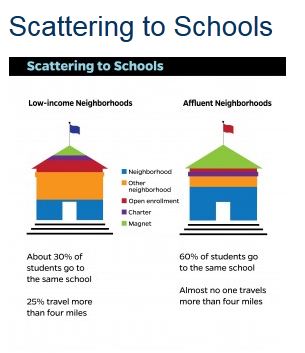
Burdick-Will took a look at 24,000 rising ninth graders in Chicago. In neighborhoods with median income over $75,000, the students attended one of two or three schools. In neighborhoods with median income under $25,000, students were divied up among around thirteen different schools. This chart from the news release about the report pretty well gets the idea:


I find the travel distance most notable-- the more wealthy students get to stay close to home. The non-wealthy get to tromp all over the city. The average travel distance in wealthy neighborhoods was 1.7 miles, and in non-wealthy neighborhoods it was 2.7.

Burdick-Will gets in a couple of good quotes:

We think of children in poor neighborhoods as ‘stuck.’ But they’re not stuck in one geographic place. They’re stuck navigating a complicated and far-flung school system.

I see a couple of caveats for this report. One is that we're only looking at one high school grade, and only in Chicago. The much larger one is that we're looking at 2009. On the one hand, the landscape may have changed in some significant ways in the six years since then. On the other hand, as CURMUDGUCATION: No Zip Code Tyranny:


Don't Fix Your Building


Up a floor from the publishing offices of the Journal of Obvious Conclusions, we find the Journal of Dumb Questions, which probably wants dibs on this working paper from the National Bureau of Economic Research-- "Investing in Schools: Capital Spending, Facility Conditions, and StudentAchievement."

I should probably be less hard on these guys-- after all, they are economists. And this is exactly the kind of stupid question we'll waste time on as long as we think the purpose of schools is to "raise student achievement" (aka "get higher test scores").

Here's the premise:

Public investments in repairs, modernization, and construction of schools cost billions. However, little is known about the nature of school facility investments, whether it actually changes the physical condition of public schools, and the subsequent causal impacts on student achievement. 

Yup. The roof in your school may be leaking, the bathrooms may be crumbling, and the heaters might not work, but before you go throwing a lot of money at the problems, let's ask the important question-- will fixing any of those things raise test scores?

The answer is, apparently, no. Now, I don't know how you pretend to research this. I could buy the paper on-line, but I can think of almost anything that might be a better use of my money (though I guess spending it on school improvement would not be on that list). The suggestion of the summary seems to be that they studied only schools that underwent big capital spending programs and looked to see if their students suddenly got better test scores. In related research, studies show that food 

Don't Fix Your Building