Latest News and Comment from Education

Saturday, June 6, 2015

CURMUDGUCATION: Hillary's Teacher PAC

CURMUDGUCATION: Hillary's Teacher PAC:

Hillary's Teacher PAC


With that first tweet, America's Teachers PAC made its twitter debut.

The PAC has a lovely website that launched just at the end of May and gives a clearer picture of what Hillary's-- well, no, of course this is the vision of the good folks at America's Teachers PAC who are I am sure following the rules that require them to be a separate entity from Clinton.

For one thing, they refer repeatedly to "our network of teachers-- reform and union." So right off the bat, we get their view of how the 'sides" of the education debates parse-- it's the reformers versus the unions. So there's one thing they don't get about current education issues-- that the reform side is a complicated web of entities including folks like the Center for American Progress, a reformster group with close ties to Hillary, and that "the union" doesn't even begin to describe the network of folks standing up for public education (that, in fact, the national unions are both late and lukewarm in their opposition to the reformster movement). But they repeatedly define these as the two "factions"-- reformers and unions.

The PAC lists talking points educational ideas to which it is committed.

1. Universal pre-school
2. Two free years of community college
3. Increased teacher pay and flex work options
4. Access to high quality schools for all communities
5. Full-service community schools

#4 opens with this familiar reformy dog whistle: "No child should be trapped in a failing school. Families should have alternatives if their neighborhood school is consistently underperforming." So, choice and charters. One more thing Hillary America's Teachers PAC gets wrong.

You find the same list on their LinkedIN page created on April 6 by Naveed Amalfard.

Amalfard is a math teacher in DC public schools, and he's been at that job for one whole year. He was previously at Emory in the economics department, held a summer job with McKinsey, was founder and CEO of Readers Beyond Borders for four years (You can watch him talk about it here). Can you guess how he ended up in a classroom? That's right-- Amalfard is a Teacher for America temp.

The America's Teacher blog used to open with a post from Amalfard:

I'm Naveed, an 11th grade statistics teacher in Washington, DC. I started America's Teachers as a grassroots Super PAC to bring together teachers, parents, and students to advocate for better public schools. Teaching in a high-poverty school has given me some insight into some of the web of challenges facing struggling students. I've developed a real appreciation for the depth and breadth of the educational crisis in our country.

Oh my goodness. One whole year and he gets the whole of the educational crisis. Once again, the Onion takes a back seat to reality.

You can't read that post on America's Teachers PAC website (where, actually, they neglect to call themselves a PAC); you have to find a cached copy. Now the website is pretty thoroughly scrubbed clean of any references to actual individuals, which seems like a bad choice since it gives the group the appearance of just one more shadowy collection of back room dark money deal makers.

We do know they've recruited the usual assortment of well-scrubbed college types. This recruiting post from the GW Democrats asks for fellows to join the America's Teachers PAC. The fellowship last twelve weeks-- the first half for training in "volunteer recruitment and management, event planning, and digital organizing." The second half will be putting these skills to work to make Hillary the next President. "Fellows will be integrated into the PAC and well-supported by its leadership. Each fellow will be responsible for specific workstreams." Operations will be base primarily in DC.

As to who that leadership might be...? Well, that's not entirely clear. A few of us asked the @AmericaTeachers twitter account who their backers are, but there was no answer (and given the nature of twitter, I don't find that particularly nefarious). I've emailed that question to the group 


How Kevin Johnson Used Public Money To His Own Personal Ends


How Kevin Johnson Used Public Money To His Own Personal Ends:

How Kevin Johnson Used Public Money To His Own Personal Ends


Kevin Johnson has ambitions of becoming something much more than just mayor of his hometown of Sacramento, Calif. So far, the former NBA star hasn’t found a way to realize them—but his desire to expand and promote his brand has meant that Sacramento city staffers have had lots of extra work to do that hasn’t had anything much to do with running the city.
Thus was Johnson’s taxpayer-subsidized mayoral team put to work on his behalf last year as he tried to play kingmaker when the National Basketball Players Association was searching for a new executive director.
In 2014, NBPA brass invited Johnson—at the time riding high on publicity from the assistance and counsel he offered NBA commissioner Adam Silver as he dealt with Los Angeles Clippers owner Donald Sterling’s racism scandal—to consult on its effort to replace deposed boss Billy Hunter.
Johnson, though, set up his own “advisory search committee” and personally approached candidates. The labor for this project came right off the Sacramento municipal payroll, with city workers using private email accounts, presumably to keep the operation off the books.
“All the emails included members of his [mayoral] staff,” says a source who witnessed Johnson’s approaches and requested anonymity, “and were him telling his staff to do this and him telling people they should get in touch with this staff person to get this done.
“It was always his staff.”

Public employees, public money, private work

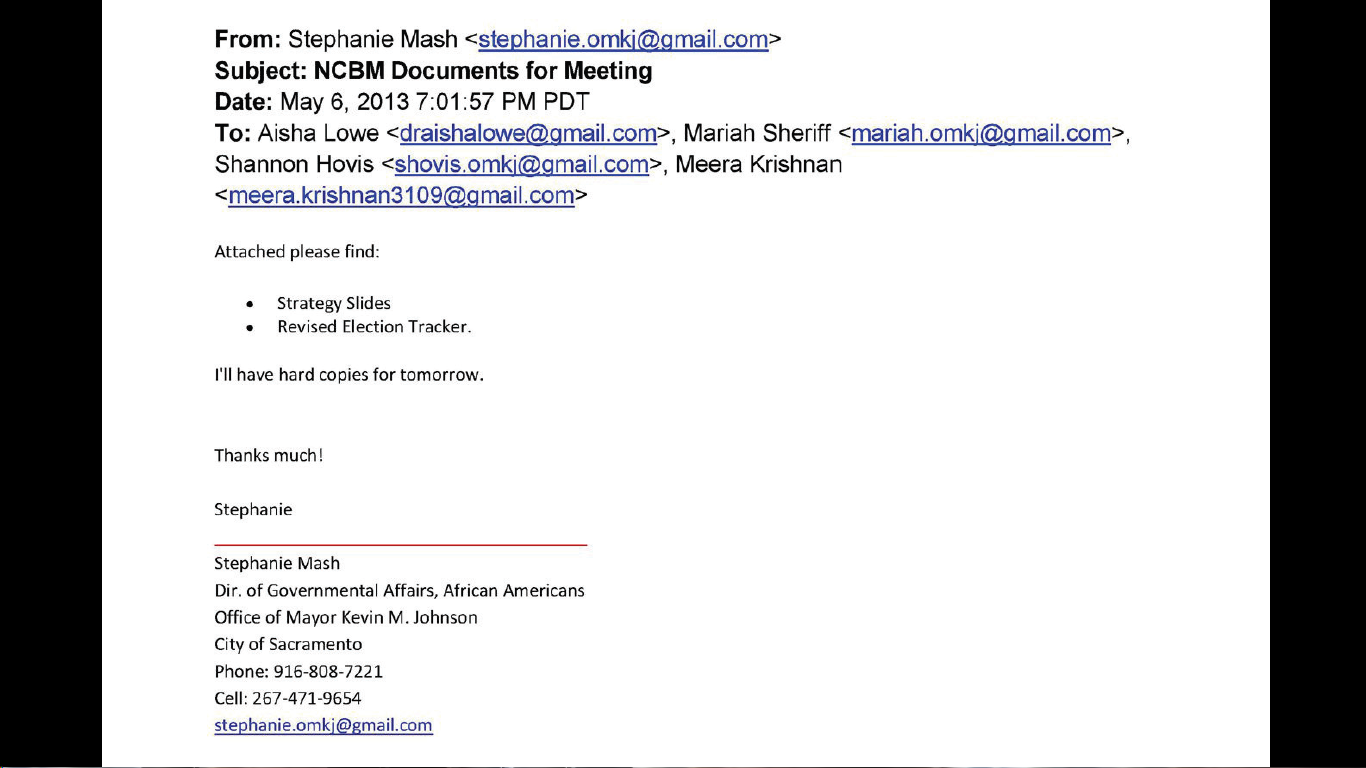
Among the mayoral staffers Johnson used during his NBPA excursion, according to a source, were Ben Sosenko, the press secretary; Daniel Conway, the chief of staff; Stephanie Mash, director of government affairs, African-Americans; Astrid Mirazo, administrative coordinator for the mayor’s office; and Aaron Anderson, whose online rĆ©sumĆ© says he’s in charge of “public-private partnerships” for the mayor’s office. This source says Johnson also exploited the labor of Andre Breaux, who earned a fellowship in Johnson’s office through his work at the University of Arkansas’ Clinton School of Public Policy, then signed on to the staff. Johnson clearly taught the young fellow that there’s nothing wrong with using public labor for private deeds: Breaux’s own rĆ©sumĆ© boasts that he “[m]anaged project tasks for the Mayor’s role as Chairman of the National Basketball Players Association (NBPA) Executive Director Search Committee.”
How Kevin Johnson Used Public Money To His Own Personal Ends
An email typical of those sent around by and to Johnson’s publicly-paid minions.

Alas, all the Sacramentans’ money and Johnson’s time and effort went for naught. The union’s executive committee grew tired of his cock-of-the-walk attitude, and when Johnson saw a lack of kowtowing on their part, he left the headhunting expedition in a huff while the search was still ongoing. 
“He wanted to run the thing with an iron fist,” says one observer, “and when he saw he couldn’t get everything his way, he took his ball and went home.”
Of course, the people of Sacramento had paid for the ball Johnson was playing with. And it turns out that Johnson’s use of city employees for the NBPA campaign wasn’t a one-off for him.
Deadspin wrote last week about all the time, effort, and bullying Johnson put into taking over and then demolishing a black mayor’s group. Court records now show that folks on the Sacramento payroll also did Johnson’s private bidding during every phase of that bizarre, megalomaniacal campaign, which flopped as badly as his foray into NBPA politics.
The discovery phase of civil lawsuits inspired by what Johnson called a “coup” carried out against the National Conference of Black Mayors has produced lots of evidence showing that he had members of his mayoral staff carrying out his clandestine operations. Among the civil servants doing Johnson’s dirty work: Mash and Sosenko, veterans of the NBPA excursion; Mariah Sheriff, director of governmental affairs in education; Aisha Lowe, whose emails identify her as interim director of African-American affairs for the mayor’s office; and Shannon Hovis, coordinator of governmental affairs in education. Meera Krishnan, a senior fellow on the mayor’s staff on loan from Harvard, was also knee-deep in Johnson’s NCBM muck.
In both the NBA and NCBM projects, the mayor and his staff used private email accounts. The staff typically just appended “OMKJ@gmail.com” (for “Office of Mayor Kevin Johnson) to their first names—press secretary Ben Sosenko, for example, used ben.omkj@gmail.com, when his normal work email address is bsosenko@cityofsacramento.org, while Johnson favoredmayorjohnson@kevinjohnson.com.
There is little purpose in using private email accounts, as has been pointed out by Hillary Clinton’s detractors, other than to make tracing a public servant’s deeds more difficult.

A history of dubious acts

Johnson’s history of using public money for his own purposes well predates his mayoralty. He was banned from accepting federal grants for any of his foundations in 2008, after an investigation by Gerald Walpin, inspector general for the Corporation for National Community Service. Walpin focused mostly on misdeeds at St. HOPE Academy, which Johnson founded to run charter schools. Walpin referred Johnson to the U.S. Attorney for criminal prosecution after How Kevin Johnson Used Public Money To His Own Personal Ends:

Thursday, June 4, 2015

Dumb Arguments About The Common Core Distract From What Matters Most

Dumb Arguments About The Common Core Distract From What Matters Most:

Dumb Arguments About The Common Core Distract From What Matters Most


While it’s refreshing to see K-12 education become a prominent issue in the very early stages of the 2016 election campaigns, it’s unfortunate to see support for the Common Core – the contentious new standards adopted by most states – become the focus of the debate.
What’s even worse is to see Democrats saying such bewildering, even misleading, things about the Common Core as they defend it against Republican criticism.
Specifically, when the subject turns to Common Core, there is a tendency among Democrats to immediately assert their support for the policy because of concerns for equity in the public school system.
For sure, inequity is a problem – if not the problem – in American schools. Inequities related to students’ race, ability levels, English language proficiency, and income characterize nearly every aspect of the outputs and inputs of the system. The achievement gap between white students and their black and brown peers has been at the center of education policy discussion for years. Students with learning disabilities experience a similar gap when compared with their mainstream peers. Racial discrimination also plagues school discipline policies resulting in black and brown students disproportionately being targeted for punishment, expulsion, and push-out into a school to prison pipeline. And many states discriminate against students on the basis of income by giving richer school districts more money than poorer ones.
But declaring that Common Core is somehow a solution to inequities is more than a stretch – it’s disingenuous. And if Democrats want to have some credibility in the debate on equity in the public school system, they should focus on policy proposals that really have something to do with equity.
Common Core Confusion
No doubt the Common Core has become a prominent issue in the presidential race, at least in the Republican primary.
As Politico reports, New Jersey Governor Chris Christie is the latest presidential aspirant in that party to make a big display of declaring opposition to standards he once championed. Now, the article explains, “Virtually every 2016 Republican presidential candidate has turned against the education standards, other than former Florida Gov. Jeb Bush.”
This is a strange turn of events for sure given that the idea of national standards was originally a popular conservative notion, dating back to the publication of “A Nation at Risk” during the Reagan administration. Even in Republican-led states where Common Core backlash has led to revising the standards, “the replacement standards have been near carbon copies of the Common Core,” The Hechinger Report explains.
But instead of pointing out the incoherency of this, Democrat operatives respond to Dumb Arguments About The Common Core Distract From What Matters Most:

The War of Attrition Over Public Schools - Living in Dialogue

The War of Attrition Over Public Schools - Living in Dialogue:

The War of Attrition Over Public Schools 


By Anthony Cody.
Public schools are in the midst of a war of attrition over their control – and even the very institution of public education is in danger. There is a sort of pincer assault under way, with billionaires on the far right pushing for complete de-regulation, and others, like the Gates Foundation, pursuing top-down systemic control of every public school in the nation.
On the “anti-government” side, billionaires like the Koch brothers and Walton family want to turn schools into a publicly-funded free market free-for-all, where virtually anybody who wants to can set up a school and teach whatever they want. This philosophy is resulting in voucher money going to schools that use the Bible as a source in teaching about the origins of life on Earth. The American Legislative Exchange Council has developed legislation sometimes called “Opportunity Scholarships” which give parents tax credits that can be applied to private or parochial school tuition. This week, the state of Nevada became the latest to adopt this model, so soon tax dollars will flow to whatever school the parent chooses, stripping funds from public schools. Deregulation is extending to the teaching profession as well. In Wisconsin, newly proposed rules would allow anyone to teach, regardless of their level of education, so long as they have “relevant experience.”
On the “pro-government” side, the Gates and Broad Foundations have been working closely with the Obama administration and teacher unions to advance the Common Core and aligned tests as the new accountability system that will re-wire our schools and turn our classrooms into uniform “sockets” for technologically-based learning systems. With the lure of Race to the Top grants, and by threatening the loss of Title One funds, the federal Department of Education has coerced a majority of states into adopting the Common Core. For similar reasons, many states now mandate the inclusion of test scores in teacher evaluations, though these systems are irrational and unfair. The Vergara case in California diabolically pitted the interests of students against those of teachers, asserting that teacher seniority protections interfered with students’ ability to get a good education.
The result of these attacks has been the unprecedented demoralization of the teaching profession. The number of applicants for teacher credentialing programs has plummeted in the state of California from around 77,000 around 2001 to fewer than 20,000 in 2012. According to the MetLife survey, teacher The War of Attrition Over Public Schools - Living in Dialogue:

Five things people say about standardized tests and the opt-out movement that aren’t true - The Washington Post

Five things people say about standardized tests and the opt-out movement that aren’t true - The Washington Post:

Five things people say about standardized tests and the opt-out movement that aren’t true


Denisha Jones is a visiting assistant professor of early childhood education at Howard University in Washington D.C., and over the last 10 years, she has taught kindergarten, preschool, and served as a campus-based preschool director. Her research interests include service-learning, dealing with challenging behaviors, the de-professionalization of teaching, and promoting diversity in education. She is also an administrator for United Opt Out National, a non-profit organization that works to eliminate high-stakes standardized testing in public education.
In this post, a version of one that appeared in emPower Magazine on Wednesday, June, 3,  Jones looks at common myths about standardized testing as well as about the growing opt-out movement, in which parents and students and teachers are refusing to take/administer high-stakes tests that they believe are being used for invalid purposes.
The introduction she wrote on her original post talks about the country’s testing obsession and about the push-back against the opt-out movement now under way by school reformers and even some civil rights organizations who have somehow equated annual standardized testing with civil rights.  Jones notes that President Obama has said that he would veto any rewrite of No Child Left Behind, the current version of the 1965 Elementary and Secondary Education Act, that does not include annual standardized testing for accountability purposes.
Jones wrote that “most of the arguments made by those who believe in standardized testing are filled with myths about what standardized testing can and should accomplish and misconceptions about the promise of opting out.” Here she addresses these myths head-on (and you can read her entire post here):

By Denisha Jones
Here are five popular myths about standardized testing and the opt-out movement — and the facts that tell what is really happening.
Myth #1. Standardized testing is needed to address the racial and socioeconomic achievement gaps.
This is the main point of 12 national civil rights group who issued a press release on May 5, 2015, denouncing “anti-testing efforts.” The group joint statement says: “For the civil rights community, data provide the power to advocate for greater equality under the law. It’s the reason we’ve fought to make sure that we’re counted equally in every aspect of American life, such as in employment, the criminal justice system, and consumer lending.” They acknowledge that high-stakes standardized testing (tests used to determine graduation or grade retention) can be misused and undermine the purpose of public education, but they counter that the today’s opt-out movement prohibits the collection of important data that will reveal the education disparities by race and class and our ability to fix what we measure. Additionally the statement takes issues with opt out activists using the Five things people say about standardized tests and the opt-out movement that aren’t true - The Washington Post:

CURMUDGUCATION: Nevada Abandons Public Education

CURMUDGUCATION: Nevada Abandons Public Education:

Nevada Abandons Public Education

Nevada has made its bid for a gold medal in the race to the bottom of the barrel for public education. The state's GOP legislature, with help from Jeb Bush's Foundation for Excellence in Education (a name that belongs in Orwellian annals right next to "Peacekeeper Missile"), has created an all-state voucher system.

This is the full deal. No foot-in-the-door program for poor, disabled, or trapped-in-failing-school students. Next fall every single student in Nevada gets a taxpayer-funded voucher to spend at the school whose marketing most appeals to that student's parents.

The backers of the bill are as delighted as they are divorced from reality. Here's bill sponsor Senator Scott Hammond, quoted in the Washington Post:

Nothing works better than competition.

This statement belongs in the annals of baseless expressions of faith, right next to "I'm sure that he'll leave his wife soon" or "Everything should be fine now that the government guy is here to help us" or "Go ahead and hand me that basket of vipers; I'm sure God will protect me."

In point of fact, not only do many things work better than competition, but competition doesn't really work all that well. And competition certainly does not work well when we're talking about providing an important public service to all people-- not just the ones who win the competition. It's true that when it comes to winning the race or getting the VP job or convincing that hot human to marry you, there can be only one. But what does that have to do with public education? Does Senator Hammond believe there should only be one great school in Nevada and only some students should get to succeed?

There are so many ways in which competition does not belong in public education. Building is a better metaphor than racingCompetition doesn't even foster traditional conservative valuesThe free market often resists quality rather than fostering itThe market doesn't know what to do with "losers.Charter school competition does not create pressure for excellenceMarket competition creates perverse incentives to game the system, and tends to put the wrong people in charge.Choice twists the product in an involuntary marketVoucher system disenfranchise the taxpayers, literally creating taxation without representation and pitting taxpayers against parents. The whole inefficient system depends on lies and fantasies for financing. And if you think competition fosters excellence, just go take a look at your cable tv. Finally, don't forget that time that Dr. Raymond of CREDO (charter and choice fans par excellence) declared that the free market doesn't work in education.

Like many school choice programs, Nevada's will actually be a school's choice program. The vouchers will provide poor students with a whopping $5,700. Want to go to Shiny Rich Prep Academy, high-poverty students? So sorry. It turns out your voucher just doesn't quite bring in enough money. Are you a student with issues, problems, or a disability? Sorry-- it's too hard to make money educating you, so we're going to find some means of making you go away.

Though it should be noted-- in one potential windfall for families that aren't all that into the whole edumacation thing, the voucher can be spent on home school supplies.

All of you who can't get into a Really Nice School? You are all welcome to go back to a public school. You know-- the public school that had to cut pretty much everything because it lost a ton of money 
CURMUDGUCATION: Nevada Abandons Public Education:

Hillary Clinton Works For The Support Of An Old Ally: The Teachers Union - BuzzFeed News

Hillary Clinton Works For The Support Of An Old Ally: The Teachers Union - BuzzFeed News:

Hillary Clinton Works For The Support Of An Old Ally: The Teachers Union

The endorsement process begins in the Democratic primary. O’Malley and Sanders try to win over the AFT, led by longtime Clinton supporter Randi Weingarten.


Three Democratic candidates each traveled to Washington this week to court the endorsement of the American Federation of Teachers — and after taking part in the hour-long meetings, the thing that stood out most to Randi Weingarten, the union, president, was this: Hillary Clinton knew what she was doing.
The other two, Martin O’Malley and Bernie Sanders, maybe less so.
The AFT meetings, which took place over the course of Tuesday and Wednesday, may offer Clinton the possibility of an early, influential endorsement from the major teachers union that endorsed her in the 2008 presidential race. Weingarten herself is close to and has supported Clinton for years. She sits on the board of Priorities USA Action, the super PAC raising millions to support her candidacy.
On matters of education policy, according to Weingarten, Clinton engaged the group with noticeably more depth and granular detail than her competitors. It was, she said, the most striking difference between the three candidates, particularly on the set of issues that have created fissures inside the Democratic Party, including testing, teacher evaluations in tenure decisions, and Common Core.
“Both in terms of the presentation as well as the questions, Secretary Clinton was clearly understood and spoke in great depth,” said Weingarten. “The members of the board did not ask Sen. Sanders or Gov. O’Malley as many questions about public education. I don’t frankly…” Weingarten paused. “I really don’t… Let me just observe that it was interesting. I don’t really want to draw a conclusion about it.”
Weingarten said that all three candidates — Clinton; Sanders, the U.S. senator from Vermont; and O’Malley, the former Maryland governor of Maryland — voiced strong support for public school teachers. But Clinton “talked so granularly about the issues that people felt a freedom to ask follow-up questions,” she said.
The three meetings, hosted at AFT’s headquarters, were each attended by about 150 union members, around one third of whom are on the group’s executive council. Each of the candidates gave brief introductory remarks before answering questions from the audience. The conversation with Clinton, O’Malley, and Sanders touched on five key areas, said Weingarten: the “imbalance in the economy,” public education, health care, retirement security, and the democracy.
The AFT effort to engage the candidates marked the first formal endorsement meeting of its kind by a union or interest group in the 2016 Democratic primary.
The meetings were not open to the media. But in an interview on Wednesday evening, Weingarten described AFT’s endorsement process and outlined in broad strokes each candidate’s message. She declined to elaborate on any shades of difference in policy or position between Clinton, O’Malley, and Sanders.
Prior to the meetings, the candidates each completed a policy-focused questionnaire, which AFT leadership began preparing in collaboration with its members in February. The attendees on Tuesday and Wednesday formulated their questions for the three Democrats — which were not prescreened — having Hillary Clinton Works For The Support Of An Old Ally: The Teachers Union - BuzzFeed News:

Thompson: The Truth None of Us Wants to Face This Week In Education

This Week In Education: Thompson: The Truth None of Us Wants to Face:

The Truth None of Us Wants to Face


 I still teach GED part-time, so I have not become completely absorbed into the edu-political world that is so divorced from the reality of inner city schools. I seek a balance, addressing the school improvement proposals that are politically viable, while remaining connected with the reasons why practitioners and parents are so dismissive of reform agendas. 

I can't deny that I've been acculturated into much of the "status quo" mentality illustrated by my first principals' mantra, "Pick your battles." The battles that we inner city teachers want policy people to launch are simply not winnable. 
However, Jay Mathews, in How Do We Help Our Least Motivated, Most Disruptive Students?, tackles the issue that I know I shouldn't  touch. 
Twenty years after I was repeatedly warned that assessing disciplinary consequences in a credible manner is an issue that school systems won't dare address, and as the agenda has shifted to reducing suspensions, why should I try to answer Mathews' question? Against my better judgment, I'll respond to his columns and readers. (After I read the book he cites, I'll see whether I dare to get closer to the 3rd rail of edu-politics by discussing it.)
Mathews wrote a three-part series on Caleb Stewart Rossiter's Ain't Nobody Be Learnin' Nothin'.  His first column on Rossiter's indictment of grade inflation "inspired a flood of comments and e-mails saying such malpractice was happening nearly everywhere in the country." But Mathews, like so many teachers turned advocates can only ask, "What do we do about it?" He then turned to Rossiter’s solution to low academic and behavioral standards which doesn’t seem practical to Mathews (or me) but which "represents the toughness I sense many Americans think is overdue."
Mathews begins his third column with his obligatory praise of KIPP, even though he probably realizes that its methods can't be scaled up and are thus irrelevant to systemic improvement. He concedes "that a significant number of low-performing students are likely not to enroll in schools like KIPP — or will drop out — because they don’t like the emphasis on good behavior and hard work."
Mathews agrees with Rossiter that neighborhood schools should teach good behavior and they should not keep returning disruptive students to their original classes, "where they distract students trying to learn." I would add that disruptive students also want to learn and, above all, they want to learn how to control their behavior. I would also argue that troubled students should never be described as "miscreants" or "slow learners" which is Mathews' characterization of Rossiter's views.
Like Mathews, I oppose the segregation of low-performing students or directing them to a vocational track "as early as the beginning of middle school." If older students choose vocational schools, that is one thing, but we adults need to make sure that they are not pressured to do so or to make a premature decision that could limit their horizons.
According to Mathews, Rossiter wants "miscreants and slow learners switched to remedial classes, where their problems would be addressed so they could return to the mainstream courses at the beginning of the next quarter." I'm afraid that Mathews uses such wording because he correctly surmises that that is the sort of tough talk that the public (not Mathews) wants. Regardless of what Rossiter wants to say, I believe Mathews is correct about what the public wants to hear, and the result would be increased (and cruel?) segregation. On the other hand, I support the carefully worded proposals of Professor Emeritus Lynn Canady which would incorporate a type of block scheduling This Week In Education: Thompson: The Truth None of Us Wants to Face:

Does Mayor Kevin Johnson's new downtown-housing plan actually bring new housing to the central city? Sacramento News & Review -

Sacramento News & Review - Does Mayor Kevin Johnson's new downtown-housing plan actually bring new housing to the central city? - Bites - Opinions - June 4, 2015:

Does Mayor Kevin Johnson's new downtown-housing plan actually bring new housing to the central city?

The mayor promises 10,000 new housing units downtown. But weren’t they already going to happen?


This week, Mayor Kevin Johnson launches his “Think Downtown” housing initiative for Sacramento’s central city.The mayor’s policy initiatives are always branded to the hilt. This one is no exception; the Sacramento Housing and Redevelopment Agency has agreed to foot the bill for a public-relations campaign led by 3fold Communications.
A lot of marketing can make it difficult to tease out the actual substance of initiatives like these. But at bottom, the mayor’s housing proposal looks like a slightly downsized restatement of the vision city leaders have been kicking around for a long time.
The gist is that the mayor wants to bring10,000 housing units to the central city in the next 10 years. (Central city meaning that area of town between the American River and W Street, the Sacramento River and Alhambra Boulevard.) Johnson also wants to put policies in place that will make building downtown housing easier. And he wants to sell central-city living to suburbanites.
What isn’t mentioned by the mayor and his surrogates is the fact that there are already 10,000 housing units or more planned for the central city.
In fact, the current plan for the downtown rail yards alone includes 10,000 to 12,000 housing units. That plan dates back to a pre-Johnson time, when Sacramento’s stated goal was to become America’s “most livable city,” and when city leaders and developers dreamed of soaring condo towers downtown.
Of course, that was before the recession. It was before the rail yards changed hands again, before we had to make room for a soccer stadium. Today, folks around City Hall say 5,000 to 6,000 homes in the rail yards is more likely.
But nearby Township Nine is under construction, planned for 2,500 units. Add in the ancillary development around the Kings arena, another 500 units. The Sacramento Commons project at Seventh and N is proposed for 1,000. Start adding in smaller projects Ice Blocks and the Midtown Whole Foods (with apartments on top), and 10,000 units doesn’t seem so bold.
So why the PR campaign? And why do developers need incentives to do what they already plan to do?
“Just because 10,000 or 20,000 units are proposed, doesn’t mean that’s what will get built,” says Bill Burg, president of Preservation Sacramento.
“City processes can be annoying and frustrating. There’s a lot of red tape,” says Burg, and that can put developers off.
So, as the mayor’s initiative gels this summer, look for efforts to streamline the permitting process and make development easier. (There’s a reason that Region Builders was tapped to lead the steering committee for the mayor’s housing initiative.)
There are few folks more committed to promoting the central city than Burg. He’s been a one-man marketing campaign, evangelizing grid living for years and talking about the “58,000.” That’s the number of residents the central city used to have back in 1950. Today, it’s around 30,000.
But Burg says we also need to be careful about what kinds of incentives the city gives developers, and what rules it throws out.
Burg is concerned that the mayor’s initiative will be presented fully formed with little input from community groups (a criticism aimed at many of the mayor’s policy initiatives). And he worries about streamlining the development process too much. “Is the process just going to get rid of rules that—though they may clog up the process—also protect neighborhoods?”

It’s teachers vs. day care, as the children pay | The Sacramento Bee

It’s teachers vs. day care, as the children pay | The Sacramento Bee:

It’s teachers vs. day care, as the children pay


 BY THE EDITORIAL BOARD

Appealing to Union, Hillary Clinton Calls Teachers 'Scapegoats' - First Draft. Political News, Now. - NYTimes.com

Appealing to Union, Hillary Clinton Calls Teachers 'Scapegoats' - First Draft. Political News, Now. - NYTimes.com:

Appealing to Union, Hillary Clinton Calls Teachers ‘Scapegoats’

Hillary Rodham Clinton at an event in Hampton, N.H., on May 22.
Hillary Rodham Clinton at an event in Hampton, N.H., on May 22.Credit Ian Thomas Jansen-Lonnquist for The New York Times


Hillary Rodham Clinton made an appeal for an endorsement from theAmerican Federation of Teachers this week, suggesting in a private meeting with union officials that critics have turned teachers into “scapegoats for all of society’s problems.”
“From what I’ve seen, all of the evidence, and my own personal experience, says that the most important and impactful thing we can do for our public schools is to recruit, support and retain the highest-quality educators,” Mrs. Clinton said before a question-and-answer session with teachers, according to the union, which released her remarks.
“It is just dead wrong to make teachers the scapegoats for all of society’s problems,” she said. “Where I come from, teachers are the solution.” Mrs. Clinton’s remarks were first reported by BuzzFeed.
Mrs. Clinton, as well as two other Democratic presidential hopefuls, former Gov. Martin O’Malley of Maryland and Senator Bernie Sanders of Vermont, appeared at the union’s executive council meeting this week. But even allies of Mr. O’Malley and Mr. Sanders acknowledge that Mrs. Clinton is likely to earn the federation’s backing.
Still, Mrs. Clinton is under some pressure from advocates of an education overhaul, who have been at odds with the teachers’ union for several years and believe President Obama has been a supporter of their issues. Representatives for teachers have publicly denounced Mr. Obama’s education agenda and programs like “Race to the Top,” which awarded bonuses to school districts based on performance markers. That makes Mrs. Clinton’s comments about teachers as “scapegoats” all the more striking.
In an interview in March, Ann O’Leary, who has since become a senior policy adviser for Mrs. Clinton’s campaign, indicated that the candidate planned to engage in a dialogue with both the teachers and advocates of an overhaul, something Mr. Obama has been accused of not doing.
Lea Crusey, of the group Democrats for Education Reform, who called Mr. Obama “a consistent champion for reform,” said advocates had “been in contact” with Mrs. Clinton’s team, and that they hoped to hear from her on issues such as college affordability, charter schools and “continued support for accountability.”
Mrs. Clinton has a long record on the subject, including on efforts to overhaul public education. In Arkansas, when she was first lady, she was part of a task force that tried to improve the state’s poor-performing schools.Appealing to Union, Hillary Clinton Calls Teachers 'Scapegoats' - First Draft. Political News, Now. - NYTimes.com:

Are students better off in charter schools? State says it’s unsure | The CT Mirror

Are students better off in charter schools? State says it’s unsure | The CT Mirror:

Are students better off in charter schools? State says it’s unsure


Amid the ferocious debate about whether Connecticut students are better off in charter schools, the State Department of Education has released the results of its first-ever research on the subject.
It provides little clarity.
"The results were a mixed bag," Education Commissioner Dianna Wentzell told the state education board Wednesday. "In some cases, students in Choice programs made greater academic gains than their peers not enrolled in these programs, thereby closing achievement gaps, while in other cases they did not."
Wentzell warned the board members not to draw strong conclusions from the findings. "Choice programs" is a term for public charter schools, regional magnet schools and suburban schools that enroll inner-city students through the Open Choice program.
Whether students are better off in charter schools compared to their neighborhood schools has been a topic of considerable debate at the state Capitol this year as Gov. Dannel P. Malloy pushed the legislature to spend $12.5 million more next year to expand enrollment in charter schools.
Tuesday, sharp differences of opinion were on full display in Hartford as legislators sent a bill to the governor's desk that increases state oversight of these publicly funded, privately operated charter schools.
"The data is clear: Charters in Connecticut are delivering results for our students," said Jennifer Alexander, the leader of ConnCAN, a charter-advocacy organization, in an email to reporters Tuesday. "Connecticut's charter schools outperform their host districts."
That assertion has been reinforced in a barrage of television advertisements recently -- ads that say charter schools deserve more state funding because "40,000 students are trapped in failing schools."
Some legislators, and many educators, aren't buying it, however.
"Some of the things they are lauding them for are questionable," Sen. Edwin Gomes, D-Bridgeport, said on the floor of the Senate early Tuesday morning.
The years-long, highly technical research attempted look into the performance issue.
The study looked at the testing outcomes for students in third and sixth grades in charter, magnet and neighborhood schools in Bridgeport, Hartford, New Haven and Waterbury during the 2010 school year. These students were compared to the proficiency rates of like students in suburban and rural schools.
Following students for two years starting in Grade 3 (from 2010 to 2012)
Proficient in math and reading in 2010Proficient in math and reading in 2012difference from non-urban schools in 2010difference from non-urban schools in 2012
Students in charter schools63.6%58.2%-15.3%-27%
Students in regional magnet schools48.458.1-30.5-27.1%
Students in non-choice schools in urban districts43.9%48.3%-35%-36.9%
The results found that by 2012, the achievement gap among the third grade cohort of charter students and their non-urban peers had grown by 5.4 percent. The gap for the six grade cohort narrowed by 8 percent.
"The inconsistent findings between cohort 1 and cohort 2 are puzzling," the 41-page report states. "It cannot be said with certainty that clones of these [school] choice programs, or an exportation of specific pedagogical techniques and strategies used, will necessarily ensure similar performance successes for urban students."
This research is long overdue, many legislators say.
"Before I do any investing, I want to know my rate of return." said Sen. Marilyn Moore, D-Bridgeport, on the Senate floor. She was referring to a proposal to spend nearly $100 million each year on charter schools.  Twenty-one Democratic Are students better off in charter schools? State says it’s unsure | The CT Mirror: