Latest News and Comment from Education

Tuesday, April 28, 2015

Education tech funding soars -- but is it working in the classroom? - Fortune

Education tech funding - Fortune:

Education tech funding soars -- but is it working in the classroom?


 Technology has captured the American education system. As it does, the money keeps flowing in — and so do questions about its impact.

From iPads in kindergarten to virtual classrooms in high schools to online graduate degrees, technology has captured the American education system. As it does, the money keeps flowing in — and so do questions about its impact.
In 2014, venture funding for education technology reached $1.87 billion dollars. It’s expected to hit $2 billion this year. That’s a big jump from $385 million in 2009,according to CB Insights, the first year the venture capital research firm started tracking education funding.
“The education space is attractive because it’s a big and important part of the economy,” said Rob Hutter, managing partner of Learn Capital an education based venture capital firm. “The edtech companies that get funding can be important 50 years down the line, and not just in a few years.”
And it’s a good business to be in, said Bob Sun, founder of online math site, First in Math.
“There’s a high profit margin with no warehouses and not much cost except for research and development,” explained Sun, who also said his firm has grown 20% in the past six years and hasn’t needed outside funding.
But while many sing the praises of education technology in the classroom, some question if it’s having the desired effect.
“Education technology is not yet a proven solution for learning, and limits the experience of education and human interaction,” argued Art Langer, academic director and faculty member of the Executive Masters in Technology Management at Columbia University.
Education technology takes off
The beginnings of education technology have mirrored the advancement of tech itself. As computers got better and faster in the 1960s, colleges like the University of Illinois introduced computer terminals where students could access resources on a course and listen to pre-recorded lectures. By the 1980s many college courses were accessible online at university libraries.
Then along came video conferencing which reached thousands of students. The 1990s and 2000s saw the explosion of the internet and online classes. The National Center for Education Statistics estimates the number of K-12 students enrolled in online distance learning programs increased by 65% from 2002 to 2005.
Add to this smartphone apps, laptops and iPad accesses, and classrooms of all ages have some sort of technology at their fingertips. And at least one study says it’s all for the good.
“Education technology allows students to share their work and collaborate beyond their schools walls,” said Wendy Eiteljor, director of education technology for pre-K to grade 12 at the Shipley School in Bryn Mawr, Penna.
“It’s also providing alternative ways for students to participate in discussions,” she added.
Drawbacks to high tech
But some in the field see roadblocks to all the technology that’s flooding the system. One of the biggest areas of concern, among many, is access, said David Liu, COO ofKnewton, a learning technology provider that develops platforms to personalize educational content.
“It can heighten the disparity between rich schools and poor schools, putting disadvantaged students even Education tech funding - Fortune:

Small high school reform boosts districtwide outcomes -- ScienceDaily

Small high school reform boosts districtwide outcomes -- ScienceDaily:

Small high school reform boosts districtwide outcomes


 Creating small high schools improves outcomes for students in the overall school district -- both in new small schools and existing larger schools -- according to a study of New York City schools by researchers at New York University, Syracuse University, and Arizona State University.

The findings, published in the April issue of Educational Researcher, help to answer questions of whether introducing small high schools comes at an expense to the rest of the school district.
"Our findings suggest that there was real, meaningful improvement in New York City's high school outcomes as small school reform was implemented," said Leanna Stiefel, professor of economics at NYU's Robert F. Wagner Graduate School of Public Service and the Steinhardt School of Culture, Education, and Human Development, and associate director of the Institute for Education and Social Policy. "Small school reform lifted all boats."
Small school reform, in which new, small high schools replace large, comprehensive high schools, has been adopted by major U.S. cities, such as New York, Los Angeles, Chicago, Philadelphia, San Diego, and Boston. Studies in New York and Boston have found that small high schools deliver better outcomes -- including higher graduation rates -- than large high schools for urban students.
While research shows that students attending new small schools fare better than those attending old schools, little has been done to explore changes to districts as a whole. The question remained: is better performance at small schools gained at the expense of losses elsewhere, or does small school reform lift the whole district?
Stiefel and her colleagues examined New York City's small school reform, in which hundreds of new small high schools were built in less than a decade. They studied four cohorts of high school students: two groups set to graduate in 2001 and 2002, before school reforms began, and two expected to graduate in 2007 and 2008, after small school reforms were underway.
Using demographic data on individual students, as well as measures of student outcomes -- graduation rates, rates of students taking the English and math Regents tests, and English and math Regents scores -- the researchers estimated effects of the school reform on student outcomes. They found that introducing small schools improved outcomes for students in all types of high schools: large, small, continuously operating, and new.
New York City's graduation rates increased from 51 percent in 2001 to 64 percent in 2007 and 68 percent in 2008. While students in small high schools had the highest graduation rates, roughly 13 percentage points higher than their peers in continuously operating schools in 2007 and 2008, the graduation rates increased across all types of schools. Regents test taking and passing rates also improved significantly from 2001 to 2008 across new and existing high schools.
The researchers noted that other changing factors in New York City and New York state, including increased spending on education and new teacher certification regulations, may have influenced their results. However, the findings still suggest that small school reform can play a role in systemic reform.
"Our evaluation is relevant for policymakers who aim to initiate small high school reform in an environment -- like that found in many urban school districts in the U.S. today -- where change and reform is ongoing and 'business as usual' involves continual change," said Stiefel.Small high school reform boosts districtwide outcomes -- ScienceDaily:

K12, Inc. Continues Its Massive Transition (LRN)

K12, Inc. Continues Its Massive Transition (LRN):


K12, Inc. Continues Its Massive Transition

K12 traditionally caters to students and families who work better in smaller, at-home, individualized settings. Photo: K12. 
For-profit educator K12 (NYSE: LRN  ) released its quarterly report today, handily beating expectations for both revenue and earnings. Revenue came in at $244 million -- about $6 million ahead of what was forecast -- and earnings came in at $0.45 per share, far ahead of the expected $0.37 per share. Yet the stock itself is up less than 5% as of mid-day.
In order to understand why the reaction was so muted, it's important to grasp where K12 has been, where it's going, and the massive transformation it is undertaking to make its business model more sustainable.
A tale of two approachesTraditionally, K12's bread and butter was in what are now called "Managed Schools." With such schools, K12 would set up a charter school subsidiary in a local community. The company would handle essentially all of the schooling -- teaching, curriculum, assessment, etc. -- for students whose families chose to use the company's online offerings instead of attending the neighborhood school.
The model itself started running into serious problems back in 2011. Parents, educational officials, and some short-sellers claimed that the company was recruiting students for the program based solely on meeting booming enrollment expectations. This led many to accuse the company of accepting students who were doomed to fail in the at-home environment simply to make an extra buck.
As education officials began to investigate these claims, the company began exploring other ways to provide e-learning solutions to schools. That gave birth to what are now referred to as "Non-Managed Schools." In these schools, K12 principally provides the content and online platform for classroom teachers to use in augmenting their instruction.
Diverging resultsAs you might expect, growth in enrollment and revenue from managed schools has screeched to a halt, while non-managed programs have been growing by leaps and bounds. Altogether this is a very positive development: focusing on non-managed programs allows K12 to adopt an approach that is both sustainable and will keep the company out of the public's cross-hairs.
The problem: managed programs still bring in much more revenue than non-managed onesK12, Inc. Continues Its Massive Transition (LRN):

Vouchers on the Move: Return to School Segregation? | PR Watch

Vouchers on the Move: Return to School Segregation? | PR Watch:

Vouchers on the Move: Return to School Segregation? 


Twenty-five years ago, Wisconsin Governor Tommy Thompson signed the nation's first school voucher bill into law. Pitched as social mobility tickets for minority students, Wisconsin vouchers allow children to attend private, and sometimes religious, schools on the taxpayers' dime.
But as shown by the murky history of the voucher movement, and by the way voucher programs have developed in Wisconsin and other states, racial equity had nothing to do with it. It was a scheme cooked up out of an ideological disdain for public schools and teachers' unions, and first used to actually preserve school segregation in the South.
Today, vouchers bills are on the move in multiple states and on Capitol Hill. GOP presidential hopefuls, who want to boost their free market bona fides for a 2016 run, have been outbidding themselves in touting vouchers as educational panaceas that will not only help minority children close education gaps, but cut corporate and property taxes in the process.

A Nationwide Voucher Program?

On April 15, Rand Paul (R-KY) introduced an amendment to an omnibus education bill that would have spelled the end to federal education aid as we know it.
Under the amendment to the Senate bill, which is a revamp of the No Child Left Behind Act, federal Title I dollars, intended to support public schools with a high proportion of low-income students, would instead follow individual students even if they choose to attend private schools.
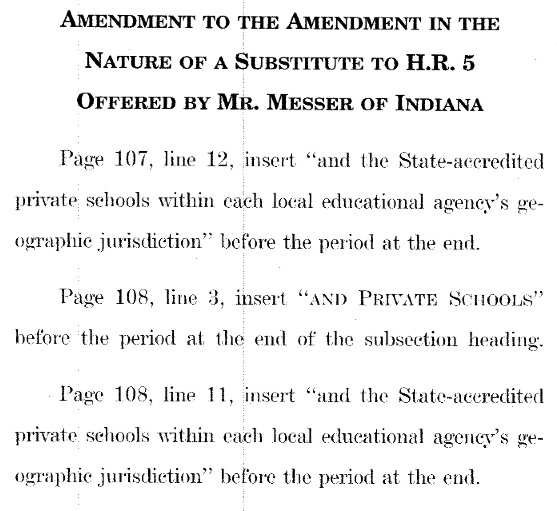
This would have paved the way for a multi-billion-dollar nationwide voucher system, siphoning money from public school districts to private andAmendment to the Student Success Act
Amendment to the Student Success Act
possibly religious schools that—unlike their public counterpart—have no obligation to serve minority, at-risk or special-needs students. These schools are also free to ditch the science curriculum in favor of climate-denial and creationism.
A few months earlier, Congressman Luke Messer (R-IN) bused a bunch of kids to the Capitol to celebrate "National School Choice Week." Among the speakers were Sen. Ted Cruz (R-TX) and House Speaker John Boehner (R-OH). Their enthusiasm, however, was somewhat dampened by the kids who—for all Messer's emceeing—seemed ill at ease with being displayed as placard-wearing pawns in a political game.
Precisely what kind of school choice Messer had in mind became clear when he introduced a voucher amendment to the House version of the bill. Both Messer and Paul chose to withdraw their respective amendments, but introducing them in the first place is a way of flexing their muscles. Vouchers are gaining traction and Messer, who chairs the Congressional School Choice Caucus, has vowed not to rest until "every kid in America has that kind of opportunity."

GOP Presidential Hopefuls Hail Vouchers as Miracle Cures

Rand Paul's and Luke Messer's attempts to direct federal taxpayer money to private schools comes in the wake of a massive push for school vouchers. In 2013, Senator Marco Rubio (R-FL) introduced an "Educational Opportunities Act" which would have created a voucher-like system allowing children from low- or middle-income families to attend private schools funded through tax-deductible corporate and private donations. The businesses get the write-off and taxpayers lose out on public revenue.
New Jersey Governor Chris Christie has implemented a slew of school “reforms,” including an expansion of the state’s charter school program and a new law making it easier to fire tenured teachers. But he now has his eyes set on vouchers, or what he calls “opportunity scholarships,” as well.
Others have upped the ante. Louisiana’s Republican Governor Bobby Jindal created the largest voucher program in the nation in 2012 with the hope of enrolling 380,000 K-12 students in private and religious schools. It was later struck down as unconstitutional by the state supreme court. “[S]tate funds … cannot be diverted to nonpublic schools … according to the clear, specific and unambiguous language of the constitution,” the court wrote in its ruling. The North Carolina and Alabama voucher programs were ruled unconstitutional on similar grounds by courts last year.
Not one to be outdone by his fellow presidential contenders, Republican Governor Scott Walker of Wisconsin recently announced he would lift the 1,000-student cap on the statewide voucher system. And even though the Wisconsin Constitution has a similar “public purpose doctrine,” which does not allow taxpayer money to fund a “private purpose,” the original Milwaukee voucher program has already survived multiple court challenges. Chances are that Walker (if given the go-ahead by the GOP-controlled legislature) will prevail in creating the largest voucher program in the nation.

A Trojan Horse in Wisconsin and Elsewhere

As ground zero for school vouchers, and the first state to enroll religious schools in the program, Wisconsin is worthy of closer scrutiny. Walker’s sweeping expansion was unveiled in his 2015 budget address. Denounced by both local and national media as “a serious threat to local education” (The Post Crescent) and part of “a clumsy attack on education” (The New York Times) the proposal was "applauded" by the American Federation for Children, the lobby powerhouse linked to the billionaire DeVos family and their ideological crusade to destroy the public education system as we know it. In 2011, AFC greased the skids for Walker with a $1.1 million issue-ad buy while he faced recall for having all but destroyed collective bargaining rights for teachers and public sector employees.
“Every child,” Walker said in his address, “deserves to succeed.” It’s an empty sound bite, but it’s also a surprisingly revealing one. Wisconsin school vouchers were never meant for everyone; this was part of their appeal. When introduced in Milwaukee in 1990, they were pitched as social mobility tickets, and they were restricted to students from families earning less than 175 percent of the federal poverty level.
The program was championed by some prominent African-American community leaders and lawmakers, such as Dr. Howard Fuller and Annette “Polly” Williams, a Democrat from Milwaukee who went on to travel the country rallying support for “school choice.”
But what happened once the system was in place soon drew the ire of its early supporters. Under Walker, the income requirement for Milwaukee was upped to 300 percent of the poverty level. A married couple with two children can currently earn $78,637—far more than the median U.S. family income of $52,250—and still send them off to private schools at the public's expense. Polly Williams put it bluntly in a 2013 interview with the Milwaukee Journal Sentinel: "They have hijacked the program."
In fact, what happened in Milwaukee is far from unique. Other states have introduced vouchers as "civil rights" measures only to expand the programs to higher-income white families. The voucher-like corporate tax credit program in Georgia was originally billed as a way of helping African-American and Latino families, but most scholarships have been awarded “white students from upper income families,” the Southern Education Foundation wrote in a scathing report.
In 2013, Governor Mike Pence of Indiana raised the income requirements of the voucher program in the Hoosier State, and last year, Florida's Republican governor Rick Scott lifted the income bar for the state voucher program, allowing a family of four making up to $62,010 a year to participate—$20,000 higher than the previous limit.
While the statewide voucher program in Wisconsin is so far limited to students from families making less that 175 percent of the federal poverty level, just like the Milwaukee program in its infancy, school advocates are worried that we will once again see a gradual "easing" of the requirements.

Subsidizing Segregation?

What emerges is a pattern of limited voucher programs signed into law under the promise of helping minority children, but later expanded to subsidize more affluent white families. What are the consequences?
As universal voucher programs are still some way off, there is no empirical data. But a 2006 study published by the University of Connecticut takes a novel approach in answering the question. By analyzing voter patterns when vouchers were on the ballot in California, the authors conclude that “among white households with children, support for voucher increases with the proportion of minority students in the local public schools. This is not true of non-white households."
In other words, as more middle class families are free to enroll their kids, self-segregation with white children drawing taxpayer money to attend racially homogenous private schools could take off. The possibility deeply concerns education experts.
“The question is: are we comfortable using our tax dollars to subsidize those choices?" Julie Mead, professor of Educational Leadership and Policy Analysis at UW-Madison, told CMD.

The Racial History of School Vouchers

The history of the voucher movement is seldom told, least of all by its advocates. But it is a history well worth telling, and it might give some idea of where we are headed.
Concern for minorities was never part of the original design. It was a libertarian scheme cooked up out of an ideological hostility toward the idea of public schools. And more tellingly, vouchers were first used to flout desegregation laws.
Early supporters would time and again find themselves faced with a dilemma: should they support public desegregated schools or private ones—including those discriminating on the basis of race? As it turned out, ideology trumped any concern for the children.
Until the mid-1980s, the school voucher movement remained a fringe movement of hardline libertarians and New Right ideologues—including the American Legislative Exchange Council (ALEC)—as well as religious school leaders. It also had some disturbing bedfellows thrown in for good measure, such as white supremacists keen on using vouchers to foster “white flight.”
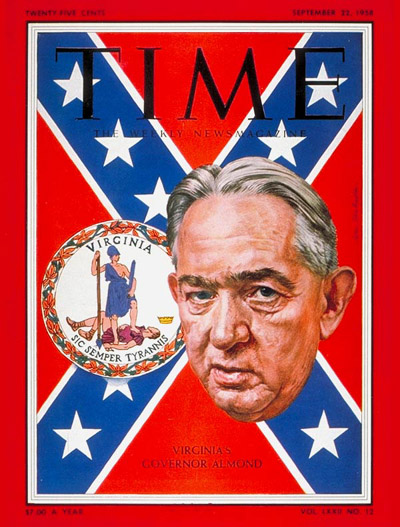
J. Lindsay AlmondIn fact, school vouchers first emerged as a policy prescription in the mid-1950s, just as the U.S. Supreme Court was ordering school desegregation in the Brown v. Board of Education series of decisions. While University of Chicago economist Milton Friedman, who first floated the idea in a 1955 essay, wanted to see public schools turned into competing corporations on the free market, vouchers were de facto used in the South as a way to preserve segregation.
In 1959, for example, Virginia Governor Lindsay Almond introduced tax-funded tuition grants to white parents who wanted to send their children off to private schools that were not subject to the desegregation laws.
When Friedman learned of this, he found himself between the rock of public school segregation by law and the hard place of state intervention. He embraced racially segregated schools as a benefit of the free market while “So long as the schools are publicly operated, the only choice is between forced nonsegregation and forced segregation; and if I must choose between these evils, I would choose the former as the lesser. Privately conducted schools can resolve the dilemma ... Under such a system, there can develop exclusively white schools, exclusively colored schools, and mixed schools."
For many years “school choice was widely understood by the courts and the public as a strategy to preserve school segregation,” education historian Diane Ravitch writes. In the 1970s, rightwing ideologues (often allied with religious school leaders, and entrepreneurs eager to cash in on the new market) fought an uphill battle.
The first known statewide attempt to introduce a voucher system took place in Michigan where a shadowy group calling itself Citizens for More Sensible Financing of Education managed to put the question of voucher schools on the midterm ballot in 1978, but an overwhelming majority (74 percent) rejected the proposal.
The time was not yet ripe as many voters still recalled the segregationist roots of schools vouchers. Not to be deterred, however, the two engineers of the proposal—Richard McLellan and Robert Baldwin—would go on to fight for school privatization both in Michigan and nationwide.
McLellan, a Lansing attorney, later co-founded the rightwing Mackinac Institute and recently served as Governor Rick Snyder’s unofficial education advisor. In 2013, The Detroit News revealed how he had been meeting in secret with Snyder’s aides using code words to discuss how to smuggle a state voucher system in the back door.
Baldwin is less well known, but he acted as an advisor to ALEC and founded several Michigan and national advocacy groups hoping to enlist support for vouchers. He got more than he bargained for.

Strange Bedfellows

Viewing the result of the 1978 ballot proposal as a partial success, ALEC would go on to inundate lawmakers with a massive nationwide push toward private school vouchers in 1981. A voucher bill was sent to “16,000 state and federal officials, including every state legislator in the country,” ALEC boasted in the November 1981 issue of the internal newsletter The State Factor.
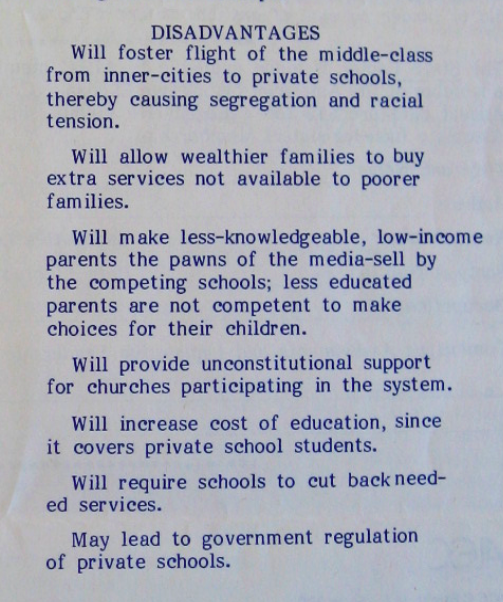
In a lengthy analysis of what the implications of school vouchers might be, ALEC admitted to a few disadvantages, such as ”flight of the middle-class from inner-cities to private schools, thereby causing segregation and racial tension.” But this, ALEC went on to argue, is more than made up for by the fact that vouchers are true to the principles of federalism by empowering individuals at the expense of government.
When President Ronald Reagan a year later announced plans to introduce a similar scheme of tuition-tax credits for families with children in private schools in an attempt to shore up Catholic support, voucher advocates from the “New Right,” including ALEC founder Paul Weyrich of the Moral Majority, were enthusiastic.
Under the plan, parents would be able to deduct half the cost of tuition directly from the federal
- See more at: http://www.prwatch.org/news/2015/02/12730/segregation-school-vouchers#sthash.qv8LpA18.dpuf


solidaridad: New Report Finds Over $200 Million in Fraud and Abuse at Charter Schools

solidaridad: New Report Finds Over $200 Million in Fraud and Abuse at Charter Schools:


New Report Finds Over $200 Million in Fraud and Abuse at Charter Schools

“The Tip of the Iceberg: Charter School Vulnerabilities to Waste, Fraud, and Abuse” Exposes Costly Consequences of Lacking Charter Schools Accountability, Transparency
** Full report available here: http://bit.ly/1DDlpjM **
A new report by the Alliance to Reclaim Our Schools (AROS) and the Center for Popular Democracy (CPD) found that financial fraud, waste, and mismanagement by charter schools cost taxpayers more than $200 million in just 15 states—a significant increase from the more than $100 million in charter school financial fraud exposed in a similar report released by CPD last year.
Charter School Fraud Robs ALL our students!
“Charter schools act like they have a ‘get out of accountability free’ card,” said Jonathan Stith, director of the Alliance for Educational Justice and a spokesperson for AROS. “$200 million dollars that was supposed to go to schools and classrooms is just gone. And that's likely to be the tip of the iceberg, given the lack of transparency or standards applied to charter schools.”
“We will continue to have a charter school fraud problem until we address the root cause – the broken oversight systems that exist on a federal and state level,” said Kyle Serrette, the Director of Education for CPD. “Certainly not all charter school operators are fraudulent, but our system is not good at differentiating the sheep from the wolves in sheep’s clothing. That’s a problem, given the fact that taxpayers around the country are collectively spending over $20 billion a year on charter schools. Charter school parents, children, and taxpayers deserve better.”
Examples of charter fraud and mismanagement covered in the report include:
Washington, DC: The DC Public Charter School Board unanimously revoked the charter of Dorothy I. Height Community Academy Public Charter School—which enrolled 1,600 students across three campuses and an online academy—after the school’s founder, Kent Amos, was accused of diverting funds from the school for his personal profit. Despite evidence that Amos—who is currently being sued by the DC Attorney General—diverted more than $14 million from the school in the last 10 years, the DC Public Charter School Board pointed to their limited ability to oversee for-profit management companies, which are often intertwined with non-profit charter schools and face no requirements to disclose salaries or other pertinent information that could prevent rampant fraud.
Michigan: In April 2014, Steven Ingersoll, founder of Grand Traverse Academy, was convicted of federal fraud and tax evasion. He did not report $2 million of taxable income in 2009 and 2010. The school’s audit revealed a $2.3-million prepayment to Ingersoll’s school management company. Ingersoll then used half of a $.8 million loan for school construction to pay down some of his debt to the school. After the founder’s ouster, his daughter-in-law continued to handle the finances of the school.
Ohio: In January 2015, the state auditor released a report of the results of unannounced visits by inspectors to 30 charter schools. In nearly half of the schools, the school-provided headcount was significantly higher than the auditors’ headcount. Schools are funded based on headcount, so these inflated figures amount to taxpayer dollars siphoned away from students. Among the seven schools with the most extreme variances between reported head count and the auditors’ headcount, almost 900 students were missing, at a cost ofroughly $5.7 million. Auditors identified eight other schools with troubling, but less significant variances.
Additionally, in June 2014, a grand jury indicted the superintendent and 2 board members of Arise! Academy in Dayton of soliciting and accepting bribes in exchange for awarding a “lucrative” consulting contract to a North Carolina-based company. The contract was worth$420,919 and the charter personnel received kickbacks in the form of cash, travel, and payments to a separate business.
California: In July 2014, the Los Angeles Unified School District performed a forensic audit of Magnolia Public Schools. They found that the charter-school chain used education dollars to pay for six non- employees’ immigration costs and could not justify $3 million in expenses over four years to outsource curriculum development, professional training, and human resources services that the school itself reported.
The report calls for a set of core reforms to end the hemorrhaging of public funds to fraudulent charter schools and also calls on state and federal lawmakers to act now to put systems in place to prevent fraud, waste, abuse and mismanagement.
###
The Alliance to Reclaim Our Schools (AROS) is a national coalition representing more than 7 million Americans who attend and work in public schools, and live in the communities most impacted by the ESEA.solidaridad: New Report Finds Over $200 Million in Fraud and Abuse at Charter Schools:

‘Teachers of the world, unite. You have nothing to lose but your rubrics.’ - The Washington Post

‘Teachers of the world, unite. You have nothing to lose but your rubrics.’ - The Washington Post:

‘Teachers of the world, unite. You have nothing to lose but your rubrics.’


Hardly a week goes by where some education-related group gathers somewhere to talk about something, but a gathering of education activists this past weekend in Chicago was different from the usual.  It was the second annual conference of the Network for Public Education, an advocacy organization started by education historian and activist Diane Ravitch and some of her allies, and it attracted more than 600 teachers, parents, students, union leaders, school board members and others from around the country. It reflects the growth and seriousness of the movement that is fighting corporate school reform.
Sometimes incorrectly labeled in the media as being union-launched and led, the movement against the privatization of public education and standardized test-based accountability systems has grown in large part because the people in schools who have traditionally kept quiet about reforms they found ineffective or harmful to students — teachers, principals and superintendents —  began to speak out publicly. Parents began to to organize and students did as well.
Ravitch has been the titular leader of the movement since her 2010 book, “The Death and Life of the Great American School System,” was published, explaining why she was abandoning her support for No Child Left Behind and test-based school reform. From 1991 to 1993, Ravitch worked as assistant secretary in charge of research and improvement in the Education Department of President George H.W. Bush, and served as counsel to Education Secretary Lamar Alexander. She was a supporter of No Child Left Behind, the chief education initiative of President George W. Bush, until she researched its effects on schools and students and found a narrowing of curriculum, an obsession with test prep and demoralized teachers.
The movement had another big moment in 2012, when the Republican Texas education commissioner, Robert Scott, told the Texas State Board of Education that the mentality that standardized testing is the “end-all, be-all” is a “perversion” of what a quality education should be. Since then it has grown and sprouted an opt-out movement in which tens of thousands of parents in different states are refusing to allow their children to take high-stakes standardized tests. Some teachers, too, are refusing to administer the tests, and principals and superintendents have come against them as well. In fact, a group called United Opt Out had its own convention in Florida this past January.
It is fair to say that the pushback on corporate reform by these activists is responsible for the current national debate on the value of high-stakes standardized tests and a move in states to reduce their number and influence.  It has also affected the discussions in Congress around the rewriting of No Child Left Behind, being led by Alexander, now a Republican senator from Tennessee, who chairs the Senate education committee.
Ravitch and others co-founded the network — which, to be clear, has union support but is not union-run — a few years ago in an effort to try to connect the many grassroots anti-reform organizations around the country.
Peter Goodman, who writes a political blog in New York called “Ed in the Apple,” wrote this about the Chicago conference:
For me, meeting in-service and retired teachers, parents and 
‘Teachers of the world, unite. You have nothing to lose but your rubrics.’ - The Washington Post:

Sacramento School Kids Continue to Pay for City's Privatization Scheme


Proposed Sacramento budget follows Mayor Kevin Johnson’s priorities http://bit.ly/1QFD1Vi

Sacramento School Kids Paying for City's Privatization Scheme? http://bit.ly/1aXDonr

After-school programs could be cut at Sacramento schools


According to a city of Sacramento staff report, the 4th “R” program is facing a budget deficit of $458,000 for the fiscal year that begins July 1. That gap is partly the result of increasing employee costs; many employees at 4th “R” sites recently joined a labor union, and the city now must pay those workers increased benefits, according to Alan Tomiyama, the city’s recreation manager.

4th “R” programs would be eliminated at the following schools: Golden Empire Elementary, Wenzel Elementary, Bancroft Elementary and Erlewine Elementary.
The city would no longer operate START after-school programs at the following schools: Abraham Lincoln, Bret Hart, David Lubin, Elder Creek, Ethel Phillips, Golden Empire, Hollywood Park, Hubert H. Bancroft, James Marshall, John Cabrillo, Mark Twain, O.W. Erlewine, Parkway, Peter Burnett, Pony Express, Susan B. Anthony, Tahoe and Theodore Judah.
The Sacramento City Unified School District does have plans to look for other vendors to continue the after-school program at the 18 schools. District Superintendent JosƩ Banda told parents in a letter last week that funding is available for START through state and federal grants, and the after-school programs will not be eliminated.

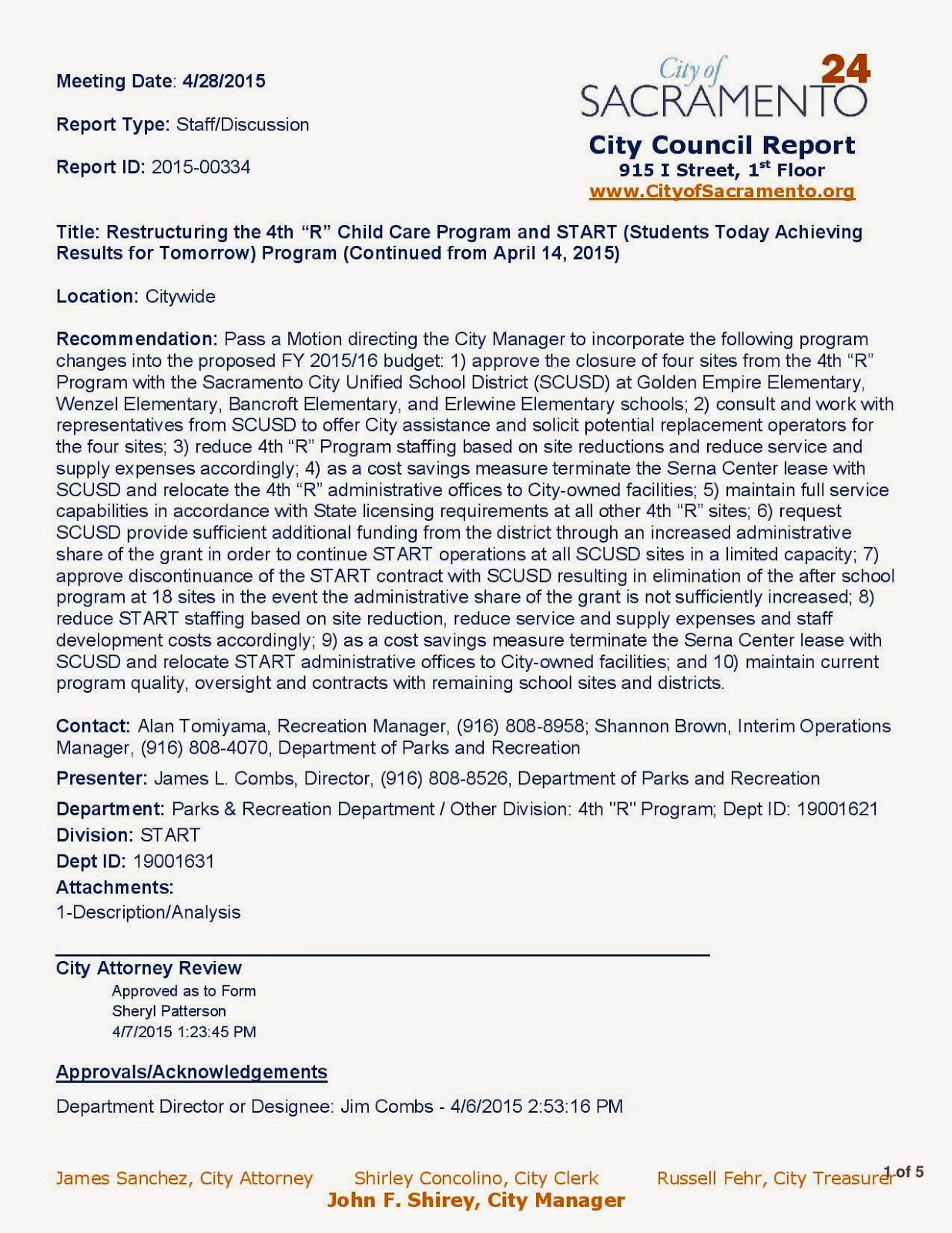
The city of Sacramento is considering closing 4th “R” after-school programs at four Sacramento City Unified School District campuses and severing its ties to another after-school program at 18 schools.
A City Council discussion on the proposal scheduled for Tuesday night was postponed until April 28. Eric Guerra, who last week won a City Council seat representing one of the affected 4th “R” campuses, is scheduled to be sworn in that evening. City Manager John Shirey and council members said they wanted to allow Guerra to take part in the debate and explore ways to save the programs.
Under what the city said is a cost-saving plan, 4th “R” would be eliminated at Golden Empire Elementary in Rosemont, Caroline Wenzel Elementary School in Greenhaven, Hubert H. Bancroft Elementary in College Greens and O.W. Erlewine Elementary in Larchmont Riviera. Golden Empire, Bancroft and Erlewine are within 1 mile of one another.
According to a city of Sacramento staff report, the 4th “R” program is facing a budget deficit of $458,000 for the fiscal year that begins July 1. That gap is partly the result of increasing employee costs; many employees at 4th “R” sites recently joined a labor union, and the city now must pay those workers increased benefits, according to Alan Tomiyama, the city’s recreation manager.


Read more here: http://www.sacbee.com/news/local/education/article18519929.html#storylink=cpy

At the same time, enrollment in the 4th “R” programs has steadily declined at the four campuses slated to be closed as more parents enroll their children in free after-school programs at those campuses. There are 187 children combined in 4th “R” at the four schools, Tomiyama said.
About 90 percent of the funding for 4th “R” comes from fees paid by parents and guardians of children in the program; the other 10 percent is from state grants that help subsidize the program for low-income families. With the majority of 4th “R” funding generated by parent fees, dwindling enrollment has damaged the program’s budget.
Golden Empire, Bancroft and Erlewine all have free START after-school programs operated by the city. Wenzel has a free program offered by an outside vendor.
“These four sites are the lowest enrolled sites because, quite frankly, the vast majority of clients (at the schools) are going to the (free after-school programs),” Tomiyama said.
Felise Dooley is one of the parents who has moved a child from 4th “R” to a free after-school program.
Dooley pulled her car to the front of Wenzel Elementary on Tuesday morning and said she hoped to learn about after-school options for a child who attends a charter campus nearby. Her third-grade son used to attend Wenzel and its 4th “R” program, she said. But the cost was between $400 and $500 a month. Now she hopes to enroll him in the free California After School Education & Safety Program (ASES) operated at the campus – one of the multiple vendors that provide a free after-school program.
“It keeps him busy, keeps his brain stimulated for summer and even after school,” she said.
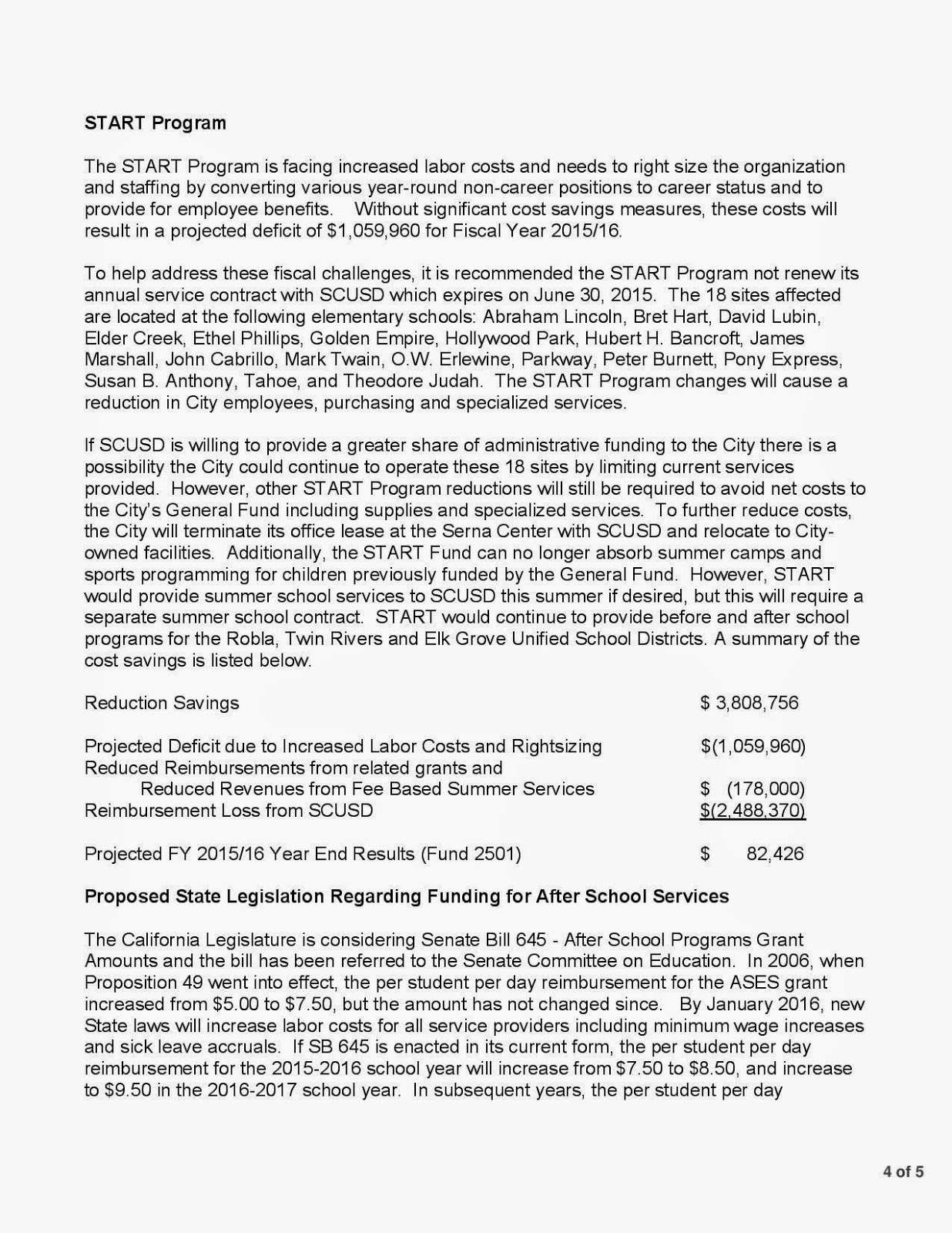
The free START program is also about to run a deficit. Employee salaries and benefits are rising, and the program will carry a $1 million deficit in the upcoming fiscal year “without significant cost saving measures,” according to the city report. As a result, the city plans to cut its ties with START at 18 schools. However, free after-school programs are expected to continue at those campuses.
Most of START’s funding comes from state and federal grants. The program receives 10 percent of its budget each year from the city of Sacramento’s general fund.
START began in 1996, fostered by then-City Councilman Darrell Steinberg. Within three years it grew to 42 schools serving 7,000 students, offering homework help, recreation and literacy education.
The program is available only to schools that qualify for at least 50 percent free and reduced-price meals.
Steinberg, who served as state Senate president pro tem until last fall, said Tuesday that the after-school brand remained in Sacramento but became an inspiration for other after-school programs across the state.
“When I started it, it got a lot of attention in the capital city, and the Legislature picked it up, and (U.S.) Sen. (Barbara) Boxer picked it up,” Steinberg said. “It was a significant catalyst to the statewide programs.”
Steinberg said he knew about the START deficit and hopes a replacement is found.
“I love the brand,” he said. “It has done a lot of good over the years. But that’s less important to me than making sure the same number or more children get comprehensive after-school experience.”
The Sacramento City Unified School District does have plans to look for other vendors to continue the after-school program at the 18 schools. District Superintendent JosƩ Banda told parents in a letter last week that funding is available for START through state and federal grants, and the after-school programs will not be eliminated.
“I’m talking with (Banda) about the need to keep these sites open based on the letters I’ve received and the need I know these communities have,” said Councilman Rick Jennings.
The fate of 4th “R” is less clear.
Banda wrote parents last week that the district is working with the city to find a solution to the proposed elimination of 4th “R” at the four schools. Jennings, who represents Greenhaven, said the city is exploring whether the district or an outside vendor can assume responsibility for the programs.
Shirey said the city is negotiating with the school district and, “We hope those will be productive discussions, and we may be able to return (to the City Council in two weeks) with a different set of recommendations.”
Call The Bee’s Ryan Lillis, (916) 321-1085. Read his City Beat blog at www.sacbee.com/citybeat.
4th “R” programs would be eliminated at the following schools: Golden Empire Elementary, Wenzel Elementary, Bancroft Elementary and Erlewine Elementary.
The city would no longer operate START after-school programs at the following schools: Abraham Lincoln, Bret Hart, David Lubin, Elder Creek, Ethel Phillips, Golden Empire, Hollywood Park, Hubert H. Bancroft, James Marshall, John Cabrillo, Mark Twain, O.W. Erlewine, Parkway, Peter Burnett, Pony Express, Susan B. Anthony, Tahoe and Theodore Judah.

Read more here: http://www.sacbee.com/news/local/education/article18519929.html#storylink=cpy

THE 4TH "R"

4thr house logoYEAR-ROUND CHILD CARE

Conveniently located on many elementary school campuses, The 4th “R” offers year-round child care for Kindergarten through 6th grade children. We offer a safe, well supervised, comfortable, and supportive environment for your child.
In operation since June 1986, The 4th “R” introduces children to a variety of recreational activities while providing a well-planned, nurturing environment that promotes healthy development of the child. Qualified staff provide a wide variety of group and individual activities to enhance your child’s physical, social and emotional development.


Corporate Education Reform: Are We Getting It Right? Can We Make More Money?

Global Conference 2015 | K-12 Education Reform: Are We Getting It Right? » Milken Institute:


K-12 Education Reform: Are We Getting It Right?
Tuesday, April 28, 2015 / 9:30 am - 10:30 am


Moderator
Lowell Milken, Co-Founder, Knowledge Universe Education; Founder, National Institute for Excellence in Teaching (NIET)


Speakers
Rudolph Crew, President, Medgar Evers College, the City University of New York; Former Chancellor, New York City Public Schools
John Deasy, Superintendent-in-Residence, Broad Center for the Management of School Systems; Former Superintendent, Los Angeles Unified School District
Sara Heyburn, Executive Director, Tennessee State Board of Education
Eva Moskowitz, Founder and CEO, Success Academy Charter Schools
Gary Stark, President and CEO, National Institute for Excellence in Teaching


The hard work of policymakers, educators, parents and students to improve America's elementary and secondary schools has begun to pay off. But all too many students in large urban districts and rural areas are still being left behind. Leaders must remain diligent to ensure that students in every classroom have a high-quality educational experience. This panel will explore specific steps we can take move faster to improve the learning environment for all students. What role should charter schools, common core standards, teacher preparation programs and other initiatives play? How do we evaluate the role of the federal government, and what is the right balance between accountability and flexibility? Can we reach a consensus and collaborate on achieving shared goals?Global Conference 2015 | K-12 Education Reform: Are We Getting It Right? » Milken Institute: