Latest News and Comment from Education

Friday, April 10, 2015

Latest Test Security Issue Creates Anxiety for Teachers

Latest Test Security Issue Creates Anxiety for Teachers:

LATEST TEST SECURITY ISSUE CREATES ANXIETY FOR TEACHERS


Please do not miss this as The War Report on Public Education discusses the criminalization of black teachers and the new "school-to-prison pipeline."

Click on the website below to listen live and join the discussion:
http://bbsradio.com/thewarreport


 The Atlanta test cheating scandal fresh on their minds, Oklahoma teachers have had a higher-than-usual level of anxiety over a security flub by a test vendor.

Earlier this week news started leaking out from teachers who are taking training to begin the Spring testing season that seals on every third grade reading and math test booklet were missing.
Third grade teachers state-wide have their reputations and evaluations riding on their students’ performance on the tests.
As that news spread, social media started to buzz about the possible consequences to the seals being missing. Teachers had a lot of questions about negative possibilities.
  • When the test booklet instructions are very plain to instruct students to break the seal on their booklet, what happens if the teacher/test administrator leaves that part of the instructions out as they were later instructed to do in training?
  • Could a teacher have their license in jeopardy if they went ahead with administering the tests?
  • When results come out later and they show marked improvement for a particular teacher, will the lack of a seal on the packet cause others to question the validity of the results?
In a discussion on social media, one teacher said, “I think y’all should support teachers’ refusal to administer tests that aren’t sealed.”
That teacher went on to argue,
Also, the “script” is wrong so the Test Administrator has to go off script to administer the tests. In order for teachers to have their certificates protected, it seems that specific script by the SDE should be developed and immunity from prosecution should be distributed, before Teachers administer the test.
Rob Miller, a middle school principal and education blogger, wrote in a recent post,
If I was a third grade teacher, I would not touch these booklets without a witness or proctor with me at all times. Based on what happened last week with the Atlanta educators, I’m not taking any chances. The message has been clearly communicated.Don’t cheat.
More importantly, don’t even put yourself in a position where someone might suspect or accuse you of cheating.
The lack of security seals on these tests puts teachers at increased risk of false accusations on their integrity. What happens next year if a teacher’s scores go up higher than would normally be predicted? Will some people think the teacher somehow gained an advantage by viewing this year’s test? If yes, will an investigation be ordered?
At least one legislator, Jason Dunnington (D-HD88), asked the Oklahoma State Department of Education about the changes made to the third grade test instructions.
He reported back to several teachers that he was convinced that there would not be any repercussions to teachers following the revised instructions not to tell students to break the seal on their test booklet that is not there anyway.
But not everyone was as nervous or concerned as some.
Tyler Bridges, a current and experienced school administrator, said in one social media chat,
District test coordinators get probably 10+ emails a year about changes in directions bc of mistakes. These emails come from the Latest Test Security Issue Creates Anxiety for Teachers:

NPR wants their name taken off program on Chuy that was critical of Rahm. | Fred Klonsky

NPR wants their name taken off program on Chuy that was critical of Rahm. | Fred Klonsky:


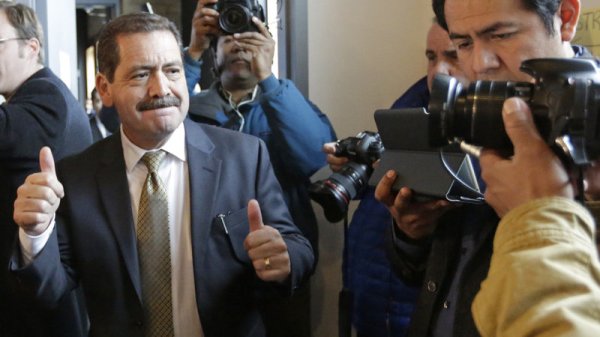
NPR wants their name taken off program on Chuy that was critical of Rahm.


ap312382036744_wide-679b4ce0abf9eb17a42f5c9c485c53c503312e74-s800-c85


 NPR has a sliding scale when it comes to their journalistic standards.

For example, it was only after investigative reporter David Sirota exposed the fact that the Laura and John Arnold Foundation was funding a series critical of public employee pensions were they forced to return Arnold’s $3.5 million. Arnold is a major critic of public pensions.
But their claim of journalistic standards caused them to remove their name, pulled their branding, from an episode of Latino USA about Chicago’s mayoral race.
It aired last week.
The program criticized Rahm as “caring only about millionaires and billionaires.”
“Chuy and the battle for Chicago,” the April 3, 2015, episode produced byLatino USA, does not meet NPR’s editorial standards. NPR distributes Latino USA to more than 130 stations, and did not have an opportunity to review the program prior to distribution.
In the episode, his opponent and other critics make some serious charges about Mayor Rahm Emanuel and the way he has governed the city. There are mentions of “financial mismanagement,” that he cares only about NPR wants their name taken off program on Chuy that was critical of Rahm. | Fred Klonsky:

District take steps to outsource substitute teacher services | Philadelphia Public School Notebook

District take steps to outsource substitute teacher services | Philadelphia Public School Notebook:

District take steps to outsource substitute teacher services

Officials say too many classrooms are without adequate staffing. The move may bring nonunion teachers into schools next fall.


The School District of Philadelphia wants to hire a private company to provide substitute teachers, a move that it says will improve coverage while possibly saving money. It will also bring nonunionized teachers into schools. 
On Friday the District posted a request for proposal (RFP) seeking bids on a service to fill some 500 empty classrooms a day, or an average of more than two per school. Currently, said Naomi Wyatt, the District's chief talent officer, it is able to fill only 64 percent of the vacancies – a poor rate that can destabilize the school day and costs money besides.
Teachers, principals, and other school employees must give up preparation periods or regular duties to monitor the empty classrooms. Teachers earn personal days as payback for the lost prep time.
"We recognize that we need to improve the quality and quantityof substitutes available to all District schools," said Naomi Wyatt. "We are seeking a vendor that can provide high-quality substitutes at a 90 percent fill rate." 
Wyatt said the current cost of substitute service, including the need to reimburse teachers, is more than $18.6 million a year. The District also wants the contractor they hire to provide subs for other positions, including principals, secretaries, supportive services assistants, and cleaners.
For all but the cleaners, who are represented by 32BJ SEIU, the workers can be replaced by nonunion members. 32BJ has a clause in its contract preventing any outsourcing for the length of its current contract. However, the District wants the vendor to handle the logistics of finding and placing the substitute cleaners, who will remain District employees.
Now, substitute teachers are required to be members of the Philadelphia Federation of Teachers and are paid according to per-diem and longer-term rates specified in the PFT contract. Daily pay can vary from $40 for an uncertified teacher to $180 for a retiree who has worked for 30 days in the school year. There are also long-term substitutes paid on a salaried basis.
Workers hired by a private company may or may not be unionized, Wyatt said.
PFT president Jerry Jordan did not immediately return a call seeking comment.
Wyatt said that Philadelphia teacher attendance rate is "pretty good for a large district." The real problem, she said, is a shrinking pool of substitutes – now at about 1,000. The rule of thumb is that a district should have two-and-a-half to three times the number of available subs as there are daily openings.
"We don't have a large enough pool to cover our average daily openings," she said. "The second challenge is that frankly a lot of subs only want to go to certain schools on certain days for certain positions. A small number is flexible, who want to go often and will go anywhere. We hope the vendor will create a larger pool and find more people willing to go anywhere." 
Under the current PFT contract requirements, subs cannot be paid more for taking hard-to-fill positions, she said. A vendor might be able to change the compensation structure to offer incentives, such as a bonus for taking at least 10 positions a month. "We aren't structured to pay those kinds of incentives," Wyatt said. 
Plus, an outside firm can pay more attention to the logistics of recruiting, training, and placing substitutes, Wyatt said. There are only four District employees now handling all the paperwork around substitutes, and the requests to take assignments are done by robocall, not by a person who can form relationships. The companies "have people who all day, all they do is call up subs and encourage them to take positions, they work the numbers and work the vacancies," she said. The vendor would be encouraged from the current pool of subs.
Many subs are retirees, but state rules prevent the District from going to them except as a last resort due to concern about "double-dipping" – receiving a pension while getting paid District take steps to outsource substitute teacher services | Philadelphia Public School Notebook:


How can we improve schools? It’s simple. Leave it to teachers | Education | The Guardian

How can we improve schools? It’s simple. Leave it to teachers | Education | The Guardian:

How can we improve schools? It’s simple. Leave it to teachers

For the past five years ideology has trumped children’s needs, says Sir Alan Steer, leaving poorer pupils behind. The priority of the next government must be to treasure the teachers


Students listening to teacher talking in classroom
The next government ‘should prioritise policies to raise the quality of teaching’. Photograph: Alamy


 he English school system is not underachieving. Among its 23,000 schools are examples of excellence to compare with any in the world – and standards today are incomparably higher than 40 years ago. A far wider section of society now benefits from a good education than would have been true in the immediate postwar period. As acknowledged in the 2014 report from the chief inspector of schools, there is much to applaud.

Unfortunately the success of the majority is not the complete picture. If most children succeed in realising their potential, some do not. If most schools continue to improve, a minority appear stuck in mediocrity. What is especially worrying is that the underperformance of children has a tendency to affect specific groups, particularly those from disadvantaged backgrounds. Explanations offered for this rarely survive close examination.
“Where”, asked Sir Michael Wilshaw in 2013, “do you think is the worst place in England to be a child from a poor family, in terms of educational opportunity? Is it inner London, Liverpool, Leeds or Manchester? Not at all. The evidence suggests that it’s west Berkshire.” Disadvantaged children in this lovely, affluent part of south-east England, he pointed out, last year had the worst attainment in the country at primary school; the second worst at secondary school and were in one of the bottom three local authorities for qualifications at age 19.
Such children, denied access to a good quality education, are often also being denied the opportunity to become fulfilled citizens. The link between educational standards and subsequent earning capacity is clear and well known, but the damage is not only to individuals. At a national level extreme inequality can affect economic growth. The Organisation for Economic Cooperation and Development calculated that increasing income inequality since 1985 in the UK had reduced growth in the 1990s by 9%. Over a longer period it claims that British GDP would have grown by 7% had income inequality been at the same level as in France.
What can be done? Some commentators, from both ends of the political spectrum, believe that the performance gap between different social groups is beyond the power of a school to change. But children from specific ethnic groups or social backgrounds are not inherently programmed to underachieve. They may face greater challenges, but there are many examples of these being overcome.
In the 1970s, we worried about the aspirations and achievement levels of girls. As a young headteacher in east London in the 1980s I found a culture of low expectation for children of Bangladeshi origin. London at that time was seen as a centre of poor schools and underachieving children. Few thought then that things could be different.
Today such attitudes appear ridiculous and offensive. The rise in the achievement and aspirations of girls over the past 40 years has been one of the great triumphs of society and the education system. The local authority of Tower Hamlets, with its large Bangladeshi population, is now considered as a beacon of excellence across Europe. London leads the country in educational standards for all groups and is envied by other national capitals.
Change for the better is always possible. There is no reason why disadvantaged children in Peterborough, West Berkshire, Barnsley, Herefordshire and the Isle of Wight should be condemned to starting life so much worse off than those living in Hackney. This postcode lottery of opportunity is unacceptable.
But ministers’ headline-grabbing schemes are often the wrong sort of change. Free schools are an example where politicians’ interests trump those of children. Often created in areas where there is no need and absorbing large amounts of public money, free schools fail to produce any sign that they will raise standards and help children. On the contrary. As society worries about religious intolerance, Matthew Taylor, chair of the Social Integration Commission, argues that the creation of free schools and the expansion of faith schools are increasing segregation between different ethnicities and classes.
Political interference in the curriculum and assessment of children is another example of the wrong kind of change. Central direction may be needed, but it should come from a credible professional source rather than from a “here today, gone tomorrow” secretary of state. Schools and teachers cannot concentrate on teaching if they are subject to constant change in the courses being taught.
Strategies for change should concentrate on what we know works. International studies over many years show that the quality of teaching makes the most difference. In September 2014 the Sutton Trust published a report, based on How can we improve schools? It’s simple. Leave it to teachers | Education | The Guardian:
When trainees ask the inevitable question – whether it gets easier as time goes by – we owe it to them to tell the truth. The teaching might, but the job doesn't 

A LETTER FROM THE DEAD - Dead 50

Dead 50:

A LETTER FROM THE DEAD

GratefulDead-SantaClara-480

More Info


Dear Heads,

Although none of us knew it when we walked off the stage at Soldier Field on July 9, 1995, the Grateful Dead's long strange trip ended in Chicago that night. As you are aware, twenty years later, we’re returning to Chicago to properly say Fare Thee Well.
But every good ending must start with a beginning. For us, it all began fifty years ago when we grabbed a bunch of instruments off the walls of a music store in Palo Alto California and began banging away on them in the back room, at night after the store had closed for the day.
Since we made the decision to go back to Chicago to say our final goodbye, it has become clear to us that we first need to return to our beginnings, where we first said hello — to each other and to all of you.
And so it is that we have decided to plug in for two additional shows on June 27 and 28 at Levi’s Stadium in Santa Clara, California — just a dozen miles south of where Dana Morgan’s Music Store once stood. At Levi’s — as at Soldier Field — we will have the pleasure of being joined by Trey Anastasio, Bruce Hornsby and Jeff Chimenti.
Ours wasn’t just a long, strange trip — it was a VERY long, VERY strange trip. We weren’t sure what it was going to be like to put a punctuation mark on the end of it. None of us anticipated the overwhelming outpouring of love and interest following our initial announcement of the shows at Soldier Field, and we were blown away by the response.
We have tried to do the right thing wherever we could for the Chicago shows by honoring the roots of where we came from, while dealing with the realities of the current times. But that’s hardly comforting when you’re shit outta luck for tickets and your only option is inflated prices on secondary ticketing websites. That would piss us off too.
From the moment these shows were first talked about, we have been thinking about what we could do to honor the roots of our Deadhead experience, even in the face of changing technologies. (Remember: Ticketmaster didn’t even go online until we got out of the game.) These shows were always intended as an expression of our gratitude, to both the music and the fans, so it’s important that we get things as right as we can.
We have always been proud of our in-house mail order ticketing process, and the phenomenal way our fans have built a tradition out of turning a standard envelope into a frame-worthy piece of art. Some 60,000 mail order tickets were issued for the Soldier Field shows by the good folks at Grateful Dead Ticket Sales — yet we were still crushed to see how many of your beautifully designed envelopes did not get tickets.
For shows of this magnitude, it’s impossible to eliminate every scalper. However, we offer you this: Working with our partners, we are using an online ticketing platform for the Levi’s shows that will help ensure that the tickets for these shows will get into the right hands, the hands of our true fans. We believe that this process is the best way to give each of you an equal opportunity to obtain tickets at the most affordable possible prices. We are are proud to announce that 65,000 tickets per night will be available via the "online mail order" for the Levi’s shows. For the nuts and bolts, go to Dead50.net.
We will not be adding any more Fare Thee Well shows. The three Chicago shows will still be our final stand. We decided to add these two Santa Clara shows to enable more of our fans to celebrate with us one more time. But this is it.
We love you guys more than words can tell, and hope to see you in the Bay Area or Chicago. If you can’t make it to the shows, we are working on ways for you to still experience our Fare Thee Well, from wherever you might be. Stay tuned for those details.
Gratefully yours,
Billy, Bobby, Mickey & Phil

Dead 50:


Grateful Dead - Truckin' - YouTube http://bit.ly/1GU8cYp

Pinpointing Reading Disabilities to Help Students Succeed

Pinpointing Reading Disabilities to Help Students Succeed:


1688897198_59a4054886

Pinpointing Reading Disabilities to Help Students Succeed

Reading disabilities exist. Research in neuroscience is showing this to be true, and public schools and special education should be on the front lines working to remediate these deficits and helping children to adapt so they can be successful in school.
One serious drawback for students with disabilities, in the one-size-fits-all class, is that they could stumble along, frustrated, without ever having their problems identified or remediated. This could prove to be a setback when they get to college—or be a hindrance for them getting into a good college.
Dyslexia, an inability to make sense of letters and words, has been getting a lot of attention lately. It has become something of a catch-all topic in regard to learning disabilities. Certainly, students with dyslexia would benefit from a resource class with a special education teacher who understands the difficulties dyslexia presents. I know parents who do not feel their children are being adequately served in school when it comes to dyslexia. They often turn to outside programs or resources for help.
But dyslexia isn’t the only learning disability that may fall under the radar screen or where students in school lack services. There are more and different disabilities besides dyslexia.
Two years ago Chaired Professor Laurie E. Cutting, a scientist from Vanderbilt, described an overlooked disability—Specific Reading Comprehension Deficits, or S-RCD. Students with S-RCD might appear to read O.K., on the surface, but they find it difficult to understand what it is they read. Getting special help, once this disability is identified, could be the key to a student’s future success.
What was interesting about Cutting’s and her co-researchers’ study, was that by examining MRIs and other neurobiological markers, they found differences between reading comprehension disabilities and dyslexia. Here is what they said:
Researchers have been able to pinpoint brain activity and understand its role in dyslexia, but no functional magnetic resonance imaging or fMRI studies, until now, have examined the neurobiological profile of those who exhibit poor reading comprehension despite intact word-level abilities.
Neuroimaging of children showed that the brain function of those with S-RCD while Pinpointing Reading Disabilities to Help Students Succeed:


Boot Camp or School? Critics Worry Charters for Minority Kids Are Too Militant - Yahoo News

Boot Camp or School? Critics Worry Charters for Minority Kids Are Too Militant - Yahoo News:

Boot Camp or School? Critics Worry Charters for Minority Kids Are Too Militant


Their controversial methods sound like a cross between Harvard and a Marine Corps boot camp: strict dress and posture code, high (and rigid) expectations, public shaming of underachievers, zero tolerance for shenanigans.
In the no-excuses culture of some charter schools, it’s common for administrators to wave good-bye to teachers who can’t hack it and heap praise on a student who wet himself rather than take a bathroom break at test time.
There’s no arguing, however, with the results of the aptly named Success Academy, a New York City–based chain of charter schools that’s known for academic achievement as much as militaristic discipline. Student test scores are strong—Success students are typically among New York state’s top performers—and each year parents scramble to enter a long-odds lottery just for a chance to enroll their kids.
Yet critics say Success—and other tough-love charter schools, such as Chicago’s Noble Street chain—are sacrificing education, and students’ love of true learning, on the altar of a misguided,teach-to-the-test culture.
For all its achievement, Success’ pressurized environment has led to one of the higher rates of student suspension and expulsion in New York, along with a teacher turnover rate that’s all but put a revolving door on the faculty lounge.
“It’s really quite high” compared with traditional public schools, says Pauline Lipman, a University of Illinois–Chicago educational policies professor and an expert on urban education and inequality. The tough standards and hyper-focus on test scores, she says, typically don’t leave room for creativity, independent thought, or individualized education—it prepares kids to take tests instead of preparing them for college.
“They basically drill kids in a good portion of the year. And when kids don’t [achieve], then they are shamed,” says Lipman. That approach, she says, teaches kids that “it’s their own fault because they aren’t putting forth the effort.”
That’s true at Success Academy: Low-scoring students are sent to “effort academies,” whichThe New York Times recently described as part detention, part study hall. At the same time, Success and other no-excuses charter schools have suspension and expulsion rates up to six times higher than traditional public schools, and they’ve been accused of pushing out students with learning or emotional disabilities.
There’s another problem with the approach: “I think it’s grounded in race,” Lipman says. “It sees poor [minority] families as pathological” and assumes they’re poor because they aren’t working hard enough. 
The student populations at no-excuses charters “are almost entirely black and Latino,” says Lipman, and the schools are located in poor communities with failing traditional public schools. Those charters, she adds, convince parents—and school administrators—that tough love is the answer rather than giving chaotic, underachieving, understaffed, and overwhelmed neighborhood schools the resources they need to succeed.
But one parent says critics of Success Academy are painting things with a broad brush. Ariela Rozman, whose son attends a Success Academy school in New York City, says he is thriving, eager to learn, and can’t wait for classes to start in the morning.
“I can’t help but feel that there is an implicit assumption in education debates that parents whose children are primarily served by charter schools like Success—who tend to be low-income students of color—aren’t capable of making those choices or have somehow been duped into buying into these schools’ philosophies,” she wrote in an essay in The Huffington Post published on Thursday.
“That’s deeply biased and flat-out wrong,” Rozman continued. “I think we can safely say that the thousands of parents who descended on Albany recently, advocating for their children’s right to stay in Success Academies, or the parents of the 20,000-plus children who enter the lottery for spots in Success Academy schools each year haven’t been hoodwinked.”
“They’re making real, informed choices—just like I do,” wrote Rozman, “about what they want for their kids.”
 

Related stories on TakePart:


Original article from TakePart

Florida puts limits on standardized testing

Florida puts limits on standardized testing:

Florida puts limits on standardized testing


Responding to a backlash about the continued use of high-stakes standardized tests, the Florida Legislature on Thursday passed significant changes to the system that was primarily put in place by former Gov. Jeb Bush.
The changes, though not as wide as critics wanted, still represent a departure for Republicans who had fully embraced the reforms championed by Bush during his eight years in office. Bush is touting his reforms in what appears to be a likely presidential campaign.
The measure sent to Gov. Rick Scott would limit the amount of testing that can be done in public schools, including a firm cap of 45 hours of state-authorized testing per year. It would also undo a restriction on school starting dates that had been put in place at the urging of Bush. Schools could start as soon as Aug. 10 under the bill.
House Speaker Steve Crisafulli contended that the changes should not be seen as retreat from the A+ plan adopted back in 1999, Bush's first year as governor.
"We have made great strides in Florida based on the A+ plan," said Crisafulli, a Merritt Island Republican. "I think we continue to make great strides, and a lot of that was based off those policies, but we're always open to massaging those policies, and that's what taken place."
Scott has not yet said whether he will sign the bill into law, but the GOP governor in the past has echoed those who said the amount of testing in state schools has gotten out of hand. Scott earlier this year suspended an 11th-grade standardized test that had been scheduled for spring.
Bush's A+ plan expanded the use of standardized tests from the third grade to 10th grade. It also created an A-to-F grading system of schools tied to test results. Schools with top grades are rewarded with extra money, and chronically failing schools can be subject to sanctions.
Other tests, including end-of-year exams, were added later by legislators to the state's standardized testing regimen. This year Florida switched to a new test — called the Florida Student Assessment — based on new standards primarily founded on Common Core. The rollout of the test was marred by technical glitches.
But even before the test was given this year a backlash was mounting. One southwest Florida school district voted in August to opt out of statewide testing. The board reversed the decision a week later.
The mounting frustration was evident on the Senate floor last week. Sen. Tom Lee, who had been Senate president while Bush was in office, complained there was "too much damn testing" going on in the state. He also complained about the influence on education policy by the foundation set up by Bush to promote his changes.
Senators insisted on adding clauses to the bill sent to Scott that would delay the release of this year's school grades until an independent review of the new test can be performed. Other sanctions associated with annual testing would also be put on hold while the review is underway.
Some legislators said the bill still doesn't do enough to undo the current system.
"I don't think it's a panacea, and I'm afraid we will hear a lot from educators," said Rep. Dwight Dudley, a St. Petersburg Democrat.
Despite the public criticism leveled at the group, the executive director of the Foundation for Florida's Future still praised the bill now headed to Scott.
"They voted to keep education transparent and provide teachers with the information they need to help students learn, while ensuring testing at every level is done Florida puts limits on standardized testing:


Why the Senate’s proposed No Child Left Behind rewrite doesn’t go far enough - The Washington Post

Why the Senate’s proposed No Child Left Behind rewrite doesn’t go far enough - The Washington Post:

Why the Senate’s proposed No Child Left Behind rewrite doesn’t go far enough


 Sen. Lamar Alexander, the Tennessee Republican who is chairman of the Senate education committee, and ranking Democrat Sen. Patty Murray of Washington state recently reached an agreement on a rewrite of No Child Left Behind that, if it were to become law, would significantly reduce the federal role in local public education.

The “Every Child Achieves” proposed legislation would, for example, shift decisions about how to evaluate teachers, what to do about low-performing schools and other matters from the federal government to states and local school districts. But there is something it would not do: eliminate federally mandated standardized testing for grades 3-8 and once in high school.
Here is a piece that looks at the details of the proposed legislation, written by Monty Neill and Lisa Guisbond. Neill is executive director of  FairTest, or the National Center for Fair and Open Testing, which is dedicated to eliminating the abuse and misuse of standardized tests. Guisbond is an assessment reform analyst at FairTest.

By Monty Neill and Lisa Guisbond
Despite proposing important steps to reduce the harmful uses of standardized exam results driven by No Child Left Behind, this month’s Senate committee draft legislation – “Every Child Achieves” – fails to address the law’s deeply destructive annual testing mandate. To fix this, Congress must respond to the growing grassroots movement calling for less testing and more learning.
NCLB, the current version of the Elementary and Secondary Education Act (ESEA), significantly harmed public education, especially for vulnerable students. This is primarily because of two flawed components: mandated annual testing in reading and math in grades 3-8, plus once in high school; and the punitive sanctions attached to those tests. The consequences include narrowed curriculum, teaching to the test, increased cheating, a wider school-to-prison pipeline, and emotional damage to children.
Unfortunately, the bill proposed by Sens. Alexander and Murray keeps the mandate to test every student every year in elementary and middle school.Advocates for assessment reform will push for amendments to eliminate the every-grade testing requirement, specifically cutting reading and math tests to once each in elementary, middle and high school (“grade span” testing).
The Senate committee bill would allow use of performance assessments as one part of an accountability system. Performance assessments include portfolios, projects and extended tasks, such as research papers and lab experiments. Well-designed and implemented performance assessments promote in-depth, engaging instruction with powerful outcomes for students. However, their positive impact is limited in the context of a test-driven system. Without addressing the problem of testing in every grade every year, therefore, this rewrite would perpetuate an educationally damaging system.
The bill does provide for an “innovation” program, through which up to five states can apply in the new law’s first three years. It would allow states to build systems focused on portfolios and projects that could replace statewide exams for accountability purposes. The systems could include locally-designed assessments that vary across schools and districts but still produce comparable results across the state.
While creating the new assessments, participating districts would not have to use the state test. The best current example is the New York Performance Standards Consortium, a network of 48 public high schools. They require students to successfully complete extended tasks in four Why the Senate’s proposed No Child Left Behind rewrite doesn’t go far enough - The Washington Post:

A Bipartisan Proposal to Fix No Child Left Behind: A Good First Step; Further to Go | ED.gov Blog

A Bipartisan Proposal to Fix No Child Left Behind: A Good First Step; Further to Go | ED.gov Blog:

A Bipartisan Proposal to Fix No Child Left Behind: A Good First Step; Further to Go


 Earlier this week, Senators Lamar Alexander (R-TN) and Patty Murray (D-WA), the Chair and Ranking Member of the Senate education committee, announced an agreement to begin a bipartisan process of fixing the Elementary and Secondary Education Act (ESEA), also known as No Child Left Behind (NCLB). The committee will consider the proposed bill next week. This agreement, however, is just a beginning. As I detailed in a speech yesterday at the Martin Luther King Jr. Memorial Library in Washington, D.C., there is work ahead to deliver a bill that fulfills the historic mission of this law.

Congress originally passed ESEA 50 years ago this week. Then as now, it stood to connect civil rights to education, enshrining America’s core value that every child deserves a quality education, no matter her race, disability, neighborhood, or first language. I am happy to see this bipartisan effort come together, yet I also know the distance we have to go toward a bill that establishes an expectation of excellence for all American children, and stays true to ESEA’s role as a guarantor of civil rights.
ESEA must continue this nation’s vital progress in closing gaps for vulnerable students. In that effort, there is more yet to do.
Positive Steps
The Alexander-Murray proposal moves reauthorization forward in important ways, including requiring States to adopt college- and career-ready standards as part of the effort to ensure that all students are prepared for the demands of higher education and the workforce. It also would require that states set achievement goals and graduation rate goals for all students and student subgroups. And, the proposal would provide more flexibility than NCLB for states and school districts, and ensure that parents know how their children and children’s school are doing by keeping requirements for annual statewide assessments.
The bipartisan agreement also provides improved support for educators, especially for principals and school leaders. And it takes steps in the right direction by promoting transparency on resource inequities and rejecting earlier proposals to allow resources to be siphoned away from our neediest schools.
Further to Go
Yet there are areas where this bill doesn’t do enough to support the learning of students throughout this country. As the bill progresses, we look forward to working with Congress to ensure that a final bill will do more to maintain the crucial federal role in protecting our country’s most vulnerable students. The goal is not just to identify a problem, but to do something about it.
A good bill must expand access to high-quality preschool, to give children a chance to get off to a strong start in life.
A good bill must ensure that schools and educators have the resources and funds they need to do their jobs – and that schools with high proportions of low-income and minority students receive their fair share of those resources.
A good bill must ensure meaningful accountability, and support for action, in any school where subgroups or the whole school are persistently underperforming.
A good bill must ensure bolder action and focused resources for the lowest-performing five percent of schools, including America’s lowest-performing high schools.
A good bill must ensure strong support for innovations by local educators that change outcomes for students.
And a good bill needs to close a long-standing loophole in federal law that undermines the ability of Title I funds to provide supplemental resources for schools serving high concentrations of students from low-income families, and allows local funding inequities to continue.
Photo of Star
Star Brown
Yesterday, at the Martin Luther King Jr., Memorial Library in Washington, D.C., I had the great opportunity to share the story of four-year-old Star Brown from Minneapolis. In her short life, she and her family have faced enormous challenges, and she could easily have ended up behind, before she ever started school.
With the help of teachers at the Northside Achievement Zone, however, Star is overcoming her challenges and is on track to start kindergarten next year. Her story is one of opportunity made real.
It’s easy to say that every child deserves opportunity—regardless of race, disability, zip code or family income. And it’s easy to say that we expect excellence from all our children. But it takes work to make opportunity real. Star, and the millions more students like her, deserve all the support and opportunity this country has to offer. Our work is to make sure that opportunity is not just a possibility, but a promise. Now is not the time to turn back the clock.