Latest News and Comment from Education

Thursday, February 19, 2015

Fixing Our National Accountability System: Part 1 | The Crucial Voice of the People

Fixing Our National Accountability System: Part 1 | The Crucial Voice of the People:


Fixing Our National Accountability System: Part 1


"Mad Woman" found at http://fiftyfourandahalf.files.wordpress.com/2012/05/mad-woman.jpg and in homes across the country!
“Mad Woman” found at http://fiftyfourandahalf.files.wordpress.com/2012/05/mad-woman.jpg and in homes across the country!


 The latest Marc Tucker publication from the National Center on Education and the Economy (NCEE) is titled “Fixing Our National Accountability System.” I have so many issues with the title alone that it didn’t take long to decide that my responses would obviously require more than one blog.

First the words “Our National.” National means affecting the nation as a whole.
That IS the problem with our current U.S. education accountability law – No Child Left Behind (NCLB). That law put in place a test-based system that affected the whole nation in a negative way – no doubt about it.
Did it then go further and become a “federal” accountability mechanism? “Federal” means a union of states in which members agree to designate a central authority. Did NCLB do that? You bet it did! Our congressmen and women acted – and gave authority to the U.S. Department of Education to execute their law. NCLB is the federal educationlaw of the land controlling the use of high-stakes standardized tests for Fixing Our National Accountability System: Part 1 | The Crucial Voice of the People:

Doug Christensen on ESEA: Time for the Voices of Educators, Parents and Students to be Heard - Living in Dialogue

Doug Christensen on ESEA: Time for the Voices of Educators, Parents and Students to be Heard - Living in Dialogue:


Doug Christensen on ESEA: Time for the Voices of Educators, Parents and Students to be Heard 


 By Anthony Cody.

I first heard of Doug Christensen back in 2008, when he was still serving as Commissioner of Education in Nebraska. He was forced to resign because the locally-based assessment system he had developed there did not meet the mandates of No Child Left Behind — as described in this interview here. I connected with Christensen again a couple of years later, and we discussed the importance of local initiative and self determination. This week, I caught up with him again, as he has been on Capitol Hill, sharing his views with lawmakers wrestling with the reauthorization of ESEA. Here is what he has to say.
doug2
  1. What are you telling our representatives in Congress this week in regards to ESEA?
Doug Christensen:  I support the notion that it is time for our federal government to reduce its “footprint” in the business of states. The constitution of each state clearly provides for and is responsible for the education of the youngest of each state’s people. It is not the role of the federal government. The role of federal government is to incentivize things like CTE, high poverty programs, safe and drug free schools and out-of-school learning centers.
Of course, this brings up the caveat so often cited that “if you are going to accept federal monies, you need to be accountable for it.” First, there is no such thing as “federal money.” The money with which the federal government has been entrusted belongs to the citizens and taxpayers in the states. Second, the federal government can not be a proxy for the citizens and taxpayers of any state. The accountability for the use of any public funding is back to the people who pay, i.e., local taxpayers. Federal accountability has too long displaced state and federal accountability. Third, of course states need to be accountable for their intentions in terms of what they will do with the monies received from federal grants and then be accountable for spending it for the purposes it is intended to serve. Beyond that, the accountability is back to the taxpayers of the state for the results in terms of student learning.
The best way for the federal government to reduce the footprint is to back up the testing requirement to grades 4-8-11 and let the states fill in the other grades with state or locally-determined assessment systems. As long as the requirement remains for every grade testing, there is no space for states and school districts to implement strategies designed to create more and better opportunities to learn for each child because that space is taken up by test prep, test taking and reporting. We can do better with our time and monies.
  1. How has your experience in Nebraska shaped your perspective on standardized tests?
Doug Christensen: More than ever, I am convinced of the harm being done by standardized testing. All of the research confirms that standardized tests measure advantage and not learning. And, they measure content recall, not application or higher order learning skills. So much of the test prep time is reserved for going over and over content pieces so that students can recall them…….not learn them.
I am also convinced that if we do not bring assessment out of the curriculum and instruction of the classroom (rather than out of the standards), we will never really know what and how well students are learning. Assessment should never be an end of instruction. When it is, using the data is a “forensic” activity while assessment that is embedded in instruction is “anthropomorphic” and useful while instruction is going on. The classroom teacher is the person who is with the students as they are learning (anthropomorphic) and they need data but the kind that verifies their judgments about who is learning, what are they learning, who is not learning and what is it they are not learning. No standardized test can answer those questions, only Doug Christensen on ESEA: Time for the Voices of Educators, Parents and Students to be Heard - Living in Dialogue:

Big Education Ape: Twitter Call to Action! Tweet your trouble with NCLB rewrite! The Network For Public Education | http://bit.ly/1AjngfH

New Education Initiative Replaces K-12 Curriculum With Single Standardized Test | The Onion - America's Finest News Source

New Education Initiative Replaces K-12 Curriculum With Single Standardized Test | The Onion - America's Finest News Source:


New Education Initiative Replaces K-12 Curriculum With Single Standardized Test

NEWS • Education • News • ISSUE 51•07 • Feb 19, 2015

Parents Can Opt Out United Opt Out National

Click Here to go to United Opt Out National: 


Click Here to go to the WebsiteUnited Opt Out Team

WASHINGTON—Citing the need to measure student achievement as its top priority, the U.S. Department of Education launched a new initiative Thursday to replace the nation’s entire K-12 curriculum with a single standardized test.
According to government officials, the four-hour-long Universal Education Assessment will be used in every public school across the country, will contain identical questions for every student based on material appropriate for kindergarten through 12th grade, and will permanently take the place of more traditional methods such as classroom instruction and homework assignments.
“By administering one uniform test to our nation’s 50 million students, we can ensure that every child is evaluated by the exact same standard, regardless of background, age, or grade level,” said Education Secretary Arne Duncan,
explaining that students will be able to take the test at any time between age 5 and 18. “It’s absolutely crucial for us to know where our kids stand, and eliminating the teaching model will provide us with the most affordable and efficient means of measuring student proficiency.”

“There is no better way to ensure consistency in America’s schools,” Duncan added.
The new test will reportedly cover all topics formerly taught in K-12 classrooms, including algebra, World War I, cursive penmanship, pre-algebra, state capitals, biology, letters of the alphabet, environmental science, civics, French, Newtonian mechanics, parts of speech, and the Cold War. Sources said students will also be expected to demonstrate their knowledge of 19th-century American pioneer life, photosynthesis, and telling time.
“By doing away with the overly complex program of full-length school days and lessons stretched out over 13 academic years, we can concentrate on increasing the reliability of our data and determine just how each student stacks up,” said Patrick Herlihy, an education researcher who helped design the test. “This is the best, most comprehensive way yet of holding our schools accountable.”
“This initiative also has the potential to help level the playing field,” Herlihy continued. “Kids in Mississippi, for example, will have literally the exact same educational opportunities as kids in Massachusetts.”
Officials confirmed the test will consist mostly of multiple-choice questions, though it will also include an essay section in which students will be able to choose from one of several prompts, ranging from “Describe the American system of federalism,” to “If I could be any animal in the world, I would be a…,” to “Write a book report on Lois Lowry’s The Giver.”
Jeff Escudero, a 10-year-old from Winamac, IN who plans to take the test and hopefully complete New Education Initiative Replaces K-12 Curriculum With Single Standardized Test | The Onion - America's Finest News Source:

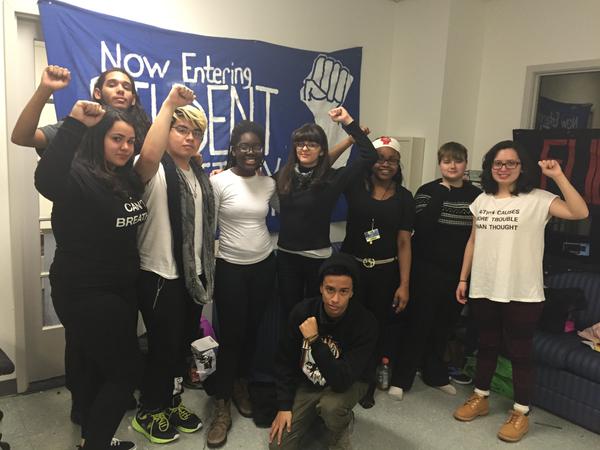
CURMUDGUCATION: Newark Students Occupy District Offices #OccupyNPS

CURMUDGUCATION: Newark Students Occupy District Offices:


Newark Students Occupy District Offices

Embedded image permalink


Social media is an amazing thing. I've been following events in Newark from the comfort of Pennsylvania. And it has been rather exraordinary.

Newark students have occupied Superintendent Cami Anderson's office. As reported by Bob Braun, who was there with the students during the first night (you could see him in the background on the video feed), the actual occupation was not too tricky. A board meeting was going on upstairs, and the office on the 8th floor was just open and unguarded.

The Newark students are not strangers to this brand of activism. They have previously occupied a board meeting and helped scare Anderson away from an appearance at AEI in New York.

That was Tuesday night. The district, as reported by Braun, was initially confrontational, then switched gears to expressing concern for the students and promised water and access to bathrooms.

By Wednesday, the district appeared to be playing a harder brand of ball. Police reportedly delivered this letter to parents of students in the office, telling them to get their kid the heck out of there.

That didn't happen. Students in the office were told there was pizza for them-- outside in a school bus waiting to take them to school. Much of the day involved tweets, phone calls, and other communications regarding food for the students that district officials insisted was not being held up but which clearly was not getting to the students. (The live streaming from inside the building made this kind of obfuscation hard for the district to pull off.)

Late in the evening, a group of clergy arrived at the building and told security that they were clergy and they were taking the food up to the students. They delivered the food, along with some words of support and encouragement, led some prayers for the students, the building, and the city, and then returned outside to a rally in front of the building where just about every civic leader in Newark was gathered, speaking to the press. The district claims it has been attempting to talk to the students and negotiate, but the students have not said a word that I've seen to indicate they've heard any such overtures. I'm pretty sure the threatening letters and the bus pizza gambit don't 
CURMUDGUCATION: Newark Students Occupy District Offices:

UltraViolet | Teach consent in high schools

UltraViolet | Teach consent in high schools:


Teach consent in high schools

This is HUGE: the U.S. Senate is going to vote on legislation that could help significantly reduce sexual assault and intimate partner violence in schools across America.

Women ages 16-24 are the most likely to experience sexual violence, and it's a huge problem especially on college campuses, where one in five survive sexual assault. In recent months, two state-wide education systems have passed mandatory affirmative consent rules for higher education campuses, and private colleges across the country are incorporating education about preventing sexual violence into student programming.

But students shouldn't have to wait to arrive at college to learn about consent--information about consent and healthy, respectful intimate relationships should be included right along with the crucial information about STIs and pregnancy teenagers are already learning in high school. And the Teach Safe Relationships Act will insure that age-appropriate, comprehensive information is presented to students in their high school health classes. Add your name.

Tell your Senator:

Cosponsor the Teach Safe Relationships Act and incorporate information about consent, sexual assault, and violence prevention in the national high school sex ed curriculum. UltraViolet | Teach consent in high schools:


AFT logoThe American Federation of Teachers (AFT) is joining UltraViolet's campaign to support this legislation and teach age-appropriate information about consent.

Mark Naison: "It's like the Gestapo, the education Gestapo!" - Citizen Combatants: Education Activism in New York State

Mark Naison: "It's like the Gestapo, the education Gestapo!" - Citizen Combatants: Education Activism in New York State:


Mark Naison: "It's like the Gestapo, the education Gestapo!"


Last summer Mark Naison and I walked together across the verdant lawn at Fordham University.  He wore a heavy black brace on his left knee and he was limping badly.  It was an old tennis injury, Mark explained, that he had exacerbated by playing hard even as his orthopedist had told him to rest.  For anyone else, that black brace would have been a heavy anchor.  For Mark it was a trivial inconvenience that he dragged along with him as he charged forward.  I could barely keep up. 

I had reached out to Mark as I began to explore the impact of education policy on public education in New York.  I asked, “If you were to think about the policies that you’ve witnessed, as they’ve been rolled out over the last few years, which would you say are the most deleterious, and why?”

“I would say school closings,” Mark replied.  “I think once you start closing allegedly failing schools rather than trying to help them, what it does is create a wave of fear that goes through every community where those schools are located.  It puts teachers under intolerable stress, principals under intolerable stress, and it eventually ends up on the backs of students.  I have story after story of teachers on medication for anxiety, depression.  What does it mean when teachers are constantly looking over their shoulders, if their students don’t get the test scores that are needed to keep the school open. 

“The principal loses, everybody loses.  Everybody is afraid of being displaced.  And you have no recourse [because of mayoral control]. The panel for education policy is totally controlled by the mayor.  They make the decision about whether or not the school is closed.  Your democratic input has no meaning.  So everybody’s voices are smothered.  One hundred sixty eight schools have been closed in New York City since 2007.  And many thousands of teachers have been pushed out. 

“But it’s not just the schools that are closed.  It’s the schools that aren’t closed that could be closed.  So there’s this polarized relationship.  You’ve been an administrator, you have to do evaluations.  It becomes loaded with tension and pressure in way I don’t think it ever quite was before. 

“I’m not saying that principals and teachers ever had an easy relationship, but the level of . . . [Mark thinks about how to phrase his comment].  I think many principals became abusers of teachers.  It’s one thing if you are secure.  But if you’re about to lose your job, everybody is going to keep passing it along.  So it goes from the principal to the teacher, to the kids, to the family.  And the result is kids who need most to be nurtured and loved are now being put under stress. 

“At the same time, the best things about school are being pushed out.  Art, music, history, trips, physical activity.  And it’s not happening in affluent schools because the scores are going to be good, because the PTAs raise money that can be used to hire art and music and technology teachers. 

“So there are terrible, tragic consequences in the Bronx, where recess is being used for test prep where you have the highest rates of obesity in the state.  It’s a nightmare—the fear, the wave of fear, and this way before anybody even knew what the Common Core was.  It started in 2007, when they started giving letter grades to [New York City] schools. 

“The other thing, this is all called ‘civil rights.’  This is supposed to be for equity.  The person responsible for the worst policies in NYC schools was a so-called civil rights lawyer named James Liebman from Columbia.  He was the first accountability officer in the Bloomberg administration.  He said that we have to figure out a way to make schools in low income communities perform.  And he figured out all these formulas for rating schools, based on test scores and other things.  So, here he is, in the name of what he thinks is equity, maximizing 
Mark Naison: "It's like the Gestapo, the education Gestapo!" - Citizen Combatants: Education Activism in New York State:

Florida Gov. Scott concedes that kids are over-tested, drops 11th-grade standardized exam - The Washington Post

Florida Gov. Scott concedes that kids are over-tested, drops 11th-grade standardized exam - The Washington Post:


Florida Gov. Scott concedes that kids are over-tested, drops 11th-grade standardized exam


After years of calls by educators and parents for a reduction in standardized tests, Florida Gov. Rick Scott said Wednesday that yes, in fact, students in public schools in the state are being over-tested (such as in Duval County, where kids in K-5 take 14 assessments), and he issued an executive order eliminating one statewide 11th grade standardized assessment for English Language Arts.
The announcement by Scott was linked to a new report (see below) completed by Education Commissioner Pam Stewart, who recommended a testing reduction after doing an investigation into the number, frequency and purpose of standardized tests and whether  local assessments were assessed by state tests.
The Florida Department of Education issued a press release about the announcement, complete with quotes from Scott, Stewart,  Senate President Andy Gardiner and Speaker of the House Steve Crisafulli, who all praised one another for working together to come to the conclusion that they did. School reform critics were less delighted. Education activist Rita Solnet said, “While I appreciate the governor’s acknowledgement of over testing in Florida, parents are frustrated and want to know how this translates into immediate legislative action.”
Florida adopted the Common Core State Standards in 2010 and signed onto a consortium of states, known as PARCC, writing new standardized tests aligned to the standards. But as pushback against the Core initiative grew, Scott decided to “rebrand” them in Florida, changing the name to the Florida Standards and making some changes but keeping most of the Core intact. He also pulled the state out of PARCC and purchased a new test (from Utah, which is actually considering dropping that same test), calling it the Florida Standards Assessments that are supposed to be aligned to the Florida Standards. There are many other standardized tests given in the state as well.
The new report by Stewart detailed the number of standardized tests students take in different districts:
As indicated by districts, over half of Florida’s districts administered at least five or more assessments throughout the year, per grade in the grade spans of K-5, 6-8, and 9-12.
For grades K-5, counts include the Florida Assessments for Instruction in Reading (FAIR) and alternative assessments for third grade promotion, when districts included them.
For grades 6-8, this count includes but is not limited to industry certifications and district end-of-year assessments. Some districts included industry certifications and end-of-year assessments in their response; others did not.
For grades 9-12, this count includes but is not limited to industry certifications, district end-of-year assessments, and AP assessments. Some districts included industry certifications and AP in their response; others did not.
More districts indicated that they assess more frequently in grades 9-12 than in other grade levels.
Actually, if you look at the county-by-county details, students in a number of grade levels were subjected to a number of standardized tests in the double digits. Take Duval County, for example. Students in K-5 take 14 assessments and students in grades 6 12 take as many as 23 per grade.

Here were Stewart’s recommendations, from the report:
  1. Issue an Executive Order to suspend the grade 11 Florida Standards Assessment (FSA) for English language arts until legislation is enacted to eliminate the mandate.

Teachers union takes first legal step towards strike that could close Los Angeles Unified schools

Teachers union takes first legal step towards strike that could close Los Angeles Unified schools:


Teachers union takes first legal step towards strike that could close Los Angeles Unified schools


After seven months and 18 rounds of cantankerous contract talks, Los Angeles Unified administrators and leaders of the district’s 35,000-member teachers union finally found common ground Wednesday when United Teachers Los Angeles made its first legally required step toward a strike.
The so-called “impasse” was declared by UTLA, after negotiators emerged from talks Wednesday divided by more than $800 million per year, including 3.5 percentage points in pay raises and roughly $500 million in funding for additional teachers to reduce class sizes.
In a statement titled “LAUSD Agrees With UTLA’s Declaration of Impasse,” Superintendent Ramon Cortines welcomed the legal action as a chance to reach an agreement in front of a mediator.
“I’ve been disappointed and frustrated by the lack of progress toward an agreement,” Cortines said. “It’s my hope that the appointment of a mediator will lead to an expeditious settlement that ultimately supports our students and the district at large.”
A mediator will be called in if California’s top labor authority, the Public Employment Relations Board, agrees with UTLA’s case for an impasse. Should a mediator fail to resolve the conflict, a fact-finding panel will be formed with one UTLA representative, one LAUSD representative and one neutral party. While the panel will recommend settlement terms, neither side is bound by those recommendations.
“UTLA will not accept a piecemeal agreement that addresses only one or two issues, which fails to improve student learning conditions and educator working conditions,” UTLA stated. “We will continue our aggressive organizing campaign through every stage of this process.”
UTLA’s campaign includes a $3-million “strike fund,” which will fund efforts to organize teachers for the first work stoppage and school shutdown since 1989. After regional rallies that drew several thousand teachers last year and school picket lines earlier this month, UTLA’s capacity to strike will face its greatest hurdle Feb. 26 when union leadership plans to assemble “tens of thousands” of teachers in Grand Park for a “massive rally.”
Earlier this month, the district increased its offer by one percentage point to an immediate salary hike of 5 percent, including more than seven months of back pay. LAUSD would also increase the starting salary of freshman teachers to $50,0000 and fund $26 million in class size reductions.
The teachers union, however, is holding firm in its demands for an immediate 8.5 percent raise and 5,000 additional educators to reduce class sizes at an estimated budget cost of about $525 million.
Another issue raised by union leadership in its statement declaring impasse is a controversial new Teachers union takes first legal step towards strike that could close Los Angeles Unified schools:

Principal: ‘There comes a time when rules must broken…. That time is now.’ - The Washington Post

Principal: ‘There comes a time when rules must broken…. That time is now.’ - The Washington Post:


Principal: ‘There comes a time when rules must broken…. That time is now.’

Last year the parents of about 60,000 New York state students decided to opt their children out of high-stakes standardized testing, putting the state at the forefront of an “opt-out” movement that is growing nationally. That movement will be put to its own test as new Common Core testing are scheduled to begin shortly in states around the country. In this post, award-winning Principal Carol Burris of South Side High School in New York explains why she is now calling for parents to choose to keep their children from taking high-stakes standardized tests even though it breaks the rules.
Burris, who has written frequently for this blog,  was named New York’s 2013 High School Principal of the Year by the School Administrators Association of New York and the National Association of Secondary School Principals, and in 2010, was tapped as the 2010 New York State Outstanding Educator by the School Administrators Association of New York State. Burris has been exposing the botched school reform program in New York for years on this blog, and it is worth reading. Some of her earlier posts are listed at the bottom.

By Carol Burris
It has become increasingly clear that Congress does not have the will to move away from annual high-stakes testing. The bizarre notion that subjecting 9-year-olds to hours of high-stakes tests is a “civil right,” is embedded in the thinking of both parties. Conservatives no longer believe in the local, democratic control of our schools. Progressives refuse to address the effects of poverty, segregation and the destruction of the middle class on student learning. The unimaginative strategy to improve achievement is to make standardized tests longer and harder.
And then there are the Common Core State Standards. Legislators talk a good game to appease parents, but for all their bluff and bluster, they are quite content to use code names, like the West Virginia Next Generation Content Standards,  to trick their constituents into believing their state standards are unique, even though most are word for word from the Common Core.
The only remedy left to parents is to refuse to have their children take the tests. Testing is the rock on which the policies that are destroying our local public schools are built. If our politicians do not have the courage to reverse high-stakes testing, then those who care must step in. As professor of Language and Composition, Ira Shor, bluntly stated:
 Because our kids cannot defend themselves, we have to defend them. We parents must step in to stop it. We should put our 
Principal: ‘There comes a time when rules must broken…. That time is now.’ - The Washington Post:


Philadelphia SRC Approves 5 New Charter Schools, 4 Arrested During Heated Meeting « CBS Philly

Philadelphia SRC Approves 5 New Charter Schools, 4 Arrested During Heated Meeting « CBS Philly:


Philadelphia SRC Approves 5 New Charter Schools, 4 Arrested During Heated Meeting


By Mike DeNardo, Jan Carabeo
PHILADELPHIA (CBS) — At a raucous meeting that lasted more than five hours, the School Reform Commission Wednesday night voted to deny 34 of 39 applications for new charter schools.
The meeting was frequently disrupted by protesters opposed to new charters, four of which were arrested.
The SRC granted conditional three-year charters to five schools. The schools receiving charters include Independence Charter School West, KIPP Dubois, MaST Community Charter-Roosevelt campus, Mastery Charter Gillespie campus and Tech Freire Charter.
SRC chair Bill Green says there was no effort to appease GOP leaders in the legislature, who pushed the district to approve more charters:
“There was no strategy there. We reviewed each applications on its own terms for merit, and called the balls and strikes that we thought were appropriate.”
Some spoke in support:
“Four years my son has attended GLA,” says parent Hanna Nunez. “He has received an extraordinary education.
While many others were clearly against, like Commissioner Marjorie Neff who voted against every charter application.
“There were deficiencies in all of them,” she said. “Some more deficient than others.”
The anti-charter group came out on top with the SRC approving just the five schools.
The district has an $80-million deficit, but Green says the five new charters won’t have a deep Philadelphia SRC Approves 5 New Charter Schools, 4 Arrested During Heated Meeting « CBS Philly: 

Cuomo's education agenda picks up where Bloomberg left off | Capital New York

Cuomo's education agenda picks up where Bloomberg left off | Capital New York:


Cuomo’s education agenda picks up where Bloomberg left off


It can be easy to forget, as Governor Andrew Cuomo promotes his aggressive education reform agenda, that he only recently became the most prominent champion of the cause in New York.
Before Cuomo took office, and continuing right up to the election of Mayor Bill de Blasio, that champion was Michael Bloomberg.
Cuomo doesn't go out of his way to credit the former mayor—or anyone, really—for influencing his thinking on education. But it's clear that the program he has been advocating, and which he has promised to prioritize in the coming session in Albany, draws heavily on the agenda of Bloomberg and, in particular, former New York City schools chancellor Joel Klein.
Merit pay for teachers who help raise their students’ test scores, stricter teacher evaluations with more weight on exams, support for charter schools and little patience for struggling schools are national reform initiatives ushered into New York City during the decade Klein served as chancellor.
Now, Cuomo is elevating those proposals to the state level, and assuming the mantle of education reform for New York as the teacher-friendly de Blasio administration directs policy out of City Hall.
Cuomo's role as a key player on local education policy took shape rather dramatically last year during the fight over the future of New York's charter schools, when the governor saw an opportunity to establish his dominance in education policy (and over his erstwhile colleague de Blasio). While Cuomo had been a consistent supporter of teacher evaluations and charters, his role as a fully formed education reformer sprung to life during that 2014 legislative session.
The collection of policies he embraced bore a particularly close resemblance to that of Bloomberg and Klein.
“What was percolating then is now boiling,” said David Cantor, Klein’s longtime former press secretary. “Cuomo has picked up the pieces of reform that have been out there and sort of thrust them together.”
Some of those ideas were embraced nationally by the Obama administration and U.S. Department of Education secretary Arne Duncan, in other cities, most prominently by former Washington D.C. schools chancellor Michelle Rhee. But the Bloomberg-Klein Cuomo's education agenda picks up where Bloomberg left off | Capital New York:

Yong Zhao Explains America's "Faustian Bargain" | John Thompson

Yong Zhao Explains America's "Faustian Bargain" | John Thompson:


Yong Zhao Explains America's "Faustian Bargain"


In one sense, I can understand why some Americans have flirted with the "Faustian Bargain" that is high-stakes testing. As Yong Zhao explains in Who's Afraid of the Big Bad Dragon, the authoritarianism of a single test-driven ladder to economic success has an enduring power. But, I don't understand reformers who whistle past the graveyard, gambling that they can grab the benefits of a single, controlled path to improving education outputs without losing our creativity, individuality, diversity, and innovative talents.
Reformers apparently believe that our democracy is too weak to compete with Chinese authoritarianism in the global marketplace. But, they pretend that we are too invulnerable to succumb to the inherent dangers of data-driven institutions of social control.
It's been a long time but let's remember Sputnik. Many fearful adults insisted that my generation was too soft and could not compete with the Soviets. Even in elementary school, we were often urged to put down our childish books, knuckle down, and become nascent engineers. That dread, it later became clear, was a legacy of adults who had survived the Great Depression and World War II.
But, we children were also bolstered by the dynamism, courage, and democracy that overcame those ordeals. Plenty of other adults nurtured us, urged us to "be ourselves," and challenged us to "learn how to learn." Despite memories of extreme poverty and the war against totalitarianism - or because of those memories - my generation often prospered in schools that fostered "creative insubordination."
Reading Zhao's account of the "rising tide of authoritarianism" created by high-stakes testing, I once again pondered the seemingly inexplicable. Why is it not obvious to reformers that "the damage done by authoritarianism is far greater than the instructional time taken away by testing, the narrowed educational experiences for students, and the demoralization of teachers." Why are they even tempted to emulate "a survival strategy the Chinese people developed to cope with thousands of years of authoritarian rule?"
Sadly, I believe that the worst of school "reform" is rooted in more than the fear that America can't prosper in the 21st century global marketplace. Reform also grew out of a sincere, but second-rate effort to help poor children of color. My generation saw education as a civil rights campaign designed to give all children the same rights and opportunity that was bestowed on the most fortunate Americans. Starting with the bifurcation of the United States accelerated by Reaganism and Supply Side Economics, too many Americans lost faith that equity could be achieved by Yong Zhao Explains America's "Faustian Bargain" | John Thompson:

Why I am a Teacher Activist « Movement of Rank and File Educators

Why I am a Teacher Activist « Movement of Rank and File Educators:


Why I am a Teacher Activist

February 19, 2015 — Leave a comment


#WhyImTeacherActivist
By Mindy Rosier
I have been a teacher for almost 18 years and the last 8 ½ with the DOE. I am now a newly delegate, however, I do feel it is important to share my story with you all to show you that you don’t need to have an official position to help organize your school. You can make a difference in any capacity. You need to educate yourself on this road of activism and justice. The truth is very ugly out there and we need to make an impact. We need to be fierce and unrelenting. We all have a voice and we need to use it loud and clear. Today we are fighting for our schools, our kids, and our livelihoods and I will be damned to let anyone take that away from us!
For way too long I was a complacent special ed teacher in Harlem who did what everyone else did. I complained with co-workers which really got nothing done other than cause more complaining.
My little District 75 school has been co-located with Success Academy for years. In fact, they began in my building. Over the years we have lost so much space to them, and what we gave up was never enough. In Oct 2013, Moskowitz came up with a plan that got pushed through via Bloomberg and his cronies that would have essentially kicked out my school. Enough was enough! During this time, I met Community Education Council 3’s VP Noah Gotbaum, Sen. Perkins, and a few others who spoke up for my school and something began stirring inside of me. Mayor de Blasio came into office and overturned that decision and saved my school. Of course Moskowitz got upset. In late November, I met Maria B. from the Alliance for Quality Education (AQE) and she basically gave me a crash course in organizing. She saw something in me that I didn’t even think was possible. I was very quiet, and mostly kept to myself, but I was very angry and she tapped into that. A press conference was planned on the corner of my school. She told me who I needed to call including community leaders, elected officials, and parents. I contacted the media and I discovered how useful Twitter can be for getting the word out. Our press conference was amazing. Many great people showed up to speak and even though I did not know of MORE at the time, I found out later that some of them was there as well. I will never forget how Noah Gotbaum said to me that day, “you need to speak up.” I have never shut up after that. ( Here is the link to the complete story I wrote for Crooks and Liars about what happened to my school and our battle with Eva Moskowitz.) At the end of March, Maria organized another press conference but this time on the steps of Tweed. So once again, I helped contact community leaders, elected officials, parents, my fellow educators, and the media. New York Communities for a Change was involved in the planning of this too. Maria encouraged me to speak at this press conference from a teacher’s perspective. This was on school day morning and I got permission to take a personal day for this. As nervous as I was, I gave my speech. Noah felt my schools’ story was very important and wanted me to share it again at the Save Our Schools Rally a couple of days later.. After several elected officials, I gave my speech to hundreds of people at the NY Public Library and proudly marched to Governor Cuomo’s office.
By this time, I had grown more confident. I took to social media with no abandon and I met MORE. In the following months, I helped fellow MOREista Patrick, who is in the gen ed school in my building, write up a proposal for our two schools by providing him all the information needed for my school so that we could become a combined Community Learning School. We got accepted!! My admins have been very hands off on this new adventure and they just recently said that they are trusting me with this and are basically giving me free reign. Also throughout  this Why I am a Teacher Activist « Movement of Rank and File Educators:

Accountability doesn't need to be a dirty word in education - Newsday

Accountability doesn't need to be a dirty word in education - Newsday:


Accountability doesn't need to be a dirty word in education

Updated February 18, 2015 11:08 AM

By LILY ESKELSEN GARCƍA AND OTHA THORNTON, Special to the Washington Post


Public education for every child was an American idea, but it has always been a local and state responsibility. Even when Congress passed the Elementary and Secondary Education Act 50 years ago, the intended federal role was limited but clear: ensuring equal opportunity.


The act provided federal resources for states to level the playing field between schools in wealthy and poor districts. However, its 2002 reauthorization, which became known as No Child Left Behind, took the law off track by mandating that all students hit arbitrary scores on standardized tests instead of ensuring equal opportunities.


No Child Left Behind has failed. Now we have a chance to fix the law by refocusing on the proper federal role: equal opportunity. To do that, we must change the way we think about accountability.


Under No Child Left Behind, accountability has hinged entirely on standardized test scores, a single number that has been used to determine whether students graduate or teachers keep their jobs. The problem is, a single test score is like a blinking "check engine" light on the dashboard. It can tell us something's wrong but not how to fix it.


What we need instead is a whole dashboard of indicators that monitor better measures of success for the whole child - a critical, creative mind, a healthy body and an ethical character. And we need indicators of each student's opportunities to learn - what programs, services and resources are available?


Success should be measured throughout the system - preschool to high school - but a standardized test tells us so little. We want to know which students are succeeding in Advanced Placement and honors programs, where they earn college credit in high school. You can measure that. We want to know which students have certified, experienced teachers and access to the support professionals they need, such as tutors, librarians, school nurses and counselors. We want to know which students have access to arts and athletic programs. Which middle school students are succeeding in science, technology, engineering and math tracks that will get them into advanced high school courses, which will get them into a university. You can measure all that, too.


And we want the data broken down by demographic groups, so Accountability doesn't need to be a dirty word in education - Newsday:


Who Needs Gifted Education When We’ve Got Common Core and Rigor?

Who Needs Gifted Education When We’ve Got Common Core and Rigor?:


woman_box

Who Needs Gifted Education When We’ve Got Common Core and Rigor?

Common Core interjects the idea of rigor into standards for all. So where do gifted students fit in this plan? If every student is meant to accomplish these high standards, are there higher standards for students whose IQ is off the charts, or who have been identified as twice exceptional (students with a disability but who are also gifted)?
According to the National Association of Gifted Children, there are three to five million gifted students in the U.S. What is being done for them and how will Common Core impact the gifted student population?
Common Core enthusiasts will say that through differentiation and universal learning (online), gifted students will get even more rigorous activities beyond the already demanding standards. The trouble is they are still pretty much the same standards.
Common Core devotees, who stand to profit greatly, will tell you that Common Core will fix the gifted issue in our schools. What will it mean for students hanging out on the far right of the bell curve? Well here are some problems to consider when it comes to Common Core and gifted students. And, of course, many of these problems face all students.
  • First, most gifted students attend regular classes. Teachers might not focus on gifted students. They will concentrate instead on the students with problems who will drag scores down if they aren’t given a lot of drilling.
  • Gifted students with inquisitive questions or quirky behavior might be considered a liability to the teacher with a large class and many demanding students. Or they might be considered nice students to have around. I have heard of gifted students who are sent to the library to tutor other students. While a little of this might be fine, gifted students should be working on their own school material.
  • Many gifted students develop a deep interest in a particular subject. But students are being denied a well-rounded curriculum.  With no exposure to a variety of subjects, and that special subject, gifted students miss out on important learning.
  • Along with the above, we all know that the arts are gone in many poor schools. But how many elementary and middle school students are currently missing Who Needs Gifted Education When We’ve Got Common Core and Rigor?: