Latest News and Comment from Education

Tuesday, August 4, 2020

New UK College of Education Faculty Bridge Divides for Vulnerable and Underserved Populations | Cloaking Inequity

New UK College of Education Faculty Bridge Divides for Vulnerable and Underserved Populations | Cloaking Inequity

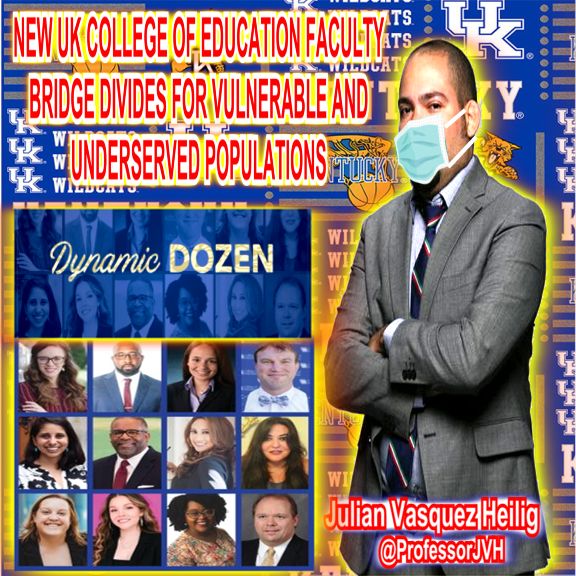
NEW UK COLLEGE OF EDUCATION FACULTY BRIDGE DIVIDES FOR VULNERABLE AND UNDERSERVED POPULATIONS


A diverse group of new faculty recruits to the University of Kentucky College of Education are making an impact in areas where needs are among the greatest and resources are often lacking. They will join distinguished researchers and educators who are addressing some of the most pressing issues facing the nation.
“We worked to recruit individuals who bring to the table a breadth of expertise and energy. Not only are they adding to the diverse representation of our college, but they are people who have dedicated their careers to developing knowledge that will uplift vulnerable populations,” said UK College of Education Dean Julian Vasquez Heilig, who is also a professor in the Department of Educational Policy Studies and Evaluation.
“Their passions will be evident to students in their classrooms and expose students to critical theories on anti-racism, health disparities, and educational equity. They each represent an important voice among our growing body of experts using teaching, research, and service efforts to lift our nation from the many divides we are facing,” Vasquez Heilig said.

Meet the New Faculty 

Cheryl Matias
Cheryl E. Matias, Ph.D., professor, Department of Curriculum and Instruction 
Cheryl E. Matias’ research focuses on race and ethnic studies in education with a theoretical focus on critical race theory, critical whiteness studies, critical pedagogy and feminism of color. Specifically, she uses a feminist of color approach to deconstruct the emotionality of whiteness in urban teacher education and how it impacts urban education. Her other research interest is on motherscholarship and supporting woman of color and motherscholars in the academy. She is a former K-12 teacher in both South Central, Los Angeles Unified School District and Bed-Stuyvesant, New York City Department of Education. Matias was the 2019-2020 Interdisciplinary Institute for the Study of (In)Equality Visiting Professor at the University of Denver and was recently awarded the 2020 American Educational Research Association Mid-Career Award for her work on racial justice in teacher education. She was also an associate professor in the School of Education & Human Development at the University of Colorado Denver.
Greg Vincent
Gregory Vincent, J.D., Ed.D., professor, Department of Educational Policy Studies and Evaluation 
Gregory Vincent is an acclaimed civil rights attorney and university professor and administrator. He previously served as vice president for diversity and community engagement at The University of Texas at Austin where he also was a professor in the School of Law and in the Department of Higher Education Administration, where he held the W. K. Kellogg Professorship in Community College Leadership. Vincent was named the 2016 Educator of the Year by the University of Pennsylvania and received the Ohio State University Moritz College of Law Distinguished Service Award in 2012. Vincent serves as the 48th Grand Sire Archon for the Sigma Pi Phi Fraternity, the Boulé. He previously served as the 16th President of Hobart and William Smith Colleges, his alma mater. He will oversee research, teaching, and service efforts in the areas of educational equity, civil rights, and social justice.
Photo of Philip Rumrill
Philip Rumrill’s research interests include aging and disability, issues facing students with disabilities in higher education, assistive technology and reasonable accommodations, chronic illness, the career development implications of disability, workplace discrimination, program evaluation, research design and methodology, and self-advocacy strategies for people with disabilities. A nationally Certified Rehabilitation Counselor, Rumrill joined the Department of Early Childhood, Special Education, and Counselor Education at UK on July 1. He also serves as director of research and training in the UK Human Development Institute. Rumrill comes from Kent State University where he was a professor and coordinator of the Rehabilitation Counseling Program and founding director of the Center for Disability Studies.
Photo of Sahar Alameh
Sahar Alameh, Ph.D., assistant professor, Department of STEM Education 
Sahar Alameh taught high school science, including chemistry and physics, for seven years before completing her Ph.D. Having witnessed firsthand the difficulties teachers face when teaching science for understanding, her research focuses on improving students’ explanations and understanding of scientific phenomena. She develops philosophically-supported models of scientific explanation, which allow the meaningful assessment of student explanations, and the provision of specific feedback to enable students to reflect on and improve these explanations. Originally from Beirut, Lebanon, she is actively involved in research and outreach activities. She has been an editorial associate at the Journal of Research in Science Teaching, reviewing manuscripts on science teaching strategies, theoretical and empirical studies of effective pedagogies in science, and theories related to science learning and teaching. Through overseeing the journal’s Doctoral Student Mentored Review Initiative, Alameh has supervised over 18 doctoral students and post-doctoral fellows in science education from universities around the world.
Travis Andrews
Travis S. Andrews, Ph.D., CRC, assistant professor, Department of Early Childhood, Special Education, and Counselor Education  
Travis S. Andrews’ research interests include rehabilitation education related to recruitment and retention of minority students and rehabilitation counselors, distance education and technology in counseling, and minorities with disabilities with a focus on mental health and school to work transition. His educational background includes degrees in sociology (B.A.), rehabilitation counseling (M.S.), and rehabilitation counseling and counselor education (Ph.D.). Andrews has 10 years of experience as a clinical rehabilitation counselor and owned and operated Andrews Counseling and Consulting, PLLC, in North Carolina. He is a Certified Rehabilitation Counselor (CRC), Board Certified TeleMental Health Provider (BC-TMH), and Licensed Clinical Mental Health Counselor Supervisor (LCMHCS) in North Carolina.
Photo of Kayla Johnson
Kayla Johnson, Ph.D., assistant professor, Department of Educational Policy Studies and Evaluation 
Kayla Johnson uses student voice, community-engaged, and visual participatory methods to explore issues relating to learning and social justice in international education settings. Her most recent projects explored how postsecondary institutions in Peru can better support first-generation Indigenous students from rural communities, as well as how international service learning programs can be designed to better meet the needs of host community members. Since 2016, she has co-operated a non-governmental organization in the Peruvian Andes that facilitates access to culturally-grounded education for Indigenous children and adults.
Sarah LaCour
Sarah E. LaCour, Ph.D., J.D., assistant professor, Department of Educational Policy Studies and Evaluation 
Sarah E. LaCour’s current work includes an investigation of the equity in access to educational opportunity under a state-wide school choice initiative. She relies on her years of experience both as a classroom teacher and as a practicing litigator to inform her research. Her research interests lie in policy evaluations using both legal and quasi-experimental analysis. Her recent publications include quasi-experimental analyses of Denver’s professional compensation program and of a detracking initiative in upstate New York. She is also published in both legal handbooks and practitioner periodicals.
Photo of Sharim Hannegan Martinez
Sharim Hannegan-Martinez, Ph.D., assistant professor, Department of Curriculum and Instruction 
Sharim Hannegan-Martinez’s teaching-informed research examines the relationship between loving pedagogies, literacy, and student wellness, particularly as it relates to students of color. Her most recent study explores the pedagogy of loving relationships— cultivated in part by the literacy practices employed by teachers — as an intervention to traumatic stressors within the context of urban classrooms. This research has been recognized by both the Ford Foundation’s Predoctoral and Dissertation Year fellowships. Before pursuing her Ph.D. at the University of California, Los Angeles, she was a high school English teacher in East Oakland and worked with pre-service teachers in the University of San Francisco’s Urban Education and Social Justice (UESJ) program. She is a founding member of the People’s Education Movement Bay Area and has collaborated with other grassroots education organizations such as the Education for Liberation Network.
Zitsi Mirakhur
Zitsi Mirakhur, Ph.D., assistant professor, Department of Educational Policy Studies and Evaluation 
Zitsi Mirakhur’s research focuses on understanding ways to generate more equitable school experiences and outcomes for all students, particularly students of color and those from economically disadvantaged families. Her most recent work focuses on examining the factors that contribute to inequality for historically underserved New York City students. Trained as a demographer, Mirakhur has experience working closely with qualitative researchers, on program evaluations, and in research-practice partnerships with a variety of stakeholders including teachers, program developers, and school district staff. Most recently, Mirakhur was a research associate at New York University’s Research Alliance for New York City Schools, where she continues to serve as an affiliated researcher.
Photo of Justin Nichols
Justin Nichols, Ed.D., assistant professor, Department of Kinesiology and Health Promotion 
Justin Nichols’ areas of interest are associated with coaching contract development and sport as an agent of change in social mobility/social justice. He is committed to leadership through promoting diversity, equity, and inclusiveness in positions of centrality in sport/athletics. Other areas of interest include course, curriculum, and program design/development. He serves on UK committees/boards at the college and university levels. He also serves as a committee member for Partnerships for Youth Grassroots Grant Campaign, helping local organizations promote activities for under-served youth in the Lexington area. Prior to his time at UK, he was a coach at a variety of levels ranging from elementary to collegiate; assistant athletic director at the high school level; and program/fitness director in the YMCA system. Nichols teaches courses in the Department of Kinesiology and Health Promotion’s Sport Leadership emphasis, specifically in the areas of supervision, theory, and research methods at the graduate level as well as sport management and tests & measurements for the undergraduate level. He currently serves as the director of Life Fitness in the Department of Kinesiology and Health Promotion and director of the graduate certificate in Sport, Fitness, and Recreation Management. He serves as chair of the College of Education Undergraduate Recruitment, Retention, and Student Success Committee.
Photo of Karen Perry
Karen Perry, M.A., assistant professor, Department of Educational Leadership Studies 
Karen Perry previously served as the director of Personalized Learning and Innovative Design for Henry County Schools, a large suburban district with 50 schools and 43,000 students, located just south of Atlanta. She led personalized learning work, including strategic planning and district-level work to support the implementation shift to student-centered learning. Perry’s more than 20 years in education include teaching secondary social studies and serving as a graduation coach to support at-risk students in graduating on time.
Shemeka Thorpe
Shemeka Thorpe, Ph.D., post-doctoral scholar, Department of Educational, School, and Counseling Psychology 
Shemeka Thorpe’s research focuses on the sexual well-being of Black women from adolescence to early adulthood as well as the sexual health and substance use of college students. She is a Lyman T. Johnson postdoctoral fellow under the co-mentorship of Candice Nicole Hargons and Danelle Stevens-Watkins, both faculty members in the Department of Educational, School, and Counseling Psychology. Thorpe earned her Ph.D. at the University of North Carolina-Greensboro in Community Health Education.
New UK College of Education Faculty Bridge Divides for Vulnerable and Underserved Populations | Cloaking Inequity

NYC Educator: Magical Co-Teachers

NYC Educator: Magical Co-Teachers

Magical Co-Teachers


I finally understand the DOE plan to conduct remote learning. I'm hearing details, and now it makes total sense to me. There will be no more Miserable Mondays and Torture Tuesdays, so all schools will be six hours and fifty minutes.

This way, you'll be able to spend the first thirty minutes of each day meeting with your remote or in-person counterpart. You'll also get a thirty minute prep and the end of the day and you won't even need to be in the building for that.

There are other details I've heard, but I'm going to focus on just a few here. One, of course, is that if you happen to be in a building like mine, with multiple sessions, your day starts at 8 and ends at 2:50 already. I guess if you have a first period class, you spend the first thirty minutes of it coordinating with your co-teacher. Your students will just have to sit and wait, I guess.

Who is your co-teacher? Well, if you are teaching remotely, your co-teacher is the person who teaches the other ten students in the building. And if you are in the building, your co-teacher is the person who teaches the ten students who aren't online that day. Let's examine this concept just a little bit.

First of all, the person in the classroom will have several disadvantages. One is the state regulation that says all desks must face in the same direction so as to preclude droplets being orbited in the direction of students or the teacher. I mean, it's good that the people in that room will have less chance of contracting and spreading a deadly disease, but nonetheless it's gonna be tough to communicate when everyone is social distanced, no one can approach anyone, no one can see the teacher's face, and the teacher can't come to any student to check work or answer questions that require knowledge of anything that is not apparent. Students won't be writing on boards, or even in a chat window.

So there's that. There's the fact that teachers have different voices and styles and may cover different material without actually planning to. There's the fact that students may like your style better than mine, end up hating me, and may CONTINUE READING: 
NYC Educator: Magical Co-Teachers


Teachers need real prep time, not release time | JD2718

Teachers need real prep time, not release time | JD2718

Teachers need real prep time, not release time


The New York City Department of Education has scheduling guidance. But nothing to get excited about.
A new DoE document is floating around – I’ll get my hands on a copy tomorrow. It is called “Instructional Principals and Programming Guidance.”
People are focusing on the model schedules. Since I only have screen shots, that’s what I will start with.
In the Programmer’s Group, first comment? “I love how non-programmers program” So, no, not good. Not usable for most of us.

Preparation Tiime

The worst part? Teacher prep is 30 minutes per day, moved to the end of the day, with the expectation that teachers can prep at home.
We know we never get enough time for preparation. It would have been nice, you know, pandemic, remote learning, that sort of stuff, if they had actually given us a tiny bit more prep time, since it takes CONTINUE READING: Teachers need real prep time, not release time | JD2718

Anniversary of this Blog | Larry Cuban on School Reform and Classroom Practice

Anniversary of this Blog | Larry Cuban on School Reform and Classroom Practice

Anniversary of this Blog


Dear Readers,
This post marks my 11th anniversary as a blogger. I want to thank those readers who regularly read my twice-weekly posts, those who have dipped into them occasionally, those who have subscribed to the post, and finally those who have taken the time to write thoughtful comments. Also to the growing number of international readers, I am grateful for your attention to one American’s viewpoint on school reform and classroom practice.
As with all things, there is a history to writing this blog. My daughter Janice who is a writer in marketing communication urged me to begin a blog in 2009. She guided me through the fits-and-starts of working on this platform. After 11 years, I thank her for getting me started on this writing adventure.
For the nearly 1400 posts I have written since 2009, I have followed three rules:
1. Write about 800 words.
2. Write clearly on school reform and classroom practice.
3. Take a position and back it up with evidence.
For anyone who blogs or writes often, I want to say that sticking to these rules has been no easy task. Yet after eleven years, it has been very satisfying. I remain CONTINUE READING: Anniversary of this Blog | Larry Cuban on School Reform and Classroom Practice

Mr. G for District 3: Chris Guerrieri's Education Matters: How deadly is COVID-19? We have just begun to scratch the surface.

Mr. G for District 3: Chris Guerrieri's Education Matters: How deadly is COVID-19? We have just begun to scratch the surface.

How deadly is COVID-19? We have just begun to scratch the surface


I like horror movies and this is how they all begin.

Kids can be killers,
Infected children younger than age 5 may carry up to 100 times as much of the coronavirus in their noses and throats as adults — while older children carry at least as much as grown-ups, according to new research.

https://nypost.com/2020/07/30/kids-can-carry-100-times-as-much-covid-19-as-adults-study/?fbclid=IwAR3ntB3jGJAw8AWRdT_Xb718l0U81tQOwImKEqAFsx9uCBXNsZGqCgng2O4

You can pick your poison, COVID-19 or heat stroke,

As COVID-19 cases rise rapidly throughout the South, some scientists believe there could be an important, but overlooked factor in the spread of the virus in the region--air conditioning.


https://www.webmd.com/lung/news/20200708/air-conditioning-may-be-spreading-covid

Gulp, well I guess we should be glad a lot of Air Conditioners in my district don't work.

Time to suit up,

Dr. Anthony Fauci suggested Wednesday that Americans should consider wearing goggles or a face shield in CONTINUE READING: 
Mr. G for District 3: Chris Guerrieri's Education Matters: How deadly is COVID-19? We have just begun to scratch the surface.


CURMUDGUCATION: Catholic Church Looks To Cash In On Espinoza

CURMUDGUCATION: Catholic Church Looks To Cash In On Espinoza

Catholic Church Looks To Cash In On Espinoza


Well, this is not exactly a surprise.

Now that SCOTUS has poked another huge hole in the wall between church and state, and now that the Catholic Church and the Trump administration have been forging closer ties over support for school choice (aka getting tax dollars to Catholic schools), and now that Betsy DeVos is insisting that financial aid intended for public schools should go to private schools-- now that all that is going on, it should come as no surprise that the Catholic Church is now arguing publicly to be given more taxpayer dollars.


It surfaced here in the National Catholic Register last Thursday. The op-ed is penned by Cardinal Timothy Dolan, Cardinal Seán O’Malley and Archbishop José H. Gómez, from New York, Boston and Los Angeles, and it leads with the Espinoza decision, saying it "corrected an historic injustice." Also, the Covid-19 pandemic is sad and affecting everyone. And then they move quickly from there to demanding their cut of taxpayer funding. Their talking points include the following:

* Catholic schools have been around for two centuries. They would like you to focus on the part of the Catholic system that serves the upwardly mobile poor, and not the part that serves exclusive wealthy folks.

* Catholic schools educate lots of non-Catholic students, like them Protestants, Jewish folk, and CONTINUE READING: 
CURMUDGUCATION: Catholic Church Looks To Cash In On Espinoza


IN THE WORDS OF DOLLY PARTON, HERE YOU COME AGAIN… – Dad Gone Wild

IN THE WORDS OF DOLLY PARTON, HERE YOU COME AGAIN… – Dad Gone Wild
IN THE WORDS OF DOLLY PARTON, HERE YOU COME AGAIN…


“What exactly was the difference? He wondered to himself. And who decided which people wore the striped pajamas and which people wore the uniforms?”
― John Boyne, The Boy in the Striped Pajamas

“Besides all those whaling details, Moby Dick is about someone who’s looking for something so huge, something they’ve wanted all their life, yet they know when they find it, it will kill them. ”
― Laurie Anderson

Here we sit on the eve of a new school year. It arrives in a manner few envisioned. It comes in a manner that is nearly unrecognizable to us. It comes with hopes as in the past, but also with new fears and trepidation. Yet still, it comes.

Across Tennessee, kids will resume their daily trek to their classrooms. For some will mean simply padding across their bedroom floor to their desks and logging in. For others, it will be a more traditional journey – one that will require buses and car lines, albeit with new entry procedures.

Whichever form schooling takes, it will be filled with unanswered questions and second-guessing. Is it really possible to emulate schooling through a digital platform? How long will this last? Will classes be engaging enough? And probably the most important – am I doing enough to keep my child safe while protecting their future.

Throughout the summer, I’ve been fairly critical of Metro Nashville’s Public School’s effort to prepare for the upcoming school year. In my opinion, back in May and June, there wasn’t CONTINUE READING: IN THE WORDS OF DOLLY PARTON, HERE YOU COME AGAIN… – Dad Gone Wild

Teacher Tom: This Might Not Be Such a Bad Thing

Teacher Tom: This Might Not Be Such a Bad Thing

This Might Not Be Such a Bad Thing


Despite the Covid-19 pandemic continuing to surge in the US and elsewhere, some school districts have already opened and others are hot on their heels. And as could easily be predicted, districts in Mississippi and Indiana have already reported positive Covid-19 tests, requiring quarantining, despite precautions. The largest district in Georgia has reported 260 cases amongst staff as they returned to classrooms to prepare for reopening. And a YMCA summer camp recently, despite requiring evidence of negative tests, staff masking, and health screening when the campers arrived, still sparked an outbreak with positive cases numbering in the hundreds. As long as we insist on putting children together in large groups, there will be outbreaks no matter how careful we are. 

As things now stand, it looks like more and more schools across the country will be opening in the coming weeks, despite clear evidence the pandemic is nowhere near under control in much of the US, and the common knowledge that schools are always major contributors to the spread of pretty much anything that's going around.

The pressure is on from all sides. In some places, like Arizona, governors are so keen to jump start their economies that they are threatening punitive budget cuts to schools that don't restart in-person instruction in their schools. Families are struggling without the free child care that schools provide while our governments dither over providing the financial relief that out-of-work and furloughed parents need to put CONTINUE READING: Teacher Tom: This Might Not Be Such a Bad Thing

Monday, August 3, 2020

COVID-19 “Microschools” Are Betsy DeVos’s Latest Privatization Scheme

COVID-19 “Microschools” Are Betsy DeVos’s Latest Privatization Scheme

COVID-19 “Microschools” Are Betsy DeVos’s Latest Privatization Scheme


Working parents grappling with the difficult choices before them this school semester — keeping their children home to learn remotely, or risking COVID-19 transmission by sending them to class — are increasingly turning to a new trend being hailed as a “solution” to the pandemic: privatized “microschools.”

Microschools consist of small groups, or “pods,” of mixed-level students located in homes or local facilities like churches or community centers, who are guided through personalized pedagogies by parents or educators as an alternative to public education. The model blends a private school and homeschool approach, retaining flexibility of homeschooling while relying on paid teachers to facilitate a classroom experience.
Right-wing and Libertarian proponents of privatization, including Charles Koch, the Walton Family Foundation, the Heritage Foundation, the Reason Foundation and Education Secretary Betsy DeVos, are exploiting the pandemic to push the model.
DeVos tweeted her support several times last week for the School Choice Now Act that would provide $5 billion in tax credits for families opting for homeschooling or private school. At the same time, DeVos and the Trump administration have threatened to withhold federal funds from any school that does not open its classrooms fully in the fall.
Microschools were already gaining interest over the last several years with companies like Prenda piloting the model in Arizona in 2018. Since its launch, Prenda has opened more than 200 “campuses” in the state, according to its CEO, Kelly Smith. The pandemic, however, has strengthened the appeal: Google searches for “microschool” have spiked since major districts began announcing plans to remain online for the fall.
Now, Silicon Valley is jumping on the bandwagon, with several new startups hoping to take advantage of what they see as a big market amid the COVID-19 crisis. New online platforms in Seattle and San Francisco are connecting families and educators looking to pool resources and form CONTINUE READING: COVID-19 “Microschools” Are Betsy DeVos’s Latest Privatization Scheme

Will the Teachers Take Control? | Dissent Magazine

Will the Teachers Take Control? | Dissent Magazine

Will the Teachers Take Control?
No group is better positioned than organized teachers to force Washington to develop a national plan to deal with the pandemic.


On August 3, 1981, federal air traffic controllers in the United States launched an illegal strike, grounding flights from Guam to Puerto Rico. President Ronald Reagan walked into the Rose Garden that morning to deliver an ultimatum: unless they returned to work within forty-eight hours, the controllers would be fired. While few contemporary observers immediately grasped its significance, that confrontation soon led not only to defeat for the controllers—who were permanently replaced when they defied Reagan’s order—but to disempowerment for American workers generally. Following Reagan’s example, private-sector employers made the 1980s synonymous with strikebreaking and union-busting, initiating a decades-long labor retreat.
We might soon witness a similarly momentous showdown. Today, thirty-nine years to the day after the Professional Air Traffic Controllers Organization (PATCO) strike began, teachers across the nation are staging a National Day of Resistance demanding safe schools. Their protest is every bit as audacious as the 1981 strike, yet the teachers’ strategy, and the context behind their protest, could not be more different. The differences indicate both how much public-sector unions have learned from history and the crucial role their members are poised to play in pushing our leaders to finally deal seriously with this raging pandemic.
The controllers’ strike, even many of its most ardent supporters later conceded, was poorly conceived. It was an illegal walkout whose most important demand was a large across-the-board wage increase—a demand levied during a recession in which other unions were offering concessions. PATCO not only challenged a popular president, it made no effort to cultivate allies even in the AFL-CIO, after alienating union leaders by endorsing Reagan’s election a year earlier. Controllers believed they could win their fight alone—that they would CONTINUE READING: Will the Teachers Take Control? | Dissent Magazine

Ed Notes Online: Teachers, Parents, Students to Rally Outside Tweed and UFT HQ to Protest Unsafe School Reopening

Ed Notes Online: Teachers, Parents, Students to Rally Outside Tweed and UFT HQ to Protest Unsafe School Reopening

Teachers, Parents, Students to Rally Outside Tweed and UFT HQ to Protest Unsafe School Reopening


Good morning,

I thought you would be interested in this rally and march led by school staff, parents and students, happening today at 5 pm outside UFT headquarters and Tweed DOE offices. This is part of a national day of action against unsafe, unfunded school reopening. In addition to MORE, 20 additional groups are joining and we expect a big turnout.

Please let me know if you have any questions,

Liat

FOR IMMEDIATE RELEASE August 3, 2020
Press Contacts:
Liat Olenick
917-930-2788

Teachers, Parents, Students to Rally Outside Tweed and UFT HQ to Protest Unsafe School Reopening 


New York, New York:  Today, the MORE-UFT Caucus as well as parents, students and advocacy organizations including the Alliance for Quality Education, Rise and Resist and Coalition for Educational Justice will join school communities taking action across the country to march and rally to push back against the insufficient, unsafe, underfunded hybrid reopening plan being put forth by the UFT, the Chancellor and the Mayor. Those who cannot join the rally and march in person will be taking action from home to prevent an unsafe reopening. 


“The science is clear. COVID is airborne indoors, especially in poorly ventilated, crowded classrooms Here in New York City, more than 20,000 people have already died from COVID-- mostly Black and Latinx New Yorkers. Returning to school buildings while COVID continues to spread across the country will put more Black and Latinx New Yorkers at even greater risk,” said teacher Andrew Worthington. “ We demand no new cases for 14 days, all health and safety measures implemented including consistent rapid testing, contact tracing, safe public transit and community input.”
‘Our schools were underfunded before COVID hit. Now they face new budget cuts because the Governor refuses to tax the rich, and the Mayor refused to substantially divest from the NYPD. In order to reopen safely we need more funding for teachers, nurses, social workers, counselors and supplies and New Yorkers need financial relief,” said Tajh Sutton, CEC14 President and Teens Take Charge Program Manager. “Forcing school buildings to reopen without additional funding will put staff in the untenable position of having to enforce high stakes public health guidelines without adequate resources which could further put our Black and Brown students at risk of being criminalized.” 

“The DOE, the Mayor and the Governor have consistently left parents, teachers and students out of decisions about reopening. They have refused to consider our creative ideas, hear our feedback on remote learning or transparently answer basic questions,” said Marilena Marchetti. “We demand that stakeholders are fully empowered and included in planning for both school reopening and for equitable remote learning that includes opportunities for outdoor learning and therapeutic service delivery for prioritized student populations.” 


What: March and rally to stop and unsafe school reopening as part of a national day of action. 
When: Monday, August 3rd, 5:00 p.m.- 7:00 p.m. 
Where: The March will start at UFT Headquarters at 52 Broadway and end at DOE offices at Tweed Courthouse. 
Who: Movement of Rank & File Educators(MORE-UFT), Parents Supporting Parents NY, PoliFem, DC 37 Progressive Caucus, Justice Center en el Barrio, Rise and Resist, Revolting Lesbians, Alliance for Quality Education NYC, Ya-Ya Network, Black Lives Matter School Week of Action NYC, A Call to Action on Puerto Rico, Workers World Party, New York Boricua Resistance, Peoples Power Assemblies NYC, NYC Coalition for Educational Justice, BATALA, Young People of Color Incorporated, Freedom For all, Dynamic Therapy Intervention, NYC Democratic Socialists of America 23. Party for Socialism and Liberation, Community Education Council 14
Ed Notes Online: Teachers, Parents, Students to Rally Outside Tweed and UFT HQ to Protest Unsafe School Reopening

The Undeniable Impact of the COVID-19 Crisis on Today’s Education | Occupy Wall Street News

The Undeniable Impact of the COVID-19 Crisis on Today’s Education | Occupy Wall Street News

COVID-19 and Education: The Effect of the Pandemic on Today’s Education


The COVID-19 epidemic will forever be known as the world health crisis that managed to shut down almost every school in the world. Since the virus doesn’t care about one’s race, age, or gender, the education community had to make a decision, and fast. The result is a major change in education systems all around the globe. It is not only the educators and students that are affected but their parents and families as well.

Impact of the pandemic on schools and teachers

Due to the presence of the virus, the education community needed to think fast and find other ways to provide quality education to its students. Others have resorted to online learning. It is not only the traditional schools that are now teaching their student online. Even other institutions are adapting to the new normal by providing virtual lessons like online piano lessons and subject tutorials to their clients.
Now, schools are looking forward to innovating other ways to provide students with quality and effective education. Researchers argue that online learning is not that effective. This is the very reason why educators are working hard to help keep students engaged and better learn despite the current learning arrangements.
Many teachers are overwhelmed for all of a sudden, they need to adapt to online teaching. Many of which are not necessary for traditional teaching. According to a new poll, over a third of teachers fear for their health, both physically and mentally. Many have to work long hours just to be able to prepare and finish everything they need to do for their students. Add the fact that they now have to ensure their families are well-taken cared of while making sure they get to cater to their students and the school’s need at the same time.

Impact of the COVID-19 crisis on students

Social distancing and online learning can have negative effects on students’ personal and academic lives. According to a recent study, the sudden shift in online learning will result in a wider achievement gap. While top students are more likely to thrive, many students will have a hard time coping with the new learning arrangements due to many reasons.
For one, there is little-to-no learning structure back home. Students have already associated school with studies. Suddenly have to do CONTINUE READING: The Undeniable Impact of the COVID-19 Crisis on Today’s Education | Occupy Wall Street News