Latest News and Comment from Education

Sunday, June 28, 2020

CATCH UP WITH CURMUDGUCATION + ICYMI: Yes, It's Still Happening Edition (6/28)

CURMUDGUCATION: ICYMI: Yes, It's Still Happening Edition (6/28)


Yes, It's Still Happening Edition

I haven't reminded you for a while-- if you read something here that speaks to you, go to the original posting site and share that puppy. You have the power to amplify voices. Everything that ever went viral was shared one person at a time. So do your part and spread the word.


An Experiment in the Socially-Distanced Classroom   
From the blog "Counting From Zero," some teachers head to the classroom and take a look at the practical issues of social distancing for the classroom. The good, the bad, the ugly. I told you it was going to be up to teachers to work this stuff out.

Cleveland/University Heights City Schools On Board for Ohio's Ed Choice Lawsuit
I student taught in Cleveland Heights (Wiley Middle School). They may join many other Ohio districts fighting back against Ed Choice, Ohio's attempt to follow Florida in siphoning off unlimited money to choice schools. I hope they get it stopped.

The often ugly reality Black students face
Allan Blodget guest-writes at The Answer Sheet about what he found when he discovered an Instagram community of Black students writing about their school experiences.

Ed Department Killed Website That Made Applying for Loan Forgiveness Too Easy  
Lauren Camera at US News has this important story. The coda is that, thanks to coverage, the department decided to go ahead and put the website back up. But if you want further confirmation of what USED prioritizes these days (spoiler: not students), here's a story.

Lamar Alexander Said What?  
What he said, reported by CNBC, is that the feds have to provide extra funding to schools if it wants them to reopen this fall. Yes, really.

Michigan Republicans Try To Head Their Governor Off At The Back-To-School Pass
Nancy Flanagan has the story of Michigan's GOP trying to push some crappy policies quick-like before the governor can actually do something useful. Because if we're not learning anything else, and we hadn't already learned it from school shootings, the pandemic can teach us that to some folks, absolutely nothing matters more than politics.

What an actual school reopening plan looks like    
Jersey Jazzman runs down the characteristics necessary for a decent school reopening plan

Jamaal Bowman Scores Victory  
Call it an upset. Call it the Progressive wing of the Dems taking the old guard to school once again. Call it one more example of an outstanding educator moving into the political world. But whatever you call it, cheer.

The Standardized Testing Horror Show Is Not Over
There are plenty of reasons to think that the support for the Big Standardized Test is flagging, but as Nancy Bailey points out, there are zero reasons to relax vigilance. That fight is nowhere close to over.

For some California teens, school closures led to work in the fields
From Elizabeth Aguilera at CalMatters, a story about how huge a failure distance crisis learning was for some teens, and what school closure means for students who are also migrant workers.

Trying to make sense of fluid fall 
From Inside Higher Ed, a couple of simulations suggest that colleges are going to have some real problems in the fall.

You want a confederate monument? My body is a confederate monument.
From the New York Times, a powerful piece of essay writing from poet Caroline Randall Williams.

Teachers in Fairfax revolt against fall plans 
Meanwhile, what may be the first open revolt by a staff against the district's plans for next fall. From the Washington Post.

The Ed Tech Imaginary
I can't imagine why you would not be subscribing the Audrey Watters' newsletter, but just in case, here's the text of a recent address, looking at the stories we tell ourselves about ed tech. Well worth your while.

A message from your university's vice-president for magical thinking  
Speaking of school reopening plans, here's McSweeney's with a piece that is, I guess, darkly humorous.


CURMUDGUCATION: ICYMI: Yes, It's Still Happening Edition (6/28)

CATCH UP WITH CURMUDGUCATION


New Report: Zuckerberg’s Favorite Digital Ed Program Is All Sizzle, No Steak - https://www.forbes.com/sites/petergreene/2020/06/25/new-report-zuckerbergs-favorite-digital-ed-program-is-all-sizzle-no-steak/#5190ccf56b5b by @palan57 on @forbes

The 2020 Test That Many School Districts Failed Before The Pandemic Even Started - https://www.forbes.com/sites/petergreene/2020/06/22/the-2020-test-that-many-school-districts-failed-before-the-pandemic-ever-started/#4670df117223 by @palan57 on @forbes

GOP Legislators To Schools: Re-Open Or Else. - https://www.forbes.com/sites/petergreene/2020/06/15/gop-to-schools-re-open-or-else/#68a0e814159c by @palan57 on @forbes


Florida Tightens The Public Education Noose
I have run out of words for Florida. It's been a little more than a year since I dubbed them "the worst," and there really isn't anything to add to that, except of course there is. The leadership positions under Governor Ron DeSantis have been handed over to profiteers and people whose whole life story is anti-education, plus a very active astro-turfy group of folks determined to cheer the legisla
TN: When Charters Abandon The Community
So here we go again. Another angry piece written about the abrupt closing of a charter school -- two, actually. This time it's a pair of KIPP schools in Memphis. The closings were announced in April , the reasoning a little fuzzy. KIPP Memphis Preparatory Elementary and KIPP Memphis Preparatory Middle were par of Tennessee's failed experiment, the Achievement School Distric t, a collection of scho
CA: San Diego Charter Versus The Evil Union
This week you may have run across a piece entitled " How the Union Stopped Innovation at My School. " The piece, which has turned up in numerous California outlets, was written by Jessica Chapman, a teacher at Gompers Preparatory Academy . Chapman's story has been steadily promoted by For Kids and Country , the organization run by Rebecca Friedrichs , a former teacher who loves Jesus and America a
CA: Charter Decides To Grab A Small Business Loan
Palisades Charter High School has a lot of history . When launched in 1961, it was the most expensive high school in the LA City School system. The state grabbed the farm property through eminent domain; previous residents included the daughter if Francis X. Bushman , and Debbie Reynolds and Eddie Fisher. Members of the Class of '65 were the basis for What Really Happened to the Class of '65? . B
Trump Back DeVos On Soaking Scammed Students
Trump has mostly ignored DeVos and the education department (insert joke about Trump and education here), but he's now decided to jump in, with both feet, right onto the backs of people scammed by for-profit colleges. This story has been dragging on for-freakin-ever. In 2017, 18 states and DC sued DeVos over her stated intention of ignoring/rewriting the Borrower Defense to Repayment rule from 201
ICYMI: Fathers Day Edition (6/21
I've had my hands full elsewhere, and have been spending refreshingly little time on line, but I still have a few goodies to pass along. Remember, sharing is caring, What Teachers Want American Education Research Journal has some research about what it takes to attract and retain teachers. A fun conversation starter. Looking for the Missing NBC News has the story of Detroit teachers who went looki
No, Software Still Can't Grade Student Essays
One of the great white whales of computer-managed education and testing is the dream of robo-scoring, software that can grade a piece of writing as easily and efficiently as software can score multiple choice questions. Robo-grading would be swift, cheap, and consistent. The only problem after all these years is that it still can’t be done. Still, ed tech companies keep making claims that they ha
AEI And The Commodification Of Education
The American Enterprise Institute comes from that part of the ed reform spectrum devoted to free market approaches. But a new report from AEI really pushes the boundaries of treating education as a commodity like a 
CURMUDGUCATION - http://curmudgucation.blogspot.com/


I'm Trying Not To Take Sides | Blue Cereal Education

I'm Trying Not To Take Sides | Blue Cereal Education

I'm Trying Not To Take Sides


Aliens PyramidsThese are complicated times, and in the interest of serving ALL students (and avoiding as many problems with parents as possible), I’m renewing my commitment to avoid pushing my own personal values and ideology and just sticking to the facts.
It’s not that hard in early American history. I mean, sure – there’s the issue of Columbus and whether he “discovered” America or not. Rather than give my own opinions, I just give kids facts. I’ve prepared a sheet of links to over 200 scholarly sources and primary documentation for them to peruse at their leisure, and they can decide for themselves whether or not what Columbus did was “good” or “bad,” or whether the Vikings got here first, or the Chinese, or that guy from Africa whose name I can never remember.
The whole clash of early settlers and the natives can be a little tricky, but no worries – I just present all sides of the issues and let my 8th and 9th graders figure out what it all means. It’s not my job to label something as “genocide” or “natural progress” or “God’s will.” Maybe smallpox blankets were a tacky move, maybe not. Maybe scalping and CONTINUE READING: I'm Trying Not To Take Sides | Blue Cereal Education

EdAction in Congress June 28, 2020 - Education Votes

EdAction in Congress June 28, 2020 - Education Votes

EdAction in Congress June 28, 2020


House takes initial steps to end police brutality

The House passed the George Floyd Justice in Policing Act (S. 3912/H.R. 7120) by a bipartisan vote of 236-131 while a separate bill failed to advance in the Senate. The bill passed by the House takes initial steps to end police brutality, protect the civil rights and liberties of all people, and change the culture of law enforcement agencies. Majority Leader Mitch McConnell (R-KY) could take up the bill or consign it to the Senate’s legislative graveyard, where scores of NEA-supported bills passed by the House already languish. TAKE ACTION

HELP Committee chair calls for federal aid to help schools reopen safely

To help schools and colleges reopen safely this fall, retiring Senate HELP Committee Chair Lamar Alexander (R-TN) is calling on the federal government to provide additional funding—though not nearly as much as educators have sought. “The surest step back to normalcy in our country is when 70-75 million college and high school and elementary school students go back to school,” he said. “If we need more money for that, I’m for that.” This support is helpful and a signal that educators’ advocacy is having an impact. But to move anything forward soon, many more Republican senators will need to put pressure on Majority Leader Mitch McConnell (R-KY).
NEA’s priorities for the next coronavirus package include at least $175 billion to stabilize education funding, at least $4 billion to equip students with hot spots and devices to help narrow the digital divide and close the homework gap, at least $56 million in directed funding for personal protective equipment, relief for student loan borrowers, and at least $4 billion to protect voting rights and make voting by mail more widely available. LEARN MORE TAKE ACTION

House infrastructure bill includes more than $130 billion for schools

Your advocacy has paid off. The House is scheduled to vote this week on the Moving Forward Act (H.R. 2), which now includes the Reopen and Rebuild America’s Schools Act that provides significant support for public schools and the students most in need. Specifically, the bill would create a $100 billion grant program and $30 billion tax-credit bond program that target high-poverty schools whose facilities pose health and safety risks to students and staff. It would also provide $5 billion in funding to help close the digital divide and equip more students to go online. Nationwide, as many as 12 million students—1 in 5—are unable to do schoolwork at home due to lack of internet access. TAKE ACTION

Cheers and Jeers

Reps. Seth Moulton (D-MA) and Pete Stauber (R-MN) led a bipartisan letter signed by more than 60 members of the House urging Education Secretary DeVos to revise her CARES act equitable services rule because “runs counter to the intent of Congress.”
Rep. Susie Lee (D-NV) played a leading role in building support to try to override the president’s veto of a congressional resolution that would overturn Education Secretary Betsy DeVos’ revised borrower defense rule and protect students from unscrupulous for-profit colleges. Although a broad majority of the House voted YES, the veto override came up short—two-thirds must support it.
Reps. Brian Fitzpatrick (R-PA), Will Hurd (R-TX), Fred Upton (R-MI) for joining all Democrats present in supporting the George Floyd Justice in Policing Act.

232 representatives voted for the Washington, D.C. Admission Act (H.R. 51), which would make the District of Columbia our nation’s 51st state and give its 700,000 residents the right to full representation in Congress.
180 representatives opposed the Washington, D.C. Admission Act (H.R. 51).


EdAction in Congress June 28, 2020 - Education Votes

It's time to revisit the Washington Murals debate. - SF PUBLIC SCHOOL MOM

It's time to revisit the Washington Murals debate. - SF PUBLIC SCHOOL MOM

It’s time to revisit the Washington Murals debate.


I firmly stand behind my vote to paint down the Life of Washington Murals. I don’t need white (and Asian) alumni, many of whom graduated from the school before it was even integrated as a result of Brown v. Board of Education, to tell me what those murals represent.
The Black children and families that walk into the school each day seeing their ancestors picking cotton and kneeling before a slave master, know what those paintings represent. Native American and Indigenous children and families don’t need false histories of scalping and “Indian attacks” and true histories of “Dead Indians” to know what those paintings represent. That history is a part of them.


As Caroline Randall Williams states in her NY Times article titled “You Want a Confederate Monument? My Body Is a Confederate Monument”:
“My blackness does not put me on the other side of anything. It puts me squarely at the heart of the debate.”
— Caroline Randall Williams
When I voted to paint over the Life of Washington Murals, I did so because I know what it feels like to see your history marginalized and erased. I know CONTINUE READING: It's time to revisit the Washington Murals debate. - SF PUBLIC SCHOOL MOM

Burger Chef and Dan Died on the Same Day | Dissident Voice

Burger Chef and Dan Died on the Same Day | Dissident Voice

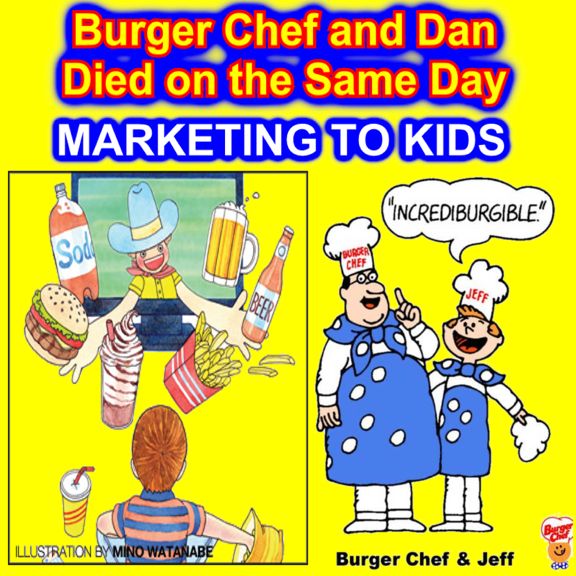
Burger Chef and Dan Died on the Same Day


If you’re like most 16 year old males, there’s a better than average chance that the suit inventory in your wardrobe consists of a total of one. And by suit I mean the matching sport coat and pants that was purchased on clearance from a discount warehouse that has as much chance of staying in business as a groundhog attempting to take up tenure on the 18th hole of Torrey Pines. It’s the periodic skeleton in the closet that rears its head primarily during weddings you don’t care about, shows its face annually to celebrate the birth of Jesus at the church you otherwise never attend and the threads that make an intermittent appearance at whateverthefuck anniversary or birthday you’re required to participate in. Not to mention the occasional unanticipated funeral.
We’ll get back to the suit momentarily.
While growing up in the Midwest, a significant part of my weekly caloric intake came from Burger Chef. For those unfamiliar with it, Burger Chef was a fast food restaurant chain that originated in Indianapolis, Indiana in 1954. It rapidly expanded throughout the United States and at its peak in 1973 approached 1,200 locations, challenging McDonald’s for artery-clogging supremacy. It was a mostly now-forgotten pioneer on many levels, patenting the first flame broiler that is now standard throughout the industry. But perhaps the most lasting and ingenious element that Burger Chef introduced to the fast food marketplace was an understanding that its success was primarily predicated on its ability to market specifically to children. They initially introduced a couple of mascots: Burger Chef (who looked sort of like everyone’s creepy uncle) and his sidekick Jeff (who looked like the kid everyone beat up on in high school). They were also the first fast food concept to introduce a meal specifically targeted at kids – the Burger Chef Funmeal (five years before McDonald’s would copy the idea with their own Happy Meal). The Funmeal included a small hamburger, fries, dessert and a drink that came in a colorful box containing puzzles, riddles, stories and toys. No one had ever seen the likes of this sort of culinary miracle before, and not a week went by that Burger Chef didn’t coerce a portion of my father’s paycheck from him just to get me off his back.
Back to the suit.
Mine was a shade of brown that when worn made me look like a turd that had escaped the toilet pre-flush and had – through some genetic malfeasance – CONTINUE READING: Burger Chef and Dan Died on the Same Day | Dissident Voice

Police training is broken. Can it be fixed?

Police training is broken. Can it be fixed?

Police education is broken. Can it be fixed?
A patchwork system for training police focuses too much on military approaches and not enough on de-escalation and anti-bias. Past attempts at reform haven’t led to wholesale change.

In late May, when video began circulating of George Floyd trapped under the knee of a police officer, struggling to breathe, it was the latest reminder of America’s failure to address the racism and brutality that pervades U.S. policing. For those who train and educate law enforcement officials, Floyd’s death — along with the recent police killings of Breonna Taylor, Tony McDade and other Black Americans — was also a moment of reckoning, prompting some of those educators to examine their role in preparing officers for a profession responsible for so much senseless violence.
In Virginia, where community colleges enrolled some 2,200 students last year in programs designed to train law enforcement officials, school system administrators decided it was time to review their curricula for future officers. Across the country, in California, Eloy Ortiz, chancellor of the state’s community college system, called for a similar examination of police training. A few college police academies announced their own reviews.
In Minnesota, where Floyd was killed, the interim director of the state board overseeing police education pledged to develop a “sweeping action plan” for change, while advocates pressed the legislature to pass reforms, including more investment in de-escalation training. Bills introduced in Congress in recent weeks, one by Democrats and the other by Senate Republicans, both called for more training for law enforcement officials.
But any effort to improve police education will have to contend with the reality that America’s system for training officers is a complex patchwork of hundreds of different programs that operate with virtually no CONTINUE READING: Police training is broken. Can it be fixed?

Defund the police, not education – Liberation News

Defund the police, not education – Liberation News

Defund the police, not education


In a country as wealthy as the U.S., you would think ensuring that students have access to quality education and services would not be an issue. You would think that in a country as wealthy as ours, it would be a priority that students and their families remain in good health and have access to health care, as well as mental health care during a global pandemic. You would think that national COVID-19 testing would be required before opening up the doors of schools to students, educators, and staff.
In this country, the people expect these basic public health needs to be met considering the wealth we have generated. Instead, our reality is we continue to see our public schools defunded, and the funds invested into a brutal, repressive, militarized police force whose purpose is to exercise lethal force on all, irrespective of age, race, gender, or supposed criminality. To reverse this inequity, we should defund the police – not our public education system.  
As of early June, this year, on-duty police had  killed  429 people across the United States. If this rate continues, more than one person a day will be killed by police in 2020. According to the Police Integrity Research group at Bowling Green State, on-duty police claim the lives of between 900 and 1,100 people, a year  – with fewer than eight deaths, on average, resulting in indictments and even fewer convictions.
Despite the plethora of evidence showing the repressive and violent nature of the police across the nation, the uprising against racist police brutality and terror which occurred in Ferguson in 2014, as well as Baltimore in 2015 were not enough to convince Democrats or Republicans that something needs to be done about police departments across the nation. The disproportionate number of Black, Indigenous and Latino people behind bars has not been enough for politicians to take the cries of Black America and all working class people seriously. Politicians continue to ignore the needs of the people, and instead use taxpayers money to  fund and militarize oppressive police forces. 
For example, the New York Police Department has one of the largest police forces in the nation. In fact, if the NYPD were a military, it would be the 7th largest military in the world due to its size and the level of CONTINUE READING: Defund the police, not education – Liberation News

How Racism Gets Taught and Misrepresented in Our Schools | Dissident Voice

How Racism Gets Taught and Misrepresented in Our Schools | Dissident Voice

How Racism Gets Taught and Misrepresented in Our Schools
Teaching It Forward


The not-so-subtle purpose of compulsory schooling is to ensure a populace subservient to the status quo which primarily serves the ruling class. What we call education is derived from a Prussian model designed to reward individuals based on how well they stay in line and do as they’re told through the process of grading. It’s no mystery that those who conform the most by repeating verbatim the state-controlled curriculum they’re force fed receive the highest marks and are thus given the greatest opportunities for societal advancement. By discouraging individual thought and creativity while instead placing a premium on conformity, the powers that be ensures obedience instead of dissent from the people most likely to rise up against it. By controlling what is taught and holding educators responsible for their student’s test results, the ultimate goal of mass indoctrination is all but assured.
It’s this sort of forced institutionalization that has not only enabled but encouraged the racism that has plagued this country since the inception of government-mandated schooling. And there is no greater evidence of this than a brief perusal of a couple of the mostly southern school textbooks that were used to teach bigotry to young minds in the 1950s and 1960s.
An entire generation of Baby Boomers learned Alabama history from a textbook called Know Alabama. In a chapter called Plantation Life, fourth graders learned how living on a plantation was “one of the happiest ways of life.” The 1957 edition encouraged students to imagine themselves on their CONTINUE READING: How Racism Gets Taught and Misrepresented in Our Schools | Dissident Voice


VOICES: River City, Episode 67: California’s School-to-Prison Pipeline – VOICES: River City

VOICES: River City, Episode 67: California’s School-to-Prison Pipeline – VOICES: River City

VOICES: River City, Episode 67: California’s School-to-Prison Pipeline


Do cops belong in schools?
The answer is obvious: No. Yet Americans have spent the last seven decades increasing their presence in institutions of education, to devastating results. We discuss chapter three in Alex Vitale’s ‘The End of Policing’ (which you can download for just $3 from Verso Books!), while incorporating some local flair.
Longtime Sacramento residents may remember 25 years ago, when Sacramento County sheriff’s deputies terrorized students at Encina High School: pepper spraying, punching and throwing as many kids as they could get their hands on. (Fun fact: now-Sheriff Scott Jones makes a cameo on the KCRA news clip, lying through his teeth about what actually happened.) This traumatized many Encina students, and shaped how they viewed police for the rest of their lives.
Back then Sacramentans made excuses for the cops.
Today, things are different. The region is asking serious questions about if they really belong as an occupying force in our schools.
Last fall, Sacramento City Unified School District cut its policing contract by more than half. Two school board members–Leticia Garcia and Mai Vang–voted against it because they wanted police completely out. Vang, who is running for Sacramento City Council in District 8, has also signed a pledge to never take campaign contributions from cops.
Enjoy! And keep an eye out for the 1995 clip of sheriff’s deputies terrorizing the high school.
Thanks for listening and, as always:
And thank you to Be Brave Bold Robot for the tunes.
VOICES: River City, Episode 67: California’s School-to-Prison Pipeline – VOICES: River City

It’s Ridiculous to Treat Schools Like Covid Hot Zones (David Zweig)* | Larry Cuban on School Reform and Classroom Practice

It’s Ridiculous to Treat Schools Like Covid Hot Zones (David Zweig)* | Larry Cuban on School Reform and Classroom Practice

It’s Ridiculous to Treat Schools Like Covid Hot Zones (David Zweig)*


This article appeared in Wired Magazine June 24, 2020.
David Zweig writes about technology and culture for a number of publications, including the New York Times, the New Yorker, and the Atlantic. He is also the author of the book Invisibles: Celebrating the Unsung Heroes of the Workplace.”
On May 18, education ministers from the EU gathered on a conference call to discuss the reopening of schools. Children had been back to class for several weeks in 22 European countries, and there were no signs yet of a significant increase in Covid-19 infections. It was early still, but this was good news. More than a month later, the overall mortality rate in Europe has continued to decline. Now, as we look to the fall, the US belatedly appears keen to follow Europe’s lead.
The question of how US schools should be reopened—on what sort of schedule, with what degree of caution—has yet to be determined. But recent guidance from the US Centers for Disease Control and Prevention, released May 16, conjures up a grim tableau of safety measures: children wearing masks throughout the day; students kept apart in class, their desks surrounded by 6-foot moats of empty space; shuttered cafeterias and decommissioned jungle gyms; canceled field trips; and attendance scattered into every other day or every other week. Reports suggest that certain US schools may even tag their kids with homing beacons, to help keep track of anyone who breaks the rules and gets too close to someone else. It seems that every measure, no matter how extreme, will be taken in an effort to keep the students and the staffers safe.
This could be a grave mistake. As children return to school this fall, we must take a careful, balanced view of all the safety measures that have been proposed and CONTINUE READING: It’s Ridiculous to Treat Schools Like Covid Hot Zones (David Zweig)* | Larry Cuban on School Reform and Classroom Practice

22 Reasons Why Schools Should NOT Reopen in the Fall

22 Reasons Why Schools Should NOT Reopen in the Fall

22 Reasons Why Schools Should NOT Reopen in the Fall


Well-meaning parents and schoolboards have been working remotely to determine how to safely reopen schools, but these plans are filled with uncertainty. Many of the changes make schools unrecognizable.
The Coronavirus has involved conflicting information. Now we’re seeing an uptick in cases.
It’s not what anyone wants, but fall doesn’t seem like a good time to reopen schools.
Here’s why:

1. Illness and Russian Roulette 

According to the CDC, the risk might seem low for children, but they still get sick, some seriously. Children and teenagers have died. Questions still surround the disease. It’s not worth the risk. Maybe the situation will improve by January, or next summer. Currently we’re experiencing a pandemic and safety is the number one concern.

2. How Will the Flu and Covid-19 Tango? 

Maybe Covid-19 alone doesn’t affect children as badly as adults, but what if you mix it with the flu? Every year the flu kills children. Last January, before Covid-19 became well known, 27 children had died of the flu. What will the dance of these two illnesses look like in the fall?

3. Adults Matter Too!

A large concern with children is that they can spread the disease to teachers, parents, and grandparents who could be vulnerable. It isn’t fair to risk their health by CONTINUE READING: 22 Reasons Why Schools Should NOT Reopen in the Fall