Latest News and Comment from Education

Friday, May 24, 2019

Chicago teachers speak on inequality, attacks on public education at downtown rally - World Socialist Web Site

Chicago teachers speak on inequality, attacks on public education at downtown rally - World Socialist Web Site

Chicago teachers speak on inequality, attacks on public education at downtown rally

The Chicago Teachers Union held a rally outside the James R. Thompson Center in downtown Chicago Wednesday under the slogan “Standing strong for the schools Chicago’s students deserve.”
Teachers have grown increasingly disillusioned with the high-flown “social justice” pretensions of the CTU, since it has collaborated for years with the city’s Democratic Party administration and former Mayor Rahm Emanuel in imposing school closings, layoffs, and countless other attacks on teachers and public education.

The CTU rally
As the rally took place, former CTU President Karen Lewis and the union’s political-legislative director Stacy Davis-Gates were holding closed-door discussions with newly inaugurated Democratic Mayor Lori Lightfoot, a former federal prosecutor, to discuss plans for forthcoming attacks on teachers and public education. The labor agreement for nearly 25,000 educators expires on June 30.
Various national and local union officials, along with longtime political charlatans such as Jesse Jackson, took to the stage to offer demagogic speeches paying lip service to teachers’ aspirations, at the same time attempting to promote illusions in the Democratic Party, which has been responsible for attacking public education and teachers’ working conditions no less than the Republicans.
American Federation of Teachers President Randi Weingarten, who has a salary in excess of $500,000, was introduced as “she who shuts it down across the country,” unintentionally summing up her role in sabotaging a whole series of teachers strike over the last year. She stated most bluntly the purpose of the event, saying, “So I’m really glad to be in Chicago today with the CTU welcome party to your new mayor.”
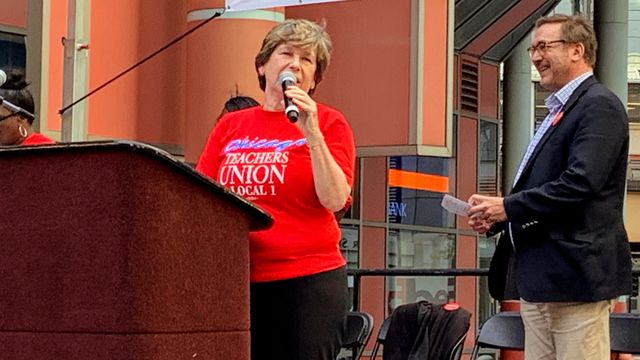
Randi Weingarten (left)
Current CTU President Jesse Sharkey, a leading member of the now-defunct International Socialist Organization, unconvincingly attempted to present himself and the CTU as skeptics and even potential opponents of Lightfoot, at the same time giving credence to her claims to be seeking a “fairer and more just city, not just for downtown but on the South and West Sides too, and the working-class neighborhoods.”
Making it clear that the CTU is opposed to any strike action to fight the new attacks being readied by Lightfoot and district officials, Sharkey has called for the intervention of a federal mediator in the contract talks.
Only a small crowd of 300-400 people were on hand at the rally, reflecting the mass disaffection of teachers with the CTU and the Democratic Party. By CONTINUE READING: Chicago teachers speak on inequality, attacks on public education at downtown rally - World Socialist Web Site


What many black parents think about when teachers are armed in schools - The Washington Post

What many black parents think about when teachers are armed in schools - The Washington Post

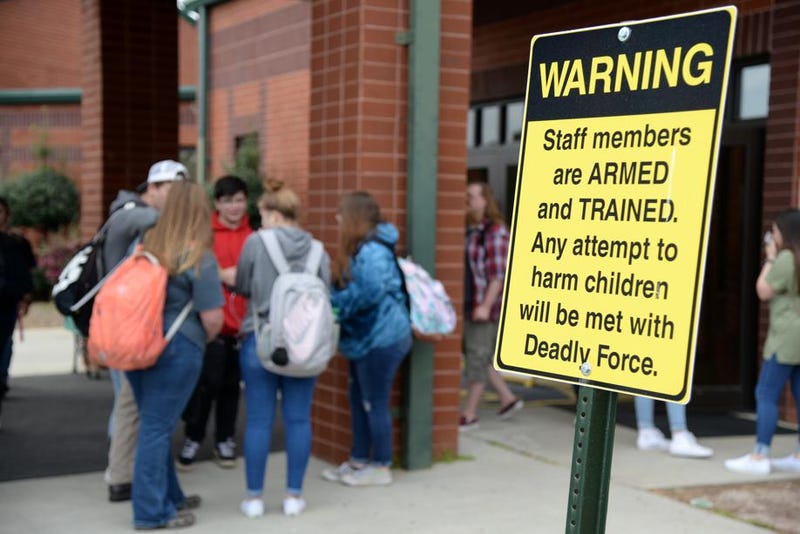
What many black parents think about when teachers are armed in schools

Image result for What many black parents think about when teachers are armed in schools
A new analysis by a gun control advocacy group says there have been more than 65 publicly reported incidents of mishandled guns at schools in the last five years. They include:
The analysis, by Giffords Law Center to Prevent Gun Violence, has not deterred legislators in a number of states from moving to expand opportunities for teachers to carry guns in schools.
In Florida, teachers can now carry guns at schools under a new law signed by Gov. Ron DeSantis (R). In Texas, the legislature has sent a bill to the Republican governor, Greg Abbott, that would allow more teachers and school personnel to carry guns on campus. And in other states — including Missouri, Montana, Oklahoma and North Carolina — legislators are pushing to create programs that would allow for adults to carry guns in schools.
This post looks at the issue from the lens of black parents, whose children are shot by authorities and disciplined at school in far greater percentages than white children. This was written by Rann Miller, an African American educator who directs the 21st Century Community Learning Center, a federally funded after-school program located in southern New Jersey.
Miller spent six years teaching in charter schools in Camden, New Jersey, and is the creator, writer and editor of the Official Urban Education Mixtape Blog. His writing on race and urban education has appeared in SalonAlterNet, and the Progressive, where I’m an education fellow. Follow him on Twitter:@UrbanEdDJ
By Rann Miller
I am an educator. I am a former social studies teacher and a current director of an afterschool program for a school district. I am also African American and the parent of a school-aged child, with two other children in CONTINUE READING: What many black parents think about when teachers are armed in schools - The Washington Post

School Rankings as Racist, Classist Propaganda | radical eyes for equity

School Rankings as Racist, Classist Propaganda | radical eyes for equity

School Rankings as Racist, Classist Propaganda


On 20 May 2019, the Charleston Post and Courier offered this: Here’s what it takes for a SC school to be the No. 1 public high school in the US. And here is what is newsworthy:
The news was out before the sound of the school announcement system crackled through the halls: Academic Magnet High, long regarded as the top-performing high school in South Carolina, had climbed to No. 1 in a national ranking of public high schools.
Just three days later, The State (Columbia, SC) reported: Richland 1’s elite elementary school is also its whitest and least impoverished. This coverage explains:
Like all parents, Sara McBride just wanted her son to get the best possible education.
That’s why she tried to get her son into Richland 1’s highest-ranked school: Brockman Elementary. A school where class sizes are small and teachers’ advanced degrees and experience nets them a higher average salary.
The South Carolina Department of Education provides for 1270 public schools in the state a Poverty Index; for 2018, Academic Magnet High is the #1 least impoverished school in the entire state, and Brockman Elementary is #57, placing these two celebrated schools in the top 4.5% of all schools in the state in terms of extremely low poverty as well as disproportionate racial imbalances (Brockman is 75% white and AMH has only 3.5% black enrollment).
SC as a state ranks in the bottom ten of high-poverty states (about an 18% poverty rate) and has a relatively high percentage of black citizens (28%) as well as about 5-6% Hispanic/Latinx.
Across the U.S., there are some harsh facts about measurable student outcomes and demographics of students being served. Race, School Rankings as Racist, Classist Propaganda | radical eyes for equity

Report: The cost of charter schools for the West Contra Costa Unified School District – In the Public Interest

Report: The cost of charter schools for the West Contra Costa Unified School District – In the Public Interest

Report: The cost of charter schools for the West Contra Costa Unified School District

In the Public Interest, in partnership with California’s West Contra Costa Unified School District (WCCUSD) staff, directly measured the financial impact of charter schools on students who attend the district’s traditional public schools.


The report is a follow-up to our 2018 Breaking Point: The Cost of Charter Schools for Public School Districts, which was the first, and continues to be the only, effort to measure the direct cost of charter schools on California school districts.
Key findings from the report include:Charter schools cost WCCUSD $27.9 million during the 2016-17 school year.
  • Charter schools cost WCCUSD $27.9 million during the 2016-17 school year.
  • WCCUSD loses $978 a year in funding for each charter school student.
In the Public Interest recommends that each California school district should produce an annual report assessing the economic impacts of charter school expansion on district students. This data and analysis will empower local officials to balance the potential value of charter schools against the needs of students.


Our Resources on Public Education


The Cost of Charter Schools for Public School Districts
5/8/2018A first-of-its-kind analysis revealing that public school students in three California school districts are bearing the cost of the unchecked expansion of privately managed charter schools.
 
Fraud and waste in California’s charter schools
3/1/2018A report documenting that total alleged and confirmed fraud and waste in California’s charter schools has reached over $149 million, which represents only the tip of the iceberg due to lax regulation and little transparency.
 
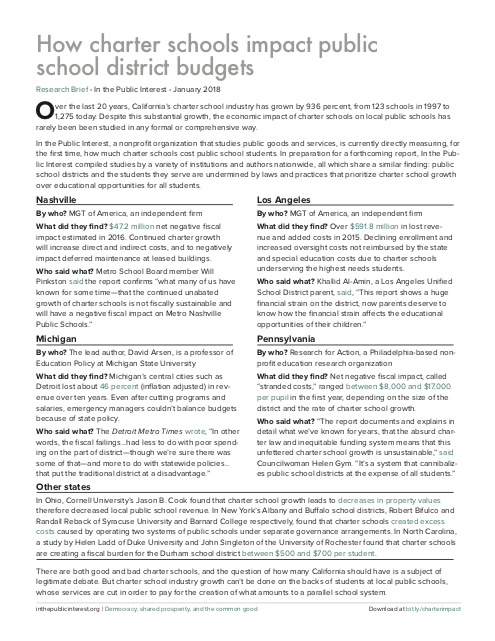
How charter schools impact public school district budgets
2/23/2018A compilation of studies by a variety of institutions and authors, all which share a similar finding: districts and the students they serve are undermined by prioritizing charter school growth over educational opportunities for all students.
Our Resources on Public Education - http://www.inthepublicinterest.org/?p=7919

Eliminating Worldwide Illiteracy with Electronic Tablets but Without School Teachers? | janresseger

Eliminating Worldwide Illiteracy with Electronic Tablets but Without School Teachers? | janresseger

Eliminating Worldwide Illiteracy with Electronic Tablets but Without School Teachers?


This blog will take a one-week early summer break and come back in June on a new, three-day, Monday-Wednesday-Friday summer schedule.  Look for a new post on Monday, June 3.
Diane Ravitch made the announcement yesterday morning on her blog:  A U.S. philanthropy has awarded $10 million in prize money to two companies—Kitkit School and Onebillion—for developing and testing out in Tanzania an electronic tablet program for teacherless education.  “You knew this was coming, didn’t you?” writes Ravitch.
First it was Bridge International Academies, the for-profit, international private school venture underwritten by Bill Gates, Mark Zuckerberg and other philanthropists and operating in Kenya, Liberia, Uganda and India. At Bridge Academies, students must pay tuition, teachers in the schools must continually recruit new students, and teachers must present scripted curricula delivered to them electronically from a central site.  Critics have pointed out that by employing less educated teachers who merely present scripted lessons, colonialist efforts like this one are undermining the development of a strong profession of well qualified school teachers in the locations of such experiments.
This week the news is not about scripted curricula delivered to teachers in the Global South. This week’s XPRIZE is for newly developed, programmed tablets to do the job of the teachers.
Philanthropy News Digest describes the challenge XPRIZE presented to several tech developers when it asked them to come up with teacherless teaching: “Launched in 2014 with support from the Merkin Family, Dick & Betsy DeVos Family, and Tony Robbins foundations, Elon Musk, and other funders, the Global Learning XPRIZE challenged innovators to develop scalable solutions that enable children to teach themselves basic reading, writing, and math skills within fifteen months.  Each of the five finalists received $1 million to field test their CONTINUE READING: Eliminating Worldwide Illiteracy with Electronic Tablets but Without School Teachers? | janresseger

States’ Math and Reading Performance After the Implementation of School A-F Letter Grade Policies | VAMboozled!

States’ Math and Reading Performance After the Implementation of School A-F Letter Grade Policies | VAMboozled!

States’ Math and Reading Performance After the Implementation of School A-F Letter Grade Policies

It’s been a while! Thanks to the passage of the Every Student Succeeds Act (ESSA; see prior posts about ESSA herehere, and here), the chaos surrounding states’ teacher evaluation systems has exponentially declined. Hence, my posts have declined in effect. As I have written prior, this is good news!
However, there seems to be a new form of test-based accountability on the rise. Some states are now being pressed to move forward with school letter grade policies, also known as A-F policies that help states define and then label school quality, in order to better hold schools and school districts accountable for their students’ test scores. These reform-based policies are being pushed by what was formerly known as the Foundation for Excellence in Education, that was launched while Jeb Bush was Florida’s governor, and what has since been rebranded as ExcelinEd. With Jeb Bush still in ExcelinEd’s Presidential seat, the organization describes itself as a “501(c)(3) nonprofit organization focused on state education reform” that operates on approximately $12 million per year of donations from the Bill & Melinda Gates Foundation, Michael Bloomberg Philanthropies, the Walton Family Foundation, and the Pearson, McGraw-Hill, Northwest Evaluation Association, ACT, College Board, and Educational Testing Service (ETS) testing corporations, among others.
I happened to be on a technical advisory committee for the state of Arizona, advising the state board of education on its A-F policies, when I came to really understand all that was at play, including the politics at play. Because of this role, though, I decided to examine, with two PhD students — Tray Geiger and Kevin Winn — what was just put out via an American Educational Research Association (AERA) press release. Our study, titled “States’ Performance on NAEP Mathematics and Reading Exams After the Implementation of School Letter Grades” is currently under review for publication, but CONTINUE READING: States’ Math and Reading Performance After the Implementation of School A-F Letter Grade Policies | VAMboozled!


CURMUDGUCATION: OH: Union Reps Fired By Turnaround CEO

CURMUDGUCATION: OH: Union Reps Fired By Turnaround CEO

OH: Union Reps Fired By Turnaround CEO


Lorain City Schools is one of the three Ohio districts that has been subjected to HB 70, a takeover law that replaces both the school board and the superintendent with a single all-powerful CEO. You can get the background of Lorain's troubles here, and see what has been happening in the fight against HB 70 here.

The short form for Lorain is this: HB 70 is a terrible piece of law, calling for a CEO who is knowledgeable and competent in every single aspect of school management, from teacher assignment to bus schedules, and this super-competent person has to be able to run every aspect of the district while building relationships with all the local folks who are still smarting from having the state strip all of their local power.


Location of my first teaching job
So let's start by accepting that nobody is going to be able to do this job well. But Lorain won some sort of reverse lottery, and got CEO David Hardy, Jr., who is especially not good at this job. Hardy's background is Teach for America and charter schools. I've reached out to someone who worked with him previously, and they suggest that he doesn't take criticism well, nor does he much care for teachers. That's just one person-- but nothing about his history in Lorain suggests otherwise. He has refused to move his family to Lorain, has refused to meet with the elected school board, and has not established positive working relationships with any CONTINUE READING: CURMUDGUCATION: OH: Union Reps Fired By Turnaround CEO


Learning from Our Teachers: The Education Strikes of 2018 - Los Angeles Review of Books

Learning from Our Teachers: The Education Strikes of 2018 - Los Angeles Review of Books

Learning from Our Teachers: The Education Strikes of 2018

Red State Revolt By Eric BlancThe Teachers’ Strike Wave and Working-Class PoliticsPublished 04.23.2019Verso224 Pages


IN SPRING OF 2018, tens of thousands of K–12 educators and support staff in West Virginia, Oklahoma, and Arizona went on strike, demanding livable salaries and other concessions from the state. Where did these uprisings in Trump country come from? How were they able to win in states where public sector strikes are illegal and other anti-labor laws prevail? In Red State Revolt: The Teachers’ Strike Wave and Working-Class Politics, Eric Blanc sets out to answer these questions.
The saga began in West Virginia. Teacher salaries were stagnant as state legislators continued to defund public education. At the same time, these politicians granted enormous tax breaks to corporations. They also took a pair of scissors to any document that resembled a pro-labor bill. Although anger among educators had brewed for decades, resignation was the norm. When another premium increase for employee health insurance was announced at the end of 2017, few people had any reason to suspect that there would be resistance in West Virginia.
But there was. After two months of protests and strikes, not only did these employees stop the proposed premium increase, they also forced the state to drop its pro–charter school and anti-labor legislation. In the process, they secured a five percent raise for all state employees. Inspired by the victories in West Virginia, teachers and support staff followed suit in Oklahoma and in Arizona, again forcing the hands of their Tea Party–influenced governments. They achieved more in two months than they had in the past two decades.
What propelled the shift from resignation to resistance? Blanc went to these states to get some answers. Through numerous interviews and a discerning attention to broader issues of labor and politics in the United States, he paints a clear portrait of the forces at work in this historic moment. Of note, he traces the influence of Bernie Sanders’s 2016 presidential campaign that popularized an alternative to the status quo. His influence was most felt in West Virginia, where he won every county in the Democratic primary. At the level of action, the Sanders campaign pushed people to get involved in grassroots politics. By the time the health-care premium increases in West Virginia were announced, there were a number of self-identified “democratic socialists” with radical ideas and organizing experience.
In the words of West Virginia teacher Emily Comer:
The role of the Bernie campaign of 2016 on organizing in West  CONTINUE READING: Learning from Our Teachers: The Education Strikes of 2018 - Los Angeles Review of Books

Seattle Schools Community Forum: The Entire Board Must Vote No on the Science Adoption

Seattle Schools Community Forum: The Entire Board Must Vote No on the Science Adoption

The Entire Board Must Vote No on the Science Adoption


You'll note the use of the word "must" in the headline for this post.  I have gone from "should" to "must" based on new information I received today via public disclosure documents from the district.

I had put in a request weeks ago and received a message that there were over 900 emails between the head of Science, Mary Margaret Welch, and Amplify.   I'm not surprised that there were some but that is quite a volume for less than two years.

However, there were 25 other emails between Welch and several other people that I asked the good folks in the Public Disclosure area to send as soon as they could.  They were kind enough to get them to me yesterday.

They reveal that Welch entered into an agreement in early August 2017 with Lawrence Hall at UC Berkeley (who had a grant from IES - a federal agency, Institute of Education Sciences) and SRI International (who is the entity carrying out the research for the grant).  The grant was to study the efficacy of Amplify Science for first graders around literacy and science.  


If funded, districts would receive the full curriculum package along with teacher professional development and support over the two years of implementation at no cost to the participating districts.  Districts also receive a stipend to partner with us to CONTINUE READING: Seattle Schools Community Forum: The Entire Board Must Vote No on the Science Adoption

LAUSD’s Measure EE Highlights the Need For Charter School Oversight

LAUSD’s Measure EE Highlights the Need For Charter School Oversight

LAUSD’s Measure EE Highlights the Need For Charter School Oversight
This is a compromise, but we owe that to our children and the way that we can model compromise as a Board and as a community. Let’s not forget that the disenfranchised here are our students…If you don’t compromise it leads to this retrenchment and cynicism that then goes to this downward spiral and even more resentment and cynicism and disappointment, and that is never the source of progress.
– LAUSD Board Member Nick Melvoin


Last July, the Los Angeles Unified School District (LAUSD) Board had the opportunity to put a parcel tax on the regularly scheduled November ballot. Unfortunately, the California Charter School Association (CCSA) opposed the resolution by George McKenna and Scott Schmerelson, falsely claiming that “the proposal [excluded] 110,000 charter public [sic] school students.” Therefore, Ref Rodriguez (in one of his last actions before pleading guilty to felonious acts related to his campaign), Nick Melvoin and Monica Garcia voted against asking the voters for funding that was desperately needed by the students of the district.
Less than nine months later, Melvoin and Garcia had a change of heart. Perhaps they read the writing on the wall and realized that Jackie Goldberg’s impending election meant that the parcel tax was going to pass without their support. Or maybe it was the fact that Melvoin’s expectations for a quick victory in the January strikecrumbled when parents and the community supported the demands made by the teachers. In any case, they finally joined McKenna and CONTINUE READING: LAUSD’s Measure EE Highlights the Need For Charter School Oversight

Thursday, May 23, 2019

Louisiana’s VAM: Quantitative Bungling on Display | deutsch29

Louisiana’s VAM: Quantitative Bungling on Display | deutsch29

Louisiana’s VAM: Quantitative Bungling on Display

This post is about value-added assessment (VAA), also called value-added modeling (VAM). I saw that Louisiana’s “father of VAM,” LSU psychology professor, George Noell, and others, had recently published a VAM reflection related to VAM usage on Louisiana’s teacher preparation programs (TPPs), entitled, “Linking Student Achievement to Teacher Preparation: Emergent Challenges of in Implementing Value Added Assessment,” and I just had to write about it.
(You can read the article for free by signing up for a 14-day trial here; meanwhile, I have contacted the publisher for permission to link to full article. Stay tuned.)
Notice that Noell’s et al. title includes the carefully-selected term, “linking,” because it is a tricky game to establish that VAM proves causation and not just correlation. However, the big buzz about VAM usage in education is that VAM is often reverently consulted in decisions about the professional fates of teachers, schools, and TPPs.
VAM is used to judge, and in those judgments, the judges assume that the teacher, or the school, or the teacher prep program “caused” some associated VAM score. If the VAM score is deemed pleasing, then good for you, teacher, school, or TPP.
If not, well, you better fix whatever needs fixing (though VAM is not precise enough to inform on this point) or you could be *correlated* right out of professional existence.
The first piece I wrote as a public education advocate was this 2012 “VAM Explanation for Legislators.” I did so at the behest of a fellow Louisiana teacher and advocate, who asked if I would write something that our Louisiana legislators could understand, “on the eighth-grade level.”
Not sure if I hit the appropriate grade-level readability, but I did rip the erratic CONTINUE READING: Louisiana’s VAM: Quantitative Bungling on Display | deutsch29

Education Research Report: Flaws in High-Profile “Gold Standard” Study Used to Market Teach for America

Education Research Report: Flaws in High-Profile “Gold Standard” Study Used to Market Teach for America

Flaws in High-Profile “Gold Standard” Study Used to Market Teach for America


Andrew Brantlinger is a former public school math teacher who is now an associate professor at the University of Maryland’s Department of Teaching and Learning, Policy and Leadership. Earlier in his academic career, he worked with data concerning the New York City Teaching Fellows alternative certification program. So Brantlinger was intrigued when, six years ago, the federal Institute of Education (IES) Sciences published a report entitled, The effectiveness of secondary math teachers from Teach For America and the Teaching Fellows programs, finding that Teach for America corps members significantly out-performed other teachers at their high-poverty schools. This IES-funded high-profile study, which was authored by researchers at Mathematica, a non-partisan, research organization, is prominently featured in TFA promotional material.
TFA selects high-achieving college graduates and places them in these high-poverty schools after several weeks of preparation. Although the TFA corps members start off uncertified, the placement is followed by ongoing, on-the-job support, and many do eventually gain standard certification.
Brantlinger was eventually able to obtain the data used in the IES/Mathematica study and, along with co-author and University of Maryland doctoral candidate Matthew Griffin, he was able to perform a secondary analysis of the study data. 
In a Review Worth Sharing published today by the National Education Policy Center, Brantlinger and Griffin explain that the original analysis was flawed in three primary ways:
  • First-year Teach for America teachers were under-represented in the study (while second-year corps members were over-represented). This matters because teachers typically make considerable professional growth in their initial years on the job.
  • Poorly qualified teachers were over-represented in the comparison group. For example, nationwide, 80 percent of 8thgrade math teachers at high-poverty schools are fully certified. Yet just 40 percent of the comparison group were fully certified, while 58 percent of the TFA teachers in the study were fully certified. Keep in mind that alternative-certification programs, by definition, generally place teachers in schools before they are certified—making the situation studied here difficult to generalize. This may limit the study’s applicability to other schools and also bias the results in TFA’s favor.
  • TFA teachers were likely trained to teach to the exams used as study outcomes, since such an approach is part of the program. The study did not account for this likely alignment between the outcome measure and the TFA focus.
Despite assertions to the contrary on TFA’s website and promotional materials and by the authors of the Mathematica report, the effect size identified by the study was small—certainly small enough to be explained by these three flaws in data and methods.
The Mathematica study was designed as an experiment, with students randomly assigned to matched pairs of TFA and comparison teachers. Randomization studies are sometimes described as the “gold standard” for research because they reduce the odds that treatment and control groups are not comparable. However, as Brantlinger and Griffin’s analysis highlights, the on-the-ground reality of experimental studies does not CONTINUE READING: Education Research Report: Flaws in High-Profile “Gold Standard” Study Used to Market Teach for America

John Thompson: Holding Diane Ravitch and Corporate School Reformers Accountable - Living in Dialogue

Holding Diane Ravitch and Corporate School Reformers Accountable - Living in Dialogue

Holding Diane Ravitch and Corporate School Reformers Accountable
A Review of The Wisdom and Wit of Diane Ravitch: Part 1

By John Thompson.
As we wait for Diane Ravitch’s next, comprehensive masterpieceSlaying Goliath, a new anthology, The Wisdom and Wit of Diane Ravitch, offers a unique opportunity to assess the quality and accuracy of both Ravitch’s and the corporate school reformers’ analyses of school improvement. Of course, Ravitch’s experience in education research and politics gave her advantages in understanding policy complexities over the non-educators who imposed test-driven, accountability-driven policies on the nation’s schools. On the other hand, it was the edu-philanthropists’ untested opinions that became the laws of almost all of the states, so they should have been just as rigorous as Ravitch in studying the facts of life in our nation’s diverse schools.
Ravitch came to the school reform wars with a reputation as a thorough, balanced scholar, with close ties to conservative reformers. She had been an Assistant U.S. Secretary of Education, and a member of the National Assessment of Educational Progress Board (NAEP), and worked with policy analysts with the Fordham Institute, the Brookings Institution, and other think tanks.  Ravitch also had a long career as an education historian.  In contrast to corporate reformers who demanded schools and systems where “everyone is on the same page,” Ravitch believed, “Historians understand that debate and dissent are part of the work of understanding history.”
Ravitch explained, “There is not one truth, but on the other hand, you can’t just make up facts and narratives, hire a fancy PR firm, and rewrite history to suit yourself.”   She said, “One of the things that a historian tries to do is to correct the record.” So, it is not surprising that an accountability audit of Ravitch’s positions during CONTINUE READING: Holding Diane Ravitch and Corporate School Reformers Accountable - Living in Dialogue

California teachers, students, officials rally for school funding | The Sacramento Bee

California teachers, students, officials rally for school funding | The Sacramento Bee

‘Starvation diet’ for schools protested by California teachers, officials, students at Capitol


More than 1,000 California teachers, students and school district administrators marched in downtown Sacramento and rallied at the state Capitol on Wednesday afternoon, adding their voices to a statewide advocacy day for school funding.
The event, part of the national “Red for Ed” movement, brought together union members and school administrators who have sometimes been at odds, with teacher strikes unfolding this year in Sacramento, Los Angeles and Oakland. The groups put aside their differences Wednesday to push for legislation directing more money to public education


“For too long, we have been on a starvation diet for our schools,” said California Teachers Association President Eric Heins.
Some teachers and staffers from the Sacramento City Unified School District shared concerns about out-of-date textbooks, a shortage of physical education teachers and librarians, and worn-out portable buildings.
“I am at nine schools and I take care of about 3,700 students,” said Noh Le-Hinds, a school nurse and union representative in Sacramento City Unified. “We think healthy students learn better.”
Katie Carr, a special education teacher, said her elementary school doesn’t provide reading intervention for its most vulnerable students.
“These are kids that are already struggling with academics,” she said. “Books are a basic right, and kids deserve better. “
“It’s difficult to make ends meet as a teacher,” said Sacramento City Teachers Association President David Fisher. “We are in a crisis of losing teachers, because it costs a lot to become one. Paying your mortgage or rent are extremely difficult. ”
Many at the rally said they are concerned that charter schools are undermining the public school system.
“Charter schools laws are basically destroying public education, and we don’t think a dime of public funds should go to corporate charter organizations,” said California Teachers Association Vice President David Goldberg. “Every school should serve the needs of the community.”
A package of bills backed by teachers unions and currently under consideration in the Legislature CONTINUE READING: California teachers, students, officials rally for school funding | The Sacramento Bee