Latest News and Comment from Education

Wednesday, February 27, 2019

GiveWell expands cost-effective giving focus to include policy interventions - Vox

GiveWell expands cost-effective giving focus to include policy interventions - Vox

Give a man a fish, he eats for a day. But if you lobby for better fishing policy…
A charity focused on cost-effective giving is shifting its sights toward influencing policy.


What’s the most cost-effective way to help people?
Lots of people have tried to answer that question. Donors care, a lot, about whether the charities they’re giving to are effective (though they often don’t know a good way to measure that). Charity evaluators like GuideStar, CharityWatch, and Charity Navigator rate charities primarily by how well they’re run.
My favorite charity evaluator, GiveWell, takes a different approach — the group focuses on identifying charities that deliver the most cost-effective interventions available. In global health and development, for example, we often have robust evidence that some health interventions are a particularly good way to save and change lives. That means that the charities delivering those interventions are places where your money goes especially far. Those interventions include distributing malaria nets, treating kids for intestinal parasites, supplementing Vitamin A to reduce child mortality from infectious disease, and, yes, just directly giving people money.
But can we do better than that? That’s a question GiveWell is asking — and it is expanding its scope in the hopes of finding even more promising opportunities.
GiveWell recently announced that it’s more than doubling the size of its research team to try to find more cost-effective programs. But its revised approach involves increased attention to something relatively new for GiveWell: policy-oriented philanthropy.
In a blog post announcing the change, the organization said it would be researching new, more complex ways to measure how to do good in areas, including:
  • Public health regulations like anti-smoking laws, restrictions on lead paint, air pollution, and the fight against counterfeit medicines
  • “Improving government program selection,” or assisting governments in their selection of more effective health, education, and antipoverty programs
  • “Improving government implementation,” or helping with training and operations so that government policies work better
  • “Increasing economic growth and redistribution” — advocating for or helping implement policies that produce healthy overall economic growth, and ones that reduce inequality
  • Improved data collection
  • Advocating for more aid spending to go to the most cost-effective direct-delivery programs
GiveWell is not planning to change their focus on low- and middle-income countries. But they’ll CONTINUE READING: GiveWell expands cost-effective giving focus to include policy interventions - Vox


3rd Grade Reading Guarantees: Impact Investors Build System To Terrorize Eight Year Olds – Wrench in the Gears

3rd Grade Reading Guarantees: Impact Investors Build System To Terrorize Eight Year Olds – Wrench in the Gears

3rd Grade Reading Guarantees: Impact Investors Build System To Terrorize Eight Year Olds


I know a number of activists out there are working to raise awareness around the brutality of third grade reading guarantees. These laws demand students achieve a specific score on standardized reading test. If they do not, they can’t advance to the next grade. I wrote this short introduction with the idea that it could be shared with people  who are not yet aware of the speculative financial underpinnings linked to these laws.
“Pay for success” was embedded into federal education law with the passage of the Every Student Succeeds Act. Public-private partnerships, in coordination with investors, are embracing this form of “innovative finance,” catalyzing new markets in human capital. Digital platforms, including ed-tech and online behavioral services, are designed to generate data for the evaluation of outcomes-based contracts. That is what is behind the push for expanded screen-time and benchmark testing in schools.
It’s known as “collective impact,” and the Strive Network based in Cincinnati is working with United Way chapters across the country to advance data-driven education and social services to meet the demands of this burgeoning investment market. Children are being turned into data so the debt associated with funds allocated to provide education and social services to them can be traded on global markets (like bundled mortgages prior to the 2008 crash).
A “cradle to career roadmap” with set achievement metrics has been created with benchmarks where impact evaluation will be imposed as a CONTINUE READING: 3rd Grade Reading Guarantees: Impact Investors Build System To Terrorize Eight Year Olds – Wrench in the Gears


The LAUSD’s Revolving Door Continues

The LAUSD’s Revolving Door Continues

The LAUSD’s Revolving Door Continues


– LAUSD School Board slogan
While claiming poverty, the Los Angeles Unified School District (LAUSD) is currently spending $2.4 million on the special election to replace admitted felon and charter school supporter Ref Rodriguez. The District’s General Counsel, David Holmquist, was asked by Board Member Scott M. Schmerelson to look into the “viability” of “bringing legal action against this enormous cost which was not [the District’s] fault.” Holmquist has yet to publicly provide an answer.


Unfortunately for the students of the LAUSD, this may not be the last time that funds meant for their education are diverted to a special election. After supporters of the charter school industry spent $622,536.89 to get Board President Monica Garcia elected to a five and a half year term that ends in 2022, she has announced that she is running for José Huizar’s seat on the Los Angeles City Council in 2020. If she is successful, another election will have to be held to fill out the remainder of her term. This also leaves the possibility that the residents of Board District 2 will be unrepresented while this special election is held.
While the loss of another charter school industry supported Board Member might seem at first glance to be a good thing for the 80% of students who attend LAUSD public schools, Garcia’s entrance into the CONTINUE READING: The LAUSD’s Revolving Door Continues


Trump Creates a Humanitarian Crisis in Venezuela While a Real One is Right Here in Our Schools | Dissident Voice #Unite4OaklandKids #WeAreOEA #WeAreCTA #strikeready #REDFORED

Trump Creates a Humanitarian Crisis in Venezuela While a Real One is Right Here in Our Schools | Dissident Voice

Trump Creates a Humanitarian Crisis in Venezuela While a Real One is Right Here in Our Schools


A created political farce played out with the frightening consequences for war against Venezuela resting in the balance on its border with Colombia this weekend, as the Trump Administration unsuccessfully tried to force the first of $20 million of unsolicited “humanitarian aid” into the country. This had nothing to do with concern for the Venezuelan people and everything to do with undermining the legitimate government of Venezuela. It should be called the food as a weapon campaign. Meanwhile teachers in Oakland California who are going into their 4th day of a strike could really use that wasted money to shore up the attack going on against education in their city and the entire U.S. for that matter.
The will to make quality education accessible in this country has long since left the station but under Trump and his Secretary of the Department of Education, Betsy DeVos, champion of the for profit charter school system, the decline has become precipitous. California, the richest state in the country, has been little or no help in coming up with a plan for the crisis.
Teachers in the U.S.: Unsung Heroes
In my estimation public school teachers, entrusted to teach all our children to become critical thinkers, are the hardest working and most underappreciated group anywhere, working in a system that neglects them and sets them and their students up for failure. In the last couple of years teachers’ strikes have emerged as energizing and leading the way for all of organized labor. There have been teachers’ strikes, with varying degrees of success, in a number of states including West Virginia, Oklahoma, Kentucky, Colorado, Illinois and most recently in Los Angeles.  Their demands follow a similar pattern. Most of them call for a pay increase for teachers who have notoriously been underpaid and undervalued. In the Oakland strike teachers are asking for a 12% pay raise over three years, hardly a greedy demand seeing that represents a 4% yearly raise or just about enough to keep up with inflation and cost of living. Oakland educators are the lowest paid in the Bay Area, where rents have risen 40 to 50 percent since 2012. The skyrocketing costs of housing have caused more than 18% of teachers to leave the district each year, including 600 last year.
I am not an economist but If Jeff Bezos and Amazon was ever forced to pay taxes I would think that could pay for a 15% or a more deserved 20% raise for all 3.2 million public school teachers in the United States per year. Why not?
But in all these strikes pay raises has been only one demand while most of them were about safety issues and quality of education in the class room. The CONTINUE READING: Trump Creates a Humanitarian Crisis in Venezuela While a Real One is Right Here in Our Schools | Dissident Voice

Essential Reading: Peter Greene’s Expose of Ohio’s State Takeover of the Lorain City Schools | janresseger

Essential Reading: Peter Greene’s Expose of Ohio’s State Takeover of the Lorain City Schools | janresseger

Essential Reading: Peter Greene’s Expose of Ohio’s State Takeover of the Lorain City Schools


Retired high school English teacher in Western Pennsylvania, prolific blogger—and recently a columnist on education at Forbes MagazinePeter Greene has published the tragic story of the state takeover of the school district where he spent his very first year of teaching—in Lorain, Ohio.
His post is long and filled with details, but if you live in Ohio, you should feel guilty if you don’t sit down and read the whole thing.
And if you live in another state, you should also read OH: Lorain, HB 70, and a Reformy Attack.  Why?  Because it is very same story as what happened in Flint, Michigan (see hereand here) when a state-appointed emergency manager arrogantly and ignorantly oversaw the lead poisoning of the city’s water supply.  And it is the very same story as what happened to Newark, New Jersey’s schools under the bungled state-appointed manager, Cami Anderson, (see here) who refused to attend the meetings of the locally elected school board.
Greene’s tale of Lorain, Ohio is the story of the actions of the legislatures in lots of states where people from rural areas and little towns disdain the people who live in urban communities where poverty is concentrated—places where the poorest citizens are segregated in school districts where test scores lag. These days lots of states prefer to punish the school district instead of investing.  Ignoring decades of research that correlate lagging test scores with neighborhood and family poverty, and wooed by corporate reform ideologues preaching school governance by appointed school boards and CEOs, our society has allowed itself be snookered by politicians who think it is best to deny local control in poor school districts.

The College Board “Nonprofit”: Oh, the Money One Can Make! | deutsch29

The College Board “Nonprofit”: Oh, the Money One Can Make! | deutsch29

The College Board “Nonprofit”: Oh, the Money One Can Make!


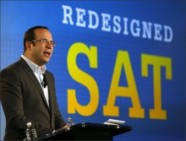
The College Board is actually a nonprofit entity (EIN 13-1623965), but don’t let that fool you. The money is a-flowing, and for College Board’s top admin, testing is turning out to be quite the lucrative racket.
24sat-david-coleman-sat-test-600
David Coleman, College Board
Let’s just consider some info from the College Board’s 2016 tax form.
Total revenue in 2016 was $916M, just shy of one billion dollars, $3.3M of which derived from government grants. The greatest revenue generator was “AP and instruction,” at $446M, followed by “assessments,” at $338M.
piggy bank cash
As for 2016 lobbying expenses: The College Board spent $2.3M (a drop in the billion-dollar bucket of its total revenue), with the following explanation:
The College Board contacts legislators and their staff to provide data and statistics on K-12 education and college admissions and to encourage them to support appropriations for education.
If your nonprofit breaks a billion in revenue, then $2M spent on lobbying becomes relatively nothing. In addition, “providing data and statistics” is probably far enough removed to be considered as not actively lobbying.
But let’s move on to the few who profit the most from nonprofit College Board.
The highest paid independent contractor by far was another testing entity, Educational Testing Services (ETS), at $359M.
Former Common Core “architect” and College Board president, David Coleman, drew $1.7M in total compensation in 2016, $512K of which is “bonus and incentive CONTINUE READING: The College Board “Nonprofit”: Oh, the Money One Can Make! | deutsch29


NYC Educator: Zombie Plague of Bad Teachers in Press--Real Ones Just Go to Work

NYC Educator: Zombie Plague of Bad Teachers in Press--Real Ones Just Go to Work

 Zombie Plague of Bad Teachers in Press--Real Ones Just Go to Work


Someone put the bat signal on my Cory Booker post and I've gotten a few status quo questions. I've responded to them, but I really hate answering questions like that.

What would you do about all the teachers who suck? We'd respect the union more if it didn't defend all those bad teachers. Why are all city schools so terrible?

These questions are not new to me. For years I've read newspaper editorials and op-eds that sprang from these assumptions. I've been writing this blog for almost 14 years, and I don't really love moving back to square one. Nonetheless I've responded to a few of them.

As I write this, I'm finished teaching for the day, waiting on a School Leadership Team meeting. I'm in the teacher cafe with a bunch of people who are prepping lessons. I've already done most of what I've got to do, and the rest will wait until morning. I've set this blog to pop up at 4 AM, and that's around the time I'll be popping up too. I have a little quiet time in the morning, then I walk my dog and come in.

I'm in an hour early every morning. Because my job as chapter leader is basically insane (I'm not complaining--I love this job), it's the only way I can make sure I have time to do actual schoolwork.  There is a group of us here early, and I'm the only one who's chapter leader. Everyone else is doing extra, off schedule unpaid work too. They're prepping lessons, writing PowerPoints, making copies, stapling papers, and doing 500 other things. But that's not where the real work is.

The real work is on the classroom when you're with 34 teenagers, some of whom may be smarter, or even crazier than you are. I can't really guarantee I'll always be the smartest. You never know when some kid will get all arrogant and have a better argument than you do. But you can always work on being crazier than they are. However, no matter how unpredictable you fancy yourself, there's always some kid even more so, and that kid might be in front of your face at this very moment.

In that case, you'd better be smart, because that's a very delicate situation. What can you do or say that might make the odd behavior before you cease, improve, or better yet, become productive? For me, the answer is conversation first, and if there's a later, home contact more often than not. A lot of teachers don't like to call. I don't blame them CONTINUE READING: 
NYC Educator: Zombie Plague of Bad Teachers in Press--Real Ones Just Go to Work


Chavez Charter Chain Teachers, Newly Unionized, Decry School Closing | GFBrandenburg's Blog

Chavez Charter Chain Teachers, Newly Unionized, Decry School Closing | GFBrandenburg's Blog

Chavez Charter Chain Teachers, Newly Unionized, Decry School Closing


Last night I attended a hearing at the ‘Public’ Charter School Board on 14th St NW here in Washington DC to support the teachers at Chavez Prep Middle School, which the un-elected chain’s board has decided to close.
Mark Simon wrote on Facebook,
“Chavez teachers did an amazing job last night! PCSB members asked some good questions of trustees, but avoided the Obvious role of Ten Square, which was simultaneously advising on contract negotiations and bank loan negotiations. Getting no concessions from the bank conveniently busts the union. Coincidence? Victory Ten Square. So why is the PCSB pushing Ten Square on schools anyway? Could preventing charter unionization from spreading be a bigger agenda than keeping one successful school open?”
I wrote:
I was there too, but didn’t stay until the very end- my back hurt from standing so much. (in the overflow space out in the hall) It’s definitely not a coincidence that they closed those particular schools; it’s clearly union-busting, just like McDonald’s or Walmart closing the few of their stores that unionized.
I didn’t hear anybody mention that, though they may have done so after I left.
BTW about 8-9 years ago I attempted to mentor a young math teacher at Chavez Parkside (Anacostia) through the CONTINUE READING: Chavez Charter Chain Teachers, Newly Unionized, Decry School Closing | GFBrandenburg's Blog


Debunking 3 myths about black students — using data and logic - The Washington Post

Debunking 3 myths about black students — using data and logic - The Washington Post

Debunking 3 myths about black students — using data and logic

Ivory A. Toldson, a professor of counseling psychology at Howard University, has a new book with a mouthful of a title and an important message: “No BS (Bad Stats): Black People Need People Who Believe in Black People Enough Not to Believe Every Bad Thing They Hear About Black People.”
The book, as the title suggests, addresses myths about black students and debunks with them data and logic. The post below was written by Toldson, who takes three of the myths head-on.
Toldson also is the president of Quality Education for Minorities, editor in chief of the Journal of Negro Education and executive editor of the Journal of the Center for Policy Analysis and Research, published by the Congressional Black Caucus Foundation.
This appeared on the Conversation website, and I was given permission to publish it.
By Ivory Toldson
Evidence suggests white teachers are more negative with — and have lower expectations for — black students. As a counseling professor who specializes in educating black children, these findings do not surprise me. I often hear education professionals and others use simplistic negative statistics to explain complex challenges facing black students.
In my new book, “No BS (Bad Stats): Black People Need People Who Believe in Black People Enough Not to Believe Every Bad Thing They Hear about Black People,” I refer to these kinds of negative statistics as “BS,” or “bad stats.” They are data points that are incomplete, poorly contextualized, usually negative and sometimes wrong.
My book uses data, research and anecdotes to confront nine lies about education and black students. I give CONTINUE READING: Debunking 3 myths about black students — using data and logic - The Washington Post

Tuesday, February 26, 2019

Why Schools Have Such Strict Bathroom Rules - The Atlantic

Why Schools Have Such Strict Bathroom Rules - The Atlantic

When Schools Tell Kids They Can’t Use the Bathroom
By imposing harsh restrictions on when students can use the restroom, educators are teaching kids to ignore their bladder.


Most people probably take their bathroom privileges for granted, heading to the toilet in their home or office whenever the need arises without thinking much about it. But at school, children don’t always have that luxury.
recent survey by the Society for Women’s Health Research found that schools often disregard kids’ restroom rights, often by failing to have a bathroom rule on the books and provide staff with education on bladder health. Absent official policies, parents and doctors tell me, many teachers come up with their own regulations, which anecdotes suggest can border on absurd. I heard about a teacher who allegedly stipulated that her students could only go to the restroom during class time once every two months, for instance, and read about some school districts routinely locking restrooms at lunchtime or after school to discourage misbehavior.
Schools seek to minimize the amount of time kids spend in the bathroom during class to ensure that they get the most out of their instruction, and generally restrict students’ access to prevent misconduct in the restrooms, where kids tend to be unsupervised. Well-intentioned yet overburdened teachers might adopt such rules to avoid disruptions and ensure that all their students are accounted for. But treating bathroom use as a discipline issue can have serious health implications, especially when a kid needs to go, but can’t.

Read: Using the restroom: A privilege—if you’re a teacher
A majority (84 percent) of respondents in the recent survey, which was distributed among school nurses serving all grade levels nationwide, said students often have ulterior motives when they ask to use the bathroom—maybe they don’t have to go and just want to meet up with a friend, for example, or perhaps they intend to skip the bathroom altogether and cause a ruckus in the hallway. A little more than half reported that kids misbehave in the bathroom. Underlying these assumptions is the fact that few schools have written policies on students’ bathroom use—just 8 percent of nurses said such rules existed, while fewer than half said students on their campus can use the bathroom whenever they please, with permission required only as a formality.
And the survey’s results suggest that such realities persist despite growing recognition of the health consequences. More than a third of respondents expressed concern about the adequacy of kids’ bathroom-break time—and CONTINUE READING:  Why Schools Have Such Strict Bathroom Rules - The Atlantic

School Districts Serving Students Of Color Have Less Money : NPR

School Districts Serving Students Of Color Have Less Money : NPR

Why White School Districts Have So Much More Money


In 1954, the Supreme Court ruled in Brown v. Board of Education that segregated public schools are unconstitutional.
In 2018, on the 64th anniversary of that ruling, a lawsuit filed in New Jersey claimed that state's schools are some of the most segregated in the nation. That's because, the lawsuit alleges, New Jersey school district borders are drawn along municipality lines that reflect years of residential segregation.
The idea that school district borders carry years of history is the premise of a new report from the nonprofit EdBuild, which studies the ways schools are funded in the U.S.
The report starts with a number: $23 billion. According to EdBuild, that's how much more funding predominantly white school districts receive compared to districts that serve mostly students of color.
"For every student enrolled, the average nonwhite school district receives $2,226 less than a white school district," the report says.
EdBuild singles out 21 states — including California, New Jersey and New York — in which mostly white districts get more funding than districts composed of primarily students of color.


More than half of students in the U.S. go to segregated, or "racially concentrated" schools, according to the report. Those are schools in which more than three quarters CONTINUE READING: School Districts Serving Students Of Color Have Less Money : NPR


Proposed legislation would substantially curb growth of California charter schools | EdSource

Proposed legislation would substantially curb growth of California charter schools | EdSource

Proposed legislation would substantially curb growth of California charter schools
Restrictions would limit appeals, cap number of new charters, factor fiscal impact


The chairman of the Assembly Education Committee and several Democratic colleagues introduced a package of bills Monday that would impose severe restrictions on the growth of charter schools.
Three of the bills would eliminate the ability of charter schools to appeal rejected applications to the county and state, place an unspecified cap on charter school growth and enable school districts to consider the financial impact of charter schools when deciding whether to approve them. A fourth bill would abolish the right of a charter school that can’t find a facility in its authorizing district to locate a school in an adjoining district.
Assemblyman Patrick O’Donnell, D-Long Beach, who chairs the Education Committee, said the bills collectively would enable school districts “to make responsible and informed decisions” that are “critical for student success and taxpayer accountability.” Eric Premack, a veteran charter school adviser and advocate, called the legislation a “full-frontal” assault and “scorched earth” approach to charter schools.
Charter schools are publicly funded schools that have greater flexibility in hiring, curriculum and other aspects of their operations. Unlike traditional public schools run by elected school boards, charter schools in California are nonprofit organizations with self-appointed boards.
The California Teachers Association, which put out the press announcement on Monday, other teachers and school employees unions, and the California state chapter of the NAACP, endorsed the bills. Their release coincides with the continuing teachers strike in Oakland Unified, where teachers are blaming charter school growth for weakening the district’s financial strength and are demanding restrictions on charter school expansion.
Another bill that O’Donnell co-authored, with Sen. Connie Leyva, D-Chino, requiring charter schools to comply with the state’s open meeting, public records and conflict of interest laws, passed the Senate last week and, on a fast track, is scheduled to be heard in O’Donnell’s Education Committee on Feb. 26. Many charter schools already adhere to the laws, but Senate Bill 126 would make CONTINUE READING: Proposed legislation would substantially curb growth of California charter schools | EdSource

John Thompson: Oklahoma’s “Staggering” Teacher Exodus | Diane Ravitch's blog

John Thompson: Oklahoma’s “Staggering” Teacher Exodus | Diane Ravitch's blog

John Thompson: Oklahoma’s “Staggering” Teacher Exodus


John Thompson writes from Oklahoma:
The Tulsa World’s headline nailed the big picture, “‘Staggering’: 30,000 Oklahoma Teachers Have Left Profession in the Past Six Years, Report Shows.” The World’s Michael Dekker cites State Superintendent Joy Hofmeister who explained, “The loss of 30,000 educators over the past six years is staggering — and proof that our schools must have the resources to support a growing number of students with an increasing number of needs.”
These huge losses occurred in a state which employed only 50,598 teachers in 2017-18.
Hofmeister addressed the immediate problem, “Steep budget cuts over the last decade have made the teaching profession in Oklahoma less attractive, resulting in a severe teacher shortage crisis and negative consequences for our schoolchildren.” The analysis, 2018 Oklahoma Educator Supply and Demand Report, by Naneida Lazarte Alcala, also touched on the ways that the lack of respect and the decline of teachers’ professional autonomy contributed to the massive exodus from the classroom.
The report showed that Oklahoma’s annual attrition rate has been 10 percent during the last 6 years, which was 30 percent more than the national average. This prompted an increase from 32 emergency certifications in 2012 to 2,915 in 2018-19. As a result, the median experience of state teachers declined by 1/5th in this short period.
Given the challenges faced by the Oklahoma City Public School System, it is noteworthy that the highest turnover rate in 2017-18 (almost 25 percent) occurred in central Oklahoma. Over 11 percent of teachers in the central region are new hires.
It should also be noted that charter schools have the highest turnover rate (almost 42 percent), even higher than that of middle schools. 
I kid my colleagues in middle school. But there is a serious point. Choice advocates have had success in their political campaign to defeat traditional public schools, but their turnover rate is another sign that the oversupply of charters shows that privatization isn’t a viable, educational alternative to neighborhood schools. 
But the financial cutbacks were not the only cause of the crisis. Alcala cites a survey of teachers who have left Oklahoma schools; 2/3rds said that increased compensation would not be enough to bring them back to the classroom.  Citing reasons that were beyond the scope of the report, 78 percent said that the quality of the work environment had declined, and nearly half said it had deteriorated a great deal.
On the other hand, the report suggested aspects of teaching conditions that merit further examination. It cited research on the negative effects of teacher turnover on student achievement, especially for low-income students. This stands in contrast with research cited by accountability-driven, competition-driven school CONTINUE READING: John Thompson: Oklahoma’s “Staggering” Teacher Exodus | Diane Ravitch's blog