Tacos for Teachers: GoFundMe's Try to Feed Students, Teachers During Strike
With thousands of Los Angeles teachers threatening to go on strike Thursday, several GoFundMe campaigns have popped up aimed at helping feed both educators and students during the work stoppage.
The strike would impact around 600,000 students, although Los Angeles Unified School District officials said they intend to keep all of their schools open while also serving meals.
The Feed LA Students during Teacher Strike GoFundMe campaign says 68 percent of the students at Thomas Starr King Middle School in Los Feliz are on the free and reduced lunch program, and it is estimated that at least half of all students may not attend school during the strike. The campaign, which appears to be organized by teachers, set out to raise $1,500 to make bagged lunches for families to pick up in front of the school in the morning or at lunchtime, and has already exceeded the goal, with more than $1,675 donated.
"The teachers want to make sure that students have healthy food available to them during this teacher action,'' the campaign's page says.
The Tacos for Teachers GoFundMe campaign wants to raise at least $5,000 to send taco trucks to the picket lines, and has received over $2,600 so far.
"Help support striking Los Angeles teachers and their fight for public education by donating to Tacos for Teachers, the fund that brings taco trucks to the picket lines,'' the campaign's site says.
Privatizing forces have appropriated the language of civil rights and social justice movements, while simultaneously gutting our schools of resources and selling our schools away to corporate-run charter companies.”
– Reclaim Our Schools LA
As noted by the Los Angeles Unified School District (LAUSD) School Board members in their joint statement dated August 21, 2018, “students and their families will bear the brunt of a strike action.” Many parents of the hundreds of thousands of students who attend District schools are scrambling to make arrangements for their children knowing that if schools remain open, LAUSD lawyers have admitted that “the health and safety of students” would be threatened and a normal academic program will be impossible to maintain. Students who depend on meals delivered by the schools are especially vulnerable as the district has not stated how these programs would be handled if schools are forced to close.
With this massive disruption at the doorstep of the District, our elected leaders have been mostly silent. Board Members seem content to let Superintendent Austin Beutner do their speaking for them. That is, with the exception of Nick Melvoin, who has been eager to express his disdain for people who would actually teach as a profession instead of using the classroom as a bridge to law school. Given Beutner’s lack of experience in education and his desire to CONTINUE READING: Where Do the LAUSD Board Members Stand?
The Serious Implications of the New Report of the Federal Commission on School Safety
On December 18, buried in the pre-holiday news was the release of a report from Betsy DeVos’s Federal Commission on School Safety. This blog reported last week on its most troubling recommendation—the one that was immediately enacted when DeVos’s department rescinded Obama-era guidance designed to reduce racial disparities in school discipline. It is worth exploring more broadly the implications of what was in the Commission’s report.
For the Washington Post, Laura Meckler reported: “President Trump’s Federal Commission on School Safety, formed after a mass shooting at a Florida high school, recommended… that school systems consider arming personnel and advised against increasing the minimum age requirement for gun purchases.”
For Politico, Kimberly Hefling wrote: “A Trump administration school safety panel hardly touched on the role of guns in deadly school shootings in its wrap-up…. But the panel instead encouraged more coordination between schools and law enforcement that could include programs that arm highly trained school personnel. It said local communities should consider incentives that encourage military veterans and those with a law enforcement background to work in schools. It also endorsed the adoption by states of ‘extreme risk protection orders’ designed to temporarily restrict access to firearms by individuals found to be a danger to themselves or others and encouraged Congress to modernize privacy laws.”
Sweetwater Schools Financial Problems Became Political Cudgel
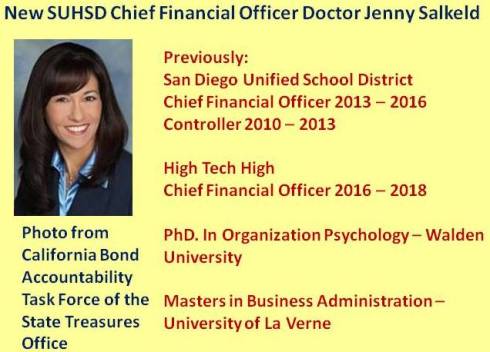
The newly hired Chief Financial Officer of Sweetwater Union High School District (SUHSD), Jenny Salkeld, discovered a significant problem with the budget she inherited. She presented her findings to the Sweetwater leadership team in early September which forwarded her report onto the County Office of Education (COE). The SUHSD board also called in all bargaining units to suspend contract negotiations and inform them of the budgetary uncertainties. Sensationalism and subterfuge became the new reality in Chula Vista, California.
“On June 25, the school board approved a budget for this school year that assumed the district had spent $328 million in unrestricted funding last school year and had $17 million in reserves going into this school year. In September, Salkeld presented a report showing that the district actually had spent $20 million more than that and started this school year with a negative reserve balance of $4 million.
“On top of spending more than previously estimated, the district received $6 million less in one-time state funding than it had expected.”
After receiving Sweetwater’s alert about the accounting errors, the COE officially disapproved the 2018-19 budget the district had submitted. The reasons for disapproving the budget were the reasons Salkeld had reported. The county’s CONTINUE READING: Sweetwater Schools Financial Problems Became Political Cudgel | tultican
The Network for Public Education welcomes four outstanding leaders to our NPE Board
Network for Public Education President, Diane Ravitch, is proud to announce that four accomplished leaders and supporters of public education have been elected to three year terms on the NPE Board of Directors.
Lavelle Jones was born and raised in Jersey City, New Jersey where she attended public schools. She received her Bachelor of Arts degree from Wellesley College and her Juris Doctorate from Seton Hall Law School. She is retired from the New Jersey Bar.
Lavelle worked for Colgate-Palmolive Company where she developed the company’s minority and women-owned business program, created global strategies for professional services and led global teams. The National Network Journal listed Lavelle as one of the most influential black women in business. She was also a two-time recipient of the Harlem YMCA Black Achievers in Industry award.
Since her retirement, Lavelle has applied her skills, as a volunteer, in support of her favorite causes: the well-being of older Americans, the education and safety of children and the preservation of wildlife. She joined AARP as a volunteer in 2007 and currently serves as AARP New Jersey State President. She also serves on the Board of Directors of the Allen-Shaw Foundation, a private charity devoted to the education of children in the nation of Jamaica. Since 2014, Lavelle has served NPE as the volunteer national conference coordinator.
Denisha Jones is the Director of Teacher Education and an Assistant Professor in the School of Education at Trinity Washington University. Dr. Jones began her career in education as a kindergarten teacher in D.C. after earning her Bachelor of Arts in early childhood education from the University of the District of Columbia. She also worked as a preschool director before spending the last 14 years in teacher education.
Determined to be a more effective advocate in the fight against school privatization, she began law school and graduated with her J.D. in May 2018. She has been a board member and administrator for the Badass Teachers Association (BATs), Inc., and currently, she is the interim Assistant Executive Director for BATs; she is chairwoman of the National Advisory Board for the Public Education Defense Fund and she serves on the advisory board of Defending the Early Years.
Her research interests include developing critical consciousness in pre-service teachers, organizing activist research projects that challenge the privatization of public education, and leveraging the intersection of public policy, social movement lawyering, and critical social justice education to dismantle the neoliberal assault on public education.
James Harvey has served as the executive director of the National Superintendents Roundtable since 2007. The Roundtable, an invitational membership organization, is dedicated to progressive leadership in support of just and humane schools.
A native of Ireland, Harvey attended elementary and secondary schools in Ireland and London and completed his high school education at a public school in Pennsylvania. He is the author or co-author of dozens of articles and five books on education and education policy. He served in the Carter administration as an education lobbyist and on the staff of the Committee on Education and Labor of the U.S. House of Representatives.
His doctoral work at Seattle University examined both the National Assessment of Educational Progress (NAEP) and American school performance in an international context and was published by the Roundtable and the Horace Mann League in 2015 and 2018 as The Iceberg Effect and How High the Bar? He serves on the Steering Committee of the Urban Superintendents Academy sponsored by AASA and Howard University and on the board of the Horace Mann League.
Roxana Marachi is Education Chair of the San José / Silicon Valley NAACP and an Associate Professor of Education at San José State University where she teaches courses in Educational Psychology and Educational Leadership. She received her PhD in Education and Psychology at the University of Michigan in 2003, where she studied the impacts of learning environments on student motivation and behavior in schools.
Marachi served as co-chair of the Safe Schools and Communities Subcommittee of the American Educational Research Association from 2009-2012, and is currently investigating research-to-practice gaps in the implementation of policies related to high-stakes testing, privatization, and the technologization of teaching and learning. Marachi was the recipient of the 2015 Justice Award from Californians for Justice and the 2015 Freedom Fighter Award from the San José / Silicon Valley NAACP, and is actively involved in local, state, and national efforts to strengthen and protect public education.
These four outstanding leaders and friends of public schools join Diane Ravitch, Anthony Cody, Phyllis Bush, Yohuru Williams, Leonie Haimson and Julian Vasquez Heilig as members of the Board of Directors of NPE.
The teachers of Los Angeles are poised to strike for better public schools for their city’s children
It is likely that the teachers of Los Angeles, California represented by UTLA will strike beginning tomorrow. If they do, it will be about more than salaries. Teacher demands include smaller class sizes, as well as more counselors, librarians and nurses in schools. They are demanding funding for community schools and less testing. They are demanding an end to disruptive and humiliating random searches of students in their schools.
You can show your support for the teachers of Los Angeles by wearing red on Thursday, January 10. Take your picture and then post it on social media. The Alliance to Reclaim our Schools, Los Angeles branch (ROSLA), has established a Solidarity Fund. If the teachers do strike tomorrow, you can make a donation here. Funds will be used by ROSLA to raise public awareness and support the strike. The Network for Public Education welcomes four outstanding leaders to our NPE Board - Network For Public Education
Miscounting Poor Students Billions of dollars in federal aid and virtually every metric for assessing achievement gaps rely on an accurate system for counting students from low-income families.
THE NUMBER OF POOR students enrolled in a particular school or living in a certain school district is one of the most important education data points that exists, and the stakes are high for getting the count right.
The figures are used to direct billions of dollars in federal and state aid, and they're a pillar of K-12 accountability systems that ensure disadvantaged students are keeping up with their wealthier peers.
But the method that's traditionally used to track them – how many students qualify for free and reduced-priced lunch – is no longer a reliable proxy for poverty as eligibility for the school lunch program has expanded in recent years. And getting an accurate count is becoming more difficult in part due to increasing numbers of students in the country illegally and students from immigrant families, both of whom are wary of enrolling in government benefit programs amid the Trump administration's crackdown on illegal immigration.
"This is a prime example of a really wonky, not-sexy problem that is extremely important," Ary Amerikaner, vice president for P-12 policy, practice, and research at The Education Trust, says. "These data underlie a huge number of critical decisions in the education world."
As just one example, Title I, the largest federal K-12 program, directs $14.5 billion annually to school districts with lots of poor students to ensure they have access to the same types of learning opportunities as wealthier children. For decades, school districts have relied on the number of students enrolled in the school lunch program in order to identify which specific schools are serving the most poor students. Moreover, schools use that count when assessing achievement gaps, namely whether poor students are keeping up academically with wealthier students and, if not, whether they are at least making gains – metrics used in accountability systems in every school district in the country.
Traditionally, the number of poor students was determined by the number of students who enrolled in the National School Lunch Program, which provides free or reduced-price lunches to students whose families make less than 130 percent or 185 percent of the federal poverty level, respectively. But in 2010, in the wake of the Great Recession, Congress adopted two important policy changes aimed at expanding eligibility, which in turn muddied the count.
First, it expanded what's known as "direct certification," which assumes students qualify for free and reduced-price lunch if they already receive other types of government support, like participation in the Supplemental Nutritional Assistance Program, commonly known as food stamps. Second, and most importantly, Congress expanded what's known as the "community eligibility provision," which allows schools to provide free lunch to all students, including to those CONTINUE READING: Why It’s Getting Harder to Count Poor Children in the Nation’s Schools | Education News | US News
Facing a $36 million deficit and a possible state takeover, the top budget officer at the Sacramento City Unified School District has a sober message for his counterparts around California.
Sacramento is “just one of the first dominoes,” said John Quinto, the district’s chief business officer.
By any measure, Sacramento City’s distress is worse than the vast majority of California school districts.
But Quinto’s warning hints at looming problems for many more: The costs of pensions, health care and special education outpace new revenue they’re receiving from the state and they put some schools on a trajectory for red ink.
“Those things combined are finding most school districts in a budget-cutting mode, and it’s a shocker in what has been a growing economy,” said Kevin Gordon, a lobbyist whose firm, Capitol Advisors Group, represents large school districts.
Those stresses are driving education advocates to put forward proposals that would ask Gov.-elect Gavin Newsom to set aside more money for K-12 schools. A rush of new funding wouldn’t necessarily spare Sacramento City, but it could put off a reckoning for many other districts.
So far, the options on the table include:
▪ Assembly Bill 39 by Assemblyman Al Muratsuchi, D-Torrance, which would swell education spending by $35 billion. For context, California budgeted $78.4 billion in state and local funds for K-12 school in this financial year.
▪ A pledge by Assembly Democratic leadership to help schools pay their rising pension bills, which could take the form of a direct payment to the state’s two largest pension funds or an unrestricted funding boost for school districts. Assembly Budget Committee Chairman Phil Ting, D-San Francisco, included that goal last month when he previewed the party’s objectives for upcoming budget negotiations.
▪ A general appeal from K-12 advocates asking Newsom to put more money into education than law requires. To them, more is better, but they’d consider anything over the minimum to be a win.
DeVos moves to boost college online learning while reducing regulatory oversight
The U.S. Education Department issued proposals Monday that could extend federal student aid dollars to a wider variety of higher-education providers, a move that some say could spur innovation and others worry could attract predatory actors.
Education Secretary Betsy DeVos has bemoaned what counts as a college course worthy of federal loans and grants. She has also challenged the accreditation system that stands between schools and billions of dollars in financial aid, questioning whether the Education Department’s accreditation rules work to the detriment of innovation and students.
The proposals would grant accrediting agencies more leeway to approve programs that don’t fit traditional models and loosen standards on instruction and the interaction between students and faculty. In doing so, the Education Department could bolster online and competency-based education, a burgeoning field that lets students learn at their own pace and move along as they master material.
The proposals are part of a process in which education stakeholders attempt to reach consensus on regulatory changes. But given the issues up for debate and the ways they could fundamentally change higher education, negotiators may have difficulty agreeing on much.
Under the proposals, the Education Department would give accreditors, and to a lesser extent colleges, more authority over how distance education, correspondence courses and credit hours are defined. The plan takes aim at Obama-era rules, including what counts as a credit hour.
John Thompson: Oklahoma and the Same Tired Privatization Agenda, Part 3
This is the third in a series about education politics in Oklahoma by John Thompson, historian and retired teacher.
The Oklahoman no longer dominates Oklahoma politics as it did for generations, but it is still the biggest bear in our woods. Now that legislators and governor-elect are more inexperienced than ever, the corporate school reform-loving newspaper is aggressively pushing its privatization agenda. Since our state government is almost completely lacking in knowledge of how and why the state implemented the entire accountability-driven, charter-driven experiment at the beginning of the decade, who knows who will win the hearts and minds of newly-elected officials?
One of the most worrisome of the Oklahoman’s recent editorials praised Reason magazine’s prescription for school improvement. Reason’s diagnosis was virtually indistinguishable from that of Jeb Bush’s ExcelinEd, which said that underfunded high-poverty urban schools don’t need more money as much as they need to learn from high-performing schools in the rich exurbs.
The Oklahoman then editorialized:
In 2011 and 2012, Oklahoma implemented reforms that have proven effective in Florida, including a third-grade reading law that required retention of students who were two years below grade level, and an A-F school grading system. Lawmakers have since watered down some of those reforms. Instead of backing off, Reason’s education rankings indicate Oklahoma lawmakers should double down.
The Oklahoman is still angry that moderate Republican State Superintendent Joy Hofmeister led a bipartisan effort that allowed schools to use more discretion when deciding whether to retain 3rd graders who don’t pass their reading test. For years, it has led the chorus for adopting an under-funded replica of the full Florida agenda. Fortunately, the CONTINUE READING: John Thompson: Oklahoma and the Same Tired Privatization Agenda, Part 3 | Diane Ravitch's blog
Did the IPET Initiative Reform Schooling? (Part 3)
Did the Gates-funded initiative to alter how teachers get evaluated in three school districts and four charter networks between 2009-2016, fail?
A local newspaper and the RAND corporation’s independent evaluation reached similar conclusions when it came to achieving the goals of improving low-income minority students’ test scores. Both concluded that the project did not meet that goal. New policies of identifying effective teachers and having those teachers work with low-income minority students also failed to yield the promised outcomes of the donor initiative. The dominant criterion used to judge “success” and “failure in U.S. public schools for the past generation has been effectiveness, that is, were the goals of the project achieved? Yes or no. Up or down. A binary answer. Using this criterion, the initiative failed.
Yet–frequent readers of this blog know that a “yet” or “but” soon arrives–there is evidence of a mixed verdict on the “success” and “failure” of IPET. Consider the following points:
*With Gates prior funding of research on measures of teaching effectiveness, support of the Obama administration, and school districts and charter networks eager to take the money and put these ideas into practice, the process part of IPET policymaking was clearly a political “success.” IPET mobilized federal, state, and local officials to consider the project and then adopt it with accompanying funding. A donor’s huge grant to school districts and charter CONTINUE READING: Did the IPET Initiative Reform Schooling? (Part 3) | Larry Cuban on School Reform and Classroom Practice
UFT Executive Board January 7, 2018--We Support LA Teachers and Discuss Election
Secretary Howard Schoor welcomes us..
Speakers—
Betty Godfried—retired Adult ed. CL—After 7 years, Rose Marie Mills has been removed (applause) and is being reassigned. Third time an unsuitable admin has been dismissed in recent years. Only teachers or paras are discontinued. Admin is moved around. Rank and file made these things happen. Current fight was in service and retired members who were victimized.
Ended illegal test procedures, articles published, met with reps, spoke here. Documented activities, will prepare packet. Thanks Schoor for giving it to Mills, thanks Mulgrew for meeting, would’ve liked more support. Carmen Alvarez also supportive. Still long way to go, issues need to be resolved. New superintendent may need guidance. Union may need to negotiate. Thanks teachers for all the work they did, thanks for applause, thanks for those who do listen, says coming here has made a difference.
This ten minute mike one of last bastions of true union democracy. Giving voice to voiceless is doing something good.
David Price—CL Bard HS Queens—Teachers at school want to know what UFT will do in solidarity with UTLA. Happy to see resolution in favor. Concerned that DA is after the 10th. Proposed resolved. Schoor—Only members may propose resolutions.
Price—Urges members to add resolved that UFT invite UTLA leaders to speak before elected bodies, and that we publicize UTLA campaigns. Has members who want to donate to strike fund, would rather contribute to that than COPE. We are in solid position to show strength.
Schoor—At last meeting I called on non-member of Exec. Board. We need to know who people are who come in so we are now requiring sign-ins. We welcome all members and retired members. We need to know why people are here if they are not members.
Tony Evers, Inaugurated as Wisconsin Governor, Faces a Divided State But Has Backing from Strong Public Education Network
In his fine book on the political ramifications of the 2010 Red-wave state elections, The One Percent Solution, Gordon Lafer describes state politics marked by big money and the impact of the Tea Party: “In January 2011, legislatures across the country took office under a unique set of circumstances. In many states, new majorities rode to power on the energy of the Tea Party ‘wave’ election and the corporate-backed RedMap campaign. Critically, this new territory included a string of states, running across the upper Midwest from Pennsylvania to Wisconsin, that had traditionally constituted labor strongholds…. In addition, this was the first class of legislators elected under post-Citizens United campaign finance rules, and the sudden influence of unlimited money in politics was felt across the country… Wisconsin’s was the most notorious legislation adopted during this period… Wisconsin’s ‘Budget Repair Bill’ (Act 10) largely eliminated collective bargaining rights for the state’s 175,000 public employees… (Act 10) marked a singular triumph for the ALEC network. Not only did the bill embrace principles laid out in ALEC model legislation, but its passage was made possible by an extensive corporate investment in local politics. (Governor Scott) Walker himself is an alumnus of ALEC, and from 2008 to 2012 he received over $400,000 in campaign contributions from ALEC-member companies. In addition, forty-nine members of the 2011 Wisconsin legislature were ALEC members….” (The One Percent Solution, pp. 44-49)
Yesterday, January 7, 2019, Tony Evers, a Democrat, was inaugurated to replace Walker as Wisconsin’s governor, but both houses of the Wisconsin Legislature remain Republican—and ALEC-dominated.