Latest News and Comment from Education

Tuesday, October 23, 2018

Pennsylvania’s Keystone Exam – the Monster We Refuse to Let Die | gadflyonthewallblog

Pennsylvania’s Keystone Exam – the Monster We Refuse to Let Die | gadflyonthewallblog

Pennsylvania’s Keystone Exam – the Monster We Refuse to Let Die

Let’s say there was a monster loose in Pennsylvania and you caught it.
Its days of wandering loose causing chaos and destruction were over.
But what would you do with such a beast now?
Would you kill it outright? Stop it from ever hurting anyone ever again?
Or would you simply neutralize it – place it perhaps in the center of a labyrinth, continue feeding it, and in fact create a whole religion based on worshipping it?
In the keystone state, we have just such a creature, and we’re going with the second option – the maze, nourishment and a cult.
And, heck, it would just make more sense to stop doing something that isn’t working, wastes money and causes legitimate problems for students.
But this is Pennsylvania! We’re not going to admit we made a mistake. Better to bury Continue reading: Pennsylvania’s Keystone Exam – the Monster We Refuse to Let Die | gadflyonthewallblog


Monday, October 22, 2018

John Thompson: The Negative Effects of Corporate Reform and Disinvestment in Education | Diane Ravitch's blog

John Thompson: The Negative Effects of Corporate Reform and Disinvestment in Education | Diane Ravitch's blog

John Thompson: The Negative Effects of Corporate Reform and Disinvestment in Education
John Thompson, historian and teacher, lives in Oklahoma.


The Oklahoma press is focusing on the state’s low level of college readiness as measured by the ACT test, 16 percent, in comparison to the national rate of 27 percent. The state known for dramatic cuts in education funding is ranked 19th in the nation with an average composite score of 19.3. But it is missing the big picture.
The average ACT composite for my old school, Centennial, is 14.8, which is above average for the high-poverty neighborhood schools in Oklahoma City and Tulsa. Even when we were ranked last in the state, our ACT scores were significantly higher. Since I retired, Centennial received a $5 million School Improvement Grant. I believe that its ACT decline is just one example of evidence explaining how and why tens of billions of dollars of corporate school reform drove meaningful learning out of many inner city schools.
The important question is what caused the national decline. Retired PBS education reporter John Merrow argues these ACT-takers “have had 12 or 13 years of test-centric education, and the kids coming up behind them have also endured what the ‘school reformers’ designed.” He also asks, “How much more evidence do we need of the folly of ‘No Child Left Behind’ and Education Secretary Arne Duncan’s ‘Race to the Top’ before we take back our schools?”
Since reformers sought to improve low-performing schools, it is significant that Merrow cites the ACT report on recent outcomes:
A higher percentage of students this year than in recent years fell to the bottom of the preparedness scale, showing little or no readiness for college coursework. Thirty-five percent of 2018 graduates met none of the ACT College Readiness Benchmarks, up from 31% in 2014 and from 33% last year.


All types of researchers are contributing to the autopsies being performed on data-driven, competition-driven reform. And many of us are especially intrigued by the analyses of corporate school reformers on why test-driven accountability, the expansion of charter schools, and the quest to “build a Continue reading: John Thompson: The Negative Effects of Corporate Reform and Disinvestment in Education | Diane Ravitch's blog


ISTA: Lying Down With Dogs – Live Long and Prosper

ISTA: Lying Down With Dogs – Live Long and Prosper

ISTA: Lying Down With Dogs


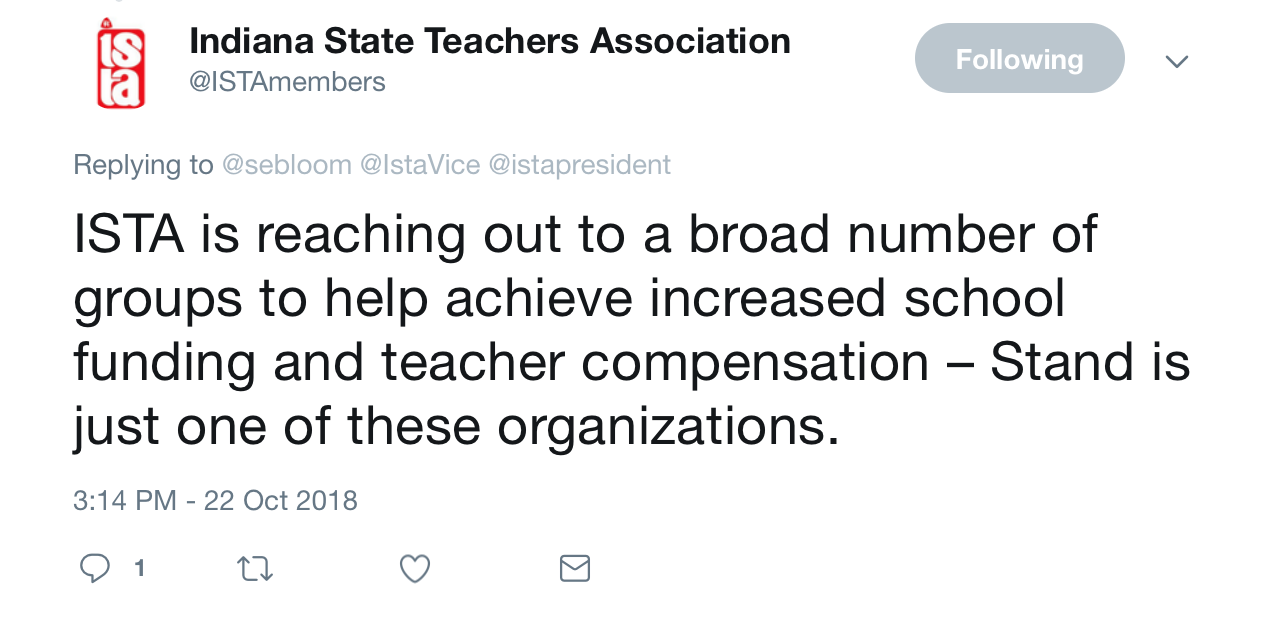
The Indiana State Teachers Association is joining with Stand for Children. Why would ISTA join with an ed-reform group?

In case you don’t know, Stand for Children is a pro-ed-reform group deeply involved with the privatization of Indianapolis Public Schools (IPS).
With the arrival of Oregon-based Stand For Children, Indianapolis school board elections started to take on a decidedly different tenor. Until 2010, a few thousand dollars was all that was needed to win a seat. That all changed when Stand For Children, an education reform 501(c)(4), started pouring tens of thousands of dollars into the 2012 elections. Stand’s tax return that year reported that the election of three Indianapolis school board members was a top accomplishment for the organization.
The result of this is that Indianapolis has seen school closures and disruptions led by the district superintendent…appointed by the school board purchased by Stand for Children.
Stand for Children also spent $473,172 lobbying Indiana lawmakers on Public Law 1321, which was passed in 2014. Public Law 1321 was based on a 2013 model policy drafted by the American Legislative Exchange Council (ALEC), the Koch-funded member organization of corporate lobbyists and conservative state legislators who craft “model legislation” on issues important Continue reading: ISTA: Lying Down With Dogs – Live Long and Prosper


Investigation of Clayton Valley Charter High School extended, referred to DA

Clayton Valley investigation will continue, county votes

Investigation of Clayton Valley Charter High School extended, referred to DA


PLEASANT HILL — After a contentious discussion that lasted roughly two hours, the Contra Costa County Board of Education decided Wednesday night to continue investigating the possible misuse of funds at and alleged mismanagement of Clayton Valley Charter High School in Concord.
A recent audit by the county found that the married former top leaders of the school made almost $850,000 in less than two years before leaving in the spring, secretly hired people and created positions without the school board’s approval.
Among the staff recommendations at the county office of education was to refer some issues — including the salaries of former executive director David Linzey and his wife, Eileen Linzey, the former chief program officer — to the district attorney’s office to potentially evaluate whether any use of funds violated the law.
“The individual and combined salary of the (executive director) and his wife appear to represent the potential for the substantially improper use of charter school funds for the personal benefit of any officer,” a staff memo to the board said.
David Linzey’s salary totaled $312,212 annually for managing the school — a salary that county education staff said exceeded the pay of most superintendents in Contra Costa County who oversee more students, schools and staff than Clayton Valley. Eileen Linzey, who was hired to fill the other top job at the school in early 2017, was paid a yearly salary of $223,392 — also more than what most of the county’s superintendents make.
The audit also found that Eileen Linzey was hired without the school posting the job internally and externally and noted that she reported to the executive director, her husband. However, Clayton Valley’s board members have disputed that, saying she reported directly to them.
An amendment to David Linzey’s contract added health benefit payments and a car allowance to his base salary, prompting county staff to recommend submitting a compensation summary to the California State Teachers’ Retirement System to determine if benefit “spiking” — using benefit payments to boost the overall salary base in an effort to  Continue reading: Clayton Valley investigation will continue, county votes


Big Education Ape: Audit finds steep salaries, misuse of funds at Clayton Valley charter school - https://bigeducationape.blogspot.com/2018/09/audit-finds-steep-salaries-misuse-of.html

Video of Teaching for Black Lives Book Launch: “It really touched my heart more than you will ever know.” – I AM AN EDUCATOR

Video of Teaching for Black Lives Book Launch: “It really touched my heart more than you will ever know.” – I AM AN EDUCATOR
Video of Teaching for Black Lives Book Launch: “It really touched my heart more than you will ever know.”

Video of Teaching for Black Lives Book Launch: “It really touched my heart more than you will ever know.”


Town Hall Seattle recently sponsored the Seattle book launch event for the new Rethinking Schools book, “Teaching for Black Lives,” at the Langston Hughes Performing Arts Center.

It was a sold out forum and turned out to be a wonderful celebration of Blackness, resistance, and pedagogy. It was a special night for all of us editors of Teaching for Black Lives–Dyan Watson, Wayne Au, and myself–who got to come together in celebration of the work we had done to create this book. But the highlight of the evening was the Garfield High School students who opened the event. Their poignant descriptions of institutional racist schooling, coupled with their appreciation for the transformative power of the lessons in Teaching for Black Lives, was truly moving for me.
Janelle Gary, in what I would consider the best praise the book has ever gotten, ended her speech to the assembled audience saying:
There’s this quote on page 10 of Teaching for Black Lives: “Teaching for Black lives also means considering the loneliness of learning about one’s history when you might be one of the few students in class or few teachers in school that this history represents.” And that stuck out to me the most because…I felt alone and I felt like none of my teachers were going to be able to relate to me. And just reading that in the book really lets me know that I wasn’t crazy.
So I just wanted to thank Mr. Hagopian, and I want to thank everybody who’s here. This book is amazing…if you haven’t read it yet, please read it. And if you have, read it again and suggest it to someone because it really touched my heart in a way more than you will ever know. Thank you.
Below is the video of the Town Hall event–featuring the wonderful speeches of Garfield student leaders from New Generation Janelle Gary, Chardonnay Beaver, Ke’von Avery–followed by an edited transcript of the Janelle’s presentation. I hope this book event inspires you to work to dismantle institutional racism in education and teach for Black lives! Continue reading: Video of Teaching for Black Lives Book Launch: “It really touched my heart more than you will ever know.” – I AM AN EDUCATOR


Public schools for private gain: The declining American commitment to serving the public good  - kappanonline

Public schools for private gain: The declining American commitment to serving the public good  - kappanonline.org

Public schools for private gain: The declining American commitment to serving the public good 
When schooling comes to be viewed mainly as a source of private benefit, both schools and society suffer grave consequences. 

We Americans tend to talk about public schooling as though we know what that term means. But in the complex educational landscape of the 21st century — where charter schools, private schools, and religious schools compete with traditional public schools for resources and support — it’s becoming less and less obvious what makes a school “public” at all. 
A school is public, one might argue, if it meets certain formal criteria: It is funded by the public, governed by the public, and openly accessible to the public. But in that case, what should we make of charter schools, which are broadly understood to be public schools even though many are governed by private organizations? And how should we categorize private schools that enroll students using public vouchers or tax credits, or public schools that use exams to restrict access? For that matter, don’t private schools often serve public interests, and don’t public schools often promote students’ private interests?  
In short, our efforts to distinguish between public and nonpublic schools often oversimplify the ways in which today’s schools operate and the complex roles they play in our society. And such distinctions matter because they shape our thinking about education policy. After all, if we’re unclear which schools deserve what kinds of funding and support, then how do we justify a system of elementary, secondary, and higher education that consumes more than $800 billion in taxes every year and consumes 10 to 20 or more years of every person’s life?  
To clarify what we mean by public schooling, it’s helpful to broaden the discussion by considering not just the formal features of schools (their funding, governance, and admissions criteria) but also their aims. That is, to what extent do they pursue the public good, and to what extent do they serve private interests? 
A public good is one that benefits all members of the community, whether or not they contribute to its upkeep or make use of it personally. In contrast, private goods benefit individuals, serving only those Continue reading: Public schools for private gain: The declining American commitment to serving the public good  - kappanonline.org


Image result for Public loss private gain

Education May Propel the Blue Wave in DeVos Country

Education May Propel the Blue Wave in DeVos Country

Education May Propel the Blue Wave in DeVos Country
Should Democrats retake the Rust Belt, it may not only snuff out the DeVos legacy but also change the course of education policy in the nation


It’s increasingly clear that if the November midterm elections are to produce a “Blue Wave” for the Democratic Party, then many of the wins will need to come in Midwestern states that Trump carried in the 2016 presidential election. But what’s less well understood is that an issue helping Democratic candidates compete in the region is education. In the stomping ground of U.S. Secretary Betsy DeVos—including her home state of Michigan as well as the surrounding states of Ohio, Wisconsin, Illinois, and nearby Minnesota—Democratic candidates are getting an edge by sharply opposing the DeVos agenda of privatizing public schools.
Up and down the ballots in state contests in the Midwest, Democratic candidates call for an end to school voucher programs that use public taxpayer funds to pay for tuitions at private schools, they propose tougher regulations of privately managed charter schools funded by the public, and they pledge to direct public money for education to public schools. Should Democrats retake the Rust Belt, it may not only snuff out the DeVos legacy but also change the course of education policy in the nation.

Why the Midwest Matters


The need for Democrats to prevail in the Midwest is acute. Trump won Indiana, Iowa, Michigan, Ohio, and Wisconsin in 2016 and came close in Minnesota. But a perhaps more important trend in these states is the Republican dominance down ballot where Republicans control both chambers of the state legislature and governors and most of the U.S. House seats in Michigan, Wisconsin, Iowa, Indiana, and Ohio.
So far, most Democratic candidates running in state governor races in these states are well ahead or very competitive, and at least 35 seats in state legislatures in Michigan, Minnesota, and Wisconsin are considered “flippable” by party advocates. Republican candidates are in danger of losing governor elections in Michigan, Wisconsin, Illinois, and Iowa, and elections could give Democrats the upper hand in state legislatures previously controlled by Republicans in Iowa, Minnesota, Michigan, and Wisconsin.
According to Politico, “Democrats are poised to chip away at Republican statehouse dominance in next month’s midterm elections, with wins appearing likely in some of the biggest states in the industrial Midwest.”

‘Making Education Central’

Even before the primaries were over, the Democratic National Committee declared that education would be “on the ballot” in the midterm elections, according to Education Week. The EdWeek reporter quotes a DNC source saying that Democratic candidates are “running and winning by making education central to their campaigns.” Subsequent Continue reading: Education May Propel the Blue Wave in DeVos Country


Sunday, October 21, 2018

DeVos on ballot - enrique baloyra

DeVos on ballot - enrique baloyra


Despite not appearing on any ballot this November, Betsy DeVos sure is having a big impact this election cycle. Her corporate agenda has long been the object of scorn among activists. But now as secretary, her name has become a rallying cry for progressive candidates everywhere.
In Texas, Democratic nominee for US Senate Beto O’Rourke is running an ad that calls Ted Cruz “the deciding vote on putting Betsy DeVos in charge of our children’s public education.”
In Alaska, education advocate Alyse Galvin, who gained notoriety for pressuring Senator Lisa Murkowski to vote no in the secretary’s confirmation hearing, is running for the seat Rep. Don Young has held for 44 years.
If Democrats want to regain control of Congress on November 6, they’ll have to win big in Midwestern states where the president won just two years ago. And that’s exactly where DeVos is least popular.
In Ohio, Wisconsin, Illinois, Minnesota, and especially her home state Michigan, Democratic candidates are hammering their Republican opponents for supporting DeVos and her policies.
In Michigan, where DeVos and her family have spent $14 million supporting Republican candidates this year alone, Democratic nominee for governor Gretchen Whitman promises “to stop the dismantling of public education and put an end to the DeVos agenda…”
https://twitter.com/gretchenwhitmer/s...
“[DeVos’] political legacy has had disastrous consequences for Michigan children. After decades of unlimited charter growth — dominated by for-profit charters — the state ranks dead last in the nation in growth of academic achievement as measured by standardized test scores and is in the bottom 10 states in key measures of academic achievement.”
https://www.salon.com/2018/10/20/educ...
DeVos made it priority number one to gut civil rights protections for children with disabilities and LGBT students. Her attempts to roll back Title IX protections for sexual assault victims come as the
#MeToo movement has gained national momentum. Her support for allowing schools to arm teachers using federal money has drawn a Freedom of Information Act lawsuit. Last week a judge ordered her to stop blocking Obama-era student loans protections.
And to top it off, her security detail cost taxpayers $14 million this year. For an education secretary.
Disney couldn’t have created a better villainess.


Tuck’s Ethnocentrism Contradicts Californian Values - LA Progressive

Tuck’s Ethnocentrism Contradicts Californian Values - LA Progressive

Tuck’s Ethnocentrism Contradicts Californian Values


Business banker Marshall Tuck is running for California State Superintendent of Public Instruction again. He’s backed by the same ideologically charged billionaires as the last time — several of whom supported reactionary measures like Proposition 8. With nearly unlimited funding, voters will be deluged with Tuck’s messaging. There’ll be plenty of unsubstantiated claims that he ran successful schools.

Marshall Tuck is running for California State Superintendent of Public Instruction again, backed by the same ideologically charged billionaires as the last time — several of whom supported reactionary measures like Proposition 8.

Those ads won’t reveal the truth about Tuck’s record. There’ll be no mention that when he ran the Green Dot Charter Corporation, one of his high schools “achieved” the dubious distinction of back-to-back years of absolutely zero students scoring proficient on the mathematics portion of the California State University (CSU) entrance examination. There won’t be discussion of how, under Tuck, one Partnership for Los Angeles Schools’ (PLAS) high school went five years without achieving even twenty percent of students scoring proficient on either the mathematics or the English portion of those same CSU exams. Five years. These awful proficiency rates were reflected in Scholastic Aptitude Tests (SAT) scores as well. Under Tuck’s “leadership” the schools he managed were among the very lowest scorers on the SAT in Los Angeles County, year after year.

Tuck’s record of terrible academic results isn’t the only issue that will be carefully obscured. His abject treatment of students of color, in a fashion much like his contemporary counterparts Tom Horne and John Huppenthal in Arizona, is something he works hard to hide. It’s time to shine a bright light on this.


Using their positions of authority, Tuck, Horne, and Huppenthal closed down popular, research proven, Ethnic Studies programs. Tuck did it at PLAS schools like Santee High School when he was their “CEO.” The other two did it while they were Superintendents of Public Schools in Arizona. Tuck went a step further than the others — he also restricted and shuttered both Heritage Continue reading: Tuck’s Ethnocentrism Contradicts Californian Values - LA Progressive

Tony Thurmond for California State Superintendent of Public Instruction - NPE Action


A Plan to Improve California's Public Schools

Tony Thurmond for State Superintendent of Public Instruction -https://www.tonythurmond.com/

Big Education Ape: Why Electing Tony Thurmond as Superintendent of Public Instruction Is the Most Important Race in California - https://bigeducationape.blogspot.com/2018/10/why-electing-tony-thurmond-as.html

Big Education Ape: The truth about money in public education politics - https://bigeducationape.blogspot.com/2018/10/the-truth-about-money-in-public.html

Big Education Ape: Tony Thurmond for California State Superintendent of Public Instruction - NPE Action - https://bigeducationape.blogspot.com/2018/10/tony-thurmond-for-california-state.html


Brookings: The role of AI in education and the changing U.S. workforce

The role of AI in education and the changing U.S. workforce

The role of AI in education and the changing U.S. workforce


Editor's Note: 
This report is part of "A Blueprint for the Future of AI," a series from the Brookings Institution that analyzes the new challenges and potential policy solutions introduced by artificial intelligence and other emerging technologies.
The growth of artificial intelligence (AI) and emerging technologies (ET) is poised to reshape the workforce.[1] While the exact impact of AI and ET is unclear, experts expect that many jobs currently performed by humans will be performed by robots in the near future, and at the same time, new jobs will be created as technology advances. These impending changes have important implications for the field of education. Schools must prepare students to remain competitive in the labor market, and postsecondary institutions must provide students and displaced workers with relevant education and retraining opportunities. Innovations in technology will also create new tools to support educators, students, and others seeking retraining and employment.
Consequently, there is a multitude of policy-relevant questions that we may consider with respect to how AI and ET will impact education. Rather than focus on just one of these many questions, this paper provides an overview of some of the most salient issues we should consider with respect to what technological advances in AI and ET mean for education. Specifically, this paper discusses several types of challenges, opportunities, and risks that AI and ET pose to the field of education. This paper then concludes with several recommendations for adapting education in anticipation of the changes associated with advances in AI and ET.

CENTRAL CHALLENGES FACING EDUCATION
The types of jobs that are at the least risk of being replaced by automation involve problem solving, teamwork, critical thinking, communication, and creativity.[2] The education profession is unlikely to see a dramatic drop in demand for employees given the nature of work in this field. Rather, preparing students for the changing labor market will likely be a central challenge for schools and educators. Policymakers and practitioners must adapt K-12 education to help students develop the skills that are likely to remain in demand (sometimes referred to as “21st century skills”). K-12 education should thus prioritize teaching critical thinking, problem solving, and teamwork across subject areas. Teaching students to become analytical thinkers, problem solvers, and good team members will allow them to remain competitive in the job market even as the nature of work changes. Equally important, these skills form a strong foundation for independent thinking that will serve Continue reading: The role of AI in education and the changing U.S. workforce


Arizona: The State Where Conflicts of Interest Are Celebrated in the Charter Industry | Diane Ravitch's blog

Arizona: The State Where Conflicts of Interest Are Celebrated in the Charter Industry | Diane Ravitch's blog

Arizona: The State Where Conflicts of Interest Are Celebrated in the Charter Industry


A friend in Arizona sent me the official bio of a member of the State Board of Regents, which is appointed by the Governor.
Jay Heiler was appointed in 2012. He has a distinguished resume…but. In addition to serving on the state Board of Education, he is also the Founder and President of the Board for Great Hearts Academies, a national charter chain based in Phoenix.
Regent Heiler graduated with honors in journalism from Arizona State University in 1983, where he was a Pulliam Scholar and served as editor-in-chief of the 45,000-reader campus daily, The State Press. He took his law degree at ASU as well, where he was named the Truman Young Fellow and began a prosecutorial career while still in law school, preparing and trying cases at the city, county, state and federal levels. He has served on the boards of both the Goldwater Institute and the Morrison Institute, Arizona’s two leading public policy think tanks, and hosted his own public affairs television program, Straight Answers. A dedicated advocate for education quality and reform, he is founder and President of the Board for Phoenix-based charter school management organization Great Hearts Academies. He is also president of the board for the Arizona Charter Schools Association. His past community service includes a number of charitable boards and board presidency of Esperanza, a third-world medical care and public health organization headquartered in Continue reading: Arizona: The State Where Conflicts of Interest Are Celebrated in the Charter Industry | Diane Ravitch's blog