Latest News and Comment from Education

Monday, October 8, 2018

A $1 billion Gates Foundation-backed education initiative failed to help students — here’s how the foundation's next $450 million project will look - Business Insider Nordic

A $1 billion Gates Foundation-backed education initiative failed to help students — here’s how the foundation's next $450 million project will look - Business Insider Nordic

A $1 billion Gates Foundation-backed education initiative failed to help students 
— here’s how the foundation's next $450 million project will look

  • The Bill and Melinda Gates Foundation spent more than $200 million on a teacher effectiveness initiative, and an independent assessment found that the program failed to help students.
  • Now the Gates Foundation is trying a new approach: supporting local organizations that work directly with teachers and principals.
  • Professors who specialize in education told Business Insider that the new initiative's focus on local groups is a step in the right direction.
  • However, experts noted the Gates Foundation is funding some of the same groups as before, and one professor said many of the new projects are vague and broad in scope.
In 2009, the Bill and Melinda Gates Foundation launched an ambitious project to improve teacher effectiveness among certain primary and secondary schools in California, Florida, Tennessee, and Pennsylvania.
The goal was to reform teacher evaluations. More effective teachers, the foundation predicted, would improve student achievement, raise graduation rates, and help low-income and minority students get into college.

About $1 billion went into the Intensive Partnerships for Effective Teaching initiative, with the Gates Foundation itself pouring over $200 million into a group of school districts and charter school networks in the four states.
The initiative, designed to last seven years, ended in 2016. This year, the Rand Corporation released a report concluding the program had failed to dramatically improve student achievement or graduation rates. Bill Gates himself noted the initiative's poor results in a speech last fall, saying his Continue reading: A $1 billion Gates Foundation-backed education initiative failed to help students — here’s how the foundation's next $450 million project will look - Business Insider Nordic


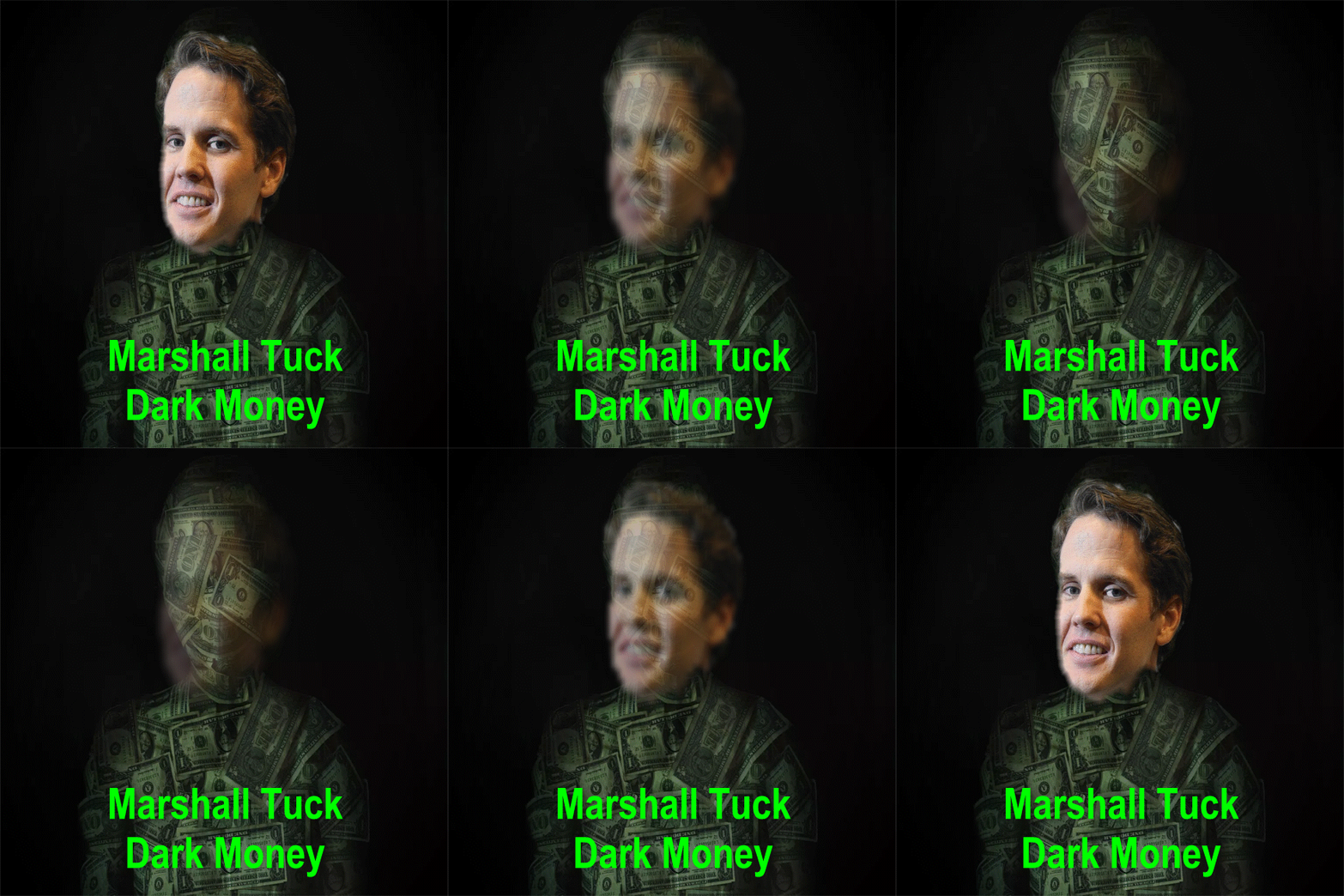
Marshall Tuck: The Republicans’ Trojan Horse

Marshall Tuck: The Republicans’ Trojan Horse

Marshall Tuck: The Republicans’ Trojan Horse


In last week’s column, I wrote that “the future of public education and the heart and soul of progressive California” were at stake in the Superintendent of Public Instruction race.  What makes this race so important is that it represents an attempt by moneyed interests and forces on the right to play in Democratic politics through the use of stealth and dishonesty.  Indeed, if you like the way the Lincoln Club intervenes in and tries to upset the Democratic apple cart in races here in San Diego, you’ll love how the right is trying to game California’s Democratic voters in this contest.
It’s so bad, that the state party came out with this extraordinary assertion last May leading up to the primary in response to Tuck’s refusal to disavow his Republican allies:
Tony Thurmond has won the overwhelming support of Democrats for Superintendent of Public Instruction because he champions our progressive values. Marshall Tuck’s support is limited to ultra-wealthy billionaires and right-wing thugs like Newt Gingrich and John Cox, who we see next to him in the latest independent mailer that Tuck has tacitly endorsed. It doesn’t matter how many pictures of President Obama he sends out to voters. We hear both sides of his mouth, and we know the conservative agenda he is part of.
Democrats must be 100 percent clear on this: Gingrich, DeVos and Trump have outlandish education Continue reading: Marshall Tuck: The Republicans’ Trojan Horse


Many schools in the US can teach whatever they want. It turns out that they teach lies - Muchas escuelas de EEUU pueden enseƱar lo que quieran. Resulta que enseƱan mentiras

Muchas escuelas de EEUU pueden enseƱar lo que quieran. Resulta que enseƱan mentiras

Many schools in the US can teach whatever they want. It turns out that they teach lies
The schools with programs of bonuses to the parents, for which the secretary of Education Betsy DeVos advocates, teach creationism, racism and sexism.


PORTLAND, Oregon (USA). - It was the last hours of the morning in an artistic cafe. The smell of coffee and baked goods sweetened the air. Ashley Bishop was sitting at a table, remembering a time when she had been taught that the majority of secular American society was worthy of contempt.
Having grown up in private evangelical Christian schools, Bishop saw the world in a polarized way, good and evil, heaven and hell. He had been taught that dancing was sin, that homosexuals were pedophiles and that mental illness was a function of satanic influence. The teachers in their schools spoke of slavery as black immigration and the instructors described the ecologists as "hippy witches."
Bishop's family moved from one place to another while she was little, but they always enrolled her in evangelical schools.
So when Bishop left school in 2003 and entered the real world at age 17, she felt like she was an alien who was landing for the first time on planet Earth. Having been separated from the dominant society, she was unable to manage the labor market and develop secular friendships. And, since he lacked shared cultural and historical references, he spent most of the twenties hiding in his room with an overwhelming social anxiety.
He had been taught that dancing was sin, that homosexuals were pedophiles and that mental illness was a function of satanic influence.
Now, at 31, he has become everything he was once taught to hate. He shares an apartment Continue reading: Muchas escuelas de EEUU pueden enseƱar lo que quieran. Resulta que enseƱan mentiras
Muchas escuelas de EEUU pueden enseƱar lo que quieran. Resulta que enseƱan mentiras
Los colegios con programas de bonos a los padres, por las que aboga la secretaria de Educación Betsy DeVos, imparten creacionismo, racismo y sexismo.

PORTLAND, Oregón (EE UU). ― Eran las Ćŗltimas horas de la maƱana en un cafĆ© artĆ­stico. El olor del cafĆ© y los productos horneados endulzaban el aire. Ashley Bishop estaba sentada frente a una mesa, recordando una Ć©poca en la que le habĆ­an enseƱado que la mayorĆ­a de la sociedad secular estadounidense era merecedora de desprecio.
Al haber crecido en escuelas cristianas evangélicas privadas, Bishop veía el mundo de una forma polarizada, el bien y el mal, el cielo y el infierno. Le habían enseñado que bailar era pecado, que los homosexuales eran pederastas y que la enfermedad mental era una función de la influencia satÔnica. Los maestros de sus escuelas hablaban de la esclavitud como la inmigración negra y los instructores calificaban a los ecologistas como "brujas hippies".
La familia de Bishop se trasladó de un lugar a otro mientras ella era pequeña, pero siempre la matriculaban en escuelas evangélicas.
Así que cuando Bishop dejó la escuela en 2003 y entró en el mundo real a los 17 años, se sintió como si fuera una extraterrestre que aterrizaba por primera vez en el planeta Tierra. Al haber sido separada de la sociedad dominante, se vio incapaz de manejar el mercado de trabajo y desarrollar amistades seculares. Y, puesto que carecía de referencias culturales e históricas compartidas, pasó la mayor parte de la década de los veinte años escondida en su habitación con una agobiante ansiedad social.
Le habían enseñado que bailar era pecado, que los homosexuales eran pederastas y que la enfermedad mental era una función de la influencia satÔnica.
Ahora, a los 31, se ha convertido en todo lo que una vez le enseñaron a odiar. Comparte un apartamento con su novia, con la que lleva dos años. Va a terapia y toma medicamentos para la depresión, un problema que nace, en parte, de su asfixiante educación.
Con el paso de los años, algunas de las escuelas a las que Bishop asistió siguen siendo, en gran parte, como entonces, pero otras han cambiado de forma significativa: a diferencia de Sigue leyendo:Muchas escuelas de EEUU pueden enseñar lo que quieran. Resulta que enseñan mentiras

Staggering amounts of outside money raised in SPI race :: K-12 Daily

Staggering amounts of outside money raised in SPI race :: K-12 Daily :: The Essential Resource for Superintendents and the Cabinet

Staggering amounts of outside money raised in SPI race


(Calif.) Charter school supporters backing Marshall Tuck for state superintendent of public instruction have raised nearly $10 million since the beginning of July for independent spending during the closing weeks of the campaign.
The outside money, combined with another $1.2 million that donors gave Tuck’s campaign itself over the summer, gives the former charter school administrator a significant financial advantage over his opponent, Tony Thurmond, currently a member of the state Assembly representing the Richmond area.
So far, independent committees favoring Thurmond have brought in only about $2.5 million. That could change quickly, however, because his primary outside support comes from the California Teachers Association, which has among the biggest political war chests in the state.
The two candidates have themselves raised a similar amount of money since the close of the primary in June, when Tuck narrowly defeated Thurmond by less than 2 percent or about 87,000 votes.
Tuck has brought in close to $1.3 million since July, while Thurmond has raised about $800,000 during the same period.
The big influence of outside money was not unexpected given the determination both sides have exhibited not only in the June primary, but also the last time the office was up for election in 2014.
Four years ago, when Tuck faced off against Tom Torlakson, the incumbent, independent committees on both sides spent close to $5 million.
Torlakson, who also enjoyed the support of CTA, won that election by about 4 percentage points.
In June, supporters of Tuck spent close to $9 million on independent expenditures; meanwhile, those supporting Thurmond, spent another $4 million.
The vigor that both sides continue to put into capturing the office is surprising given the fact that in California, the state superintendent actually has very little direct authority over the state education system. The governor and legislative leaders control spending decisions through the budget process, Continue reading: Staggering amounts of outside money raised in SPI race :: K-12 Daily :: The Essential Resource for Superintendents and the Cabinet

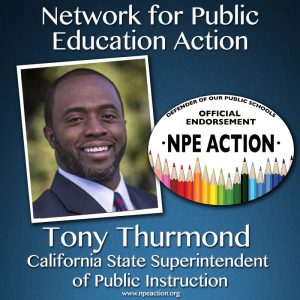
Image result for Tony Thurmond as Superintendent of Public Instruction

A Plan to Improve California's Public Schools

Tony Thurmond for State Superintendent of Public Instruction -https://www.tonythurmond.com/
Image result for Right Wing, Anti-Gay Marshall Tuck

The Fundamental Right to Education Education Law Prof Blog

Education Law Prof Blog

The Fundamental Right to Education


In my last article, The Constitutional Compromise to Guarantee Education, I examined the period immediately leading up to and following the Fourteenth Amendment and found that the ratification of the 14th Amendment and southern state's education clauses in the constitutions were inextricably intertwined.  Quite simply, rewriting their constitutions and providing for public education was a condition of readmission to the Union, as was the ratification of the 14th Amendment.  In other words, without constitutional guarantees of education, southern states never reenter the Union.  And without southern votes for the 14th Amendment, the amendment never becomes part of the constitution.  Thus,  I argue that one cannot understand the rights of state citizenship that the 14th Amendment secured, nor the meaning of a republican form of government, without examining those state constitutions. 
Our legal lexicon, at least as far as I know it, does not have a word to capture what occurred.  For lack of a better term, I call these events a constitutional compromise.  None of the major constitutional exercises of power, nor the constitutional revisions that emerge, would have occurred without the others.  My conclusion is that, whatever we call it, the federal constitution did, as a matter of fact, guarantee access to public education.  The article then moves on to the arguably tougher question of figuring out what, if any limits, the constitutional compromise places on states in their delivery of education.
After finishing that research and having time to further reflect on it, I began to question how exactly a modern court would deal with this history.  There is no constitutional compromise doctrine, no republic form of government standard, no development of the rights of state citizenship.  So I began to dig further and came upon yet additional problems and concerns.  The foremost is that those who enacted the 14th Amendment thought about rights far differently than us.  Their thoughts on how best to protect those rights was also far different.  The main effect and purpose of the 14th Amendment was not to grant courts authority, but to give Congress authority.  With the 14th Amendment, Congress's prior civil rights legislation would be on strong footing and Congress could pass far more.  In short, the primary protection for life, liberty, property, due process, equal protection, and Continue reading: Education Law Prof Blog
Related image


Facing the Trilemma of Classroom “Data Walls” | Larry Cuban on School Reform and Classroom Practice

Facing the Trilemma of Classroom “Data Walls” | Larry Cuban on School Reform and Classroom Practice

Facing the Trilemma of Classroom “Data Walls”

Image result for Data Walls

Over the past few years I have visited many classrooms. In elementary schools, I have seen pasted on a wall or cork board, “data walls” that look like these:
21efa15c6a81bcac8dd070eaa6377bd0.jpg


aHR0cDovL25tdXNkLWNhLnNjaG9vbGxvb3AuY29tL3VpbWcvaW1hZ2UvMTI2NDg2MjA0MDg0My8xMjIwNzEwMjU4MjgyLzEyNjcyODAyNzg4NTRfd25wNzAwLmpwZw==.jpg
Usually, students have numbers or aliases assigned to mask their identity. Of course, most students find out who is who.
Whether to use these “data walls” to spur individual students to improve their academic performance or have data displays for the entire class without individuals being noted or not have them at all in a classroom but use individual and class data only among teachers or school leadership teams has been debated in blogs, media, and journals for the past decade (see herehere, here, and here).
With the onset of the mantra “data driven instruction” largely stemming from the accountability features of the federal law, No Child Left Behind (2002), school boards, superintendents, principals, and teachers have heard time and again the importance of gathering, analyzing, and using test data school-wide to improve instruction and in classrooms for students to plan individual strategies. Let’s call that “retail” data.
“Wholesale” data are school-by-school and district numbers that are aggregated  and sent to administrators, teachers, and parents. Those data may (or may not) become a basis for policy changes.
The focus on test scores since the early 1980s–remember A Nation at Riskreport–has given critics the argument that NCLB further narrowed both Continue reading: Facing the Trilemma of Classroom “Data Walls” | Larry Cuban on School Reform and Classroom Practice


Sunday, October 7, 2018

CURMUDGUCATION: ICYMI: Post Show Edition (10/7)

CURMUDGUCATION: ICYMI: Post Show Edition (10/7)


Final performance and set strike last night, so I'm operating on too-little sleep. But that doesn't mean I didn't find you some worthwhile reads for your Sunday afternoon.

Tackling Bro Culture Is Hard

The Kavanaugh spectacle has opened up sopme discussion of dealing with bro culture in high schools. Here's a NYT take on the subject.
School Hopping Brings Chaos

A visit to Detroit shows how the proliferation of shake shady charters leads to a great deal of destructive disruption in students' educations.
The Easiest Money Bill Ackerman Has Made

The umpteenth example of how charters can be great tools for profiteers (particularly if they are also legislators who get to write the rules of the game).

It Didn't Start with Trump

The Guardian takes us back to the roots of modern teacher-bashing. Let's go back to 1983 and Ronald Reagan...

What Top-Rated Schools Have In Common- Fewer Poor Kids

The Nevada Current takes a look at high-achieving schools and discovers a strong link to wealth.

Guilty Verdict for Man Who Defrauded Newpoint Charter Schools

A look at yet another scam artist who uses the unregulated freedom of charters to make himself rich at taxpayer expense. Will you be surprised if I tell this story is from Florida?

Don't Let Richmond Dictate Charter Schools

Laura Bowman's plea to keep Virginis relatively clean of charter blight.

The  Truth About Money in Public Education Politics

Yet another look at how dark money worms its way into local education elections.

What Happens When There Are No Public Schools     

Jeff Bryant takes us to Michigan for a look at the bad outcomes of bad choice programs.


CURMUDGUCATION: ICYMI: Post Show Edition (10/7)


Jerry Brown’s mixed legacy: Is California’s departing governor a Resistance hero or a hypocrite? | Salon.com

Jerry Brown’s mixed legacy: Is California’s departing governor a Resistance hero or a hypocrite? | Salon.com
Jerry Brown’s mixed legacy: Is California’s departing governor a Resistance hero or a hypocrite?
National media celebrates Brown’s accomplishments, but for California progressives the picture’s more complicated


f anything should be obvious in the wake of the 2016 election it’s that both major American political parties are in deep trouble, reflecting the larger trouble of a society potentially headed for state breakdown. The unacknowledged terrible record of the GOP’s “deep bench” paved the way for Donald Trump. On the Democratic side, Bernie Sanders’ promotion of popular progressive positions and his surprisingly strong 2016 showing challenged more than just Hillary Clinton, it challenged the entire direction of the party for over a generation.

In the aftermath, both parties are struggling to redefine themselves, but in very different ways. The Republicans' redefinition is being driven by Trump, while Democrats are undergoing a more varied bottom-up process.  One such perspective on what that involves can be gleaned by reflecting on the legacy of retiring California Gov. Jerry Brown — and what he’s left undone.
The view from the New York Times, "5 Takeaways From California Gov. Jerry Brown’s Last Bill Signing Session," was a bit of jumble, starting with Brown’s “lasting legacy as ‘the policy trendsetter of the country,’” and ending on the contrary note by mentioning his “a willingness to wield the veto pen,” usually against progressive measures, given Democratic dominance of the state legislature.

That contradiction — unrecognized and unreflected on by the Times — speaks volumes about Brown’s actual record and legacy, while the three other takeaways all reflect the impact of grassroots movements: Black Lives Matter for a “series of high-profile criminal justice measures,” and “[s]weeping changes to police transparency laws,” and the women-led Resistance and #MeToo movement for “[p]ushing back against gender discrimination and sexual harassment,” though vetoes and other caveats applied to those as well.
The good news for Democrats is how little Brown and his governor’s pen had to do with any of that progressive legislation, which actually spans a broad range of specific topics. His retirement won’t decapitate any of the driving forces involved. The bad news is how uneven the actual Continue reading: Jerry Brown’s mixed legacy: Is California’s departing governor a Resistance hero or a hypocrite? | Salon.com


Wick-Ed | Blue Cereal Education

Wick-Ed | Blue Cereal Education

Wick-Ed

Candle Man


Think of something you love.
Not a person – a topic. A hobby. A personal passion.
Now pretend that it’s very important to you to share this passion with others. In fact, you’re getting PAID to spread this interest and your expertise. This is exhilarating and terrifying, because on the one hand you’re being given the opportunity to make a career out of something you deeply care about, but on the other… this passion is part of what defines you.
It’s personal. It matters to you. You care whether or not it’s done WELL.
Still – GIDDY!
Plot Twist: Most of those with whom you’ll be sharing are here against their will and care nothing about your topic, nor do they wish to. Also, they’re supposed to be learning about six other things they don’t care about all at the same time. 
But nothing’s perfect, amiright? And besides, surely once they’re exposed to what you’re really talking about, they’ll start to love it a LITTLE – how could they not? Your interest wasn’t planned or forced – you can’t HELP but dive in. It’s naturally engaging! It’s just a matter of lighting the first few candles in the bucket, surely.
How will you begin?
Well, you should put together some sort of high-interest discussion-starter to get them talking about your passion. You labor for hours trying to find the right entrance point – something accessible, but relevant.
Something rich in possibilities, but which still clearly lays the groundwork for where Continue reading: Wick-Ed | Blue Cereal Education

The Right Wing, Anti-Gay Crusade Behind Marshall Tuck’s Campaign to Take Over California Schools - LA Progressive

The Right Wing, Anti-Gay Crusade Behind Marshall Tuck’s Campaign to Take Over California Schools - LA Progressive

The Right Wing, Anti-Gay Crusade Behind Marshall Tuck’s Campaign to Take Over California Schools


The privatizers’ ideal candidate for California State Superintendent, Marshall Tuck, recently suffered a serious blow to his credibility when he announced he was returning a contribution from a mysterious anti-gay zealot but keeping over $61,000 from a PAC. The situation revealed a campaign scrambling to maintain a narrative that appeals to California’s mostly progressive voters when the reality is much darker.
The race for this officially nonpartisan office pits two Democrats who are miles apart on education policy, underscoring how divisive the charter lobby’s influence is becoming for California’s governing party.
Tuck’s opponent Tony Thurmond is a social worker, former school board member, and current State Assemblymember. He has been endorsed by Senator Kamala Harris; U.S. Congressional Representatives Barbara Lee, Eric Swalwell, and Karen Bass; and the teachers’ union.
Tuck, on the other hand, has the same pro-privatizing platform that voters rejected when he was defeated for the position four years ago, and it’s the same education platform of Republican presidential candidates Jeb Bush and John Kasich, and Vice President Mike Pence: To deregulate public education, to outsource school services, to make it harder for teachers to gain tenure, and to expand the market of “school choice.”

Tuck’s bid to take over California public schools is being bankrolled by familiar names in the anti-public education Billionaire Boys Club, as former Deputy U.S. Secretary of Education, Diane Ravitch, calls them. Looked at through another lens, their support can be politically inconvenient: Doris Fisher (whose Gap retail company has faced numerous child labor scandals), Eli Broad (former top investor at AIG, and whose non-accredited Broad Academy trains privatizing “education leaders”), Alice Walton (heir to the anti-labor Walmart fortune), Reed Hastings (Silicon Valley billionaire who has tried for years to take away the right of local voters to elect their own school boards, and who  Continue reading: The Right Wing, Anti-Gay Crusade Behind Marshall Tuck’s Campaign to Take Over California Schools - LA Progressive


Image result for Right Wing, Anti-Gay Marshall Tuck


Yong Zhao: Problems with Evidence-based Education: Side Effects in Education Education in the Age of Globalization

Education in the Age of Globalization » Blog Archive » Problems with Evidence-based Education: Side Effects in Education
Problems with Evidence-based Education: Side Effects in Education


The following is the Introduction of my book What Works Can Hurt: Side Effects in Education published by Teachers College Press in June 2018.
Introduction
“Ibuprofen may cause a severe allergic reaction,” you are warned when you buy a bottle of Advil, and “this product may cause stomach bleeding.” Medical products are required to disclose clearly their intended effects and known side effects. The intended effect of the common pain reliever Ibuprofen, for example, is to temporarily relieve “minor aches and pains.” The drug’s known side effects include allergic reaction and stomach bleeding. Hence Ibuprofen products must carry a warning label of their potential adverse effects.
But it is unlikely that anyone has received such warning about educational products.
“This program helps improve your students’ reading scores, but it may make them hate reading forever.” No such information is given to teachers or school leaders.
“This practice can help your child become a better student, but it may make her less creative.” No parent has been given information about effects and side effects of instructional practices in schools.
“School choice may improve test scores of some students, but it can lead to the collapse of American public education.” The public has not received information about the side effects of sweeping education policies.
It is also rare to find published research studies in education that report the potential adverse effects of an intervention. Educational research typically has focused exclusively on collecting evidence to prove or disprove the benefits or intended effects of products, programs, policies, and practices. The recent movement toward evidence-based educational practices and policies is only about gathering and verifying evidence for effects. It shows no concern for negative side effects.
Does this mean that educational products are immune to adverse side effects? Does it mean that all educational products have no negative impact on students?
***
The old Chinese saying “drink poison to quench thirst” was my first thought when the No Child Left Behind Act was enacted (No Child Left Behind Act of 2001, 2002). The law had bipartisan support and was widely viewed as the right solution to some of the most persistent problems in American education: low achievement in reading and math and the growing achievement gap. The only loud protest at the time was that it was an unfunded federal mandate, meaning that if there were more money to support its implementation, the solution prescribed in the law would really lead to transformative changes in American education.
As readers will see in Chapter 1, the main ingredients in the NCLB solution were testing and accountability, a focus on reading and math, and scientifically proven effective instructional materials and strategies. Having grown up in China, I had personal experience with testing and accountability. I knew how high-stakes testing corrupts education, turning it into test preparation. I knew how a test-driven education causes damage to the physical and psychological well-being of students, parents, and teachers. I knew that a test-driven education does not result in citizens who can defend a democracy, nor does it produce the creative and innovative individuals needed in the modern economy. I knew that it does not reduce inequity, either, Continue reading: Education in the Age of Globalization » Blog Archive » Problems with Evidence-based Education: Side Effects in Education

CURMUDGUCATION: DeVos Secret Vist To View Koch Program

CURMUDGUCATION: DeVos Secret Vist To View Koch Program

DeVos Secret Vist To View Koch Program


Betsy DeVos visited Wichita last Monday, but it was a very quiet visit. Her online schedule shows Monday an unscheduled day, and neither the Department of Education nor the group she visited issued any news release. It was a local source-- Suzanne Perez Tobias at the Wichita Eagle-- that picked up the story.

So what did DeVos travel to Wichita to see? She traveled to Koch Industries to meet a teacher and some students from the Youth Entrepreneurs, a group founded by Charles Koch and his wife Liz in 1991. It started out as an eight week course at a Wichita high school "designed to improve the professional potential of at risk students." That's not a shocker-- the Koch brothers have been pretty clear about preferring business solutions to educational problems, as well as their desire to have schools crank out useful meat widgets for the business leaders of America. According to their annual report, the program was in 126 schools with 182 teachers working with 3,487 students.


Their foundational values are unsurprising for a Koch venture. Responsibility-- "take responsibility for your own life." Be principled-- act with respect, integrity and toleration. Knowledge-- seek and use the best knowledge. None of that low-quality knowledge. Freedom-- "respect the rightgs of others and study the links between freedom, entrepreneurship, and societal well-being." Passion-- Find fulfillment by improving lives of others. That may not sound very Kochian, but the next one does. Opportunity-- "You make your own opportunities." Sound judgment-- by which we mean using "economic thinking to create the greatest benefit while using the least resources."(Yes, that's incorrect usage.) Win-win focus-- cooperation creates value for yourself and others. It's an interesting list, a portrayal of the conflicted shore where Christian do-unto-otheriness crashes in to Ayn Randian "take care of yourself and let everyone else rot," a neighborhood where the DeVos and Koch families have long lived. I'm glad this course is only an elective.

The program notes its differences from the Junior Achievement program. YE is a yearlong elective Continue reading: 
CURMUDGUCATION: DeVos Secret Vist To View Koch Program