Latest News and Comment from Education

Friday, September 14, 2018

Amendment 8 Behind the Scenes: Political ideology, religion, dark money, billionaires, and of course, the money trail | LWVeducation

Amendment 8 Behind the Scenes: Political ideology, religion, dark money, billionaires, and of course, the money trail | LWVeducation

Amendment 8 Behind the Scenes: Political ideology, religion, dark money, billionaires, and of course, the money trail


Florida’s 652 charters run the gamut from small ‘mom and pop’ charters to large chains organized by for-profit management companies. Some serve children and districts well. Many others tell different stories. They involve not only political ideology but also religion, dark money networks, billionaires, and of course, self-interest.
The Erika Donalds version of the charter story starts simply. A small group of members seceded from the Florida School Boards Association (FSBA) in 2015 to form the Florida Coalition of School Board Members (FCSBM). Erika Donalds, a member of the Collier County school board and wife of Florida Representative Byron Donalds, fronts this coalition, but the political network behind it is extensive. It goes all the way to our nation’s capital.
About 14 of the 50 alternative school board association members have been publicly identified, including:


• Rebecca Negron, who has just been defeated for a seat on the Martin County school board even though her supporters raised over $250,000 to unsuccessfully attack her opponent. She is the wife of Senate President Joe Negron. Senator Negron wrote the initial legislation for the Florida Tax Credit Scholarship program to give corporate taxes to private schools.
Some FCSBM members also have strong dark money ties to national conservative political advocacy groups.
• Erika Donalds openly displays the Americans for Prosperity logo on her Collier 912 Freedom Council website. This is a tea party group supported by the Koch brothers and others.
• In the March 29, 2018 article in the Tampa Bay Times, Speaker of the Florida House Richard Corcoran’s wife Ann, who operates her own charter school, is identified.
• Shawn Frost, who is Chair of the Indian River school board, is part of this coalition. He announced in the Indian River Guardian that he expects to be appointed to the Florida State Board of Education. Frost reported campaign contributions from Betsy DeVos, the U.S. Secretary of the Department of Education. In 2014, Frost received $20,000 in campaign contributions from the American Federation of Children run by Betsy DeVos. Frost lives in Vero Beach, but maintains a room in his father’s house in Indian River to meet the residence requirements for being on the school board. He is also the head of MVP Strategy and Policy which specializes in consulting for school board races.
• A Duval School Board member Scott Shine has reportedly joined the FCSBM. He withdrew from his 2018 reelection campaign due to ‘personal attacks’.
• Sarasota school board members Erik Robinson, a former Republican Party Chairman and Bridgit Ziegler are listed members. Ziegler’s campaign reported $45,000 in donations from the out of state Phoenix Media LLC. According to the Herald Tribune, the money was funneled through a PAC run by fellow board member Erik Robinson, who is often called ‘The Prince of Dark Money’.
Some FCSBM members are collaborating to build a Florida chain of Classical Academy Charters. This isn’t just any group of charter schools. They are sponsored by the Hillsdale College Barney Charter School Initiative. The College, located in Michigan, has a long religious/conservative/libertarian agenda. The DeVos immediate family and close business associates have several Hillsdale  Continue reading: Amendment 8 Behind the Scenes: Political ideology, religion, dark money, billionaires, and of course, the money trail | LWVeducation


Stop the Voucher Tax Scam - Network For Public Education

Stop the Voucher Tax Scam - Network For Public Education

Stop the Voucher Tax Scam


There is no nice way to say it–it’s a tax scam to promote vouchers.
Twelve states have designed ingenious ways to use the U.S. tax code so that businesses and the wealthy can make money when they “contribute” to voucher programs.
Here is how it works. A business or taxpayer makes a donation to a state voucher “scholarship.” Then the state gives all or most of the “donation”  back as a tax credit. The donor then deducts the donation as a charitable deduction on federal taxes, even though they got the money back.

And right now it is perfectly legal.
The profiteering resulting from these tax credit voucher schemes has been marketed by tax accountants, private schools, and voucher proponents. And all of this means less money for public schools in state and federal coffers.
The good news is that the IRS is now trying to stop this.
The bad news is that Betsy DeVos’s American Federation for Children and EdChoice are mobilizing thousands to pressure the IRS to keep the scam going.
Please file your comment today with the IRS and tell them “close the loophole.”
This is all you have to do.
  • Go to https://www.regulations.gov/comment?D=IRS-2018-0025-0001
  • In the ‘Comment” box, type the phrase I submit the attached comment in response to the IRS proposed regulations on Contributions in Exchange for State and Local Tax Credits.”  Then continue with your comment. We give you a model comment to paste in below.
  • Enter your first and last name.
  • Follow the directions to submit.
  • Below is a comment you can use:
    —————————————————-
    I submit the attached comment in response to the IRS proposed regulations on Contributions in Exchange for State and Local Tax Credits.​ I am writing to thank the IRS for proposing the ending of a tax shelter that allows taxpayers to turn a profit when they fund private schools through state tuition tax credit programs.  This comes at the expense of state and federal budgets. Meanwhile, people line their pockets while the rest of us pay our fair share of taxes.
    Please stay the course and make sure that tax accountants, private schools, and others can no longer exploit the federal charitable deduction to promote voucher tax credits. Thank you.
    —————————————————-
    It is extremely important that you do this.  Please add your comment here today.
    Then post this link on your Facebook page. Continue Reading:Stop the Voucher Tax Scam - Network For Public Education


NPE 2018 National Conference - Network For Public Education - https://wp.me/p3bR9v-2Iy via @Network4pubEd


Incorrect Data Drives Major Education Decisions | The Report | US News

Incorrect Data Drives Major Education Decisions | The Report | US News
When the Data’s No Good
Serious education policy decisions are being driven by data. The problem is, it’s not always accurate.


IT'S BEEN A ROUGH YEAR for education data – one that's challenged the accuracy of federal databases, uncovered discrepancies that call into question major policy decisions and now, with another school year underway, one that will ask states, districts and schools to collect, report and use more data than ever before.
Take, for example, the revelation last month from an NPR investigation that only 11 of the roughly 240 schools that reported a school-related shooting actually experienced one. Or the inexplicable doubling of the number of districts reporting they were under a federal mandate to desegregate racially imbalanced schools, which itself, as Education Week uncovered, comes on the heels of an equally inexplicably 86 percent drop in the number of school districts reporting that. Or the graduation scandal in the District of Columbia, where 1 in 3 students who earned a diploma in 2017 shouldn't have, in large part because of administrators fudging attendance data.

"At some point, wouldn't you think someone would say, 'Two hundred and forty [shootings]? That's more than one a day. Obviously we don't have that,'" says Robert Pondiscio, senior fellow and vice president for external affairs at the Thomas B. Fordham Institute, a D.C.-based education think tank. "If you are casual about releasing data that at a moment's reflection would say to you, 'No that can't be right,' then are you casual about releasing other data? What does it take for data not to pass the smell test?"

The data discrepancies can have serious ramifications for researchers who rely on federal databases to study any number of things, as well as policymakers and practitioners who use such information to make decisions for their communities. Moreover, that data is often used to determine how billions of dollars in education funding is distributed to states and school districts, making it all the more imperative that it's accurate.
Nora Gordon, an associate professor at Georgetown University's McCourt School of Public Policy, says she especially worries about the databases that rely on self-reported information, like the Department of Education's Civil Rights Data Collection, which was the source of information for both the erroneous school shooting data and the unexplained increases and decreases in desegregation orders.
"I feel like there is a lot of policy attention to that data source, with good reason, but I don't know Continue reading: Incorrect Data Drives Major Education Decisions | The Report | US News


THE ALTERNATIVE REALITY OF LAUSD SUPT. AUSTIN BEUTNER - Perdaily.com

THE ALTERNATIVE REALITY OF LAUSD SUPT. AUSTIN BEUTNER - Perdaily.com

THE ALTERNATIVE REALITY OF LAUSD SUPT. AUSTIN BEUTNER


What is most disingenuous about the L.A. Times "Reporter" Howard Blume's latest article entitled "LAUSD chief signals desire to limit teacher job protections and change funding rules" is that virtually nothing in the article is even remotely true. And worst yet, ersatz "Reporter" Blume knows it's not true. But at least he's got a good excuse for not telling the truth, since at the L.A. Times, they have gone from 1400 to 350 reporters. And where all remaining reporters like Blume know full well that they too will be out the door, if they even attempt to actually report the truth as to what is going on at LAUSD and elsewhere.
Howard Blum knows the truth and at an earlier time in his reporting life, when he was a real reporter, Blum might just have posed some of the following questions:
You now talk about wanting to "limit teacher job protections," but given the assault LAUSD has already waged against more expensive high seniority teachers over at least the last 10 years for their sole "crime" of being at the top of the salary scale, can you tell me Supt. Beutner what real job protections do any LAUSD teachers still have?
How many thousand teachers with no prior negative evaluations- 73% of whom are over 40 and at the top of the salary scale- have you and your immediate predecessors gotten rid of on completely fabricated charges in order to balance your budget and avoid nonetheless impending bankruptcy?
If LAUSD is in such dire financial straits, why has the number of administrators Continue reading: THE ALTERNATIVE REALITY OF LAUSD SUPT. AUSTIN BEUTNER - Perdaily.com


Thursday, September 13, 2018

LAUSD chief signals desire to limit teacher job protections and change funding rules

LAUSD chief signals desire to limit teacher job protections and change funding rules

LAUSD chief signals desire to limit teacher job protections and change funding rules
Los Angeles schools Supt. Austin Beutner has yet to lay out his plans to help the nation’s second-largest school district shore up its finances and improve its academics. But on Thursday, in a speech to an invitation-only audience, he gave strong signals that he might fight to place some limits on job protections for teachers and to get Sacramento to change the way it determines funding.
Beutner defended the concept of tenure but expressed dissatisfaction with the results.

“We need a transparent, efficient and fair process to manage ineffective teachers out,” he told the crowd of students, parents, district leaders and representatives of community organizations gathered in the library of the Robert F. Kennedy Community Schools complex in Koreatown. “In the same way we need to support teachers, we need to support students and make sure that they have great teachers in their classrooms.”
Only “a few, a very few, people in the teaching profession are not helping students succeed,” he said, but “an ineffective teacher can cause students to lose more than a year of learning, which is setting students up for failure.”
Tenure rules in California’s traditional public schools provide strong protections for fully trained teachers after two years.
Changing teachers’ job protections or the way in which they are evaluated would most likely have to be accomplished through contract negotiations, state legislation or a ballot initiative. Beutner acknowledged the Los Angeles Unified School District could not just decide such highly contested matters on its own.
His speech was part of a public relations counter-offensive against the teachers union, which Continue reading: LAUSD chief signals desire to limit teacher job protections and change funding rules


The New Standardized Morality Test. Really.

The New Standardized Morality Test. Really.

The New Standardized Morality Test. Really.

Image result for Morality Test
I'm not really sure how to start this, because -- well, I'll just let the lede on this press release speak for itself:
IOWA CITY, Iowa—ACT, the nonprofit developer of the ACT® test and other assessments taken by millions of individuals worldwide, announced today that it was selected by the Crown Prince Court in Abu Dhabi to provide the Moral Education Standardized Assessment (MESA) for the Moral Education program in the United Arab Emirates (UAE). 
That's right. The ACT folks have developed a standardized test for measuring morality.
It goes with the moral education program developed for the UAE. If you look at it, it seems relatively benign. Based on four pillars, which are Character & Morality, Individual & Community, Civic Studies, and Cultural Studies. The four goals are to build character, instill ethical outlook, foster community, and endear culture.  The local goal is to "develop responsible, cultured, engaged adults ready for the wider globalized world. The global objective is to "develop student awareness of the shared human experience and make them messengers of the values they embody."


As one might expect, there is all manner of moral irony in this plan for a nation that is not exactly an egalitarian haven for freedom of expression and the rights of women and children (the penal code allows the "chastisement by a husband of his wife and … minor child" as long as he doesn't go to far. Homosexuality is not explicitly forbidden throughout the UAE (ten years for sodomy in Dubai), though certain emirates do forbid it and all the UAE criminalizes Continue reading: The New Standardized Morality Test. Really.
Image result for Morality

Discriminatory School Discipline is a Crisis! We Must Lead. | Cloaking Inequity

Discriminatory School Discipline is a Crisis! We Must Lead. | Cloaking Inequity

DISCRIMINATORY SCHOOL DISCIPLINE IS A CRISIS! WE MUST LEAD.

When I was teaching at UT Austin, school discipline was a dissertation topic that students wanted to investigate, but there weren’t available faculty at the institution that were conducting research in the area at the time. As a result, student interest in the disparate and unequal discipline practices occurring in schools began to drive my own interest in the area. So we began an informal research group that would meet once a month or so to coordinate and discuss our school discipline research. While there were several students working on the issue, I’d like to quickly highlight two of the students that I worked with. Rebecca Cohen was probably one of the sharpest graduate students I chaired at UT. Her dissertation was entitled Discipline without Derailing: An Investigation of Exclusionary Discipline Practices in Schools. She found:
Maintaining a safe and orderly learning environment in schools is fundamental to the greater goals of education, but determining optimal disciplinary responses to student misbehavior is often complicated. While there is an abundance of research that speaks to the negative impact of exclusionary discipline (e.g., suspension, expulsion or any other disciplinary response that removes a student from the traditional classroom setting) on student behavioral and academic outcomes, there is an absence of work that examines if, when, and to what extent a student is actually better off receiving non-exclusionary dispositions. Using multivariate regression analysis on a unique dataset from an urban Texas school district, this study directly compares the impact of exclusionary vs. non-exclusionary discipline on student outcomes (controlling for student characteristics, school characteristics, and offense type). Additionally, the study examines the extent to which offense type influences the relationship between disposition and student outcomes. The study’s findings suggest that a student is generally worse off in terms of academic progress and risk of future offenses when she/he receives an exclusionary disposition for any disciplinary infraction. The impact of exclusion, however, was shown to vary by student offense.
I tried to recruit Dr. Rebecca Cohen to California State University. She’d make a fantastic faculty member.
Then there is Dr. Heather Cole. I don’t think I have encountered a graduate student who was more prolific writer during graduate school. We published six pieces together while she was in graduate school! 6! Relevant to this blog, we also took on school discipline in two pieces about school-based Youth Courts.
Cole, H. & Vasquez Heilig, J. (2011). Developing a school-based youth court: A potential alternative to the school to prison pipeline. Journal of Law and Education, 4(2), 1-17.
Cole, H., Vasquez Heilig, J., Fernandez, T., Clifford, M., & Garcia, R. (2015). Social Justice in action: Urban school leaders address the school to prison pipeline via a youth court. In M. Khalifa, C. Grant, N.W. Arnold and A. Osanloo (Eds.), Handbook of Urban Educational Leadership (pp. 320-328). New York, NY: Rowman and Littlefield.
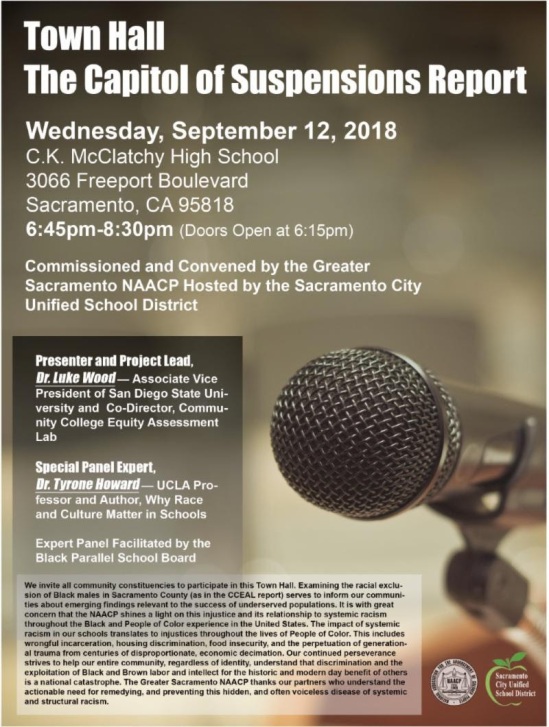
I’ll come back to Youth Courts in a moment. Last night, here in Sacramento, the NAACP sponsored a community-town hall to address school discipline.
NAACP Community Townhall flyer
new report entitled The Capitol of suspensions: Examining the racial exclusion of Black male in Sacramento countyauthored by Luke Wood, Frank Harris and Tyrone Howard shows the Sacramento City Unified School District suspends Black students more than any other school district in the state. The report also shows that several other districts in the Continue reading: Discriminatory School Discipline is a Crisis! We Must Lead. | Cloaking Inequity

Since 'Citizens United,' Just 15 Groups Account for 75 Percent of the $800+ Million in Dark Money Spent on US Elections

Since 'Citizens United,' Just 15 Groups Account for 75 Percent of the $800+ Million in Dark Money Spent on US Elections

Since 'Citizens United,' Just 15 Groups Account for 75 Percent of the $800+ Million in Dark Money Spent on US Elections
"Policy ideas and candidates' positions should be promoted by organizations who are proud to be engaged in our public arena, not secretive front groups designed to deceive voters, hide donors, and deploy deceptive tactics."


Just 15 groups were responsible for more than 75 percent of dark money political spending from 2010 to 2016, and together poured more than $600 million—out of a total of $800+ million—into campaigns in the wake of the landmark Citizens Unitedcase, according to a new analysis from Issue One, a nonpartisan nonprofit that advocates for stricter campaign finance rules.
"The dark money groups and anonymous donors behind them that endlessly bombard Americans with television ads spouting half-truths and outright lies do a disservice to voters."
—Nick Penniman, Issue One
"Dark money groups hold enormous sway over what issues are, and are not, debated in Congress and on the campaign trail," the report explains. "But the donors behind these groups rarely discuss their motivations for bankrolling these efforts, leaving the public in the dark about who funds these increasingly prominent and potent organizations."
In addition the new Dark Money Illuminated (pdf) report, which identifies about 400 donors and organizations bankrolling these 15 secretive groups, the researchers also developed profiles for each dark money group and an "extensive, first-of-its-kind databasecontaining nearly 1,200 transactions, each supported by primary source documents."
"Right now, the dark money groups and anonymous donors behind them that endlessly bombard Americans with television ads spouting half-truths and outright lies do a disservice to voters," said Issue One CEO Nick Penniman. "In the internet age, every American should be able to know where the money is being spent and who is giving it in near real-time."
Of course, overall political spending since 2010 is in the many billions of dollars, but the Issue One report specifically focuses on groups that have been allowed to conceal their donor lists.
While the groups examined by Issue One have supported both Democrat and Republican candidates at various levels of politics, the only ones to break $100 million primarily back the GOP. The U.S. Chamber of Commerce—which gets substantial funding from big banks, pharmaceutical companies, and polluting industries—spent $130 million, and Crossroads GPS, co-founded by former White House strategist Karl Rove, spent $110 million. The third highest spender was the right-wing billionaire Koch Brothers' Americans for Prosperity.
Check out the full list:
dark money spending
"Whether you're a conservative Republican or a progressive Democrat, policy ideas and candidates' positions should be promoted by organizations who are proud to be Continue reading: Since 'Citizens United,' Just 15 Groups Account for 75 Percent of the $800+ Million in Dark Money Spent on US Elections


Students are waging war on sexist and racist school dress codes — and they’re winning - Vox

Students are waging war on sexist and racist school dress codes — and they’re winning - Vox

Students are waging war on sexist and racist school dress codes — and they’re winning
Traditional dress codes punish marginalized students disproportionately, but this anti-racist, anti-sexist dress code could fix that.


Emma Stein was just a freshman when she was cited for a dress code violation at her school, suburban Chicago’s Evanston Township High School. A security guard said her dress was too short, so Stein had to pull a pair of sweatpants over her clothes. She was not punished for the infraction, but it was still a really upsetting experience.
“It added a level of insecurity to this already stressful time,” Stein recalled.
Stein wasn’t the only one troubled by the dress code at the 3,700-student school. In 2016, students staged a protest demanding a new policy that didn’t discriminate along gender or racial lines.
And the school’s administration listened.

Image result for sexist and racist school dress codes
“We needed to look at getting a new dress code, and we wanted to make sure it was body-positive and didn’t marginalize students,” the school’s principal, Marcus Campbell, said.
In 2017, Evanston Township High School debuted its new dress code, which permitted tank tops, leggings, hats, and other previously banned items. The policy also stated that students were not to be marginalized based on race, class, gender, sexual orientation, or other identity markers.
The story of Evanston Township High School’s dress code is an increasingly common one. As dress code controversies sweep the education system, parents and students are fighting back against policies that they see as sexist, racist, or both. And more and more schools are listening to these protests, adopting guidelines that reflect a new understanding of what constitutes “appropriate” student dress.

Oregon NOW’s model dress code has had an international impact

Adopting a new dress code isn’t easy when most existing policies are several years old and contain many of the biases schools are edging away from now. So, the Oregon chapter of the National Organization for Women devised a model policy for Portland Public Schools that took effect in 2016 and has since spread across the country.
School districts such as Evanston’s District 202 and California’s San Jose Unified have either borrowed heavily from the dress code policy or adopted it outright. Praised for being inclusive, progressive, and body-positive, the Oregon NOW model may be the Continue reading; Students are waging war on sexist and racist school dress codes — and they’re winning - Vox
Image result for sexist and racist school dress codes

Wealthy People Are Destroying Public Schools, One Donation At A Time

Wealthy People Are Destroying Public Schools, One Donation At A Time

Wealthy People Are Destroying Public Schools, One Donation At A Time


Recent news stories about wealthy folks giving multi-million donations to education efforts have drawn both praise and criticism, but two new reports by public education advocacy groups this week are particularly revealing about the real impact rich people have on schools and how they’ve chosen to leverage their money to influence the system.
‘The Education Debt’
The first report, “Confronting the Education Debt” from the Alliance to Reclaim Our Schools examines the nation’s “education debt” – the historic funding shortfall for school systems that educate black and brown children. The authors find that through a combination of multiple factors – including funding rollbacks, tax cuts, and diversions of public money to private entities – the schools educating the nation’s poorest children have been shorted billions in funding.
One funding source alone, the federal dollars owed to states for educating low-income children and children with disabilities, shorted schools $580 billion, between 2005 and 2017, in what the government is lawfully required to fund schools through the provisions of Title I of the Elementary and Secondary Education Act and the Individuals with Disabilities Education Act.
The impact of not fully funding Title I is startling, the report contends, calculating that at full funding, the nation’s highest-poverty schools could provide health and mental health services for every student including dental and vision services, and these schools would have the money to hire a full-time nurse, a full-time librarian, and either an additional full-time counselor or a full-time teaching assistant for every classroom.
State and local governments contribute to underfunding too by keeping in Continue reading:Wealthy People Are Destroying Public Schools, One Donation At A Time


Stunning New Report: How Can Our Society Repay A Long Education Debt to Our Poorest Communities? | janresseger

Stunning New Report: How Can Our Society Repay A Long Education Debt to Our Poorest Communities? | janresseger

Stunning New Report: How Can Our Society Repay A Long Education Debt to Our Poorest Communities?


How can our society overcome nearly a quarter century of catastrophic public education policy designed by neocons, supply side economists, billionaire privatizers, and the American Legislative Exchange Council?  A new report, released yesterday by the Alliance to Reclaim Our Schools, outlines three steps by which we can recommit ourselves to a public school system prepared to serve and nurture all of America’s children.
  1. Congress must fund fully two federal programs designed to help school districts serving concentrations of children in poverty and children with special needs: Title I and the Individuals with Disabilities Education Act (IDEA);
  2. Together the federal government, states and local school districts must, by 2025, launch 25,000 sustainable, wraparound Community Schools to ensure that children and families in our poorest communities have access to supports that will enable the children to achieve at school; and
  3. The U.S. Department of Education must recommit itself to its primary purpose: ensuring equity across America’s over 90,000 public schools.
The report challenges federal and state governments together to address today’s reality: “Districts serving white and more affluent students spend thousands to tens of thousands of dollars more, per-pupil, than high poverty school districts and those serving majorities of Black and Brown students. The challenges faced by these schools—larger class size, fewer experienced teachers, the lack of libraries, science equipment, technology and counselors—all reflect a lack of resources. By failing to provide adequate funding, we deny these children the chance to fulfill their potential.”
School finance is a three part bargain, with each school district taxing itself (currently roughly 45 percent of school funding); states providing revenue (currently about 47 percent) and creating a state distribution formula to overcome disparities in local capacity; and the federal government providing a relatively smaller amount (currently roughly 8 percent) to support students with particular needs and to oversee civil rights. The Alliance to Reclaim Our Schools outlines five policy mistakes which have compounded a fiscal crisis over time for public schools in poor communities and areas without sufficient capacity to raise funding locally:
  1. Congress has failed to fund Title I and the IDEA at the levels promised when these programs were enacted.
  2. Local funding in the poorest communities is inadequate even when the citizens make a Continue reading: Stunning New Report: How Can Our Society Repay A Long Education Debt to Our Poorest Communities? | janresseger