Latest News and Comment from Education

Tuesday, August 28, 2018

SBE’s charters report mixed performance results :: K-12 Daily

SBE’s charters report mixed performance results :: K-12 Daily :: The Essential Resource for Superintendents and the Cabinet

SBE’s charters report mixed performance results


(Calif.) Among the sprawling network of 27 charter schools overseen by the California State Board of Education, 20 were found to be in good financial health during the 2017-18 fiscal year.
But just nine in the group were found to have either met the state standards for academic progress or exceeded it.
Six schools were found to have met some student performance marks but not others, and two charters were found to be failing.
State law gives the SBE authority to approve a charter application under several conditions, the most common being denial at the local level. Since the early 1990s, the board has considered scores of applications, but only approved a handful prior to the election of former Gov. Arnold Schwarzenegger.
Gov. Jerry Brown, also a strong charter advocate, has also actively endorsed new charter school adoptions by his appointees to the SBE.
To gauge fiscal status, the California Department of Education considers a variety of factors, including the adequacy of cash management, debt levels, trends in enrollment and attendance, revenue and expenditure projections, and assessing the multi-year projected financial position of the charter school.  
Additionally, charter schools are required to maintain a cash reserve based on schools of similar size.
Five of the SBE’s sponsored schools were found to be in poor financial shape:
  • Academia Avance Charter, Los Angeles;
  • Celerity Rolas Charter School, Los Angeles;
  • Paramount Collegiate Academy, Sacramento (voluntary closed in February 2018);
  • Prepa Tec Los Angeles High, Los Angeles; and
  • Rocketship Futuro Academy, Concord.
So far, the CDE has issued letters of concern to each of the charter boards and requested that corrective action be taken. If the charter leadership doesn’t take the requested action or doesn’t Continue reading: SBE’s charters report mixed performance results :: K-12 Daily :: The Essential Resource for Superintendents and the Cabinet


New direction for Gates Foundation aims to build on progress in L.A. schools

New direction for Gates Foundation aims to build on progress in L.A. schools

New direction for Gates Foundation aims to build on progress in L.A. schools


A new direction for the Bill & Melinda Gates Foundation — and millions in new funding — will make their presence felt in Los Angeles schools as a result of grants announced Tuesday.
The L.A. district and others across the country hope to benefit from a foundation effort to build on what already is helping to keep students on track toward graduation.
It’s not as sexy or laser focused as the foundation’s past sweeping strategies, but that’s partly the point.
“We’ve come to understand how important context is,” said Bob Hughes, director of K-12 education for the foundation. “One size doesn’t fit all.”
The Seattle philanthropic institution is known for spending billions in pursuit of “the big idea” to transform public education. And even those billions don’t capture the extent to which the foundation has leveraged its influence to campuses in every corner of the country.
One such effort was to refashion large, impersonal middle and high schools into smaller academies. The results, in terms of improved student achievement, overall were lackluster. Later came a teacher-effectiveness initiative, which some critics and supporters characterized as a mission to find and fire bad teachers. Once again, the results were disappointing in terms of improving outcomes for students.

Such conclusions were made after schools and school districts across the country reshaped themselves based on the concepts. In many cases, they were forced to do so by new state and federal policies and laws.
The latest approach — and its initial $92 million in grant money — emphasizes networks of schools that can work together and learn from one another. In many cases, the foundation Continue reading: New direction for Gates Foundation aims to build on progress in L.A. schools


Teaching: Respect but dwindling appeal - PDK Poll 2018

Teaching: Respect but dwindling appeal - PDK Poll 2018

Teaching: Respect but dwindling appeal

Americans trust and support teachers, but they draw the line at wanting their own children to join a profession they see as undervalued and low-paid.

Related image
Two-thirds of Americans say teachers are underpaid, and an overwhelming 78% of public school parents say they would support teachers in their community if they went on strike for more pay, according to the 2018 PDK Poll of the Public’s Attitudes Toward the Public Schools.
Even as most Americans continue to say they have high trust and confidence in teachers, a majority also say they don’t want their own children to become teachers, most often citing poor pay and benefits as the primary reason for their reluctance.
These findings are part of the 50th annual PDK Poll of the Public’s Attitudes Toward the Public Schools, which queried U.S. adults about a range of issues confronting education, including teacher pay and the teaching profession, school security, options for improving the public schools, perceptions of opportunities for different groups of children, college affordability, the value of a college degree, and school schedules. The survey is based on a random representative sample of 1,042 adults with an oversample to 515 parents of school-age children in May 2018. Langer Research Associates of New York City produced the poll for PDK International using the GfK KnowledgePanel®, in which participants are randomly recruited via address-based sampling and invited to participate in surveys online. Full details about the poll’s methodology are available at pdkpoll.org/methodology.
Earlier, PDK released responses to a series of school security questions. An abbreviated version of those results is included in this supplement.
Among key findings in this report are the remarkable support for improving teacher salaries — and record-high compunctions about entering the profession, in part given poor pay. Two-thirds of Americans say teacher pay in their community is too low; just 6% say it’s too high. An overwhelming 73% say they would support teachers in their community if they went on strike for higher salaries, including about 6 in 10 Republicans.
As things stand, 54% of Americans say they would not want their child to become a public school teacher, a majority for the first time in a question initially asked in 1969. Poor pay and benefits are at the top of the list of reasons why, cited by 3 in 10 of those who’d rather not see their child go into teaching. In a related result, funding remains the most commonly cited problem facing the public schools, a result that’s been consistent since the early 2000s.
Key points
This year's poll finds broad support for higher teacher pay. Two-thirds of Americans say teachers are underpaid, a new high in data since the first PDK poll in 1969. Just 6% of adults say teachers earn too much.
Teacher salaries also emerge as a prominent issue when we ask Americans to identify the biggest problems facing the public schools. Nine percent specifically mention teacher salaries, and 26% cite funding issues more broadly. Concern about funding is far higher among adults who say teachers are underpaid (32%) than among those who say they are not underpaid (14%). 
An overwhelming 78% of public school parents — those who would be most affected by a teacher walk-out — say they would support teachers in their community if they went on strike for more pay. Among the general public, 73% say they would support a job action for higher wages.
A majority of Americans say they don’t want their own children to become teachers, most often citing poor pay and benefits as the primary reason for their reluctance.
Nearly 8 in 10 Americans prefer reforming the existing public school system rather than finding an alternative approach — more than in any year since the question was first asked two decades ago. There’s no difference closer to home: 78% say they’d rather reform than replace the local school system.Read more
The public supports spending more on students who need extra support (60%) rather than spending the same amount on every student (39%). But they divide evenly on where the funds should come from: Half favor raising taxes to accommodate the additional need; half say the schools should spend less on students who require fewer resources, with sharp partisan and ideological differences. In a separate question and for the 17th consecutive year, Americans have named the lack of funding as the biggest problem facing their local schools.
Arming teachers trails other school security measures supported by parents. Parents lack strong confidence that schools can protect their children against a school shooting but favor armed police, mental health screenings, and metal detectors more than arming teachers to protect their children. 
The public perceives substantial gaps in educational opportunities and expectations facing student groups. Some are racial or geographic, but the sharpest are income-based: 75% of Americans say public school students in low-income communities have fewer educational opportunities than those in well-off communities, and 55% say schools in low-income areas have lower expectations for their students.
Fifty-five percent say students today receive a worse education than what they experienced when they were students. U.S. adults see job preparation as particularly weak, but they also identify some areas — such as college prep, encouraging critical thinking, and providing a good education for all — where today’s students are receiving a better education than they did.
The poll finds broad support for proposals to make college more affordable. Seventy-five percent of Americans are in favor of free tuition for community college — up sharply in just the past few years — while 68% support increasing federal funding to help students pay tuition at four-year colleges. Currently, only about half of K-12 parents say they’re at least somewhat likely to be able to pay for college — and among those making less than $50,000 a year, that falls to just one-third. 
Hand in hand with support for tuition assistance, the public sees value in educational attainment. Eighty-two percent see a four-year degree as good preparation for a good-paying job — though only 22% say it’s “very” good preparation. That view rises sharply for graduate degrees.
The public schools continue to suffer from an image deficit. Among those who know them best, parents of current students, 70% give their oldest child’s school an A or B grade. Among the public more broadly, by contrast, only four in 10 give their local schools an A or B. In results that are typical across the years, far fewer give top grades to the public schools nationally, just 19%.
High school parents are largely satisfied with their child’s current school schedule. But it could be better: More than half say current start and end times are off their ideal by at least 30 minutes — generally, too early. Read more
Share these results:
Teaching: Respect but dwindling appeal - PDK Poll 2018


DPE Forces are Over-Represented on Charter Law Review “Action Team” | tultican

DPE Forces are Over-Represented on Charter Law Review “Action Team” | tultican

DPE Forces are Over-Represented on Charter Law Review “Action Team”


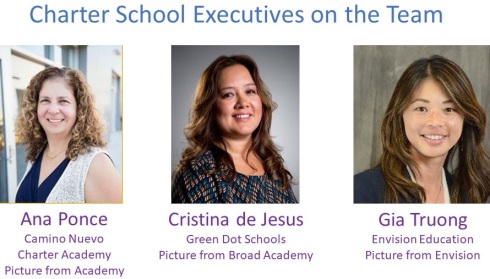
California’s lame duck Superintendent of Public Instruction, Tom Torlakson, has formed an Action Team to review laws governing California’s charter schools. Six of the thirteen Action Team members work for the destroy public education (DPE) movement. Ninety percent of the state’s students attend public schools yet 23% of the Action Team are charter school management executives. Also, 23% of the team are graduates of Eli Broad’s unaccredited school administrators’ academy.
2 charter executives
3 Privatizing Organzations
“In the past few years, we have updated virtually our entire K–12 education system. Now it’s time to look at the key laws governing charter schools, which have not been significantly changed in 26 years, to see how they can be modernized to better meet the needs of all public school students, including those who attend charter schools.”
This statement is malarkey. The original 1992 law capped charters growth at 100 schools statewide with no more than 10 in any one district. In 1998, Assembly Bill (AB) 544 expanded the statewide cap to 250 and allowed for an additional 100 charters each year thereafter. In 2000, proposition 39, which was advertised as a means to pass school bonds, had a little noticed provision that mandated charter school co-location with public schools. Legislation enacted in 2002created the Charter Schools Facilities Program, which authorizes bond financing for new charter school buildings. A 2004 EdSource paper stated, “Since the passage of Senate Bill 1448—the Charter Schools Act of 1992—more than 30 other laws have addressed the operation, over sight, or funding of charter schools.”
 “Aren’t charter schools better quality than public schools?”
I have often heard this question from many otherwise well-informed people. It indicates a victory for marketing when this destructive myth persists.
The Executive Director of Network for Public Education (NPE), Carol Burris, spent a year studying California’s charter schools. In her 50-page finalized report called “CHARTERS AND CONSEQUENCES: An Investigative Series” she wrote,
“The majority of charter vs public studies indicate that overall achievement of charter schools is the same or worse than public schools.  Continue reading: DPE Forces are Over-Represented on Charter Law Review “Action Team” | tultican


Monday, August 27, 2018

Ohio probes charter school operators accused of defrauding parents, students and taxpayers in Florida

Ohio probes charter school operators accused of defrauding parents, students and taxpayers in Florida

Ohio probes charter school operators accused of defrauding parents, students and taxpayers in Florida


Ohio’s top public accountant is actively investigating the case of two businessmen accused of using charter schools to defraud Florida taxpayers, students and schools — and maybe here, too.
On Friday, Ohio Auditor Dave Yost acknowledged that a probe has been ongoing for a year. Meanwhile, court documents filed this month in Florida indicate 19 Ohio charter schools were overbilled nearly $600,000. Prosecutors and forensic accountants say the money was laundered through 150 bank accounts and shell companies then returned as “rebates” and “kickbacks” to Marcus May, who once ran more than 20 charter schools in Ohio.
In 2012, May used a parent company, Newpoint Education Partners LLC., to open Cambridge Education Group, a charter school operator based in Akron. To grow business in Florida, authorities say he “falsely represented” that his Ohio schools were well managed. By 2016, prosecutors say he allegedly defrauded Florida and its public schools of more than $1 million.
May has repeatedly declined to speak with the Beacon Journal.


The pattern in Florida seems to mirror transactions in Ohio.
One forensic document in the Florida case details how Ohio schools paid $1.1 million to Apex Learning, a Seattle-based company May used to bill the 19 Cambridge schools in Ohio and 15 Newpoint schools in Florida for online and hard-copy curriculum. Russ Edgar, the lead Florida prosecutor in the white collar criminal case against May, has produced invoices that show how Apex inflated pricing for furniture and computers to siphon $229,756.57 from Florida’s education system and $456,551.92 from Ohio schools, including four in Akron.
“After the allegations in Florida came to light, Marcus May was immediately relieved of any managerial duties and later of his equity in Cambridge,” John Stack, co-owner of Cambridge, said in a written statement. He said Cambridge hired a forensic accountant to find out if Apex negatively impacted any Ohio schools. Once the schools were identified, the money was returned.
Of the 18 Cambridge schools still open in Ohio, 13 signed new management contracts this summer with Oakmont Education. Stack founded the company with Marty Erbaugh, an investment banker from Hudson. Oakmont will take over Cambridge’s dropout recovery high schools for struggling teenagers and young adults.
“Oakmont doesn’t believe that any of the schools we manage were negatively affected by Marcus May’s actions or Cambridge’s management,” said Stack, who filed the paperwork to create Oakmont on March 20, four days after a Florida jury convicted one of May’s associates.

Ohio connection
Allegations of self-dealing surfaced in late 2016 when a Cleveland school managed by Cambridge questioned what May was doing with state funds. Boards at the other schools have stuck with Cambridge, or moved to Stack’s Oakmont, through the ordeal.


Prosecutors say bank records show that May spent public funds — some of it provided by parents for student uniforms and lunches — on exotic trips, jet skis, a mansion mortgage, plastic surgery and other personal effects. Court documents in Florida connect some of the money to Ohio land that houses the Cambridge headquarters at 481 N. Cleveland-Masillon Road, a title agency on South Main Street and charter schools in Cleveland and Columbus. The Beacon Journal checked with the Ohio Secretary of State’s Office to see who’s behind the companies that own these properties. The secretary’s office said Continue reading: Ohio probes charter school operators accused of defrauding parents, students and taxpayers in Florida


From the CTU and President Karen Lewis. – Fred Klonsky

From the CTU and President Karen Lewis. – Fred Klonsky

From the CTU and President Karen Lewis.

This week begins the new school year. May you each find success and new energy as you return to your classrooms and the profession you love.
As our new year begins, it is a time for us to renew our commitment to fighting for the schools our students and teachers deserve. Let us return to our Chicago Public Schools (CPS) classrooms with a renewed strength, laser focus and open hearts as we welcome our colleagues and students in this new season of growth and change.
As you know, I recently retired from CPS and therefore have resigned from my position as president of the Chicago Teachers Union. It has been a tremendous honor and privilege to serve in a leadership capacity and to join each of you on the battlefield for justice and equity in public education.
The decision to end my tenure was one that weighed heavily upon me and was done in consultation with my husband, family, friends and colleagues. Since taking office in 2010, this has been a constant fight against powerful forces and their myriad of allies that seek to destroy collective bargaining and rob our children of their futures. Yet, as great of an enemy as this system has been, I had no way of knowing that all of this was preparing me for the biggest foe of them all.
Yet, I am not afraid.

With any fight, clear vision and bravery are prerequisites of struggle. While I continue to restore my health, I encourage each of you to channel your energy into a collective power that moves our union forward and guarantees the wins we’ve secured—and the campaigns we have started will continue until every child has every resource needed to be successful.
In my fight against brain cancer, I am reminded through my faith that when storms come, the brave do not jump overboard. They do not abandon ship, nor do they panic. Even if the captain is down and storm clouds are gathering, the rest of the crew must steer the ship on its charted course.
As you enter your building, remember: We have a contract fight on our hands—and the racist, misogynistic, homophobic and elitist voices remain strong. Our enemies are banking on this transition in CTU leadership to confuse, conflate and co-opt our union. Do not let them.
Transitions are not meant to be easy. Change never is. However, I have worked side-by-side with Vice President Jesse Sharkey, who has assumed my responsibilities as president as laid out in the CTU Constitution, beginning when I was first diagnosed in 2014. Under his consistent leadership, the CTU will remain a focused, fighting union that protects the interests of its members and those we serve.
Any presidency can only be as strong as the rest of its leadership team. Continuity is important. That is why officers Michael Brunson and Maria Moreno remain valuable in their current roles of recording secretary and financial secretary in this administration. As Jesse’s role as president is formalized, the vice presidency now becomes vacant, and it is my hope that members will value the addition of CTU Political Director Stacy Davis Gates in that role.
Through our organizing, legislative and political efforts, the CTU has restored the pension levy, stopped the spread of non-unionized charter operations, and launched political campaigns that have sent educators Sue Garza, Brandon Johnson and Aaron Ortiz to public office. The CTU worked to reduce CPS’s gaping budget deficit, won back hundreds of millions of dollars from the mayor’s TIF slush fund, and fought off mismanagement and bank deals, charter companies and corruption. We successfully negotiated more than $10 MILLION for sustainable neighborhood public schools. Our political, organizing and communications model has been adopted by other labor organizations across the nation.
Even with these significant wins, there is still much more work to do. Let us channel our victories into renewed campaigns to ensure our careers are not threatened and that Chicago has an elected, representative school board.
Wages, benefits, and safe and collaborative working conditions are important to all of us and central to every contract campaign. But in a city rife with unemployment, poverty, and violence, so is ensuring that every student has access to a librarian, counselor, social worker, nurse, special education professional and the support services they need.
As I focus my attention on this next chapter of my life, I want each of you to remember that the detractors, naysayers and union busters will come. They will seek to take advantage of this moment in order to entice you to act against your own self-interests. However, if their offer does not make us stronger, if it doesn’t unite us, and doesn’t move our cause forward, then we must turn a blind eye to their schemes and keep our eyes on the prize.
CPS may always be a hot mess, but with our due diligence, creativity, expertise and insights we can one day make this the strongest school district in the nation.
Every teacher, paraprofessional and clinician who wears CTU red understands what this is about. Harlem Renaissance poet Langston Hughes said it best when he challenged us in a work he entitled, “Democracy,” in which he states:
Democracy will not come
Today, this year
Nor ever
Through compromise and fear.
Thank you all for your well-wishes, thoughts, and prayers. I love you all and I will see you soon.
Karen GJ Lewis, NBCT (Retired)
CTU President Emeritas
From the CTU and President Karen Lewis. – Fred Klonsky