Latest News and Comment from Education

Sunday, May 20, 2018

A moral imperative: Ending poverty – Randi Weingarten – Medium

A moral imperative: Ending poverty – Randi Weingarten – Medium:
A moral imperative: Ending poverty
Fifty years since the launch of the Poor People’s Campaign by the Rev. Martin Luther King Jr., 43 million Americans remain in the grips of poverty and 140 million Americans are considered low-income. The number of families living on $2 per person, per day — yes, $2 per day — has grown to 1.5 million American households, including 3 million children.
Think about that: Going years without seeing a dentist. Going to school in dirty clothes. Cleaning soiled diapers in order to reuse them. Selling plasma to buy food. Never having enough food.
I don’t know if President Trump thinks about that, in between his seemingly endless self-congratulatory tweets about his stewardship of the economy. It is true that the U.S. economy has generated immense wealth over the last half-century for those at the top of the economic ladder.
Against the backdrop of soaring economic inequality, a new campaign to protest policies that keep people in poverty has been revived. The new “Poor People’s Campaign: A National Call for Moral Revival” was launched last week in state capitals and Washington, D.C., to demand federal and state living wage laws, investment and equity in education, protection of the right to vote, affordable high-quality healthcare and an end to mass incarceration.
The Rev. William Barber II, the founder of the Moral Mondays movement, has mapped a path to bring about this “moral revival” that includes policy demands, voter registration and civil disobedience.
Image result for rev. william barber ii randi weingarten
While poverty disproportionately affects people of color, numerically, there are more white Americans in poverty than any other race or ethnic group. The new Poor People’s Campaign builds on the Moral Mondays movement that mobilized across racial lines, finding the common ground of the disenfranchised. This is more important than ever, given the rising polarization in the age of Trump.
The United Nations recently conducted a report that revealed a bleak picture of the extreme poverty in the United States, documenting the terrible circumstances endured by the poor — from unsafe sewage and sanitary conditions, to chronic homelessness, to criminalization and harassment just for being poor. The report concluded that, particularly in a rich country like the United States, “the persistence of extreme poverty is a political choice made by those in power,” and that “with political will, it could be readily eliminated.”

Compare the political choices made by President Lyndon Johnson, whose War on Poverty enacted anti-poverty, health, education and employment policies and civil rights legislation, with the policies promoted by President Trump. Take the recent GOP tax bill, which is the biggest transfer of wealth to the rich in decades. The wealthiest 1 percent receives 83 percent of the benefits. The tax plan will increase the deficit to nearly $1 trillion in fiscal 2019, and the GOP is already using the skyrocketing deficit as an excuse to make deep cutsto Social Security, Medicare, Medicaid, student aid, food and housing assistance, and other programs the neediest Americans depend on.
A recent AFT-Democracy Corps poll found that most respondents have not Continue reading: A moral imperative: Ending poverty – Randi Weingarten – Medium:

Saturday, May 19, 2018

64 years after Brown: How private religious schools are taking America backwards on segregation

64 years after Brown: How private religious schools are taking America backwards on segregation:

64 years after Brown: How private religious schools are taking America backwards on segregation


Thursday marked the 64th anniversary of the United States Supreme Court’s landmark Brown v. Board of Education of Topeka 1954 decision, which established legal racial segregation in America as unconstitutional.
It was also a time for reflection for civil rights attorneys at the American Civil Liberties Union, which played a pivotal role in fighting the Brown case. The organization continues that fight today, as many schools regress toward being nearly as separate and unequal as they were when the Supreme Court made its 1954 ruling.
“There was a long-fought period of states and school districts fighting back against desegregation,” ACLU Racial Justice Program director Dennis Parker said in a phone interview. “We’re now in a period where a lot of our schools are becoming more segregated. You no longer have the racial explicit limitations, but you have other things that challenge explicit integration.”
These newer anti-integration elements include the maneuverings of some religious private schools and voucher programs — two of the more insidious but lesser-known institutions driving school resegregation today.

School vouchers are certificates of government funding designed for low-income K-12 students that allow them to take the government money that would have gone toward them attending a public school and use it to attend a charter or private school instead. The ACLU has routinely sued states across the U.S. for implementing voucher programs that defund public schools in favor of sending students to private ones.
“One of the sad consequences of a lot of voucher programs has been the increasing of segregation,” Parker said. “Having a voucher is not always enough to get you into a private school. It ends up being a way to give tax breaks to middle-class families to have kids go to private schools. The overall effect is public education funding is used by private and religious schools.”
t’s a problem decades in the making. White communities in the South began establishing non-Catholic Christian private schools in the 1960s to keep segregation alive after Brown forced integration. And today, the fallout is not just a Southern phenomenon. Private religious schools in the Midwest and elsewhere have high tuition rates that disproportionately poor parents of color often can’t afford to pay. As a result, these schools are nearly as segregated today as public schools were in the South during Jim Crow, according to Parker.

Elder High School in Cincinnati, Ohio, was founded as an all-male Continue Reading: 64 years after Brown: How private religious schools are taking America backwards on segregation

Cash Incentives for Charter School Recruitment: Unethical Bribe or Shrewd Marketing Technique?

Cash Incentives for Charter School Recruitment: Unethical Bribe or Shrewd Marketing Technique?:

CASH INCENTIVES FOR CHARTER SCHOOL RECRUITMENT: UNETHICAL BRIBE OR SHREWD MARKETING TECHNIQUE?


IN CASH-STRAPPED SCHOOL districts, where traditional public schools and charters compete over funds, schools face acute financial pressure to attract and retain students. In recent years, some charter schools have discreetly turned to a controversial recruitment strategy: offering low-income families cash stipends or other prizes in exchange for drawing new students into their schools.
The practice is a not-much-discussed part of the school choice debate, and it’s not well-known how widespread it is either. This is in large part because schools are typically under no obligation to report it. Critics say these incentives amount to unethical bribes targeting primarily low-income families, though defenders say they’re just shrewd marketing techniques.
The KIPP charter network is one of the largest and most prestigious charter school networks across the country. In December 2016, KIPP Adelante, a San Diego charter, sent a newsletter out to enrolled families offering substantial cash stipends to those who could help recruit new fifth graders to their school.
The promotion read:
If you know a 5th grader at another school and you get them to come to school here, you will receive a premium of $500 to offset your child’s educational expenses. In addition, the family you bring to KIPP Adelante will receive a premium of $100 (also for educational expenses) for enrolling their child here. Bring two 5th Graders to the school – get $1000! These students have to attend our school for at least 2 weeks before you can collect your premium.
A former KIPP Adelante teacher shared the newsletter with The Intercept, troubled by the ad targeting a school where 99 percent of students enrolled are children of color, and 98 percent qualify for free-and-reduced-price lunch.
That same year, the school offered a smaller cash incentive program to KIPP Adelante employees to help recruit fifth graders. The specific drive to recruit those students can be explained by the school’s unique makeup. In San Diego, elementary schools tend to go through the fifth grade, with Continued Reading; Cash Incentives for Charter School Recruitment: Unethical Bribe or Shrewd Marketing Technique?:

Thursday, May 17, 2018

Betsy DeVos knows little about public education. And she doesn’t want to learn. - The Washington Post

Betsy DeVos knows little about public education. And she doesn’t want to learn. - The Washington Post:
Betsy DeVos knows little about public education. And she doesn’t want to learn.


Education Secretary Betsy DeVos visited New York City this week. And what did she learn?
Nothing about public education, that’s for sure.
While in New York, DeVos did not visit a single public school. Not a traditional public school, and not a charter school. DeVos, however, did make time to tour a pair of private Orthodox Jewish day schools. She also made time to speak at a breakfast sponsored by two charities that promote Catholic parochial education.
Let me repeat that. Education Secretary Betsy DeVos visited the nation’s largest public school district, one responsible for educating 1.1 million students annually, and didn’t bother to check out even one public school.

What could she be thinking?
According to the Education Department’s own data, there are more than 50 million students attending U.S. public schools during the 2017-2018 school year. At last count, only 10 percent of the nation’s schoolchildren — about 5.7 million — attend private schools.
DeVos has made no secret of her desire to see that number increase. She is a strong supporter of charter schools and private education. And in her address to the Alfred E. Smith Foundation on Wednesday morning, she appeared to hold private religious education up as the ideal. “Parents hold the inalienable right to decide what learning environment best meets their children’s individual needs,” she said, adding:
There are many in Washington who seem to think that because of their power there, they are in a position to make decisions on behalf of parents everywhere. In that troubling scenario, the school building replaces the home, the child becomes a constituent and the state replaces the family.
Prior to her appointment, DeVos, who was basically a wealthy education hobbyist, was best known for her hostility toward traditional public schools — despite the fact neither she nor her children ever set foot in one as a student. She has ceaselessly lobbied and advocated for charter-school expansions, as well as government vouchers that would pay for private education, including at religious schools. She’s also a strong advocate of homeschooling.
While DeVos likes to wrap herself in the language of the righteous — she claimed on Wednesday morning that she is concerned about the “average” performance of U.S. students when it comes to international rankings — there is little proof that her suggested alternatives to public education will work any better.

While in some places there is evidence that children in charter schools perform better than those in traditional public schools, in other places, it’s just not so. In DeVos’ native Michigan, for example, children in the fourth and eighth grades in the state’s charter schools did worse on Continue reading: Betsy DeVos knows little about public education. And she doesn’t want to learn. - The Washington Post:


A few rich charter school supporters are spending millions to elect Antonio Villaraigosa as California governor

A few rich charter school supporters are spending millions to elect Antonio Villaraigosa as California governor:
A few rich charter school supporters are spending millions to elect Antonio Villaraigosa as California governor


California voters have seen a barrage of sunny television ads in recent weeks touting former Los Angeles Mayor Antonio Villaraigosa's record on finances, crime and education, aired by Families & Teachers for Antonio Villaraigosa for Governor 2018.
But the group is, in fact, largely funded by a handful of wealthy charter school supporters. Together they have spent $13.7 million in less than a month to boost Villaraigosa's chances in the June 5 primary — at a time when his fundraising and poll numbers are lagging. Reed Hastings, the founder of Netflix, jump-started the group with a $7-million check, by far the largest donation to support any candidate in the election.
Their efforts are part of a broader proxy war among Democrats between teachers unions — longtime stalwarts of the party — and those who argue that the groups have failed low-income and minority schoolchildren.
Gary Borden, executive director of the California Charter Schools Assn. Advocates, which is behind the pro-Villaraigosa independent expenditure group, said it is backing Villaraigosa for his history of challenging the status quo in education as mayor of Los Angeles. While he led the city, he tried to take over its schools and blasted the influence of the teachers union in Los Angeles.
"He didn't need to do the things he did," Borden said. "Some of this goes back historically, just to how strong Antonio has been on public education and our level of confidence that that's how he will be as governor."
His group's advocacy effort has raised more than $17.1 million from 14 donors for the Families & Teachers independent expenditure committee, according to campaign finance documents filed with the secretary of state's office. Such groups cannot legally coordinate with campaigns, but can accept unlimited donations.

After Hastings, the biggest contributors are philanthropist Eli Broad and and former New York City Mayor Michael Bloomberg, who each donated $2.5 million, and hedge fund manager Bill Oberndorf, who contributed $2 million.

Oberndorf is a major donor to Republican candidates and causes, and replaced Betsy DeVos as chairman of the American Federation for Children after President Trump nominated DeVos to be his education secretary.
"I have become involved in this race to ensure that low-income and minority children in our state have the same education options most Californians already enjoy who live in a community with high-quality public schools or send their children to private schools,"  Continue reading: A few rich charter school supporters are spending millions to elect Antonio Villaraigosa as California governor:


Wednesday, May 16, 2018

Full-Time Virtual and Blended Schools: Enrollment, Student Characteristics, and Performance | National Education Policy Center

Full-Time Virtual and Blended Schools: Enrollment, Student Characteristics, and Performance | National Education Policy Center:

Full-Time Virtual and Blended Schools: Enrollment, Student Characteristics, and Performance


This sixth NEPC Annual Report on Virtual Education provides a detailed overview and inventory of full-time virtual schools and blended learning, or hybrid, schools. Full-time virtual schools deliver all curriculum and instruction via the Internet and electronic communication, usually asynchronously with students at home and teachers at a remote location. Blended schools combine virtual instruction with traditional face-to-face instruction in classrooms.
Evidence related to inputs and outcomes indicates that students in these schools differ from students in traditional public schools. In particular, school performance measures for both virtual and blended schools indicate that they are not as successful as traditional public schools. Nevertheless, enrollment growth has continued.
Compared to prior years, there has been a shift in source of growth, with more school districts opening their own virtual schools. However, these district-run schools have typically been small, with limited enrollment. Thus, while large virtual schools operated by for-profit education management organizations (EMOs) have lost considerable market share, they still dominate this sector. 
This report provides a census of full-time virtual and blended schools. It also includes student demographics, state-specific school performance ratings, and—where possible—an analysis of school performance measures.

Bill Gates gives $44 million to influence state education reform | tbo.com

Bill Gates gives $44 million to influence state education reform | tbo.com:

Bill Gates gives $44 million to influence state education reform 


SEATTLE — Billionaire philanthropist Bill Gates saw an opportunity with a new federal education law that has widespread repercussions for American classrooms.
His non-profit, Bill and Melinda Gates Foundation, has given about $44 million to outside groups over the past two years to help shape new state education plans required under the 2015 law, according to an Associated Press analysis of its grant database.
The grants illustrate how strategic and immersive the Microsoft founder can be in pursuit of his education reform agenda, quietly wielding national influence over how schools operate. Gates’ carefully curated and intersecting web of influence is often invisible but allows his foundation to drive the conversation in support of its vision on how to reshape America’s struggling schools systems.
Critics call it meddling by a foundation with vast wealth and resources. The Gates Foundation says it’s simply helping states navigate a "tectonic" shift in responsibility for education — from the federal government to more local control.

"For 50 states with varying sets of capacities and capabilities and readiness, it was both an opportunity and also a concern that states and partners in those states needed support," said Allan Golston, president of the Gates Foundation’s U.S. work.
The Gates Foundation spent about $44 million focused on the 2015 federal education law called the Every Student Succeeds Act. The law gives states flexibility to create their own education system framework defining what a "good school" is — and in turn states get federal dollars for complying with their own rules.
The law requires academic standards, which means that the backbone for most state education systems is the Common Core — a symbol for many critics during the Obama years of federal overreach in schools. Gates was influential in supporting the Common Core academic standards, and now is doing the same as states sort out the best ways to implement their education policies under the 2015 law.
In Tennessee, a Gates-funded advocacy group had a hand in the state’s new education plan, with its leader sitting on an important advising committee. A media outlet given money by Gates to cover the new law then published a story about research funded by Gates. And many Gates-funded groups have become the de facto experts who lead the conversation in local communities, across states and featured nationally.
Gates also dedicated millions of dollars to protect Common Core as the new law unfolded. Patrick McGuinn, an education policy expert and professor at Drew University, said the Every Student Succeeds Act removed the political pressure from the standards despite how politically toxic Common Core has become. The policy idea suggests every Continue Reading; Bill Gates gives $44 million to influence state education reform | tbo.com:


Tuesday, May 15, 2018

HENRY A. GIROUX: The Slow and Fast Assault on Public Education | Boston Review

The Slow and Fast Assault on Public Education | Boston Review:

The Slow and Fast Assault on Public Education

Image result for big education ape war on teachers
Since Donald Trump’s election in November 2016, there have been few occasions to feel hopeful about politics. But now we are witnessing a proliferation of causes for hope, as brave students from Parkland, Florida, and equally courageous teachers throughout the United States lead movements of mass demonstrations, walkouts, and strikes.
The United States is in the midst of a crisis of values, ethics, and politics. It has been decades in the making, produced largely by a neoliberal system that has subordinated all aspects of social life to the dictates of the market while stripping assets from public goods and producing untenable levels of inequality. What we are now living through is the emergence of a new political formation in which neoliberalism has put on the mantle of fascism.
Amidst this cataclysm, public schools have been identified as a major threat to the conservative ruling elite because public education has long been integral to U.S. democracy’s dependence on an informed, engaged citizenry. Democracy is predicated on faith in the capacity of all humans for intelligent judgment, deliberation, and action, but this innate capacity must be nurtured. The recognition of this need explains why the United States has, since its earliest days, emphasized the value of public education at least as an ideal. An education that teaches one to think critically and mediate charged appeals to one’s emotions is key to making power accountable and embracing a mature sense of the social contract.
Now, as our public schools are stretched to their breaking, their students and teachers are leading the call for a moral awakening. Both argue that the crisis of public schooling and the war on youth are related, and that the assaults on public schooling can only be understood as part of a larger war on liberal democracy.
No one movement or group can defeat the powerful and connected forces of neoliberal fascism, but energized young people and teachers are helping to open a space in which change looks more possible than at any time in the recent past. The Parkland students have embraced a grassroots approach and teachers are following their lead. Both are primed for action and are ready to challenge those eager to dismantle the public education system. They recognize that education is a winning issue because most Americans still view it as a path through which their children can gain access to decent jobs and a good life. The usual neoliberal bromides advocating privatization, charter schools, vouchers, and teaching for the test have lost all legitimacy at a moment when the ruling elite act with blatant disregard for the democratizing ethos that has long been a keystone of our society.
All of the states in which teachers have engaged in wildcat strikes, demonstrations, and Continue reading: The Slow and Fast Assault on Public Education | Boston Review:
The Slow and Fast Assault on Public Education

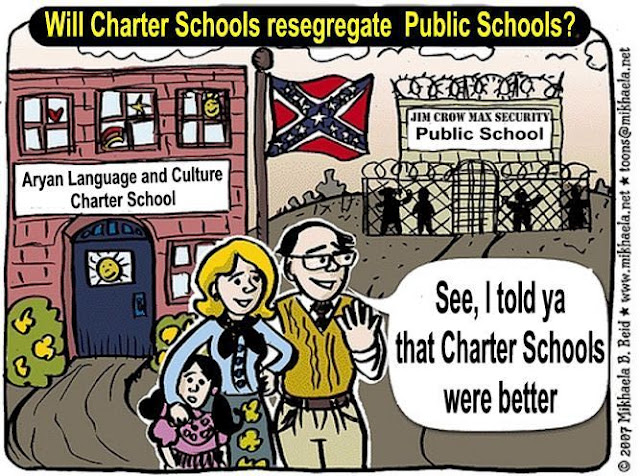
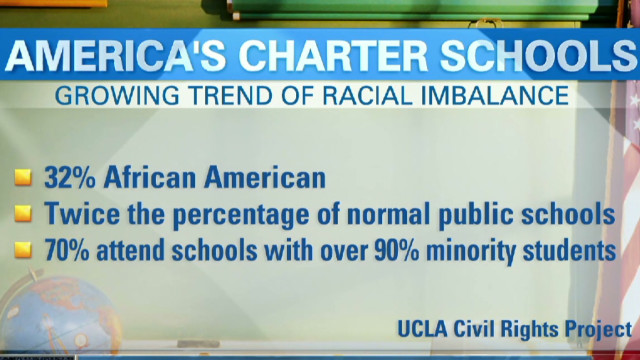
Any education reform that ignores segregation is doomed to failure

Any education reform that ignores segregation is doomed to failure:

Any educational reform that ignores segregation is doomed to failure

A new report finds that such reforms only placate white people, don't bring equity

Image result for charter school segregation


n education, America does everything but equity.” With these words, Failing Brown v. Board, a new report from the civil rights group Journey for Justice Alliance, makes plain how the machine of educational reform, with all its innovations and disruptive technologies, is missing an essential cog: the resources to deliver a quality neighborhood school.

Most states cut education spending in the 2008 recession. Yet, despite the economy having recovered, there is less funding today for education than even those lean years, according to the Center on Budget and Policy Priorities. Researchers from this non-profit found that in 2015, “29 states were still providing less total school funding per student than they were in 2008.”
No wonder the quality of our schools is suffering, and parents are grasping at straws. But the seductive promise of educational programs that don’t grapple with the roots of inequality will eventually ring hollow.
Yesterday, the director of Journey for Justice Alliance, Jitu Brown — alongside other civil rights groups including the NAACP, the Advancement Project, American Federation of Teachers and the National Education Association — held a press conference on the steps of the Supreme Court in Washington, D.C. The occasion was the release of the report, to do what many reformers openly refuse to — confront a system of segregated schools.
Segregated housing and schools, gerrymandered districts and voter suppression picked up were Jim Crow left off. Housing ghettos are born of racist housing policies that rob the black community of opportunities to amass wealth. According to Prosperity Now, a national nonprofit to expand economic opportunity for low-income families, and the Institute for Policy Studies, a progressive think tank, white households have seven times the amount of wealth as African Americans, and six times as much as Latinos.
Wealthier neighborhoods to hoard wealth and maintain a racially separate school system through a financial structure based on property taxes. Local school districts rely heavily on the revenue that comes from local property taxes, creating funding disparities between rich and poor districts. These primary sources of inequality continue to limit opportunities, suppressing the social mobility of subsequent generations. Yet many education reformers avoid, accept — or even embrace! — segregation, knowing that federal policy got Continue reading; Any education reform that ignores segregation is doomed to failure:


Image result for charter school segregation

Monday, May 14, 2018

Education Department Unwinds Unit Investigating Fraud at For-Profits - The New York Times

Education Department Unwinds Unit Investigating Fraud at For-Profits - The New York Times:

Education Department Unwinds Unit Investigating Fraud at For-Profits


WASHINGTON — Members of a special team at the Education Department that had been investigating widespread abuses by for-profit colleges have been marginalized, reassigned or instructed to focus on other matters, according to current and former employees.

The unwinding of the team has effectively killed investigations into possibly fraudulent activities at several large for-profit colleges where top hires of Betsy DeVos, the education secretary, had previously worked.

During the final months of the Obama administration, the team had expanded to include a dozen or so lawyers and investigators who were looking into advertising, recruitment practices and job placement claims at several institutions, including DeVry Education Group.


The investigation into DeVry ground to a halt early last year. Later, in the summer, Ms. DeVos named Julian Schmoke, a former dean at DeVry, as the team’s new supervisor.

Now only three employees work on the team, and their mission has been scaled back to focus on processing student loan forgiveness applications and looking at smaller compliance cases, said the current and former employees, including former members of the team, who spoke on the condition of anonymity because they feared retaliation from the department.

In addition to DeVry, now known as Adtalem Global Education, investigations into Bridgepoint Education and Career Education Corporation, which also operate large for-profit colleges, went dark.

Former employees of those institutions now work for Ms. DeVos as well, including Robert S. Eitel, her senior counselor, and Diane Auer Jones, a senior adviser on postsecondary education. Last month, Congress confirmed the appointment of a lawyer who provided consulting services to Career Education, Carlos G. MuƱiz, as the department’s general counsel.


The investigative team had been created in 2016 after the collapse of the for-profit Corinthian Colleges, which set off a wave of complaints from students about predatory activities at for-profit schools. The institutions had been accused of widespread fraud that involved misrepresenting enrollment benefits, job placement rates and program offerings, which could leave students with huge debts and no degrees.

Elizabeth Hill, a spokeswoman for the Education Department, attributed the reduction of the group to attrition and said that “conducting investigations is but one way the investigations team contributes to the Continue reading: Education Department Unwinds Unit Investigating Fraud at For-Profits - The New York Times: