Latest News and Comment from Education

Monday, July 17, 2017

Message in a Bottle Diane Ravitch's blog | A site to discuss better education for all

Diane Ravitch's blog | A site to discuss better education for all:

Message in a Bottle Diane Ravitch's blog
A site to discuss better education for all


Texas: Special Session of Legislature Opens Tomorrow, to Restart Voucher Debate

Governor Greg Abbott has called a special session of the Texas legislature, beginning tomorrow, which will consider a school finance reform bill and vouchers, among other things. The public schools of Texas are underfunded. In 

Betsy DeVos and ALEC in Denver This Week

Betsy DeVos will be the keynote speaker at the ALEC annual meeting in Denver this week. Protestors will be there to greet her, although the U.S. Department of Education is keeping silent about which day she will appear. ALEC has been 

Trump and the Russian Mafia: A Cautionary Story

Craig Unger, a contributing editor at Vanity Fair, published an article about Donald Trump’s relations with the Russia mafia. It is called “Trump’s Russian Laundromat.” Remember when Trump said he had no connections to Russia? 

Betsy DeVos Tells Senators She Will “Return” Office for Civil Rights to a “Neutral” Role

A group of Democratic Senators wrote a letter to Secretary of Education Betsy DeVos to express their concern that she was abandoning civil rights enforcement. DeVos wrote back to say that she was “ returning” the Office for Civil Rights to its role as a “neutral” investigative agency. It is at a time like this that DeVos’s ignorance of education policy and history becomes embarrassing. OCR is the
Gary Rubinstein: Does KIPP Deserve to Expand in Philadelphia?

Gary Rubinstein learned that KIPP plans to add more schools in Philadelphia and nearly triple its enrollment. So Gary did what he always did: he checked the public data for KIPP in Philadelphia. He found that KIPP has one high school in the city. “ That school got the lowest possible rating, essentially an F. Not only were their test scores low, but they also got the lowest possible rating in ‘gr
Philadelphia: KIPP Gets Whatever It Wants, Despite Poor Performance

Despite lackluster results at some of its Philadelphia schools, KIPP plans to increase the number of itsschools in the city and more than double its enrollment, from 1,770 to 4,400 students. Current plans call the growth of K-12 networks of KIPP schools. Apparently, the KIPP Network will accept students in the early grades but not in middle school or high school. KIPP wants to create its “culture
New Jersey: Linda Weber, Candidate for Congress, Thanks You for Your Help!

Linda Weber is running against a Republican incumbent in New Jersey. Hers is one of the districts that Democrats hope to flip, so as to gain control of the House in 2018 and stop ztrump’s plans to defund public schools, environmental protection, Medicaid, and every other social program. I put out an appeal to raise money for Linda when she needed to meet a June 30 deadline, and many of you respon

YESTERDAY

Bridge International Academies: A Dutch Perspective

Dutch journalist Maria Hengeveld reviewed the claims and business plans of Bridge International Academies and found much not to like. She is clearly irked that the Dutch Ministry of Affairs has invested in this plan. Shannon May, a founder, says that BIA is all about “social justice.” Hengeveld adds: “And for profit. According to her husband, the “global education crisis” is worth about US$51 bil
Nicholas Kristof Defends For-Profit Takeover of Schools in Africa

In this column , Nicholas Kristof defends the takeover of schooling in Africa by Bridge International Academies. Kristof says that since the government failed to provide basic education, it is welcome news that BIA is doing it, for a fee. The investors include Bill Gates and Mark Zuckerberg. He writes that American liberals should get over their squeamishness about privatization and for-profit op
Massachusetts: How to Kill a Successful School

Pelham, Massachusetts, is a small town in the western part of the state. It contains about 1,300 residents. It has only one school, an elementary school that enrolls about 130 children. The Pelham school is part of the Amherst district; when children leave elementary school, they move on to the Amherst-Pelham Regional Schools for junior and senior high. Three school committees, three budgets, one
Jennifer Berkshire: Watch What Betsy DeVos Does, Not the Nonsense She Says

Jennifer Berkshire writes about Betsy DeVos’s radical agenda, which she cloaks in platitudes. She has become the mistress of not speaking to the press. When invited to address the annual meeting of the Education Writers Association in D.C., she skipped out, claiming she was too busy. She briefly appeared on a network news show, speaking about the only subject she cares about: choice. When asked a
Florida: Parents Fight Corporate Takeovers of Public Money!

Parents in Alachua County in Florida have created an organization to fight the opening of a for-profit charter school run by Charter Schools USA in their community. Their organization is called Parents Against Corporate Takeovers (PACT) . The charter will drain students and money from their local community public schools. In addition to hurting public schools, the new charter will have poor overs
Massachusetts Professor Identifies Dark Money Funding Parent Group, Sets Off Twitter Controversy

Maurice Cunningham is a professor of political science at the University of Massachusetts. During the heated battle over a referendum to expand charter schools (Question 2), Cunningham wrote about the funding of both sides. The Massachusetts Teachers Association spent heavily to oppose Question 2, but they were far outspent by the many millions poured into the state to support charter schools. Mo


The Correct Link for “Fake News” about Vesilnitskaya

The story appeared on the CNN WEBSITE. http://money.cnn.com/2017/07/14/media/trump-russian-lawyer-veselnitskaya-theories-obama/index.html
Diane Ravitch's blog | A site to discuss better education for all:


Charter Schools: When Black Hair Violates The Dress Code : NPR Ed : NPR

When Black Hair Violates The Dress Code : NPR Ed : NPR:

When Black Hair Violates The Dress Code


Raising teenage girls can be a tough job. Raising black teenage girls as white parents can be even tougher. Aaron and Colleen Cook knew that when they adopted their twin daughters, Mya and Deanna.
As spring came around this year, the girls, who just turned 16, told their parents they wanted to get braided hair extensions. Their parents happily obliged, wanting Mya and Deanna to feel closer to their black heritage.
But when the girls got to school, they were asked to step out of class. Both were given several infractions for violating the dress code. Mystic Valley Regional Charter School, north of Boston, bans hair extensions in its dress code, deeming them "distracting."
When administrators asked the girls to remove their braids, Mya and Deanna refused.
The next day, Colleen and Aaron Cook came to the school where, they say, they were told the girls' hair needed to be "fixed." The Cooks refused, telling administrators that there was nothing wrong with the hairstyle.


Mya and Deanna Cook, 16, with their parents, Aaron and Colleen Cook.
Courtesy of the Cook family.
As punishment, the girls were removed from their extracurricular activities, barred from prom, and threatened with suspension if they did not change their hair.
According to Colleen Cook, administrators at Mystic Valley have routinely reprimanded black students for dress code violations involving hair.
Other black girls have been pulled out of class, she says, lined up, asked if they had hair extensions and given detention if they did.
Colleen remembers when one student, who wore her hair in its natural texture, was taken out of class and told that she would need to relax, or chemically straighten, her hair before returning to school the next day.
In defense of their daughters, the Cooks brought in a yearbook to show school leaders the many white female students with hair extensions and dyed hair.
But, the Cooks say, the administration didn't see that those students were in violation When Black Hair Violates The Dress Code : NPR Ed : NPR:

On Common Terminology and Teaching Writing: Once Again, the Grammar Debate | radical eyes for equity

On Common Terminology and Teaching Writing: Once Again, the Grammar Debate | radical eyes for equity:

On Common Terminology and Teaching Writing: Once Again, the Grammar Debate


In 1971, after years of scrounging and clawing, my parents were able to build their dream home on the largest lot at the new golf course in my home town. This was a redneck working-class vision of what it meant to achieve the American Dream.
As a consequence, I lived on and worked at this golf course (called a “country club” without a speck of irony) throughout my adolescence. Some of my formative moments, then, occurred on the golf course while I was working—including discovering that when a teen has been covertly drinking mini-bottles of liquor for hours virtually every adult can see that in about 2 seconds.
The grass on the course itself was over-seeded a couple times a year, and this required the work of all the employees and many of the club members simply volunteering, including my father.
One fall, I believe, I was told to drive around the old pickup truck used exclusively on the course. I was likely a year or so away from driving legally.
The truck was a 3-speed manual shift on the column and a transmission that worked about as well as you’d imagine for a work truck that never left the fairways of a redneck golf course.
My father hopped in the passenger seat and told me what to do, throwingOn Common Terminology and Teaching Writing: Once Again, the Grammar Debate | radical eyes for equity: 

The Compromise That Secured a Constitutional Right To Education - Education Law Prof Blog

Education Law Prof Blog:

The Compromise That Secured a Constitutional Right To Education

In my forthcoming article, The Constitutional Compromise to Guarantee Education,
Stanford Law Review, I argue that, contrary to popular belief, our federal constitution does protect a right to education.  I base the argument on congressional debates, state constitutional conventions, and the new state constitutional amendments that states passed in the conjunction with ratifying the Fourteenth Amendment to the U.S. Constitution.  
On one hand, the right lays in plain sight.  On the other, it has been overlooked due to the complexity of the ratification process and subsequent historical events that sought to overturn the substance and effect of the Fourteenth Amendment.
The abstract offers this summary:
Although the Supreme Court refused to recognize education as a fundamental right in San Antonio v. Rodriguez, the Court in several other cases has emphasized the possibility that the constitution might afford some protection for education. The Court, however, has never explained why the constitution should protect education.

New litigation is attempting to capitalize on the Court's sympathy toward education, but convincing the courts will still require a compelling affirmative constitutional theory. This Article offers that theory, demonstrating that the original intent of the Fourteenth Amendment was to guarantee education as a right of state citizenship. This simple concept has been obscured by the unusually complex ratification of the Amendment. But this article, relying on primary sources, reveals that providing public education was a condition of southern states' readmission to Union and was incorporated into the meaning of the Fourteenth Amendment. As a right of citizenship, this Article also theorizes that the Fourteenth Amendment prohibits states from partisan and other illegitimate manipulations of educational opportunity--some of which have continued to this day.
Read the full draft here.
Education Law Prof Blog:

Mike Klonsky's SmallTalk Blog: WEEKEND QUOTABLES

Mike Klonsky's SmallTalk Blog: WEEKEND QUOTABLES:

WEEKEND QUOTABLES

"We want the USGA to dump sexist Trump because women and men deserve to make sure that they are safe and that sexual predators are not considered ambassadors of sports." -- Protesting Trump at U.S. Open

Catherine Rampell
Everything is a distraction from something much, much worse. -- Washington Post 
Walt Gardner 

It's so easy to scapegoat teachers' unions for all the ills afflicting public schools ("State of the Teachers Union," The Wall Street Journal, Jul. 6). Critics point to the success of charter schools, which are overwhelmingly non-union, as evidence.
But what these critics don't admit is that states like Massachusetts and Minnesota, which have strong teachers unions, also post high test scores. Is that merely a coincidence or is it evidence that the critics are wrong?  (Correlation is not causation.)  Moreover, not all charter schools post positive results by any means. -- Reality Check
 Jessica Valenti

 Perhaps this shouldn’t come as a surprise from DeVos, who appointed Candice Jackson as a civil rights official in the education department – a woman who Mike Klonsky's SmallTalk Blog: WEEKEND QUOTABLES:


Louisiana Educator: The Common Core Experiment in Louisiana is Stalling

Louisiana Educator: The Common Core Experiment in Louisiana is Stalling:

The Common Core Experiment in Louisiana is Stalling
Lackluster LEAP test performance and lax promotion/retention practices combine to shortchange students. Public records requests reveal the bleak truth.


The Louisiana Department of Education released LEAP test scores in math, English, and Science last week. The average test scores were stalled at approximately the same levels as 2016. Unfortunately since the new ESSA plan submitted by Superintendent White requires growth to mastery by 2025, the LDOE felt a need to spin the results using a three-year time span. The press releaseattempted to put the best face on stalled performance by combining the last two years and comparing the combined result to the first year of Common Core testing. Educators and many parents are not fooled.

State Superintendent John White claims that in recent years, Louisiana has raised expectations for student performance as measured by state tests. Actually, my public records requests show that the expectations of student performance have been lowered drastically to the point that they are almost non-existent! Also Public records data provides the evidence that Louisiana standards are not actually enforced as required by state laws affecting student promotion. The lack of expectations of students is resulting in many of our students being awarded meaningless diplomas after 12 years of schooling. Too many of our students are totally frustrated by being forced to sit through a curriculum that is not appropriate for their needs. A major part of the problem is that not every student can or should be prepared for college. Students are all different and capable in their own unique ways. They should not be treated like identical widgets.

One of my recent public records requests asked the Louisiana Louisiana Educator: The Common Core Experiment in Louisiana is Stalling:

IEA was neutral on pension theft. What else is new? – Fred Klonsky

IEA was neutral on pension theft. What else is new? – Fred Klonsky:

IEA was neutral on pension theft. What else is new?

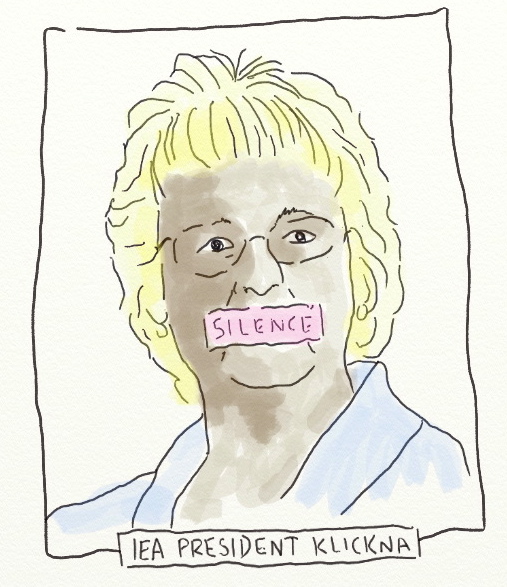
klickna
“There are no neutrals on a runaway train.” Howard Zinn
Illinois President Cinda Klickna showed up long enough to explain the legislature’s recent pension theft and then quickly left town.

Her two terms as president of the organization ended last week.
But not before declaring that the largest teachers union in the state was neutral on creating a defined contribution pension system for Tier II and Tier III teachers.
Because of their neutrality, there was no lobbying call for members to oppose what had been a long-standing union position of opposition to turning our pensions into any privately run annuity.
1.     Were there pension changes in the new FY 18 State budget?
Yes, there were changes made to pensions in SB 42, one of the three budget bills that make up the FY18 State budget.
2.     How does SB 42 impact pensions?
Within Senate Bill 42, the budget implementation bill, the General Assembly created a third tier for new hires under most pension systems, including State Universities Retirement IEA was neutral on pension theft. What else is new? – Fred Klonsky:

Coding: The New Vocationalism (Part 3) | Larry Cuban on School Reform and Classroom Practice

Coding: The New Vocationalism (Part 3) | Larry Cuban on School Reform and Classroom Practice:

Coding: The New Vocationalism (Part 3)


What are public schools for?
That is the larger question raised by the “new vocationalism” in the past decade, as vendors, donors, and technology-enthused policymakers have pushed coding and computer science courses into public schools. Through advocacy groups that lobby districts and states to legislate both as requirements and social media campaigns touting high-paying jobs at the end of schooling, the hyperbolic rhetoric of reform with its statistics of how many computer programmer and software engineer jobs will need to be filled in 2020 has pushed the “new vocationalism” as the primary purpose for tax-supported public schools.
Americans have always wanted their schools to pursue more than one purpose. Opinion polls (see here and here)  have regularly shown that both parents and non-parents wanted public schools to do many things:
*insure that students become literate,
*prepare citizens to be engaged citizens,
*developing students moral and ethical character,
*getting children and youth ready  for careers,
*teaching students how to think,
*appreciating cultural diversity.
Those polls (above ones from 1981 and 1996 ) also showed that opinions shifted over time from one goal to another. The key point, however, is that Americans have wanted more than one purpose for tax-supported public schools.
Narrowing schooling’s purposes to preparation for work–as opposed to, say, a civic one or social justice or community uplift–has occurred before in the history of U.S. public schools (see Part 1). Such constricting of purpose confirms anew that schools mirror potent economic and political forces within the larger society.
For nearly four decades, federal and state reform-driven policies of higher Coding: The New Vocationalism (Part 3) | Larry Cuban on School Reform and Classroom Practice:

Seattle Schools Community Forum: Mayor Murray Needs to Step Down

Seattle Schools Community Forum: Mayor Murray Needs to Step Down:

Mayor Murray Needs to Step Down

Image result for Mayor Murray

The Sunday Times story revealed a report from the '80s about Mayor Murray and his role as a foster parent.

An Oregon child protective services investigator in 1984 determined that Mayor Ed Murray sexually abused his foster son, according to documents published by the Seattle Times today.
From The Stranger's reporting:

Finding the child sex abuse allegations to be credible, a child protective services investigator recommended that Murray stop fostering children all together. 

So did a foster care specialist, who wrote, "Under no circumstances should Mr. Murray be certified in the future." 

A prosecutor declined to press charges against Murray due to concerns with meeting the burden of proof, notbecause she didn't believe Simpson.

In a separate document, a foster care specialist wrote, "Although he was not indicted, the Protective Services department feels that the allegations are true, as does the district attorney’s office.”
I tweeted to the Mayor and the City Council that he should step down this Seattle Schools Community Forum: Mayor Murray Needs to Step Down:


Does KIPP Deserve To Expand In Philly? | Gary Rubinstein's Blog

Does KIPP Deserve To Expand In Philly? | Gary Rubinstein's Blog:

Does KIPP Deserve To Expand In Philly?


Charter schools are a large component of the modern education reform movement.  In theory, the charters will get better results because with the added autonomy they get, there is also added accountability.  A charter school can lose its charter for poor performance.  ‘High performing’ charters with a proven track record will also have the opportunity to expand while ‘low performing’ charters will not have their charters renewed.  This survival of the fittest as charter schools compete with each other and with the public schools will, supposedly, cause the school system to evolve more quickly than the incremental improvements of the traditional school system.
KIPP is one of the largest and best known charter networks in the country.  There are currently five KIPP schools in Philadelphia, two elementary schools, two middle schools, and one high school.
An article recently ran on the Philadelphia Website called ‘The Notebook’ about KIPP’s applications to expand and how some in the community are skeptical because of the poor performance of the KIPP schools.
I looked at the recent school report card for their one and only high school, KIPP DuBois High School.  Though they don’t have letter grades, they do have six levels with different Does KIPP Deserve To Expand In Philly? | Gary Rubinstein's Blog:

CAN THE ONE L.A. ORGANIZATION "MAKE DEMOCRACY WORK"? - Perdaily.com

CAN THE ONE L.A. ORGANIZATION "MAKE DEMOCRACY WORK"? - Perdaily.com:

CAN THE ONE L.A. ORGANIZATION "MAKE DEMOCRACY WORK"? 

Garcetti.jpg

Can the One L.A. Organization"make democracy work" again in Los Angeles? Not without addressing a still segregated and purposefully dumbed down LAUSD that is exclusively run for the benefit of its entrenched bureaucracy and the obscene profits of their corporate vendors' interests that keep them in power. There is not one issue of social disruption that One L.A. is trying to address that wouldn't be put to bed by the kind of vibrant public education that used exist as the most effective means of societal integration in the 1950s and 1960s by giving folks the education and well-compensated work they are entitled to.

One L.A. is a multi-ethnic and community organization that for many years now has been trying to reach across Los Angeles' diverse ethnic communities to try and address issues like gun violence, that continues to take 300 lives a year in the city. It is also concerned with affordable housing and homelessness in a city where those of moderate income have more and more been forced out of their homes as prices for both ownership and rentals goes way beyond the ability of those of moderate income to afford. But most of all, what One L.A. is trying to do in the aggregate is tap into the strengthens of these diverse communities to form a truly unified democratic coalition to increase the chances of success and quality of life for all Angelenos.

However, what I felt regrettable about this meeting was a failure to link the aforementioned issues of concern as a predictable result of LAUSD failing to give the vast majority of its still segregated students- who are socially promoted through it without an education- any skills that might keep them from being homeless, imprisoned or dead.

Mayor Eric Garcetti spoke to resounding applause about his CAN THE ONE L.A. ORGANIZATION "MAKE DEMOCRACY WORK"? - Perdaily.com:


Teacher Tom: That's What I Want For All Children

Teacher Tom: That's What I Want For All Children:

That's What I Want For All Children


We often discuss teaching as a profession, and it certainly is a field populated by professionals, but the longer I do this the more I come to understand that what we do falls much more precisely under the heading of a "calling." I've never met a preschool teacher who went into it for the money: everyone knows it stands among the lowest paying careers out there. No, we're in it for the purpose of doing good, for making the lives of young children and their families better. Whether or not we succeed is another story, of course, and I'm quite certain that there are some who have ulterior motives, but most of us feel called to our work for the highest purposes. I know that's true for me because, honestly, I could probably make more money as a barista and I would probably be less tired at the end of the day were I to be a jack hammer operator.

That said, there are those who are hellbent on turning education into a business, one that is measured, as all businesses are, by the singular measure of profit. That's how capitalism works: the bottomline is all that matters. Indeed, courts have found that stockholders of corporations have grounds for suing a company that chooses "public good" over profit. The United States Supreme Court itself has ruled that corporations count, for the purposes of free speech, as "people." People who place money before the good of others are called sociopaths.

So this is where we stand as the corporate education reformers, from Microsoft's education dilettante Bill Gates to Amway heir and US Secretary of Education Betsy DeVos, seek to shape our schools according to free market principles, where survival of the fittest competition stands at 
Teacher Tom: That's What I Want For All Children:

Sunday, July 16, 2017

An Urban Teacher's Education: You Can Be an Astronaut, but You Can't Be Black

An Urban Teacher's Education: You Can Be an Astronaut, but You Can't Be Black:

You Can Be an Astronaut, but You Can't Be Black

Image result for You Can Be an Astronaut, but You Can't Be Black

“What do you want to be when you grow up?” It’s a question I always imagined every kindergarten student hearing.

“I want to be a doctor!,” declares Sally. 

“I want to be a teacher!,” exclaims Johnny 

"I want to be an astronaut!,” shouts Bobbie.

The possibilities were always thought to be endless for middle-class white students, particularly boys. 

“That’s great! You can do it. You can be anything you want to be!,” our teachers and parents replied. In the United States, you can do anything you want to do if you just put your mind to it. 

It’s almost embarrassing to admit that I never really stopped to consider what those conversations might have been like in other households. In families where parents had not experienced the sense that this was anything resembling a land of opportunity, where their most salient experiences with carving out some degree of financial safety and success more often had to do with what sorts of demeaning labor richer people were willing to offer them money for than fulfilling their potential. 

How do parents and teachers who’ve suffered incredible trauma at the hands of oppressive systems guide their young people who begin to sense that it may not be as simple as asking the question, “What do you want to be when you grow up?”

In my family and in my schools, it was always about encouraging whatever idea I had at the moment. Although I don’t remember ever seriously thinking I would consider a career path apart from teaching, I had a profound sense that I would hear affirming comments from all of my supporting adults if those ideas ever arose. 

The whole of American ethos is based on individual determinism. You do you. Whatever you want to do, that’s what you should do. I think middle to high-income white children growing up in the United States may be exposed to the reality that this undoubting encouragement doesn’t exist for every student all over the world. The way we’ve taught history in public schools for sometime has often emphasized American exceptionalism. We have a vague consciousness that this is not quite what it’s like for children in all parts of the world. But rarer is the white child who understands that this unconditional support of a child’s career aspirations is not available to a great many children in the US.

One of the elements of white consciousness that may be most crippling when it comes to intra-racial dialogue is an almost total lack of opportunity to see outside of ourselves, to see outside of ways we’ve been brought up, to suppose that what we are and the way we think are mostly natural functions of the human condition rather than constructs that built in us as we marinate in the comfortable surroundings of white, patriarchal culture. 

As a result, I think we white folks often approach the world with an expectation not only that we have a right to be whatever we want, but also an assumption that everyone else thinks that way too. One place we see that play out in school is when white educators attempt to encourage students from diverse backgrounds to do well in school as if all of those students were in school primarily for themselves. A great many students from all backgrounds see their purpose in school primarily as a responsibility to bring honor and/or strength to their family rather than to their individual name. 

Because it is difficult in a culture that worships white identity for white folks to see outside of our habits of thought, we often engage with people from different backgrounds in ways that are confusing and often harmful due to our blindness of other ways of thinking and knowing. And I’m afraid that our overwhelming sense of ability, that we can do anything, also translates into a false belief in our capacity to know, understand, and be like other people.

We very often hear white folks who want to be allies to people of color and other marginalized An Urban Teacher's Education: You Can Be an Astronaut, but You Can't Be Black: