Latest News and Comment from Education

Wednesday, May 24, 2017

Randi Weingarten: Flawed Bellwether Education Report on Teacher Pensions

 Flawed Bellwether Education Report on Teacher Pensions - https://www.aft.org/sites/default/files/memo_bellwether-report_052217.pdf
Randi Weingarten: Flawed Bellwether Education Report on Teacher Pensions

To: Interested Parties
From: AFT President Randi Weingarten
Date: May 22, 2017
Subject: Flawed Bellwether Education Report on Teacher Pensions
Last week, Bellwether Education Partners issued a fallacious report on teacher pensions. Far from the distorted picture painted by the report's authors, the teacher pension system is actually a win-win for participants, working people and the American economy at largeTeachers who vest receive a guaranteed retirement income, and teachers who leave before vesting get all their own contributions back, with interest. The system provides real retirement security for participants, which the authors want to dismantle.1
The reality is that if you break the current social contract — a modest pension after a lifetime of service, in exchange for a modest income — you add to the retirement crisis engulfing this country. 
The median family of retirement age in America has just $12,000 in savings. Half of all Americans have saved less than $24,000 for retirement and half of working Americans — 78 million — work for employers that do not offer a retirement plan. Social Securityaccounts for 90 percent of retirement income for a third of all recipients and half of retirement income for minorities.
By pauperizing teachers, the retirement burden will shift increasingly to taxpayers. And the billions that public pension funds invest in the real economy will be stripped away.
The assumptions underpinning Bellwether’s report are erroneous. The firm develops its model in a vacuum, where the impact of wages, working conditions, new job opportunities, and family income and responsibilities is suspended, and only pension rules are used to determine whether a teacher vests and when she retires.
The report misrepresents the impact of defined benefit pension plans on those who leave teaching, omitting the fact that there isn’t forfeiture of contributors, and it fails to explain the positive impact of defined benefit pension plans on those who stay. In addition, it tends to ignore the fact that about half of all teachers are excluded from Social Security and therefore rely on the pension as their main source of retirement income.
Furthermore, Bellwether’s state pension fund sample includes several funds that have commingled data for a variety of employees, making it impossible to separate teachers from other education employees. Teachers have an average turnover rate much lower than noncertificated employees, and higher average years of service. Using commingled data in the sample is a fundamental flaw. 2 
Bellwether’s four recommendations are also wide of the mark: 
  • Lowering vesting standards to no more than three yearsThis would provide an incentive for more teachers to leave the profession earlier rather than later.
  • Offering graded vestingThis also provides an incentive to leave early and hurts taxpayers.
  • Moving to a more gradual accumulation of benefitsStates maintain their pension formulas to account for both productivity gains and inflation over a teaching career, and to provide a meaningful benefit to a career teacher. Other models that base the final benefit on average wages do not provide educators with retirement security, especially for educators in non-Social Security states.
  • Not using pension plans to help retain teachersPension policy and design can and should follow a workforce policy that is aimed at attracting and retaining a high-quality workforce for the long term.
The truth is that Bellwether appears to have reverse engineered its findings to align with the views of its corporate funders, which include the American Center for School Choice, the American Enterprise Institute, the Alliance for School Choice, K12 Inc. and the Thomas B. Fordham Institute. These groups want to undermine confidence in the pension system and place teachers’ retirements at the whim of the market. But why? Probably because their friends on Wall Street stand to reap billions in management fees by converting guaranteed benefits into 401(k)-type accounts.
Instead of working to undermine retirement security for teachers, firefighters, cops, nurses and other public workers, we invite Bellwether to look at the report we released last week that reveals how billions in Wall Street fees — not overly generous retirement benefits — are harming public pensions and putting state government balance sheets at risk. The authors should follow our lead by urging pension funds to divest from risky hedge funds and demanding fee limits and fee transparency.
The savings could go a long way toward solving underfunding, while providing a modest income stream for participants would permit dignity in retirement and contribute to the economic health of communities.3 Pension investments in roads, bridges and the electricity grid not only give a good rate of return for investors, they help rebuild our country and our economy.
Footnotes: 
1 In order to see how well defined benefit pension plans serve the teaching profession, Nari Rhee, manager of the Retirement Security Program at the UC Berkeley Center for Labor Research and Education, studied CalSTRS data to determine if most California classrooms were staffed by longterm teachers or by short-term teachers. Defined benefit plans are typically designed to reward long-term workers and defined contribution plans are designed to reward short-term workers. Also, California is one of 15 states where teachers are barred from participating in Social Security, so the pension is the major source of retirement income. Her analysis showed that:
  • 72 percent of young new California teachers who commit to the profession for more than five years stay for 30 or more years, until at least they are eligible for early retirement at age 55;
  • 75 percent of California teachers will have worked 20-30 years or more by the time they leave public education; and
  • The CalSTRS defined benefit pension plan, designed to benefit long-term educators, provides a significantly higher and more secure benefit to most classroom teachers than an idealized 401(k) (with low fees and a low annuity conversion factor). 
2 Examples of commingled data systems include the Colorado Public Employees’ Retirement Association PERA’s education division, which includes nonteachers; the Texas TRSTeacher Retirement System, in which a majority of active members are nonteachers; and the Oregon PERSPublic Employees Retirement System, which includes all school employees.
3 The National Institute on Retirement Security has found that every dollar paid out in public employee benefits generates $2.36 in economic activity; any additional investments, such as rebuilding bridges and repairing the energy grid, boost that margin.
Read more:  Flawed Bellwether Education Report on Teacher Pensions - https://www.aft.org/sites/default/files/memo_bellwether-report_052217.pdf


Get Your Popcorn Ready: DeVos testifies on Trump’s budget, her first time before Congress since rocky confirmation hearing - The Washington Post

DeVos testifies on Trump’s budget, her first time before Congress since rocky confirmation hearing - The Washington Post:

DeVos testifies on Trump’s budget, her first time before Congress since rocky confirmation hearing

Image result for get your popcorn ready
Get Your Popcorn Ready

Image result for big education ape DeVos  help committee
Education Secretary Betsy DeVos traveled to Capitol Hill on Wednesday morning to testify about the Trump administration’s proposed budget, her first public appearance before Congress since her rocky confirmation hearing in January.
DeVos is tasked with explaining a spending plan that has drawn criticism from both ends of the political spectrum.
Rep. Tom Cole (R-Okla.), chairman of the House education appropriations subcommittee, opened the hearing Wednesday with praise for DeVos’s efforts to expand charter schools. But he said he would have questions about the administration’s proposals to dramatically cut college financial aid programs such as work-study and college-access programs for low-income students — “which, frankly, I will advise you,” Cole said, “I have a different point of view on.”
President Trump has proposed slashing $10.6 billion from federal education initiatives, including after-school programs, teacher training and career and technical education, and reinvesting $1.4 billion of the savings into promoting his top priority: School choice.
The administration is also seeking far-reaching changes to student aid programs, including elimination of subsidized loans and public service loan forgiveness and a halving of the federal work-study program that helps college students earn money to support themselves while in school.
Rep. Tom Cole (R-Okla.)
Randi Weingarten, president of the American Federation of Teachers, called the administration’s spending proposal “cruel to children,” while Sen. Patty Murray (Wash.), ranking Democrat on the Senate Health, Education, Labor and Pensions Committee, said the budget proposed by Trump and DeVos “slashes funding for public schools to fund their DeVos testifies on Trump’s budget, her first time before Congress since rocky confirmation hearing - The Washington Post:
Image result for big education ape DeVos  murray

See How Easy It Is To Cheat on San Diego Unified Online Courses

See How Easy It Is To Cheat on San Diego Unified Online Courses:

It Is Shockingly Easy to Cheat San Diego Unified’s Online Courses

Across the district, online courses are enabling thousands of students to get caught up on classes they previously failed. But students also have access to the web as they take quizzes and tests, making it possible to find answers to the exact questions that appear on tests.

Teachers and principals say they’re virtually powerless to stop it.

Image result for big education ape cyber charter


 Googling answers in real time as you take a test. Letting online lectures play on mute while you watch a movie instead. Typing in random letters and numbers as answers and receiving credit.

Those are all moves students and educators told me happen regularly in San Diego Unified’s online credit recovery courses.
On a recent visit to East Village High School, I even watched some of them do it.
There, I saw students Google quiz questions from their online courses and pull up websites where other students have uploaded answers. I saw one student type gobbledygook where short answers were supposed to go – and watched as the computer marked the answer as complete. And I talked with students who said everybody is doing it – whether it’s an online course offered by San Diego Unified or a charter school that offers similar online classes.
“Everyone is cheating. Left and right. Up and down. No matter where you are, someone is cheating. That’s a given,” said Daniel Martinez III, a senior at East Village High School.
Across the district, online courses are enabling thousands of students to get caught up on classes they previously failed – sometimes in a matter of days. But students also have access to the web as they take quizzes and tests, making it possible to find answers to the exact questions that appear on tests.
Teachers and principals – both at East Village High, two other district high schools and a charter school – say they’re virtually powerless to stop it. In theory, instructors can monitor students’ computers as they complete coursework, making sure they’re not Googling answers to tests or quizzes. But because students can complete coursework and tests from home or anywhere else they find internet, it’s impossible for teachers to crack down on cheating that happens outside of school.
District officials have pointed to the fact the courses are vetted and approved by the University of California for rigor. But by students’ own accounts, lack of rigor isn’t the problem. It’s how easy they are to game.
Cheating is as simple as opening a second computer window, Googling quiz questions verbatim, then finding the exact answers that others have downloaded to websites designed to help students See How Easy It Is To Cheat on San Diego Unified Online Courses:
Image result for big education ape online charter

Trump budget would devastate public education for private choice

Trump budget would devastate public education for private choice:

Trump budget would devastate public education for private choice

Image result for BIG EDUCATION APE Trump budget would devastate public education for private choice
Image result for BIG EDUCATION APE Trump budget
The Trump administration has announced its plan to transform education funding as we know it. The new budget proposal takes aim at a host of elementary, secondary and higher education programs that serve needy students, redirecting those funds toward K-12 school choice in the form of vouchers, tax credits and charter schools.
Public schools that enroll a large percentage of low-income students stand to lose significant chunks of their budget, as well as a number of specialized federal programs for their students. At the same time, the Trump budget will incentivize families to leave not only these schools, but public schools in general.
As a scholar of education law and policy, I note that my recent research on state voucher and charter programs shows that the loss of both money and core constituents proposed by this new budget could throw public education into a downward spiral.

The proposed changes in federal funding

Through Title I of the Elementary and Secondary Education Act, the federal government currently sends US$16 billion a year to public schools to provide extra resources for low-income students. While Title I is the single largest federal grant, the federal government spends more than twice that amount through a multitude of other programs. School systems like those in Miami, Milwaukee, Houston, San Antonio and Detroit get anywhere from 15 to 25 percent of their funding from the federal government.
The new budget proposes about $4 billion in cuts to programs like literacy for students with disabilities and limited English proficiency, class-size reduction, and after-school and summer programs.
The Trump administration promises the money is not really gone; it’s just coming back under different policies. The administration plans to add $1 billion to Title I, but the additional money comes with a big catch: States must spend that money on school choice. To access the new money, states and districts would have to adopt student enrollment Trump budget would devastate public education for private choice:


 Image result for BIG EDUCATION APE Trump budget

50CAN: Seeking More Local Investment to Advance Its Set Agenda | deutsch29

50CAN: Seeking More Local Investment to Advance Its Set Agenda | deutsch29:

50CAN: Seeking More Local Investment to Advance Its Set Agenda


50CAN is a corporate reform organization that wants to expand many facets of education reform including increasing the number of charter schools (as well as the money they receive); promote the grading of schools using test scores, and passing state-level legislation for “achievement school districts” (state-run districts).
50CAN has a web site that offers a lot of information on what it believes it has accomplished and what it hopes to accomplish. Of course, one must get past the ed reform fluff, such as that on the opening page:

Hi there! We’re 50CAN!

We’re a nonprofit network of local leaders advocating for a high-quality education for all kids, regardless of their address.
A slight shift from the usual, “regardless of their zip code.”
The mission statement page is also hazy, but it does begin with the “regardless of their address” slogan:

We are guided by four foundational beliefs that make up our vision for the road ahead.

We believe that growing the ranks of citizen-advocates will change the trajectory of children’s lives.
We believe in the power of evidence-based policy and the power of open advocacy.
We believe that nationwide change depends on a network of local advocates.
We believe that to improve education for all students, we need an unwavering commitment and a clear-eyed approach.
As for that “vision page” linked above, well, also nebulous feel-good (including 50CAN: Seeking More Local Investment to Advance Its Set Agenda | deutsch29:

Marie Corfield: #ManchesterBombing: This One's Personal

Marie Corfield: #ManchesterBombing: This One's Personal:

#ManchesterBombing: This One's Personal


See that picture? That's my extended family and me back stage with Ariana Grande after one of her concerts. The four little girls in the front are friends of the family. More on them later. 


No, we didn't win a radio station contest. Ariana is my cousin. And what happened in Manchester is personal—but not just because we're relatives. 

I teach in a K-4 school. My students are between the ages of five and ten. Many of them love Ariana, and they know we are related, but they're little, so I get questions like, "Is Ariana Grande really your daughter?" or "Is Ariana Grande really your sister?" They ask if she will come do a concert, if I can get her autograph. You get the idea. 

Her concerts are full of starry-eyed little girls, 'tweens and teens just like some of my students; just like all the little girls in that picture. The Manchester concert was no different. They wear their computer-operated cat ears that blink on and off in sync with the music. They know the words to every song and sing them louder than I remember singing at a concert when I was young (or maybe it just seems that way because I'm older). They worship Ariana because she is a pop star with Nickelodeon roots. She's 
Marie Corfield: #ManchesterBombing: This One's Personal: 

Research Counts for Little When It Comes to Adopting “Personalized Learning” | Larry Cuban on School Reform and Classroom Practice

Research Counts for Little When It Comes to Adopting “Personalized Learning” | Larry Cuban on School Reform and Classroom Practice:

Research Counts for Little When It Comes to Adopting “Personalized Learning”

Image result for big education ape Research
Image result for big education ape gates personalized learning

 The K-12 sector is investing heavily in technology as a means of providing students with a more customized educational experience. So far, though, the research evidence behind “personalized learning” remains thin.

Ben Herold, Education Week, October 18, 2016
The pushers of computer-based instruction want districts to buy products and then see if the product works. Students and teachers are being used for marketing research, unreimbursed research. Districts are spending money based on hype and tests of the educational efficacy of an extremely narrow range of products as if this is a reasonable way to proceed in this era of extreme cuts in budgets.
Laura Chapman, comment on above guest post, May 21, 2017
Both Ben Herold and Laura Chapman are correct in their statements about the thinness of research on “personalized learning” and that districts spend “money based on hype and tests of the educational efficacy of an extremely narrow range of products….”
In short, independent studies of “personalized learning,” however, defined, are rare birds but of even greater importance, are subordinate to decisions on buying and deploying software and programs promising to tailor learning to each and every student from kindergarten through high school. To provide a fig leaf of cover for spending on new technologies, policymakers often use vendor-endorsed studies and quick-and-dirty product evaluations. They are the stand-ins for “what the research says” when it comes to purchasing new products advertising a platform for “personalized learning.”
Why is research nearly irrelevant to such decisions? Because other major criteria come into play that push aside educational research either independent or vendor-sponsored, on technology. Policymakers lean far more heavily upon criteria of effectiveness, popularity, and longevity in spending scarce dollars on new technologies championing “personalized learning.”
Criteria policymakers use 
The dominant standard used by most policymakers, media editors, and administrators to judge success is effectiveness: What is the evidence that the policy of using new technologies for classroom instruction has produced desired outcomes? Have you done what you said you were going to do and can you prove it? In a society where “bottom lines,” Dow Jones averages, Super Bowl victories, and vote-counts matter, quantifiable results determine effectiveness.
Since the Elementary and Secondary Education Act (1965), federal and state policymakers have relied on the effectiveness standard to examine what students Research Counts for Little When It Comes to Adopting “Personalized Learning” | Larry Cuban on School Reform and Classroom Practice:

Image result for big education ape gates personalized learning
Image result for big education ape Research

The TFA Top-10 Listers, Where Are They Now? | Gary Rubinstein's Blog

The TFA Top-10 Listers, Where Are They Now? | Gary Rubinstein's Blog:

The TFA Top-10 Listers, Where Are They Now?

Related image

A frequent criticism of TFA is that their teachers usually don’t stay beyond the two-year commitment.
Over the years, TFA has had different responses to this.  For a long time the statistic they touted was that 60% of corps members who complete the two years also teach a third year.  Though this statistic doesn’t include those who don’t make it though the two years (which is around 12%) it still is more than most people would figure.  Though they don’t publish these statistics so much anymore, it used to be generally accepted that only about 25% stay for a fourth year.
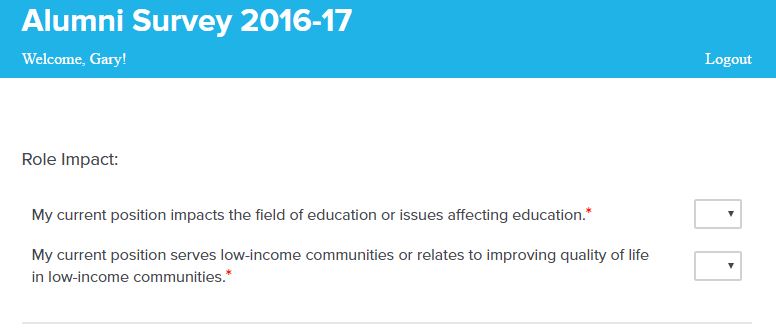
Nowadays, TFA has found a sneaky way to inflate their retention numbers by using their annual survey.  According to TFA, 80% of people who answered the survey say that they are either still ‘in education’ or somehow ‘serves low-income communities.’  This number is inflated for two reasons:  1) The self-selection of the survey takers, and 2) The way they collect this information by having alumni answer these ambiguous questions:
Without having access to the data of all 50,000 alumni, it is hard to know, anymore, what percent of TFAers become career teachers.
Four years ago, TFA got some national attention as ten of their new 2013 CMs got the opportunity to read a David Letterman Top 10 List ‘The Top 10 Reasons I Decided To Become A Teacher.’  This offended many people who really decided to become teachers since most of the TFAers were likely not going to become teachers for more than two years.
Now I know that ten people is a very small sample, but I thought it would be interesting to follow up on these ten people, four years later.  Even though it is just ten people, we can presume that these ten people were not just randomly chosen by TFA to be on David The TFA Top-10 Listers, Where Are They Now? | Gary Rubinstein's Blog:
Image result for big education ape  Teach for america
Image result for big education ape  TFA

CURMUDGUCATION: Dear Jeb Bush:

CURMUDGUCATION: Dear Jeb Bush::

Dear Jeb Bush

Image result for big education ape devos jeb bush


Image result for big education ape devos jeb bush

Today you put in an appearance at Betsy DeVos's American Federation for Children, a group very much in tune with your goals in education. I can see why you and DeVos have always gotten along-- wealthy children of privilege who feel a righteous need to remake your home state according to your own beliefs in competition and battle and a system that sorts people into their proper places.


Reporter Matt Barnum tweeted this quote from you this afternoon:

The simple fact is when you create a marketplace of school choice ...the children do better ... It defies logic to suggest otherwise.

That's consistent with things you've said in the past. Just a month ago you sent an op-ed out to New Hampshire newspapers in which you wrote

When public schools face increased competition, they get better and kids learn more.

Now, your assertions don't really hold up to any sort of scrutiny (Politifacts ruled your NH line "mostly false") and I've burned many bloggy bytes arguing that. If you like, you can amble through this blog, but I'm not going to wade into that argument here.

No, what I want to do is ask a question, addressing your belief in the power of competition and the marketplace. This is going to sound like a snotty gotcha question, but it's really not. I find that all of us do better at grappling with these kinds of abstract ideas if we look at how they really play out in 


 Image result for big education ape devos jeb bush
Image result for big education ape devos jeb bush

A Mathematical Five-Minute Tribute to Hamilton the Musical | The Jose Vilson

A Mathematical Five-Minute Tribute to Hamilton the Musical | The Jose Vilson:

A Mathematical Five-Minute Tribute to Hamilton the Musical

Image result for A Mathematical Five-Minute Tribute to Hamilton the Musical

Can you imagine having only five minutes to get a point across, inspire hundreds of people, and keep your message grounded in the work? Yeah, me neither. But I did my best in the video below.
At this point, I was in the third of four presentations for that weekend in San Antonio. Special shout-out to the folks at Math Forum and NCTM for getting me there, of course.
I didn’t know what I would say until three hours before this presentation. But, if you’ve been following me for the last few months, you also know I’ve been obsessed with the Hamilton soundtrack and all that comes with it.
I do have slides to share upon request, but in the meantime, please enjoy and leave comments A Mathematical Five-Minute Tribute to Hamilton the Musical | The Jose Vilson:

Badass Teachers Association: The Unequal United States - Which State is Best to Teach in? by Momma Brown's Blog

Badass Teachers Association: The Unequal United States - Which State is Best to Teach in? by Momma Brown's Blog:

The Unequal United States - Which State is Best to Teach in? 

by Momma Brown's Blog


Originally posted at: https://medium.com/march-for-public-education/the-unequal-united-states-which-state-is-the-best-to-teach-in-abf003a31e0c

Divide and Conquer. 


In one of the Facebook groups that I follow, a member posed this question: “Just out of curiosity: what’s the best state to teach in, and why?” A flurry of comments came in — 347 comments were generated from that one question! I found the responses to be both enlightening and disturbing.
Some of the comments were humorous:
“A state of bliss.”
“A state of denial.”
“A state of sobriety.”
“A state of intoxication.”
Some comments looked outside of the United States:
“Finland” (This country was written many times.)
“International schools.”
“On-line.”
While a few teachers commented:
“No state.”
“None, get out of teaching.”
“Don’t go into any state of teaching.”
Most respondents answered very strongly concerning the state they taught in. The “best” states characteristics tended to be geographically north-eastern, union-supported, secure in teacher tenure rights, and included average to above-average teacher pay, including pensions.
The top state responses: Massachusetts, New York (but not always NYC), New Jersey (but there was much discussion over Governor Christie), Connecticut, Rhode Island, Maryland, and northern Virginia (not southern), Minnesota, and California.
The meh states included Ohio and Pennsylvania.
The characteristics of states to avoid included: hostile governors, anti-union sentiment, right-to-work laws, lacked teacher tenure rights, lacked pension benefits, and paid teachers unlivable wages. These “bad” states were listed as: Florida, Illinois, Badass Teachers Association: The Unequal United States - Which State is Best to Teach in? by Momma Brown's Blog:


DNA Test: The Ancestry of Charter Schools – Have You Heard

DNA Test: The Ancestry of Charter Schools – Have You Heard:

DNA Test: The Ancestry of Charter Schools

Have You Heard
Did you hear the one about how charter schools were the brainchild of Albert Shanker, the legendary teachers union head? Writer Rachel Cohen did, but when she began tracing the tale back to its origins, she found that the real *father* of charter schools looks a lot like their biggest fans today: market-oriented reformers who aren’t crazy about public institutions or labor unions. As for claims that the charter school vision has been *hijacked* from Shanker’s original vision, well, that’s a myth too. Charter schools have turned out very similar to how their *dads* first conceived of them back in the frenzy of government deregulation that began in the 1970’s and has never stopped. It’s Have You Heard #18!


 DNA Test: The Ancestry of Charter Schools – Have You Heard: