Latest News and Comment from Education

Saturday, January 14, 2017

solidaridad: NPE Action endorses Alva and Petersen for the LAUSD Board of Education

solidaridad: NPE Action endorses Alva and Petersen for the LAUSD Board of Education:

NPE Action endorses Alva and Petersen for the LAUSD Board of Education

Carl Petersen and Lisa Alva for LAUSD
The Network for Public Education Action is proud to endorse two candidates for the Los Angeles Board of Education District 2 primary election—Lisa Alva and Carl Petersen. 
Although it is very unusual for us to endorse two for the same position, both are well qualified and are committed to the ideals of NPE Action.
The third candidate in the race, the incumbent Monica Garcia, has clearly demonstrated by her record that she is not aligned with the pro-public education agenda of the Network for Public Education Action.
We therefore urge our supporters to vote for either Lisa or Carl.

Lisa Alva
Lisa has been a classroom teacher, school leader and a voice for teachers for 18 years. She told us that her first priority if elected “would be to redirect funding, resources and personnel to neighborhood public schools so that all children, especially at-risk youth, have enough variety in classes, and small enough classes, to benefit from a complete education that includes electives and vocational-technical training, from pre-K through Adult School. This means beginning and ending every conversation with the question, “How will this benefit students?”
She supports less standardized testing, and smaller class sizes. She also embraces charter school reform and transparency, and a return to democratically controlled schools.
According to Lisa, “Charter schools needlessly drain resources from neighborhood schools, weaken the teaching profession and leave more students behind than they serve.”
Carl Petersen
Carl is the father of five children, all of whom have attended public schools. Two of his daughters are on the autism spectrum so he is especially sensitive to the importance of funding for students with special needs.
Carl’s first priority is to stop Eli Broad’s Great Public Schools Now Initiative “to reach 50 percent charter market share.” According to Carl, “The LAUSD does not currently have the capacity, or the will, to oversee the 250 charters that already operate within the District. Doubling the number of these organizations will create opportunities for financial improprieties like those that have occurred at El Camino Real Charter High School, where public funds were used for expensive dinners, first class airfare and personal expenses. Charters are currently allowed to cherry pick students who are not English learners, do not have special education needs and do not have behavioral issues. The higher costs of serving these students are borne by the LAUSD schools that continue to serve these populations. Increasing the number of charters will shift these costs to an even lower base of students. The bankruptcy of the District is a likely result.”
Carl believes there should be less testing and he is opposed to the Common Core. He believes that there should be more accountability for the Los Angeles Board of Education.
The LAUSD school board election primary will take place on March 7.  We ask you to choose between these two fine candidates when you cast your vote. 
Thank you,
Carol Burris
Executive Director
You can share these endorsements using the following links:


Before DeVos, look at Florida's school 'reform' mess - Orlando Sentinel

Before DeVos, look at Florida's school 'reform' mess - Orlando Sentinel:

Before DeVos, look at Florida's school 'reform' mess

Betsy DeVos wants to bring education 'reform' nationwide. In Florida, even 'reformers' regret what they did
This week, Congress began vetting Donald Trump's Cabinet nominations.
Fireworks flew as members vetted nominees such as Rex Tillerson for Secretary of State.
I don't know Tillerson from Adam. So I'll leave the fighting over him to the D.C. politicians.
But I'm very familiar with the school "reform" movement championing Betsy DeVos as Trump's pick for education secretary — because Florida has been Ground Zero on that front.
And here in Florida, that so-called "reform" has been a disaster.
Don't take it from me. Take it from a bipartisan coalition of legislators who have admitted that Florida's testing-obsessed brand of "reform" has spiraled out of control and ultimately hurt both students and teachers.
Just last week, Republican legislators vowed to roll back some of the testing overkill started by Jeb Bush — the man leading the charge to put DeVos in charge of schools nationwide.
The problems are evident. Under Florida's so-called "reform" and "accountability" movement…
•Testing mandates have been so intense that some schools reported that test-related activities interrupted more than 60, 70 and even 90 of the 180 school days each year.
•Three years ago, Orange County had to create 1,000 new standardized tests — for everything from P.E. to band — to keep up with mandates.
•Science and art classes have been cut — sometimes entire courses, sometimes nine full weeks of curriculum, just so students could run more testing drills.
•Teachers have fled the state's public schools — so much that the state's own research show 40 percent of new teachers leave within five years after they start.
This is why Republican legislators have already begun repealing some of the very "reform" measures they used to champion.
But here's the real problem with the "accountability" movement: It is bogus.
Reformers bog down public schools with mandates that parents and teachers hate — but then offer vouchers to schools that don't have to meet the same standards.
Think about that. It's an obvious double standard with a goal of driving drive people away from traditional schools and to the private ones.
It's like offering someone two plates of barbecue ribs. You're free to choose whichever plate you want ... oh, but first we're going to place a big steaming pile of dog poop on top of one of them. Now choose!
Of course you're going to choose the poo-free platter.
If these folks were honest, they'd require every school that takes one nickel of public money or tax credits to meet the same standards. Some. None. Just be consistent.
But they don't. Because that would be a fair fight.
A few years ago, legislators actually talked about requiring private schools that receive vouchers to meet the same "accountability" standards — and the private schools went bonkers.
One pro-voucher group even penned a column in the Sentinel saying that forcing them to play by the same burdensome rules would "threaten private-school appeal."
Well, no kidding. The private schools basically said: What you are doing to public schools is so bad that, if you do it to us as well, people wouldn't choose us anymore.
It was basically an admission that the "reform" movement — with "accountability" for Before DeVos, look at Florida's school 'reform' mess - Orlando Sentinel:


Schools Matter: The Corporate Education Reform Poster State

Schools Matter: The Corporate Education Reform Poster State:

The Corporate Education Reform Poster State


Since Lamar Alexander served as Governor in the 1980s, Tennessee has been at the forefront of corporate education reform.  Tennessee was in the first wave of states to initiate mandatory student competency on standardized tests in order to get a diploma, and it was one of the first to ram down a career ladder program that ended up disproportionately rewarding teachers who worked in the whitest and leafiest suburbs.

Alexander's focus on shiny new things in education earned him the title of Education Governor, while allowing the state to shrink the proportion of funding going to education.  More state money was available, then, to to build an economy based on the hospital and prison industries, along with foreign investment in bringing auto manufacturing to Tennessee.  

Alexander's gubernatorial replacement, Ned Ray McWherter, wanted to take on the mantle, too, of Education Governor, if he could find a cheap way to do it. Enter the tobacco-chewing agriculture statistician from UT Knoxville named Bill Sanders, who had been trying for years to sell a statistical formulae for measuring the effects of various treatments on the subsequent growth of ag products, from soybeans to cattle. It was called value-added modeling (VAM), and Sanders promised that he could accurately and cheaply measure growth in academic achievement, while sorting out the bad farmers teachers whose crops of students remained stunted.

Sanders offered the perfect education solution by not requiring major investments in teacher pay, facilities, resources, curriculum, or teacher preparation.  The state could continue to squeeze the education budget as it continued to avoid any talk of a state income tax, even as it while it expanded the prison industry, the hospital industry, and foreign industries looking for sweet deals to lure companies to Tennessee.

VAM became law in 1992, with Sanders' proprietary algorithm written into state statute.

The details to this sordid case of ed reform run amok can be found in The Mismeasure of Education.  The story line in Part II details the contours and dimensions of the education funding shortfalls, and it details the State's commitment to low and entirely regressive taxes.  It also traces the State's desperate 
Schools Matter: The Corporate Education Reform Poster State:


Questions from California: what education leaders would ask Betsy DeVos – if they could | EdSource

Questions from California: what education leaders would ask Betsy DeVos – if they could | EdSource:

Questions from California: what education leaders would ask Betsy DeVos – if they could


 Tuesday, the U.S. Senate Committee on Health, Education, Labor and Pensions is expected to hold a confirmation hearing on the nomination of Betsy DeVos as secretary of education. A lot has been written about her position on vouchers and school choice. But DeVos has not granted any public or press interviews since President-elect Donald Trump announced her nomination.
EdSource asked a cross-section of education experts, teachers, students and administrators what questions they would ask DeVos, given the focus of their work and policy interests, if they had the opportunity – and why it’s important that the public hear those answers. Their insights and questions cover a range of important issues. They include whether she is committed to Title I funding for low-income children, how she’d respond to the fears of gay and immigrant students under a Trump presidency, how she would improve the academic achievement of minority children who are struggling and how she would carry out her goal of Questions from California: what education leaders would ask Betsy DeVos – if they could | EdSource:
City College of San Francisco wins full accreditation after 5-year battle | EdSource - https://edsource.org/?p=575489 

See how Betsy DeVos responded to Senate questionnaire on conflicts of interest, lobbying | MLive.com

See how Betsy DeVos responded to Senate questionnaire on conflicts of interest, lobbying | MLive.com:

See how Betsy DeVos responded to Senate questionnaire on conflicts of interest, lobbying


With her confirmation hearing slated for Tuesday, West Michigan native Betsy DeVos - Donald Trump's pick for U.S. Secretary of Education - is in the process of addressing questions over any potential ethical issues of concern.
The U.S. Office of Government Ethics is in the process of conducting its check on DeVos. Her confirmation hearing was originally scheduled for this week but was postponed to give the ethics office more time to conduct its review.
But some federal documents have already been released in which the school choice advocate and GOP mega donor responded to questions on conflicts of interest, cooperation with Congress and future employment.
Below are excerpts of DeVos' response to a questionnaire from the U.S. Senate Committee on Health, Education, Labor and Pensions, which is hosting DeVos' confirmation hearing.
Democrats on the committee have also sent letters to DeVos requesting information on topics ranging from her stance on various education issues to which legislation education groups backed and supported by DeVos have advocated for. DeVos has had conversations with some of those senators but does not plan to send a public response to them prior to her confirmation hearing, said Ed Patru, a spokesman for Friends of Betsy DeVos.
Here's the questions and responses included in the questionnaire:
Question: Please describe any business relationship, dealing or financial transaction which you have had during the last five years whether for yourself, on behalf of a client, or acting as an agent, that constitutes a potential conflict of interest with the position to which you have been nominated.
Answer: In connection with the nomination process, I will consult with the U.S. Office of Government Ethics and the Department of Education Agency Ethics Official and will submit OGE Form 278 to the Office of Government Ethics to facilitate the identification of any potential conflicts of interest.
Question: Explain how you will resolve any potential conflict of interest that may be disclosed by your response to above items.
Answer: In connection with the nomination process, I will consult the U.S. Office of Government Ethics and the Department of Education Designated Agency Ethics Official to identify potential conflicts of interest. Any potential conflicts of interest will be resolved in accordance with the terms of an ethics agreement that I will enter into with the Department's Designated Agency Ethics Official and that will be provided to this committee. I will resolve any potential conflicts of interest that arise during the course of my service with the Department of Education's Designated Agency Ethics Official.
Education Secretary nominee Betsy DeVos still working through ethics process
As Secretary of Education nominee Betsy DeVos awaits her formal hearing before a U.S. Senate committee, the West Michigan native is still working through the process of addressing any potential ethical concerns.


Question: Do you intend to serve the full term for which you have been appointed or until the next Presidential election whichever is applicable?
Answer: Yes
Question: Do you agree to appear and testify before this Committee and any other duly constituted committee of the Senate to represent the office for which you have been nominated and to respond to issues that are of concern to the Congress?
Answer: Yes
Question: Please indicate whether you will sever all connections with your present employer, business firm, association or organization if you are confirmed by the Senate.
Answer: Yes
Question: Please state whether you have any plans after completing government service to resume employment, affiliation or practice with your previous employer, business firm associations or organization.
Answer: After government service, I do intend to return to my family business.
Question: Has a commitment been made to you for employment after you leave Federal service?
Answer: No
Question: Please list any lobbying activity during the past 10 years, regardless of whether or not you were registered as a lobbyist, in which you have engaged for the purpose of directly or indirectly influencing the passage, defeat or modification of any Federal legislation or of affecting the administration and execution of Federal law or policy.
Answer: I have never been registered as a federal or state lobbyist. In my capacity as a volunteer chairman of the American Federation for Children, I have met with Senators, Members of Congress, and members of the public in the past ten years to discuss school choice programs generally and the DC Opportunity Scholarship Program and SOAR Act specifically. I have also authored opinion editorials and made public statements in support of federal school choice programs and education reform. See how Betsy DeVos responded to Senate questionnaire on conflicts of interest, lobbying | MLive.com:


Dr. Martin Luther King and Donald Trump - Living in Dialogue

Dr. Martin Luther King and Donald Trump - Living in Dialogue:

Dr. Yohuru Williams on Donald Trump and the legacy of Dr. Martin Luther King.


Image result for Dr. Martin Luther King and Donald Trump


Keeping Retirement Weird. Senator Biss’ view on pension theft seems to have changed. Activism works. | Fred Klonsky

Keeping Retirement Weird. Senator Biss’ view on pension theft seems to have changed. Activism works. | Fred Klonsky:

Keeping Retirement Weird. Senator Biss’ view on pension theft seems to have changed. Activism works.


Back in 2013, Skokie Senator Dan Biss’ name was synonymous with pension theft.
He was then, and is now, a liberal Democratic member of the Illinois General Assembly.
Some suspect he is one of those who has his eyes on the Governor’s Mansion now that Governor Rauner is considered one of the most vulnerable Republicans in the country.
Before the Illiinois Supreme Court ruling affirming the pension protection clause, Biss had plenty of opportunities to defend his pension theft position. Trust me, we retirees can be a pain in the ass.
As in the video above of our 2013 visit to the Senator’s Skokie office..
Recently a retired teacher activist Sharon Hayhurst forwarded to me a letter she received from Senator Biss after she asked him about his current position on pensions.
Dear Sharon,

The Student Progress At KIPP Is Small And Dim (Clap Clap Clap Clap) Deep In The Heart Of Texas | Gary Rubinstein's Blog

The Student Progress At KIPP Is Small And Dim (Clap Clap Clap Clap) Deep In The Heart Of Texas | Gary Rubinstein's Blog:

The Student Progress At KIPP Is Small And Dim (Clap Clap Clap Clap) Deep In The Heart Of Texas


Reformers love A-F school ratings.  They think that giving a school a single letter grade will inform parents to make the best ‘choice’ of where they should send their child.  The idea is that these ratings will improve schools in two ways:  1) When a school gets an F rating, the staff will stop being so lazy and negligent in the future so they can get their rating up to passing, and 2) Parents will ‘vote with their feet’ to ‘escape’ the ‘failing’ school which will cause that school to get closed down for under enrollment.
New York City used to have such a system and when the new mayor was elected I had a meeting with the accountability team at the NYC Department of Education to share my feelings about the A-F ratings.  I said that I did not like them because they were based on some very sketchy statistics and that these crude calculations could improperly label a school as failing which would then become a self-fulfilling prophecy as the most motivated families flee that school.  I was pleased to see, a year later, that New York City did abandon the A-F rating system.
But throughout the country, the A-F system is spreading.  In the Every Student Succeeds Act (ESSA) states are required to identify the bottom 5% of schools.  It doesn’t demand an A-F system, but there definitely does have to be some sort of ranking to determine which The Student Progress At KIPP Is Small And Dim (Clap Clap Clap Clap) Deep In The Heart Of Texas | Gary Rubinstein's Blog:

Mike Klonsky's SmallTalk Blog: Participatory Democracy: When voting is not enough.

Mike Klonsky's SmallTalk Blog: Participatory Democracy: When voting is not enough.:

Participatory Democracy: When voting is not enough.


Democracy is not a sport where the two teams do battle every few years and we as spectators cheer our team on, hoping for the best and then watching the post-game show on cable. We're told, the best we can hop for in this case, is a "peaceful transition" of power  -- to the new oligarchs.

On the contrary, participatory democracy requires a citizenry that is both active and educated, with the courage to stand up for its rights and freedoms regardless of which party is in power. It's a 24-7 job. That doesn't mean of course, that we neglect the ballot. But you can only win at the ballot box that which you are willing to fight for and defend on your block, in your school, workplace, and in the community.

Case in point... in 2015 Chicagoans overwhelmingly voted for a referendum supported by the teachers union, calling for an elected School Board and an end the mayor's autocratic rule over the public schools.

An elected school board bill passed the IL House in March in bipartisan fashion, by a 110-4 vote. But the measure was blocked by an unholy alliance between Rahm Emanuel, Gov. Rauner and Senate Pres. John Cullerton, who never allowed the bill to come to a needed vote in the IL Senate. You'll notice that two of the three blockers are Democrats.

From DNAinfo:


With the 100th Illinois General Assembly sworn in Wednesday, state Rep. Robert Mike Klonsky's SmallTalk Blog: Participatory Democracy: When voting is not enough.:


THE SHADOW OF INEQUITY « Dad Gone Wild

THE SHADOW OF INEQUITY « Dad Gone Wild:

THE SHADOW OF INEQUITY 

img_1471

In public education circles, we spend a great deal of time talking about equity. As much talking as we do, though, we struggle with actually defining it, and we have a hard time grasping that what is equal isn’t always fair, and what is fair isn’t always equal. We’ve all seen the graphic that illustrates the difference between equality and equity:main-qimg-2eb6869c346ceff37ba0cf90e66ab659-c
Recently I stumbled across a story by blogger Lara David that struck a chord with me, and I’d like to share. She has all her students sit in a circle, and she instructs each of the students to throw left shoes into the center. She then randomly begins to hand out left shoes to students. The students quickly begin to complain because the shoes are either the wrong size or mismatched. “What?” she asks. “I equally distributed the shoes. Everyone has two shoes, so what’s the problem?” Obviously, the answer is that the shoes were not the needed shoes. In order to be equitable, all students would need to have received the shoes that fit and matched. The same challenge exists in public education.
In education, the shoes that we tend to throw into the middle of the circle are teachers and rigorous instruction. How often have we heard the mantra A quality teacher in every classroom? But what does that even mean? Education researchers have provided characteristics of a great teacher – a great teacher respects students; a great teacher is warm, accessible, enthusiastic and caring; a great teacher sets high expectations for all students; a great teacher collaborates with colleagues on an ongoing basis – but do we evaluate and label teachers based on those characteristics? Or do we use a convoluted, biased mystery system?
I’d argue that rigorous instruction is also often defined differently based on the demographics the school is serving. If you are in a more affluent school, rigorous instruction translates to students being challenged by a wealth of educational experiences that come through field trips, outside speakers, after school clubs, etc. Poorer schools are left to rigorously focus on doing well on standardized tests, so that they make sure they don’t get on the naughty list, which makes them eligible for state takeover and to be labeled a failing school. In doing so, we create two separate, unequal tracks for kids upon graduation. Those who have been exposed to a wealth of experiences will gravitate THE SHADOW OF INEQUITY « Dad Gone Wild:

Truth: Why vouchers and school choice were created – Cloaking Inequity

Truth: Why vouchers and school choice were created – Cloaking Inequity:

Truth: Why vouchers and school choice were created


Donald Trump promised during his presidential campaign to spend $20 billion on school choice in his first 100 days. The rumor out of DC is that those funds will come from Title I —if he actually keeps this campaign promise. The fact that Betsy DeVos, a prominent supporter of vouchers for school run by corporations and churches, has been nominated as US Secretary of Education appears to suggest that he will.
Vouchers are being sold by Howard Fuller (who has come out in support of Betsy Devos) and others privatization proponents as civil rights


However, what should be know is that vouchers were first created and used for two primary purposes— profit and to discriminate against children of color.
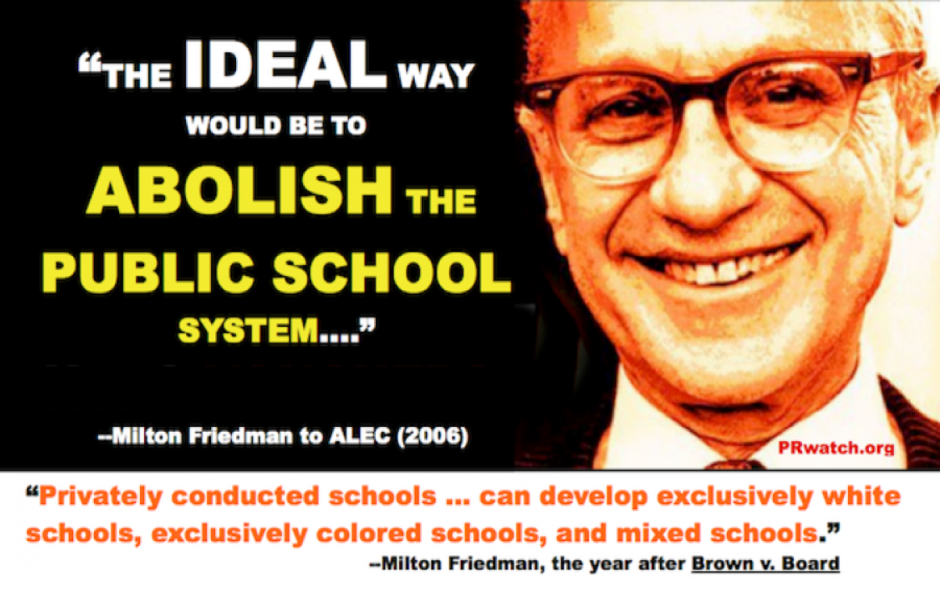
Milton Friedman, a white academic from the University of Chicago, invented the idea of school vouchers in the mid-1950s. He was very clear about his belief that corporations should profit from education and run schools— not the public. In 1997 he wrote “Public Schools: Make Them Private” He argued that vouchers were “a means to make a transition from a government to a market system,” to enable “a private, for-profit industry to develop that will provide a wide variety of learning opportunities and offer effective competition to public schools.” In addition to abolishing the public system of schools, he also believed that vouchers could be used to stack schools by race if folks so chose.
Picture1.png
However, vouchers were not and are not being sold to the masses as a massive attempt to privatize or engineer schools, instead vouchers are politically framed as mostly “limited” approaches that would help poor children in cities (!?). Save our Schools New Jersey writes,
Pro-privatization foundations and think tanks market-tested the idea of vouchers as an intervention for high-poverty school districts and found that it was more palatable to voters than a broad-based voucher program that would be open to all children.  The nation’s first modern school voucher program was passed into law by the Wisconsin legislature in 1989, targeting students from low income households in the Milwaukee School District.  Despite poor academic results and an extremely high rate of turnover, voucher supporters were able to grow this pilot program significantly, once it was enacted, including a particularly large expansion in June 2013, under the leadership of Governor Scott Walker.
As of late-2012, targeted private school voucher programs were in place in the cities of Cleveland, Milwaukee, New Orleans, and Racine; in the District of Columbia, Colorado’s Douglas County, as well as statewide in Arizona, Florida, Georgia, Indiana, Illinois, Iowa, Louisiana, Minnesota, Pennsylvania, Ohio, Oklahoma, Rhode Island, Utah and Virginia.  Although vouchers have consistently failed academically, legislatures in Indiana, Louisiana and Wisconsin have expanded their initially targeted programs statewide.
Are vouchers really for low-income and children of color? In 2014, the NC NAACP filed an amicus brief challenging the constitutionality of North Carolina’s voucher program. After Brown v. Board of Education, Southern states decide that they would desegregate with All Deliberate Slowness. One of the ways that they implemented this approach was school vouchers. Vouchers were the confederacy’s response to Brown v. Board (See New Research: Vouchers— schools do the choosing). The NAACP brief was cited in a blog as saying,
This report and the Pearsall Plan were adopted by the General Assembly in 1956. Governor Luther Hudges told the legislators at the opening of the session that “the people of North Carolina expect their General Assembly and their Governor to do everything legally possible to prevent their children from being forced to attend mixed schools against their wishes.” Governor’s Address to the General Assembly, July 23, 1956, 10 Senate Journal.
Neither the Governor nor the all-white legislature disappointed those expectations. The quarter of the state represented by the NC NAACP was ignored. The State established a procedure for local referenda which would permit a school district that was ordered to desegregate to close all its public schools. The State would then provide vouchers to white students in those districts to attend private schools. The rationale behind the statutory change regarding the State Board of Education and non-public schools was out in the open. The ploy of state oversight helped legitimize the use of taxpayer dollars to fund white families’ abandonment of desegregated public schools and to subsidize racially segregated private schools (See Morgan, History of Private School Regulation in North Carolina, p.3). This is the direct and notorious ancestry of school vouchers in North Carolina, and the corrupt foundation upon which the current voucher legislation is built.
What’s shocking is that private school “segregation academies” were in created in states across the South at that time, and they still exist today! In fact, they are even very prominent in African American majority counties.
As the NAACP worked to desegregate North Carolina’s public schools from 1968 to 1972, private school enrollment nearly tripled in the state from approximately 18,000 to over 50,000. Increased enrollment in private schools, furthermore, was often concentrated in areas with high populations of African-American students.
The NAACP found the following:
  • Bertie County is 62% African American. Lawrence Academy was founded in Bertie County in 1968. Its student body is 98% white.
  • Halifax County is 53% African-American. Halifax Academy and Hobgood Academy were both founded in 1969. Halifax Academy is 98% white; Hobgood Academy is 95% white.
  • Hertford County is over 60% African-American, but Northeast Academy, established in 1966, is 99% white.
  • Vance County is 49% African-American; Kerr-Vance Academy, established in 1968, is 95% white.
Some of legacy “academies” in North Carolina are still clear about how you can attend their predominately white schools. continue reading: Truth: Why vouchers and school choice were created – Cloaking Inequity: