Latest News and Comment from Education

Wednesday, November 23, 2016

CURMUDGUCATION: Trump's Naked Normal

CURMUDGUCATION: Trump's Naked Normal:

Trump's Naked Normal

Image result for trump  naked


People keep reposting the latest Trumpian shenanigans and saying, "This is not normal." On the one hand, I get what they're saying. On the other hand, as I've watched this administration unfold like a pile of maggots bursting out of a rotting deer carcass, it's dawning on me that Trump is actually normal. Fully normal. Nakedly normal.


As Jon Stewart pointed out, we don't really live in a new America. This is the same country that elected Barack Obama, the same country that existed a month ago. There is not much happening that has not happened before-- it's just that now it is naked. From "Christians" who don't remember anything from the Bible except "Abortion is bad" to "Progressives" who think he may work out after all, Trump has exposed a great deal of hypocrisy and base motives previously hidden behind pretty dressing. Trump has somehow ripped off the new clothes and dared anyone to pretend they still see them.

My first clue was back during the campaign. Trump didn't really do anything, say anything, campaign on any point that other GOP candidates had not already done. But where some GOP stalwarts would try to be racist or misogynistic through complicated dogwhistles or clever wink-wink nudge-nudge rhetoric, Donald J. Trump just said, "What the hell. Let's just say it. Those Mexicans are after your job and they look pretty dangerous and rapey. And we'd be better off if we just made all the 
CURMUDGUCATION: Trump's Naked Normal:


Russ on Reading: How Many Days to America? A Thanksgiving Reflection

Russ on Reading: How Many Days to America? A Thanksgiving Reflection:

How Many Days to America? A Thanksgiving Reflection


The title of this post comes from a picture book by Eve Bunting, with illustrations by Beth Peck. Back when I was teaching elementary school, I always read this book aloud to the students around Thanksgiving. The book tells the contemporary story of a family from an unnamed Caribbean island who flee their home by night to escape political persecution at the hands of government soldiers. They board a boat and endure many hardships on a journey that ends with a landing in Florida on Thanksgiving Day. Once safe on land, they spend their first day in America celebrating their freedom and safety with relatives on shore.

I love this book for many reasons, Bunting's spare, but vivid prose, Peck's wonderful crayon drawings, the joyous ending, but especially because it resonates so beautifully with the experiences of those other Pilgrims who celebrated the first Thanksgiving - escaping persecution to find freedom and safety in a faraway new land. I would usually back up this reading with a reading of Ann McGovern's classic, If You Sailed on the Mayflower in 1620,illustrated by Ann Devito.

Thanksgiving, that most American of holidays, rolls around this year as the meaning of the recent election begins to be revealed. I find myself thinking about how grateful I am for the diversity of peoples and cultures that make up the American family. This diversity has enriched my life in so many 
Russ on Reading: How Many Days to America? A Thanksgiving Reflection:


Frank Cannon: Betsy DeVos Would Be a Jeb-Like Pick for Secretary of Education | Truth in American Education

Frank Cannon: Betsy DeVos Would Be a Jeb-Like Pick for Secretary of Education | Truth in American Education:

Frank Cannon: Betsy DeVos Would Be a Jeb-Like Pick for Secretary of Education

Image result for big education ape Betsy DeVos

American Principles Project’s President Frank Cannon released a statement about the speculation that school choice advocate and GOP donor Betsy DeVos.
From the very beginning of his campaign, President-elect Donald Trump promised an end to the failed Common Core standards. He repeatedly assured parents across the heartland that he intended to return power over education to local schools.
“It is puzzling, then, to see reports that the Trump transition team is considering an establishment, pro-Common Core Secretary of Education – this would not qualify as ‘draining the swamp’ – and it seems to fly in the face of what Trump has stated on education policy up to this point.
“President-elect Trump rightly slammed Governor Jeb Bush for his support of Common Core on the campaign trail. Betsy DeVos would be a very Jeb-like pick, and the idea that Trump would appoint a Common Core apologist as Secretary of Education seems unlikely. We remain hopeful that Trump will pick a Secretary of Education who will return control over education to parents and local school districts – someone like Bill Evers, Sandra Stotsky, or Larry Arnn – and not someone who will simply rebrand and repackage the failed Common Core standards that were so thoroughly rejected by voters in both the GOP primary and in the November election.
DeVos is a Common Core supporter who was active in supporting pro-Common Core candidates in Michigan. She also serves on the board of Foundation for Education Excellence founded by former Florida Governor Jeb Bush (R-FL) that also has been a cheerleader of the Common Core State Standards.Frank Cannon: Betsy DeVos Would Be a Jeb-Like Pick for Secretary of Education | Truth in American Education:
 Image result for big education ape Betsy DeVos

Daring to Confront Race and Class through Poetry in Trumplandia | the becoming radical

Daring to Confront Race and Class through Poetry in Trumplandia | the becoming radical:

Daring to Confront Race and Class through Poetry in Trumplandia

Image result for Daring to Confront Race and Class through Poetry in Trumplandia


My mind is racing, as it always will
My hands tired, my heart aches
Writing specifically about Mark Twain’s Adventures of Huckleberry Finn and drawing on powerful words from Toni Morrison, Jocelyn Chadwick, president-elect of the National Council of Teachers of English (NCTE), argues in We Dare Not Teach What We Know We Must: The Importance of Difficult Conversations:
Our ELA classrooms take our children around the world and beyond—into past, present, and future worlds. We provide safe and trusted spaces for them where difficult conversations can and do take place. If at times teachers, at whatever level they teach, hit a roadblock, perhaps this impediment is due to or own predilections of codifying our students, stereotyping them before we even listen to them, much less get to know them….[T]he last time I checked, we teach students—not colors, not types. Perhaps it is we who need to stop and reread all of the texts we teach from the 21st-century perspective of students’ empowerment— empowerment that our literature provides….It has been some of us who have been demurring, listening to the voices of others, telling us we dare not teach what we know we must. (p. 91)
Published in English Journal in the month the U.S. elected Donald Trump, Chadwick’s confrontation of “some of us who have been demurring” and “difficult conversations” resonates in ways, I suspect, that even Chadwick may not have anticipated.
Toni Morrison’s words after the election also serve teachers of English Language Arts in the same way that Chadwick anchors her argument about our classrooms, the literature we explore, and the discussions we encourage and allow:
On Election Day, how eagerly so many white voters—both the poorly educated and the well educated—embraced the shame and fear sowed by Donald Trump. The candidate whose company has been sued by the Justice Department for not renting apartments to black people. The candidate who questioned whether Barack Obama was born in the United States, and who seemed to condone the beating of a Black Lives Matter protester at a campaign rally. The candidate who kept black workers off the floors of his casinos. The candidate who is beloved by David Duke and endorsed by the Ku Klux Klan.
In Morrison’s lament, we must recognize the weight of both race and social class on the American character. Morrison confronts white privilege and the consequences of that privilege being eroded: “These people are not so much angry as terrified, with the kind of terror that makes knees tremble.”
As teachers of ELA, it is ours to dare, to dare to teach openly against the world within which our students live and within which our classrooms exist. In the spirit of Chadwick’s call to re-read, and I would add re-teach, literature in that light, please consider how Barbara Kingsolver’s “What the Janitor Heard in the Elevator” from her collection Another America/Otra America provides “safe and trusted spaces” for investigating the increased problems with race and social class in 2016 America.
Barbara Kingsolver’s “What the Janitor Heard in the Elevator”
Kingsolver is best recognized as a novelist—notably for her The Poisonwood Bible—but she is also a brilliant essayist, a skillful poet, and an activist who lives her activism.
Her sole collection of poetry, Another America/Otra America, reflects the essential political nature Daring to Confront Race and Class through Poetry in Trumplandia | the becoming radical

CURMUDGUCATION: Pearson Hurt By Common Core

CURMUDGUCATION: Pearson Hurt By Common Core:

Pearson Hurt By Common Core


Yesterday's Wall Street Journal reports that Pearson bet big on Common Core and came up snake eyes or triple lemons or whatever gambling metaphor for losing your prefer.

The Journal article (it's behind a paywall but if you squint real hard, you can read it through the "don't you want to subscribe" haze) says that two factors led to losses for the edu-biz giant-- one self-inflicted, and one market-driven.


The self-inflicted injury was Pearson's inability to "develop and deliver new digital courses on time." A big part of Pearson's plan was to produce and sell digital Common Core curriculum, but after investing more than $125 million, they are three years behind schedule and have not yet "produced returns." The project has been run by a "academic" with no tech experience who is trying to design an entire curriculum to be run through tablets. It is not going well. Says the Journal, "Her vision sometimes clashed with technological realities." Because, of course, the educational quality and content has to be made to fit the tech, not the other way around. Pearson says it's confident that soon the product will be ready, on market, and making tons of money. Oh, and they've taken the word "Common" out of the name-- it will now be the "Pearson System of Courses."

The market-driven injury was, of course, the huge backlash against the Common Core and the Big Standardized Tests that were supposed to come along with the standards. Pearson bet big on the testing and watched themselves get chased out of many states as parents, teachers, students, and 
CURMUDGUCATION: Pearson Hurt By Common Core:


Loosely regulated, charter schools pose fiscal risk (by Jonathan Pelto)  - Wait What?

Loosely regulated, charter schools pose fiscal risk (by Jonathan Pelto)  - Wait What?:

Loosely regulated, charter schools pose fiscal risk (by Jonathan Pelto) 


This article was first published in The Hill newspaper of Washington D.C.  You can read and comment on the article at: http://origin-nyi.thehill.com/blogs/pundits-blog/education/303815-loosely-regulated-charter-schools-pose-fiscal-risk?amp
While the subprime mortgage crisis remains the epitome of what occurs when greed and corruption go unchecked, a growing number of experts and observers are warning that a new economic scandal is taking shape in the United States.
In an article published earlier this month, Business Insider observed:
 “We just got even more evidence supporting the theory that charter schools are America’s new subprime mortgages.”
The magazine wrote:
The Office of the Inspector General (OIG) released the results of a damning audit of the charter school industry which found that charter schools’ relationships with their management organizations pose a significant risk to the aim of the Department of Education.
The findings in the audit, specifically in regard to charter school relationships with CMOs, echo the findings of a 2015 study that warned of an impending bubble similar to that of the subprime-mortgage crisis one of the authors, Preston C. Green III, told Business Insider.
With more than 6,700 charter schools spread across 42 states and the District of Columbia, fraudulent activities associated with the publicly funded, but privately owned, charter school industry have become the fodder for almost daily news stories.
According to an October 2015 investigation conducted by the Center for Media and Democracy (CMD), the federal government has spent more than $3.3 billion over the past two decades on the creation and maintenance of the charter school industry.  CMD noted:
“The Department of Education is pushing for an unprecedented expansion of charterLoosely regulated, charter schools pose fiscal risk (by Jonathan Pelto)  - Wait What?: 


What Will It Mean if Trump Extends the Privatization of Public Education? | janresseger

What Will It Mean if Trump Extends the Privatization of Public Education? | janresseger:

What Will It Mean if Trump Extends the Privatization of Public Education?


In the New York Review of Books, Diane Ravitch asks: When Public Goes Private (in Education), as Trump Wants: What Happens?
Privatization of our schools is not new, but many of its promoters have been obscuring its growth over the past two decades by calling it something different: “For the past fifteen years, the nation’s public schools have been a prime target for privatization. Unbeknownst to the public, those who would privatize the public schools call themselves ‘reformers’ to disguise their goal. Who could be opposed to ‘reform’? These days, those who call themselves ‘education reformers’ are likely to be hedge fund managers, entrepreneurs, and billionaires, not educators. The ‘reform’ movement loudly proclaims the failure of American public education and seeks to turn public dollars over to entrepreneurs, corporate chains, mom-and-pop operations, religious organizations, and almost anyone else who wants to open a school.”
Why have people been so anxious to undermine the institution, historically unique to the United States, of a system of publicly operated, publicly owned, publicly regulated schools designed to serve all of the nation’s children?  “The motives for the privatization movement are various. Some privatizers have an ideological commitment to free-market capitalism; they decry public schools as ‘government schools,’ hobbled by unions and bureaucracy. Some are certain that schools need to be run like businesses, and that people with business experience can manage schools far better than educators. Others have a profit motive, and they hope to make money in the burgeoning ‘education industry.’ The adherents of the business approach oppose unions and tenure, preferring employees without any adequate job protection and merit pay tied to test scores. They never say, ‘We want to privatize public schools.’ They say, ‘We want to save poor children from failing schools.’  Therefore, ‘We must open privately managed charter schools to give children a choice,’ and ‘We must provide vouchers so that poor families can escape the public schools.'”
Ravitch is an education historian, and her story of the growth of privatization under Presidents George W. Bush and Barack Obama—a trend President-elect Donald Trump has promised to swell—captures the essential elements of what has happened: “The privatization movement has a powerful lobby to advance its cause. Most of those who support privatization are political conservatives.  Right-wing think tanks regularly produce glowing accounts of charter schools and vouchers along with glowing reports about their success. The American Legislative Exchange Council (ALEC), a right-wing organization funded by major corporations and composed of two thousand or so state legislators, drafts model charter school legislation, which its members introduce in their state legislatures… If the privatization movement were confined to Republicans, there might be a vigorous political debate about the wisdom of privatizing the nation’s public schools. But the Obama administration has been just as enthusiastic about privately managed charter schools as the Republicans. In 2009, its own education reform program, Race to the Top, offered a prize of $4.35 billion that states could compete for. In order to be eligible, states had to change their laws to allow or increase the number of charter schools, and they had to agree to close public schools that had persistently low scores. In response to the prodding of the Obama administration, forty-two states and the District of Columbia currently permit charter schools.”
Ravitch lists some of the powerful hedge-fund-backed organizations that lobby for the spread of charter schools—Democrats for Education Reform and Families for Excellent Schools.  And she implicates the role of philanthropy in subsidizing the privatization of education: the Bill and Melinda Gates Foundation, the Walton Family Foundation, the Edythe and Eli Broad Foundation, the Bloomberg Family Foundation, the Susan and Michael Dell Foundation, the Laura and John Arnold Foundation, the Fisher Family Foundation, Reed Hastings  of Netflix, Jonathan Sackler of Purdue Pharma that makes Oxycontin, and Michigan’s Dick and Betsy DeVos who made their fortune through Amway.
Ravitch’s piece is a book review of Samuel Abrams’ Education and the Commercial Mindset and What Will It Mean if Trump Extends the Privatization of Public Education? | janresseger:
Image result for zombie apocalypse school

With A Brooklyn Accent: Why Clinton Lost the Election by "George Washington"

With A Brooklyn Accent: Why Clinton Lost the Election by "George Washington":

Why Clinton Lost the Election by "George Washington"
Did Hillary Clinton throw the election by George Washington


            Looking at the Clinton support from the 2008 Democratic Primary we saw an abundance of support from white working class voters.(http://articles.chicagotribune.com/2008-03-31/news/0803300390_1_blue-collar-hillary-clinton-voters). Yet throughout the 2016 election Clinton’s support with this group all but disappeared. Not only did the support disappear but Clinton thought it proper to insult the group that gave her so much strength in the primaries. What some call a mistake I assert a sense of something more deliberate.

 “The Deplorables” became not on a calling call for Anti-Hillary sentiment but also led to a movement of sort to make sure she was defeated. Women starting wearing T-Shirts called “Deplorables” to show solidarity with each other and against Clinton. But as BAR journalist Glen Ford points out “deplorables want good jobs too”.

Hillary Clinton spent a 13 year period as first lady of Arkansas. So it stands to reason she was extremely versed with this population. It also stands to reason that Clinton would have a tangible memory of the importance of this group considering the tough terrain in swing states. In sum politicians don’t make these sort of “mistakes” unless it was deliberate. We move onto the question of strategy and lack of campaign adjustments.

We have an excerpt from long time Democratic Party operative: “I don’t have to make the case that blue collar voters are, to put it mildly, less than enthusiastic about HRC’s positions on trade and the economy,” David Betras wrote in his 1,300 word missive, citing her struggles in recent primaries.(https://www.washingtonpost.com/news/powerpost/paloma/daily-202/2016/11/22/daily-202-rust-belt-dems-broke-for-trump-because-they-thought-clinton-cared-more-about-bathrooms-than-jobs/58339cf3e9b69b7e58e45f1b/)


Again we have Clinton abandoning her base from 2008. But wait it gets worse. Clinton was too close to Obama on the issue of NAFTA (her husbands debacle), the TPP, and earlier in the campaign she was fundamentally opposed to Glass Steagall (again another won of Bill’s debacles). And we have  wonderful column by former Secretary of Labor Robert Reich: (http://inthesetimes.com/article/18493/hillary-clinton-bernie-sanders-glass-steagall-wall-street). Clinton was to the RIGHT of Donald Trump on Glass Steagall! Not that I With A Brooklyn Accent: Why Clinton Lost the Election by "George Washington":

NYC Educator: Danielson's Guide to a Highly Effective Thanksgiving

NYC Educator: Danielson's Guide to a Highly Effective Thanksgiving:

Danielson's Guide to a Highly Effective Thanksgiving


Full disclosure--found on the internet, unattributed.  

Ineffective: You don't know how to cook a turkey. You serve a chicken instead. Half your family doesn't show because they are unmotivated by your invitation, which was issued at the last minute via facebook. The other half turn on the football game and fall asleep. Your aunt tells your uncle where to stick the drumstick and a brawl erupts. Food is served on paper plates in front of the TV. You watch the game, and root for the Redskins.

Developing: You set the alarm, but don't get up and the turkey is undercooked. 3 children are laughing while you say grace. 4 of your nephews refuse to watch the game with the rest of the family because you have failed to offer differentiated game choices. Conversation during dinner is marked by family members mumbling under their breath at your Aunt Rose, who confuses the Mayflower with the Titanic after her third Martini. Only the drunk guests thank you on the way out. Your team loses the game.

Effective: The turkey is heated to the right temperature. All the guests, whom you have invited by formal written correspondence, arrive on time with their assigned dish to pass. Your nephew sneaks near the desert dish, but quickly walks away when you mention that it is being saved until after dinner. You share a meal in which all family members speak respectfully in turn as they share their thoughts on the meaning of Thanksgiving. All foods served at the table can be traced historically to the time of the Pilgrims. You watch the game as a family, cheer in unison for your team. They win.

Highly Effective
: The turkey, which has been growing free range in your back yard, comes in your house and jumps in the oven. The guests, who wrote to ask you please be invited to your house, show early with foods to fit all dietary and cultural needs. You watch the game on tape, but only as an video prompt for your family discussion of man's inhumanity to man. Your family plays six degrees of Sir Francis Bacon and is thus able to resolve, once and for all, the issue of whether Oswald acted alone. NYC Educator: Danielson's Guide to a Highly Effective Thanksgiving:


MythBuster: Do We Have a “Government-Run Education Monopoly”? | gadflyonthewallblog

MythBuster: Do We Have a “Government-Run Education Monopoly”? | gadflyonthewallblog:

MythBuster: Do We Have a “Government-Run Education Monopoly”?

screen-shot-2016-11-22-at-11-48-57-pm


“There’s no failed policy more in need of change than our government-run education monopoly, and you know that’s exactly what it is.”
With these words, candidate Donald Trump unleashed his K-12 education policy at a campaign stop in September, two months before winning the general election.
In the speech, the former reality TV star and current President-elect vowed to spend $20 billion in federal tax dollars to encourage more charter and voucher schools nationwide.
It remains his most concrete executive policy offering to date. Yet it’s based on this characterization of public schools as a “government-run education monopoly.”
One wonders – is it true? Do we really have such a thing here in the U.S. or is it just propaganda to boost an unpopular education scheme?
The devil, it seems, is in the details.
The answer is both yes and no: Yes, public schools are government-run. No, they’re not a monopoly.
First, let’s consider “government-run.” Everything the government does from paving the roads, to delivering mail, to protecting us from invaders is “government-run.” The military is government-run. Would you rather a foreign power tell our soldiers what to do? Congress is government run. Would you rather big business come in and decide all our laws?
In that same spirit, yes, our public schools are indeed government run. But who else should run them? Russia!? The Mafia!? A media cabal?
In emphasizing the role of government in education, Trump appears to be trying to MythBuster: Do We Have a “Government-Run Education Monopoly”? | gadflyonthewallblog:

Image result for gates sued for monopoly

I am Thankful for…. | The Merrow Report

I am Thankful for…. | The Merrow Report:

I am Thankful for….

Image result for John Merrow
Although I am very concerned about our future, Thanksgiving Week is a time to reflect on how much I am thankful for.  Here’s my list of some of the people and organizations that make our lives life better.  Because some of them are non-profits relying on individual generosity, I am including their contact information.
FAIRTEST:  This organization (full name: The National Center for Fair and Open Testing) has been an honest and honorable advocate for reducing our reliance on standardized bubble tests.  It’s also a solid source of information about the growing ‘Opt Out’ movement, where students simply say ‘No Mas’ to excessive testing.  A non-profit, FAIRTEST is an organization to be both thankful for and worthy of your financial support.
WHAT KIDS CAN DO was years ahead of its time when it began spotlighting the accomplishment of young people in 2001. You may know WKCD from “Fires in the Bathroom: Advice for Teachers from High School Students” (The New Press 2005), but WKCD uses digital, print, and broadcast media to send a dual message: 1) What young people can accomplish when given the opportunities and supports they need, and 2) what they can contribute when we take their voices and ideas seriously. The youth who concern WKCD most are those marginalized by poverty, race, and language. WKCD was founded an educator and a journalist with more than 60 years combined experience supporting adolescent learning in and out of school.
READWORKS  If you believe as I do, that reading is the essential gateway to success, then Readworks is a group you should be thankful for. Readworks is a free and easy-to-use that helps teachers do a better job.  In its own words, “ReadWorks is committed to solving America’s reading comprehension crisis and student achievement gap. Driven by cognitive science research,the non-profit ReadWorks creates world-class content, teacher guidance, and integrated tools that improve teacher effectiveness and student achievement.   Lean and mean group that spends its money helping teachers helping kids.
THE URBAN ASSEMBLY  While improving educational opportunities is never easy, the smoothest path to success is to start in kindergarten and first grade, then add a grade or two every year.  The tough job is starting in high school, after the kids you want to help have spent eight or more years in traditional schools.  So that’s what Richard Kahan decided to do when he transitioned from a hugely successful career in real estate and urban planning. Today The Urban Assembly supports a group of 21 high performing, small public schools in New York City, including seven Career & Technical Education (CTE) schools and three all-girls schools, serving over 9,000 students from low-income neighborhoods.  These themed schools (EG, Academy for Government and Law; Gateway School for Technology; Institute of Math and Science for Young Women) are open to all students.
YOUTHBUILD  I got to know YouthBuild during my first go-round at the NewsHour sometime between 1985-1990. I’m happy to report that this organization, dedicated to giving marginalized youth a second, third and perhaps fourth chance, is stronger I am Thankful for…. | The Merrow Report:


Tuesday, November 22, 2016

Michelle Rhee takes herself out of the running for Trump’s education secretary - The Washington Post

Michelle Rhee takes herself out of the running for Trump’s education secretary - The Washington Post:

Michelle Rhee takes herself out of the running for Trump’s education secretary


Michelle Rhee, who rose to national prominence as the controversial chancellor of D.C. Public Schools, appeared on Tuesday to take herself out of the running to become President-elect Donald Trump’s education secretary.
Rhee’s name had been circulated as a potential candidate for education secretary, speculation that only intensified after she and her husband — former NBA star and current Sacramento Mayor Kevin Johnson — met with Trump over the weekend. Trump pronounced them both “greatly talented” and, according to his transition team, they spoke about “the possibility for increasing competition through charter and choice schools.”
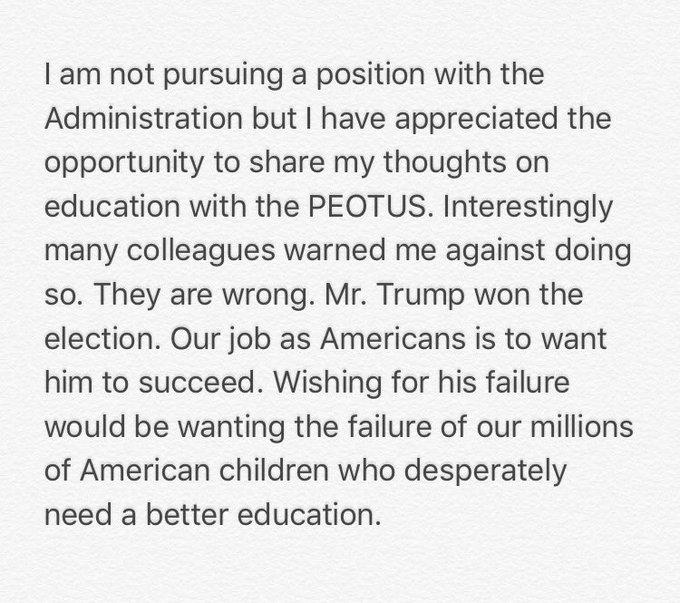
Rhee put the education secretary rumors to bed on Tuesday afternoon, tweeting that she was not pursuing the position. But she pushed back against criticism by some in the education reform community that she should not have met with Trump, given his statements about women, immigrants, Muslims and people with disabilities.
“I have appreciated the opportunity to share my thoughts on education with the PEOTUS,” Rhee’s message said, using an acronym for President-elect of the United States. “Interestingly many colleagues warned me against doing so. They are wrong. Mr. Trump won the election. Our job as Americans is to want him to succeed. Wishing for his failure would be wanting the failure of our millions of American children who desperately need a better education.”
“I am hopeful about the opportunity to find common ground on this important issue of education and will do whatever I can to be supportive,” she wrote in a separate tweet.


In light of the speculation about the Secretary of Education role, I wanted to clarify my position and what's best for America's students.

As an Asian American woman, Rhee would have brought diversity to a prospective Cabinet that is otherwise shaping up to be largely white and male. She also would have brought a diversity of ideas: Rhee is a longtime Democrat who has been a strong supporter of the Common Core State Standards, which Trump and his base abhor. She says that young undocumented people who have grown up in the United States should have a route to citizenship, putting her squarely at odds with the president-elect, who put mass deportation at the center of his campaign.
But Rhee’s blunt pronouncements about broken public schools — and the way she seemed to relish public battles with the teachers union as she instituted sweeping changes in D.C. schools — have made her one of the most widely known figures calling for change in the education system. She has been a foremost voice pushing for the expansion of charter schools and a rare Democrat who embraces vouchers for private schools — on expanding such taxpayer-funded alternatives to traditional public schools, she and Trump see eye to eye.
And not incidentally, Rhee’s brash style is a lot like Trump’s: The two share the distinction of having fired employees on national television, Trump on his show “The Apprentice” and Rhee during a public television documentary.Michelle Rhee takes herself out of the running for Trump’s education secretary - The Washington Post: