Latest News and Comment from Education

Monday, November 7, 2016

Education disturbing and motivational on @LastWeekTonight – Cloaking Inequity

Education disturbing and motivational on @LastWeekTonight – Cloaking Inequity:

Education disturbing and motivational on @LastWeekTonight


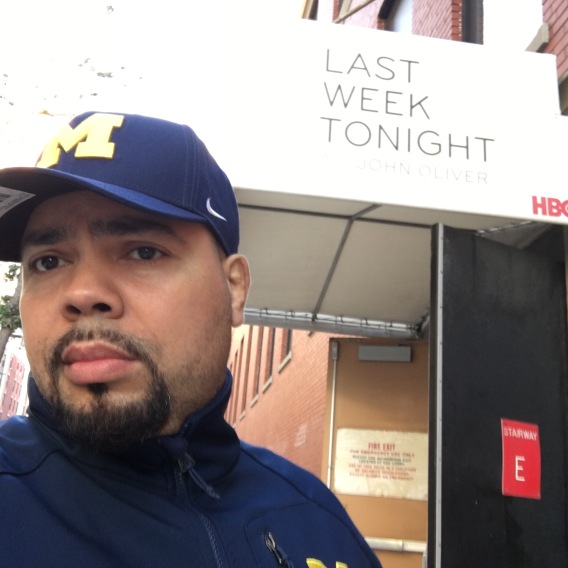
John Oliver is engaging in humorous discussions on TV about education that are disturbing and motivational. So today I’d like to talk a little about Last Week Tonight— currently my favorite show on TV. I’ll begin with my visit to the show a few weeks ago when I travelled to New York. I’ll end with my two favorite clips where John Olivers addressed school segregation and charter schools.
A few weeks before I left for New York, I applied for tickets for Last Week Tonight on their website. I didn’t get tickets from their lottery. I was really disappointed. Really really. However, the website stated that there was a chance I could get into the show on standby by waiting in line for a few hours. So I showed up at the studio on Sunday at 3 pm. I encountered a line of about 70 people waiting for no-shows (on 300 tickets that were already distributed).
img_5582
Long standby line

Considering all of the people waiting in line for standby, getting into the show wasn’t looking to promising. The show took down my name and asked where I was from. I then had to return two hours later to see if I could get into the show. Here is how I felt when I was thinking that I wouldn’t make it into the show.
img_5583
Looking disappointed

Well, I did make it into the show! I was the very last person admitted into the studio. I shouldn’t have gotten into the show. I was solo in the standby line, and the couple in front of me had a shot at the last ticket for the show, but because they didn’t want to split up, they graciously gave me their standby ticket for the show.


When I say I was the last person in line, I really was. All of the seats in the show were taken so I watched the show as standing room only. Here is my view.
The show was incredible live! John Oliver was as funny during impromptu interactions with the audience before the show as he was in his prepared remarks on the show. I left the show very happy and angry— the show tends to do that. John Oliver skewered politicians, crooked industrialists, and much more that Sunday night.
My two favorite education oriented clips have addressed school segregation and charter schools. The counterrnative that he inputted into the national discussion in the charter school clip was palpable as the clip spurred many market-based school choice advocates  to publish scathing responses. Despite their opposition, the charter school clip has already been watched by nearly 7 million people!
More recently, John Oliver took on school segregation. This is topic that comes up in many conversations that I have about education reform. This was even an issue on the Rick Smith Show this week when the host explained that busing was problematic in Ohio. In my discussion with Howard Fuller, he also made the point that busing and integration efforts were an issue. I discussed my thinking on innovative integration efforts previously in the post How can we desegregate re-segregated public schools? (again)
The US stepped up to the challenge and eliminated blatant dejure segregation, now we have to decide if we now have the will power to now overcome defacto segregation in our nations schools.
Check out Last Week Tonight’s Youtube page here.
Please check out and follow my YouTube channel here.
Please Facebook Like, Tweet, etc below and/or reblog to share this discussion with others.
Want to know about Cloaking Inequity’s freshly pressed conversations about educational policy? Click the “Follow blog by email” button on the home page.
Twitter: @ProfessorJVH
Click here for Vitae.

Education Research Report: Black teachers found themselves restricted to only teaching Black students

Education Research Report: Black teachers found themselves restricted to only teaching Black students:

Black teachers found themselves restricted to only teaching Black students

Image result for Black teachers found themselves restricted to only teaching Black students

Despite recent efforts to improve teacher diversity, only 7 percent of the nation’s teaching workforce is Black. And while many school districts are hard at work bringing more Black teachers into the classroom, they are leaving the profession at higher rates than their peers.

To build and maintain a teacher workforce that is representative and capable of serving an increasingly diverse student population, district leaders must pay as much attention to understanding and creating the right conditions to retain Black teachers as they do to recruiting them. That starts with listening to, and learning from, Black teachers. Researchers at The Education Trust have done just that and have published their findings in a new report.

The report, “Through Our Eyes: Perspectives and Reflections From Black Teachers,” adds rigorous qualitative data to the ongoing national conversation about teacher diversity by presenting findings from a series of nationally representative focus groups. The purpose of these focus groups was to better understand the experiences of Black teachers, including why they teach, what they believe they bring to the classroom and the field, and what challenges they experience in the workplace.

“What we found was eye-opening. Whether we were in rural or urban settings, we heard the same sentiments from Black teachers over and over again: They have high expectations for their students. They want to empower their students through knowledge. And many were ‘called’ to be teachers,” said Ashley Griffin, Ph.D., lead researcher and Ed Trust’s interim director of K-12 research. “Yet, while they shared a passion for teaching, they also shared the frustration of being pigeon-holed into specific roles, thus diminishing their opportunities for professional growth and job satisfaction.”

“Through Our Eyes” expounds on the experiences of teachers, who:
  • have a penchant to connect to and teach Black students well, but found themselves restricted to only teaching Black students;
  • were limited to acting as disciplinarians instead of being respected for their ability to manage their classrooms;
  • put in extra time and effort, but still weren’t heard in staff meetings; and
  • related well to students, but had to “tone down” their personalities to be seen as professionals.


Civil rights group makes legal case for controversial Education Dept. regulation - The Washington Post

Civil rights group makes legal case for controversial Education Dept. regulation - The Washington Post:

Civil rights group makes legal case for controversial Education Dept. regulation


A chorus of opponents has accused the Obama administration of overstepping its legal authority with a proposal to regulate the spending of billions of dollars meant to help educate children from poor families.
The nonpartisan Congressional Research Service bolstered that criticism, finding in May that the proposed regulation appeared to “go beyond what would be required by a plain reading of the statute.”
But a new analysis — conducted by attorneys at WilmerHale at the request of the Leadership Conference on Civil and Human Rights and provided to The Washington Post — comes to a different conclusion, finding that the Education Department has “ample” legal authority to move forward with its proposal.
The dueling legal opinions are just one sign of what has become one of the most fiercely contested national issues in education. Though it receives far less attention than the Common Core State Standards, testing or charter schools, the Education Department’s proposal has the potential to dramatically reshape how school districts nationwide allocate money and teachers among campuses.
Federal law has long said that school districts cannot underfund schools in poor neighborhoods and then use federal Title I dollars to fill the hole. Instead, they must ensure that schools in poor neighborhoods get all the state and local dollars they would if Title I dollars were not available — an attempt to give children from poor families a fairer shot at a decent education.
Nevertheless, many Title I schools continue to receive fewer dollars than more-affluent schools in the same district. And the requirements for showing compliance with the law were almost universally regarded as onerous and often counterproductive to providing students with the services they needed.
Congress attempted to solve that in the new Every Student Succeeds Act, which passed last year, by maintaining the spirit of the provision but tweaking its language. Now, school districts must show that the methodology they use for allocating state and local money to schools is fair and does not shortchange schools in poor neighborhoods.
The controversy centers on a regulation that the Education Department has proposed to implement that law. It has undergone several iterations and has yet to be finalized. But at its heart is the notion that school districts must show they are spending a roughly equivalent number of state and local dollars per pupil in high-poverty schools as in more-affluent schools.
Critics — including one of the lead authors of the law — say that Congress never intended to require school districts to meet such a test and that the Education Department is using Civil rights group makes legal case for controversial Education Dept. regulation - The Washington Post:


California voters poised to gut English-only instruction law - The Hechinger Report

California voters poised to gut English-only instruction law - The Hechinger Report:

California voters poised to gut English-only instruction law

In a near complete reversal of precedent, polling shows a 'yes' vote is likely on California's Multilingual Education Act

Image result for buenos dias


Non-partisan voter poll released on Friday found that 68 percent of California voters plan to vote yes on that state’s Proposition 58, known as the Multilingual Education Act.
Based on a measure proposed by State Sen. Ricardo Lara (D), the new proposition would largely eliminate the red tape involved in creating a bilingual education program. A ‘yes’ vote would signal a major shift in thinking for a state that effectively outlawed bilingual education in 1998. The evolution in thinking on the value of bilingual education and the specifics of the voter proposition was covered in depth by The Hechinger Report in this story from our archives.
SAN DIEGO, Calif. — Last spring, Derrick Fields, 9, sat in his social studies classroom at Sherman Elementary School, learning about the creation of the telegraph. The machine was invented so that “someone can connect to someone who is far away,” he said.
This was pretty normal stuff for a fourth grade history lesson, except for one thing: The entire lesson — from the textbooks to the teacher’s instructions to the students’ short essays — was in Spanish.
In fact, half of Derrick’s time is spent learning in Spanish and the other half in English in what’s known as a dual language immersion program.
Teaching academic subjects in Spanish, or any foreign language, has been widely understood to be illegal in California since 1998. Proposition 227 appeared on the June ballot that year, offering voters a chance to weigh in on whether or not students should be taught primarily in English in public schools. While opponents saw the measure as racist, it was loudly championed by Ron Unz, a Silicon Valley millionaire with political aspirations, as the best way to integrate the state’s booming immigrant population.
Unz’s argument won the day. Proposition 227 was voted into law with 61 percent of the vote. Now part of California’s extensive education code, the law holds that “all children in California public schools shall be taught English by being taught in English.”
For the most part, that has been interpreted as: Don’t teach in Spanish.
“I am in the camp that says it’s just a terrible waste,” said Patricia Gandara, an education professor at the University of California, Los Angeles. “There are all kinds of social, cognitive and tangible benefits that accrue to those with more than one language. It’s a terrible loss.”
Most schools did away with their long-term bilingual programs, even though Prop 227 didn’t actually outlaw learning in a foreign language. It just made it much harder. But the parents at Derrick’s school were willing to sign annual parental waivers and school leaders were willing to pull together documentation that a dual language program would meet the “special needs” of their students and submit an application for California voters poised to gut English-only instruction law - The Hechinger Report:
 

The education policies Americans will vote on this Tuesday

The education policies Americans will vote on this Tuesday:

The education policies Americans will vote on this Tuesday
Here’s how voters’ decisions could affect schools.

On Tuesday, Americans will go to the polls and vote for the next president of the United States. But they will also have a chance to weigh in on numerous ballot initiatives to reform public education in their states.
Massachusetts, California, Georgia, and Louisiana voters all face major decisions on education policy this week — including who gets to decide to raise tuition, whether their state should take over management of low-performing schools, and a proposal to improve access to bilingual education.

Charter school expansion

Massachusetts voters will have the opportunity to vote for or against charter school expansion in the state. The ballot measure, called Question 2, would allow as many as 12 new independent charter schools to be authorized each year or allow for greater enrollment at existing charter schools.The education policies Americans will vote on this Tuesday:

A state takeover of low-performing schools

Georgia is considering a referendum that would create an “Opportunity School District” for the state’s lowest performing schools. This district would be run by a superintendent appointed by the governor. The district would include up to 100 schools and 150 schools are eligible. These schools would have to remain under state control for at least five years.The education policies Americans will vote on this Tuesday:
Image result for governor deal no opportunity school district

More access to bilingual education

California voters will have the opportunity to vote on a ballot initiative, called Proposition 58, that would allow many more students to receive bilingual instruction. This measure has the chance to affect the 23 percent of public school students in the state who are English language learners.The education policies Americans will vote on this Tuesday:

University power over tuition hikes

Louisiana voters will have to decide whether they want to allow colleges and universities to make their own judgment calls on tuition hikes this week. Universities and colleges would have the authority to decide on how much to raise tuition and fees by 2019 if the measure passes.The education policies Americans will vote on this Tuesday:

How to fund education

Several states are looking into new ways to fund public education or improve funding of public education. In Missouri, Constitutional Amendment 3 would provide around $300 million each year to early education anti-smoking efforts through a cigarette tax increase. And in Maine, voters will decide whether to approve a 3 percent income tax surcharge for those making more than $200,000 in order to fund public education.The education policies Americans will vote on this Tuesday:


 Image result for Missouri, Constitutional Amendment 3 yes

China parliament bans some private, for-profit Charter-schools | Reuters

China parliament bans some private, for-profit schools | Reuters:

China parliament bans some private, for-profit schools


China's parliament has banned private, for-profit schools that teach first- through ninth-graders, a move to tighten government control over education that may cool a fast growing but poorly regulated sector.

Leaders of the National People's Congress adopted a revised law on private education that banned the schools, according to a document released on Monday at the end of a bi-monthly session.

The education sector has boomed in China in recent years - and become a magnet for investment - as the government relaxed restrictions to help meet growing demand and to increase options.

Regulation has been weak, however, leading to widely varying standards of quality.

Chinese children are entitled to nine years of free, compulsory education, from elementary to junior high school.

The document said it was acceptable to set up private, profit-generating schools at other grade levels, "but they cannot establish compulsory education (level), for-profit, private schools".

The adoption of the revised law comes not long after the Shanghai government told principals from 21 international and bilingual schools in the city to offer China-specific subjects, according to the news magazine Caixin last week.

Greater government control of education follows a tightening of oversight of a range of areas since President Xi Jinping became Communist Party boss in 2012, including over information, news and the internet. The government has campaigned against the spread of "Western values" at universities.

Caixin last week quoted unidentified sources as saying the legislators were motivated by concern that the proliferation of often-expensive private schools would widen inequalities in access to basic education.

The change would affect about 10,700 schools and as many as 12 million students, it reported.

(Reporting by Sue-Lin Wong and John Ruwitch; Editring by Nick Macfie)
China parliament bans some private, for-profit schools | Reuters:


Poor Elijah’s Almanack: The Ministry of Truth ESSA vs NCLB | VTDigger

Poor Elijah’s Almanack: The Ministry of Truth | VTDigger:

POOR ELIJAH’S ALMANACK: THE MINISTRY OF TRUTH


Editor’s note: This commentary is by Peter Berger, an English teacher at Weathersfield School, who writes “Poor Elijah’s Almanack.” The column appears in several publications, including the Times Argus, the Rutland Herald and the Stowe Reporter.
In George Orwell’s “1984,” Winston Smith works for the Ministry of Truth. His job is to rewrite history so it conforms to Big Brother’s ever-changing official version of the past. That way nobody remembers what really happened, and Big Brother’s latest pronouncements make sense, at least until the pronouncements change again, at which time Winston has to change history again.

Winston has a fulltime job.
So do the many Winstons in the education world. Like Winston, reformers constantly need to edit contradictions between public education’s past as it really happened and public education’s future as reformers plan to reconstruct it, at least as they plan to reconstruct it today.
These plans for the future are allegedly based on lessons reformers have learned from the past. Inconveniently, the actual past chronicles modern school reform’s long series of failures, follies, and bankrupt initiatives that have consistently defied common sense and persisted in the face of what should have been overwhelming evidence.
For example, when the education world finally rejected the whole language method of reading instruction after it had spawned a generation of illiteracy, the president of the National Council of Teachers of English steadfastly insisted that despite the evidence, her organization was “still embracing” whole language because “once you get to know” it, you “believe in it.”
Other times, though, rather than explicitly defying the past, reformers prefer to rewrite it. Consider these examples drawn from a recent issue of NEA Today where advocates have reimagined history to promote their recycled reforms.
Now that No Child Left Behind has taken its rightful place on the ash heap of discredited education reforms, education’s experts are vocal and united in their condemnation of NCLB’s decade of “unrealistic proficiency” mandates. Of course, they were just as vocal and united in their support of those proficiency mandates right up to the moment they changed their minds. Now the same experts are vocal and united in their support for the Every Student Succeeds Act, which bears an equally unrealistic title, imposes equally unrealistic expectations, and will enjoy experts’ full-throated support until the day it doesn’t, at which time they’ll again forget they supported it.
NCLB identified “core academic subjects” as public education’s top priority, with particular emphasis on reading, writing and mathematics. The law’s “rigid testing regimen” determined a school’s success based on its students’ language arts and math scores. This “narrow” assessment focus led to a consequent narrowing of instructional focus, especially at the elementary level, with subjects like social studies “squeezed out” as districts revamped their curricula and reallocated class time in an effort to avoid NCLB’s sanctions.
The arts have a rightful place in public education, but they don’t rank as equals with reading and writing as reasons we established and pay for public schools.

Advocates celebrate the Every Student Succeeds Act’s accent on a “well-rounded education,” in contrast to NCLB’s concentration on “core academic subjects.” Proponents contend that ESSA will foster a “broader curriculum,” a renewed emphasis on “subjects like science and social studies,” and a school day that doesn’t crowd out physical education, music, and the arts.
So far, so good. It sounds at first as if maybe the experts Poor Elijah’s Almanack: The Ministry of Truth | VTDigger:


Shilling For Charter Schools | Huffington Post

Shilling For Charter Schools | Huffington Post:

Shilling For Charter Schools


In an opinion essay on Sunday, New York Times columnist David Leonhardtcontinued the newspaper’s campaign “shilling“ for charter schools. Leonhardt, is certainly not an expert on public education. As a boy he attended the prestigious and expensive Horace Mann School in Riverdale, New York and then went to Yale. The article, which pretended to be a scientific report based on the latest data, was bad reporting and an embarrassment for both the author and the newspaper. Unfortunately, the Times, which is constantly shilling for charter schools, does not seem to care.
Leonhardt opened with a touching anecdote about an African American family from Boston. “Alanna Clark still remembers the stress of third-grade reading time.” Her mother sought learning support from her school without “success.” We learn Alanna’s older sister passed through school until, unprepared, she entered a community college where she dropped out. But wonder of wonder, Alanna won a charter school lottery and “ today is a poised, soft-spoken 10th grader at a charter school called Match.”
Next Leonhardt switches gears to explain how “social scientists have quietly spent years analyzing the outcomes of students who attend charter schools” and have discovered that while “many charter schools fail to live up to their promise,” “one type,” schools like Boston Match, repeatedly show “impressive results.”
Leonhardt must have been sleeping the past dozen years if he missed the exaggerated claims made by the parade of consults, experts, and researchers working for charter school groups. Not only does the New York Times continually hype charter schools and parade out any data that seems to support them, but the charter crowd has powerful support from hedge fund financiers, so-called philanthropists, and politicians like New York State Governor Andrew Cuomo and even President Barack Obama.
Now wide awake, Leonhardt interviewed the principal of Match to learn that the school is successful because it has “high expectations” for students and offers “high support.” He concludes that Match and similar charter schools are great because of that mantra, “High expectations, high support.” However Leonhardt should have done a google search. “High expectations, high support“ seems to be the mantra of virtually every charter school in the United States, including the “many charter schools [that] fail to live up to their promise.”
The “high expectations, high support” formula means devoting more resources to classroom teaching and less to almost everything else. Students are in class more hours. Schools set high standards and try to instill students with confidence in them. They also invest in helping teachers become better at teaching. But of course, what Leonhardt discovered has nothing to do with charter schools. This is about a community and a society investing in the education of its children.
Leonhardt next reports on the “rigorous” studies and scientific data that support what he found at Match. The “latest batch” of evidence was produced by professors at prestigious universities that have “tracked thousands of charter-school applicants, through high school and beyond, in Boston, where most charters fit the ‘high expectations, high support’ model.”
But when I looked at the study by the professors at the prestigious universities, their conclusions were much more tentative than those suggested by Leonhardt.
1. Charter schools are often test prep academies rather than places were students learn.
“Charter schools may be particularly likely to ‘teach to the test,’ since they are at risk of closure if their students score poorly.” In addition, “Charter students have somewhat higher baseline test scores than other Boston students,” which means they scored better on the tests before they went to the charter schools.
2. Charter school student test scores may be skewed by cheating.
“Although encouraging, gains on state-mandated standardized tests provide an inconclusive gauge of the benefits of charter attendance. Like other American public schools, charters are evaluated in part by the performance of their students on these tests. A growing literature suggests that educators respond strategically to the incentive to boost test scores . . . The potentially distortionary effect of test-based accountability may be especially large in the charter sector, where schools whose students do poorly on state assessments can be closed. In our Massachusetts setting, for example, 14 out of 96 charters granted through 2013 have been lost. Charter schools would appear to have a particularly strong incentive to teach to the test, at the expense, perhaps, of a focus on the development of skills with a longer-term payoff.”
3. Charter school success may be because they weed out poor academic performers and potentially disruptive students and ship them back to traditional public schools.
“A defining feature of Massachusetts’ successful urban charter schools appears to be adherence to No Excuses pedagogy, an approach to urban education described in a book of the same name (Thernstrom and Thernstrom 2003). No Excuses schools emphasize discipline and comportment, traditional reading and math skills, Shilling For Charter Schools | Huffington Post:


 Image result for Shilling For Charter Schools

AFT vs. Everybody? Asking Whether Draft ESSA Rules Ban Forced Teacher Transfers - Politics K-12 - Education Week

AFT vs. Everybody? Asking Whether Draft ESSA Rules Ban Forced Teacher Transfers - Politics K-12 - Education Week:

AFT vs. Everybody? Asking Whether Draft ESSA Rules Ban Forced Teacher Transfers


One of the trickiest elements of proposed spending rules for the Every Student Succeeds Act has been the issue of forced teacher transfers.
Here's the issue: The U.S. Department of Education has made it clear it wants more state and local funds being directed to schools with large shares of poor students under ESSA. But that possibility has concerned teachers' unions and others because in many cases, at least in theory, that could mean moving teachers (and their salaries) to different schools where they may not wish to teach.
The proposed ESSA supplement-not-supplant rules have this to say about the issue: "Nothing in this section should be construed to require the forced or involuntary transfer of any school personnel."
And here's how American Federation of Teachers President Randi Weingarten has interpreted that language: The proposed rules ban forced teacher transfers.
During a meeting with reporters in late September, Weingarten said that, in her view, the way the rules were written mean they can't be used "to do the awful bad things that people are projecting that you would do," including forced transfers. That amounts to a ban, she stated.
20160727_130019-thumb-600xauto-20243.jpg"I read the draft regulation differently than others," Weingarten said. 

The Department's View

It's important to point out that the proposed rules also say that they would not override local collective bargaining agreements. So any agreements that ban forced transfers would stand. However, that language itself obviously leaves out any agreements that don't have such a ban. 
What did the Education Department say about this issue? In its fact sheet about its proposal, the Education Department encouraged districts to consider "Avoiding forced staff transfers and instead investing in providing the resources that students need to learn and that will attract staff to choose to work in Title I schools." 
It's unclear why the department would feel the need to encourage districts not to do forced teacher-transfers if doing so were already banned under the proposed rules. We asked for some clarification from the department about this issue. Here's the statement we got in response, in its entirety:
Our proposal would not require forced teacher transfers or take away local hiring authority. Our proposed rule includes a rule of construction that states: "nothing in this section shall be construed to require the forced or involuntary transfer of any school personnel." Districts that would be required to move additional resources to Title I schools to meet the new statutory requirement could, for example, consider strategies that do not involve transferring teachers at all, including increased salaries for teachers in Title I schools, additional funding for preschool or advanced coursework in Title I schools, or additional funding for extended learning time opportunities in Title I schools.
There's nothing in that statement that confirms or denies that forced transfers are banned. It's essentially a reiteration of what's in the proposed rules. 

Other Voices

IMG_1557-thumb-autox666-21703-thumb-autox399-21704-thumb-300x399-21705.jpgBut what do others who've studied this issue think about whether the proposed rules ban teacher transfers? Here are some answers we've gotten:
Tom Zembar, Senior Policy Analyst, National Education Association's Education Policy and Practice Department
Zembar wrote to us that the department's proposal "clearly delineates that educator rights are protected under law" and in regulations and collective bargaining agreements, among other places.
But Zembar also said, "However, while the construction clause protects current agreements, it does not eliminate problems that are likely to surface due to overly prescriptive rules and unnecessary compliance tests in future rounds on local negotiations."
Nora Gordon, Associate Professor of Public Policy, Georgetown University
"The proposed rule absolutely does not ban forced transfers. It simply states that such transfers are not required," said Gordon, who has studied and sharply criticized the proposed ESSA rules, in an email. "The disconnect here comes from whether or not you expect new state and local money. To comply with the rule without forced transfers is not impossible: it just requires an influx of new state and local money." 
Noelle Ellerson, Associate Executive Director, AASA, the School Superintendents Association
"I don't know how schools achieve the stated goals" if the rules ban forced transfers, Ellerson told me. AASA also has concerns about the proposed rules. 
"I don't think they ban it. I think they make it clear that's not their intent," she added, referring to the Education Department.
Recently, 49 state-level affiliates of AASA signed on to comments on the proposed rules. (The state missing there, Hawaii, has a statewide district.) Click here to read those comments
Liz King, Director of Education Policy, Leadership Conference on Civil and Human Rights
"We know that forced transfers are a huge part of this conversation, and we're glad that the reg clarifies that there is nothing in it that requires forced transfers," said King, whose organization supports the department's overall approach to these spending rules. "Moreover, it is a terrible way of coming into compliance and we know that it wouldn't work."
Sheara Krvaric, Attorney, Federal Education Group
Asked if she thinks the rules ban forced transfers, Krvaric responded, "No."
She later added: "The language says that involuntarily transfers are not required. If this means that involuntary transfers aren't allowed, that's something that should be clarified in the final [rules]." (The Federal Education Group consults with states and districts about K-12 spending issues.)
Chris Minnich, Executive Director, Council of Chief State School Officers
Here's Minnich's statement on the matter:
The proposed rule from the U.S. Department of Education does not require the forced transfer of school personnel, but nor does it prohibit it. Based on how the rule is currently written, we know many schools would be forced to move resources, which could include teachers and other school personnel, rather than focusing on doing what is in the best interest of students. 
CCSSO recently put out its own alternative supplement-not-supplant proposal, which you can read here.
ESSA_button.jpgScott Sargrad, Managing Director for K-12 Policy, Center for American Progress
"I don't think they explicitly prohibit districts from doing forced teacher transfers," said Sargrad, who has testified to Congress in favor of the department's proposal.
However, Sargrad added that the department is clearly pushing districts to think of other ways to comply with its proposed rules, assuming those become the final rules. In his view, districts could respond to such a proposal by creating extended learning time, or improving working conditions to "help attract more experienced, more effective educators" into Title I schools. 
"Forced transfers is generally a bad idea," Sargrad told us. "And there are alternatives to forced transfers to meet the supplement-not-supplant requirement."
Clearly, forced teacher transfers are unpopular, whether you like the tack the department is taking or not. But that consensus by itself doesn't address whether they would be banned if the department's proposal goes through. 
So what's your interpretation of the language? Do you agree with the AFT? Let us know in the comments section.
Photos: AFT President Randi Weingarten, right, in Philadelphia during the Democratic National Convention in July (Andrew Ujifusa for Education Week); Secretary of Education John B. King Jr. at a high school in Washington, D.C. last month. King has said the proposed spending rules for the Every Student Succeeds Act are designed to increase the resources available to low-income students. AFT vs. Everybody? Asking Whether Draft ESSA Rules Ban Forced Teacher Transfers - Politics K-12 - Education Week:

Don't miss another Politics K-12 post. Sign up here to get news alerts in your email inbox.
Follow us on Twitter at @PoliticsK12.
 AFT vs. Everybody? Asking Whether Draft ESSA Rules Ban Forced Teacher Transfers - Politics K-12 - Education Week: