Thursday, August 18, 2016

Seattle Schools Community Forum: 100 Black Parents' Survey

Seattle Schools Community Forum: 100 Black Parents' Survey:

100 Black Parents' Survey


In advance of the meeting tonight at Mt. Zion Baptist Church at 6 pm with Garfield principal Ted Howard and black parents at GHS,  I thought I would put up their short survey. 

I'm putting it up for two reasons.

One, if there are any black Garfield parents who haven't seen it, they might want to weigh in.

Two, I note the list of items that is their wish list of 17 items.  Know what's NOT on it?  Blended classes.  It's a long list and that's not on it.  What they do say on honors is this:

Increase of black students in Honors and AP classes

Now I asked public education activist and Garfield teacher Jesse Hagopian about this issue of drawing more students of color into Honors/AP.  I asked if there couldn't be encouragement for kids to go into these classes and supports for those who need it.  He had no real answer except that there wasn't enough of a cohort of these kids for a comfort level for them. 

A cohort.  Yes, that's a term used a lot at Garfield but usually HCC students.  It apparently matters to many groups of students.

What the list DOES include are supports like:

- academic supports like tutoring
- college/career opportunities
- resource list for testing, AP, etc and supports for tests like SAT/ACT, AP

I think the entire list is valid and quite interesting.

As well, you may remember that I posted an article earlier this year from The Atlantic on more black parents who are homeschooling.  Here's another interesting one on that same topic from the Christian Science Monitor.


While some parents cite religious and moral reasons, others say they are keeping their kids out of public schools to protect them from school-related racism.Seattle Schools Community Forum: 100 Black Parents' Survey:

If California wants better compliance from charter schools, it must fix its oversight system - LA Times

If California wants better compliance from charter schools, it must fix its oversight system - LA Times:

If California wants better compliance from charter schools, it must fix its oversight system


 California needs reasonable, clearly defined and well-enforced rules for charter school oversight, a point driven home by a recent report issued by the Southern California chapter of the American Civil Liberties Union and the nonprofit law firm Public Advocates. The study concluded that 253 California charter schools may have been in violation of state law because of discriminatory admissions policies.

The best way to address this situation is to make a structural change in the state's oversight process.
California’s system for authorizing charter schools — that is, approving charter schools and monitoring them — is splintered among more than 320 local, county and state agencies. This is far too many — we know that too many authorizers mean that schools are subjected to a patchwork of differing standards and practices. Most authorizers are school districts, but charter school organizers may also approach county offices of education for authorization, and the state Department of Education sometimes plays a role as well.


Charter schools are not the primary focus of any of these agencies. Instead, school districts and county education offices were mandated to oversee charter schools by the state Legislature and they are now stuck with a complex task many never wanted to begin with. School districts in particular, working within tight budgets, often don't have the capacity or staffing to deal effectively with charter schools. Most districts must direct the majority of their time and energy into operating traditional public schools.
What’s the result?
The ACLU/Public Advocates report reviewed the websites of 1,000 of the state's 1,200 charter schools, and found that a quarter of them had admissions policies that erected barriers to some children, including low-income students and English learners. Some schools required elaborate essays or auditions, or mandated volunteer work by parents. By law, charters, which are taxpayer-funded public schools, must be open to all California schoolchildren. Although the report makes it clear that a majority of California's charter schools meet their obligation to all the children in their communities, too often, no one is paying attention when an individual charter school does something wrong.
It is time to end California’s splintered system of oversight.  


First, the state should intentionally reduce the number of authorizers by allowing school districts to opt out of the oversight role. Any district that wishes to remain an authorizer should be required to submit a detailed plan to the state showing how it will provide sufficient resources and attention to the work of overseeing charters. Give districts three years to submit an acceptable plan or lose their power to oversee charter schools.
But then the state must also create an alternative, dedicated oversight system for charter schools that want to open in districts that don’t authorize charters. These oversight boards could be set up at county offices of education, or consolidated into a statewide chartering board. In either case, the system could be funded through a fee deducted from each charter school’s revenue.
In states where charter oversight is consolidated and more closely regulated, the results have been notable. We’ve seen higher standards enforced and best practices increase in Minnesota, after the state required authorizers to apply for the privilege of overseeing schools. In Colorado, a statewide authorizing board was created in 2004, allowing districts to opt out of authorizing. The board now oversees 35 charter schools across 18 towns and cities in the state.
Finally, California should clarify the state rules that govern admissions policies at all public schools, traditional, magnet and charter. It should also set rules for charter authorizers' role in enforcing those policies.  
Hundreds of charter schools in California are delivering good academic results for students and treating students fairly. Where school districts have the desire, the budget and the personnel to adequately authorize charters, district-level oversight can work. 
However, where authorization and oversight are flawed, and where schools aren't abiding by the law, the state must establish a better system to ensure an equitable education to all.
Greg Richmond is the president and chief executive of the National Assn. of Charter School Authorizers.If California wants better compliance from charter schools, it must fix its oversight system - LA Times:
How Goldilocks Opened a Charter School That Nobody Wanted


Big Education Ape: Charter School Approval Flea Flicker: Three charter schools closed by CPS file appeals with stat... http://bit.ly/1QGhKNd


Big Education Ape: Glendale Unified board denies charter school plans; petitioners say they will appeal to county -... http://bit.ly/1P9tvbD

Big Education Ape: Flea Flicker: Rocketship appeals to state board to build school in Concord - ContraCostaTimes http://bit.ly/1RVCrnq

Big Education Ape: Flea Flicker: Should state be able to approve charter schools in Virginia? - Daily Press http://bit.ly/1QPtgEg
Big Education Ape: Washington Charter Schools Find Another Source Of Public Money | KUOW News and Information http://bit.ly/1QPtknC

Audit finds chaotic financial management at Tennessee's Achievement School District | Times Free Press

Audit finds chaotic financial management at Tennessee's Achievement School District | Times Free Press:

Audit finds chaotic financial management at Tennessee's Achievement School District

NASHVILLE - It's in charge of turning around Tennessee's failing schools, but the state's Achievement School District now has its own flunking grade from state Comptroller watchdogs.
The just-released audit by the Division of State Audit provides a blistering critique into what auditors say the agency's lack of internal financial controls over basic functions.
So just how bad are things at the agency that directly manages five public schools and contracts with private charter groups to operate 24 other schools falling into the bottom five percent of schools statewide in terms of student performance?
Even as Division of State Audit accountants' examination was still underway this spring, the state Department of Education, which had allowed the ASD to operate independently, informed the Comptroller's office in April that it had staged an intervention and seized control over the ASD's "fiscal and federal processes."
As a result, the functions were transferred from Memphis to Nashville with a turnover of the ASD's financial staff. Education Commissioner Candice McQueen's staff told auditors they were hiring a fiscal director, fiscal manager, accountant, account tech, federal programs director and federal programs manager.
Problem areas cited by the Division of State Audit ranged from loose controls over spending, travel and credit cards to insufficient monitoring of the actual schools that ASD runs or contracts out.
Specific findings include:
1) The Achievement School District's management did not establish adequate controls over several key human resources and payroll processes
State law directs that it "shall develop written procedures, subject to the approval of the commissioner, for employment and management of personnel as well as the development of compensation and benefit plans." 
"During our audit," watchdogs wrote, "we found seven key areas where ASD did not establish processes over key human resources and payroll functions, including segregating duties; maintaining personnel files; verifying education credentials; documenting time and attendance; completing performance reviews; documenting approvals of bonuses and pay raises; and exiting employees.
2) The Achievement School District's management "failed to implement adequate internal controls over its expenditures, travel claims, and purchasing card purchases
"Based on our testwork," auditors wrote, "we found several deficiencies that indicate that ASD management did not establish adequate internal controls over expenditures and purchasing card purchases. Specifically, we noted that management did not properly approve expenditures, travel claims, and purchasing card purchases, nor did they provide adequate support for some transactions.
3) The Achievement School District's fiscal management "did not perform sufficient fiscal monitoring of its direct-run schools and charter management organizations
"Considering the problems identified in previous Tennessee Single Audits," auditors noted, "we inquired with management to determine if ASD management conducted fiscal monitoring of ASD's Achievement Schools and charter management organizations; we found that ASD's main office staff do not conduct such monitoring.
In one instance, auditors discovered there were payments of $5,895 to employees who no longer even worked for ASD.
Among other things, auditors also couldn't find six expenditure transactions for a dental insurance premium, donation, coffee supplies, and accrual calculations, totaling $131,637, and for three travel claims for a flight and expenses involving charter school operators. That totalled $4,734 and, the audit says, "management could not provide supporting documentation."
Auditors wouldn't even publicly cite specifics in one of their findings on "internal controls." Instead, they found refuge in an exclusion to the Tennessee Open Records Act. It deals, among other things, at ensuring sensitive information about security problems with information systems doesn't get out.
But according to the new audit, that's on top of a lot of other problems that both the state and federal government, which in addition to Tennessee provides funding, have found in previous audits.
On March 30, 2016, the U.S. Department of Education, Office of Inspector General, released an audit of Tennessee's Race to the Top grant, which included funds spent by the ASD.
"This federal audit identified similar internal control deficiencies and areas of
federal noncompliance with the Race to the Top grant at ASD," the latest Comptroller notes. "During our current audit, we continued to find similar issues relating to fiscal deficiencies and noncompliance, but we have also identified new areas of deficiencies related to human resources and purchasing cards."
It notes that ASD "did not have sufficient processes, procedures, and specific
critical controls in place to ensure compliance with federal and state requirements, including proper administration of federal and state funds. In some instances, we found that ASD had actually created or adopted procedures but had failed to follow them."
The audit said that the Comptroller's office has previously "reported deficiencies in ASD's internal controls and noncompliance with federal program requirements, resulting in approximately $721,000 of federal questioned cost."Audit finds chaotic financial management at Tennessee's Achievement School District | Times Free Press:

CURMUDGUCATION: AEI: Comparing Public and Charter Schools

CURMUDGUCATION: AEI: Comparing Public and Charter Schools:

AEI: Comparing Public and Charter Schools


The folks at the American Enterprise Institute have released a study comparing charter schools to public schools. "Difference on Balance: National Comparisons of Charter and Traditional Public Schools" announces in its title that AEI continues to support the modern charter school industry (charter schools are not public schools in any meaningful way except their willingness to accept public tax dollars).


That said, a quick scan of the end notes shows a broad assortment of articles and even some studies not from the usual suspects. So this could be interesting. We should never pretend that AEI is anything but a huge fan of charter schools as a tool in the invisible hand of free market economics, but AEI is also, on the whole, one of the more intellectually rigorous thinky tanks in the biz. They may be working to sell reformster PR, but at least its not flimsy thin baloney PR, and after you've read a hundred or so of these things, you start to appreciate people who at least do a little homework and don't just base their "research" on five "reports" from their own organization.

At any rate, let's take a look at this thirty-two page paper. Once again (I believe this is the closest thing I have to a bloggy slogan) I've read it so that you don't have to. Here we go.

Our Author 

The paper is by Nat Malkus, a senior research analyst with AEI. From 2009 to 2015 he worked withAmerican Institutes for Research, the outfit that sounds like a research organization but is in the 
CURMUDGUCATION: AEI: Comparing Public and Charter Schools:

Jersey Jazzman: Inequity In Illinois School Funding: A Follow Up

Jersey Jazzman: Inequity In Illinois School Funding: A Follow Up:

Inequity In Illinois School Funding: A Follow Up

I want to add something to yesterday's post about school funding inequity in Chicago, and how the blame is being unjustly placed on the city's teachers and their union:

As I said, it's tricky to compare school spending across districts in any context. But Illinois is especially difficult because many of the state's districts are regional high schools: in other words, rather than comprehensive K-12 districts, many schools are organized into K-8 districts and separate high school districts.

For better or for worse, high schools tend to spend more per pupil than elementary schools. Which means comparing the spending at a K-12 district with that of a K-8 or 9-12 district can lead to a false comparison.

We can use regression-based adjustments to account for this disparity, but we really have to approach the differences between districts with some caution. That said, I think it's instructive to look at these adjusted differences in Cook County, IL (as we did yesterday) to see just how screwed Chicago's schools are.


Data is from the US Census Bureau's F33 school finance files, and the Small Area Income and Poverty Estimates (SAIPE). I've marked the districts with greater than 80 percent high school enrollment in dark blue. The spending figures have been adjusted to account for differences in high school enrollments.

A couple of things jump out right away. There is a clear downward slope in the relationship between spending and student poverty; in other words, in Cook County, as poverty goes up, spending is more likely to come down. This is exactly the opposite of what research on school funding suggests we should do.

Also notice that no high school district in Cook County has as high a student poverty level as Chicago. Yes, Chicago is a K-12 district, but keep in mind, as a pointed out yesterday, it is also a district where the overall average family income is significantly higher than the Jersey Jazzman: Inequity In Illinois School Funding: A Follow Up:


Las Madres de la Plaza, el pueblo las abraza - Lily's Blackboard

Las Madres de la Plaza, el pueblo las abraza - Lily's Blackboard:

Las Madres de la Plaza, el pueblo las abraza

La verdad que pensรฉ que nos podรญan aplastar. Roberto Baradel, secretario general de SUTEBA, el sindicato de educadores en Buenos Aires, me tenรญa agarrada de una mano, y de la otra iba agarrada de mi esposo Alberto, mientras caminรกbamos entre los miles y miles de manifestantes en la Plaza de Mayo, cerca de la Casa Rosada, que mantiene barricadas contra este tipo de protestas. Sabรญamos que si nos soltรกbamos nos perderรญamos en el mar de manifestantes.
Estaba en Buenos Aires en una reuniรณn regional de la Internacional de la Educaciรณn Soy una de sus vicepresidentes regionales y tuve el honor de formar parte de varias presentaciones. Pero esta marcha no estaba en la agenda oficial. Roberto me preguntรณ si sabรญa sobre Las Madres de la Plaza.
Claro que sabรญa quiรฉnes son. En las dรฉcadas de 70s y 80s cuando Argentina estaba gobernada por los militares,los que criticaban el gobierno fueron “desaparecidos”. Fueron secuestrados, torturados y asesinados. Sus cuerpos fueron desechados en tumbas comunes sin identificaciรณn o lanzados al mar desde aviones en vuelos rutinarios de muerte. Mรกs de 600 docentes fueron detenidos y desaparecidos.
En el 30 de abril de 1977, una docena de madres dirigidas por Azucena Villaflor llegรณ a la Plaza de Mayo y se pararon en frente al palacio presidencial. Llevaban colgados del cuello imรกgenes de sus hijos desaparecidos. Marcharon juntas frente a la Casa Rosada.
Fue un acto de valor inimaginable resultado de la indignaciรณn y de un dolor inimaginable. Estas mujeres comunes y corrientes sin fortuna, puestos importantes o incluso el derecho de hablar la verdad, salieron cada semana a marchar en protesta; para exigir justicia; y para avergonzar un gobierno sinvergรผenza. Otras personas del pueblo se animaron y empezaron a ir a las marchas semanales para exigir justicia. Hicieron una colecta y compraron un anuncio en el periรณdico con los nombres de los desaparecidos.
La noche que saliรณ el anuncio, Azucena Villaflor fue sacada de su casa, torturada y “desaparecida”al igual que su hijo Nรฉstor.  El gobierno creyรณ que su muerte cruel servirรญa como ejemplo para que los demรกs desistieran y le pondrรญan fin a las marchas.
Pero no fue asรญ. 39 aรฑos despuรฉs, Roberto me estaba jalando de la mano para ver a las madres, (hoy en dรญa tambiรฉn abuelas) porque habรญa miles y miles de personas en solidaridad con ellas. Estaban preparando su marcha nรบmero 2.000, las 2.000 vueltas, una inmensa marcha. 
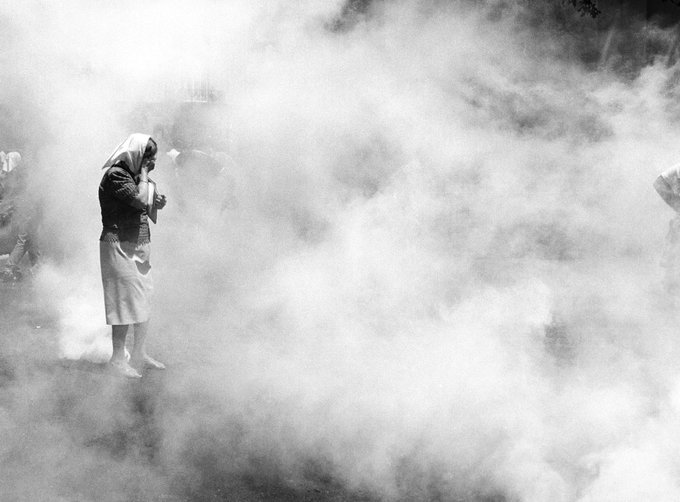
Mi foto favorita. Las rondas las hacรญan ellas, pero ahora las hacemos todos. Gracias a ellas 

El miedo no podรญa intimidarlas. La violencia no podรญa callarlas. Incluso su propio dolor no las abatiรณ. Estas luchadoras triunfadoras con paรฑuelos blancos, algunas apoyadas por andadores, esperaron con calma y paciencia en una pequeรฑa tienda de campaรฑa para apoyarse en los brazos de voluntarios y presentarse como los sรญmbolos vivientes que la injusticia debe ser desafiada, y que la gente comรบn y corriente tiene el poder para organizarse y ganar.
Debido a su incansable persistencia, se colocรณ la presiรณn internacional sobre el gobierno en busca de respuestas.Una comisiรณn recogiรณ testimonios. Las pruebas de ADN comprobaron la identidad de muchos de los desaparecidos. Oficiales militares de alto rango fueron juzgados, condenados y sentenciados por sus crรญmenes. Algunas de los desaparecidas eran mujeres embarazadas. Los bebรฉs que nacieron en las prisiones de tortura fueron robados y dados a familias escogidas por los militares luego de que sus madres fueran asesinadas. Las madres de la Plaza tuvieron รฉxito en la identificaciรณn de cientos de estos niรฑos.
Roberto tuvo que convencer a los voluntarios que estaban de guardia con las madres que me dejaran entrar a la carpa donde estaban para conocerlas. Es testimonio de su propio activismo lo conocรญan y confiaban en รฉl. Me dejaron entrar. Fue un increรญble honor conocerlas. Tengo dos hijos. No me puedo imaginar lo que harรญa si mi gobierno se los llevara, si los desaparecieran. Se me salรญan las lรกgrimas pensando en el dolor, pero tambiรฉn de pensar con orgullo de la fuerza de estas magnรญficas mujeres. La mรกs joven de las madres tiene ahora 87 aรฑos.
IMG_6359No habrรก un aniversario nรบmero 3.000 donde marcharรกn las madres de la primera vez. Sin embargo, la Plaza de Mayo estรก repleta. Hijos e hijas y nietos y desconocidos como yo llegan. Las madres han construido una organizaciรณn de luchadoras apasionadas por la justicia social. Sus hijos perdidos no regresarรกn a casa. Por eso concentran sus esfuerzos en abogar por los pobres y lo mรกs dรฉbiles – por los niรฑos de hoy.
El poder de las madres es una lecciรณn universal. Se levantaron mujeres que no tenรญan derechos; vulnerables y de luto por la pรฉrdida mรกs profunda posible. Su valentรญa inspirรณ a otros. Su persistencia llevรณ a los asesinos ante la justicia. Su visiรณn es tan clara que su legado permanecerรก.
Cuando salieron y comenzaron a marchar por la 2.000 vez en frente, la vuelta 2.000, miles y miles de hijos y nietos y amigos adoptados y desconocidos marcharon con ellas en la Plaza de Mayo. Gritamos en su honor:
Las Madres de la Plaza ¡el pueblo las abraza!
No es un simple lema. Es un recordatorio de lo que estamos llamados a hacer cuando las injusticias que enfrentamos parecen insuperables y las fuerzas en nuestra contra parecen omnipotentes.


Recordemos a las madres. Abracรฉmoslas. Marchemos con ellas. Nos han mostrado el camino.Las Madres de la Plaza, el pueblo las abraza - Lily's Blackboard: