Latest News and Comment from Education

Sunday, May 15, 2016

Past Time for a Charter School Moratorium in California | tultican

Past Time for a Charter School Moratorium in California | tultican:

Past Time for a Charter School Moratorium in California


In December 2015, elected officials and education professionals in Orange County, California joined a growing number of voices across our state calling for a charter school expansion moratorium:
“So today, we are asking Orange County residents to stand with our children and call for an immediate temporary moratorium on charter schools at all levels until there is transparency and accountability on par with public schools.”
 Michael Matsuda, Superintendent, Anaheim Union High School District
Al Jabbar, Board member, Anaheim Union High School District
Annemarie Randle-Trejo, Board member, Anaheim Union High School District
Brian O’ Neal, Board member, Anaheim Union High School District
Anna Piercy, Board member, Anaheim Union High School District
Kathy Smith, Board member, Anaheim Union High School District

In their joint declaration, they pointed to concerns about lack of transparency in the use of money by publicly supported charter schools. They also worried that charter schools laws do not sufficiently protect students; stating this example, “The USA though, because of lax charter laws that favor privatization, is the only country in the world that allows public taxpayer money to fund schools operated by foreign nationals.”

To this last point, in January, a notice in the San Diego Union about Magnolia Public Schools piqued my interest enough to investigate. To my surprise, I found that Magnolia Public Schools were part of the Gulen charter school empire, the schools governed by the Turkish Imam, Fethullah Gulen. I found that California already has eleven of these schools including one here in my hometown, San Diego.

A Little Charter School History

In 1974 Ray Budde, who taught educational administration at the University of Massachusetts, presented the Society for General Systems Research some ideas for the reorganization of school districts in a paper he titled “Education by Charter”.

Ted Kolderie, one of the original designers of the nation’s first charter school lawin Minnesota tells us:

“Ray Budde’s proposal was actually for a restructuring of the district: for Past Time for a Charter School Moratorium in California | tultican:


Petition REPEAL Charter School Act of 1992 in CA Ballot Initiative http://bit.ly/1Gt6Nu3


California’s charter school law repeal movement update http://bit.ly/1P1Evv9


Schools Matter: California's charter school law repeal movement update http://bit.ly/1YtorCJ


Russ on Reading: The College Remedial Course Hoax

Russ on Reading: The College Remedial Course Hoax:

The College Remedial Course Hoax

This week the New York Times ran an editorial entitled Guess Who’s Taking Remedial Classes? In the editorial the Times cites a study by the “think tank” Education Reform Now that shows that many students from more affluent suburban schools are taking remedial courses in college and claiming that this study is proof that high schools are not doing their job. Diane Ravitch responded by identifying Education Reform Now as an arm of the pro-reform Democrats for Education Reform and chastised the Times for taking their report as gospel. “Jersey Jazzman” Mark Weber eviscerated the report in a thorough analysis on his blog in an article I highly recommend you read. Weber asks all the right questions of this report and of the Times editorial, but I would like to take my own look at the implications of college remedial courses, especially as they relate to four-year colleges. These courses, while initially well-meaning, are a fraud perpetrated on the college student.

The vast majority of four-year colleges accept students based on their qualifications, usually in the form of an SAT or ACT score, a high school transcript, and perhaps a college essay and some other factors like community service or demonstrated leadership ability. Some students who are accepted to college may not meet the academic standards of the institution, but other mitigating factors, including athletic ability, having a parent who attended the institution or having the ability to pay the tuition without financial aid may get them admitted. When a four-year college admits a student, they also should be making a commitment to ensuringRuss on Reading: The College Remedial Course Hoax: 

Recycling Poverty, Segregated Schools, and Academic Achievement: Then and Now | Larry Cuban on School Reform and Classroom Practice

Recycling Poverty, Segregated Schools, and Academic Achievement: Then and Now | Larry Cuban on School Reform and Classroom Practice:

Recycling Poverty, Segregated Schools, and Academic Achievement: Then and Now


 A recent spate of reports and books  linking family poverty, segregated schools, and academic achievement (see here, here, and here) have concluded that school improvement (insofar as test scores are the measure) has hit a wall. Over the past decade, test scores have plateaued in reading and math or even fallen (see hereand here). After thirty years of reform after reform, achievement gaps between high- and low-income schools run to four or more grade levels between schools within and across districts (see here and here)   How come?

Researchers have pointed out for decades that the largest influence on school achievement (as measured by test scores),  has been family socioeconomic status. No surprise now with the release of new data on test scores that the the same findings about poverty and segregation shape student achievement. Such findings have been around since the massive Coleman Report (1966) and have appeared regularly every decade since. With such findings appearing again and again,  the question asked a half-century ago is the same questions now: Can schools make a difference when socioeconomic conditions (e.g., poverty) clearly play a large role in determining academic achievement?
Those who say “yes,” then and now, have urged upon elected decision-makers different reform policies from better teachers and teaching, more parental choice in schools, higher standards, more testing, accountability, new technologies in schools, and larger investments in education. “No excuses” school leaders, Recycling Poverty, Segregated Schools, and Academic Achievement: Then and Now | Larry Cuban on School Reform and Classroom Practice:

Randi Weingarten: Honoring our past and inspiring our future

Honoring our past and inspiring our future:

Honoring our past and inspiring our future

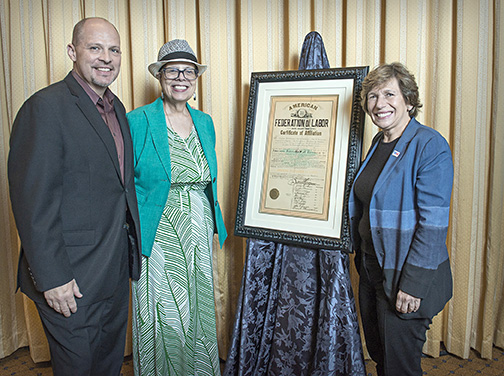
The American Federation of Teachers reached a significant milestone this week: the centennial of our founding. As I’ve pored over historical documents from our archives, it’s clear that, from generation to generation, our union has been a vehicle to fight for positive change both in public schools and in society. As we enter our second century, we remain fiercely committed to creating educational opportunity, building professional voice and agency, and advancing economic, racial and social justice for all.
The seeds of teacher unionism were sown in the late 19th century, with teachers like Henrietta Rodman, who helped found a teachers union in New York City and led the fight to allow women teachers to keep their jobs when they married or had children. In Chicago, Margaret Haley worked through her local union to challenge pervasive poverty, teachers’ lack of resources and low pay, and a curriculum imposed by bureaucrats. Recognizing the strength they would have as affiliates of a national union in a larger labor movement, in 1916 both women’s unions joined with five other local unions to form the American Federation of Teachers.
Then, as now, working people had many reasons to be angry. The AFT has worked to channel the aspirations underlying that anger into positive action. From the start, our leaders have known that power is necessary to bring about change, and that working people build power through their collective action at the ballot box and the bargaining table and through their skills, knowledge and ideas.
For 100 years, the AFT has worked to build power and use it for good. In the 1920s, the AFT lobbied Congress for children’s rights, improved teacher salaries and programs to combat adult illiteracy. We have continued that work. For example, in 2015, as Congress worked to reauthorize the primary federal education law, AFT members took more than 120,000 online actions and met face to face with legislators to help shape the law so it could have the potential to give educators the voice and resources they need to give children the education they deserve.
The AFT has grown to include other school employees, professors, government workers, nurses and healthcare professionals, and early childhood educators. While the AFT and the larger labor movement grew, so did America’s middle-class and working families’ standard of living. The labor movement helped ensure that working people, not simply special interests, had power in our democracy. Collective bargaining provided AFT affiliates leverage to advocate for quality, agency and voice on the job—the embodiment of our motto: “A union of professionals.”
The AFT has also used collective action to advance racial and social justice. As early as 1918, the AFT demanded equal pay for African-American teachers and lobbied for equal educational opportunities for African-American children. In 1953, the AFT filed an amicus brief in support of the plaintiffs in the Brown v. Board of Education case before the Supreme Court, the only educational organization and union to do so. Hundreds of AFT members traveled south in the 1960s to register new African-American voters and teach in AFT-run Freedom Schools. Today, the AFT is working to attract and retain teachers of color and to promote racial equity in education, the economy and criminal justice. And we stand up against bigotry in all its forms.
The AFT’s greatest strength has always been our members, professionals whose skills, knowledge and ideas both strengthen, and are strengthened by, their union. The AFT’s Share My Lesson is the fastest-growing free digital collection of resources for educators. The AFT Innovation Fund cultivates promising union-led ideas to strengthen public education. Our student debt clinics have helped members sharply reduce crushing college debt. And AFT members—from registered nurses and adjunct professors to paraprofessionals and parole officers—practice solution-driven unionism, using our expertise to improve the quality of our work.
You don’t hit 100 without some setbacks. Austerity has caused harmful cuts to public education and services throughout our history. Wisconsin Gov. Scott Walker and other governors intent on destroying any curb on their power have waged war on public sector unions. Many elected officials have sought to destabilize public schools and services in order to promote flawed privatization schemes.
It’s all the more reason to honor the example of the AFT’s founding mothers and fathers, to take our anger, build on our aspirations, and channel them into action—for our cause, our country and our members, and for those we serve and those who will follow. From one generation to the next, we are honoring our past and inspiring our future.
2016-05-15-1463316380-8392459-NYT_MAY15_2016_FULL.jpeg
Weingarten, right, with Michael Mulgrew, president of the United Federation of Teachers (AFT Local 2), and Karen Lewis, president of the Chicago Teachers Union (AFT Local 1).
Honoring our past and inspiring our future:


Donald Trump’s Education Mirage

Donald Trump’s Education Mirage:
Donald Trump’s Education Mirage


Donald Trump’s education agenda is puzzling. Where does he stand and what does he know about public schools, teachers and students?
The common thread is that no one really knows what a President Trump would do when it comes to public schools and education. He complains but offers few real solutions.
This is the best you can find. The Video and his claims are disputed by Stauss’s piece. And his  education agenda lacks substance.
The Bullying Problem
When it comes to Donald Trump and education issues, it is first a challenge to plow through the persona that is Trump.
With bullying a problem with young people, it is difficult for many teachers and parents Donald Trump’s Education Mirage:

NYC Public School Parents: Read the blog post that PARCC doesn't want you to see -- and then share it on your blogs!

NYC Public School Parents: Read the blog post that PARCC doesn't want you to see -- and then share it on your blogs!:

Read the blog post that PARCC doesn't want you to see -- and then share it on your blogs!

Here is the critique of the 4th grade PARCC exam  by an anonymous teacher, as it originally appeared on Celia Oyler's blog before she was threatened by PARCC and deleted key sections.  See also my post about my tweet that was deleted  after PARCC absurdly complained to Twitter that it infringed on their copyright!

As an act of collective disobedience to the reigning testocracy, I urge all other fellow bloggers to paste the below critique and copy it into their blogs as well.

As the teacher points out below, "we can use these three PARCC prompts to glimpse how the high stakes accountability system has deformed teaching and warped learning in many public schools across the United States. "

No high-stakes test that is used to judge students, teachers and schools should be allowed to be kept secret to escape accountability for the test-makers -- especially ones as flawed as these!  

If you do repost this, please let me know by emailing me at leoniehaimson@gmail.com thanks!
The PARCC Test: Exposed

The author of this blog posting is a public school teacher who will remain anonymous.

I will not reveal my district or my role due to the intense legal ramifications for exercising my Constitutional First Amendment rights in a public forum. I was compelled to sign a security form that stated I would not be “Revealing or discussing passages or test items with anyone, including students and school staff, through verbal exchange, email, social media, or any other form of communication” as this would be considered a “Security Breach.” In response to this demand, I can only ask—whom are we protecting?

There are layers of not-so-subtle issues that need to be aired as a result of national and state testing policies that are dominating children’s lives in America. As any well prepared educator knows, curriculum planning and teaching requires knowing how you will assess your students and planning backwards from that knowledge. If teachers are unable to examine and discuss the summative assessment for their students, how can they plan their instruction? Yet, that very question assumes that this test is something worth planning for. The fact is that schools that try to plan their curriculum exclusively to prepare students for this test are ignoring the body of educational research that tells us how children learn, and how to create developmentally appropriate activities to engage students in the act of learning. This article will attempt to provide evidence for these claims as a snapshot of what is happening as a result of current policies.

The PARCC test is developmentally inappropriate

In order to discuss the claim that the PARCC test is “developmentally inappropriate,” examine three of the most recent PARCC 4th grade items.

A book leveling system, designed by Fountas and Pinnell, was made “more rigorous” in order to match the Common Core State Standards. These newly updated benchmarks state that 4th Graders should be reading at a Level S by the end of the year in order to be considered reading “on grade level.” [Celia’s note: I do not endorse leveling books or readers, nor do I think it appropriate that all 9 year olds should be reading a Level S book to be thought of as making good progress.]

The PARCC, which is supposedly a test of the Common Core State Standards, appears to have taken liberties with regard to grade level texts. For example, on the Spring 2016 PARCC for 4th Graders, students were expected to read an excerpt from Shark Life: True Stories about Sharks and the Sea by Peter Benchley and Karen Wojtyla. According to Scholastic, this text is at an interest level for Grades 9-12, and at a 7th Grade reading level. The Lexile measure is 1020L, which is most often found in texts that are written for middle school, and according to Scholastic’s own conversion chartwould be equivalent to a 6th grade benchmark around W, X, or Y (using the same Fountas and Pinnell scale).
Even by the reform movement’s own standards, according to MetaMetrics’ reference material on Text Complexity Grade Bands and Lexile Bands, the newly CCSS aligned “Stretch” lexile level of 1020 falls in the 6-8 grade range. This begs the question, what is the purpose of standardizing text complexity bands if testing companies do not have to adhere to them? Also, what is the purpose of a standardized test that surpasses agreed-upon lexile levels?

So, right out of the gate, 4th graders are being asked to read and respond to texts that are two grade levels above the recommended benchmark. After they struggle through difficult texts with advanced vocabulary and nuanced sentence structures, they then have to answer multiple choice questions that are, by design, intended to distract students with answers that appear to be correct except for some technicality.

Finally, students must synthesize two or three of these advanced texts and compose an original essay. The ELA portion of the PARCC takes three days, and each day includes a new essay prompt based on multiple texts. These are the prompts from the 2016 Spring PARCC exam for 4th Graders along with my analysis of why these prompts do not reflect the true intention of the Common Core State Standards.

ELA 4th Grade Prompt #1

Refer to the passage from “Emergency on the Mountain” and the poem “Mountains.” Then answer question 7.
  1. Think about how the structural elements in the passage from “Emergency on the Mountain” differ from the structural elements in the poem “Mountains.”
Write an essay that explains the differences in the structural elements between the passage and the poem. Be sure to include specific examples from both texts to support your response.
The above prompt probably attempts to assess the Common Core standard RL.4.5: “Explain major differences between poems, drama, and prose, and refer to the structural elements of poems (e.g., verse, rhythm, meter) and drama (e.g., casts of characters, settings, descriptions, dialogue, stage directions) when writing or speaking about a text.”

However, the Common Core State Standards for writing do not require students to write essays comparing the text structures of different genres. The Grade 4 CCSS for writing about reading demand that students write about characters, settings, and events in literature, or that they write about how authors support their points in informational texts. Nowhere in the standards are students asked to write comparative essays on the structures of writing. The reading standards ask students to “explain” structural elements, but not in writing. There is a huge developmental leap between explaining something and writing an analytical essay about it. [Celia’s note: The entire enterprise of analyzing text structures in elementary school – a 1940’s and 50’s college English approach called “New Criticism” — is ridiculous for 9 year olds anyway.]

The PARCC does not assess what it attempts to assess

ELA 4th Grade Prompt #2
Refer to the passages from “Great White Shark” and Face the Sharks. Then answer question 20.
 Using details and images in the passages from “Great White Sharks” and Face to Face with Sharks, write an essay that describes the characteristics of white sharks.

It would be a stretch to say that this question assesses CCSS W.4.9.B: “Explain how an author uses reasons and evidence to support particular points in a text.”

In fact, this prompt assesses a student’s ability to research a topic across sources and write a research-based essay that synthesizes facts from both articles. Even CCSS W.4.7, “Conduct research projects that build knowledge through investigation of different aspects of a topic,” does not demand that students compile information from different sources to create an essay. The closest the standards come to demanding this sort of work is in the reading standards; CCSS RI.4.9 says: “Integrate information from two texts on the same topic in order to write or speak about the subject knowledgeably.” Fine. One could argue that this PARCC prompt assesses CCSS RI.4.9.
However, the fact that the texts presented for students to “use” for the essay are at a middle school reading level automatically disqualifies this essay prompt from being able to assess what it attempts to assess. (It is like trying to assess children’s math computational skills by embedding them in a word problem with words that the child cannot read.)

ELA 4th Grade Prompt #3
  1. In “Sadako’s Secret,” the narrator reveals Sadako’s thoughts and feelings while telling the story. The narrator also includes dialogue and actions between Sadako and her family. Using these details, write a story about what happens next year when Sadako tries out for the junior high track team. Include not only Sadako’s actions and feelings but also her family’s reaction and feelings in your story.
Nowhere, and I mean nowhere in the Common Core State Standards is there a demand for students to read a narrative and then use the details from that text to write a new story based on a prompt. That is a new pseudo-genre called “Prose Constructed Response” by the PARCC creators, and it is 100% not aligned to the CCSS. Not to mention, why are 4th Graders being asked to write about trying out for the junior high track team? This demand defies their experiences and asks them to imagine a scenario that is well beyond their scope.

Clearly, these questions are poorly designed assessments of 4th graders CCSS learning. (We are setting aside the disagreements we have with those standards in the first place, and simply assessing the PARCC on its utility for measuring what it was intended to measure.)

Rather than debate the CCSS we instead want to expose the tragic reality of the countless public schools organizing their entire instruction around trying to raise students’ PARCC scores.

Without naming any names, I can tell you that schools are disregarding research-proven methods of literacy learning. The “wisdom” coming “down the pipeline” is that children need to be exposed to more complex texts because that is what PARCC demands of them. So children are being denied independent and guided reading time with texts of high interest and potential access and instead are handed texts that are much too hard (frustration level) all year long without ever being given the chance to grow as readers in their Zone of Proximal Development (pardon my reference to those pesky educational researchers like Vygotsky.)

So not only are students who are reading “on grade level” going to be frustrated by these so-called “complex texts,” but newcomers to the U.S. and English Language Learners and any student reading below the proficiency line will never learn the foundational skills they need, will never know the enjoyment of reading and writing from intrinsic motivation, and will, sadly, be denied the opportunity to become a critical reader and writer of media. Critical literacies are foundational for active participation in a democracy.

We can look carefully at one sample to examine the health of the entire system– such as testing a drop of water to assess the ocean. So too, we can use these three PARCC prompts to glimpse how the high stakes accountability system has deformed teaching and warped learning in many public schools across the United States.

In this sample, the system is pathetically failing a generation of children who deserve better, and when they are adults, they may not have the skills needed to engage as citizens and problem-solvers. So it is up to us, those of us who remember a better way and can imagine a way out, to make the case for stopping standardized tests like PARCC from corrupting the educational opportunities of so many of our children.NYC Public School Parents: Read the blog post that PARCC doesn't want you to see -- and then share it on your blogs!:

Detroit schools' decline and teacher sickout reflect bad economy and demographic shifts - LA Times

Detroit schools' decline and teacher sickout reflect bad economy and demographic shifts - LA Times:

Detroit schools' decline and teacher sickout reflect bad economy and demographic shifts

Detroit teachers stage sickout
For two days this month, most Detroit schools were closed as teachers staged a sickout after learning the district was so low on funds it might not pay them.
 (Bill Pugliano / Getty Images)
e mostly poor and black students enrolled in Detroit Public Schools have been exposed to lead, have endured crumbling classrooms, and have some of the lowest literacy rates in the country. They've also seen one neighborhood school after another shut down.
Then this month they had to endure something else. For two days, most of them had no school to go to.
On May 2 and 3 — the start of Teacher Appreciation Week — scores of teachers called in sick, shutting down 97% of schools. The action came about after the teachers union said it learned that the district was running out of money, and that teachers' paychecks might not be guaranteed past June 30.
Most teachers went back to school after the union secured a promise that they would be paid through the end of June.
The walkout was yet another troubling episode for a long-beleaguered school district that is hundreds of millions of dollars in debt and behind on payments to its retirement system. It was also another reminder of how the destiny of schools is guided by shifting demographics, the growing charter-school sector and poor economics, though Detroit is an extreme example.
How did things get so bad?
The distrust and financial insecurity that exploded this month followed years of buildup — a mounting deficit, dramatically declining enrollment and management by one state-appointed official after another. The problems paralleled Detroit's overall downturn as it lost population and jobs as industry declined.
"The district is starved for cash," said Mike Addonizio, an education professor at Wayne State University. "That brought them to where they are today."
A major driver of that loss in revenue has been the loss of students. In 2002-2003, Detroit Public Schools counted 164,496 students in its ranks — by this year, that number was down to 47,000. And with each student that leaves, so do several thousand dollars. The Detroit schools' decline and teacher sickout reflect bad economy and demographic shifts - LA Times:


Editorial: Charter schools the problem, not other programs - LimaOhio.com - limaohio.com

Editorial: Charter schools the problem, not other programs - LimaOhio.com - limaohio.com:

Charter schools the problem, not other programs


Ohio’s problem with holding public charter schools accountable was well documented last week during a program at Elida High School that featured the executive director of the Ohio Coalition for Equity and Adequacy of School funding.
Charter schools have been a disaster.
Students who attend the state’s charter schools learn 36 days less math and 14 days less reading than traditional public school students, according to research done by the Hoover Institute at Stanford University. It crunched data obtained from student standardized test scores and ranked Ohio’s charter school performance 49th in the nation, with only Nevada being a worse gamble. That’s incomprehensible, considering that in 2013-14 when the study was done, charter schools accounted for more than 120,000 students, or 7 percent of the total public school enrollment in Ohio.
It doesn’t end there.
No sector in Ohio — not local governments, school districts, court systems, public universities or hospitals — misspends tax dollars like charter schools, according to research done a year ago by the Akron Beacon Journal. It reviewed 4,263 state audits and found charter schools misspent public money “nearly four times more often than any other type of taxpayer-funded agency.”
Clearly, the licensing of charter schools needs a major fix, to the point of closing down underperforming schools that falsely sell themselves as a good alternative to public education.
However, Ohioans should be careful not to confuse the failed charter school program with the state’s successful open enrollment and Educational Choice Scholarship Program (otherwise known as vouchers).
Thanks to these two programs, a ZIP code will not determine where parents send their child to school and what type of education he or she will receive. Parents are provided an option of where to send their children.
Yes, every time a student leaves their “ZIP code school,” that school loses its state funding for said student. That can be $4,650 each year for a student in kindergarten through eighth grade and $6,000 each year for a high school student.
That kind of money can add up quickly, and we won’t argue it can put a financial strain on a district.
However, there’s a reason the voucher program as well as open enrollment have seen significant growth the last 10 years. To put it frankly, they work.
Children who live in a ZIP code where a public school is underperforming have the opportunity to receive a better education through both programs. Time and time again we have seen how Ohio’s EdChoice program or its open enrollment program provide students with the tools they need to succeed.
Both programs can help break the cycle of poverty that plague a community by offering students the opportunity to get a high-quality education in a school that best fits their needs.


Saturday, May 14, 2016

Complete US DOE FOIA Showing Delaware DOE & US DOE Emails – Exceptional Delaware

Complete US DOE FOIA Showing Delaware DOE & US DOE Emails – Exceptional Delaware:

Complete US DOE FOIA Showing Delaware DOE & US DOE Emails 

On December 23rd, 2015, I found letters sent from the United States Department of Education sent to all the state DOEs about potential opt out penalties for the 2015-2016 year if schools went below the 95% participation rate.  In response, I sent a very detailed Freedom of Information Act request to the US DOE.  For the first time, you can view the entire response in its entirety.  I wrote an article based on some key parts of the US DOE FOIA response last month.
Julie Glasier is the main contact person for Delaware at the US DOE.  Many of these emails are in response to the Delaware School Success Framework which was met with stiff resistance last fall because of the opt out penalties against schools.  Keep in mind that the US DOE Complete US DOE FOIA Showing Delaware DOE & US DOE Emails – Exceptional Delaware:


No Man’s Land | The Patiently Impatient Teacher

No Man’s Land | The Patiently Impatient Teacher:

No Man’s Land

no-mans-land-and-restricted-area-of-the-un-buffer-zone-in-the-green-line-dividing-cyprus-famagusta-joe-fox1

As I have mentioned in a previous post, I work at a magnet school. In anti-school privatization circles I have been surprised to see some criticism of magnet schools. It confused me that some would lump charter and magnet schools together. After attending the Magnet Schools of America annual conference and witnessing some of the magnet policies being practiced in other states and districts, I get it now. In some places magnets have started to resemble charter schools in all the worst ways.
Steven Singer had a recent blog post in which he described the co-opting of legitimate educational reform by those who wish to privatize and profit from public schools. His analogy is that of the cuckoo bird that sneaks its egg into another bird’s nest. I think another apt analogy is that of convergent evolution. Convergent evolution is when unrelated organisms following different evolutionary paths develop adaptations that have similarities. One example is the similar wing structures of bats, birds, and insects. While these structures appear similar, they have very different origins and possibly very different futures as well.
While charter schools, magnet schools, and the school privatization movement may appear similar to the casual observer, they have very different origins and futures. Despite the rosy picture painted by charter school advocates  both charter schools and school privatization have deep roots in the White response to school desegregation efforts (see here and here. Today’s charter schools have strayed very far form any utopian vision of charter schools as places for teacher freedom and innovation. Charters have mostly been co-opted by the forces of school privatization with openly for-profit schools, privately managed schools, and schools that are ostensibly non-profit but with huge salaries for questionably large numbers of “directors.”
In many places including my state, charter schools are still serving as way for White families to avoid more diverse school environment. This report shows that one-fifth of all charter schools in NC are 90% or more White. It concerns me greatly that liberal education reformers seem to be unconcerned that there is so much similarity between their reform agenda the privatization agenda on the right. Look, if an education reform policy has any similarity to what the GOP is doing in NC, then it is past time to reconsider exactly how social justice is being addressed and how those policy actions are actually impacting students of color and disadvantaged students.
Magnets, however, have almost the opposite origin (see here and here). They were designed to encourage voluntary desegregation by offering unique and specialized programs at school that would not otherwise house a diverse student population. Magnets are governed by the local school district are often developed based on community input and frequently highlight the resources unique to the area.
However, some districts seem to have taken the approach of “if you can’t beat them, join them” and have evolved magnet systems that resemble charter schools in the most No Man’s Land | The Patiently Impatient Teacher:

CURMUDGUCATION: FL: Teacher Purge (or, Why Schools Needs Tenure, Pt. 23,617)

CURMUDGUCATION: FL: Teacher Purge (or, Why Schools Needs Tenure, Pt. 23,617):

FL: Teacher Purge (or, Why Schools Needs Tenure, Pt. 23,617)


Here's a story of how not to solve problems at a troubled school, and why tenure is a good idea. 

The first thing you have to remember is that in 2011, the Florida legislature and Governor Rick Scott killed teacher tenure. In Florida, a teacher is now hired a year at a time. Nobody is ever actually fired-- they're just not asked back for next year. This is a particularly clever end run around any sort of employment protections, because it means no teacher is actually fired, and therefor no district ever has to give a justifiable reason for firing any teacher.

Now let's travel to Palm Beach Lakes High School to see just how bad an idea that law is, and remind ourselves why due process protections of teachers are not just a scheme to fatten union bank accounts.

Palm Beach Lakes High School is poor and low-achieving. They were once pretty huge, but FL went through a school-minimizing phase; current enrollment 9-12 is listed around 2K (in a district of 183K total students). They have a reported 80% poverty rate, and a 68% graduation rate.

They also have trouble hiring. The school kicked off the year with trouble hiring an Honors Algebra teacher. They finally filled the position in November, but that teacher bailed shortly thereafter, citing "behavioral concerns." Two other candidates each subbed for a day and said "No, thanks."

By March, the situation had only deterioriated, with a series of substitutes in the class. Parents made phone calls and were put off. But PBL is a law magnet, intended as a training ground for future lawyers, and some students in a law class discussion of contracts and negligence had a lightbulb moment about the district's failure to provide an actual teacher for the class. And five of the students decided to take their concern to the school board. The students were freshmen and 
CURMUDGUCATION: FL: Teacher Purge (or, Why Schools Needs Tenure, Pt. 23,617):


Unwilling to Help Schools, PA Legislature Attacks Teachers | gadflyonthewallblog

Unwilling to Help Schools, PA Legislature Attacks Teachers | gadflyonthewallblog:

Unwilling to Help Schools, PA Legislature Attacks Teachers

Screen shot 2016-05-13 at 10.48.35 PM
If you live in Pennsylvania, as I do, you must be shaking your head at the shenanigans of our state legislature.
Faced with a school funding crisis of their own making, lawmakers voted this week to make it easier to fire school teachers.
Monday the state Senate passed their version of an anti-seniority bill that was given the thumbs up by the House last summer.
As usual, lawmakers (or more accurately their surrogates at the American Legislative Exchange Council (ALEC) who actually wrote the bill) spent more time on branding the legislation than appealing to logic, sense or reason. The bill called HB 805 was given the euphemistic title “The Protecting Excellent Teachers Act.”
Yes, this is exactly how you protect excellent teachers – by making it easier to fire them.
Currently, if teachers are furloughed, those with least seniority go first. Under this new law, teachers would be let go based on their academic rating. Teachers can have one of four ratings: Distinguished, Proficient, Needs Improvement and Failing. Under the new legislation, teachers rated Failing would be furloughed first, followed by those under Needs Improvement, etc. Within those categories decisions would be made based on seniority.
It sounds great – if you know absolutely nothing about Pennsylvania public schools.
First off, in 2015 our rating system found 98.2% of state teachers to be in the highesttwo rating categories. So at best this bill is next to meaningless.
Second, like virtually all value added rating systems across the country, our rating Unwilling to Help Schools, PA Legislature Attacks Teachers | gadflyonthewallblog: