Latest News and Comment from Education

Friday, May 13, 2016

Report: California’s charter schools lag behind traditional schools in graduating students | EdSource

Report: California’s charter schools lag behind traditional schools in graduating students | EdSource:

Report: California’s charter schools lag behind traditional schools in graduating students


California charter schools account for a disproportionate share of students who fail to graduate high school, according to a report released this week.
“Building a Grad Nation,” which tracks graduation rates among public schools nationally, found that 24 percent of California students in all public schools who failed to graduate in 2014 attended charter schools, even though the state’s charter schools enrolled only 9 percent of all high school students that year.
The report has been produced annually since 2010 by Civic Enterprises and the Everyone Graduates Center at Johns Hopkins University, in partnership with America’s Promise Alliance and the Alliance for Excellent Education, as part of an effort to track states’ progress toward reaching a national graduation rate of 90 percent by 2020.
In California, 94 percent of traditional high schools in 2014 had a graduation rate of 67 percent or higher, the threshold used to identify a low-graduation-rate school. Sixty-three percent of all charter schools had a graduation rate of 67 percent or higher.
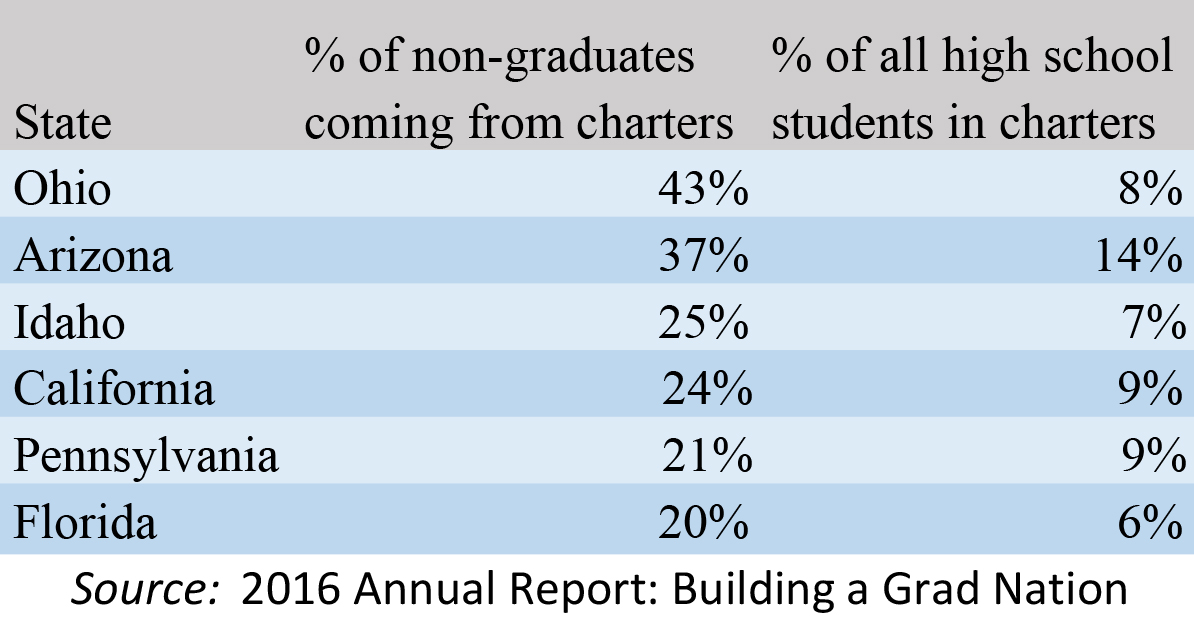
Workbook1
The California Charter Schools Association challenged the report’s findings, saying it inconsistently classified under the same umbrella regular charter schools and many alternative charters that specifically cater to dropouts, adult students and other at-risk students.
According to the report, there was some overlap when counting non-graduates from the different types of charter schools. Alternative charters were included in both the general “charter” category and the “alternative” school category, which includes all alternative, special education and vocational schools.
“We find a very large number of (alternative charters) on this list that we think the report’s authors would instead applaud for their programs and for tackling some of the most difficult challenges in education and serving some of the most underserved students in the state,” said Emily Bertelli, a spokeswoman for the California Charter Schools Association.
Bertelli listed as examples Five Keys Charter School in San Francisco, a non-traditional charter school serving county jail inmates that provides an opportunity for students to restart their education; and John Muir Charter Schools, which provide students at campuses statewide the opportunity to earn a high school diploma while working with the California Conservation Corps and other similar programs.
“Many of these schools exist to serve a vulnerable student population, and therefore deal with significant challenges,” said Robert Balfanz, a research scientist and the report’s co-author. “That’s why it’s so important that educators identify struggling students at the beginning of their high school careers and provide the things all students need to be successful.”
The nation’s overall gradation rate climbed to a record 82.3 percent in 2014. In California, the state’s graduation rate reached 81 percent. California’s graduation rate has steadily increased each year since 2010, when it was at 74.7 percent. Only Iowa has reached a statewide graduation rate of 90 percent or higher.
The report also found that schools with graduation rates lower than 67 percent generally had high concentrations of Hispanic, African-American or low-income students, a sign states haven’t done enough to provide the needed support for these student populations.Report: California’s charter schools lag behind traditional schools in graduating students | EdSource:

Children in disadvantaged neighborhoods are more likely to see their local schools close. | USAPP

Children in disadvantaged neighborhoods are more likely to see their local schools close. | USAPP:

Children in disadvantaged neighborhoods are more likely to see their local schools close.


Shrinking public finances have meant many cities and municipalities have looked to cut costs, with education not being spared. In new research, Jin Lee and Christopher Lubienski examine the effects of Chicago’s school closures, which have been justified by falling enrollment numbers. They write that schools in poorer areas are often likely to be the first targets for closure, a trend which means that there are fewer schools available for children – often African American and Latino – in less advantaged neighborhoods.
Public schools in the US are increasingly being shut down when they have been identified as underperforming on the basis of test scores and graduation rates. The traditional approach to school closure has been to reduce financial losses caused by empty classrooms and under-enrolled schools, especially in rural school districts. Indeed, this classic approach to maximizing efficiency is now evident in school closure policies in larger cities which are experiencing out-migration and depopulation. But now it has been combined with the idea of punishing apparent organizational underperformance.
The Chicago Public Schools (CPS), the third largest school district in the United States, is no exception. Chicago announced in the spring of 2013 that 54 primary schools would close in the upcoming school year, and that economies of scale provided justification for determining which schools to be closed. Considering that the number of primary school-age children has decreased by 24 percent in Chicago over the last decade, it is not surprising that school closures were accelerated in particular areas experiencing this decline. However, it is important to think carefully about where schools are closed and how that may impact students in terms of spatial equality.
In new research, we examine the possibility that school closings shape inequitable access to schools particularly for children in less advantaged neighborhoods. By taking into account travel time to schools, our study finds the CPS school closing policy—based on the capacity and the number of empty seats at schools—raises the likelihood that students in segregated communities have less access to neighboring schools.
Beware of location! 
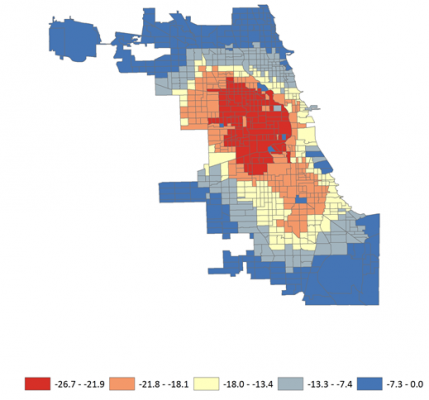
CPS has closed schools before. Chicago can close a school if the student enrollment is less than 80 percent of ideal enrollment. Thirteen primary schools were indeed closed for underutilization between 2001 and 2006, despite continuing debates over harms and benefits of school closings in large urban school districts. Yet, the reason that the latest school closing move in the fall of 2013 attracted such unwelcome attention is because of the scale: Chicago closed and relocated about 8 percent of schools. As shown in Figure 1, a substantial decrease in access to neighboring schools after these mass school closures occured in the north of downtown Chicago.
Figure 1 – Access change after the school closures
Lee Fig 1
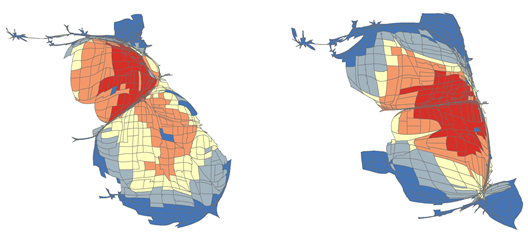
More precisely, the policy produced a notable change in access in areas with a high density of both African American and Latino American children. This suggests that school closures may be depriving students in particular areas of the opportunity to attend more convenient neighboring schools. As shown in Figure 2, the areas with a relatively large population of minority children are gradated in orange and red colors. This tells us that children in these areas experience significant declines in access after school closures.
Figure 2 – Access change by African American (left) and Hispanic (right) children
Lee Fig 2
In Chicago, when neighborhood schools close, one of the the biggest potential problems is that childrenChildren in disadvantaged neighborhoods are more likely to see their local schools close. | USAPP: 


PARCC CEO to Prof Who Posts “Live” Test Items: Reveal Your Informant | deutsch29

PARCC CEO to Prof Who Posts “Live” Test Items: Reveal Your Informant | deutsch29:

PARCC CEO to Prof Who Posts “Live” Test Items: Reveal Your Informant

Email from PARCC CEO Laura Slover, sent to me and others by Prof. Celia Oyler, who writes at celiaoyler.wordpress.com and who published a post referencing three “live” PARCC test items for grade 4:
5/12/16
Dear Professor Oyler:
I am writing to respectfully request that you remove all of the material reproduced from the PARCC assessments reproduced your blog post of May 7, 2016, which was called to our attention at https://celiaoyler.wordpress.com/2016/05/07/the-parcc-test-exposed/.
Parcc, Inc. is the owner of all intellectual property contained in the various PARCC assessments (other than third party literary excepts, for which we have reprint permission), including the essay prompts you have posted. Those prompts are protected by copyright. In addition, the materials are treated as confidential information as they are “live” test questions; indeed, the teacher who furnished you with the material stated in her essay that he or she had breached a written undertaking not to reveal any of the material and wished to avoid personal responsibility for having done so.
Your reproduction of those items infringe the Parcc, Inc. copyrights in the test, amplify the teacher’s breach of confidentiality, and threaten the utility of the assessments, both as their administration is completed over the next few weeks and in versions of the assessment to be administered in the future.
We have noted that a number of websites have linked to your site, further undermining the utility of the assessments.  As an infringer, you can be held personally liable for the damages incurred by Parcc, Inc. and those who have contributed financially to the creation and validation of the assessments, including without limitation the possible need, not only to create replacement items, but to create and revalidate new test forms.
We also request that you provide whatever information you have as to the 
PARCC CEO to Prof Who Posts “Live” Test Items: Reveal Your Informant | deutsch29:


US gives directive to schools on transgender bathroom access

US gives directive to schools on transgender bathroom access:

US gives directive to schools on transgender bathroom access


WASHINGTON (AP) — Public schools must permit transgender students to use bathrooms and locker rooms consistent with their chosen gender identity, according to an Obama administration directive issued amid a court fight between the federal government and North Carolina.
The guidance from leaders at the departments of Education and Justice says public schools are obligated to treat transgender students in a way that matches their gender identity, even if their education records or identity documents indicate a different sex.
"There is no room in our schools for discrimination of any kind, including discrimination against transgender students on the basis of their sex," Attorney General Loretta Lynch said in a statement accompanying the directive, which is being sent to school districts Friday.
In issuing the guidance, the Obama administration is wading anew into a socially divisive debate it has bluntly cast in terms of civil rights. The Justice Department on Monday sued North Carolina over a bathroom access law that it said violates the rights of transgender people, a measure that Lynch likened to policies of racial segregation and efforts to deny gay couples the right to marry.
The guidance does not impose any new legal requirements. But officials say it's meant to clarify expectations of school districts that receive funding from the federal government. Educators have been seeking guidance on how to comply with Title IX, which prohibits sex discrimination in educational programs and activities that receive federal funding, Education Secretary John B. King said in a statement.
"We must ensure that our young people know that whoever they are or wherever they come from, they have the opportunity to get a great education in an environment free from discrimination, harassment and violence," King said.
Under the guidance, schools are told that they must treat transgender students according to their chosen gender identity as soon as a parent or guardian notifies the district that that identity "differs from previous representations or records." There is no obligation for a student to present a specific medical diagnosis or identification documents that reflect his or her gender identity, and equal access must be given to transgender students even in instances when it makes others uncomfortable, according to the directive.
"As is consistently recognized in civil rights cases, the desire to accommodate others' discomfort cannot justify a policy that singles out and disadvantages a particular class of students," the guidance says.
The administration is also releasing a separate 25-page document of questions and answers about best practices, including ways schools can make transgender students comfortable in the classroom and protect the privacy rights of all students in restrooms or locker rooms.
The move was cheered by Human Rights Campaign, a gay, lesbian and transgender civil rights organization, which called the guidelines "groundbreaking."
"This is a truly significant moment not only for transgender young people but for all young people, sending a message that every student deserves to be treated fairly and supported by their teachers and schools," HRC President Chad Griffin said in a statement.
The guidance comes days after the Justice Department and North Carolina filed dueling lawsuits over a new state law that says transgender people must use public bathrooms, showers and changing rooms that correspond to the sex on their birth certificate. The administration has said the law violates the Civil Rights Act.
North Carolina Gov. Pat McCrory has argued that the state law is a "commonsense privacy policy" and that the Justice Department's position is "baseless and blatant overreach." His administration sued the federal government hours before the state itself was sued.
Follow Eric Tucker on Twitter at http://www.twitter.com/etuckerAP

Teachers at New York City’s Biggest Charter School Chain May Be Cheating on Standardized Tests | Alternet

Teachers at New York City’s Biggest Charter School Chain May Be Cheating on Standardized Tests | Alternet:
Teachers at New York City’s Biggest Charter School Chain May Be Cheating on Standardized Tests
So says insider report on "helping" students at Success Academy.


 One of the nation’s highest-profile charter school chains may be creating a culture of “teacher cheating” in which educators are so pressured to boost student standardized test scores that they will intervene in various ways during the tests, Politico New York has reported

“It seems possible if not likely that some teacher cheating is occurring at Success [Academy] on both internal assessments and state exams,” read a memo written last July by Roy Germano, a social scientist who the New York City-based chain hired to assess “questions we never thought to ask” as it was contemplating its continued growth. The memo was obtained byPolitico New York reporter Eliza Shapiro.
“While Germano did not conclusively prove that teachers were cheating,” Shapiro wrote, “he reports multiple incidents of Success staffers informing that Success teachers may have prepared students for specific questions on internal tests, allowed students to copy answers from each other, scored their own students higher than students in other classes, and pointed to incorrect answers on exams and warned students to rethink their answers.”
New York City’s Success Academy is the city’s largest charter school chain, with nearly 10,000 mostly poor students of color in 43 schools. It hopes to double its number of schools and students in the near future. As the New York Times reported last April, its claim to fame and justification for its “polarizing” academics and political advocacy come from its student test results on the state’s standardized math and reading exams, which have been more than double the average level of the city’s traditional public schools.
“Success Academy is the highest scoring charter chain in New York, possibly the nation,” said Diane Ravitch, a charter critic, pointing to Politico’s report. “It is also very controversial, due to its no-excuses policies, its attrition rates, and Teachers at New York City’s Biggest Charter School Chain May Be Cheating on Standardized Tests | Alternet:

Thursday, May 12, 2016

Education Mirages and Presidential Politics—Hillary Clinton

Education Mirages and Presidential Politics—Hillary Clinton:

Education Mirages and Presidential Politics—Hillary Clinton

photodune-5440930-mirage-xs

Presidential politics and education—it’s like crawling through the desert. You see the same old landscape, and then, out in the distance you see real teacher support and quality schooling! And you hear “I will make public schools great again!”
We are bombarded with statements that sound supportive of public schools and teachers, parents, and students, but as one crawls closer to the mirage, we learn it isn’t always what one hears or sees.
The closer you get the more you realize—it’s an illusion.
In the next few posts I will be looking at the Presidential candidates and mirages.
Hillary Clinton
Hillary Clinton gave a rousing speech for teachers where she praised public school teachers. She’s riled up about those who blame teachers for society’s problems.
But I think we should be asking her what she really means.
Standardized Tests
Hillary Clinton says she doesn’t like to see teachers blamed, but isn’t she a part of the old guard that brought about high-stakes standardized testing which has been used to blame teachers?
In all fairness, she supported lowering class size too. She cares about early childhood education, and I believe she is the only candidate who has mentioned autism. But I Education Mirages and Presidential Politics—Hillary Clinton:


SF school leaders give Teach for America a time-out - San Francisco Chronicle

SF school leaders give Teach for America a time-out - San Francisco Chronicle:

SF school leaders give Teach for America a time-out


The taxpayer-supported Teach for America program, which supplies enthusiastic if inexperienced teachers to thousands of schools in lower-income areas across the country, has fallen out of favor in San Francisco.
The city’s school board made clear this week that staffing some of the city’s neediest classrooms with recent college graduates who are on a two-year teaching stint and with just five weeks of training is no longer acceptable.
The board had been set to vote Tuesday night on a new contract to obtain 15 teachers for the upcoming school year — after reaching similar agreements each of the last eight years with the national nonprofit, which receives federal grants, private donations and fees from districts.
But before the vote, Superintendent Richard Carranza pulled the contract from consideration, acknowledging he didn’t have support despite a statewide teacher shortage and a local need to fill at least 500 teaching jobs by August.
The 15 teachers would have been placed in science, math, special education and bilingual education classrooms — the hardest positions to fill, Carranza said.
“I respect the board’s authority to make these decisions,” Carranza said in an interview Wednesday. “I just think it’s a missed opportunity for us to fill 15 classrooms (with) very scarce candidates out there.”
Pipeline of educators
Though the district won’t hire any new Teach for America teachers, the 15 heading into their second year will continue to receive support, officials said.
Teach for America, often referred to as TFA, has long been considered a valuable pipeline of new teachers, especially in low-income communities. The young teachers don’t have full credentials, but are billed as cream-of-the-crop college graduates with a desire to spend at least two years teaching in some of the country’s poorest communities.
But over the past several years, the organization has been condemned by critics, including teachers unions, as a crutch that fills the country’s neediest classrooms with inexperienced and cheap labor.
“Our goal as a district should be to get experienced, highly prepared, fully credentialed teachers with a track record of success into our high-needs, high-poverty schools,” said school board President Matt Haney. “For now, I believe that we should press pause on our contract with TFA, as we consider how best to address our own challenges of getting the best, most-prepared teachers where they are most needed.”
Financial ties questioned
Others, including school board member Jill Wynns, have opposed Teach for America’s financial connections to supporters of charter schools and market-based education reform.
Teach for America was started in 1990 by Wendy Kopp, a Princeton University graduate who SF school leaders give Teach for America a time-out - San Francisco Chronicle:


Education officials say they’re trying to protect poor children. A senator says they’re trying to break the law. - The Washington Post

Education officials say they’re trying to protect poor children. A senator says they’re trying to break the law. - The Washington Post:

Education officials say they’re trying to protect poor children. A senator says they’re trying to break the law.

An Obama administration proposal to ensure adequate resources for poor children in the nation’s schools has triggered a backlash on Capitol Hill and among the nation’s K-12 superintendents, who say that the U.S. Education Department is trying to unilaterally — and illegally — rewrite the nation’s main federal education law.
The nonpartisan Congressional Research Service on Wednesday lent credence to that criticism, writing that the department’s proposal seems to conflict with language in the law and “appears to go beyond what would be required under a plain language reading of the statute.”
At issue is how thousands of school districts prove that they are using $15 billion in federal Title I dollars to provide extra help for poor children in tens of thousands of schools nationwide. Federal law says that school districts must spend the money in a way that provides extra help to poor children — that it not be used to provide basic educational services — and requires that Title I schools have comparable services to those in wealthier schools in the same district. School districts are not allowed to underfund schools in poor neighborhoods and then use the federal dollars to fill in the hole.
But because high-poverty schools often spend fewer dollars per student — sometimes thousands of dollars — the Education Department has proposed a new rule to force districts to close the gap first. School districts would have to show that they are spending enough on poorer schools before they receive the federal dollars.
Department officials believe they have not only the legal authority, but the legal obligation, to enforce that rule.
“The entire purpose of Title I funds is to truly provide the additional resources necessary to ensure that students in high poverty schools have access to equitable educational opportunity,” spokeswoman Raymonde Charles said in a statement. “If schools are being shortchanged before the federal dollars arrive, then those dollars are not supplemental.”
Sen. Lamar Alexander (R-Tenn.), one of the chief architects of the new education law, is urging states to sue if the administration moves forward with the plan, arguing that it would interfere with the law’s specific intent of shifting power from Washington to state and local school officials.
“This is an intolerable situation,” Alexander said on the Senate floor. “As soon as the president Education officials say they’re trying to protect poor children. A senator says they’re trying to break the law. - The Washington Post:

Politics, Projection, Faith an Choice: A Message to Chicago – Troy LaRaviere's blog

Politics, Projection, Faith an Choice: A Message to Chicago – Troy LaRaviere's blog:

Politics, Projection, Faith an Choice: A Message to Chicago


Lessons from CPS’ Attempt to Remove an  Award-Winning Principal 
for my mother, Kay
An OverviewAccording to standards used by the Mayor’s office, there are only four schools that consistently and substantially raise student performance year after year after year.  For the past five years, I’ve led one of those four schools: Blaine  Elementary.
We have an incredibly simple philosophy for success: Take the things that have been proven to work, and implement them, while giving your staff the freedom to improvise to fit the unique circumstances of your school. Unfortunately, that’s not this administration’s strategy. Their education policies have been ideologically driven, clumsy, and scientifically baseless.
I’ve talked with so many principals who are deeply troubled by the obstacles this administration puts in their way: underfunding; a flawed school rating system; a lack of support schools that serve the most vulnerable children; a lack of respect for their work and their time; a culture of fear and intimidation; and burdensome compliance driven paperwork.  This list goes on. Under this administration, teaching, learning and leading are far more difficult than they have to be.  This is a direct result of the fact that this administration has focused on creating financial relationships that ensure their rich donors profit from our children’s losses.  It is inherently corrupt, and corruption breedsincompetence.
Instead of being guided by self interest. We must see the city as our family, and decide that the well being of everyone in that family is our priority.  That must be our vision, and we must act to make it so. I made that decision three years ago.  That my Chicago family would be the priority.  And I based my actions on that decision.
Those actions, in defense of our family, led my colleagues to nominate me for the presidency of the Chicago Principals and Administrators Association.  If elected I made it clear that I would work to develop systems and relationships that end the isolation of principals and administrators and brings them together to have a collective voice for policies that support student development, instead of undermining it.
When I was a lone voice the administration tolerated me. But when faced with the prospect of an organized group of education leaders speaking as one on behalf of students, they’ve moved with haste and reckless abandon to prevent that from happening.
The Charges: An Exercise in ProjectionI’ve already written about this administration’s hasty, effort to remove me.  Today I’m Politics, Projection, Faith an Choice: A Message to Chicago – Troy LaRaviere's blog:

Whitney Tilson and I Debate Education Reform and the Billionaires’ Role, Part 2 | Diane Ravitch's blog

Whitney Tilson and I Debate Education Reform and the Billionaires’ Role, Part 2 | Diane Ravitch's blog:

Whitney Tilson and I Debate Education Reform and the Billionaires’ Role, Part 2


Whitney Tilson, a key figure in the corporate reform movement, and I have continued an exchange about the teaching, charters, and the movement he represents. He was among the founders of Democrats for Education Reform and Teach for America; he is also involved in Bridge International Academies, which opens low-cost, for-profit schools in poor countries. Another in this series will appear soon. He posted this on his blog this morning. You can read it there to see my remarks are in blue; when I copied and pasted to my site, all the blue disappeared, and I didn’t have time to recolor them. My comments are marked DR, his are WT. I am engaging in this dialogue so that his readers can learn what their critics say, not filtered but straight.
From: Whitney Tilson 
Sent: Thursday, May 12, 2016 9:00 AM
Subject: Round 2 of my discussion with Diane Ravitch, on who’s the status quo, charter schools, and testing
If someone forwarded you this email and you would like to be added to my email list to receive emails like this one roughly once a week, please email Leila at leilajt2+edreform@gmail.com. You can also email her if you’d like to unsubscribe. Lastly, in between emails I send out links to articles of interest via Twitter (I’m #arightdenied) so, to get them, you must sign up to follow me at: https://twitter.com/arightdenied.
———————
STOP THE PRESSES AGAIN!!!
My new BFF, Diane Ravitch, and I have continued our conversation and it’s gotten even more interesting, as we’ve moved past the high-level principles we mostly agreed on in our first exchange of emails (sent a couple of weeks ago and posted on her blog here and my blog here) and started engaging on the many issues on which we disagree.
Our ongoing discussion covers many topics:
1) Whether reformers are now the status quo
2) Charter schools
3) Tests and how they should (and shouldn’t) be used
4) Who is the underdog in this battle
5) The tone of the debate and our shared desire to focus more on the issues and less on personal attacks
6) The details of the Vergara case – namely, a) the amount of time it takes teachers to earn tenure; b) how difficult it is for administrators to fire a tenured teacher; and c) whether layoffs should be done strictly by seniority
Because of its length, we’ve agreed to break it into two parts: Round 2 is below and will cover the first three topics. Tomorrow we’ll release Round 3, covering the remaining three.
My original email is in italics, Diane’s comments are in blue (beginning with “DR:”), and my responses are in black (beginning with “WT:”).
Enjoy!
Whitney
Hi Diane,
I really enjoyed our first exchange of ideas. Thank you for engaging.
Since you had the last word, the onus is on me to respond – which, frankly, makes me feel overwhelmed because we’ve already touched on so many enormously complex and difficult issues that we could spend weeks discussing just one of them.
So, I’m going to approach this following the old maxim, “How do you eat an elephant? One bite at a time.” I’m not going to try to respond to everything, but rather just a few things and hopefully we can build from there.
So let’s talk about two things, one high-level and one nitty-gritty: 1) tone, language and motivations; and 2) the Vergara case.
Tone, Language and Motivations
Here’s another thing we can surely agree on: we (and our allies) have Whitney Tilson and I Debate Education Reform and the Billionaires’ Role, Part 2 | Diane Ravitch's blog:

Internal documents lay out threats to the Success Academy model | POLITICO

Internal documents lay out threats to the Success Academy model | POLITICO:
Internal documents lay out threats to the Success Academy model


 Success Academy, New York City’s largest and most influential charter network, faces multiple potential crises as it attempts to triple in size over the next decade, according to a series of internal documents obtained by POLITICO New York.

The documents, which include memos, financial documents and a comprehensive draft risk assessment, show anxiety among Success executives over a variety of external threats to the network, including a “less than friendly press corps,” a “politically dynamic environment” that could stall the network’s growth, and rising real estate costs that threaten to “destroy our financial model.”
But the documents also provide an unprecedented glimpse into the internal struggles at the network, which has received national attention for the high test scores of its students, most of whom are black or Latino and come from poor neighborhoods. 
The documents reveal uneven returns on political spending, including more than $700,000 on a pro-charter rally last year in Albany, and concerns about a pressure-filled environment that has led to high turnover and the possibility of cheating. High-ranking Success employees also expressed dismay over a major technology investment that has yet to pay dividends, and worried over the pace and direction of the organization’s expansion.
“I don’t think the question is fully answered on how we can maintain high education quality while we scale up,” said one Success executive, as quoted in a 40-page draft of a risk assessment prepared by network staff and circulated among network executives in December 2014.
Risk assessments, sometimes required for insurance purposes, are designed to predict worst-case scenarios.
The “Enterprise Risk Assessment,” based on 14 interviews with members of the network’s senior leadership team, is dominated by concerns about the organization’s inner workings, including a disappointing $20 million student data tracking system, an uncertain talent pipeline, and the lack of a clear successor to the network’s high-profile founder and CEO, Eva Moskowitz.
“This is our single point of failure and an existential risk,” said one executive, referring to the potential leadership vacuum. (This risk assessment includes “selected comments by interviewees” for each section, but does not identify them by name.)
The expressions of concern come as Moskowitz aims to harness tens of millions of dollars in public and private funds to expand the network from its current 34 schools, serving 11,000 students, to 100 schools and 50,000 students over the next decade. That ambitious plan is key to her broader aim of establishing Success as what the network describes as a “catalyst and national model for education reform efforts,” and a legitimate citywide competitor to the incumbent public school system.
Stefan Friedman, a spokesman for Success, noted in an emailed response to a series of questions that the risk assessment was compiled in 2014, when the network underwent its largest-ever period of growth, opening ten schools in a single year. 
"Whether its opening 100 schools total or 100 additional schools, we will not rest until we are able to provide a high-quality education not only to our current student population, but to the tens of the thousands of children on our waiting lists who have been banished to low-performing district schools due to nothing more than political gamesmanship,” he said.
MOSKOWITZ, A FORMER DEMOCRATIC CITY COUNCILWOMAN who made a reputation for herself with stinging critiques of the powerful city teachers’ union, has long criticized New York City’s sprawling, unionized public school system for its relative rigidity and inability to respond promptly to students’ needs. She has offered her rapidly expanding network as a counterpoint to that system, and aims to grow it to a size that Internal documents lay out threats to the Success Academy model | POLITICO:

CURMUDGUCATION: Better Schools Dialogue Part III: Three Guiding Questions

CURMUDGUCATION: Better Schools Dialogue Part III: Three Guiding Questions:

Better Schools Dialogue Part III: Three Guiding Questions


I'm running a dialogue with Dmitri Mehlhorn in which we are looking for any common ground we might share on the topic of better schools. Here are links to Part I and Part II. I'll be along with my next response shortly, but in the meantime, feel free to speak up in the comments section.

Dear Curmudgucation,   

Thank you for engaging.  In response to my vision for public schools, you and your followers have raised three basic questions: (1) are these schools desirable, (2) are they possible, and (3) how can we get them?   

Are these schools desirable?   

My first post suggested that teachers should be paid more; freed from standardized testing and administrative choresand allowed to focus on their students. Studentsshould learn from each other and on their own, using Montessori methods andoutdoor activities, in learning communities that span different ages and ability levels.They should eat healthy foods. Both content and pedagogy should be personalized to their needs. I cross-posted this vision on other sites (including Medium and Citizen Ed), and received positive feedback from parents and educators.  Given the choice, I’m confident most of America, its teachers, and its students would prefer this vision to the status quo.  

You and your audience raised concerns: that by relying upon mobile computingthis vision elevates technology at the expense of humanity; and that competency-based CURMUDGUCATION: Better Schools Dialogue Part III: Three Guiding Questions: