Latest News and Comment from Education

Tuesday, July 21, 2015

Corruption, politics and the race shame I should not feel - The Hechinger Report

Corruption, politics and the race shame I should not feel - The Hechinger Report:

Corruption, politics and the race shame I should not feel


Even though I know logically that one person doesn’t represent a race, community or organization, I still carry the weight of shame for individuals who take advantage of public dollars and children’s resources.
There’s enough shame to go around.
Another education leader (who happens to be black) is accused of using his position on a public school board (that happens to be charter) to put his individual needs above children’s. D’Juan Hernandez, a prominent New Orleans based lawyer and businessman, used a school credit card to charge up to $13,000 worth of expenses including “payments to Tulane University, where his daughter attends, and $500 for plane tickets to Florida, where his family vacationed,” Hechinger reported.
Add Hernandez to the growing list of people accused of misusing public funds in New Orleans. Earlier this year, former New Orleans Public School Board Member Ira Thomas pleaded guilty to accepting $5,000 in bribes. Kelly Thompson, former business manager of Langston Hughes Academy, was busted pilfering almost $675,000 in 2010. A Lusher Charter School employee embezzled $25,000 in the 2011-2012 school year. Darrell K. Sims, 55, formerly with the New Orleans Military and Maritime Academy was charged with theft by fraudulent checks in the amount of $31,000 in 2013. Auditors found that an employee of KIPP New Orleans misappropriated two checks totaling almost $70,000 in 2014. And of course we have the oft-aired theft of Ellenese Brooks-Simms, New Orleans School Board member who accepted bribes totaling approximately $140,000 in 2010.
Theft can’t be ascribed to one particular racial or ethnic group. Poor people certainly aren’t the only ones stealing. People steal within any governance structure. So in New Orleans, which happens to be 60 percent black, we shouldn’t be surprised or discouraged that black people are among those who are busted. However, Hernandez’s incidental blackness has real political consequences.
You don’t have to read much into the case for post-Katrina reform to find the Brooks-Simms example. Reformers argue for change by shaming Brooks-Simms (who happens to be black) and by association the New Orleans School board.
New Orleans and other cities need black people in leadership positions because our absence proves that privileged people use individual transgressions to limit black opportunity. I’ve argued for more black, local participation in charter school movement in New Orleans. Hernandez’s actions will become ammunition against that Corruption, politics and the race shame I should not feel - The Hechinger Report:

Why new Senate ed bill falls short of LBJ’s “War on Poverty” standard - The Hechinger Report

Why new Senate ed bill falls short of LBJ’s “War on Poverty” standard - The Hechinger Report:

Why new Senate ed bill falls short of LBJ’s “War on Poverty” standard

Improvements must be made for underserved students


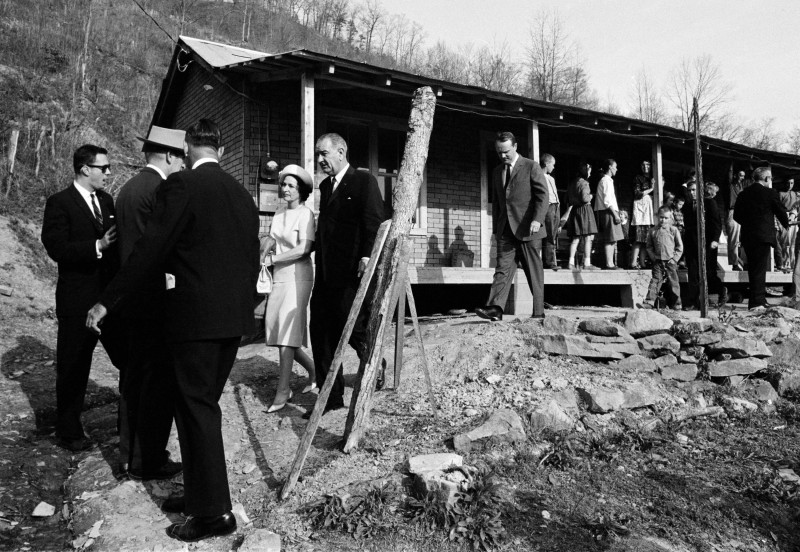
President Lyndon Johnson and his wife, Lady Bird, center left, leave the home in Inez, Ky., of Tom Fletcher, a father of eight who told Johnson he'd been out of work for nearly two years, in this April 24, 1964, file photo. The president visited the Appalachian area in Eastern Kentucky to see conditions firsthand and announce his War on Poverty from the Fletcher porch.
President Lyndon Johnson and his wife, Lady Bird, center left, leave the home in Inez, Ky., of Tom Fletcher, a father of eight who told Johnson he’d been out of work for nearly two years, in this April 24, 1964, file photo. The president visited the Appalachian area in Eastern Kentucky to see conditions firsthand and announce his War on Poverty from the Fletcher porch. AP Photo/FILE
Last week, when the U.S. Senate passed the Every Child Achieves Act, a bipartisan group of legislators took a step toward ending the nearly decade-long delay in reauthorizing the nation’s seminal education law.
As the House and Senate begin committee work to merge their two separate bills into one, we should reflect on the origin of this law and keep sight of its original purpose.
The Elementary and Secondary Education Act, or ESEA, was signed into law in 1965 by President Lyndon B. Johnson as part of his “War on Poverty.” At its heart, ESEA was a powerful move by the federal government to promote greater economic and social opportunity for all Americans through a more equitable education system.
Although the new Senate bill has some admirable qualities, it does not go far enough to live up to the original intent of this critical law, and improvements must be made on behalf of historically underserved students.
The Senate bill does the right thing by continuing to require that states test students in math and English Language Arts annually in grades 3-8 and once in high school, and that the results of those assessments be disaggregated by race, income, and special needs, and be made public. This transparency will continue to shine a harsh but important light on the pervasive gaps in opportunity and achievement that have historically been masked by aggregate reporting requirements. When coupled with accountability, this transparency has contributed to significant improvements in achievement, particularly for traditionally underserved populations. It cannot be cast aside.
In its necessary attempt to fix the overreliance on test scores and the unrealistic definitions and requirements of annual school progress, the bill goes too far. It removes the requirement to intervene in persistently low-performing schools that exist in the current version of ESEA (also known as NCLB or No Child Left Behind). The new bill leaves it to the states to define what constitutes “struggling schools” and to decide what – if any – intervention is necessary, a shift that civil rights groups rightly fear will mean there is no mechanism to “meaningfully protect and advance civil rights and achievement for the most vulnerable students.” The combination of these changes will allow states to hide achievement gaps, and ignore rather than invest in the schools that need the most support, essentially losing the law’s focus on equity.
No Child Left Behind relies too much on standardized tests for accountability and, therefore, should consider additional measures of school quality as proposed in the Senate’s bill. Educators 4 Excellence, the organization I help to lead, is a national movement of over 17,000 teachers who believe that in order to protect our most disadvantaged students, we need appropriate checks and balances in place through multi-measure accountability systems. For example, high school accountability metrics could include the proportion of Why new Senate ed bill falls short of LBJ’s “War on Poverty” standard - The Hechinger Report:

Research On Teacher Evaluation Metrics: The Weaponization Of Correlations | Shanker Institute

Research On Teacher Evaluation Metrics: The Weaponization Of Correlations | Shanker Institute:

Research On Teacher Evaluation Metrics: The Weaponization Of Correlations


Our guest author today is Cara Jackson, Assistant Director of Research and Evaluation at the Urban Teacher Center.
In recent years, many districts have implemented multiple-measure teacher evaluation systems, partly in response to federal pressure from No Child Left Behind waivers and incentives from the Race to the Top grant program. These systems have not been without controversy, largely owing to the perception – not entirely unfounded - that such systems might be used to penalize teachers.  One ongoing controversy in the field of teacher evaluation is whether these measures are sufficiently reliable and valid to be used for high-stakes decisions, such as dismissal or tenure.  That is a topic that deserves considerably more attention than a single post; here, I discuss just one of the issues that arises when investigating validity.
 The diagram below is a visualization of a multiple-measure evaluation system, one that combines information on teaching practice (e.g. ratings from a classroom observation rubric) with student achievement-based measures (e.g. value-added or student growth percentiles) and student surveys.  The system need not be limited to three components; the point is simply that classroom observations are not the sole means of evaluating teachers.   
In validating the various components of an evaluation system, researchers often examine their correlation with other components.  To the extent that each component is an attempt to capture something about the teacher’s underlying effectiveness, it’s reasonable to expect that different measurements taken of the same teacher will be positively related.  For example, we might examine whether ratings from a classroom observation rubric are positively correlated with value-added.
Just how strong that relationship should be is less clear.  Recently, I attended a conference session in which one researcher had correlated student surveys and value-added, and another had correlated classroom observation data and student growth percentiles.  Both correlations were low, roughly 0.3, though positive and statistically significant.  But the researchers’ interpretations were quite different: one described the correlation as sufficient to support inclusion of student surveys in teacher evaluations, while the other argued that student growth percentiles are not appropriate for use in teacher evaluations given the low correlation. 
Is it possible for both interpretations to be correct?  Maybe, if you expect that: 1) the correlations between student surveys and value-added should be positive but small (as was the case with the results of the first researcher, who interpreted the modest relationship as supporting the use of student surveys); and 2) the correlations between classroom observation data and student growth percentiles should relatively strong (which would be consistent with the second researcher, who found a weak relationship and concluded that growth percentile estimates were not suitable for use).  You might visualize that “scenario” as follows:
The small green portion of overlap between classroom observations and student surveys represents a small correlation.  Perhaps we expect that these two measures are capturing quite different aspects of teacher quality, and thus have only a modest expectation that teachers who do well on one measure may do well on the other.  The large orange overlap between classroom observations and student growth percentiles, on the other hand, suggests that we expect these two measures are capturing pretty much the same thing: classroom observations capture the teaching practices that generate student gains.
The classroom observation rubrics I’ve seen attempt to capture a broad set of teaching practices, not all of which necessarily have a strong direct impact student achievement gains; some may address social-emotional climate of the classroom, for example.  The inclusion of such practices contributes to the Research On Teacher Evaluation Metrics: The Weaponization Of Correlations | Shanker Institute:


Community Schools or a Bunch of Bologna?

Community Schools or a Bunch of Bologna?:

Community Schools or a Bunch of Bologna?


Bologna - good food ans symbol of deception (in american english)


With the re-authorization of the Elementary and Secondary Education Act, or No Child Left Behind into the Every Child Achieves Act (ECAA), there is a lot of talk about community schools.

For many, the term “community schools” conjures up the idea of schools as the hub of the town, with experienced principals and credentialed career teachers. We think of these schools as designed for the public good, with strong PTAs, afterschool programs, and health screenings which include a school nurse.

Most important, the community, we assume, owns these schools. They should be public in the truest sense of the word with plenty of electives including the arts and sports. With luck, community schools stay open into the evening with course offerings for adults and students! They are overseen by strong, involved school boards, we think.

Some of us might remember our own public schools as community schools when we were young. Others think their schools needed help. But all of us probably agree that community schools should be schools the community gets behind and is proud of—a source of support for families and the town or city.

The elephant in the room with community schools is…you guessed it…racial diversity. Unless the surrounding neighborhood is multicultural, community schools run the risk of being segregated.

Also, many parents might be scratching their heads. They have not forgotten the closure of what they believed used to be their community public schools. They might wonder if Community Schools or a Bunch of Bologna?:

We bought it twice but we no-longer own it: Is co-location the better option? | School Finance 101

We bought it twice but we no-longer own it: Is co-location the better option? | School Finance 101:

We bought it twice but we no-longer own it: Is co-location the better option?


I’ve been spending much of my spring and summer trying to get a handle on the various business practices of charter schooling, the roles of various constituents, their incentives and interests – financial and otherwise – in the operations of charter schools. Throughout this process, I also try to consider how or whether similar practices and incentives exist for traditional district schools and private schools and how these markets intersect. There will be much more forthcoming on this blog, and in academic papers and reports in the next few months and year.
But one issue really struck me as particularly ludicrous as I spent more and more time drawing pictures and mapping out business relationships. I had avoided for the longest time digging into the weeds of charter school land deals and facilities financing. It’s messy and there are certainly plenty of fun scandalous news reports on the topic. But when I see this kind of stuff, I ask myself – what policies enable – or perhaps even encourage these things? Where’s the boundary between legally permissible and not… and between good policy and bad?
Here, I provide an example of something that’s just bad public policy. I can’t really say… except in one piece of this puzzle (as I’ve laid it out), that there are any truly bad, unethical, or illegal actors in this scenario. But the outcome is still bad… bad… patently… amazingly stupid public policy.
It all started way back…such a long, long time back…Way back in the days when the grass was still green, and the pond was still wet, and the clouds were still clean, and the song of the Swomee-Swans rang out in space…
Oh wait… wrong story….
Let’s go to the diagrams…
District controlled public school land and facilities are governed by the public that initially financed them. The public that financed these facilities and land acquisition typically did so by adopting in public referendum a promise to use their tax dollars (perhaps with support of state aid) to finance the debt required to buy the land and build the building. The public invested in the asset through debt financing, using low interest general obligation (GO) bonds.
Through annual budget approvals the public approved the maintenance of those facilities and their tax dollars were used to maintain their asset.  The public invested in the maintenance of that asset through annual operating expenses of the district. Perhaps the public even approved additional debt financing along the way for improvements and renovations.
Many of these grand facades of public schooling were financed long enough in our past that we forget that they were financed with the tax dollars of previous generations and have been passed along and their care entrusted to the current generation.
Figure 1. The Initial Purchase & Maintenance
Slide1
In many states, approval of charter schools to operate within district boundaries does not require local board or taxpayer approval. State government entities/appointees or elected bodies may serve as authorizers, and in some states, private entities and boards may authorize charter schools to establish, draw students and with them, public tax dollars for operating revenue/expense to support educational We bought it twice but we no-longer own it: Is co-location the better option? | School Finance 101:


Effects of poverty on the brain help explain poor kids’ lower test scores

Effects of poverty on the brain help explain poor kids’ lower test scores:

Effects of poverty on the brain help explain poor kids’ lower test scores


Posted with permission from Medical Daily


(Reuters Health) - The effect of poverty on children’s brains may explain why poor youngsters tend to score lower on standardized tests compared to wealthier students, a new study suggests.

"What was already discovered is there is an achievement gap between poor children and middle-class children," the study's senior author Seth Pollak told Reuters Health. "Even when they move to better neighborhoods, children growing up in poor families tend to do less well in school than their less poor counterparts."

What's more, researchers have found in recent years that poverty is linked to worse brain development, said Pollak.

"This study closes the loop and adds the missing piece," he said.

Pollak, from the University of Wisconsin-Madison, and colleagues report in JAMA Pediatrics that about 20 percent of the gap in test scores between poor children and middle-class children may be a result of poor brain development in the upper-front and side regions of the brain known as the frontal and temporal lobes, respectively.

The researchers examined brain images and standardized test scores from 389 children and young adults, ages four to 22, participating in a study by the U.S. National Institutes of Health between 2001 and 2007.

Children with other risk factors for poor brain development were excluded from the analysis, including those with low birth weights and attention problems.

The study is therefore comparing the healthiest children in the U.S. who - for the most part - differ only in terms of family income, Pollak said.

"Still, there is a brain difference and an achievement difference between these (poor) children and middle-class children," he said.

"Accounting for 20 or 25 percent of something complex like how well kids are doing in achievement tests is huge," Pollak said, adding their estimate may be conservative.

Dr. Joan Luby, who wrote an editorial published with study, said the new research adds to what was already known, particularly to “the idea of how critical certain ingredients are to growing healthy children."

For example, she said, children need nurturing and other critical elements from their primary caregivers, but society doesn't seem to emphasize the importance of those contributions.

"It’s not enough to bring a child into the world, feed them and make sure they don’t get injured," said Luby, director of the Early Emotional Development Program at the Washington University School of Medicine in St. Louis.

"People will often ask me, 'What should teachers be doing?' Or, 'What should schools be doing?" Pollak said. "What this says to me is, what should we be doing about environments?"

For example, he said children from poor families may not be prepared when they get to Effects of poverty on the brain help explain poor kids’ lower test scores:


150 Years of Magical Thinking on Teachers- Vox

Want a good public education for your kids? Better be rich first. - Vox:

Want a good public education for your kids? Better be rich first.


Public schools are a really nice idea. The government builds a building, right in your neighborhood, where anyone can send their kids to get an education for free. It's simple and appealing.
But in practice, it's quite a bit different. Land that is in the intake zone for a good school becomes more expensive, and you create a situation in which the school is open exclusively to the "public" of people who can afford a very expensive house.
Look at this chart showing the correlation between the price of a family-size house and the reading proficiency scores in the local school (the outlier, Garrison, where the reading scores are terrible and the houses are expensive anyway is my neighborhood public school):


Of course, in principle this situation could be mitigated. It is true that land near Ross Elementary School in Cleveland Park is very expensive, but the technology exists to cram many dwellings onto a given parcel of land. You can build homes that share side walls ("townhouses"), and you can even use steel-frame construction to build vast vertical stacks of dwellings, accessible from the ground floor via elevator. That wouldn't address the housing cost problems of the truly poor, but a less-constrained building supply would at least improve the situation for the middle class.
In practice, however, affluent neighborhoods with good schools tend to enact zoning rules that mandate detached single-family homes. That ensures that expensive land leads to expensive houses, thus preventing undesirable types from accessing the "public" school.


The other possible policy reform is to change the relationship between geography and school access.
In DC, you are guaranteed the right to send your kid to your in-zone elementary school, but all charter schools admit students purely on the basis of a lottery. Convenience still counts in life, so the charter system hardly eliminates geographic sources of disadvantage. But it does mitigate them. Shifting to more reliance on charter schools or having public schools admit students without geographic preference would be good for equality. But in this case, equality really is a leveling measure that lifts up poorer households in part by dragging down richer ones.
Homeowners in pricey neighborhoods have the value of their house tied directly to both excluding others from access to the neighborhood school and also to the absence of quality educational alternatives to buying a house in Fancytown.Want a good public education for your kids? Better be rich first. - Vox:

Charter school teachers claim intimidation over union | City Pages

Charter school teachers claim intimidation over union | City Pages:

CHARTER SCHOOL TEACHERS CLAIM INTIMIDATION OVER UNION


When teachers voted to form a union at St. Paul’s Community School of Excellence last June, they hoped administrators would quit intimidating employees for uttering anything critical of how the beleaguered K-8 charter school is run.

Union or no, Superintendent Mo Chang continues to reprimand teachers for disagreeing with her, ordering them to get her approval for staff-wide emails and placing union leaders on “performance improvement plans” that have nothing to do with the quality of their teaching, says Eric Johnson, who has worked at the school for the past four years.
Johnson was placed on an improvement plan last November so that he could work on his “professionalism” – a move he views as retaliation for brewing a storm over the school's questionable use of federal funds and its reporting of child abuse.
In January 2014, the Minnesota Department of Education investigated allegations that Community School of Excellence billed federal free lunch programs for meals that students didn’t eat, as well as complaints that Superintendent Chang discouraged staff from notifying Child Protective Services when they suspected students were being abused at home. Though teachers are mandated reporters by law, Chang preferred to investigate possible abuse herself, according to employees.
The state substantiated both accusations, ultimately fining the school $200,000. As a result, the charter’s authorizer and oversight body, Concordia University, declared in September it would sever ties with the school. Concordia will officially exit in June 2016.
"Basically we've got one person who’s kinda running the whole show and they’re running it pretty rottenly," Johnson says. "Nothing has changed, and because we have this school board that is just a complete rubber stamp for whatever [Chang] does, she basically runs roughshod over the whole operation."
Staff turnover was 26 percent in the 2014-15 school year as 42 employees out of 163 total resigned or were fired. Those who stayed are warned against having "negative conversations" at staff meetings, and investigated if they ever question leadership, teachers say.
For example, after Concordia withdrew its support, Chang had all staff sign a letter expressing full faith in their school. When Johnson complained about their lack of choice in the matter, that was construed as a negative comment. He was also told that he would not be allowed to send all-staff emails without advance permission. 
Another teacher, Wendy Ansley, was also placed on an improvement plan for allegedly rallying staff against the administration. She was ordered not to publicly criticize the school. Other teachers active in Charter school teachers claim intimidation over union | City Pages:

Friedrichs v. CTA: The Road to Abood: Where Did the Supreme Court Go Wrong? - Online Library of Law & Liberty

The Road to Abood: Where Did the Supreme Court Go Wrong? - Online Library of Law & Liberty:

The Road to Abood: Where Did the Supreme Court Go Wrong?

With this series of posts, I return to constitutional law issues that SCOTUS will address in the 2015-16 term.  One case in particular—Friedrichs v. California Teachers Association—is hugely important and has already generated a great deal of commentary.  This site recently hosted an excellent Liberty Forum on the topic, Friedrichs, which involves a constitutional challenge to the compulsory payment of union dues by public employees, promises to be one of the most closely-watched cases next term.  Part of the interest owes to anticipation that the Court may overturn a nearly 40-year old precedent, Abood v. Detroit Board of Education, 431 U.S. 209 (1977), which was criticized but not overruled last year in Harris v. Quinn, 573 U.S. ___, 134 S. Ct. 2618 (2014).  Without duplicating my colleagues’ thorough discussion, I offer a few additional observations.

In a free society, membership in a club or organization—and the concomitant obligation to pay dues—should be strictly voluntary.  Similarly, the decision whether—and to whom—to make political contributions is a deeply personal one that each individual should be able to make without coercion or duress.   Freedom of association and freedom of speech are core components of personal autonomy—“the right to be left alone.”  Thomas Jefferson noted long ago that “To compel a man to furnish contributions of money for the propagation of opinions which he disbelieves is sinful and tyrannical.”  Yet government employees are routinely required to pay dues (or “agency fees”) to inherently-political public employee unions as a condition of employment.
To understand why, one must understand a few elements of basic labor law.  “Collective bargaining,” as it currently exists in the United States, was established in 1935 by the National Labor Relations Act, a New Deal statute sometimes referred to as the “Wagner Act.”  After a majority of employees in an appropriate “bargaining unit” have voted to authorize a labor union to represent them, federal law requires the employer to negotiate in good faith with the union concerning terms and conditions of employment.  Once it is certified as the bargaining representative, the union represents all employees in the bargaining unit, not just those that voted for union representation.  This is the concept of “exclusive representation,” embodied in section 9(a), which was designed to increase wages by allowing workers to form a labor cartel (hence the term “collective bargaining”).  The NLRA disfavors individual competition in the labor market on the Marxian theory that—absent collective action—workers lack adequate “bargaining power” to negotiate adequately with concentrations of capital (i.e., corporate employers).
The Great Depression was erroneously perceived as a failure of free market capitalism.  As a solution, New Deal legislation frequently sought to cure the “defect” of competition by requiring market participants (whether farmers, producers, or workers) to act collectively.  In fact, the principle of exclusive representation was originally derived from the wide-ranging “codes of fair competition” established by National Industrial Recovery Act (1933), which was declared unconstitutional in Schechter Poultry Corp. v. United States, 295 U.S. 495 (1935).  The corporatist NIRA is regarded today as a semi-fascistic statute inspired by Benito Mussolini’s economic innovations in the 1920s.  Modern day collective bargaining under the NLRA has escaped that taint, although even liberal stalwarts such as Derek Bok, former president of Harvard University, have acknowledged that the United States is alone among industrialized nations in embracing the concept of exclusive representation.  [See Derek C. Bok, Reflections on the Distinctive Character of American Labor Laws, 84 Harv. L. Rev. 1394, 1397 (1971)]
Exclusive representation was controversial at the time the NLRA was enacted, and the Supreme Court initially upheld the constitutionality of the NLRA in NLRB v. Jones & Laughlin Steel Corp., 301 U.S. 1, 45 (1937) by pretending that section 9(a) did not preclude “such individual contracts as the company might elect to make directly with individual employees.”  This was disingenuous in the extreme.  By 1944, when the dust had settled regarding the constitutionality of economic regulation, the Court in J. I. Case Co. v. NLRB, 321 U.S. 332, 338-39 (1944), interpreted section 9(a) to mandate exclusive representation as we now understand it—individual bargaining is superseded  “to serve the welfare of the group” and as “a contribution to the collective result.”
Labor unions invariably insist on “union security” features in collective bargaining agreements, including “dues check off” (i.e., employer withholding of union dues from the employees’ paychecks) and whatever type of mandatory membership or participation is allowed under local law.  Objections to compelled membership in and/or mandatory financial support of  labor unions by non-members (or “dissenting employees”) has been a recurring subject of litigation, leading to numerous Supreme Court decisions on the subject.  The Supreme Court has used the concept of exclusive representation to uphold the mandatory payment of union dues (or, in “right to work” states, agency fees) with the rationale that allowing dissenters to refrain from paying their “fair share” would permit them to be “free riders,” benefiting from the union’s representation without appropriate payment.
Of course, this rationale assumes that the dissenting employees have in fact benefited from union representation; it is The Road to Abood: Where Did the Supreme Court Go Wrong? - Online Library of Law & Liberty:

Will Ohio Flunk Failing Charter Schools? | StateImpact Ohio

Will Ohio Flunk Failing Charter Schools? | StateImpact Ohio:

Will Ohio Flunk Failing Charter Schools?


The head of the Office of School Choice in Ohio resigned over the weekend, after he admitted he had left some failing grades out of several charter school evaluations.
Critics question whether David Hansen was purposely “scrubbing” the grades to make charter sponsors look good.
Meanwhile, the status of state legislation to crack down on bad charter schools is up in the air.
The state legislature appeared ready to agree on a bill to eliminate failing charter schools by going after the authorizers who sponsor them.  Democrats called the legislation too weak but both of the Republican dominated chambers approved similar bills. Then legislators tabled House Bill 2 saying it needed more study.
U-S Senator Sherrod Brown, a Democrat, said that left charter school oversight so too lax in Ohio.  He added an amendment to the federal education bill that allows public inspection of for-profit charter school companies.
“It didn’t go as far as I wanted but it was a recognition by my colleagues that for-profit charter schools are a problem.  We need to deal with it sooner or later because the states have simply failed to do it.”
Republican State Senator Peggy Lehner doesn’t argue with that.
“Until we actually pass legislation that significantly reforms the charter school laws in Ohio we have failed.”
As chairman of the Senate Education committee, Lehner spent months on a Senate bill to clean up Ohio charter schools, which Stanford University has rated some of the worst in the nation.
Sherrod Brown lays the blame for Ohio’s lack of oversight on legislators who receive large campaign donations from charter company owners. But he also pointed the finger at the Kasich administration’s Department of Education.  Ohio’s School Superintendent Richard Ross says he and the Governor want reforms.
“We believe that there needs to be some changes in the community school law.  We advocated for what came out of the executive budget and we still see that need and it continues to be there.  :11
Lehner is also confident the House and Senate will eventually work out a new law.
“And I’ll continue to push very vigorously to see that that happens because I think that legislation will go a long way towards fixing the problems with Ohio’s charter schools.”
The CEO of the Cleveland Municipal School District, Eric Gordon, says at least they’re talking about it.
“The House has really prohibited conversation around charter reform.  Now the House was in defensive posture.  So not only is the pressure growing but it’s the first time we’ve actually seen the House have to respond to a reform package instead of being able to prohibit the conversation at all.”
And now the scandal over the alleged scrubbing of failing charter grades may put additional pressure on the legislature.  The General Assembly is expected to take up the measure again in September.Will Ohio Flunk Failing Charter Schools? | StateImpact Ohio:

State watchdog agency to investigate Twin Rivers board president | The Sacramento Bee

State watchdog agency to investigate Twin Rivers board president | The Sacramento Bee:

State watchdog agency to investigate Twin Rivers board president


The state Fair Political Practices Commission is investigating whether Twin Rivers Unified school board President Linda Fowler violated conflict-of-interest rules by accepting thousands of dollars in consulting fees from a charter school she helped establish.
Highlands Community Charter School paid Fowler’s consulting firm $13,000 in October before canceling the contract when the school principal questioned its propriety.
Twin Rivers Unified school board President Linda Fowler
The FPPC, a state watchdog agency, is acting on a June complaint it received from Jacob Walker, academic coordinator at Highlands Community Charter, according to an FPPC letter sent last week. He claimed Fowler used her position on the Twin Rivers board to pressure the school into hiring her.
Fowler’s firm was paid to pursue a federal startup grant for the adult education school, and she said she split the $13,000 with another consultant. Walker said he filed his complaint because of that contract – and a tentative new arrangement by which she can earn $600 a week.
Fowler says school board members can legally work for charter schools in their district, and that she should get paid for her efforts on behalf of the school.
The Twin Rivers Unified School District board established the Highlands school in March 2014 to give students older than 22 an opportunity to earn high school diplomas, learn vocations and improve English skills. About 40 percent of the 300 students attending Highlands Community Charter have spent time in prison.
Fowler previously told The Bee that the charter school’s founding members met before the school board approved the new program and discussed which jobs they would hold once it opened. She made the motion to approve the Highlands charter at a Twin Rivers Unified board meeting on March 4, 2014. The board, including Fowler, voted 7-0 in favor.
Fowler became a member of the Highlands Community Charter School board after the Twin Rivers board selected her as the liaison between the district board and the school.
She did not vote on her consulting contract with Highlands and stepped down as a member of its board on Sept. 18, the day after the charter’s trustees approved her contract in closed session and a week before they passed it in an open meeting. She told the board she would continue to vote on Highlands board items as the liaison from Twin Rivers Unified, according to the minutes.
It’s unclear how long the FPPC will take to investigate the complaint. Such reviews typically take a few weeks or months, said Jay Wierenga, spokesman for the watchdog agency. Ninety percent of the investigations last less then a year, depending on the complexity and how much cooperation the agency receives, he said.
Each violation of the the Political Reform Act can carry a $5,000 fine. Fines depend on a number of factors, Wierenga said, including whether the individual has had previousState watchdog agency to investigate Twin Rivers board president | The Sacramento Bee:


Read more here: http://www.sacbee.com/news/local/education/article27966496.html#storylink=cpy

Can two federal bills finally fulfill goals of No Child Left Behind? - LA Times

Can two federal bills finally fulfill goals of No Child Left Behind? - LA Times:

Can two federal bills finally fulfill goals of No Child Left Behind?


The No Child Left Behind law had an ambitious goal to reform America's public schools 16 years ago: Every student, everywhere, would be academically successful by 2014.

That hasn't happened, and the vast majority of schools that receive federal funds are now labeled as failures under the law.

"The current federal system has basically become meaningless in drawing a distinction between schools that are performing well and schools that are not," said Keric Ashley, deputy superintendent for the California Department of Education.

That could change. Both houses of Congress have approved sweeping education bills, but the effort could fall short of becoming law because of political and policy hurdles.

The Senate's Every Child Achieves Act, approved last week, as well as legislation passed by the House of Representatives, would return to the states broad authority over how to deal with low-performing schools.

At the same time, the bills maintain requirements for annual standardized testing in math and English in most grades, while also ordering states to report detailed data about student achievement.

But there are important distinctions between the House and Senate measures that ultimately could doom the effort.

The fundamental differences concern the amount of federal funding and the rules for using these dollars. The House bill, called the Student Success Act, caps education spending and allows states more freedom to reduce their own spending on schools without facing federal penalties. It also gives more freedom to states regarding which students will benefit from federal aid.

Just as crucially, the House bill would make it easier for federal money to follow low-income students who qualify for aid, regardless of what public school they attend. This approach has many supporters, but would fundamentally alter the purpose and distribution of federal funds, experts said.

That's because current federal policy concentrates this aid, called Title 1, in schools with the highest percentages of low-income students. In L.A., for example, a school in which 20% of students come from low-income families would not receive Title 1 funding under today's rules, leaving more funding available for a campus that is 80% low income. The House bill would eliminate that.

Critics say the House bill would, in effect, transfer money from Can two federal bills finally fulfill goals of No Child Left Behind? - LA Times: