Latest News and Comment from Education

Monday, June 8, 2015

New No Child Left Behind Reauthorization Attempt Targets Opt-Out Movement

New No Child Left Behind Reauthorization Attempt Targets Opt-Out Movement - Emmett McGroarty - Page 1:

New No Child Left Behind Reauthorization Attempt Targets Opt-Out Movement


Editor's Note: this column was co-authored by Lisa Henson, an attorney, activist, and mom, regarding the No Child Left Behind Re-authorization and the Common Core testing opt-out movement.
The latest attempt to reauthorize No Child Left Behind (NCLB), sponsored by Sens. Lamar Alexander (R-TN) and Patti Murray (D-WA) and euphemistically named the Every Child Achieves Act), has surprisingly gained bi-partisan support. But it targets the Opt-Out movement, one of the great grassroots phenomena.

Here’s what’s going on.
For decades, education policy-making has been increasingly centralized. Legislatures, local boards of education, and parents have been marginalized. In 2002, NCLB made things worse. Building on prior law, it required statewide standards in math, science and English. It required elaborate state accountability systems that subject children to standardized tests in English and math in grades 3 through 8 and once more in high school, and less frequently in science. It tied school evaluations, along with “sanctions and rewards,” to results on those tests.
Then, spurred by private interests, the Obama Administration used the accountability structures and competitive grants as carrots and sticks to drive Common Core into the states. For their part, the Common Core owners promised that the standards would be of high quality, internationally benchmarked, and evidence-based.

What, then, explains the rising tide of parental and teacher anger?

Many of the standards are age-inappropriate and, as a result, negatively affect learning. The math standards put children into a slowed-down progression, fail to provide a pathway to STEM studies, and will widenachievement gaps. The English standards are unsupported by the evidence. According to Prof. Sandra Stotsky, the premier English standards expert, a child educated according to the standards will be unprepared for authentic college-level work.

Then there’s NCLB’s high-stakes testing scheme. It is oppressive to students and teachers and incentivizes, in a heavy-handed way, teaching-to-the-test. Moreover, as Prof. Christopher Tienken explains, to be useful for instruction, teachers and parents need test results returned quickly, and they need to see a child’s actual questions and answers. Standardized tests fail on these counts.

High-stakes testing is more like a bar exam. But note the differences. Adults take bar exams. They do so after law school graduation. They prepare for 8 weeks. Most take a review course --sitting for 4 hours a day, reviewing material in outline form and spending learning test-taking strategies that reflect the design, and past iterations, of the exam. They spend lots of additional time taking practice tests.

There is also concern, largely generated by NCLB’s teach-to-the-test mentality-- over the total number of standardized tests to which children are subjected --as many as 113 in K-12.

Parents are pushing back. They are opting their children out of high-stakes Common Core tests in record numbers. FairTest’s Monty Neill reported in theWashington Post that this year parents opted more than 200,000 children out of the New York English tests, triple last year’s rate, and that New Jersey refusals on the Common Core test went from “perhaps a thousand last year to nearly 60,000 on the first round of this year’s test.” Numerous news reports confirm that the opt-out movement is nationwide (see, e.g., here and here).

This movement is a desperate lunge by parents to have a real say in their children’s education. Thomas Morton, a school superintendent in New York, toldUSA Today, "[T]he folks that are working in the field realize that this is a real issue. I'm not so sure that the folks . . . in Albany understand that." He could have said that about Congress.

The federal government responded with intimidation. Education Secretary Arne Duncan said that “the federal government is obligated to intervene if states fail to 
New No Child Left Behind Reauthorization Attempt Targets Opt-Out Movement - Emmett McGroarty - Page 1:

Sacramento Approves Ethnic Studies as Graduation Requirement | Hmong Innovating Politics

Sacramento Approves Ethnic Studies as Graduation Requirement | Hmong Innovating Politics:

Sacramento Approves Ethnic Studies as Graduation Requirement


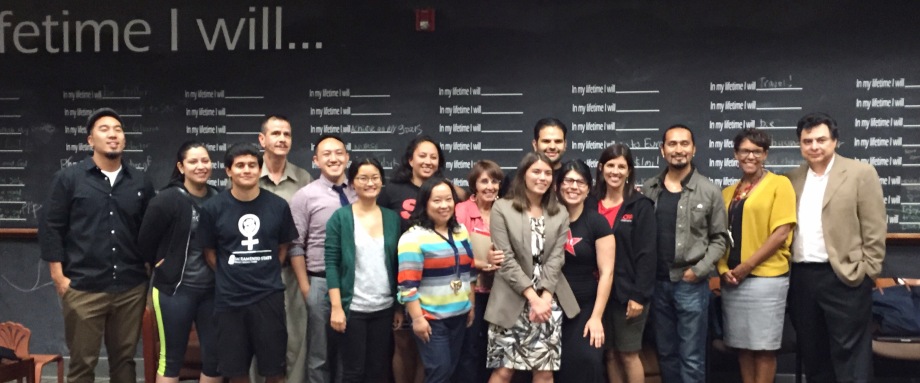
Meet the coalition behind Ethnic Studies in Sacramento

Sacramento Approves Ethnic Studies as Graduation Requirement

On Thursday, the Sacramento City Unified School Board unanimously approved the Student Advisory Council’s (SAC) resolution to make Ethnic Studies a high school graduation requirement. As Board President Darrel Woo remarked, “this is probably the most important vote I will ever cast as a school board member.” The Board’s approval is the culmination of months of research and planning by the District’s student-led council and Sacramento’s Ethnic Studies Now (ESNS) Coalition. HIP has been a proud member of the ESNS and we are overjoyed to see the community come together to help SCUSD celebrate and harness its diversity. While the implementation process will not be easy, we are proud that SCUSD has chosen be a leader in an increasingly diverse California. Ethnic Studies, in particular, is important to us because it has touched each HIP Organizer’s life.

“It helped us recognize the sacrifices of those that came before us and continues to fuel our desire to improve the lives for those that will come after us.”


Student Led. Student Driven. Student Power.

While the idea of making Ethnic Studies a graduation requirement had been floated around by various activists for a while, a tangible proposal did not materialize until a small team of passionate SCUSD students took the lead.
Jeremy Vang
Jeremy Vang, Sacramento Student Advisory Council Member
The Student Advisory Council is composed of student representatives from each of SCUSD’s thirteen high schools. At the beginning of the school year, the SAC set out to understand how high school students in Sacramento wanted to improve in their schools. Using a Youth Participatory Action-Research method, the SAC collected several hundred surveys from high schools students from throughout the District. When the survey results were tabulated, the SAC discovered that a significant portion of the student population felt their educational experience lack cultural relevance and that school violence driven by race relations was becoming too prevalent. Based on the results, the SAC drew a strong correlation to the absence of relevant curriculum to the growing challenges of their multicultural campuses. It should be noted that SCUSD is the fourth most diverse district in the entire nation, where 4 out of every 5 students is a student of color. With  mentorship from District Staff, in particular, Youth Services Specialist Mark Canero, the SAC concluded that establishing Ethnic Studies as a graduation requirement would give students the culturally relevant curriculum they thirst for, while also helping the District harness its diversity to create greater cross-cultural understanding.
Untitled Infographic-2
Once the decision to pursue Ethnic Studies as a graduation requirement was made, the SAC set out to make this a reality. They met with school board members to get an initial feel for how receptive the Board would be. They met with community leaders to build widespread and diverse support. They met with college students to help gather over 2,500 signatures. They met with professors from Sacramento State and UC Davis to learn more about existing Ethnic Studies curriculum. They met with District staff to learn about the logistics involved with changing graduation requirements.


EthnicStudiesNowIt takes a village.

Working alongside the SAC was a coalition of community members who were equally passionate about making Ethnic Studies a reality. Similar to efforts in Oakland, Los Angeles and San Francisco, Ethnic Studies Now – Sacramento (ESNS) originated from a shared vision of making Ethnic Studies more available to students in SCUSD and beyond.
The coalition originated from a significant contingent of Chicano/Chicana and Ethnic Studies professors from the local institutions of higher education. They were primarily interested in elevating Ethnic Studies in secondary education and reducing educational disparities affecting Latinos and other students of color. TheAssociation of Raza Educators – Sacramento Chapter was the first organization to support the SAC’s initiatives. Their unique expertise in developing Ethnic Studies curriculum and teacher training programs fast tracked the campaign–giving the students an eager Sacramento Approves Ethnic Studies as Graduation Requirement | Hmong Innovating Politics:

Nation's 'Disinvestment' in Public Schools Is Crippling Poor Students, Reports Say - State EdWatch - Education Week

Nation's 'Disinvestment' in Public Schools Is Crippling Poor Students, Reports Say - State EdWatch - Education Week:

Nation's 'Disinvestment' in Public Schools Is Crippling Poor Students, Reports Say


Six years after the national economy bottomed out, here's one generic view of K-12 finance: Budgets are more stable and can rely on more revenue than in 2008, and spending on K-12 has gradually recovered in many states over the last several years. So are prominent school funding advocates satisfied that states are now giving schools robust and well-targeted financial support?
Not even close.
"This should be easier, not harder," Wade Henderson, the president and CEO of the Leadership Conference Education Fund, told me in an interview.
The Education Fund is one of two advocacy groups, along with the Education Law Center, saying in reports released today that despite rosier revenue pictures and more ambitious student achievement goals, most states continue to hamstring schools, and poor students in particular, by failing to provide them more resources to help them meet these goals. 
Two Systems, One Big Failure
The two groups teamed up to issue "Cheating Our Future: How Decades of Disinvestment by States Jeopardizes Equal Educational Opportunity" that argues a majority of states continue to have flat or regressive funding schemes when it comes to providing additional financial support for students in schools with high concentrations of poverty.
"Cheating Our Future" highlights states like Pennsylvania, where insufficient public school funding has led to significant job losses in public schools, an effort in Mississippi to boost K-12 spending through a ballot initiative, and the cycle of funding lawsuits in Colorado in the face of the legislature's difficulties in overhauling its public school budget.
And in the foreground, Henderson said, is the ever-growing division between wealthier schools prepared to meet the demands of states' demand for highly skilled workers, and students in high poverty schools that not only lack basic resources, but suffer from "hidden inequity" such as the "expanded learning time that many more affluent students enjoy--including after-school programs, tutoring and mentoring, summer activities and field trips, or opportunities to learn outside the classroom."
"We are seeing increasingly that there are two separate public education systems," Henderson said. And the one left with more students in poverty and stagnant aid from states simply can't fulfill education mandates created by officials with primarily political ideology in mind, he stressed.
Four Measures Where Many States Fail
Separately but simultaneously, the Education Law Center released its fourth annual report on school funding fairness ("Is School Funding Fair? A National Report Card") that examines how and how much states fund K-12. The news there is correspondingly glum, according to the group: "Even with improvements in the economy, few states are translating that economic growth into Nation's 'Disinvestment' in Public Schools Is Crippling Poor Students, Reports Say - State EdWatch - Education Week:

Reduce Poverty and Ensure Equity: The Key to Education Reform Is Not the Common Core | janresseger

Reduce Poverty and Ensure Equity: The Key to Education Reform Is Not the Common Core | janresseger:

Reduce Poverty and Ensure Equity: The Key to Education Reform Is Not the Common Core


Last week three prominent education and civil rights leaders confronted what has appeared to be a civil rights establishment defense of annual standardized testing as the necessary centerpiece of a reauthorized No Child Left Behind Act.  John Jackson, president and CEO of the Schott Foundation for Public Education, Pedro Noguera of New York University, and Judith Browne Dianis, director of Advancement Project—a national racial justice organization, published an op-ed in The Hill in which they declared: “In recent weeks, a few national civil rights organizations including the National Council of La Raza, the National Association for the Advancement of Colored People, the League of United Latin American Citizens and National Urban League have vocally opposed efforts to highlight the dangers of high stakes testing by students and parents opting out of annual assessments.  United under the banner of the Washington, D.C.-based Leadership Conference on Civil and Human Rights, these groups are urging parents to comply with annual testing requirements.  We strongly disagree with their position.”
Jackson, Noguera, and Browne Dianis call Congress to focus the reauthorization of the federal education law on eliminating the opportunity gaps that federal policy in education was originally designed to address: “We now know students cannot be tested out of poverty….”  “We should all remember that NCLB (No Child Left Behind) was originally enacted in 1965 as the Elementary and Secondary Education Act (ESEA), as part of President Lyndon B. Johnson’s war on poverty.  The measure was designed to compensate for disadvantages in learning opportunities between low-income and middle-class children.  While it was never adequately funded, ESEA was envisioned as an ‘anti-poverty’ bill.”  “Schools serving poor children and children of color remain under-funded and have been labeled ‘failing’ while little has been done at the local, state or federal level to effectively intervene and provide support.  In the face of clear evidence that children of color are more likely to be subjected to over-testing and a narrowing of curriculum in the name of test preparation, it is perplexing that D.C. based civil rights groups are promoting annual tests.”
In his commentary for the Education Opportunity Network last week, Jeff Bryant proclaims the same theme in, Dumb Arguments About the Common Core Distract from What Matters Most.  Bryant writes: “While it’s refreshing to see K-12 education become a prominent issue in the very early stages of the 2016 election campaigns, it’s unfortunate to see support for the Common Core—the contentious new standards adopted by most states—become the focus of the debate… For sure, inequity is a problem—if not the problem—in American schools.  Inequities related to students’ race, ability levels, English language proficiency, and income characterize nearly every aspect of the outputs and inputs of the system.  The achievement gap between white students and their black and brown peers has been at the center of Reduce Poverty and Ensure Equity: The Key to Education Reform Is Not the Common Core | janresseger:

CURMUDGUCATION: The Graduation Rate

CURMUDGUCATION: The Graduation Rate:

The Graduation Rate


If you want a quick, clear look at the story behind the awesometastic grad rate miracle rate of 81%,this NPR piece from Anya Kanenetz is a good place to start (it's also pretty).

Kamanetz boils down the possible explanations to three:

1) Intervention
2) Making it easier
3) Cheating

The intervention option is clearly the best one. But it is also expensive and time-consuming. So it's no wonder that many districts resort to 2 and 3. We don't have them in these parts, but I keep hearing about recovery credits, which sound suspiciously like cheap extra credit/makeup work projects that allow schools to say a student passed a course. Beyond the official institutional ways to lower the bar, most teachers have also encountered the unofficial approach-- the one where a guidance counselor or a principal or a special ed department head calls you in to explain why you need to offer some extra credit or make-up work or just plain re-compute your final grades in order to achieve the desired result for Chris McSadstudent.

The article also notes that Texas has miraculous improvements in graduation rate, which we can just add to the list of Texas miracles that aren't (like miraculous economic growth or their earlier education miracles). But many states have figured out how to make students disappear before they can hurt the numbers.

I don't dispute the value of graduation rate as a measure of How Well We're Doing. Well, I don't dispute it as long as we change one simple thing.

Four years.

Why, exactly, is the four year part important?

I have taught so many students sooooooo many students who struggled and finally got a handle on things or broke through to understanding or just plain grew up enough that after a tough start in high school, they finally graduated-- proudly and honestly. But they did it in four years. So they don't count.

Here's Pat, who was a hellion in ninth grade and couldn't focus and was defiant and tried to Teach The School a Lesson by flunking everything on purpose. And then sometime around birthday #16, Pat just settled down and figured it out. But by then Pat was a year behind. Pat graduates in five years. 

Here's Chris, who was basically homeless until age fifteen. Chris spent two years in ninth grade because there was nobody at home to get Chris to school more than two days a week. But Chris's mom finally got a job and a car and a stable relationship, and Chris did great work in 10th, 11th and 12th grade, graduating in the middle of the class. But Chris did it in five years.

Here's Sam, who decided that cyber school sounded pretty cool. Sam left for cyberia three months into tenth grade, and the entire rest of the year was a wash, and Sam was soon back in public school, where a repeat of tenth grade was necessary to get back to speed. Sam, now convinced CURMUDGUCATION: The Graduation Rate:


PA: The Big Bucks

Can you guess who the highest-paid educator in Pennsylvania is?

It's Abington School Superintendent Amy Sichel, who on July 1 will see her salary rise to a healthy $319,714. 

Sichel may or may not be worth it. Okay, no-- nobody's worth that kind of money. But Sichel is also not the standard issue shiny bump-and-run superintendent that we see in so many districts. She has spent her entire career in the Abington School District (north of Philly), and she has held the superintendent job for fifteen years (which is roughly 143 in superintendent years).

A profile from 2012, when Sichel was tapped to lead the AASA (the school superintendents association), included praise from the teachers' union and from the school board:

“Amy is a tough cookie and a strong personality. When she comes into the room, you know she’s there,” Debra Lee, president of the Abington Education Association, says. “She’s a no-nonsense person. She expects the most of everyone, but she also gives us the most. She is a wonderful leader, someone you want to follow.”

“She doesn’t beat around the bush with good news or bad news,” [Board President Raymond] McGarry adds. “She has no hidden agendas. She tells you what she expects in terms of behavior and achievement. I appreciate that. There is nothing worse than a leader with unclear goals.”

She has made some gutsy choices, like eliminating all but college-bound tracks. But I give her points for making her changes and then sticking around to see them through. This puts her in a different 

PA: The Big Bucks

Under Attack Teachers Can Be Bullied Too | Teaching Tolerance

Under Attack | Teaching Tolerance:

Under Attack


On November 1, 2013Teaching Tolerance (TT) posted a blog by an anonymous contributor titled “Teachers Can Be Bullied Too.” The author describes being screamed at by her department head in front of colleagues and kids and having her employment repeatedly threatened. She also tells of the depression and anxiety that plagued her following each incident.
To be honest, we debated posting it. “Was this really a TT issue?” we asked ourselves. Would our readers care about the misfortune of one teacher? How common was this experience anyway? 
The answer became apparent the next day when the comments section exploded. A popular TT blog might elicit a dozen or so total comments; readers of this blog left dozens upon dozens of long, personal comments every day—and they continued to do so. “It happened to me,” “It’s happening to me,” “It’s happening in my department. I don’t know how to stop it.” 
This outpouring was a surprise, but it shouldn’t have been. A quick Web search revealed that educators report being bullied at higher rates than professionals in almost any other field. (Nursing is also at the top.) A second search put us in touch with the Workplace Bullying  Institute (WBI) and its cofounder, Gary Namie, who for years has worked with teachers seeking support and relief from bullying. Namie and WBI offer a theory for the high concentration of bullying in education and nursing.
“The professionals who get into these fields [have] a pro-social orientation,” he says. “They’re helpers, right? For teachers, they’re really development specialists. … They’re not political animals. They have their back turned to the politics, which of course, then opens them up to this attack. Because of their goodness in a way, because of their motivation. This is why they get targeted.”
Namie’s description of who gets targeted matches up with the identity of our anonymous blogger and with many of the commenters: veteran or high-achieving teachers who cultivate strong relationships with students and families. So why these teachers, we asked? Wouldn’t they be the ones colleagues and administrators would want to keep around?
Motives
“Bully targets are threatening to a perpetrator. They pose a threat in some way, usually because of teaching excellence or focus on children, or adherence to the mission or their principles,” Namie explains. “This just agitates the crap out of somebody who is unscrupulous and sadistic. They can’t stand it.”
Karen Horwitz was an award-winning English teacher who experienced a stress-related health crisis and left education after suffering alleged bullying by her principal. After fighting an extended court battle (her case went all the way to the U.S. Supreme Court, where it was dismissed), Horwitz founded an organization called the National Association for the Prevention of Teacher Abuse (NAPTA). Based on over a decade of work supporting bullied teachers, she asserts that the motives behind teacher abuse fall into two camps.
“[Some people] are doing it because they’re power hungry and they like the feeling that they can come in there … and torment a bunch of people. It makes them feel good,” she says. “Some of them are doing it because they’re making a lot of money.”
Horwitz believes that a significant percentage of teacher bullying is related to school reform or privatization agendas (forcing out teachers who “won’t play ball”) and to attempts to cover up financial impropriety, a phenomenon she calls “white chalk crime” (also the title of her book). Low-income communities and communities of color, she says, are particularly vulnerable.
“That offends me more than anything,” Horwitz says. “That they would take these really good, solid … teachers and abuse them out of teaching when those kids need them more than anything.”
While experts may debate the motives, one thing is clear: The hierarchical structure of many schools and districts combined with the isolation many teachers experience due to the nature of the job can create an environment where bullying behavior can easily go unchecked—with devastating consequences for the target of the behavior and for the kids they teach. 
Tactics and Effects
According to the numerous experts we spoke with and many of the commenters on our blog, the experiences of targeted teachers are, to use Namie’s words, “almost prototypical.” The Under Attack | Teaching Tolerance:

Traditional teaching faces a cyberthreat from school model - LA Times

Traditional teaching faces a cyberthreat from school model - LA Times:

Op-Ed Traditional teaching faces a cyberthreat from school model


There's a new network of K-8 private schools called AltSchool, based in San Francisco and soon expanding to Brooklyn, N.Y., and Palo Alto. From that tiny amount of information — the name, the locations — you can probably guess that AltSchool is trying to modernize education for the digital age. At AltSchool, according to NPR, every student “has a laptop or a tablet, and they spend about 30% of their day on their devices, completing what are called playlists.”

AltSchool, which announced recently that it was hiring executives from Google, Uber and Zynga, is also a software developer. While AltSchool expands its network into what one investor hopes will become “the world's biggest private school system,” it is simultaneously planning to license technology to other academic institutions. Silicon Valley has taken notice: In May, AltSchool announced $100 million in funding from various investors, including Facebook's Mark Zuckerberg. It would seem the company has tapped into the zeitgeist.

As a high school teacher, I've followed these developments with trepidation. Whether or not AltSchool meets lofty expectations, it epitomizes the increasingly popular belief that human instructors must cede to computers as the font of knowledge. That's a profound shift that educators have barely begun to contemplate.

AltSchool's pitch to parents — as opposed to investors — is familiar. It offers small class sizes, highly qualified teachers and instant feedback. Public schools have explicitly prioritized these qualities for decades. Somewhat less familiar is AltSchool's description of what those highly qualified teachers actually do. According to AltSchool's website, “The sheer amount of information available today calls for us ... to reimagine the educational experience” as one in which teachers “curate” the curriculum in partnership with students and parents and “co-learn with the students.”

Although he comes from a family of teachers, AltSchool's founder and chief executive, Max Ventilla, told me he “definitely agrees” that whereas teachers were once considered the Traditional teaching faces a cyberthreat from school model - LA Times:

Surging school meal prices puts strain on families - CBS News

Surging school meal prices puts strain on families - CBS News:

Surging school meal prices puts strain on families


School meals are designed to be both nutritious for students and easy on their families' pocketbooks. Yet while some school lunches might get an "A" on providing essential nutrients, they appear to be receiving a flunking grade for affordability.
The issue of school meal prices came to the forefront last week when a school kitchen manager in a Denver suburb said she lost her job after giving lunches to students who didn't have the money to pay. While the school district later said the employee was let go for other reasons, the incident raised questions about how children from families earning at least $31,000 per year -- the threshold for a family of four to receive free lunches -- could fail to afford the seemingly modest cost of school breakfasts and lunches. Reduced-price lunches are available for families earning 185 percent above the poverty rate, or about $44,000 for a family of four.
At the heart of the issue is a tough economic squeeze for families considered the "working poor," or those who are scraping by just above the poverty threshold. The average price of an elementary school lunch has surged 52 percent in just 11 years, according to a study from the Food Research and Action Center, a nonprofit that focuses on anti-hunger initiatives. During the same period, the median income of U.S. households has declined 5.4 percent.
"For families with income over 185 percent of the poverty level, that's sometimes a tough lift, if kids are eating two meals at school," Jim Weill, the president of the Food Research and Action Center, told CBS MoneyWatch. "As schools have gotten more squeezed, they are trying to be more aggressive about cost control and trying to get more income from the cafeteria."
The other cause of higher school meal costs is the Paid Lunch Equity provision, which was enacted by Congress as part of the Healthy, Hunger-Free Kids Act of 2010, Weill noted. The provision requires school districts to increase the prices of "paid lunches," or those meals purchased by children who don't qualify for free or reduced-price meals, after the U.S. Department of Agriculture found that full-price meals were sold for 13 percent less than the cost to produce the meal.
While the cost of school meals had been rising for years, that provision was a key driver in the escalating costs of school breakfasts and lunches. Elementary school lunches have seen the sharpest increase in prices (52 percent), followed by middle school and high school lunches, at 47 percent and 46 percent, respectively, according to data from the Food Research and Action Center. The average price of an elementary school lunch was $2.18 per day in the 2013-2014 school year, while middle-school and high-school lunches cost an average of $2.37 and $2.42, respectively.
A family with two children in elementary school and an annual income of $45,000 would be required to pay $784 for lunches during the typical 180-day school year. Add in breakfast, and fees for school meals can easily top $1,200 annually. For families struggling in cities with high costs of living, such as San Francisco and New York, that additional $1,200 can be hard to come by, Weill noted.
"That's a lot of money when salaries for the bottom half of the population have been declining or flat, while housing and medical costs have been going up," he noted.
In the recent Colorado case, Della Curry said she gave school lunches to children who didn't have the money to pay for a regular lunch. In her school system, kids who failed to qualify for free or reduced lunch were given one slice of cheese on a hamburger bun and a small milk.
Although providing a child with a cheese sandwich might seem like a kindness rather than letting them go hungry, the strategy ends up stigmatizing the children of the working poor, who, Weill notes, aren't responsible for whether their parents can afford school lunches. In a recent case in Maryland, one mother said her children ended up humiliated after she fell behind by $12 and her children's school gave them cheese sandwiches rather than the regular hot entree.
"It sets them up for ridicule and bullying," the mother told CBS affiliate WUSA.
While the free and reduced-price lunch program is designed to provide Surging school meal prices puts strain on families - CBS News:

This Is Where School Funding Is The Least 'Fair,' According To New Reports

This Is Where School Funding Is The Least 'Fair,' According To New Reports:

This Is Where School Funding Is The Least 'Fair,' According To New Reports


In Mississippi's Carroll County school district, there are no advanced placement courses, no foreign language classes and not enough textbooks for children to take home at night. Until last year, students on the high school football team had to change clothes in a makeshift room that previously functioned as a chicken coop. Two years ago, the district's superintendent, Billy Joe Ferguson, cut his own salary from $87,000 to $18,000 in order to free up funds for the schools.
Schools in Mississippi are provided with some of the lowest levels of state and local funding in the nation, according to two reports released simultaneously Monday detailing disparities in school resources around the country. For most of the past 10 years, the state has failed to live up to its own law requiring certain funding levels for schools.
Unfortunate circumstances like the ones in Carroll County can be seen across the country, say the reports from the Leadership Conference Education Fund and the Education Law Center, a New Jersey legal and advocacy group. The first report, from both groups, takes a qualitative approach, using anecdotes to show how inequities in school funding shortchange the nation's most vulnerable children. The other report,from the Education Law Center only, evaluates the level of school funding "fairness" in each state, focusing on four measures using 2012 data: funding level (the average state and local revenue spent per pupil), funding distribution (how funds are distributed between high and low-income areas), effort (how much a state spends on education relative to its gross domestic product) and coverage (the proportion of a state's children in public schools versus private schools).
The idea, according to the report, is to see if states "support equal educational opportunity for all students and, in particular, for low-income students in school districts with concentrated poverty."
Indeed, at a time when an increasing number of students qualify for free or reduced-price lunch nationwide, the disparities in school resources across zip codes are deep.
"In too many places -- urban, suburban, and rural -- our schools are struggling to find the resources they need to serve all children well. This is especially true in communities that serve students most at-risk, including children from low-income families and children of color," says the groups' report.
The chart below details how states did on two of the four funding fairness measures: funding distribution and effort, according to the Education Law Center. On measures of funding distribution, states like South Dakota, Delaware, Minnesota and New Jersey scored near the top. On measures of effort, states like Vermont, West Virginia and New Jersey scored highly. But the context surrounding this data demands further interrogation. For example, North Carolina improved on measures of funding distribution in 2012, but only because the state slashed funding for wealthy districts while maintaining its levels of funding for poor districts.This Is Where School Funding Is The Least 'Fair,' According To New Reports:

No Child Left Behind Act Inadvertently Impacts State Governments’ Finances, says Rutgers–Camden Researcher | Media Relations

No Child Left Behind Act Inadvertently Impacts State Governments’ Finances, says Rutgers–Camden Researcher | Media Relations:

No Child Left Behind Act Inadvertently Impacts State Governments’ Finances, says Rutgers–Camden Researcher

In 2001, the U.S. Congress passed the bipartisan No Child Left Behind (NCLB) Act, reaffirming the federal government’s commitment to student achievement, particularly for disadvantaged students. Touted as a triumph for education reform, the act requires each state to develop and implement its own student-assessment standards in order to receive federal funding.
However, the act had an unintended fiscal impact on state governments’ finances as a result of the interaction between binding school district tax and expenditure limitations (TELs) and the underfunded mandates of NCLB, explains Michael Hayes, an assistant professor of public policy and administration at Rutgers University–Camden.
Hayes examines this differential effect of NCLB on states’ contributions to education funding in states with TELs, in the spring 2015 issue of Public Budgeting and Finance.
Using state-level data, Hayes found that, from 1992 to 2009, states which imposed TELs contributed 4.3 percent more towards education funding than states without binding school district TELs after the passage of NCLB.
“This suggests the financial burden of NCLB was placed on state governments, especially in states with TELs,” says Hayes, a Philadelphia resident.
According to the Rutgers–Camden researcher, while it is evident that states gain an expanded responsibility and role in financing public education, in this case it remains to be seen whether this expansion has a positive or negative outcome.
“Some policymakers would argue that centralizing education finance at the state level increased equity in public education across school districts,” says Hayes. “This argument assumes that states provide a disproportionally higher amount of education assistance to low-performing school districts. This may not have been the case, however, and it should be a topic for future research.”
Hayes posits that several steps could be taken on the federal and state levels to correct this “fiscal shock” to state governments’ finances. On the federal level, he says, the government could redesign underfunded mandates and grants so that local governments are exempt from binding TELs if they need to increase additional funding in order to meet federal requirements. If local governments can raise additional own-source revenues, he notes, this reduces the burden on state government. 
Furthermore, explains Hayes, state governments may want to assess whether or not their specific TELs policies are meeting their intended fiscal goals, as well as examine the potential unintended consequences of TELs.
“To put it succinctly, if the social costs of TELs outweigh the social benefits, states may want to consider changing their TEL policies,” says Hayes.
Tom McLaughlin
Rutgers University–Camden
Editorial/Media Specialist
(856) 225-6545
thomas.mclaughlin@camden.rutgers.edu

ACCJC Targeting City College of San Francisco while allowing violations by the for-profit Heald College to go unchecked

Assemblyman Ting, Education Advocates Demand Accreditation Process Reforms:

Assemblyman Ting, Education Advocates Demand Accreditation Process Reforms


Assemblyman Ting, Education Advocates Demand Accreditation Process Reforms

Legislators and education advocates today called for curbs on the powers of college accreditors, who they accused of targeting City College of San Francisco while allowing violations by the for-profit Heald College to go unchecked.
State Assemblyman Phil Ting (D-San Francisco) joined advocates of statewide accreditation process reforms outside the ACCJC’s biannual meeting in Oakland today and called for reforms to reign in the commission’s powers before more students, faculty and staff at other colleges across the state are impacted.
Ting has authored two bills that aim to reform the accreditation process.
The proposed legislation and today’s protests outside the commission meeting came after California’s State Superior Court ruled in January that the commission broke the law when it tried to close City College of San Francisco.
The commission also received criticism from the U.S. Department of Education for its treatment of California community colleges in 2014.
Fred Glass, a spokesman for the California Federation of Teachers, said the issues with the ACCJC go back even further.
According to the California Attorney General, back in 2007 the for-profit vocational operator, Corinthian Schools Inc., was ordered to pay $6.5 million, including $5.8 million in consumer restitution, to settle a lawsuit that alleged the company used false advertising and unlawful business practices by presenting inaccurate salary and employment information to students.
When Corinthian bought Heald College in 2010, the ACCJC became the lead accreditor for the school. From 2010 to 2012, the ACCJC didn’t find any violations at Heald College.
In 2012, when Heald College wanted to become accredited as a four-year college, the ACCJC handed over the school’s accreditation process to the Western Association of Schools and Colleges and recommended Heald for full accreditation, according to Glass.
Corinthian was fined another $30 million for similar violations in April and abruptly closed 28 campuses, impacting roughly 16,000 students.
Glass said that the ACCJC oversaw both Heald College and CCSF, yet unfairly pursued the non-profit school and “turned a blind eye” to the continued violations at the for-profit school.
Ting’s bill, AB 1397, would create comprehensive reforms to the accreditation process, Glass said. If passed, it would provide due process, greater objectivity and transparency, including public access to commission meetings.
Currently, commission meetings allow for only 15 minutes of comments from 20 Assemblyman Ting, Education Advocates Demand Accreditation Process Reforms: