Latest News and Comment from Education

Wednesday, April 29, 2015

8th graders struggle in US history, civics on national exam - Yahoo News
8th graders struggle in US history, civics on national exam - Yahoo News:

8th graders struggle in US history, civics on national exam

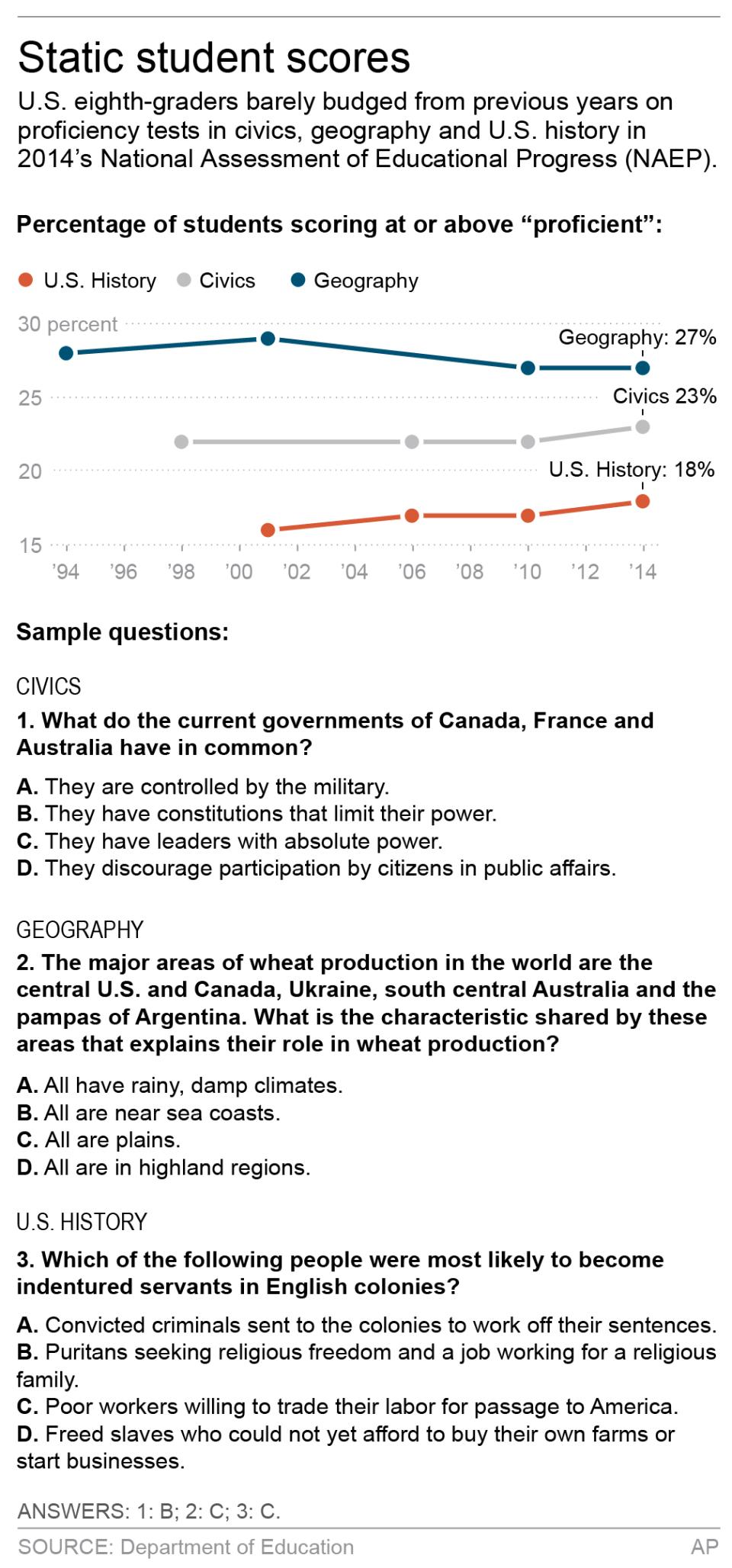
Graphic shows student NAEP scores for civics, geography and history with sample questions; 


WASHINGTON (AP) — Time for another history lesson.
Only about a quarter of eighth graders showed solid performance or better in U.S. history, civics and geography on tests known as the Nation's Report Card.
The 2014 results from the National Assessment of Educational Progress released Wednesday were similar to those four years ago when the assessments were last administered. Students did better overall in U.S. history and civics than their peers in the 1990s when the tests were first given, but geography scores have remained stagnant since 1994.
Among the findings: Less than half — 45 percent — of eighth-grade respondents were able to correctly interpret time differences using an atlas with time zones. Only about a third knew that "the government of the United States should be a democracy" is a political belief shared by most people in the U.S.
Michelle Herczog, president of the National Council for the Social Studies, said the results "point to a need for immediate action." Tackling issues like terrorism, human rights, race relations and poverty require a deep understanding of the historical and geographic context, she said.
"How do we, as a nation, maintain our status in the world if future generations of Americans do not understand our nation's history, world geography or civics principles or practices?" Herczog said.
A breakdown of the test and results:
HOW STUDENTS DID
Only 18 percent of students demonstrated solid performance or better in U.S. history. The results for geography and civics were slightly better, 27 percent and 23 percent, respectively.
A large share of the eighth graders who took the test scored at the "basic" level, meaning just partial mastery of the subjects. Only 1 percent of test takers in U.S. history, 3 percent in geography and 2 percent in civics scored in the advanced level.
White and Asian students performed better than their Hispanic and black peers. Although the scores overall were similar to 2010, Hispanic students made gains in U.S. history and geography and white students made gains in U.S. history and civics. The scores of black and Asian students didn't budge in the three categories.
OTHER FINDINGS
About two-thirds of the eighth graders were able to use a map to locate a country on the Horn of Africa, but only a quarter successfully completed a two-part question that involved explaining how the participation of African-Americans in the Civil War affected the war's outcome.
WHO TOOK THE TEST
A nationally represented sample of 29,000 eighth graders from public and private schools took a test in one of the three subjects.
It is administered by the Education Department's National Center for Education Statistics.
HOW STUDENTS LEARN
History class is going digital.
Compared to four years earlier, more students in 2014 reported using computers at school in their U.S. history and social studies classes. Fewer said they read material from a textbook and more listened to information presented online or watched movies or videos. More of them said they use letters, diaries or essays written by historical people in their studies.
The assessment is not designed to provide the context needed to explain student performance or what works in classrooms.
SAMPLE QUESTIONS
Question: The Supreme Court's 1803 decision in Marbury v. Madison established the court's power to:
—Impeach a president
—Decide whether a federal law is constitutional
—Resolve conflicts between states
—Resolve conflicts between the president and Congress
(asterisk)(The answer is B, which 41 percent of students chose correctly.)
Question: What is one responsibility that modern Presidents have that was not described in the Constitution?
A) Commanding the armed forces
B) Granting pardons
C) Appointing Supreme Court justices
D) Proposing an annual budget to Congress
(asterisk)(The answer is D, which 38 percent of students chose correctly.)
_____
Follow Kimberly Hefling on Twitter: http://twitter.com/khefling 8th graders struggle in US history, civics on national exam - Yahoo News:

The Department of Education Suggests Suspect For-Profit Colleges as Corinthian Stand-ins - MainStreet

The Department of Education Suggests Suspect For-Profit Colleges as Corinthian Stand-ins - MainStreet:

The Department of Education Suggests Suspect For-Profit Colleges as Corinthian Stand-ins


 NEW YORK (MainStreet) — Corinthian Colleges may be gone, but the 16,000 students left in the lurch are still here--and they want to finish their degrees. If you're the Department of Education (ED), you're looking for someplace for them to go. Who are you going to call?

Would you believe ITT Technical Institute?
Those 16,000 students represent millions of dollars in student loans--nearly $215 million by some estimations.
The specter of a massive loan write-off may be among the reasons that ED could be desperate to farm these students out to other for-profit schools. The federal government would recover something, since the loan write-offs would have to be reported by the borrower as income. Not every loan would be written off. Still, the likelihood is that ED wants to get paid as much as possible.
"Our priority is to offer immediate help to the 16,000 Corinthian students suddenly notified that their school would be closed, in part by providing information and options to those who may wish to complete their education," said ED spokesperson Denise Horn. "We also sent students information about their eligibility for closed school discharge and have instructed our (loan) servicers to reach out directly to affected borrowers to share information on options." ED contracts with Great Lakes Education, Navient (formerly Sallie Mae), NelNet, and the Pennsylvania Higher Education Assistance Agency to collect on Federal student loans.
"At least 42% of these students were within six months of completing their degrees," Horn said. "We are doing everything we can within statutory limits to help students affected by the largest college shut-down in American history."

But ED is in a tight spot--one that will get tighter as calls for unconditional loan discharges become louder. "There is overwhelming evidence of widespread fraud at Corinthian," said Lauren Asher, president of The Institute for College Access and Success (TICAS), in a statement. "Nothing can give students back the time they spend trying to improve their lives at Corinthian, but they must be able to start fresh by having their loans discharged. We urge the Education Department to discharge the Federal loans of current and former Corinthian students who were defrauded, including those affected by Corinthian's action."
Making sure that Corinthian students take their Corinthian credits—and their loans—to another school guaranties that ED will get paid. On Monday, Senator Dick Durbin (D-Ill.) pointed out in a speech to the Senate, "If you transfer your Corinthian credits, which already have limited value, to another school, you can't discharge your loan you took out at Corinthian."
ED has proposed sending students to schools that profile similarly to Corinthian. The unseemly picture that emerges is that Corinthian students, widely regarded as victims of a fraudulent for-profit college, would be sentfrom one scam school to another. In addition to ITT Tech, those Corinthian alternatives ED proposes include:
The Art Institutes and Argosy University, whose parent company, Education Management Corporation, is under investigation by the Department of Justice and 17 state attorneys general. The schools are also on ED's Heightened Cash Monitoring list and have had Federal funds restricted due to problems that surfaced in an audit.
DeVry University, which is under investigation by the Federal Trade Commission and two state attorneys general.
Le Cordon Bleu and International Academy of Design and Technology, whose parent company, Career Education Corporation, is being investigated by 17 state attorneys general and are also on ED's Heightened Cash Monitoring list.
Kaplan University, which is under investigation by three state attorneys general.
University of Phoenix, whose parent company, Apollo Education Group, is being investigated by two state attorneys general.
Westwood College in Chicago, owned by Alta Colleges Inc., is being sued by the Illinois attorney general for deceptive recruiting practices.
ED's Denise Horn defended the Department's handling of Corinthian: "Corinthian's closure follows a series of aggressive enforcement actions aimed at protecting students and taxpayers against an unscrupulous company"--one that ED bankrolled for years.
During the last year, once it was clear the Corinthian had become dysfunctional, ED moved to shut it down. Horn said that "the Department has acted consistently and strongly to help students, avoiding the immediate disruption in education for 72,000 students. With this week's closure, the Department will continue to work urgently to do everything possible to protect students, borrowers and taxpayers.”The Department of Education Suggests Suspect For-Profit Colleges as Corinthian Stand-ins - MainStreet:


The problem with education is America’s contempt for teachers | Dallas Morning News

Troy Earl Camplin: The problem with education is America’s contempt for teachers | Dallas Morning News:

The problem with education is America’s contempt for teachers


Almost every problem with education in the U.S., from kindergarten to college, can be traced to the same basic thing. And almost every reform of education passed into legislation is founded on this same thing — a fact that suggests these reforms can only make education worse. That thing that underlies the problems we have with education in America is the widespread American contempt for teachers.
The contempt in our culture gets expressed in many ways. Parents treat teachers like baby sitters. Administrators treat teachers’ talk of higher wages as appalling, dismissing money talk with, “You’re supposed to be in it for the children” — as though worrying about paying your bills keeps you focused on your students. Legislators impose standardized tests as a blatant accusation of incompetence. Universities hire more and more adjuncts at poverty wages. All of these are expressions of contempt for teachers.
The contempt gets translated to classroom behaviors by the students. The parents don’t respect the teachers, and when administrators almost always take the side of students over the teachers, that too teaches students not to respect their teachers. On the news, we are always hearing about the problems with our schools, and that is almost universally interpreted as problems with our teachers. From every authority, students hear the message that teachers are the problem, not deserving of respect. How should we expect them to act?
This attitude toward teachers is a uniquely American one. Students and parents who are recent immigrants are typically quite respectful of teachers. In most places around the world, teaching is an honored and honorable profession. This gets translated into respect, and even into decent pay in many countries. In the U.S., we pay poorly, disrespect teachers, provide them with terrible insurance, and overwork them in an emotionally taxing, highly stressful job.
Under such conditions, we shouldn’t be surprised to find low performance. But even then, how much are the teachers to blame? Standardized tests treat students as the same, whether the students have a high or low IQ, are autistic, have learning disabilities like dyslexia or cannot speak English. And if they do not pass the test, it is not the fault of the low IQ, learning disabilities or language barriers. No. It’s somehow the fault of the teacher. And this ignores behavioral problems that can affect students and their classmates as well.
Worse, there is research that shows standardized tests in no way reflect the quality of teaching or the degree of learning. John List and other researchers at the University of Chicago have demonstrated that by using what economists call “loss aversion,” they could dramatically raise test scores. What they did was give students, literally right before they took the test, with no warning beforehand, a small amount of money, and told them that they could keep the money if they scored well on the test. As if by magic, test scores dramatically increased. And racial gaps in test scores disappeared. What this suggests is that standardized tests do not test for student learning, nor for teacher competence in teaching. Rather, they test for students’ motivation to do well on that test. In other words, they are useless.
Does this mean students are to blame for their low test scores? What drives students to be more motivated? The lack of motivation can be traced to their parents’ attitudes. Parents who do not value education, who have contempt for teachers, who are themselves unmotivated and do not motivate their children are the problem. But so, too, is the very presence — the very overbearing presence — of standardized tests. Students are hardly motivated to do well on the tests. They are badgered and browbeaten all year, given test-taking strategies, etc., but in the end, the students are simply made to hate school, hate their teachers and hate testing. Talk about being unmotivated.
But nobody wants to deal with these problems. They are too complex. Some of these issues are too volatile. And the testing industry is in a mutually beneficial relationship with the legislators forcing these tests down everyone’s throats. In the end, it is simply easier to pick on the teachers, to heap contempt upon them all. But as long as we do that, our problems in education, from kindergarten to college, will continue to get worse.
Richardson resident Troy Earl Camplin has a doctorate in the humanities from the University of Texas at Dallas and has taught English in middle school, high school and college. Reach him attroycamplin@gmail.com.Troy Earl Camplin: The problem with education is America’s contempt for teachers | Dallas Morning News:

NAEP - 2014 U.S. History, Geography, and Civics Assessments

NAEP - 2014 U.S. History, Geography, and Civics Assessments:


Report Highlights


Results at a Glance

NAEP data provides a wealth of information about how the nation’s students are performing in various subjects and how that performance has changed over time. The overviews below present some of that data for U.S. history, geography, and civics.

About the Assessments

More than 29,000 eighth-graders across the country participated in the 2014 NAEP assessments in U.S. history, geography, and civics. Each student responded to multiple-choice and constructed-response (open-ended) questions in one of the three subjects.

U.S. HISTORY

U.S. history questions measured students’ knowledge of American history in the context of four major themes: Democracy, Culture, Technology, and World Role.
Target percentage distribution of assessment time in eighth-grade NAEP U.S. history, by theme: 2014
DemocracyCultureTechnologyWorld Role
30%30%20%20%

GEOGRAPHY

Geography questions measured the knowledge of geography in three content areas: Space and Place, Environment and Society, Spatial Dynamics and Connections.
Target percentage distribution of assessment time in eighth-grade NAEP geography, by content area: 2014
Space and PlaceEnvironment and SocietySpatial Dynamics and Connections
40%30%30%

CIVICS

Civics questions measured students’ knowledge and skills related to five essential content areas about government and society. Separate scales were not created for the knowledge components of the civics assessment.
Target percentage distribution of assessment time in eighth-grade NAEP civics, by content area: 2014
Define Civic Life, Politics, GovernmentFoundations of American Political SystemGovernment Embodiment of American DemocracyU.S. Relationship to Other NationsRoles of Citizens
15%25%25%15%20%
News Release 
Available Now:
Results from the 2014 U.S. History, Geography, and Civics Report

Vocabulary Results from the 2013 Reading Assessment
See More NAEP Results 

Teaching and Learning 
Explore information on the instructional factors related to student education in the following subject areas:

The Trouble With Grading Employees - WSJ

The Trouble With Grading Employees - WSJ:


The Trouble With Grading Employees

Performance ratings such as ‘meets expectations’ sap workers’ morale, but firms aren’t sure they can do without them


Can a year’s worth of work be boiled down to a stock phrase like “meets expectations”?
As companies reinvent management by slashing layers of hierarchy or freeing workers to set their own schedules, performance ratings—which grade workers on a 1-5 scale or with labels like “on target”—stubbornly hang on. Companies like Gap Inc.,Adobe Systems Inc.and Microsoft Corp. abolished such ratings after leaders decided they deterred collaboration and stoked staffers’ anxieties. Yet other companies are having a harder time letting go.
Intel Corp. has long rated and ranked its approximately 105,000 workers on a four-level scale, from “outstanding” to “improvement required.” Devra Johnson, a human-resources director at the chip maker, observed that ratings tended to deflate morale in a good chunk of the 70% of the company’s workforce that receives a “successful” rating each year—the second-lowest label.
“We’d call them the walking wounded,” she said.
Human-resources managers conducted an experiment to test a new way of managing performance, allowing 1,700 workers in the HR department to go unrated, although not without feedback, for about two years, according to Ms. Johnson.
Managers found they could still differentiate performance and distribute compensation. However, when Ms. Johnson’s team presented its findings, company executives weren’t ready to give the labels up, concerned that forgoing ratings would suck healthy tension out of the workplace, she said. So the HR department started rating the employees in the experiment again.
“We don’t want to be in a place where everyone’s an outstanding,” she said. “We worry a lot, as we should, about unintended consequences. You make a little tweak in an innocuous place—you don’t know, sometimes, the impact it might have.”
An Intel spokeswoman declined to be quoted for this article.
Marc Farrugia, the vice president for human resources at Sun Communities Inc., is going through the “exhausting” process of revamping performance management at the owner and operator of manufactured housing communities. He’s concerned about the accuracy of the company’s current approach to ratings; some managers just dole out higher scores in order to maximize bonuses for employees they’re scared might leave; others give everyone average ratings because it is easy. Workers complain the ratings aren’t fair and don’t paint a true picture of their annual performance.
“I’m being more and more convinced that ratings are doing more harm than good,” Mr. Farrugia said.
Some managers felt differently, however. At a recent meeting, senior managers resisted the idea of eliminating ratings, claiming workers wouldn't get the feedback they need, Mr. Farrugia said.
Plenty of managers like ratings for the same reason employees loathe them—the grades are informed less by data than by the boss’s judgment. The irony is that ratings remain subjective as companies have more ways than ever before to track staff performance. At Deloitte LLP, the company recently overhauled its performance-management system after realizing that ratings revealed more about the manager assigning the ratings than the employees themselves.
Some executives worry that figuring performance measures, such as the time it takes for restaurant workers to take an order, into reviews might lack context.
“I have a real love-hate relationship with data,” said Kevin Reddy, the CEO of fast-casual restaurant chain Noodles & Co. “You can get a false sense of security if you zero in too closely on a rating system.”
The company moved away from numeric ratings about seven years ago but still places workers into broad categories like “meets expectations.” Mr. Reddy said he and his leadership team continue to question whether they’re doing feedback right and motivating employees.
Jean Martin, a director at research and advisory firm Corporate Executive Board who works with companies on performance management systems, said executives are “giving the numbers too much power” by endlessly debating their worth. An analysis of 30,000 employees by her organization shows ratings don't have a direct impact on performance, she said.
Others say they have evidence showing that workers contribute less after receiving a poor rating. David Rock, the director of the NeuroLeadership Institute, a research firm that applies neuroscience to the workplace, said ratings conjure a “threat response” in workers, or “a sensation of danger,” especially if they don’t get the number they expect. And the hangover from a bad rating can last for months, Dr. Rock said.
One California-based Intel marketing employee said the “successful” rating he received last month made him feel as though his work mattered little to the company. He said he’s wondered whether he should work less hard, theorizing that he’d get the same rating anyway. He’s also started looking for jobs elsewhere, he said.
Companies that have gotten rid of ratings say their employees feel better about their jobs, and actually listen to managers’ feedback instead of obsessing over a number. John Ritchie, a Microsoft human-resources executive who goes by “J,” said the technology company’s practice of rating and ranking employees discouraged risk-taking and collaboration; since discontinuing the practice in late 2013, teamwork is up, he said.
The internal change mirrors the shift CEO Satya Nadella is working to effect externally, charming and collaborating with startups and venture-capital firms so that Microsoft doesn’t get left behind in the increasingly heterogeneous world of technology.
“We needed to change and everybody knew it,” Mr. Ritchie said of the new performance The Trouble With Grading Employees - WSJ:

Tuesday, April 28, 2015

Sacramento City Council votes to keep 4th “R” programs, START intact | The Sacramento Bee The Sacramento Bee

Sacramento City Council votes to keep 4th “R” programs, START intact | The Sacramento Bee The Sacramento Bee:

Sacramento City Council votes to keep 4th “R” programs, START intact


 The Sacramento City Council, faced with closing 4th “R” after-school programs at four Sacramento City Unified School District campuses and cutting ties to another after-school program, voted Tuesday night to support a plan to keep the programs intact.

The 8-0 vote, with Councilman Rick Jennings recusing himself, came in support of a compromise crafted by the city and representatives of Sacramento City Unified to help reduce an impending $1.5 million deficit in the 4th “R” and the free after-school program, START.
START, which is funded largely by state and federal grants and about 10 percent from the city’s general fund, faced a projected $1 million deficit for the fiscal year that starts July 1.
Jennings asked for the recusal because he heads a nonprofit that could contract with the city school district.
The 4th “R” program, supported largely by parent-paid child enrollments, faced closure at Golden Empire Elementary in Rosemont, Caroline Wenzel Elementary School in Greenhaven, Hubert H. Bancroft Elementary in College/Glen and O.W. Erlewine Elementary in Larchmont Rivera due to what city officials said would be a $458,000 deficit after July 1.
The 4th “R” was tied in part to declining participation. The four sites serve fewer than 190 children. Ninety percent of support for the program comes from parents and guardians.
Shortly before the vote, Councilwoman Angelique Ashby told a packed room of supporters of the two programs that the City Council would not let them down.
“I see this as something tried and true,” Ashby said. We have been doing it. We need to stick it out.”
Eric Guerra, who recently won a City Council seat representing one of the affected 4th “R” campuses and was sworn into office earlier in the meeting, made the motion to accept the agreement worked out between the city and the school district.
“Amen,” Mayor Kevin Johnson said after Guerra offered up the motion.
Councilman Steve Hansen called the solution a “work in progress” because the compromise is intended to sustain the programs for the next year while both agencies work out a longer-term fix.
City Parks and Recreation Director Jim Combs told council members the school district would waive the monthly lease payments for both 4th “R” and START at the district’s Serna Center.
The school district has put the savings to the city at approximately $190,000 for the two leases.
The district also would work with the Sacramento Chinese Community Services Center to provide fee-based child care at Caroline Wenzel Elementary starting in the fall, according to a city report. That would save the 4th “R” program about $118,000 in operating expenses.
The district asked the city to keep the other three 4th “R” sites, Golden Empire, Bancroft and Erlewine elementary schools, open through the end of the next fiscal year to allow time for the district to find child care at those sites, according to city officials.
The district also agreed to increase its START contract by 2.5 percent, or about $62,000.
The city would save additional funds by reducing the level of services to the minimum required under the START program. That could reduce programs such as youth sports.
In addition, City Manager John Shirey recommended that the city include $340,000 in next year’s fiscal budget to cover the 4th “R” program through June 2016.
Christina Pritchett, trustee for the Sacramento City Unified School District, told council members she was pleased with the expected passage.
“This is not the end,” Pritchett said. “We still have a lot of work to do. But I really appreciate the collaborative effort with the school district.”
Under the compromise, the START after-school programs are expected to continue at 17 of 18 campuses. Bret Harte Elementary has plans to look for another service provider for the after-school program.
START began in 1996, fostered by then-City Councilman Darrell Steinberg. Within three years, it grew to 42 schools serving 7,000 students, offering homework help, recreation and literacy education.
The program is available only to schools that qualify for at least 50 percent free and reduced-price meals.
The 4th “R” faced shortfall also in part because of higher employee costs and declining enrollments as parents move their children to the free after-school programs at those campuses.
Golden Empire, Bancroft and Erlewine all have free START after-school programs operated by the city. Wenzel has a free program offered by an outside vendor.Sacramento City Council votes to keep 4th “R” programs, START intact | The Sacramento Bee The Sacramento Bee:


Read more here: http://www.sacbee.com/news/local/education/article19848414.html#storylink=cpy

Read more here: http://www.sacbee.com/news/local/education/article19848414.html#storylink=cpy

Chester Finn Worries that “College Ready” Is Damaging “College Educated” | deutsch29

Chester Finn Worries that “College Ready” Is Damaging “College Educated” | deutsch29:

Chester Finn Worries that “College Ready” Is Damaging “College Educated”


Fordham Institute former president Chester Finn is concerned about the “cheapening” of the meaning of “college educated.”
Here is some of Finn’s April 25, 2015, lament:
A vast amount of contemporary education policy attention and education reform energy has been lavished on the task of defining and gauging “college readiness” and then taking steps to align K–12 outcomes more closely with it. …
The entire Common Core edifice—and the assessments, cut scores, and accountability arrangements built atop it—presupposes that “college-ready” has the same definition that it has long enjoyed…
The idea of graduating more “college-ready” kids from high school is intended to lighten the remediation burden…
But what if “college-ready” no longer means that you actually have to be prepared to succeed in credit-bearing college courses? Or if “credit-bearing courses” are diluted such that more people appear “prepared” to succeed in them, even though such success means less than it once did? …
Note that Finn writes of lots of “attention,” “presupposition,” “energy,” “intention,” and “ideas”– but no field testing.
Hold that thought.
Finn closes his post with the following concern for “reform efforts”:
The last thing American education needs—and a potentially mortal wound to other reform efforts—is to further cheapen the meaning of “college-educated.” Which cannot be severed entirely from the meaning of “college-ready.”
The concept, “college educated,” cannot be entirely divorced from a term Finn helped to promote–“college ready”– a term undeniably associated with the Common Core State Standards (CCSS).
In July 2010, in, the Fordham Institute produced a report in which it graded all state standards and DC; graded the then-month-old CCSS, and shaped the language in the report so that CCSS was always photographed through beauty-enhancing gauze filters when compared to state standards.
In the years that followed, Fordham Institute then-executive-VP/now-president Michael Petrilli traveled the country to rescue CCSS from possible repeal in legislative sessions nationwide– even if Fordham Institute itself rated the former state standards as equal to or better than the CCSS it had been paid to promote.
And now comes Finn with worries about a higher-ed dumb-down.
Ain’t that something.
Not once have I heard or read any inking from Fordham Institute that CCSS, with its “college and career ready” jingle, should have been field tested before it was actively Chester Finn Worries that “College Ready” Is Damaging “College Educated” | deutsch29:

Schneider is a southern Louisiana native, career teacher, trained researcher, and author of the ed reform whistle blower, A Chronicle of Echoes: Who’s Who In the Implosion of American Public Education.

She also has her second book available on pre-order, Common Core Dilemma: Who Owns Our Schools?, due for publication June 12, 2015.

CC book cover

95% of Garfield High School’s 11th graders have opted out of the Common Core SBAC | Seattle Education

95% of Garfield High School’s 11th graders have opted out of the Common Core SBAC | Seattle Education:


95% of Garfield High School’s 11th graders have opted out of the Common Core SBAC

Garfield_HS_2This just in.
95% of the Garfield High School 11th graders in Seattle have opted out of the Common Core SBAC tests.
This is the same class that made history when they opted out of the MAP test en masse. Remember that? See The MAP has been scrapped in Seattle high schools. Those students were in 9th grade at the time and learned to critically consider what was asked of them. They decided taking the MAP test was not a good use of resources or their time.
Now they are back and saying “No!” to the SBAC.
What is of note about Garfield High School is that the school has a minority enrollment of about 60% and approximately 40% would be considered economically “disadvantaged”. Many of these students have resettled recently in this country. This shows that there are schools across the socio-economic stratum opting out of the SBAC test in Seattle.
It has been reported that across town at Ingraham High School there is a large percentage of students opting out but no numbers have been confirmed.
When I found out, you will too readers.
I am sure there is more to come.