Latest News and Comment from Education

Thursday, April 22, 2021

Bigger than Bridges: The Infrastructure Bill is About Kids | Schott Foundation for Public Education

Bigger than Bridges: The Infrastructure Bill is About Kids | Schott Foundation for Public Education
Bigger than Bridges: The Infrastructure Bill is About Kids


For all the pressing education matters facing students, parents, and educators, the proposed American Jobs Plan (often referred to as “the infrastructure bill”) can at first glance appear to be unimportant: what does highway and bridge construction have to do with the classroom? But if the contents of the proposed bill are carried out, it would be one of the most transformative education bills in a generation. Let’s walk through some of the details to learn how. 

Constructing a Loving Schoolhouse 

The clearest way that the American Jobs Plan (AJP) would improve the lives of children is in the school itself. While they sat empty for much of the past year, the conditions of public schools remain reflections of society around them: students in wealthier areas will be greeted by top-of-the-line buildings, extensive science labs and the latest technology, while BIPOC and low-income students are much more likely to return to schools with inadequate heating and cooling, lead pipes, and air quality issues. 

It’s for good reason that the American Society of Civil Engineers gave our school infrastructure a “D+.” Decades of disinvestment and budget crises created by property tax dependency have added up to billions of dollars in needed school repairs, improvements, and expansions. The White House released infrastructure fact sheets on all 50 states, DC and Puerto Rico, detailing the gap in funding for necessary school infrastructure work: for example, the gap in Massachusetts is $1.39 billion, New York’s is $2.91 billion, and California’s is $3.22 billion. 

This is a gap that we can and must close. The AJP would allocate $100 billion to modernize existing public schools and construct new ones, covering everything from air quality to better school meals, classrooms to technology labs. Low-income and majority-BIPOC communities would significantly benefit from that investment. And 100% of lead drinking water pipes in the country, be they in schools or neighborhoods, would be replaced thanks to a $45 billion investment in plumbing replacement. 

Constructing a Loving City 

For all the benefits that school improvement will bring, the factors that impact a child’s future extend far beyond the schoolhouse. As Schott has detailed since 2018 with our Loving Cities Index, we found twenty-five key indicators in four domains that determine whether children and their families have the supports they need to thrive and succeed. In the twenty cities we studied, not one offered more than 55% of those necessary supports. The AJP would directly improve at least seven CONTINUE READING: Bigger than Bridges: The Infrastructure Bill is About Kids | Schott Foundation for Public Education


The guilty verdict in the Chauvin trial is a step forward in police accountability and a hopeful sign of progress toward dignity and humanity for all Americans. We give our thanks to the millions of young people, parents and activists who took to the streets after the murder of George Floyd – building a movement and making this verdict possible. 

As we move beyond this moment, we must support these grassroots organizations and changemakers who have spearheaded our country’s reckoning with racism, violence and oppression. We must alter our communities’ and nation’s course to create loving systems and cities in which people of color can live in safety and thrive. This means a commitment to resources and transformative change so that our communities are the vibrant and loving places they should be – for all of their residents.

We must bend the moral arc of the universe toward justice.

The Black Scream and the American Dream - Philly's 7th Ward

The Black Scream and the American Dream - Philly's 7th Ward
THE BLACK SCREAM AND THE AMERICAN DREAM


Black people have been screaming forever yet in higher pitches since 2020. Given technological advances, we get to show you our lived experience of pain on camera. You get to see on live footage the murder of our people by some bad apples in blue uniforms. We get to share our own personalized trauma on social media platforms and maybe for once receive empathy. Our scream has been amplified and we recognize digital platforms as our co-authoring friend.

One thing for sure, you’d have to live under a rock to honestly say, “I haven’t heard a Black person scream.” Let me be more explicit, all races demonstrate pain which includes violence, abuse, and depression that can result in detrimental impacts on health. Hell, we even cry out for help in our spiritual places of worship. The unfortunate silent elephant in the room is that our Black scream has become normalized.

But it is not O.K. It took a global pandemic for our communities to freely speak about the urgent need to heal from our pain. Many individuals across our melanin diaspora are advocating to find ways to heal and tend to self- CONTINUE READING: The Black Scream and the American Dream - Philly's 7th Ward

'Parents are powerless': Students face being held back after a year of remote learning - POLITICO

'Parents are powerless': Students face being held back after a year of remote learning - POLITICO
'Parents are powerless': Students face being held back after a year of remote learning
Pandemic-related learning loss means some parents are weighing whether their children should repeat a grade. In 18 states, they won’t have a choice.


David Scruggs Jr. has spent most of the pandemic at his second-grade son’s side, helping him with virtual learning as their Nashville, Tenn., home became a schoolhouse as well as his office. In the next room, Scruggs’ wife, Dorothy, sat beside their first-grade daughter, a mirror image on the other side of the wall, doing the same while holding down her own job.

For a year, the Scruggs worked to keep their kids from falling behind as the pandemic forced children to stay home and America’s education system struggled to adjust. The family installed a whiteboard and baby pink desk next to their TV. The coffee table became a receptacle for homework, folders and laminated multiplication tables.

Now, the Scruggs and thousands of families like them in Tennessee and more than a dozen other states face a reckoning with how well they succeeded in their new role as substitute teachers. In the coming months, under a new, stricter state policy, if their son doesn’t do well enough on a standardized reading test next year, he could be forced to repeat a grade.

“I don’t know how much was lost or gained in this process. That’s the scary part,” Scruggs said of learning during Covid-19. “I would hope he’s not held back. CONTINUE READING: 'Parents are powerless': Students face being held back after a year of remote learning - POLITICO

CURMUDGUCATION: A Powerful Call To Teach

CURMUDGUCATION: A Powerful Call To Teach
A Powerful Call To Teach


Sharif El-Mekki is the founder of the Center for Black Educator Development, a group that's doing important work. He blogs at Philly's 7th Ward, and recent post is worth attention. 

I suspect that El-Mekki and I disagree on some education issues, but his view of the teaching profession is inspiring and powerful. Here's a bit from the post "Why We Need Black Men (And Women) To Answer The Call And Teach." El-Mekki is addressing the need for Black men in the classroom, which sits on my list of public education issues in urgent need of being addressed. But in the process, he also tells us about the power of the profession itself.

If more men realized the power of leading a classroom—how it is the most important lever in this fight for social justice and equity, and both challenges and offers uniquely amazing rewards—more highly qualified and gifted Black male educators would sign up to do this nation building. Many who could be Freedom Fighters are searching for how to make an impact, and most are encouraged not to lead in classrooms and schools. This must change.

It is up to all of us to pose the questions: If you want to have the largest, most sustained impact on society, why not teach? Do you believe in lifting as you climb? You view yourself as a follower of the Black radical tradition? Pro-Black? Revolutionary? Anti-Racist? Pro-community? Do you love Black children, community, and a content area?

What a  CONTINUE READING: CURMUDGUCATION: A Powerful Call To Teach

Schools Matter: Dear Sen. Bennet: The best way to help "high poverty schools" is to eliminate "high poverty schools."

Schools Matter: Dear Sen. Bennet: The best way to help "high poverty schools" is to eliminate "high poverty schools."
Dear Sen. Bennet: The best way to help "high poverty schools" is to eliminate "high poverty schools."


Call me excited about the many billions of dollars that Team Biden is planning to invest in new and renewed education initiatives, from pre-K through college.  Even more exciting is the total absence (so far) of systemic efforts to bribe and/or extort states to adopt corporate policies favored by the profiteers of the education industrial complex.  It's too early to know for sure, but it looks as if these unprecedented education investments now on the horizon actually acknowledge the massive education debt owed to public institutions that have been deprived for decades of needed funds for staffing, physical plants, transportation, and instructional resources.

As these new funding streams come closer to reality, the Biden Team has also targeted child poverty, with tax credits in the Covid relief legislation that will cut child poverty almost in half. If these cuts can be made permanent, the reductions in child poverty would constitute, in themselves, the most important education reform of the past 50 years.  For as child poverty rates decrease, we may certainly expect increases in student achievement.

But old habits of thought die slowly, it seems.  For as we stand on the cusp of dramatically cutting poverty rates and addressing other structural issues that have helped preserve segregation based on race and class, some politicians remain focused on treating the symptom, rather than the disease.  

Senator Michael Bennet (D-Colo.) offers a good example of politicians who believe that the performance, CONTINUE READING: Schools Matter: Dear Sen. Bennet: The best way to help "high poverty schools" is to eliminate "high poverty schools."

NANCY BAILEY: Will America Invest in Public School Buildings, Finally?

Will America Invest in Public School Buildings, Finally?


How will the Biden administration manage a public school facelift? Is $100 billion enough? Will communities see a windfall of funding dedicated to this purpose? Will corporate partnerships help? Will Americans see it as an equity issue?

Covid-19 showed Americans the importance of public schools, but they still might not understand the crumbling conditions found in many of those buildings. How many teachers and students face substandard classrooms?

Epidemiologists and pediatricians continue to speak about classroom mitigation strategies like they’re easy, while teachers frantically describe sealed windows or classrooms with no windows. Overcrowded classrooms make safe instruction unthinkable. Lousy HVAC systems in schools became a national disgrace.

America’s schools have been allowed to deteriorate for years. Even newer school buildings have depreciated due to deferred maintenance. Powerful people want students to prove they can do well on tests, but they don’t consider how the conditions CONTINUE READING: Will America Invest in Public School Buildings, Finally?

Samuel Abrams: Why Does the New York Times Repeatedly Exaggerate the Selectivity of NYC’s Top High schools? | Diane Ravitch's blog

Samuel Abrams: Why Does the New York Times Repeatedly Exaggerate the Selectivity of NYC’s Top High schools? | Diane Ravitch's blog
Samuel Abrams: Why Does the New York Times Repeatedly Exaggerate the Selectivity of NYC’s Top High schools?


Samuel Abrams was a teacher at Beacon High Schools and is now a professor at Teachers College, Columbia University.

He wrote a few days ago in the Columbia Journalism Review about the insistence by the New York Times that admissions to schools like Beacon are even harder than they are.

Anxiety among eighth-graders and their parents persists about the selectivity of the city’s screened high schools, in no small part because of repeated misreporting by the Times and others. The paper’s coverage—exemplified by a 2017 piece headlined “Couldn’t Get into Yale? 10 New York City High Schools Are More Selective”—has even been blamed for fueling the segregation by discouraging students from underrepresented neighborhoods from applying to many screened high schools on the grounds that admission seems nearly impossible.

He describes his years-long effort to persuade the Times CONTINUE READING: Samuel Abrams: Why Does the New York Times Repeatedly Exaggerate the Selectivity of NYC’s Top High schools? | Diane Ravitch's blog

Dismantling the “Science of Reading” and the Harmful Reading Policies in its Wake – radical eyes for equity

Dismantling the “Science of Reading” and the Harmful Reading Policies in its Wake – radical eyes for equity
Dismantling the “Science of Reading” and the Harmful Reading Policies in its Wake


After emailing me about new reading legislation being proposed in North Carolina—next door to my home state of South Carolina that also has jumped on the “science of reading” bandwagon—Ann Doss Helms of WFAE (NPR, Charlotte, NC) interviewed me by phone.

I have given dozens of interviews about education over the last 15 to 20 years, and they all have a similar pattern; the journalist tosses out predictable questions and then becomes somewhat disoriented by my answers. Typically, the journalist at some point notes they didn’t know or had never heard the information I offered, the context and complications I raised about the topic.

My conversation with Helms was no different as we gradually peeled back the layers of the onion that is the “science of reading” as well as the very harmful reading policies that are being proposed and adopted in its wake.

Over the past couple years, I have blogged almost nonstop and written a book on the “science of reading” media narrative and how it is oversimplified and misleading but very compelling and harmful since state after state is adopting CONTINUE READING: Dismantling the “Science of Reading” and the Harmful Reading Policies in its Wake – radical eyes for equity

Teacher Tom: Eight in Ten Youths Believe the Adults in Their Lives Value Achievement Over Caring for Others

Teacher Tom: Eight in Ten Youths Believe the Adults in Their Lives Value Achievement Over Caring for Others
Eight in Ten Youths Believe the Adults in Their Lives Value Achievement Over Caring for Others


Here's the good news: in a national survey conducted by Harvard University, roughly two-thirds of youth listed kindness as one of their top three values and 64 percent included fairness in their top three.

Here's the bad news: Approximately 80 percent of these same kids report that their parents and teachers are more concerned with achievement more than caring for others. The vast majority of America's youth agree with this statement: "My parents are prouder if I get good grades in my class than if I'm a caring community member in class and school."

When parents and teachers are asked, most say that raising caring children is a top priority, ranking it as more important than achievement.

In other words, we adults, despite our best intentions, are falling down on the job. There is a significant disconnect between our intentions and the results we are achieving. We might hold things like empathy and compassion dear, but our kids aren't buying it. Indeed, it seems we are teaching them exactly the opposite.

And no wonder. Most children spend their first couple decades CONTINUE READING: Teacher Tom: Eight in Ten Youths Believe the Adults in Their Lives Value Achievement Over Caring for Others

State of Siege: What the Free State Project Means for New Hampshire’s Public Schools – Have You Heard

State of Siege: What the Free State Project Means for New Hampshire’s Public Schools – Have You Heard
State of Siege: What the Free State Project Means for New Hampshire’s Public Schools


Two decades ago, the Free State Project announced an audacious plan to make New Hampshire a utopia for libertarians. Now one of their central goals – privatizing education – appears within reach. Have You Heard heads to the Granite State to explore New Hampshire’s shifting political terrain and why what began as a fringe political movement is no laughing matter. Guests: Matthew Hongoltz-Hetling, author, A Libertarian Walks Into a Bear

Episode transcript is here. The financial support of listeners like you keeps this podcast going. Subscribe on Patreon or donate on PayPal.


Emails Show Bush-Led Organization’s ALEC-Like Role in State Policymaking - In the Public Interest

Foundation for Excellence in Education and Chiefs for Change Records Requests - In the Public Interest
Foundation for Excellence in Education and Chiefs for Change Records Requests

Emails Show Bush-Led Organization’s ALEC-Like Role in State Policymaking


Emails between the Foundation for Excellence in Education (FEE), founded and chaired by former Florida Gov. Jeb Bush, and state education officials show that the foundation is writing state education laws and regulations in ways that could benefit its corporate funders. The emails, obtained through public records requests, reveal that the organization, sometimes working through its Chiefs For Change affiliate, wrote and edited laws, regulations and executive orders, often in ways that improved profit opportunities for the organization’s financial backers.

“Testing companies and for-profit online schools see education as big business,” said In the Public Interest Executive Director Donald Cohen. “For-profit companies are hiding behind FEE and other business lobby organizations they fund to write laws and promote policies that enrich the companies.”

The emails conclusively reveal that FEE staff acted to promote their corporate funders’ priorities, and demonstrate the dangerous role that corporate money plays in shaping our education policy. Correspondence in Florida, New Mexico, Maine, Oklahoma, Rhode Island, and Louisiana paint a graphic picture of corporate money distorting democracy.

Correspondence files and summaries for individual state findings are available at the links below:

Education Matters: Greene is a fox in the hen house, joins Jeb Bush's anti-public education club

Education Matters: Greene is a fox in the hen house, joins Jeb Bush's anti-public education club
Greene is a fox in the hen house, joins Jeb Bush's anti-public education club


In case you were wondering why Greene had been such a disappointment, it turns out it is by design as she has joined Jeb Bush's Chiefs for Change, a group that pushes corporate reforms, i.e., high stakes testing, punish the teacher evaluations, and scabs as teachers, and privatization, the expansion of charter schools and vouchers. Friends, we have met the enemy, and it is Greene.

The Jacksonville Public Education Fund, i.e., a way station for Teach for America alumni, congratulated her on joining the Chiefs for Change, just proving a tiger can't change its stripes, once for privatization, always for privatization. 

From in the Public Interest,

Emails between the Foundation for Excellence in Education (FEE), founded and chaired by former Florida Gov. Jeb Bush and state education officials, show that the foundation is writing state education laws and regulations in ways that could benefit its corporate funders. The emails, obtained through public records requests, reveal that the organization, sometimes working through its Chiefs For Change affiliate, wrote and edited laws, regulations, and executive orders, often in ways that improved profit opportunities for the organization’s financial backers.

“Testing companies and for-profit online schools see education as big business,” said In the Public Interest Executive Director Donald Cohen. “For-profit companies are hiding behind FEE and CONTINUE READING: Education Matters: Greene is a fox in the hen house, joins Jeb Bush's anti-public education club

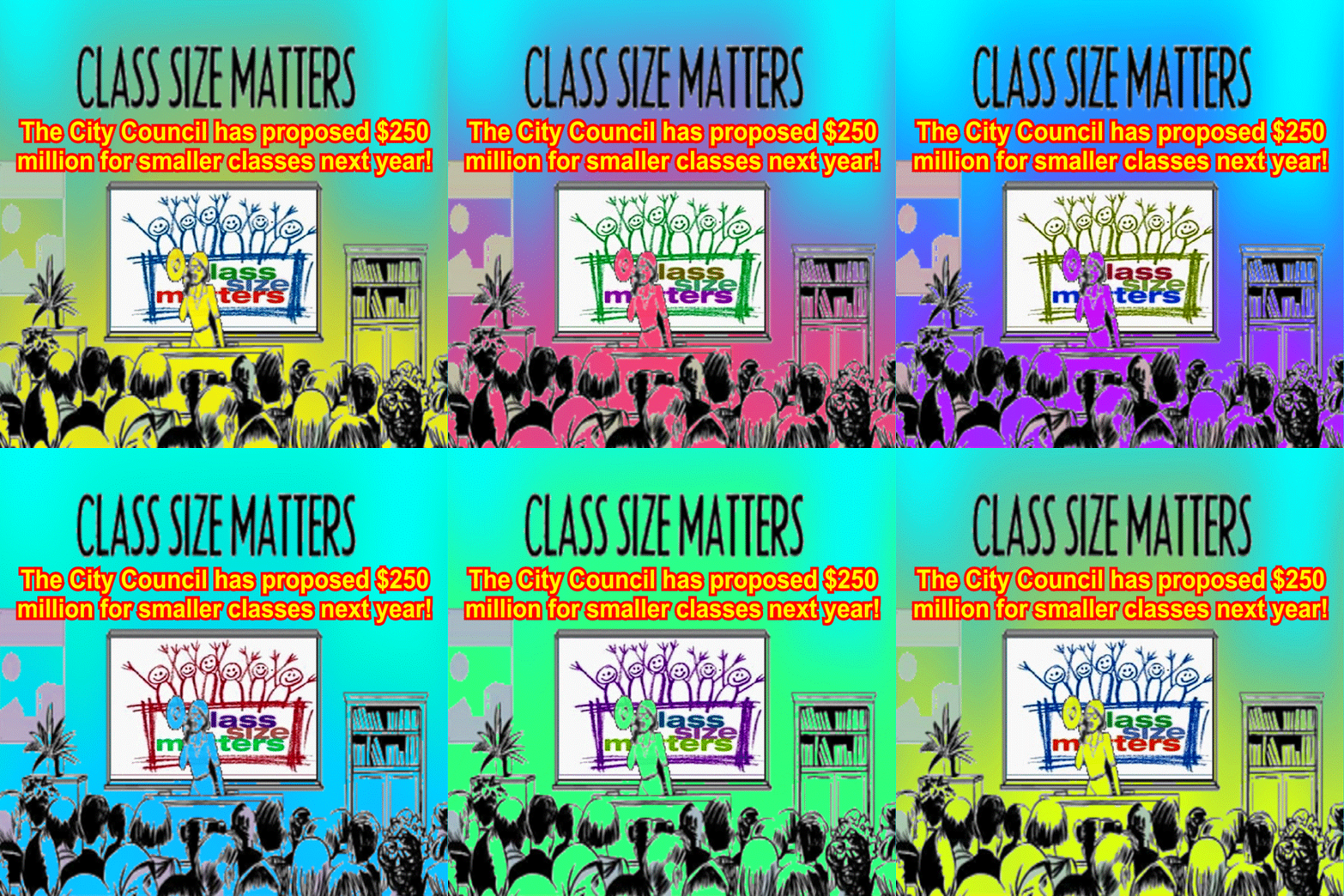
NYC Public School Parents: The City Council has proposed $250 million for smaller classes next year!

NYC Public School Parents: The City Council has proposed $250 million for smaller classes next year!
The City Council has proposed $250 million for smaller classes next year!


The NYC Council has now proposed in its preliminary budget response that DOE allocate $250M next year for class size reduction. This amount would be used to hire 2500 new teachers, which could then reduce class size in as many as 10,000 smaller classes citywide, since each new teacher and class creates smaller classes for every other class in the same grade and/or subject in each school.

See the press release here and below, and an updated fact sheet here.

Now we have to ensure that the Council negotiates hard and the Mayor and the Chancellor  agree that this funding is included in the final budget.  How can you help?

First, sign our (slightly revised) petition, if you haven't already.  

Second, if you're a member of a CEC, PTA or other community organization, please consider passing this resolution, urging that at least $250 million be spent on class size reduction next year; please also invite us to your next meeting to do a presentation on how and why smaller classes are so critical.  

If you're not a CEC member, please consider sharing the resolution with your district CEC, Community board or other organization and urge them to approve it as well.  

-------------

NYC Council proposes $250 million for class size reduction next year

In their Preliminary Budget Response, the NYC Council proposes that next year $250 million should be allocated to lowering class size, especially targeted towards struggling schools with vulnerable student populations. This would allow the Department of Education to hire an additional 2,500 teachers, which could lower class size in as many as CONTINUE READING: NYC Public School Parents: The City Council has proposed $250 million for smaller classes next year!

FAQ: Why NYC Schools should use infusion of new federal & state funds to lower class size next year | Class Size Matters

FAQ: Why NYC Schools should use infusion of new federal & state funds to lower class size next year | Class Size Matters 
FAQ: Why NYC Schools should use infusion of new federal & state funds to lower class size next year


Check out the fact sheet here or below.  If you support smaller classes, please urge your CEC or community group to support this resolution.  Please also sign our petition here.


2021 Civic Learning Awards Announced - Year 2021 (CA Dept of Education)

2021 Civic Learning Awards Announced - Year 2021 (CA Dept of Education)
State Superintendent Tony Thurmond Announces 2021 Civic Learning Award Recipients


SACRAMENTO—State Superintendent of Public Instruction Tony Thurmond announced today that 32 schools won this year’s Civic Learning Awards, which celebrate public schools’ efforts to engage students in civic learning. This year, the awards emphasize school-based efforts that went uninterrupted despite the pandemic. Now in its ninth year, the awards program is co-sponsored by State Superintendent Thurmond and Chief Justice of California Tani G. Cantil-Sakauye and is part of the Chief Justice's Civic Learning InitiativeExternal link opens in new window or tab..

“I’m so proud of these schools for keeping students engaged in civic learning during a pandemic, especially as our country grapples with serious social and civic conversations and actions that can reimagine governance at all levels,” said State Superintendent Thurmond. “I’m a passionate supporter of civics education, which not only engages students, but often inspires them to make a difference for their communities. During my time both as a civics teacher and in the State Legislature, I've always encouraged students to get involved. My office continues to be open for students to share their ideas; I’ve heard from so many students during this pandemic, and their voices are crucial now more than ever.”

“In the last year, each of these schools moved their classrooms from campuses to computer screens and, despite that challenge, they've kept true to their commitment of engaging students in civic learning,” said Chief Justice Cantil-Sakauye.

In addition, three teachers, a community organizer, and District Superintendent Michael Matsuda, Anaheim Union High School District, are among the Champions of Civics being honored with a 2021Civic Learning Award.

Chief Justice Cantil-Sakauye and State Superintendent Thurmond will host a virtual meeting with the top schools and champions today.

Last fall, the State Board of Education adopted criteria and guidance to award a State Seal of Civic Engagement to California students who demonstrate excellence in civics education and participation, and an understanding of the United States Constitution, the California Constitution, and the democratic system of government. By adopting these criteria, California joined a small but growing number of states that formally recognize and promote student civic engagement with seals to affix to student transcripts, diplomas, or certificates of completion.

Three top scoring schools earned a Civic Learning Award of Excellence:

Katella High School(Anaheim)—Katella High is being recognized for "Katella Talks," a required program where students learn the “5 Cs” of learning: communication, collaboration, critical thinking, creativity, and compassion. As part of the program, students present a problem they’d like to fix in their community or certain career field, conduct research, and present the topic to their classmates in a “TED Talk” format. For more than five years, the program has helped students improve their listening, speaking,and writing skills. This year, teachers adapted the program to a remote format. Katella High School also received a Civic Learning Award of Merit in 2020.

Walker Junior High(La Palma)—Every seventh grader at Walker Junior High is required to take a world history class with an emphasis on civics. Students participate in “call to action” campaigns, lead service projects, create public service announcements, and participate in student government. Students adapted to distance learning by producing videos and online newspapers to complete their projects. In addition, school administrators incorporated civic learning, planning, and implementation in the first goal of their local education plan. Walker Junior High received a Civic Learning Award of Distinction in 2020 and an Award of Merit in 2019.

Cloud Campus(Encinitas)—In 2020, the Encinitas Union School District offered 430 students the opportunity to participate in the year-long “Cloud Campus” distance learning option,where civics is integrated into elementary classrooms. In 2020,students participated remotely in activities, including a mock student election, which focused on California ballot measures on affirmative action, voting age limits, and consumer privacy. The school also incorporates iCivics resources into its curriculum to further bolster student engagement.

Three schools earned a Civic Learning Award of Distinction:

Royal High School(Simi Valley)—The school's Brown Bag Lunch Speakers Series presents a weekly event with guest speakers from local government, businesses, and media outlets. During the pandemic, speakers visited with students remotely. The program is open to all students and required for students in certain classes. Royal High School received a Civic Learning Award of Merit in 2019 and 2012 and an Award of Distinction in 2015.

Kairos Public Schools Vacaville Academy (Vacaville)—Middle school students are required to take a community leadership course where they participate in community service projects that support the school or local businesses. The program helps students learn how to be responsible, active citizens. Kairos Public Schools Vacaville Academy received a Civic Learning Award of Merit in 2020, 2019, 2018, and 2017.

Villa Park Elementary(Villa Park)—Students are required to participate in the Restorative Practices program, considered a hallmark of the school. Whether online or in-person, students in the program discuss issues like race, gender, disability, and inequity, often tying them into current events. Villa Park Elementary received a Civic Learning Award of Merit in 2020.

The following schools earned a Civic Learning Award of Merit:

Fresno County—Clovis East High School,Freedom Elementary,Maple Creek Elementary

Los Angeles County—Orange Grove Middle School,Sierra Vista Middle School, Sparks Middle School, Sunset Elementary, William Workman High School, Workman Elementary

Orange County—Anaheim Union High School, Ball Junior High School, Cambridge Virtual Academy, Chapman Hills Elementary, Linda Vista Elementary, Los Coyotes Elementary, Orangethorpe Elementary, Orangeview Junior High School, Oxford Academy, Raymond Temple, Western High School

Riverside County—Perris Elementary

San Diego County—Crawford High, Hoover High School, Mira Mesa High School, The Preuss School (High School)

Stanislaus County—John Pitman High School

# # # #

Tony Thurmond — State Superintendent of Public Instruction
Communications Division, Room 5602, 916-319-0818, Fax 916-319-0100


CURMUDGUCATION: Chris Evans (And Partners) Create A Useful Civics Tool

CURMUDGUCATION: Chris Evans (And Partners) Create A Useful Civics Tool
Chris Evans (And Partners) Create A Useful Civics Tool


So this is how you do it.

Chris Evans has entered the world of celebrity education support, and he's done it up right. There's a companion post to this one over at Forbes that explains in a little more detail what the site does; in this post, I want to explain why I think Evans and his partners are setting an example for how the rich and famous can have a positive impact on education.

First of all, he hasn't done it alone. He has partnered up with actor/producer Mark Kassen, one of those guys who has a long, solid, steady career in the biz without becoming a household name, and Joe Kiani, who--well, Kiani is an Iranian-American tech entrepreneur who started one of those companies that does a medical thing you don't understand, but who also has been hugely active in trying to reform the world of health care. These three started up a civic engagement site called A Starting Point, and then teamed that up with Close Up, a DC-based civics education group, to create ASP Homeroom, a site where you can find short, simple videos in which elected officials (mostly Congresspersons) lay out their position on major issues.

ASP Homeroom is a civic engagement tool that is well-suited to use by classroom teachers. It works for several reasons, not the least of which Evans and Kassen don't imagine themselves as having all the secrets of teaching civics to high schoolers. I spoke to Kassen, who said "We could not be so CONTINUE READING: CURMUDGUCATION: Chris Evans (And Partners) Create A Useful Civics Tool

I’m Back, Almost! | Diane Ravitch's blog

I’m Back, Almost! | Diane Ravitch's blog
I’m Back, Almost!


On April 8, I had open heart surgery to replace a heart that had a leaky valve and was regurgitating too much blood. I didn’t have any symptoms of heart failure, but the tests were clear. I needed a new heart valve. Given the nature and location of the ailment , there was no minimally invasive way to fix the problem. The doctor had to saw open my chest to get direct access to my heart.

And so it was done. To my surprise, the broken breast cage was not painful. I spent a week heavily medicated and monitored, and the worst effect was my inactivity, which left me unable to rise from a chair and walking as though my legs weighed a ton each. When I leave the intensive care unit, I will spend at least a week doing physical therapy.

I’m immensely impressed by the sophisticated nature of medical technology. I’m even more impressed by the dedication of the young people who staff our hospitals and their spirit of service.