Latest News and Comment from Education

Friday, January 10, 2020

"We Are All School Reformers" (Part 1) | Larry Cuban on School Reform and Classroom Practice

"We Are All School Reformers" (Part 1) | Larry Cuban on School Reform and Classroom Practice

"We Are All School Reformers" (Part 1)


On the first day of a graduate seminar at Stanford University that I taught a few years ago, I asked each of the 20 students to give a two-minute self-introduction detailing their name, what they did prior to graduate school, and why they enrolled in “Good Schools”: Research, Policy, and Practice.” After they introduced themselves, I, too, took the time to say that I had been a former high school teacher and superintendent for over two decades.
In listening to the students I reckoned that about one-third of the students had been teachers (many alums of Teach for America), about a third worked as consultants and policy analysts for education non-profits and had no direct experience in schools (save for their years as students). The remaining students came from backgrounds in business, science, and the arts.
I listened to each student as they told of their classroom experiences as student or teacher or their strong impulse to give the next generation of children and youth a better schooling than they had received. Many expressed a fervent wish to turn failing schools, particularly in urban districts, into successful ones. They wanted to reduce the inequities they saw (or experienced) in schools. This seminar, they felt, would provide answers to the questions they had about how to do such turnarounds.
After hearing their self-introductions and why they had enrolled in this seminar, CONTINUE READING: "We Are All School Reformers" (Part 1) | Larry Cuban on School Reform and Classroom Practice

Robots Will Never Replace Teachers. They Can Only Displace Us | gadflyonthewallblog

Robots Will Never Replace Teachers. They Can Only Displace Us | gadflyonthewallblog

Robots Will Never Replace Teachers. They Can Only Displace Us
My favorite movie of all time is “2001: A Space Odyssey.”
And my favorite character is the computer HAL 9000.
In the future (now past) of the movie, HAL is paradoxically the most human personality. Tasked with running the day-to-day operations of a spaceship, HAL becomes strained to the breaking point when he’s given a command to lie about the mission’s true objectives. He ends up having a psychotic break and killing most of the people he was supposed to protect.
It’s heartbreaking finally when Dave Bowman slowly turns off the higher functions of HAL’s brain and the supercomputer regresses in intelligence while singing “A Bicycle Built for Two” – one of the first things he was programmed to do.
I’m gonna’ be honest here – I cry like a baby at that point.
But once I clean up my face and blow my nose, I realize this is CONTINUE READING: Robots Will Never Replace Teachers. They Can Only Displace Us | gadflyonthewallblog

All Things Education: My Testimony Regarding the Governor's Proposed Budget for Education in Virginia

All Things Education: My Testimony Regarding the Governor's Proposed Budget for Education in Virginia

My Testimony Regarding the Governor's Proposed Budget for Education in Virginia


I definitely owe the education blogosphere a post about my post-doc job market experience (hint: it was not good). For now, I will share that I am back in the classroom teaching high school U.S. & Virginia Government to seniors (and getting my butt whooped but in a humbling and valuable way, though), and have been since the start of the 2019-2020 School Year. I  need to write a post about that, too. Good things come to those who wait, right? In the meantime, I have been involved with VEU (Virginia Educators United) because, oh, wait, I am a teacher again, and I heeded their leaders' call to attend the General Assembly's House Appropriations and Senate Finance Committees' public hearings to hear feedback on the Governor's budget priorities. The issues with the education funding in the budget are laid out very clearly here in VEU's talking points.

Here's a video of my testimony:


And here's the text from my spoken remarks:

"Good afternoon. My name is Rachel Levy and I am a Virginia public school parent, teacher, writer and activist with a Ph.D. in educational leadership and policy. I live in Ashland, Virginia, I am a member of VEA, Virginia Educators United, the Virginia PTA, and the American Educational Research Association.

The Governor’s budget proposal for education is a step in the right direction, but unfortunately, it’s not sufficient.

I have been a teacher on and off for most of my career. Teaching is the most meaningful, challenging, intellectual, and socially useful work there is. As a teacher and a parent, I have seen the quality of our facilities, the availability of our CONTINUE READING: 
All Things Education: My Testimony Regarding the Governor's Proposed Budget for Education in Virginia


PISA Peculiarities (3): More Fear, Better Scores - Education in the Age of Globalization

Education in the Age of Globalization » Blog Archive » PISA Peculiarities (3): More Fear, Better Scores

PISA Peculiarities (3): More Fear, Better Scores

PISA has many peculiar and surprising discoveries…
Fear of failure improves academic performance.
That’s a conclusion one can draw from PISA’s analysis of its data. This is true at the system level. “At the system level, the greater the fear of failure expressed by students, the higher the reading scores in that education system” (OECD, 2019, p. 193). This is especially true for high performing East Asian education systems and some English speaking systems. PISA found that:
a large number of English-speaking and East Asian education systems were amongst those whose students were both more likely to report a fear of failure and to be high performers in reading. (OECD, 2019, p. 193).
It is also true within systems: “in a majority of school systems, students who expressed a greater fear of failure scored higher in reading than students expressing less concern about failing, after accounting for the socio-economic profile of students and schools” (OECD, 2019, p. 192).
Moreover, self-efficacy or self-confidence, the opposite of fear of failure, does not seem to lead to better academic performance, according to PISA’s analysis.
The strongest positive associations between general self-efficacy and reading performance were observed largely in countries and economies whose average reading performance was below the OECD CONTINUE READING: Education in the Age of Globalization » Blog Archive » PISA Peculiarities (3): More Fear, Better Scores

Washington Met Students Seek Support Before January Decision on Closing – Education Town Hall Forum

Washington Met Students Seek Support Before January Decision on Closing – Education Town Hall Forum

WASHINGTON MET STUDENTS SEEK SUPPORT BEFORE JANUARY DECISION ON CLOSING


The January 9, 2020 show of Education Town Hall featured four current students at DCPS’s Washington Metropolitan high school in studio, talking about their journey, and that of their fellow Washington Met students, since learning right before Thanksgiving that DCPS proposed closing their school. They are


Lyric Johnson, 16 years old
Na’Asia Hawkins, 18 years old
Travius Butler, 17 years old
Angel Johnson, 19 years old
The students explained that Washington Met alone of DCPS’s four opportunity academies contains a middle school and thus is the only place in the city that ensures that students from middle school years up who have not found academic success at other schools will have a pathway to graduation. They noted that the DCPS chancellor has said the decision to close the school—first announced before Thanksgiving—will be made by the end of January. At the few public meetings about the closure, students have said that they have never gotten satisfactory answers as to the reasons for the closure, noting that students who attend will naturally have issues that students at other schools will not—and that no one seems to be taking that into account.
The students made clear that the school has provided a safe and welcoming haven for them, CONTINUE READING: Washington Met Students Seek Support Before January Decision on Closing – Education Town Hall Forum

INSECT-BASED TEACHER TRAINING | The Merrow Report

INSECT-BASED TEACHER TRAINING | The Merrow Report

INSECT-BASED TEACHER TRAINING

The latest development in the never-ending struggle to improve teaching involves “A bug in the ear” AND “A fly on the wall.”  This insect-based approach has a highly-trained but distant observers watching (on closed circuit video) teachers at work and giving them instructions and suggestions in real time, so the teachers can modify methods and instantly improve their instruction. 
According to Education Week, what’s called ‘Bug in the Ear Coaching”  is being used in about a dozen states. The premise is simple: A teacher wears an earpiece during a lesson, which is being live-streamed for an instructional coach who is somewhere else. Throughout the lesson, the coach delivers in-the-moment feedback to the teacher, who can add something or switch gears based on what she’s hearing in her ear.”
I reached out to some of the sources I developed in my 41 years of reporting for a closer look. One enthusiastic superintendent, who requested anonymity, said that the system would pay for itself in higher scores on standardized tests. “While the initial investment of $500,000 per school for cameras and directional microphones for every classroom, a dedicated room of monitors, the cost of a half-time tech person, and the salaries of the instructional experts who monitor the teachers, looks CONTINUE READING: INSECT-BASED TEACHER TRAINING | The Merrow Report


Thursday, January 9, 2020

CURMUDGUCATION: DeVos and Department May Face Increased Fine

CURMUDGUCATION: DeVos and Department May Face Increased Fine

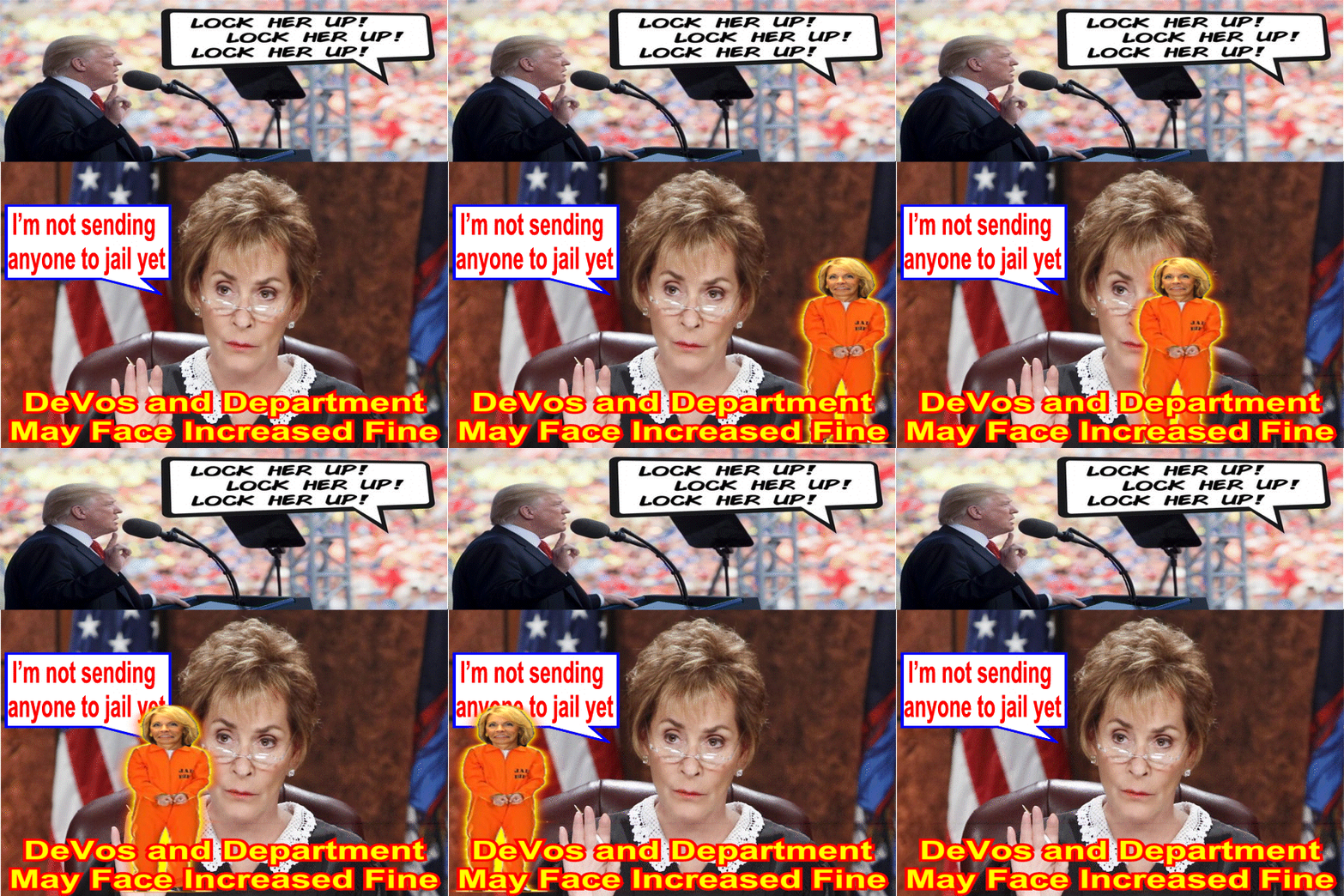
DeVos and Department May Face Increased Fine


Back in October, Secretary of Education Betsy DeVos and her department were fined $100,000 for contempt of court regarding their non-compliance with a court order to stop collecting loans from students bilked by a chain of fraudulent for-profit colleges. Turns out that price tag could get a little steeper.

In October, the department said that, oopsies, they had continued to collect from about 16,000 students and parents. The "oopsy" was a little hard to believe, given that DeVosd has been abundantly clear that she does not believe that defrauded students should have their loans forgiven. If they are making money now, then too bad about the loan. As she told the House Education Committee when they tried to rake her over some coals on this matter:

I understand that some of you here just want to have blanket forgiveness for anyone who raises their hand and files a claim, but that simply is not right.

So maybe the department made a few clerical errors. Or maybe DeVos just decided she would drag her heels as hard as possible against the injunction against collection from May 2018, as witnessed by the loans forgiven by the previous administration which she signed off "with extreme displeasure" and by her attempts rewrite the rules for loan cancellation.

Judge Sallie Kim was pretty cranky when she offered the October ruling (“I’m not sending anyone to CONTINUE READING: 
CURMUDGUCATION: DeVos and Department May Face Increased Fine


"Have To" History: United States vs. Nixon (1974) | Blue Cereal Education

"Have To" History: United States vs. Nixon (1974) | Blue Cereal Education

"Have To" History: United States vs. Nixon (1974)

NOTE: I've finally completed "Have To" History: Landmark Supreme Court Cases. At the moment, it's available on Teachers Pay Teachers and intended to be an easily affordable resource for pretty much any American History or Government teacher of whatever level – from 8th Grade Civics to APUSH. I'm not looking to make serious money or anything, but it took a long time to write and edit, so until I have time to pursue other avenues, there it is.
The following is an excerpt from this work, inspired only by my love of sharing and having nothing to do with current events. (We work very hard in history education to make sure there's as little connection as possible between what we cover in class and what's happening in the real world around us. Otherwise - phone calls!) The attached PDF includes excerpts from the Supreme Court's decision and questions over the article and written excerpts. If you find it useful, please consider purchasing the rest of the collection. Otherwise, why do you hate America?

Stuff You Don’t Really Want To Know (But For Some Reason Have To) About U.S. v. Nixon (1974) 

Three Big Things:

1. In 1972, five men working for the Nixon Administration were caught breaking into Democratic National Headquarters. Investigations revealed much wider-spread CONTINUE READING: "Have To" History: United States vs. Nixon (1974) | Blue Cereal Education

The Rural Schools Conundrum – Have You Heard

The Rural Schools Conundrum – Have You Heard

The Rural Schools Conundrum


Have You Heard heads to rural Wisconsin to investigate a puzzle. Communities in the “reddest” parts of the state keep voting to hike their own taxes to pay for schools, even as they elect and re-elect politicians who enact cuts to school funding. What gives? The answers are complicated and surprising. Full transcript available here. And Have You Heard relies on listener contributions to hit the road for episodes like this one. 


The Rural Schools Conundrum – Have You Heard

2020 Teachers’ New Year’s Resolutions: 3. Educate yourself | Live Long and Prosper

2020 Teachers’ New Year’s Resolutions: 3. Educate yourself | Live Long and Prosper

2020 Teachers’ New Year’s Resolutions: 3. Educate yourself


It’s a new year and as is our custom here in the USA, we make resolutions which, while often broken, can be redefined as goals toward which we should strive.
NEW YEAR’S RESOLUTION #3
  • Educate yourself.
BUT I DON’T HAVE ENOUGH TIME
Teachers are overworked and overstressed. Often teachers go home after a difficult day at school and spend an hour or two on planning, assessing student work, or sifting through piles of mostly meaningless paperwork.
A few hours later, after a rushed meal, minimal time with family, and a night of not-enough-sleep, it starts over again.
Weekends are a bit better…time to catch up on everything.
It’s no surprise, then, that teachers feel like they don’t have time to find out what’s happening in the politics of public education. They only know that it seems like each year there are more and more restrictions on what and how they can teach, more tests for their students, fewer resources, and larger classes.
Meanwhile, the forces of DPE (Destroy Public Education) continue to move forward increasing funding for charter schools and unaccountable voucher schools by diverting public money from public schools.
THE ARGUMENT FOR EDUCATING YOURSELF
Make the time.
I know…I’m retired. I don’t have to get up and face a classroom of kids every day. It’s easy for me to say, “Make the time.” I get it. CONTINUE READING: 2020 Teachers’ New Year’s Resolutions: 3. Educate yourself | Live Long and Prosper

LGBTQ Students Need Help, and Philanthropy Needs to Step Up | Schott Foundation for Public Education

LGBTQ Students Need Help, and Philanthropy Needs to Step Up | Schott Foundation for Public Education

LGBTQ Students Need Help, and Philanthropy Needs to Step Up

Produced in partnership between Funders for LGBTQ Issues and Schott, we hope this infographic will help both those in philanthropy and LGBTQ advocates to chart a better course toward a future where all LGBTQ youth attend well-resourced, supportive and safe public schools. Schott is proud to be a longtime supporter of grassroots LGBTQ youth organizing as a crucial component of the education justice movement.

Key Findings:
  • For every $100 awarded by U.S. foundations to education, only 15 cents were devoted to funding for LGBTQ education and safe schools.
  • More than 6 in 10 LGBTQ students experience discriminatory policies or practices at school.
  • While LGBTQ youth make up 7-9 percent of youth nationwide, they account for 20 percent of all youth in juvenile justice facilities (and 85 percent of them are youth of color).
  • Funding for LGTBQ education and safe schools has fluctuated over the past five years, but has never exceeded $9 million in a given year.
  • The top ten funders of LGBTQ education and safe schools issues account for nearly three-quarters of the funding.
Clearly there is much work for us to do. The infographic identifies four key opportunities:
FUND ACROSS SILOS FOR INCREASED IMPACT
Racial justice funders and those supporting boys and girls of color, criminal justice funders concerned about the school-to-prison pipeline, and health funders seeking to address the social determinants of health disparities have reason to be concerned with school climate for LGBTQ students. There is potential for mutual learning across silos as well as for the pooling and leveraging of resources across unlikely but natural partners.
STRENGTHEN GSAs AND OTHER VEHICLES FOR YOUTH-LED ORGANIZING
GSAs [Gay Straight Alliances] are documented to have a positive effect on student outcomes and also play a key role in the pipeline of leadership development in LGBTQ communities. Other LGBTQ grassroots organizations driven and led by youth and young adults play similar essential roles in empowering young leaders and building movements.
SUPPORT FEDERAL, STATE, AND LOCAL ADVOCACY
At the federal, state, and local levels, LGBTQ and allied organizations need resources to respond to anti-LGBTQ policies and to advance progressive policies that foster a more supportive school climate for LGBTQ youth. Funders should also be mindful of the need for Both rapid response funding and general for general support and capacity-building to develop strong organizations at all levels.
SUPPORT STRATEGIC COMMUNICATIONS TO RAISE AWARENESS AROUND LGBTQ STUDENTS
Funders have an opportunity to foster a more positive narrative around LGBTQ students. These efforts may include collecting and sharing stories of LGBTQ students, especially trans students and LGBTQ students of color; building the communications capacity of LGBTQ education and youth organizations; and supporting research, messaging, and media campaigns to respond effectively to attacks on transgender students, students of color, and immigrant students.
 Download here (623.37 KB)

Webinar: Missing Pages and Pedagogy | Schott Foundation for Public Education - http://schottfoundation.org/node/4210
Many students of color attend schools where their histories, culture and lived experiences have been little more than footnotes in their school curriculum. A growing movement led by parents, students and educators is aiming to fix that by implementing culturally responsive education.

Culturally responsive education has been shown to increase student engagement, improve student self-perception, and increase student achievement and graduation rates: but it won’t be handed to us. We have to organize and fight for it.

Join us for an engaging webinar as we discuss culturally responsive education and what it will take to win it for all our public schools.

This webinar is part of a new series of Schott-hosted webinars that shine a spotlight on culturally responsive education efforts nationwide, focusing on curriculum, teacher diversity, and safe and supportive schools.
Our speakers included:
    Dr. Curtis Acosta, Founder, Acosta Latino Learning Partnership and Acosta Educational Partnerships
    Natasha Capers, Coordinator, NYC Coalition for Educational Justice
    Natalie Zwerger, Director, Center for Strategic Solutions
    Marianna Islam (moderator), Director of Programs & Advocacy, Schott Foundation for Public Education
CONTINUE READING AND WATCH THE WEBINAR: Webinar: Missing Pages and Pedagogy | Schott Foundation for Public Education

If the Teachers of Color at Your School Are Invisible to You, Why Would They Stay? - Philly's 7th Ward

If the Teachers of Color at Your School Are Invisible to You, Why Would They Stay? - Philly's 7th Ward

IF THE TEACHERS OF COLOR AT YOUR SCHOOL ARE INVISIBLE TO YOU, WHY WOULD THEY STAY?

I reread it slower this time, an email sent to 40+ staff members with the subject line, Congrats and Great Work, from my principal. The email was a glowing account of one of my colleagues’ recent accomplishments:  wrote a grant … new outdoor classroom … dedication … significant contributions to our school community. While I realized all those statements were true and my colleague deserved this recognition, as a teacher of color, I was also hurt and perplexed.  Why do such mass acknowledgements and effusive praise only accompany the victories of my white colleagues?  
I left that job this year.  Was it because my work was constantly being rendered invisible?  Yes, that was part of the reason.
Within the same timeframe, I had also achieved a myriad of successes: presenting at a national conference, organizing and leading an off-campus leadership experience for students, co-creating and implementing a schoolwide literacy approach, publishing an interdisciplinary literacy newsletter, leading a parent/staff diversity book club, being nominated for History Teacher of the Year.  Yet, I’d never had so much as a personal email or note in my CONTINUE READING: If the Teachers of Color at Your School Are Invisible to You, Why Would They Stay? - Philly's 7th Ward

Top Reads of 2019 | Teacher in a strange land

Top Reads of 2019 | Teacher in a strange land

Top Reads of 2019

For the past decade or so, I’ve tried to read 100 books a year. It’s been a worthy and mostly achievable goal, a nice round number, and incentive to be deliberate in choosing titles, because—hey, tick-tock.  I don’t log books that I didn’t finish (or almost finish—I included one 600-pager this year that I started skimming after diligently reading 400 mind-numbing pages).
I also don’t count children’s books, although some terrific YA titles have made the cut. I use GoodReads to archive titles, rate them one-five stars, and compose a brief review, mostly to remind myself what the book is about, especially series books. My role model is Nick Hornby, whose Ten Years in the Tub is, IMHO, the Way to Write Reviews.  That is, sloppily and non-linearly, reading multiple books at the same time, being honest about what I love and what moves me–and constantly changing my mind.
Therefore… no neatly ordered top ten titles, no bumping off a favorite because it doesn’t feel prestigious enough for an audience, always embracing good ideas and good writing while overlooking flaws.
I have 14 noteworthy books to share this year, seven fictional titles and seven nonfiction. I’ll begin with books about politics CONTINUE READING: Top Reads of 2019 | Teacher in a strange land

La. State Superintendent John White Resigns | deutsch29

La. State Superintendent John White Resigns | deutsch29

La. State Superintendent John White Resigns

On January 08, 2020, Louisiana state superintendent John White submitted his letter of resignation to the Louisiana Board of Elementary and Secondary Education (BESE).
In it, White states, “I write to advise you… I will be vacating the position March 11, 2020, and to recommend that the board identify a new state superintendent.”
White’s resignation letter comes five days before the second inauguration of Louisiana governor, John Bel Edwards, who has wanted White gone since 2015.
The complication was that in Louisiana, the governor submits her/his preference for state superintendent to BESE, and the board usually votes on the governor’s preference. However, the governor does not control the ability to terminate the state school superintendent. BESE does. And since 2015, BESE has lacked a majority wishing to oust White. BESE also lacked the supermajority (8 out of 11 votes) to issue White a new contract. So, BESE did not have the votes to renew White’s contract (though 7 out of 11 BESE members apparently wanted to), and the governor could not force a termination, which left Louisiana taxpayers continuing to foot White’s $275K salary for another four years as White became a month-to-month employee.
Apparently, there has been some behind-the-scenes negotiating to send White on his way, likely contingent upon Edwards being elected to a second term, and part of that negotiation may have included White’s agreeing to formally resign prior to the seating of the next BESE board (which happens on January 13, 2020).
One reason I believe White’s exit is the result of negotiation is that the newly-elected BESE might have enough White-sympathetic votes to grant him a second contract against the governor’s will. However, White’s announcing his exit only CONTINUE READING: La. State Superintendent John White Resigns | deutsch29

Daniel Koretz: American Students Are Not Getting Smarter, and Test-Based “Reforms” Are to Blame | Diane Ravitch's blog

Daniel Koretz: American Students Are Not Getting Smarter, and Test-Based “Reforms” Are to Blame | Diane Ravitch's blog

Daniel Koretz: American Students Are Not Getting Smarter, and Test-Based “Reforms” Are to Blame

Daniel Koretz is one of the leading authorities on testing in the United States. A professor at Harvard University, he has written two important books about testing–its uses and misuses.
He wrote:
In December, we received more bad news about the achievement of American students: Our 15-year-olds made no significant progress in math and reading on PISA, the largest of the international tests. This followed on the heels of a new report from our National Assessment of Educational Progress (NAEP), which showed no real progress in reading or math for fourth or eighth grade students for the past decade, and longer for reading.
The routine debate is underway about how bad this news is, but such arguments mostly miss a core lesson: CONTINUE READING: Daniel Koretz: American Students Are Not Getting Smarter, and Test-Based “Reforms” Are to Blame | Diane Ravitch's blog

Air filters create huge educational gains - Vox

Air filters create huge educational gains - Vox

Installing air filters in classrooms has surprisingly large educational benefits
$1,000 can raise a class’s test scores by as much as cutting class size by a third.

An emergency situation that turned out to be mostly a false alarm led a lot of schools in Los Angeles to install air filters, and something strange happened: Test scores went up. By a lot. And the gains were sustained in the subsequent year rather than fading away.
That’s what NYU’s Michael Gilraine finds in a new working paper titled “Air Filters, Pollution, and Student Achievement” that looks at the surprising consequences of the Aliso Canyon gas leak in 2015.
The impact of the air filters is strikingly large given what a simple change we’re talking about. The school district didn’t reengineer the school buildings or make dramatic education reforms; they just installed $700 commercially available filters that you could plug into any room in the country. But it’s consistent with a growing literature on the cognitive impact of air pollution, which finds that everyone from chess players to baseball umpires to workers in a pear-packing factory suffer deteriorations in performance when the air is more polluted.
If Gilraine’s result holds up to further scrutiny, he will have identified what’s probably the single most cost-effective education policy intervention — one that should have particularly large benefits for low-income children.
And while it’s too hasty to draw sweeping conclusions on the basis of one study, it would be incredibly cheap to have a few cities experiment with installing air filters in some of their CONTINUE READING: Air filters create huge educational gains - Vox

Louisiana Educator: The Legacy of Superintendent John White

Louisiana Educator: The Legacy of Superintendent John White

The Legacy of Superintendent John White
 

John White has submitted his letter of resignation from the position of Louisiana State Superintendent of education.

In his resignation letter White claims the following:
"Louisiana is better educated today than any point in its history,"


BESE Vice-President Holly Boffy, said the state made "great strides" during White's time.

This post examines the key measures that John White himself set as standards for determining success and therefore the legacy of his superintendency.

John White was appointed State Superintendent of Education for Louisiana in January 2012 for the purpose of raising achievement standards, closing the achievement gap between rich and poor students and to insure that our high school diplomas indicated real achievement and eliminated diploma mills. White was appointed at a time when Louisiana’s education performance was considered to be embarrassingly low compared to all the other states. It was expected that White would get Louisiana off the bottom of the state rankings and also take steps to close the gap between high poverty students and more privileged students.


White has claimed repeatedly that Louisiana’s students were just as CONTINUE READING: 
Louisiana Educator: The Legacy of Superintendent John White