Latest News and Comment from Education

Friday, January 3, 2020

Andre Perry: Where do the 2020 candidates stand on education issues?

Where do the 2020 candidates stand on education issues?

Here’s the information you need to help you make the better choice in 2020
The education columns from 2019 you don’t want to miss

We’re less than a year away from the 2020 presidential election; last week we saw seven Democratic presidential candidates participate in a forum dedicated to education issues held in Pittsburgh. If you follow my column, you were well-prepped on the issues they discussed. If you didn’t tune in, here’s a primer on the educational issues at stake in this election, the policy actions of the current administration, and what I think of candidates’ proposals.
These columns provoked strong, favorable reactions — from charter advocatesparent advocates and policy analysts — suggesting that people want the federal government to take an active approach to elementary, secondary and higher education.
This year I’ve enjoyed engaging in the debates we should be having around the upcoming election, and, through various media, helping to shape the narrative on issues that are key to families. Engagement, examination and critique of the government are part of our responsibility as citizens, and central to our advancement in society. That’s why a free press is protected by the U.S. Constitution. I look forward to continuing to write for a better democracy in 2020.
Alabama’s investments in quality pre-K are a result of conservatives embracing what was once considered a liberal issue. Democrats, meanwhile, are chasing white working-class voters and abandoning their liberal principles.
For the 2020 election, black people cannot afford to be human shields for the charter school lobby, which doesn’t have the CONTINUE READING: Where do the 2020 candidates stand on education issues?

Inside a Training Course Where School Workers Learn How to Physically Restrain Students — ProPublica

Inside a Training Course Where School Workers Learn How to Physically Restrain Students — ProPublica

Inside a Training Course Where School Workers Learn How to Physically Restrain Students
While reporting on the use of physical restraint in schools, I wanted to understand if school workers properly used their training in the classroom. They often did not.

This week’s ProPublica Illinois newsletter is written by Jennifer Smith Richards, a Chicago Tribune reporter who has been working with ProPublica Illinois reporters Jodi S. Cohen and Lakeidra Chavis to investigate the use of seclusion and restraint in Illinois public schools.
In the year that we’ve reported on restraint and seclusion, we have worked hard to become experts on the topic.
We’re not educators, but we are dedicated learners. We read books and studies about how to work with children who have behavior disorders, and we talked to academic experts and researchers across the country about seclusion, or confining students in a place they can’t leave, and physical restraint. We learned by observing, too. ProPublica Illinois reporting fellow Lakeidra Chavis and I spent two days watching a Crisis Prevention Institute, or CPI, training for educators in the Chicago suburbs.
We saw school workers learn about verbal de-escalation and how to safely break free if a student grabs their hair or bites them. We saw how a CPI trainer walked them through standing and seated restraints and how to decide what type to use.
But we wanted to learn by doing, too. So I asked my editors at the Chicago Tribune to send me to a five-day training in Peoria last March. They agreed that this would help me better understand what school employees are supposed to do during a crisis. The state currently requires school workers who use physical restraint to be trained at least once every two years and to be taught alternatives to restraint, including de-escalation techniques.
Therapeutic Crisis Intervention, a Cornell University-based program, did not want an observer in the small session but agreed to allow one of us to participate.
So I signed up.
I learned about how children cycle through a crisis and how to help them calm CONTINUE READING: Inside a Training Course Where School Workers Learn How to Physically Restrain Students — ProPublica

Jennifer Berkshire: The Democratic Candidates and Their School Choice Problem | Diane Ravitch's blog

Jennifer Berkshire: The Democratic Candidates and Their School Choice Problem | Diane Ravitch's blog

Jennifer Berkshire: The Democratic Candidates and Their School Choice Problem

Jennifer Berkshire writes in The Nation about the quandary of Democratic candidates. For years, charter schools had bipartisan support. Clinton and Obama both supported charter schools, and joined with Republicans to expand the federal Charter Schools Program, which is now the single biggest source of funding for charter schools at $440 million annually (the second biggest source is the Walton Family Foundation).
Then came the Trump administration and Betsy DeVos, with their full-throated advocacy for school choice, including vouchers. In red states like Ohio, voucher programs are exploding, and Democrats are pushing back against school choice. They are also pushing back against charter schools, as we saw in Kentucky and Virginia, where pro-public education governors were elected.
Meanwhile, the current crop of Democratic candidates are weaving and bobbing. Sanders and Warren have come out against charter schools and privatization. Other candidates are trying to thread the needle, not fully rejecting charter schools, but opposing “for-profit” charter schools (which are legal only in Arizona, but are found in CONTINUE READING: Jennifer Berkshire: The Democratic Candidates and Their School Choice Problem | Diane Ravitch's blog


CURMUDGUCATION: New Report: Charter Fraud And Waste Worse Than We Thought

CURMUDGUCATION: New Report: Charter Fraud And Waste Worse Than We Thought

New Report: Charter Fraud And Waste Worse Than We Thought

Last March, the Network for Public Education released a report showing that the federal government has lost a billion dollars to charter school waste and fraud. But the organization had not stopped sifting through the data. Their follow-up report, “Still Asleep At The Wheel: How the Federal Charter Schools Program Results in as Pileup of Fraud ands Waste,” reveals that the situation is even worse than shown in the first report, while laying out more state by state details. Particularly striking—the vast amount of money that has been wasted on ghost schools that never served.
NPE is a group co-founded by Diane Ravitch, the Bush-era Assistant Secretary of Education who has since become an outspoken critic of education reform, and by Anthony Cody, activist and author of The Educator and the Oligarch. The organization's executive director is Carol Burris, a former award-winning New York principal. Burris was the primary author of this report. (NPE gets no money from Bill Gates of the Waltons.)
The reports examine what happened to money disbursed by the Federal Charter Fund, a charter grant source created in 1994 as part of the Elementary and Secondary Education Act (ESEA). Since 1995, it has handed out almost $4 billion.
Some new findings in this follow-up report:
The original report underestimated the number of charters that had taken federal grant funds and then either closed or never opened at all. That report found 1,000 such charters; the number now appears to be closer to 1,800. That means the failure rate is close to 37% nationally. Michigan gave grants of at least $100,000 to 72 schools that never opened at all; California gave grants to 61 unopened schools. Those two states alone account for over $16 million dollars spent without CONTINUE READING: CURMUDGUCATION: New Report: Charter Fraud And Waste Worse Than We Thought

Yong Zhao: More and Different: The Impact of AI on Future Jobs and Education - Education in the Age of Globalization

Education in the Age of Globalization » Blog Archive » More and Different: The Impact of AI on Future Jobs and Education

More and Different: The Impact of AI on Future Jobs and Education 


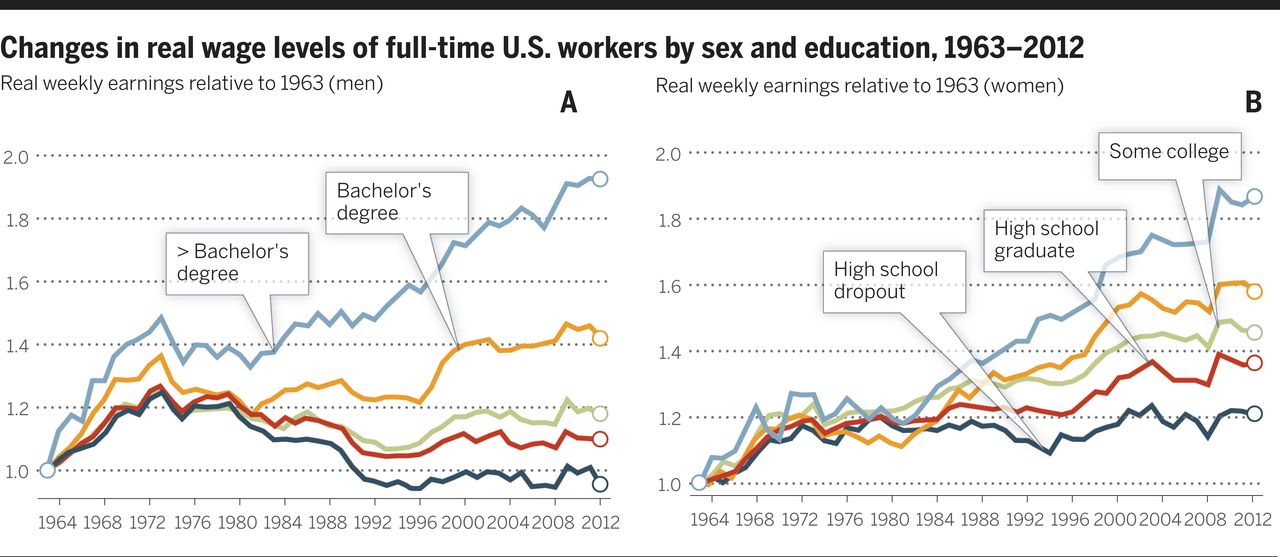
Better-paid, better-educated workers face the most exposure” to AI, concludes a  recent report about the impact of Artificial Intelligence on jobs in the future. This conclusion should make us question the widely held belief that our children should get more education. More education is never a bad idea and has long been believed to lead to better lives, more income, for example, as illustrated in the diagram below.
Historical data suggest that the premium of education has increased over the years. The payoff of more education has grown significantly from the 1960s to the 2010s as shown below.
The strong link between more education and better earnings is universal, true in almost every society.
But will this be true in the future? A recent Brookings Institution report suggests that the link between education and income may be weakened because of Artificial Intelligence (AI). Using a new approach toEducation in the Age of Globalization » Blog Archive » More and Different: The Impact of AI on Future Jobs and Education

The surprising source of key data in a report critical of the federal Charter School Program - The Washington Post

The surprising source of key data in a report critical of the federal Charter School Program - The Washington Post

The surprising source of key data in a report critical of U.S. Charter School Program


I recently wrote about a report by the advocacy group, the Network for Public Education, about waste in the federal Charter Schools Program (CSP). It was the second such report published in 2019 by the group, which was co-founded by historian and activist Diane Ravitch. Both of them, not surprisingly, received pushback from charter school supporters.

The first report, published last March and titled “Asleep at the Wheel,” said that the U.S. government had wasted up to $1 billion on charter schools that never opened, or opened and then closed because of mismanagement and other reasons. It also said the Education Department does not adequately monitor how its grant money is spent.
The second report, published last month, was titled “Still Asleep at the Wheel” and provided new details about waste in the Charter School Program. It noted that the state with the most charter schools that never opened was Michigan, home to Education Secretary Betsy DeVos.
Ever since the second report was published, critics have been attacking it, saying that it was exaggerated and even that the authors were basing their claims on data they obtained from teachers’ unions. The lead author of the report, Carol Burris, said the critics have it wrong, and in the following post, she explains where the information came from and how the results were reached.
Critics may be surprised to learn that some of the key data came from none other than DeVos herself (although not intentionally). DeVos has often said she is no fan of federally funded education programs, though she still defended the CSP in a letter to a U.S. legislator cited below.
The Network for Public Education is an alliance of organizations that advocates for the improvement of public education. It is headed by Ravitch, a former official in the administration of President George H.W. Bush who broke with corporate-based school reform and became the titular leader of the movement opposing it.
The network opposes charter schools — which are publicly funded by privately managed — seeing them as part of a movement to privatize public education. However, its two 2019 reports are focused not on the place charters hold in American education but about how the federal government spent its money CONTINUE READING: The surprising source of key data in a report critical of the federal Charter School Program - The Washington Post


Thursday, January 2, 2020

Houston: The Betrayal of the Public Schools As State Attacks Democracy | Diane Ravitch's blog

Houston: The Betrayal of the Public Schools As State Attacks Democracy | Diane Ravitch's blog

Houston: The Betrayal of the Public Schools As State Attacks Democracy


The public schools of Houston are going to be taken over by the incompetent State Education Department, which has never run a school district of any size and which has failed in its previous takeover efforts.
The Houston Chronicle hailed the pending takeover, while noting that the Houston Independent School District has been acknowledged in the recent past as the best urban school district in the nation (by the disreputable Broad Institute or Academy). Its editorial saluting the takeover by the state notes that 21 of HISD’s 280 campuses received “failing grades” from the state, and one (1) school–Wheatley High School–has a persistent record of low test scores. The failure of Wheatley–which has an even higher proportion of the neediest students than the rest of the district–triggered the state takeover.  This is a district where 80% of the students are “economically disadvantaged” and many are English learners. So, of course, the state commissioner and the editorial board of the newspaper blame low test scores on the elected school board. Apparently, they believe that democracy is the culprit, not poverty.
The citizens of Houston should rise up in protest. I am a graduate of the Houston public schools. The teachers are CONTINUE READING: Houston: The Betrayal of the Public Schools As State Attacks Democracy | Diane Ravitch's blog


California Charter Schools Had a Rough Year – and the Future Is Uncertain - Voice of San Diego

California Charter Schools Had a Rough Year – and the Future Is Uncertain - Voice of San Diego

California Charter Schools Had a Rough Year – and the Future Is Uncertain
Charter schools emerged from 2019 plenty scuffed up – but the new regulations that will govern them are far less restrictive than those proposed at the beginning of the year.


“Charter schools cheat the hangman.”
That was how Dan Walters put it in a column for CalMatters after state lawmakers brokered a compromise on sweeping new charter regulations in August.
Many lawmakers and teacher’s union backers had long sought new rules around transparency and accountability for charter schools, but for several years then-Gov. Jerry Brown managed to hold off significant reforms. 2019 – with an incoming new governor – was always going to be different.
Charter schools emerged from 2019 plenty scuffed up – but, indeed, the new regulations that will govern them are far less restrictive than those proposed at the beginning of the year.
In exchange for multiple concessions, charter advocates agreed not to oppose several key reforms: School districts will now be able to shut down poor-performing charter schools more easily. They’ll also be able to deny a new charter school’s application, if the proposed school replicates current educational programs or might damage the school district’s financial bottom line.
It’s almost certain that fewer new charters will be allowed to open under the new law. And it’s also reasonable to suspect that fewer charters – which must be re-authorized every five years in order to keep operating – will be renewed. But charter school advocates and detractors agree that the new law has created just as many questions as answers. It’s unclear how broadly CONTINUE READING: California Charter Schools Had a Rough Year – and the Future Is Uncertain - Voice of San Diego

IMANI - Today is the seventh and final day of Kwanzaa – Parenting for Liberation #P4LKWANZAA

IMANI – Parenting for Liberation

IMANI - Today is the seventh and final day of Kwanzaa


Today is the seventh and final day of Kwanzaa, a week-long celebration that honors African heritage of the Black Diaspora. 
Today, on the seventh day of Kwanzaa, we celebrate Imani (Faith) which is to believe with all our hearts in our people, our parents, our teachers, our leaders, & the righteousness & victory of our struggle. 
After your Karamu feast yesterday (and some festive celebration to ring in the New Year), today on the first day of the year,  we focus on meditation, self-reflection, and renewal. Jan. 1 is the final day of Kwanzaa, known as Siku ya Taamuli (Day of Meditation). 
Did you know: According to the Official Kwanzaa website, in the tradition of the Akan people of Ghana and the Ivory Coast, there CONTINUE READING: IMANI – Parenting for Liberation

NewBlackMan (in Exile) TODAY

NewBlackMan (in Exile)


NewBlackMan (in Exile) TODAY


Stephanie Mills Is Honored at the Black Music Honors

' Regina Belle , Angela Winbush and Paris Bennett honor the legendary Stephanie Mills at the 3rd Annual Black Music Honors.' -- Black Music Honors
Sonic Futures: The Music of Afrofuturism with George Clinton, Nona Hendryx, Vernon Reid and Alondra Nelson

'Three musical giants who have made monumental contributions to Afrofuturism as we know it today, George Clinton , Nona Hendryx , and Vernon Reid , in conversation with world-renowned scholar and critic Alondra Nelson . The panelists discuss Afrofuturism – where it came from, where it is going, and what it has to offer us. Featuring opening remarks by Gus Casely-Hayford , Director of the Smithson

YESTERDAY

The South African Songbook: Jazz Musicians Who Stayed During Apartheid

'Twenty-five years have passed since South Africa ended the cruel social experiment of apartheid , which divided its citizens, locked up its people of color and brought decades of havoc and pain. South Africa's jazz musicians were at the center of the conflict. Jazz Night in America has already told the story of pianist Abdullah Ibrahim and trumpeter Hugh Masekela , prominent South African artist
'Your Body Being Used': Where Prisoners Who Can't Vote Fill Voting Districts

'The U.S. census counts incarcerated people as residents of where they are imprisoned. In many prison towns, that has led to voting districts made up primarily of prisoners who can't vote.' -- Morning Edition


North Carolinians Fight the $7.5 Billion Atlantic Coast Pipeline

'Eastern North Carolina is home to the environmental justice movement – and also to some of the state’s biggest threats to human and environmental health. The latest is the Atlantic Coast Pipeline.' -- Grist
NewBlackMan (in Exile)