Latest News and Comment from Education

Friday, July 12, 2019

Leaders of teachers unions: America’s democracy is at risk - The Washington Post

Leaders of teachers unions: America’s democracy is at risk - The Washington Post

Leaders of teachers unions: America’s democracy is at risk

The presidents of the nation’s two major teachers union — together, they count close to 5 million members — told delegates at their annual conventions that America’s democracy is at risk and placed the blame squarely on President Trump.
Lily Eskelsen GarcĆ­a, president of the National Education Association (NEA), the largest labor union in the country with some 3 million members, said this month in Houston that she believes “our democracy itself is in grave danger of being corrupted.”
Randi Weingarten, president of the American Federation of Teachers (AFT), which is among the country’s largest unions with 1.7 million members, said: “Our democracy is under assault. . . . While our democracy has never been perfect, today its very existence is threatened.”
The two leaders gave scathing appraisals of Trump’s performance, saying that he has assaulted America’s fundamental institutions and that U.S. democracy could be lost if citizens don’t fight back. Though these unions have long offered political support for Democrats, their leaders have never used such stark language to describe the state of the nation.
Eskelsen GarcĆ­a and Weingarten also blasted Trump’s education secretary, Betsy DeVos, a longtime critic of labor unions. Weingarten announced Thursday that the AFT was suing DeVos, accusing the Education Department of making it “virtually impossible” for people to secure public service loan forgiveness.
Labor voting power has diminished over the past several decades as the structure of the economy has changed, but the union movement, and these two unions, could determine an election. Their support of Hillary Clinton in 2016 was not enough to send her to the White House, but Democratic candidates have not been shy about seeking endorsements.
There were predictions — even by union leaders — of steep membership drops after the Supreme Court ruling last year in Janus v. American Federation of State, County, and Municipal Employees. The court declared CONTINUE READING: Leaders of teachers unions: America’s democracy is at risk - The Washington Post

Jonetta Rose Barras and Thomas Byrd: on 7/11/19 Education Town Hall – Education Town Hall Forum

Jonetta Rose Barras and Thomas Byrd: on 7/11/19 Education Town Hall – Education Town Hall Forum

JONETTA ROSE BARRAS AND THOMAS BYRD: ON 7/11/19 EDUCATION TOWN HALL

On the July 11, 2019 show of Education Town Hall, host Thomas Byrd explored a variety of topics about DC’s schools with DC investigative reporter and political commentator Jonetta Rose Barras.


They began their wide-ranging conversation discussing mayoral control of DCPS schools, which began in 2007, and how it has effectively resulted in mayors who have been disengaged from schools, with the council not fulfilling an effective watchdog role. For instance, recent underfunding of Ward 7 & Ward 8 DCPS schools follows historic patterns of disinvestment in the city’s poorest wards. Yet, with new selective high schools (Bard and an expanded Banneker), high schools in those wards will lose yet more students and resources, which in turn ensures the entire system of schools of right suffers.
They also discussed the difficult budgeting that principals are forced into because of how money is designated and allocated, including at risk funds, designated for some of the city’s most vulnerable children, not getting to the students who need it the most.
And they discussed charter schools, including the harm caused by charter proliferation in DC; the irony of charters being created to foster innovation, not choice; and the problems of charters as private businesses, including SEED using DC tax money to grow its business in other jurisdictions.
— V. Jablow, 7/11/19
The Education Town Hall with Thomas Byrd
broadcasts from Historic Anacostia
in Washington, DC, on We Act Radio,
Thursdays at 11:00 a.m. Eastern
New programming 2nd and 4th Thursdays, alternating with classic shows.
Listen live via TuneIn.
Shows are archived for convenient listening shortly after broadcast.
After years of weekly broadcasts, the program now focuses one show each month on local issues and one on “the BUS,” organized by BadAss TeachersUnited Opt Out, and SOS March.

Charter Schools: Your Time Is Up | Real Learning CT

Charter Schools: Your Time Is Up | Real Learning CT

Charter Schools: Your Time Is Up

In 1954 in Brown vs. the Board of Education of Topeka, the Supreme Court of the United States ruled unanimously that racial segregation in public schools is unconstitutional.
In 1996 in Sheff vs. O’Neill, the Connecticut Supreme Court ruled that the state had an affirmative obligation to provide Connecticut’s school children with a substantially equal educational opportunity and that this constitutionally guaranteed right encompasses the access to a public education which is not substantially and materially impaired by racial and ethnic isolation.
In 2019, the Connecticut State Board of Education allows charter schools in Connecticut to violate the U.S. Supreme Court ruling in Brown vs. the Board of Education and violate the Connecticut Supreme Court ruling in Sheff vs. O’Neill.
For shame.
Wendy Lecker and Robert Cotto, Jr. explain how the charter school industry reinforces racial segregation and provides children in Connecticut charter schools with an education that is separate and unequal.
Charter schools do not work.
We must have just one public school system in Connecticut funded by our tax dollars. We must have just one public school system in Connecticut that CONTINUE READING: Charter Schools: Your Time Is Up | Real Learning CT

Is *Progressive Charter School* an Oxymoron? – Have You Heard

Is *Progressive Charter School* an Oxymoron? – Have You Heard

Is *Progressive Charter School* an Oxymoron?

Remember back in the early days of the charter school movement when charter proponents used to talk about 1,000 flowers blooming? Well, a funny thing happened to all of those flowers when they encountered an education marketplace where test scores and competition reign supreme. In this episode we meet the winner of the first-ever Have You Heard graduate student research contest, Elise Castillo, who researched the fate of three progressive New York City charter schools. We talk to Elise about what she learned and why market-based education reform may finally be losing its, well, market share. Warning: this episode contains multiple references to Jennifer’s favorite buzzword! Full transcript available here. And if you like the pod, supporting us on Patreon.


Thursday, July 11, 2019

Cary Booker Surprised to be Legally Held to His Charter School’s Application | deutsch29

Cary Booker Surprised to be Legally Held to His Charter School’s Application | deutsch29

Cary Booker Surprised to be Legally Held to His Charter School’s Application

On July 11, 2019, NJ.com published a story about Cary Booker, Democratic presidential hopeful Cory Booker’s brother: “Cory Booker’s Brother Opened a School So Bad It Got Shut Down. N.J. Just Gave Him a $150K Education Job.”
IMG_1545
Cary Booker
Some excerpts:
It was spring of 2011, and Omni Prep Academy, the Tennessee charter school co-founded and led by U.S. Sen. Cory Booker’s older brother, could no longer pay its kindergarten and first-grade teachers….
Five years after that — with the school consistently ranked near the bottom of state rankings — Omni Prep was ordered to close. …
Omni Prep, which primarily served minority children in one of America’s poorest metro areas, was ordered to close by Shelby County Schools in 2016. Its appeal to the state was rejected, with a top Tennessee education official writing the school “continually failed to meet the most minimal of performance standards.” …
After working as a policy consultant on [New Jersey governor Phil] Murphy’s campaign in 2017, Cary Booker became the administration’s senior education adviser in 2018, earning $120,000. This June, six days before Murphy stumped for Cory Booker’s presidential campaign in Iowa, the Democratic governor’s administration awarded Cary Booker a new $150,000 position leading the state’s Division of Early Childhood Education, which focuses on birth to third grade.
Yet Cary Booker has never worked in preschools in any capacity, and his primary experience with young elementary school students was at Omni Prep, according to a resume obtained through an open records request. …
A resume provided to New Jersey’s state government made no mention of Omni Prep’s closing. …
In a statement, Gov. Phil Murphy expressed confidence in Cary Booker, who has worked in education-related jobs for 30 years….
So much is problematic here and yet unsurprising in this heyday of market-based ed reform. Cary Booker failed in a charter school venture and yet is promoted to CONTINUE READING: Cary Booker Surprised to be Legally Held to His Charter School’s Application | deutsch29

Reforming Student Report Cards | Larry Cuban on School Reform and Classroom Practice

Reforming Student Report Cards | Larry Cuban on School Reform and Classroom Practice

Reforming Student Report Cards

If there is one truth that good-hearted reformers forget time and again it is a political one. If you want to make a significant change in school organization, curriculum, instruction, and any school procedure that affect students–make sure you have teachers and parents on board.  Case in point is students’ report cards.
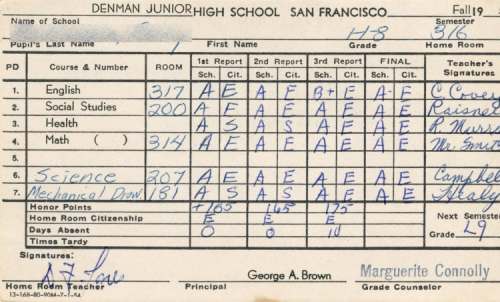
That report cards have changed over the years is a fact that any parent and grand-parent can swear to. Some past and current ones illustrate reforms that have occurred.
Nettie+Juenger+4th+Grade+Report+Card.jpg
Denman-Junior-High-School-report-card-Grade-8-Fall-1955-750x453.jpg
005-template-ideas-school-report-card-template-19137.png
CCSS_RC-K_Page_1.jpg

Get the picture? Over time, report cards have mixed academic performance with classroom behavior and personal traits. They have moved from judging children with percentages to letter grades to narratives joined to district and state standards. And, depending upon whether the report card is for elementary or  CONTINUE READING:  Reforming Student Report Cards | Larry Cuban on School Reform and Classroom Practice


EVELYN DEJESUS BECOMES FIRST LATINA ELECTED TO UPPER LEADERSHIP OF UNITED FEDERATION OF TEACHERS | Black Star News

EVELYN DEJESUS BECOMES FIRST LATINA ELECTED TO UPPER LEADERSHIP OF UNITED FEDERATION OF TEACHERS | Black Star News

EVELYN DEJESUS BECOMES FIRST LATINA ELECTED TO UPPER LEADERSHIP OF UNITED FEDERATION OF TEACHERS

Evelyn DeJesus: “I am honored to represent the members of this union—their hopes, their aspirations and the incredible work they do every day to make people’s lives better in their communities. I am energized and ready.”

Evelyn DeJesus, the vice president for education of the AFT’s largest local, the United Federation of Teachers in New York City, was elected unanimously today by the national union’s executive council as executive vice president.

DeJesus will serve alongside President Randi Weingarten and Secretary-Treasurer Lorretta Johnson. She will finish out the remainder of Mary Cathryn Ricker’s term. Earlier this year, Ricker was appointed to serve as commissioner of the Minnesota Department of Education.

DeJesus was elected to the post as the union kicks off its biennial TEACH (Together Educating America's Children) professional learning conference in Washington, D.C., where more than 1,200 educators from across the country will gather over the next three days to highlight the union’s major initiatives, including investment in public education, taking on student debt, respecting the freedom to teach, creating safe and welcoming work environments with an eye toward building power, and safeguarding a democratic future through voting and advocacy.

In her new role, DeJesus will work with the union’s top leadership to advocate for the rights of educators, healthcare professionals and public employees across the country in their fight for a better life, a voice at work and a voice in their democracy.

“I am honored to represent the members of this union—their hopes, their aspirations and the incredible work they do every day to make people’s lives better in their communities,” DeJesus said. “I am energized and ready.”

DeJesus began her career when one of her daughters became ill during a school construction project, and she courageously exposed the toxic  CONTINUE READING: EVELYN DEJESUS BECOMES FIRST LATINA ELECTED TO UPPER LEADERSHIP OF UNITED FEDERATION OF TEACHERS | Black Star News


CURMUDGUCATION: Eight Weeks of Summer: Big Hairy Say What Now?

CURMUDGUCATION: Eight Weeks of Summer: Big Hairy Say What Now?

Eight Weeks of Summer: Big Hairy Say What Now?

This post is week 5 of 8 in the 8 Weeks of Summer Blog Challenge for educators.

I've been doing the Hot Lunch Tray eight week challenge. Unlike other challenges, it does not require me to eat responsibly or beat myself up with ice water or plastic gerbils. I'm answering the questions as my old pre-retirement self. You can see what other folks are writing by checking out the #8WeeksofSummer hashtag. So here's this week's prompt:

What is your BHAG for next school year?

That's "Big Hairy Audacious Goal" for those of you haven't sat through professional development that pushes this kind of thing.

So I guess I have to address this one with a confession-- in thirty-nine years of teaching, I never set a BHAG. For that matter, I not sure I know anyone who did.


Maybe it's just a matter of phraseology. BHAG strikes me like "wacky" or "wise" or "hilarious" or "weird" or "badass rebel"-- if you have to apply the term to yourself, then you aren't. BHAG is an approach that calls attention to itself, that hollers, "Wow! Look at how bold and outside the box I'm being!" Maybe it's my New England roots or my general attitude, but this kind of thing takes me right back to Rule 10: Shut up and do the work.

I always had goals. Any teacher who's worth their salt (or cod, or whatever you want to trade in)always has goals, because any decent teacher can tell you, right now, the list of things that she knows she needs to get better at. There's never enough time, and while we refine and refine our game, it's never perfected. So teachers have projects, all the time. Get faster at assessing papers. Reconfigure the room. Rebuild the reading list. Incorporate ideas from that book/video/presentation that set my brain on fire. Come up with a better approach for that unit I CONTINUE READING: 
CURMUDGUCATION: Eight Weeks of Summer: Big Hairy Say What Now?


Choosing Democracy: SCUSD Trying to Break Teachers Contract

Choosing Democracy: SCUSD Trying to Break Teachers Contract

SCUSD Trying to Break Teachers Contract

The Sacramento School District is trying to set a dangerous precedent of breaking contracts

By Katie Ferrari

Sacramento teachers have been fighting their district to get their contract implemented for nearly two years. Their struggle puts them on the frontlines of contract enforcement. If the district gets away with breaking the law and not honoring the legally binding contract, it sets a dangerous precedent for other districts and employers across the country.

David Fisher, president of the Sacramento City Teachers Association (SCTA), says that the Sacramento City Unified School District (SCUSD) “feels like [the teachers union] got too good of a deal…because we were too well organized, so now they’re reneging.” He points out that “other districts that have signed agreements that are going to be costly would like to have the precedent of a district like ours to be able to break a contract based on ‘inability to pay’ or budget problems, because if they are successful here, they can be successful in Oakland, LA, or anywhere else.”

District vs. the Union: A Play-by-Play 

In November 2017, teachers won a groundbreaking tentative agreement with major concessions from the district three days before they were scheduled to go on strike. The three-year contract included three annual 2.5% raises, the first of which was retroactive, dating back to July 2016. The union also won an additional 3.5% raise in the 2018-19 school year for mid-career teachers to keep experienced teachers from leaving for higher pay in neighboring districts. Fisher says that mid-career teachers in Sacramento “made anywhere from $10-18k less” than nearby districts.
Most significantly, teachers proposed a way to fund the smaller class sizes and more student supports they were demanding. They would switch their healthcare to a less expensive pool and funnel those savings back into classrooms. 
Nearly two years have passed since teachers won this contract, but it has still not been implemented fully. Instead, the district has done everything it can to renege on the contract. It has manufactured budget crises by hiring 18 new administrative positions (at an estimated cost of $3 million) despite a decline in enrollment and undertaking a $6 million vacation buyout for top administrators. 


In November 2018, the district sued the teacher’s union in an attempt to break the contract on the grounds of financial difficulties. That December, the district refused to sign a memorandum of understanding that would put health plan savings towards class size reductions and student supports. Instead, they wanted to use the health plan savings to cover the budget deficits they had created.
The Sacramento County Superior Court settled in favor of the union in February 2019 and forced the district to return to salary arbitration. On May 2, the court-appointed arbitrator ruled in favor of teachers. They  would get the additional 3.5% raise for mid-career teachers the contract mandated.
After losing the lawsuit, the district changed tactics and began threatening that implementation of the contract would induce a state takeover. In March, the district announced a $35 million budget deficit that needed to be closed by the end of the 2019 school year. On April 11, Sacramento teachers went on a one-day unfair labor practice strike to demand the district honor the written agreement that health plan savings be used to lower class sizes and improve student services. 
A few weeks later, the district released its third interim budget and publicly admitted to making a $16 million mistake in budget projections by undercounting over 700 students in its enrollment. The union had been sounding the alarm about these faulty enrollment numbers since February, and an email leak later revealed that Superintendent Aguilar had known about the miscount as early as April 1.
Despite the $16 million “setback,” the district quickly set to work to create another budget crisis and impending state takeover that they could use to justify breaking the contract and directing health plan savings towards the deficit rather than students. This time, they chose to double the percentage of state-mandated reserves that are required for a school district to stay out of state receivership.
The state-mandated amount is 2%, but SCUSD produced budget projections with a 4% reserve and said they were incapable of meeting this amount and implementing the contract. Another $23 million was added to the budget deficit. Later in May, the Sacramento County Office of Education (SCOE) reviewed the district’s proposed budget and re-adjusted the reserve back to 2%.
Projections went from a $64 million deficit to “a $15 million positive ending balance” in a matter of months, Fisher says. “That’s a $69 million reversal.” 

Local Media and Charters vs. the Union  

Throughout this debacle, local media has taken its cues from the district. A week before teachers won their contract, the Sacramento Bee ran an editorial that exemplifies their coverage of this ongoing issue. The Bee slammed the union for CONTINUE READING: Choosing Democracy: SCUSD Trying to Break Teachers Contract

Mike Klonsky's Blog: Lots of candidates but no real debate on school deseg

Mike Klonsky's Blog: Lots of candidates but no real debate on school deseg

Lots of candidates but no real debate on school deseg

Even though I have a lot is issues with Kamala Harris, I thought she was bold in confronting frontrunner Joe Biden and calling him out during the televised debate, for his opposition to "forced" school integration back in the '70s. Actually, as he pointed out, his position hasn't changed. He is still against a federal role in enforcing the Brown Decision.

His opposition to busing and his partnership with avowed "states-rights" segregationists like Eastland and Talmadge, seemed like fair game during the debate. Thanks to Harris, Biden himself was finally forced to apologize for touting his work with the racist senators.

In fact, I was surprised that not one of the other candidates, particularly white progressives like Sanders and Warren, had Harris' back at the time. None would even dare mention Biden's name during either of the two debates. This even though the road to the nomination obviously runs through him and the DNC leadership. If you're not willing to take on Biden, what's the point of running? Unless of course, you're just a stalking horse for Biden, trying to dissipate the opposition or an unprincipled kiss-ass, hoping for a V.P. slot or cabinet appointment if Biden wins.

Such is the intimidating power of the Pelosi party leaders who are really running Biden against young insurgents like Reps Alexandria Ocasio Cortez, Ilhan Omar, Rashida Tlaib, and Ayanna Pressley, rather than any of the announced primary candidates who were on stage those nights.

Pelosi, it seems, would rather lose the election to Trump than risk losing the leadership of the CONTINUE READING: 
Mike Klonsky's Blog: Lots of candidates but no real debate on school deseg


Wednesday, July 10, 2019

NANCY BAILEY: Human Interaction & Picture Books vs. Waterford Upstart’s Preschool Phonics Online Video

Human Interaction & Picture Books vs. Waterford Upstart’s Preschool Phonics Online Video

Human Interaction & Picture Books vs. Waterford Upstart’s Preschool Phonics Online Video

Last Sunday, The New York Times described Waterford’s Upstart online program for preschoolers, describing it as better than nothing, or, as “closing a gap.” They described communities that could not (or would not) raise money for preschool, so, online instruction seemed like the default choice.
Who’s reviewing these programs?
Waterford Upstart is flawed. This can be determined by viewing one of the video samples that they chose to promote in The New York Time’s report. After reviewing this video, it would seem like a child would be better off without the program!
Waterford Upstart was created by the Utah legislature and has been funded by groups intent on privatizing public schools with technology. The Audacious Project through TED is helping to fund it.
There’s increasing distrust over how school district officials try to convince their communities they can’t find money for school programs including preschools, but, with the help of the state or federal government they can fund online programs CONTINUE READING: Human Interaction & Picture Books vs. Waterford Upstart’s Preschool Phonics Online Video

CURMUDGUCATION: Whom Do We Trust

CURMUDGUCATION: Whom Do We Trust

Whom Do We Trust

One of the unending underlying challenges in education is that parents and taxpayers have to trust somebody.

Back In The Day, the default was to trust teachers and administrators. That would be back when the default was to trust authority figures as a whole-- but that pendulum has swung far in the other direction (on behalf of all the Boomers, let me just say, "You're welcome"). Heck, even within the more recent past of my own career, a shift has been visible. In my first job (1979-1980) parent-teacher-student conferences often involved a parent absolutely taking my side, even though they didn't know me from a hole in the ground.


The erosion of trust has been widespread and has resulted from a variety of causes, and many of them have been--and continue to be--legit. Some of it is not an actual erosion at all, but simply finally hearing the voices of people who have never had a reason to trust authority. And some of it is the result of baloney, the kind of thing we see when someone explains that a youtube video deserves far more trust than an actual trained medical doctor. And some of it is the result of deliberate attempts to break down trust.

Education has been hit by a trust problem that really kicked off in 1983 with A Nation At Riska work which had as its singular purpose to deliver the message that public education, and the people who work in it, cannot be trusted. "Those folks," it said none-too-subtly, "are no more trustworthy than a hostile foreign power."

For thirty-six years, that drumbeat continued. Teach for America launched with the premise that teachers and the programs that produce them cannot be trusted. Common Core was sold as an CONTINUE READING: 
CURMUDGUCATION: Whom Do We Trust


Governor’s team jumps into fray over contested charter school bill | EdSource

Governor’s team jumps into fray over contested charter school bill | EdSource

Governor's team jumps into fray over contested charter school bill
Amendments to AB 1505 moderate restrictions on charter school growth

After weeks of negotiation, Gov. Gavin Newsom has stepped in to scale back proposed legislation that charter school advocates feared would radically slow charter growth.
Newsom’s office submitted amendments to Assembly Bill 1505 after numerous discussions between his advisers and representatives of charters schools, organized labor and the bill’s author, Assemblyman Patrick O’Donnell, D-Long Beach, according to sources familiar with the discussions.
O’Donnell received the changes on Friday and inserted them into the bill to keep it alive. It will go before the Senate Education Committee on Wednesday in what could be a contentious hearing over the administration’s suggested compromises. Intense discussions are expected to continue, with the intention of passing  a bill this fall that all involved say has many moving parts. No one contacted for this story would comment on the record, citing the sensitivity of the negotiations.
The changes reflect Newsom’s determination to de-escalate tensions around charter school growth and find common ground on reforms. Newsom chose to intervene in a bitter fight between the California Charter Schools Association and the California Teachers Association over a bill that has gained national notice as a bellwether of the charter school movement. Earlier this year, at his urging, the Legislature expedited passage of a bill to require more transparency in charter school operations.
As originally proposed, AB 1505 would have given school districts broad authority to reject a charter school’s application and renewal after considering the financial impact CONTINUE READING: Governor’s team jumps into fray over contested charter school bill | EdSource

Where the 2020 Democrats Stand on Busing - The Atlantic

Kamala Harris, Joe Biden, and the Debate Over Busing - The Atlantic

Where the 2020 Democrats Stand on Busing
Many of the presidential hopefuls agree that school segregation is a significant problem, but not all of them want the federal government to step in.

In the two weeks since Senator Kamala Harris of California delivered a pointed attack on former Vice President Joe Biden over his past criticism of federally mandated school busing, it’s become clear that the two Democratic candidates don’t differ all that much in their views: They both support voluntary busing, but seem hesitant to endorse it as a federal mandate.
But there are at least 10 2020 Democratic candidates who do support federally mandated busing as a means of desegregating America’s schools. “If localities are not taking action to desegregate schools, Elizabeth believes the federal government has a constitutional obligation to step in to deliver on the promise of Brown v. Board, including, if necessary, busing,” a spokesperson for Senator Elizabeth Warren of Massachusetts told The Atlantic. A spokesperson for Senator Cory Booker of New Jersey, Sabrina Singh, echoed the sentiment. “At a time of increasing segregation of schools, we should consider every tool at our disposal—including busing—to support desegregation and ensure equal opportunity for all kids,” she said.
Nearly 50 years after the Supreme Court upheld the constitutionality of busing—and 65 years after the court ordered schools desegregated—the debate over the practice, and the use of federal muscle to hasten desegregation of public schools more broadly, has again grabbed national attention. With school segregation worsening over the past several decades, presidential candidates CONTINUE READING: Kamala Harris, Joe Biden, and the Debate Over Busing - The Atlantic


The Legacy Of Busing And School Desegregation - 1A

The Legacy Of Busing And School Desegregation - 1A

The Legacy Of Busing And School Desegregation

Sen. Kamala Harris told the nation a story two weeks ago.
Here is what she said.
And I will say also that — that, in this campaign, we have also heard — and I’m going to now direct this at Vice President Biden, I do not believe you are a racist, and I agree with you when you commit yourself to the importance of finding common ground.
But I also believe, and it’s personal — and I was actually very — it was hurtful to hear you talk about the reputations of two United States senators who built their reputations and career on the segregation of race in this country. And it was not only that, but you also worked with them to oppose busing.
And, you know, there was a little girl in California who was part of the second class to integrate her public schools, and she was bused to school every day. And that little girl was me.
So I will tell you that, on this subject, it cannot be an intellectual debate among Democrats. We have to take it seriously. We have to act swiftly.
On the debate stage in Miami, Biden called Harris’ remarks a “complete mischaracterization” of his position.
But Harris’ story catalyzed a national conversation about what school integration means and how to achieve it in 2019, when “millions of black and Latino children” experience the “the consequences of racial and economic segregation,” according to The Los Angeles Times.
Could some form of busing work today? Or is the problem of school CONTINUE READING: The Legacy Of Busing And School Desegregation - 1A


Why America lost so many of its black teachers - Civil rights and wrongs

Why America lost so many of its black teachers - Civil rights and wrongs

Why America lost so many of its black teachers
Before 1964 nearly half of college-educated African-Americans in the South were teachers

JULY MARKS the 55th anniversary of the Civil Rights Act, which outlawed discrimination on the basis of race, colour, religion, sex, or national origin. It also enforced desegregation of the government-run school system nationwide, largely ending the practice of educational apartheid. But while desegregation transformed America's education system, the way it was implemented by discriminatory school boards in the South was harmful to black teachers. A new paper by Owen Thompson, an economist at Williams College, shows there was a dramatic decline in the employment of African-American teachers in the aftermath of desegregation. The policies behind that decline have contributed to lower employment for African-American educators in the decades since.
In 1954 the Supreme Court ruled in the case of Brown v Board of Educationthat “in the field of public education the doctrine of ‘separate but equal’ has no place.” Ten years later, less than 5% of black children in the Southern states of the former Confederacy were attending school with whites. The Civil Rights Act, which among other enforcement mechanisms tied federal education funding to school integration, dramatically changed that: by 1970, more than 90% of black children attended schools that also taught white children.

For African-American students, the impact of desegregation was overwhelmingly positive. It was one reason why the gap between test scores of black and white students born in 1954 and those born 30 years later declined by nearly 40%, according to research by Eric Hanushek and colleagues at Stanford University.
For African-American teachers, it was a different story. Before the Civil Rights Act, Southern black schools were staffed almost exclusively by black teachers. Nearly half of African-Americans with a post-secondary CONTINUE READING: Why America lost so many of its black teachers - Civil rights and wrongs