Latest News and Comment from Education

Thursday, June 13, 2019

Court declines to exempt charters from school segregation case | MPR News

Court declines to exempt charters from school segregation case | MPR News

Court declines to exempt charters from school segregation case


The Hennepin County District Court this week decided not to exempt Minnesota charter schools from a lawsuit aimed at addressing school segregation.
The Cruz-Guzman case claims that persistent school segregation effectively denies Minnesota children an adequate education.
Several charter schools sought to be exempted from whatever ruling might be made in the case, but a judge on Monday decided not to exempt them.
Daniel Shulman, who represents the plaintiffs, said he was delighted by the decision.
"The impact is that the charter schools don't get a free pass here," Shulman said. "They've asked the judge basically to say that they can't be held accountable for the contribution they've made to segregation. And the judge wouldn't do that, as I think was correct."

• Listen: Charter school advocates push back on segregation claims
• Jan. 2018: School desegregation case goes to state Supreme Court

Nekima Levy-Armstrong, who represents the charter schools involved in the case, said her clients are disappointed but not surprised by Judge Susan Robiner's decision.
"Our clients have done an incredible job providing culturally affirming environments for students and also outstanding educational opportunities," she said. "And we want to ensure that, regardless of the outcome of this litigation, their rights will be protected, that their ability to educate students will be protected, and that the choices of parents — particularly parents of color — will also be protected."
Two of the charter schools Levy-Armstrong represents say their student body is over 90 percent black, according to the court order filed Monday. Levy-Armstrong said the concern is that refusing to exempt her clients from whatever decision the CONTINUE READING: Court declines to exempt charters from school segregation case | MPR News

WV MetroNews Weingarten says Senate leaders ignoring public on charter school issue - WV MetroNews

WV MetroNews Weingarten says Senate leaders ignoring public on charter school issue - WV MetroNews

Weingarten says Senate leaders ignoring public on charter school issue

CHARLESTON, W.Va. — American Federation of Teachers President Randi Weingarten says the Republican majority in the West Virginia State Senate should take a cue from what the AFT has been able to do in McDowell County when it comes to education reform.

File
Weingarten was on the picket lines with WV teachers in 2018 and earlier this year.
“We’ve actually done these things within the public school system and we’ve actually done these things with people in the community, with teachers, with community members, with students, not trying to impose something that takes money out,” Weingarten said.
She visited Charleston Wednesday to meet with the state Board of Education. Weingarten said she wanted to update the board on the success of the Reconnecting McDowell program with all the talk of education reform and the Senate-passed Student Success Act.
Weingarten, who walked picket lines with West Virginia teachers the past two years, said AFT and its partners have been able to meet the emotional and social needs of McDowell County students while engaging them in the instruction they need.
Weingarten, during an appearance Wednesday on MetroNews CONTINUE READING: WV MetroNews Weingarten says Senate leaders ignoring public on charter school issue - WV MetroNews
National teachers union president: WV education bill 'a mockery' | Education | wvgazettemail.com - https://www.wvgazettemail.com/news/education/national-teachers-union-president-wv-education-bill-a-mockery/article_271b52f6-9e04-5ae2-a655-8c81929585b2.html on @wvgazettemail
Randi Weingarten

Bill calls for assurance that low-income kids get school meals :: K-12 Daily

Bill calls for assurance that low-income kids get school meals :: K-12 Daily :: The Essential Resource for Superintendents and the Cabinet

Bill calls for assurance that low-income kids get school meals

(Calif.) Public schools in California do not have to participate in federal school meal programs, but under a bill moving through the state Legislature, they will have to ensure low-income children receive at least one meal on campus that meets federal nutrition requirements.
Assemblywoman Sharon Quirk-Silva, D-Fullerton and author of AB 354, noted that academic performance is partially linked to if students are coming to school hungry, and that all traditional and public charter schools should be providing lunch to children eligible for free or reduced-price meals.
“Many schools do this, and some schools also provide breakfast, but there are some public schools that maybe have a very small percentage of Title I students, and many times they don’t give that meal to those students,” Quirk-Silva said during a Senate committee hearing Wednesday. “We want students, no matter what school they’re going to, to have at least the one nutritious meal.”
Studies have shown that healthier school environments have numerous benefits for students. For example, quality physical education predicts higher levels of physical activity in school. And school wellness policies that promote increased access to healthier foods and limit access to unhealthy foods have been linked to lower caloric intake and improved student diets.
Since 2004, all school districts participating in the federal meal programs have been required to create a committee of stakeholders and write a school wellness policy that set goals for physical and nutrition education, and set nutrition standards for meals and snacks served.
In 2010, the scope of school wellness policies was expanded by The Healthy, Hunger-Free Kids Act which, among other things, aimed to promote more physical activity and increase the amount of whole grains, fruits and vegetables served in school meal programs while lowering sugars, sodium and calorie intake.
There are 530 districts with nearly 1,800 school sites statewide that do not participate in the federal National School Lunch Program and School Breakfast Program, according to California Department CONTINUE READING: Bill calls for assurance that low-income kids get school meals :: K-12 Daily :: The Essential Resource for Superintendents and the Cabinet

The Sun-Times editorial board lies. There is no teacher pension ‘spiking.” None of these facts will matter. – Fred Klonsky

The Sun-Times editorial board lies. There is no teacher pension ‘spiking.” None of these facts will matter. – Fred Klonsky

THE SUN-TIMES EDITORIAL BOARD LIES. THERE IS NO TEACHER PENSION ‘SPIKING.” NONE OF THESE FACTS WILL MATTER.

Screen Shot 2019-06-13 at 9.09.43 AM
The unfunded liability nothing to do with pension benefits. It is entirely due to the state’s failure to pay into the pension funds over decades what they owe.

It was just a few days ago that I posted how Crain’s Greg Hinz and the Chicago Federation’s Larry Msall lied about the cap on teacher’s pensionable raises and a pension spike.
But no sooner had I hit the publish button than the Chicago Sun-Times repeats the lie.
I thought the Sun-Times was the pro-labor paper in town.
I guess we’re on our own folks.
But in the last-minute move on June 1, probably in response to a “Repeal the 3%” campaign by the state teachers’ union, the governor and Legislature bumped the cap back up to 6%. The increase, which was nixed by the House earlier this spring when it was stand-alone legislation, doesn’t affect Chicago, which has its own teacher pension fund.
This latest pension sweetener will allow local school districts to raise teacher’s pay by 24%-plus in their final four years — CONTINUE READING: The Sun-Times editorial board lies. There is no teacher pension ‘spiking.” None of these facts will matter. – Fred Klonsky

National Education Policy Center: Phony Voucher Report | Diane Ravitch's blog

National Education Policy Center: Phony Voucher Report | Diane Ravitch's blog

National Education Policy Center: Phony Voucher Report


The National Education Policy Center published a review of an annual report by EdChoice, an advocacy organization for vouchers.

KEY TAKEAWAY:
Questionable methodology and misrepresentation of the research result in a misleading report not useful for decision-making or research purposes.
BOULDER, CO (June 11, 2019) – A recent report from EdChoice presents itself as a yearly updated list and synthesis of empirical studies exploring the impacts of school vouchers across a set of outcomes. But a new review of the report finds that it fails to provide a robust summary of the research literature on vouchers and their full range of positive and negative impacts.
T. Jameson Brewer, of the University of North Georgia, reviewed The 123s of School Choice: What the Research Says About Private School Choice: 2019 Edition.
EdChoice’s report attempts to convince readers that a solid body of research evidence shows voucher benefits such as an increase in test scores, parental satisfaction, increased civic values, improvements in racial segregation, and fiscal benefits through governmental cost savings.
What Dr. Brewer found instead was a limited collection of cherry-picked studies, largely from non-peer-reviewed sources, and primarily authored by voucher advocates. The report’s misrepresentation of the existing research, combined with its use of the questionable methodology of simply counting up results categorized as positive or negative, results in an overall appearance of stacking the deck to create an illusory compilation of studies that profess to bolster EdChoice’s predetermined commitment to cheerleading school vouchers.
Find the review, by T. Jameson Brewer, at:
Find The 123s of School Choice: What the Research Says About Private School Choice: 2019 Edition, written by Andrew Catt, Paul DiPerna, Martin Lueken, Michael McShane, and Michael Shaw, and published by EdChoice, at:

National Education Policy Center: Phony Voucher Report | Diane Ravitch's blog

How Restorative Practices Work for Students and Educators - NEA Today

How Restorative Practices Work for Students and Educators - NEA Today

How Restorative Practices Work for Students and Educators
A few Mondays ago, a Denver third-grader named Luca sat down in a circle with his classmates and started a conversation like this: “If you were an animal for a day, based on your mood and feelings today, what animal would it be?”
It was the best conversation, say classmates Ellie and Lina. “I said I’d be a monkey because I was feeling silly,” says Ellie. “And I said I’d be a panda!” says Lina. “Because I was feeling lazy and hungry, and pandas are lazy and they eat all the time!”
Funny! But the point of the circle conversations, also known as “peace circles,” which take place every Monday morning in every classroom at the K-8 Dora Moore School in Denver, isn’t giggles. It’s to build community and to foster the kind of student-to-student and educator-to-student relationships that lead to supportive classrooms.
“When you go to school here, you get to know each other,” says fifth-grader Trinity. “At my old school, we never got to know each other — or to understand each other.”
Classroom circles are just one of the restorative practices that Dora Moore’s educators have adopted over recent years. Many of their students also practice their conflict-resolution skills in “peace walks,” and get regular, positive feedback through daily, one-on-one check-ins with dedicated, full-time restorative practices specialists on their campuses.
Often, this all takes place under the eyes of visiting educators who want to see and CONTINUE READING: How Restorative Practices Work for Students and Educators - NEA Today

CURMUDGUCATION: PA: UPDATE*** Voucher Expansion Goes To Governor

CURMUDGUCATION: PA: Voucher Expansion Goes To Governor

PA: Voucher Expansion Goes To Governor


UPDATE 
Wolf to veto $100M private schools bill in Pennsylvania | News | meadvilletribune.com - https://www.meadvilletribune.com/news/wolf-to-veto-m-private-schools-bill-in-pennsylvania/article_8180e6be-4208-5b57-8a0d-363a3d7dad72.html on @Meadville_Trib

The Pennsylvania GOP-controlled legislature is continuing its assault on public education, this time taking a page from the Betsy DeVos Big Book of Voucher Love.


HB 800 worked its way through the House a while back, and it has just cleared the Senate. The bill is a big wet kiss to the business community and to private schools, particularly religious ones. The Catholic Church loves this bill, as does ACSIPA, a network of Christian schools advocating for school choice. Meanwhile, the Pennsylvania Council of Churches is opposed.

The bill expands the Educational Improvement Tax Credit (EITC), a version of the same tax credit scholarship that is behind DeVos's $5 billion scheme. Tax credit scholarships exist in order to circumvent the law which says that thou shalt not give public tax dollars to private religious institutions. Here's how it works.

1) Mr. and Mrs. McGotbux gives a pile of money to Pat's Very Legit Scholarship Organization.

2) The state lets the McGotbux family count their contribution, in whole or in part (depending on the law) as payment on their taxes.

3) Pat's Very Legit Scholarship Organization gives some student at So Much Jesus School a scholarship CONTINUE READING: CURMUDGUCATION: PA: Voucher Expansion Goes To Governor

Wednesday, June 12, 2019

Unacceptable: Nineteen States Still Allow Corporal Punishment | Schott Foundation for Public Education

Unacceptable: Nineteen States Still Allow Corporal Punishment | Schott Foundation for Public Education

Unacceptable: Nineteen States Still Allow Corporal Punishment
The advancement of school discipline reform has been a bright spot among what often feels like a sea of bad news in education. Coalitions like the Dignity in Schools Campaign and national groups like the Advancement Project and NAACP have long highlighted the unjust, inequitable and ineffective school discipline policies that far too many children attend school under. Studies consistently show the school-to-prison pipeline is built on a bedrock of white supremacist, patriarchal, heteronormative and ableist biases. Fortunately, innovative cross-sector organizing uniting young people, parents and educators have been able to push positive reform policies in states and districts across the country — first by curbing harmful punishments like suspensions and expulsions, and then by introducing positive policies to replace them, like restorative practices and accountability processes that center healing instead of punishment.

However, a new report shows just how uneven these reforms have been implemented, and how desperately far many states and districts need to go.
The Striking Outlier, co-authored by the Southern Poverty Law Center and the UCLA Center for Civil Rights Remedies, details how nineteen states still have corporal punishment as an acceptable disciplinary practice in their public schools. For those nineteen states,
educators in public schools are allowed to do what employees in many prisons, juvenile detention facilities, daycare and early learning centers can’t do by law — strike another person as punishment.
Nor is this unconscionable practice a dead letter, a mere relic from a older time and no longer practiced. So many students are CONTINUE READING: Unacceptable: Nineteen States Still Allow Corporal Punishment | Schott Foundation for Public Education


Educational Accountability and the Science of Scapegoating the Powerless | radical eyes for equity

Educational Accountability and the Science of Scapegoating the Powerless | radical eyes for equity

Educational Accountability and the Science of Scapegoating the Powerless

Several years ago when I submitted an Op-Ed to the largest newspaper in my home state of South Carolina, the editor rejected the historical timeline I was using for state standards and testing, specifically arguing that accountability had begun in the late 1990s and not in the early 1980s as I noted.
Here’s the interesting part.
I began teaching in South Carolina in the fall of 1984, the first year of major education reform under then-governor Richard Riley. That reform included a significant teacher pay raise, extended days of working for teachers, and the standards-testing regime that would become normal for all public education across the U.S.
In fact, SC’s accountability legislation dates back to the late 1970s (I sent her links to all this).
As a beginning teacher, the only public schooling I ever knew was teaching to standards and high-stakes tests by identifying standards on my lesson plans and implementing benchmark assessments throughout the academic year to document I was teaching what was mandated as a bulwark against low student tests scores. State testing, including punitive exit exams, pervaded everything about being an English teacher.
Yet, an editor, herself a career journalist, was quick to assume my expertise as a classroom practitioner and then college professor of education was mistaken.
This is a snapshot of how mainstream media interact with education as a topic and educators as professionals.
I am reminded of that experience over and over in fact as I read media coverage of education. Take for example this from Education WeekWant Teachers to Motivate Their Students? Teach Them How, which has the CONTINUE READING: Educational Accountability and the Science of Scapegoating the Powerless | radical eyes for equity


Here Comes the Goose Stepper - Teacher Habits

Here Comes the Goose Stepper - Teacher Habits

Here Comes the Goose Stepper
Last week, I came across this phenomenal video on my Twitter:
First, I thought, “That’s rather funny and clever.”
Then I thought, “Man, what a bunch of goose stepping morons.”
Then, I started thinking about teaching because that’s what I do. And what I thought – forgive me – is that we’ve got some goose stepping teachers walking around and they should probably knock it off.
We watch a video like the above and shake our heads. We chuckle a little over how goofy the soldiers look, even without the Bee Gees. Because the goose step is strongly associated with the Nazis, North Korea, and other dictatorial regimes, we see it as backwards, a symbol of blind obedience. George Orwell captured most westerners’ opinion of the goose step when he wrote that it was only used in countries where the population was too scared to laugh at its military.
But here’s the thing about those goose stepping soldiers: Some of them, maybe even most of them, are thinking about how much they’re killing the thing. Pick a soldier out of the above video clip and this is probably pretty close to what’s going through his or her head:
Look at me, crushing this march. Nobody goose steps like I do. Watch me swing my legs. Perfectly straight! Not like Chan-woo over there. Man, I feel good! I’m goosing the hell out of this step!
Which goes to show you that people have an amazing capacity to feel CONTINUE READING: Here Comes the Goose Stepper - Teacher Habits

LAUSD's Plan To Avoid Financial Meltdown For The Next Three Years: LAist

LAUSD's Plan To Avoid Financial Meltdown For The Next Three Years: LAist

LAUSD's Plan To Avoid Financial Meltdown For The Next Three Years

Los Angeles Unified School Board members will meet Tuesday to take public comments on their proposed $9.2 billion budget for the upcoming school year. One week later, board members expect to take a final vote on the spending plan.
Even if the budget is balanced for now, officials warn that LAUSD's long-term financial health is becoming more precarious. This warning has become almost an annual routine in LAUSD, and in recent years, some skeptics have stopped taking them seriously.
But something feels different about this year's budget — if only because of the circumstances in which board members are considering it.
In the past year, Angelenos rallied behind the district's teachers, who went on strike in Januaryto demand higher salaries, smaller class sizes and more support staff for schools. LAUSD officials agreed to pay for all these things, though they warned the gains would only be temporary unless everyone involved could find a way to pay for them.
Just last week, Plan A to fund the agreement long-term — a ballot measure to raise taxes for LAUSD — failed in a special election by a wide margin.
Superintendent Austin Beutner said the budget he's submitting to the LAUSD board Tuesday will avoid a deficit over its three-year course — even if a Plan B for generating that revenue doesn't come together during that period.


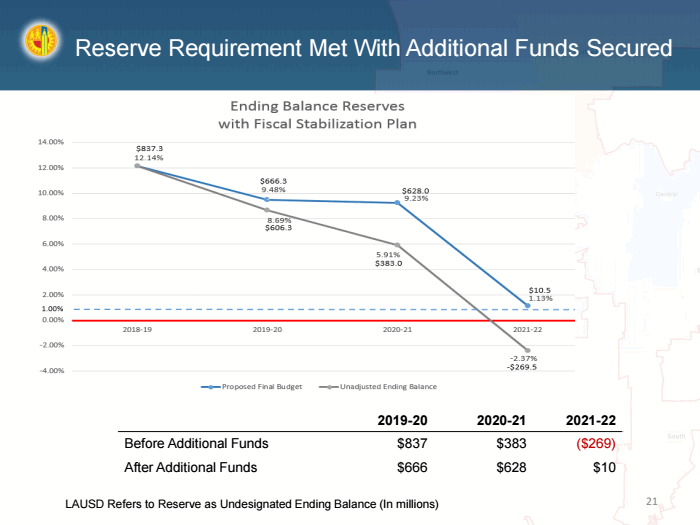
Selected portion of a source document hosted by DocumentCloud
"Ending balance" refers to the unassigned balances, but doesn't include "assigned balances" — funds received in previous years that it has committed to spend in future years.
But Beutner said district officials will need to burn through almost all of the $837 million LAUSD currently has in the bank — or, technically, stockpiled "unassigned" funds — to avoid straying into the red toward the end of the three-year budget period.
"The first two years are pretty solid," Beutner said. "They have been before the strike, during the strike and after the strike. The third year is still quite tenuous."
Beutner, like other LAUSD leaders before him, has issued similar warnings in the past. In fact,  CONTINUE READINGLAUSD's Plan To Avoid Financial Meltdown For The Next Three Years: LAist

Budget deal takes shape, details to come in trailer bills :: K-12 Daily

Budget deal takes shape, details to come in trailer bills :: K-12 Daily :: The Essential Resource for Superintendents and the Cabinet

Budget deal takes shape, details to come in trailer bills

(Calif.) State policymakers appear poised to complete the budget prior to California’s June 15 deadline, but a number of trailer bills will determine policies related to funding for early learning, teacher recruitment and credentialing, and special education.
The Legislature’s Conference Committee on the Budget reached agreement on new investments this last weekend, including a push to increase the number of pre-school slots for income-eligible four-year-olds–one of Gov. Gavin Newsom’s key priorities.
Thus far, the governor as well as education leaders have hailed the budget report for adding historic funding for schools, students and teachers throughout the state.
 “This is a strong budget for public schools and an important step on the road toward providing California’s 6.2 million students with the resources needed for a high-quality education,” Emma Turner, president of the California School Boards Association, said in a statement. “Much work remains.”
Some of that spending, however, will hinge on yet-to-be-released trailer bills. While Saturday marks the constitutional budget deadline for lawmakers to approve next year’s spending plan, trailer bills can be voted on later this month, and require only a simple majority to pass.
Under the current iteration of the budget bill, for instance, lawmakers carved out close to $153 million to bring all Local Educational Agencies to the statewide base rate, as well as more than $493 million to provide grants to LEAs serving 3 and 4 year olds with Individualized Education Plans. The committee also noted trailer bill language would need to require ongoing funding to be contingent upon the passage of legislation in the next budget to reform the special education system to improve outcomes for students.
Committee members approved $195 million in one-time spending on the Child Care Early Learning and Care Workforce Development Grant, while also adopting placeholder trailer bill language to “expand trainings and support activities to a broad range of providers.”
In an effort to improve teacher recruitment and preparation efforts for older children, lawmakers CONTINUE READING: Budget deal takes shape, details to come in trailer bills :: K-12 Daily :: The Essential Resource for Superintendents and the Cabinet


Sac City Unified Poised To Have New Budget, But Health Benefits And Labor Issues Remain - capradio.org

Sac City Unified Poised To Have New Budget, But Health Benefits And Labor Issues Remain - capradio.org

Sac City Unified Poised To Have New Budget, But Health Benefits And Labor Issues Remain

On Thursday, the Sacramento City Unified School District board is scheduled to approve a new budget for the next school year, but none of the parties involved are celebrating.
The district's budget proposal is $547.5 million for the coming year, but everyone is focused on the budget forecast for two years from now. If the district does not have enough money to pay its bills in future years, it faces state takeover.
SCUSD says the forecast shows it will be in the red in two years.
"We're currently looking at a $26 million structural budget deficit. That's the amount that we need to cut over the next couple of years,” said Alex Barrios, district spokesman.
But the Sacramento City Teachers Association says the district numbers can’t be trusted since the district has made several errors in its calculations.
"They were projecting a negative ending funding balance of over $54 million two years out. Now, six months later in June, they're projecting a positive ending balance two years out of almost $15 million," said David Fisher, head of the union.
Fisher says the district has another $8 million in a health care benefits fund, but the district and the Sacramento County Office of Education say touching that money is a bad idea. The county has fiscal oversight over SCUSD and says it already has $760 million in unfunded health care benefits.
The district is required by law to approve a budget and submit it to the Sacramento County CONTINUE READING: Sac City Unified Poised To Have New Budget, But Health Benefits And Labor Issues Remain - capradio.org

Teacher Tom: Making A Natural Teacher

Teacher Tom: Making A Natural Teacher

Making A Natural Teacher

People have called me a "natural teacher." I like the sound of it. I even sense the truth of the statement, at least insofar as I can't imagine doing anything else with my days. I hold a degree in journalism, not education. In fact, I've only taken a handful of ed classes. Instead, I've spent thousands of hours working with children of all ages, stretching back to my days as a baseball coach during my teen and early adult years. And yes, it feels natural. It always has.

I had reason recently to reflect on my first day as "head coach" of a team of first and second graders. I was 16-years-old. I'd already, the summer before, served as an assistant coach to a team of preschoolers (which hadn't been baseball so much as a big daily play date with a baseball theme), but this was the first time I was on my own with a team. I was nervous, of course, but only before I'd opened my mouth for the first time. I sent them to run some laps, then we re-convened for some warm up exercises before launching into baseball skills. It was my first 9-5 job, one during which I coached teams of kids from 5-14, boys and girls, and it was glorious. I did it for 4 summers all told: outdoors, all day, playing baseball with kids. It was my first job and, I'm afraid, it ruined me for every "real" job I tried until I landed on my current one.


In a way it saddens me to realize that I wasted the next couple decades figuring out that this is where I belong, playing with children, thinking with children, learning with children. It's not everyone who falls into their perfect niche right from the start, but I was too young and inexperienced, and growing up in a time when early childhood (heck, teaching in general) wasn't considered a "proper" option for a young man. I just couldn't see it. I thought that the sense of joy came from playing baseball all day long, not the kids.

I do, of course, look back over the path I've taken and, to steal a line from the Grateful Dead, "I see now how CONTINUE READING: Teacher Tom: Making A Natural Teacher

Justice Department sides with Maine families suing for right to use public funds for religious school - The Washington Post

Justice Department sides with Maine families suing for right to use public funds for religious school - The Washington Post

Justice Department sides with Maine families suing for right to use public funds for religious school
The Justice Department is throwing its support to three families suing Maine’s education commissioner, alleging he discriminated against them by not allowing public funds to be used for their children’s tuition at religious schools.
It was the Trump administration’s latest move in an effort to overturn state laws that prevent public money from being used for religious schooling, a stated goal of Education Secretary Betsy DeVos. Most states have similar laws, which are increasingly coming under legal attack in part because of President Trump’s 2017 executive order promoting “Free Speech and Religious Liberty.”
The case in Maine is Carson v. Makin, which was filed last year and takes aim at a 1981 state law restricting the use of public funds. That law was challenged more than a decade ago and was ruled constitutional by a federal court. But the Supreme Court has made recent moves suggesting it might strike down constitutional restraints on the use of public money for religious schools when such a case comes before it.
In Maine, some districts do not have a public high school for residents to attend. The state’s Town Tuitioning Program allows public money to be spent so those children can attend neighboring public or private secular schools.
The three families sued Maine Education Commissioner Robert Hasson, saying they had been discriminated against because of their exclusion from the program and that their constitutional rights invoked in the First and 14th Amendments — including rights to free speech and due process — had been violated.
The Justice Department filed a “statement of interest” in the case this week, supporting the families. The department has previously submitted amicus briefs in lawsuits aiming to overturn these laws, known as Blaine Amendments.
Last month, it filed a statement of interest in support of parents and religious high school students who sued the state of Vermont. They claimed that the state had violated their constitutional right to free exercise of  CONTINUE READING: Justice Department sides with Maine families suing for right to use public funds for religious school - The Washington Post