Thursday, April 25, 2019

Los Angeles: The LA Times Prefers a School Board Member with Neither Experience Nor Knowledge | Diane Ravitch's blog

Los Angeles: The LA Times Prefers a School Board Member with Neither Experience Nor Knowledge | Diane Ravitch's blog

Los Angeles: The LA Times Prefers a School Board Member with Neither Experience Nor Knowledge


The Los Angeles Times wrote an editorial endorsing Heather Repenning over Jackie Goldberg for the LAUSD seat in a special election. The editorial admitted that Jackie Goldberg has the experience and knowledge that her opponent lacks but the Times preferred a blank slate.
Repenning admittedly knows little about education issues but she previously worked as an aide to Mayor Eric Garcetti. In the primary, and she said she would not take charter money. Now that she is in a runoff with the far better qualified Jackie Goldberg, Repenning has decided that it is okay to take money from the charter billionaires. 
The Times lauded her as independent. The fact that she is now the favorite of people like billionaire Republican Bill Bloomfield is evidence that she is not independent. She will cast her vote, if elected, to support the Eli Broad privatization and Disruption agenda.
The Times posted some of the letters to the editor that it received objecting to its endorsement of an unqualified candidate, including one from me.
One letter came from a retired principal, who wrote, “The Times is repeating the mistake it made when it endorsed Ref Rodriguez in 2015 and other candidates bought and paid for by billionaire privatizers.” Rodriguez operated a charter chain at the time of his election, but was removed from the board after he was convicted on felony counts for campaign finance violations. He did not step down until the board had selected the unqualified, inexperienced Austin Beutner as superintendent of the nation’s second largest school district.
This is the Times’ description of Jackie Goldberg:

“She’s brimming with experience, smarts and humor — and connections. She’s been a teacher and served as a member of the school board, the City Council and the state Assembly, and she knows everyone involved in the world of education in California. To say that her chances of winning the May 14 runoff are high would be an understatement.
”Nor would it be a terrible thing if that happened. Goldberg’s institutional memory and her talent for digging to the heart of an issue would be of value to the board.”
So why didn’t the Times endorse her? Because the teachers already endorsed her.
Educators know and trust Jackie.

The charter billionaires know and trust her opponent.
I say to the voters of District 5: Vote for the candidate with experience and knowledge.
Don’t let the billionaires buy another seat on the school board.
Vote for Jackie Goldberg on May 14.
She will represent you, your children, and your schools, not Eli Broad and the other billionaires.
Los Angeles: The LA Times Prefers a School Board Member with Neither Experience Nor Knowledge | Diane Ravitch's blog


20 Years’ Education Reform: School Performance Improvements Fall Short | National Review

20 Years’ Education Reform: School Performance Improvements Fall Short | National Review

After 20 Years of Reform, Are America’s Schools Better Off?


On the surface, statistics show significant improvement. But if you dig a bit deeper, the status quo begins to look a lot less desirable.

Twenty years ago this spring, George W. Bush announced that he was forming an exploratory committee as a precursor to his first run for the presidency. In the announcement, he pledged to improve America’s schools, “set high standards, and insist on results” so as to “make sure that not one single child gets left behind.” An era of ambitious education reform had begun.
Two decades later, after sweeping efforts that included No Child Left Behind, Race to the Top, and the Common Core, are our schools better off? The answer is less reassuring than one would hope. On the whole, it’s certainly possible to find some evidence of improvement — but progress is easiest to find in the metrics most amenable to manipulation.
State tests in reading and math do appear to demonstrate that schools have significantly improved over the last 20 years. Between 2005 and 2009, as No Child Left Behind took full effect, the share of students who proved to be proficient in state tests rose by 1 to 2 percent per year. Over the next six years, state assessments were too varied to allow for meaningful comparison. But the same trend — with the share of proficient students increasing by 1 to 2 percent each year — did reemerge after 2015, when standardized Common Core tests became widely used. And high-school-graduation rates also skyrocketed, from 71 percent in 1997 to 85 percent in 2017.
Good news, right? Not exactly. The politicos and state education officials claiming credit for these gains are the same ones who choose state tests, define what qualifies as “proficient,” and monitor graduation rates to guard against funny business. The results are tied into state accountability systems, where lousy results can produce practical and political headaches. Thus, policymakers have both the means and the incentive to inflate the numbers any way they can.
Fortunately, the U.S. also regularly administers the National Assessment of Educational Progress (NAEP) to a random, nationally representative set of schools. Because the NAEP isn’t linked to state accountability systems, it’s a good way to check the seemingly positive results of state tests. From 2000 to 2017 (the most recent year for which data is available), NAEP scores showed that fourth-grade math results increased 14 points, which reflects a bit more than one year of extra learning. Eighth-grade math results also demonstrated significant improvement, increasing ten points in the same period. Fourth- and eighth-grade reading scores, meanwhile, barely budged. And almost all of the math gains were made in the decade from 2000 to 2010; performance has pretty much flatlined since then. CONTINUE READING: 20 Years’ Education Reform: School Performance Improvements Fall Short | National Review

Breaking: Charter moratorium voted out Senate Education Committee | Cloaking Inequity

Breaking: Charter moratorium voted out Senate Education Committee | Cloaking Inequity

BREAKING: CHARTER MORATORIUM VOTED OUT SENATE EDUCATION COMMITTEE


In 2016, I first broke the news about the NAACP calling for a moratorium on charter schools in the post @NAACP calls for national moratorium on charters. The California legislature is begining to heed the civil rights organization’s call as the Senate Education Committee passed SB 756 on a 4-3 vote (I first discussed this bill in the post Charter Moratorium on Tap: Update on Legislative Effort in California). This bill would make the NAACP charter moratorium resolution the law in California. The California NAACP is co-sponsoring the bill. Here is a draft of our NAACP support letter:
The Honorable Maria Elena Durazo
 
Member, Senate Education Committee
 
The State Capitol, Room 5066
 
Sacramento, CA 95814
 
SUBJECT:          SB 756 (Durazo)
 
POSITION:         Support
 
Dear Senator Durazo,
 
The California NAACP is pleased to co-sponsor and strongly supports SB 756 (Durazo), which establishes a five-year moratorium on new charter schools. Establishment of a moratorium on charter proliferation would provide time to reconsider and make effective policy decisions regarding the mostly unregulated environment in which charter schools currently operate.
The bill is in alignment with the NAACP’s national resolution from 2016, which calls for a moratorium on charter expansions until transparency and accountability can be achieved for all schools.
The proliferation of privately managed charter schools, fueled by money and power from outside of school communities, has caused economic and educational instability for hundreds of existing neighborhood schools, especially in communities of color. Charter schools were intended to be hubs of innovation to benefit all students not silos that further segregate and isolate students based on race and income. In larger urban school districts, research shows that unregulated growth of charter schools means neighborhood public schools become more racially segregated and carry a higher proportion of cost for educating high needs special education and English Language learner students, exacerbating fiscal and academic pressures on teachers, administrators, and support personnel.  Such inequities are unethical and unsustainable.
The California NAACP places high value on public education for all students. We advocate for a system of publicly governed schools that is accountable to communities through local elections and direct democratic control. For these reasons, the California NAACP is pleased to co-sponsor and support SB 756 (Durazo), and look forward to working with you to ensure passage of this important measure.
The bill still has a long road— it heads to the appropriations committee next and will probably absorb some amendments there. But you should know that the charter school lobbyist and their billionaire supporters have been spending heavily against the bill on busing, matching t-shirts and Subway box lunch for hundreds of protestors as the various charter accountability and transparency bills have come up for debate in Assembly and Senate education committees. However, the Network for Public Education Action and other grassroots groups have been countering with phone calls, emails and other activities.
Will charter face a moratorium in California? It remains to be seen. So goes California, so goes the nation. Get ready Betsy DeVos.
Please Facebook Like, Tweet, etc below and/or reblog to share this discussion with others.
For all of Cloaking Inequity’s posts on charters click here.
Check out and follow my YouTube channel here.
Twitter: @ProfessorJVH
Click here for Vitae.
p.s. Shout out to Dr. Roxanna Marachi! First author of the NAACP national charter moratorium resolution. Photo is of her representing the California NAACP and testifying yesterday in support of 756 at the Senate Education Committee.
Breaking: Charter moratorium voted out Senate Education Committee | Cloaking Inequity

Eva Moskowitz Accused of Violating Student Rights, Wins $10 Million from DeVos, Will Receive an Honorary Degree from Tufts | Diane Ravitch's blog

Eva Moskowitz Accused of Violating Student Rights, Wins $10 Million from DeVos, Will Receive an Honorary Degree from Tufts | Diane Ravitch's blog

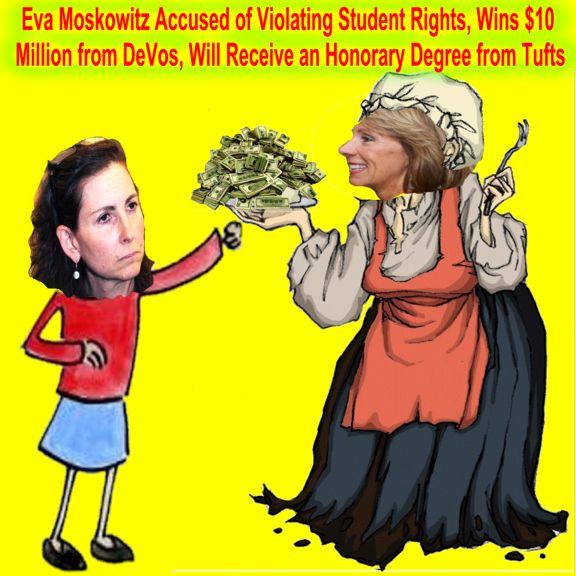
Eva Moskowitz Accused of Violating Student Rights, Wins $10 Million from DeVos, Will Receive an Honorary Degree from Tufts


As Leonie Haimson explains in this post, it has been a busy few weeks for Eva Moskowitz, founder and CEO of NYC’s controversial Success Academy charter chain.
Once again, her chain has been accused of violating the rights of students; Betsy DeVos awarded $9.8 million to her schools, added to the $43.4 million  Eva previously received from the federal Charter Schools Program; she will receive an honorary degree from Tufts University; and the President of Harvard University is giving the commencement speech to her graduating class.
How does it happen that the president of the nation’s most prestigious university is speaking to what may be a graduating class of a few dozen students at a charter school? .
“The former president of Tufts, Lawrence Bacow, who is the current president of Harvard is scheduled to speak at the Success high school’s graduation, which last year only graduated 16 out of the 73 students who entered the school in Kindergarten  or first grade.  No doubt both occurrences were influenced by the fact that the head of the Success board, hedge funder Steve Galbreath, is also on the Tufts board of trustees and heads its investment committee.”
Follow the money.
Don’t be surprised if next year Moskowitz land DeVos herself, America’s leading charter school champion.

Lack of Oversight of Federal Charter Schools Program Cheats Taxpayers, Students, Families, and Local Public Schools | janresseger

Lack of Oversight of Federal Charter Schools Program Cheats Taxpayers, Students, Families, and Local Public Schools | janresseger

Lack of Oversight of Federal Charter Schools Program Cheats Taxpayers, Students, Families, and Local Public Schools


The impact of federal investment in the Charter Schools Program has been in the news this month thanks to the Network for Public Education’s stunning new report, Asleep at the Wheel, which exposes the number of schools across the states that received millions of dollars from the U.S. Department of Education’s Charter Schools Program but never opened or, after opening, subsequently shut down.  The Network for Public Education (NPE) documents the waste of hundreds of millions of dollars out of the total $4 billion that has been spent on the Charter Schools Program (CSP), which has been operated with an outrageous absence of oversight. A third of the schools whose startup or expansion was seeded by the CSP are currently not in operation.
Last week the Network for Public Education expanded its coverage of abuses in the Charter Schools Program by breaking down the numbers to show how much money was wasted in five of the states. (NPE says it will continue to break down the numbers in upcoming weeks for the rest of the 44 states and the District of Columbia which have charter schools.)  Jeff Bryant follows up this week by summarizing the percentage of failure in CSP-funded schools in the five target states. In Michigan, 42 percent of the federal dollars granted by CSP were wasted on schools that never opened or subsequently closed. The percentage of failure was similar in Ohio (40 percent), Louisiana (46 percent), California (38 percent), and Florida (36 percent).
Responding to the Network for Public Education’s report, charter school promoter Nina Rees justifies the federal Charter Schools Program as a crucial source of venture capital to jump start and expand a privately operated but publicly funded education sector.  Chalkbeat’s Matt CONTINUE READING: Lack of Oversight of Federal Charter Schools Program Cheats Taxpayers, Students, Families, and Local Public Schools | janresseger

Smoking gun: FL can’t insure armed teachers from liability | The Edvocate Blog

Smoking gun: FL can’t insure armed teachers from liability | The Edvocate Blog

Smoking gun: FL can’t insure armed teachers from liability


With SB 7030/Arming Teachers passing in the Florida Senate as was predicted, the question raised by this blog about whether or not this is insurable remains.
SAD EMOJIDid knowledgeable political insiders deliberately plunge an entire state into a horrific Sophie’s Choice debate over forcing public school classroom teachers to live every day knowing that they or their colleagues must pivot from teaching the students they love to possibly shooting one of them?
Was this just a cruel distraction to allow the greatest threat to Florida Public Education, universal vouchers/Education Savings Accounts and a slew of other deeply hostile bills to pass into law with considerably less opposition from exhausted public education advocates?
Not to put to fine a point on it, but here’s the smoking gun as to whether arming classroom teachers can be insured. Fellow blogger Mercedes Schneider addresses the question and points out that:
The Florida Department of Education (FDOE) uses AIX Specialty Insurance Company to provide its educators professional liability policy. According to that policy, armed  CONTINUE READING: Smoking gun: FL can’t insure armed teachers from liability | The Edvocate Blog

Badass Teachers Association Blog: Understanding the Need for and the Current Protections of Upstanders

Badass Teachers Association Blog: Understanding the Need for and the Current Protections of Upstanders

Understanding the Need for and the Current Protections of Upstanders


If we are ever truly going to achieve the goal of eliminating workplace harassment and bullying from the American workplace, including the bullying of teachers and other K12 employees, there are a number of things that must be done. First and foremost, we will need a strong federal law, with strong enforcement. The current legal protections against workplace harassment have failed to even protect all targets of status-based harassment, much less the broader phenomena of workplace bullying. Second, even if a strong law is passed, we also need the help of bystanders. We need bystanders to become upstanders to defend and protect targets of bullying and to call out the bullies in their workplaces. Even in the absence of strong laws, upstanders can help to eliminate a great deal of the bullying in our workplaces. The focus of this blog will be on this former part of the solution to workplace bullying. 

In 2015 the Equal Employment Opportunity Commission (EEOC), the federal agency that enforces Title VII of the Civil Rights Act, the Americans with Disabilities Act (ADA) and the Age Discrimination in Employment Act (ADEA), convened a task force to explore the reasons why harassment continued to be such a huge issue in the American workplace nearly 30 years after harassment was ruled to be a form of discrimination by the Supreme Court. After months of testimony from experts from human resource departments, labor unions, law firms, worker organizations, employer organizations and numerous meetings of the 17 members of the task force, the EEOC Commissioners came up with a list of recommendations. One such recommendation was that we all needed to play a role to end harassment. 

Harassment in the workplace will not stop on its own. The ideas noted above (earlier in the report) are helpful, but ultimately, may not be sufficient. It is on all of us to be part of the fight to stop workplace harassment. We cannot be complacent bystanders and expect our workplace CONTINUE READING:
Badass Teachers Association Blog: Understanding the Need for and the Current Protections of Upstanders

Virginia's Rodney Robinson Named 2019 National Teacher of the Year

Virginia's Rodney Robinson Named 2019 National Teacher of the Year

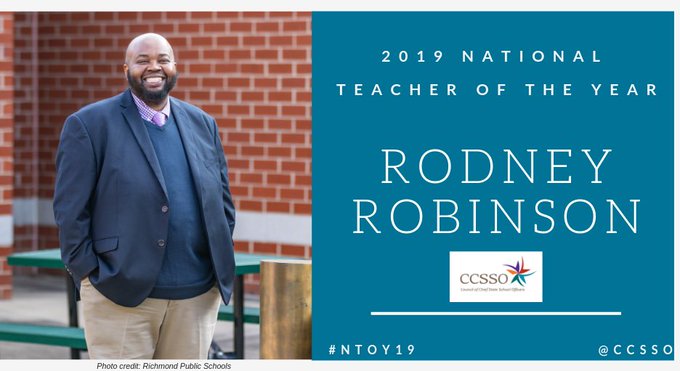
Rodney Robinson Named 2019 National Teacher of the Year


Rodney Robinson, a social studies teacher in Richmond, Virginia, was named the 2019 National Teacher of the Year on Wednesday by the Council of Chief State School Officers (CCSSO).
Robinson, a 19-year veteran of Richmond Public Schools, teaches at Virgie Binford Education Center, a school inside the Richmond Juvenile Justice Center. CCSSO commended Robinson for creating “a positive school culture by empowering his students – many of whom have experienced trauma – to become civically-minded social advocates who use their skills and voices to affect physical and policy changes at their school and in their communities.”
Robinson says he looking forward to helping lead a conversation about the students he calls “the most vulnerable in society” and how the nation can address the school-to-prison-pipeline that has pushed too many kids out of school.
“This year I hope to be the voice for my students and all students who feel unseen, unheard, unappreciated and undervalued in America,” Robinson said.
At the Virgie Binford Education Center, which serves youth ages 10-18, Robinson uses a social studies curriculum that centers on juvenile justice and the prison system. Robinson collaborated with Pulitzer Prize-winning author James Forman Jr at Yale University in developing the unit. The curriculum allows “students to step outside of themselves and examine the system and the circumstances that have led to their incarceration and a better understanding of how to avoid future incarceration,” Robinson wrote in the introduction.
Robinson, who previously taught at Armstrong High, Wythe High, and Brown Middle School, earned a bachelor’s degree in history from Virginia State University and a master’s degree in administration and supervision from Virginia Commonwealth University. In addition to being published three times by Yale, Robinson has received numerous awards for his accomplishments in and out of the classroom, most notably the R.E.B. Award for Teaching Excellence.
A proud member of the Richmond Education Association, the Virginia Education Association, and the National Education Association, Robinson is a vocal and dedicated union activist, and was a featured speaker at the VEA Fund our Future rally in Richmond.
Robinson is standing up for students who “feel unseen, unheard, unappreciated, and undervalued in America,” said NEA President Lily Eskelsen Garcia.  “He is not only a beacon of light but also a mentor, a leader and a role model in the fight for racial and social justice in education….Every student in every public school in this country deserves a teacher like Mr. Robinson no matter their ZIP code or their circumstances.”
Robinson has focused great deal of his efforts on the need for mental health services in schools and singles out the stigma surrounding treatment. As teacher of the year, Robinson will have a heightened platform to advocate for the students who are being left behind by budget cuts and a system that emphasizes punitive discipline over preventative and rehabilitative measures.
“I want school counselors, I want conflict mediators, I want restorative justice, I want people to come in and actually work with the kids and not just put a kid in handcuffs whenever there is a minor disagreement,” Robinson told WCVE Radio in Richmond.
Robinson says the positive influence black educators can have on the lives of vulnerable students cannot be overstated. When he was a student at King William County High School in the 1990s, Robinson admits he struggled “to find his place” and looked up to his band director Mr. Calvin Sorrell, who at that time was the only male, black teacher in the district. Today, only 15 percent of licensed teachers in Virginia are people of color.
“It’s important to have role models of all races and ethnicity — especially for students of color,” says Robinson.
After graduating high school, Robinson set his sights on becoming the kind of educator many students who have made mistakes desperately need.


“Most are in survival mode 24 hours a day, seven days a week… but they still persevere and strive for success. They are my inspiration, and I will fight to my last heartbeat for them,” Robinson says
Virginia's Rodney Robinson Named 2019 National Teacher of the Year

CURMUDGUCATION: Using Cultural Competency To Sell Personalized [sic] Learning

CURMUDGUCATION: Using Cultural Competency To Sell Personalized [sic] Learning

Using Cultural Competency To Sell Personalized [sic] Learning

Over at EdTechTimes, a site that for a consulting group that clearly is interested in pushingpersonalized [sic] learning, I found a podcast by Mariel Cariker entitled "Cultural Competency: Finding Ways To Bring Equity Through Personalized Learning." (It is accompanied by a transcript.) The podcast is sponsored by TeachPlus.

Like many of the arguments being used to push PL, it's an odd little mishmash.


A real killer app.

The piece opens by chatting with Nick Donahue, CEO of the Nellie Mae Education Foundation. She describes Nellie Mae as "focused on community leadership and engagement," but in the context of this podcast, it might be more appropriate to note that Nellie Mae is hugely invested in pushing personalized [sic} learning via mass standardized algorithm-managed computer delivery systems. Donahue is not a disinterested expert in the field; he's a guy with a product to sell that just happens to be the product that this podcast is "examining."

Donahue offers plenty of the usual rhetoric, including the old suggestion that education hasn't changed in 100 years. He does manage to avoid the word "disrupt," but he still advises "challenging some of the traditional structures and approaches and mindsets that have ruled education for 100 years." He suggests that school leaders approach this as a means of providing freedom for teachers, specifically the freedom and flexibility to "teach" a large group. And then he drops this line:

Flipped learning is headed in the right direction, that would mean when the kids are together with  CONTINUE READING: 
CURMUDGUCATION: Using Cultural Competency To Sell Personalized [sic] Learning


Revealing Podcast About Success Academy — Part IV | Gary Rubinstein's Blog

Revealing Podcast About Success Academy — Part IV | Gary Rubinstein's Blog

Revealing Podcast About Success Academy — Part IV


Part four of Startup’s seven part podcast about Success Academy (found here) is centered on the ‘Got To Go’ incident where a principal was found to have created a list of students he wanted to oust from his school.  This episode explores whether or not the ‘Got To Go’ list was an isolated infraction by a rogue principal or if it is something that is part of the culture of the school.
Episode 1 was about the state of public schools in NYC that would make it ripe for a network like Success Academy to emerge.  Episode 2 was the story of Eva Moskowitz and how she rose to power.  Episode 3 was about the emphasis the network puts on standardized tests and questions whether the high test scores come at some greater cost.
Episode 4 — Growth — is the most critical so far.  The ‘Go To Go’ list was a major story in the New York Times and it corroborated what many families said about Success Academy, that they push out students which, as a side benefit for them, raises the test scores of the school.
The narrator, Lisa Chow, though, got some talking points from Success Academy about how to spin this story.
Candido Brown was a new principal, put in charge of a Success Academy elementary school in Fort Greene, a neighborhood in Brooklyn. The school had already gone through two other principals in a year. The place did not represent the Success ideal of quiet classrooms and well behaved kids. It CONTINUE READING: Revealing Podcast About Success Academy — Part IV | Gary Rubinstein's Blog