Latest News and Comment from Education

Thursday, January 31, 2019

ACLU Files Lawsuit Against Sacramento Sheriff for Censoring BLM

ACLU Files Lawsuit Against Sacramento Sheriff for Censoring BLM

Black Lives Matter Leaders Sue Sacramento Sheriff for Censoring Them on Facebook


It is unconstitutional for Sacramento Sheriff Scott Jones to ban people from his public Facebook page based on their speech, identity or views. That is the basis of a lawsuit filed Wednesday on behalf of two leaders of the Sacramento chapter of Black Lives Matter by the American Civil Liberties Union Foundation of Northern California along with the law firm Rogers Joseph O’Donnell.
Tanya Faison and Sonia Lewis lead the BLM chapter in California’s state capital. Their chapter has demonstrated for racial justice in Sacramento, called for the district attorney to hold police officers accountable in use-of-force cases that have turned deadly, and been critical of Sheriff Scott Jones and his deputies.
In May 2018, deputies from Jones’ department shot and killed 32-year-old Mikel McIntyre, a black man suffering from mental and emotional disabilities who was described by his mother as being deeply depressed and suffering from anxiety. According to the Sacramento Bee, his family said he had been acting strangely.
On the shoulder of Highway 50 in Sacramento, McIntyre threw a rock at one deputy, striking him in the head. He then turned and ran away, and as he was running, he picked up another rock and threw it, hitting a police dog and another deputy in the leg. Then he kept running.
Although he was otherwise unarmed, McIntyre was shot in the back and killed. The shooting took place on a busy highway at the end of rush hour. Three deputies fired 28 shots at McIntyre. According to the report, one of the deputies—Gabriel Rodriguez—fired 18 shots alone, pausing to let a car pass by before firing at McIntyre again.
When DA Anne Marie Schubert declined to press charges against the deputies, there was—understandably—a great deal of criticism.
Jones—who is quoted by the Bee as having said he is not subject to oversight—responded to the criticism by refusing to allow any investigation of his deputies, according to the Bee. He took to his Facebook page to ratchet up support for his actions as well as criticize the highly vocal BLM chapter. When Faison and Lewis posted criticisms to his Facebook page, he deleted their comments and blocked them from his page.
“This attempt to silence us shows how little the sheriff values black lives and the movement to combat injustice and inequality,” Faison said in a statement released by the ACLU. She remains blocked and unable to CONTINUE READING: ACLU Files Lawsuit Against Sacramento Sheriff for Censoring BLM

DPS teachers rally, march for higher pay in downtown Denver | FOX31 Denver

DPS teachers rally, march for higher pay in downtown Denver | FOX31 Denver

DPS teachers rally, march for higher pay in downtown Denver


DENVER -- Hundreds of Denver Public Schools teachers took to the steps of the Colorado State Capitol on Wednesday evening for a rally and march to demand higher pay as a potential strike still looms.
“What do we want?” “Fair pay.” “When do we want it?” “Now” teachers chanted.
When asked why she was at the rally, George Washington High School teacher Emily O'Ryan said, “So I can get a living wage and stop working a second job."
From the Capitol, teachers and their supporters marched to DPS headquarters at Lincoln Street and East 19th Avenue.
“I took a $5,000 pay cut to play team DPS, but unfortunately, my rent doubled,” said Sara Goodwin, a Park Hill Elementary teacher.
So, where do things stand with the strike? Last week, Denver Public Schools asked the state's Department of Labor to intervene. The Denver Classroom Teachers Association (the union representing DPS teachers) issued its response on Monday, asking the state to stay out of their contentious salary negotiations. They want to exercise their right to strike.
Now, the Department of Labor has a 14-day period to make a decision on whether to get involved. The deadline is Feb 11. They will deliberate and have informal conversations with both sides to gauge whether their intervention will help.
“If we decide not to get involved, the teachers may strike. And so this waiting period, if you will, of the 14 days delays the strike, number one, and also allows -- hopefully -- both sides to come back together," said Cher Haavin, spokesperson for the Colorado Department of Labor and Employment.
Both DPS and the DCTA will come to the bargaining table again on Thursday at 5 p.m.
DPS teachers rally, march for higher pay in downtown Denver | FOX31 Denver


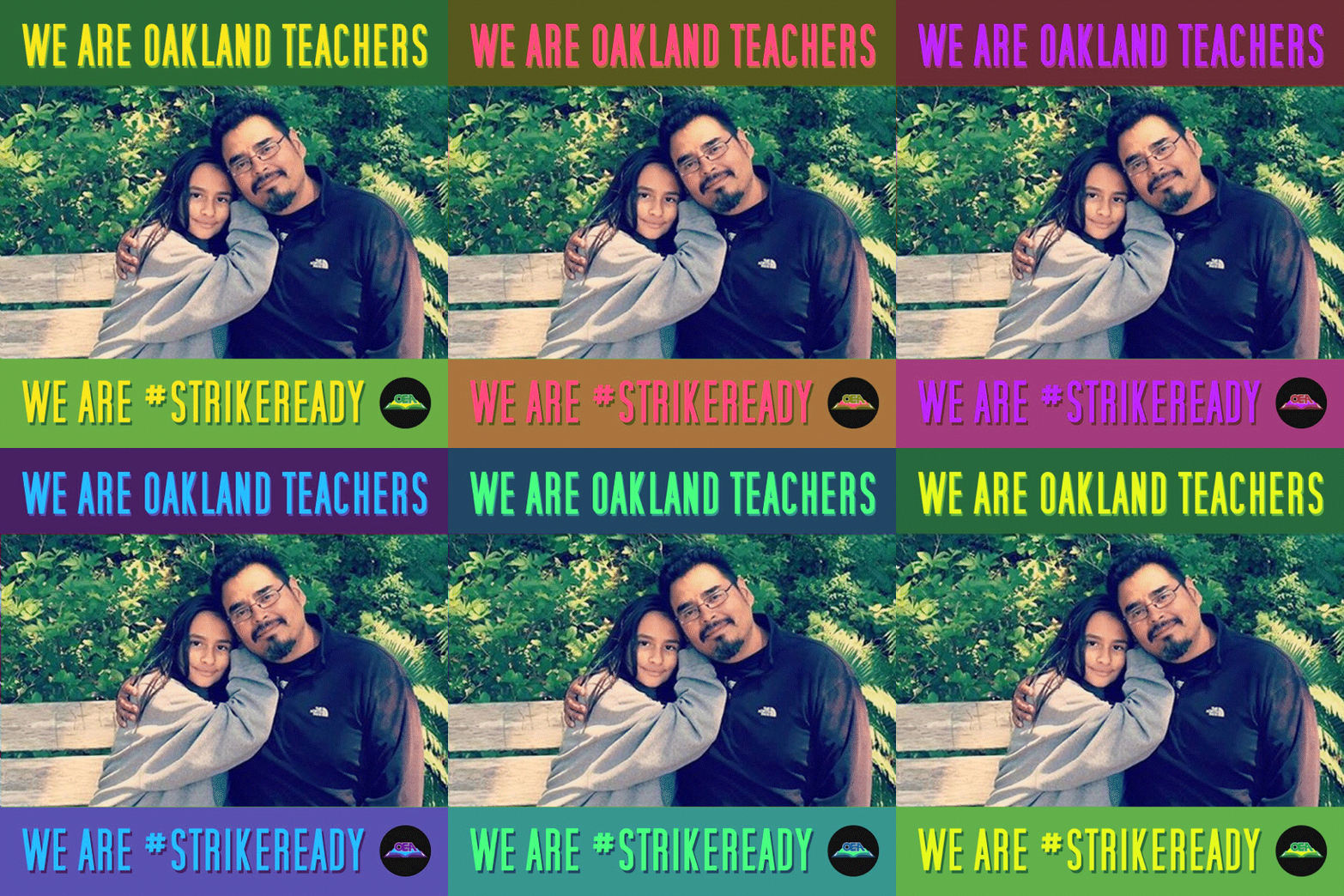
Oakland Unified Teachers Begin Voting On Potential Strike, Fight Against 2nd School Closure – CBS San Francisco

Oakland Unified Teachers Begin Voting On Potential Strike, Fight Against 2nd School Closure – CBS San Francisco

Oakland Unified Teachers Begin Voting On Potential Strike, Fight Against 2nd School Closure


OAKLAND (CBS SF) Ć¢€“ Teachers at the Oakland Unified School District began voting after school on Tuesday on a potential strike.
Educators are holding the vote, which continues outside school hours until Friday, as they seek more student resources, smaller classes and what they’re calling a “living wage” for workers.
According to the Oakland teacher’s union, Oakland teachers are among the lowest paid in Alameda County. The union is demanding a 12 percent raise over three years while the district is offering five percent.
The Oakland Education Association is also demanding smaller class sizes and more support for the district’s 37,000 students, including hiring more school counselors and nurses.

This week’s strike vote follows two “sick out” events on December 10th and January 18th, as teachers protest an ongoing stalemate in contract negotiations. The actions were not sanctioned by the union.
Voting comes just hours after the school district voted to close Roots International Academy amid protests. The middle school is the first of two dozen Oakland schools to be possibly impacted by closures, under a plan to close what the district says is a $30 million budget gap.
“This $30 million also comes after doing two years of budget restrictions,” said OUSD spokesperson John Sasaki.
According to OUSD, many smaller schools will either be moved or “absorbed” into larger schools.

Parents and teachers at high-performing Henry J. Kaiser Elementary in the Claremont Hills fought back Tuesday evening against the district’s plan to close the school and transfer its students to Sankofa Academy in North Oakland, which has significantly lower test scores.
Diedre McGhee, the parent of a second-grader at Kaiser, said she did extensive research before enrolling her son at Kaiser because of its small class sizes.
Ć¢€Å“He needs extra help and the teachers and counselors and having that smaller size has been great for him,Ć¢€ said McGhee. Ć¢€Å“IĆ¢€™m just not sure if they move to a bigger school heĆ¢€™ll have that specialized individual attention he needs.Ć¢€
Katy Hunter, a teacher whose children attended Kaiser years ago, was more blunt. Ć¢€Å“This is a bad decision. ItĆ¢€™s a bad choice,Ć¢€ she said. Ć¢€Å“If you have a school in a district thatĆ¢€™s struggling and you have a school thatĆ¢€™s really successful, and you want to build on that, use us as a model.Ć¢€
Sasaki said the district selected Kaiser Elementary for possible closure because of its size. Ć¢€Å“The layout [of Kaiser] prevents us from expanding. Sankofa has a beautiful campus and a huge school,Ć¢€ he said.
Ć¢€Å“What we want to do is take all the great things about Kaiser and put it on a bigger campus and put it into a blended school.Ć¢€
Hunter said she and other parents and teachers are already organizing to fight the closure.Ƃ But Sophia, the mother of a Sankofa student who has been through a school closure, said if Kaiser does close, students will find a home in Sankofa.
Ć¢€Å“All I can say is if they merge this school with Kaiser, the kids from there will be loved. TheyĆ¢€™ll be treated with respect. TheyĆ¢€™ll be treated equally,Ć¢€ she said.
Sasaki said itĆ¢€™s unclear when the board will vote on closing Kaiser. Board members are expected to review the plan in February. The $30 million budget gap as  CONTINUE READING: Oakland Unified Teachers Begin Voting On Potential Strike, Fight Against 2nd School Closure – CBS San Francisco

Video: Black Lives Matter At School–“I know my people are strong.” – Black Lives Matter At School

Video: Black Lives Matter At School–“I know my people are strong.” – Black Lives Matter At School

Video: Black Lives Matter At School–“I know my people are strong.”


We are excited to announce the release of our newly produced Black Lives Matter At School video! This short primer for the movement gets its subtitle from the words of high school student Israel Presley who says, “All I ever see is us being slaves. Why don’t you ever teach me about how we fought back, because I know my people are strong.


Black Lives Matter At School week of action will take place this year from February 4-8th in school districts across the country. Support the movement by signing the petition, sharing the video, and teaching for Black lives.

Video: Black Lives Matter At School–“I know my people are strong.” – Black Lives Matter At School

Betsy DeVos’ new Title IX rules might already be hurting students - Vox

Betsy DeVos’ new Title IX rules might already be hurting students - Vox

Betsy DeVos’s new sexual harassment rules might already be hurting students
One school just got rid of its Title IX coordinator. The debate could be a sign of things to come.


For many students who experienced sexual assault or harassment at Drew University in Madison, New Jersey, Title IX coordinator Emily Ralph was a supportive ear when they needed it most, students and alumni say.
Ralph was responsible for overseeing formal Title IX complaints at the university, as well as the university’s other efforts to prevent and address harassment and assault. With a master’s degree in social work as well as a law degree, she was both empathetic toward survivors and fair to everyone involved, one Drew alum told Vox.
“When Emily was put in place, reports went up,” said Sarah O’Brien, a graduate student at Drew. “That’s not because there was a problem all of a sudden — it’s because students felt comfortable reporting.”
But in early January, Ralph was let go. In what appears to be a cost-cutting measure, the university eliminated the position of full-time Title IX coordinator and announced that the role would be filled by an eight-member team, all of whom have other jobs at the university.
Drew president MaryAnn Baenninger told Vox that “with this distributed model, there will be more people who will be able to offer a knowledgeable approach that will help our whole community.” But some students and alumni are concerned that the move will make it harder for survivors to report, and easier for the university to sweep problems under the rug.
Meanwhile, advocates say situations like the one at Drew could become more common under new Title IX regulations issued in November by the Department of Education under Secretary Betsy DeVos. Anti-harassment groups fear the new regulations will make it easier for schools CONTINUE READING: Betsy DeVos’ new Title IX rules might already be hurting students - Vox

In a major step, the Los Angeles school board calls for a moratorium on new charter schools - The Washington Post

In a major step, the Los Angeles school board calls for a moratorium on new charter schools - The Washington Post

In a major step, the Los Angeles school board calls for a moratorium on new charter schools


The Los Angeles Board of Education is calling on the California legislature to impose a moratorium on new charter schools, a remarkable shift by the pro-charter panel that struck a blow to the charter movement and may lead to stronger oversight of the schools.
The vote appears to signal an inflection point in the charter school debate in California, which has more charter schools and charter school students than any other state. California has allowed charters — which are publicly funded but privately operated — to flourish with little oversight amid growing controversy over financial scandals and other issues.
Charters have become a focus of activists around the country who say the schools provide families with options in districts with failing classrooms. Opponents, including the Los Angeles teachers union, say charters drain resources from the traditional schools that most students attend and encourage further privatization of an important civic institution.
Education Secretary Betsy DeVos is a big supporter of charter schools, as are many of America’s wealthiest individuals, including billionaire Eli Broad, who several years ago promoted a plan to open enough charter schools in Los Angeles to serve at least half of the district’s more than 600,000 students.
But a growing number of education advocates and groups, including the NAACP, have called for a moratorium on charters until issues involving transparency and operations are resolved. California voters just elected a new schools superintendent, Tony Thurmond, who has said he wants to spend more money on traditional schools and stop the expansion of charters until concerns are addressed. He defeated a candidate who was supported by the charter lobby. Newly elected Gov. Gavin Newsom (D) has emphasized his desire to spend more on schools within traditional public systems.
The Los Angeles school board resolution and vote — which happened Tuesday as pro-charter protesters picketed outside board headquarters — came out of last week’s agreement between the city’s school district and the teachers union. That pact ended a six-day strike by educators in the nation’s second-largest school district.
The school board voted Tuesday to ratify the strike-ending deal between the Los Angeles Unified School District and United Teachers Los Angeles. The new contract provides teachers with 6 percent pay increases, more resources for schools and small reductions in class size.
The strike ended with other agreements, too, including what many saw as a surprising promise by the school district to support a state moratorium of up to 10 months on charter schools while the state studies their effects.
The Los Angeles Board of Education has six members, at least half of whom were elected with the help of financial support from the charter lobby. The district superintendent, Austin Beutner, is a former investment banker who is a charter backer.
“LAUSD has joined the NAACP and other key organizations in calling on the state of California for a CONTINUE READING: In a major step, the Los Angeles school board calls for a moratorium on new charter schools - The Washington Post

Dana Goldstein: In 13 Years of Education Reporting, So Much Has Changed - The New York Times

In 13 Years of Education Reporting, So Much Has Changed - The New York Times

In 13 Years of Education Reporting, So Much Has Changed

Covering recent teachers’ strikes, including the latest showdown, in Los Angeles, has brought into relief a shift in the conversation.


Times Insider explains who we are and what we do, and delivers behind-the-scenes insights into how our journalism comes together.
I first met Alex Caputo-Pearl, the strike-leading president of the Los Angeles teachers’ union, in 2011, when I shadowed him for a day at Crenshaw High School.
I was working on a book about the history of public school teaching, and Mr. Caputo-Pearl, then a social studies teacher, had a fascinating personal story. He had served in the very first class of Teach for America recruits, in 1990, and was part of a small group of original T.F.A. members who were, 20 years later, still working in urban public school classrooms.
But Mr. Caputo-Pearl didn’t remain in the Teach for America fold. He became a union activist and a critic of T.F.A., charter schools and the entire landscape of test-driven accountability for children and educators. At Crenshaw High, he helped develop a social-justice curriculum in which students organized their learning around the question of how to improve conditions in their low-income South Los Angeles neighborhood. It was unapologetically activist — outside the mainstream of what education reform looked like at the time.
The school district later ended that program, and in 2014, Mr. Caputo-Pearl was elected president of the United Teachers Los Angeles, the local union. He represented a new, more militant generation of teachers’ union leaders. This month, he led 30,000 educators in a weeklong strike for higher pay and more classroom funding, and against the growth of the charter school sector. It’s a story I covered with Jennifer Medina, my fantastic National desk colleague in Los Angeles, and our editors Julie Bloom, Dave Kim and Marc Lacey.
I’ve been reporting on education for 13 years, but I am absolutely stunned by the extent to which teachers’ strikes and walkouts are now a day-to-day part of my job. The Los Angeles action was the eighth mass teacher protest I’ve reported on in just 11 months, shutting down schools for one million students across the country. The reappearance of Mr. Caputo-Pearl in my professional life was just one of several uncanny moments that have made me, at age 34, feel old in beat-reporter years. So much has changed in education, as the focus shifts from calling out and overhauling bad teachers and schools to listening more carefully to what educators say about their working conditions and how students are affected by them.
I was at the Democratic National Convention in 2008, when one of the hottest tickets was to a panel discussion in which rising stars in the party, including Cory Booker, then the mayor of Newark, spoke harshly of teachers’ unions and their opposition to charter schools, which are publicly funded, privately run and generally not unionized. Union leaders argue that charters draw public dollars and students away from traditional schools like Crenshaw High.
Back then, it was hip for young Democrats to be like Barack Obama, supportive of school choice and somewhat critical of teachers’ unions. But CONTINUE READING: In 13 Years of Education Reporting, So Much Has Changed - The New York Times

Leaving Childhood Out in the Rain!

Leaving Childhood Out in the Rain!

Leaving Childhood Out in the Rain!


Why do corporate CEOs, foundations, and policymakers want kindergartners to learn more advanced material at a faster rate? Why is this important to them? If children are made to grow up quickly, what happens to childhood?
Why are they against play and art for children in public schools? Why do they push children to read earlier and earlier?
They claim they want to ensure that children will get a great start, that a rigorous kindergarten will lead to a better future. But when does it turn into child abuse?
Pushing children to learn more difficult material in kindergarten will not be found in wealthy private schools. Those schools still have recess, include a well-rounded curriculum, and they make kindergarten an enjoyable experience.
Child development specialists, the experts, disagree with pushing advanced work in kindergarten.

Koch Brothers Plan New Scheme Fully to Privatize American Education—at Public Expense | janresseger

Koch Brothers Plan New Scheme Fully to Privatize American Education—at Public Expense | janresseger

Koch Brothers Plan New Scheme Fully to Privatize American Education—at Public Expense


Last Friday, Washington Post columnist Dana Milbank described this year’s wave of strikes and walkouts by school teachers: “Something funny happened on the way to the labor movement’s funeral.  When Justice Samuel A. Alito Jr. and his antilabor colleagues on the Supreme Court handed down the Janus v. AFSCME decision last June, unions braced for the worst.”  But, Milbank concludes: “Labor leaders ought to thank Alito—and send chocolates to the Koch brothers for bankrolling the anti-union court case.  Their brazen assault, combined with President Trump’s hostility toward labor, has generated a backlash, invigorating public-sector unions and making a case for the broader labor movement to return to its roots and embrace a more militant style.”
I don’t know about the implications for all of labor, and I’d argue with Milbank’s point that this year’s strikes by teachers have been primarily a response to the Janus decision. The growing wave of teachers’ strikes has instead been a cry for help from a profession of hard-working, dedicated public servants disgusted with despicable working conditions, lack of desperately needed services for their students, and insultingly low pay.
But Milbank is correct that the Janus decision has not undermined membership in the two big public sector teachers’ unions, the American Federation of Teachers and the National Education Association: “The American Federation of Teachers expected it might lose 30 percent of its revenue after the high court gave public-sector workers the right to be free riders, benefiting from union representation but paying nothing.  Instead, the 1.7 million-member union added 88,500 members since Janus—more than offsetting the 84,000 ‘agency-fee payers’ it lost because of the Supreme Court ruling… The NEA had projected a loss of as many as 200,000 members, based on previous drop-membership campaigns.  Instead, the 3 million-member union is actually up 13,935 members…and the increase in membership among new teachers is particularly encouraging.”
Milbank quotes Lily Eskelsen-Garcia, the president of the National Education Association, CONTINUE READING: Koch Brothers Plan New Scheme Fully to Privatize American Education—at Public Expense | janresseger


Chaz's School Daze: Where Does School Funding Come From By State?

Chaz's School Daze: Where Does School Funding Come From By State?

Where Does School Funding Come From By State?


.....................Federal.......State....Local

Alabama11.2%54.9%33.9%
Alaska15.3%59.7%25.0%
Arizona15.4%38.6%46.0%
Arkansas10.7%50.3%39.0%
California8.9%58.0%33.1%
Colorado7.5%45.7%46.8%
Connecticut3.5%42.2%54.4%
Delaware11.0%56.4%32.6%
District of Columbia8.9%-91.1%
Florida11.7%42.0%46.2%
Georgia11.2%43.4%45.4%
Hawaii11.9%86.1%1.9%
Idaho9.9%64.9%25.3%
Illinois7.9%24.0%68.2%
Indiana9.8%59.1%31.1%
Iowa5.5%57.7%36.8%
Kansas8.3%66.4%25.3%
Kentucky8.9%62.8%28.3%
Louisiana14.6%42.6%42.8%
Maine15.9%35.9%48.2%
Maryland6.7%45.7%47.6%
Massachusetts5.0%40.0%55.0%
Michigan14.9%66.1%19.0%
Minnesota5.2%71.9%22.9%
Mississippi19.4%46.9%33.8%
Missouri8.4%33.0%58.5%
Montana13.7%52.6%33.8%
Nebraska6.5%36.0%57.4%
Nevada11.4%37.0%51.6%
New Hampshire5.9%34.3%59.9%
New Jersey3.8%40.9%55.3%
New Mexico12.4%70.7%16.9%
New York4.7%37.3%58.0%
North Carolina10.4%59.1%30.6%
North Dakota7.7%42.1%50.2%
Ohio7.8%44.3%47.8%
Oklahoma11.1%47.9%41.0%
Oregon7.0%51.0%42.0%
Pennsylvania7.9%35.2%56.9%
Rhode Island8.4%39.3%52.3%
South Carolina9.0%47.7%43.3%
South Dakota13.8%29.8%56.4%
Tennessee12.0%49.2%38.8%
Texas8.6%41.3%50.1%
United States8.4%46.0%45.6%
Utah11.4%49.0%39.6%
Vermont5.7%89.2%5.1%
Virginia7.7%36.7%55.6%
Washington7.6%58.3%34.1%
West Virginia14.5%59.7%25.8%
Wisconsin6.4%46.1%47.5%
Wyoming5.7%57.0%37.3%
Data from the National Education Association
The list shows the breakdown from Federal, State, and local sources for school funding, 

Chaz's School Daze: Where Does School Funding Come From By State?