Signs of a Dying Democracy?
-
Three speeches by public figures on the same day alarmed Dr. Robert B.
Shpiner, a clinical professor of medicine in pulmonary and critical care at
the UCLA...
America’s Faith in Schooling
-
Just see wherever we peer into the first tiny springs of the national life,
how this true panacea for all of the ills of the body politic bubbles
forth—edu...
Is the Package the Package?
-
UFT contract negotiations with the City of New York. Odd wording. Real
question. Does the City begin negotiations by (generally) explaining the
total monet...
Ridiculous Headlines about Public Education
-
I’ve been writing about education policy and practice for more than 25
years, in my local newspaper (gratis), for an education nonprofit (paid),
for Educat...
Clean Up Time Without Bossing the Kids Around
-
In the sitcom *Seinfeld*, the character Elaine Benes is annoyed that a
friend doesn't think she's up to being a babysitter: "I couldn't raise a
kid? C'm...
Back to School with New Laws
-
WSMV reports on new laws impacting classrooms as schools head back to
session: A new law, HB2393/SB2310, restricts digital-device use in
kindergarten throu...
These Texans Love Their Public Schools!
-
Come listen to Texans who love public schools and who fight for them every
day at the Network for Public Education in Conroe, Texas, September 26 and
27t...
Paula Lewis resigns from OKCPS chairperson post
-
[image: Paula Lewis resigns]Less than halfway through her current four-year
term in elected office, Oklahoma City Public Schools Board of Education
Chair...
Threatening Seashells?
-
WASHINGTON (AP) — Former FBI Director James Comey urged a judge on Monday
to throw out federal charges against him, arguing that a photo of seashells
ar...
Updates on Seattle Schools, July 27, 2025
-
*Update:*
From The Seattle Times, a story that SPS is appealing to an appeals court
over an $8M judgment against them *"**in which a former math teacher ...
Turning Back the Clock
-
Two years ago my son, Josh, gave me a fascinating birthday present, this
clock that runs backward. He engineered it himself, working with a cheap
battery-...
ICYMI: 170th Anniversary Edition (7/26)
-
I have played trombone in our town band since I was in eighth grade. It is
a special kind of treat to sit on that bandstand in the park, playing with
a gro...
MediKids: Sen. Kim’s Vision to Cover All Kids
-
The American people do not believe that children should be sick, in pain,
or without preventive care like vaccinations and annual check-ups based on
the we...
Gifted and Talented Education Issues
-
By Thomas Ultican 7/22/2026 In California, we call them GATE (Gifted and
Talented Education) students, other states have their own designations.
Whatever l...
NOLA Teacher Charged with 102 Felonies for AI Nudes
-
With new, streamlined technology comes new, streamlined criminal activity.
Consider the photo manipulation/ alteration capabilities of AI. Most of
America ...
By One Dishonest Measure
-
A loaded question that education reformers like to ponder is: Exactly how
many students in the boroughs of New York City are trapped in failing
schools? In...
Farm to Summer Celebration Week 2026: Post-Survey
-
The California Department of Education (CDE) recognizes SMP operators who
complete the three key elements during the F2Summer Celebration Week: 1)
Taste, 2...
1776
-
__________
“The fate of unborn millions will now depend, under God, on the courage and
conduct of this army…. We have, therefore, resolved to conquer...
Nosotros, El Pueblo, Venceremos
-
Siento gratitud hacia todas las personas que, a lo largo de los siglos,
alzaron sus voces y se organizaron para hacer de este país un lugar mejor.
Ahora es...
May’s Parent Engagement Resources
-
San Diego Unified Created a System to ‘Empower’ Parents. It Unraveled is
from The Voice of San Diego. Why Those Disengaged Parents in Your School
Deserve a...
The Math Was Within Us All Along
-
Now that I finished my second book, let me tell you a story that won’t make
it into the manuscript: A few weeks ago, I ...
Read More
The post The Math W...
Read and Learn from the Past
-
I just finished reading “The Boys in the Light” by Nina Willner. This is a
wonderful World War II story of survival, faith, and brotherhood. I highly
recom...
Reflections on America, the world, and life
-
I acknowledge that I rarely post here anymore. Folks should remember that I
am approaching my 80th birthday in less than 9 weeks, I am still teaching
ful...
Shutting Down The Site
-
Ten years ago, I ran for a seat on the LAUSD School Board of Education with
the goal to *Change the LAUSD*.
I am proud of the campaign we ran. We achieve...
The Company You Keep
-
Even though the filing period for the 2026 elections isn't until April,
let's all pay close attention. The candidates lining up to run will tell
you more a...
Blogoversary #19 — Time to Move on
-
Times have changed. I had a nice long run here, but let’s face it, it ended
a while ago. So I’ve moved. I’m not writing much any more, but when I do it
wil...
Il Papa è Morto
-
Francis brought a distinct pastoral outlook to his papacy. A simple man, he
lived in a small apartment in the guesthouse. He sought to make the church
acce...
Mike Shulman the ARISE UFT Judenrat
-
I was surprised to learn that Mike Shulman has aligned himself with ARISE.
I previously supported him, advocating that the Castle Doctrine could have
bee...
AIN’T IT AWFUL
-
As the terrible feelings of dread and angst spread across the world the
great majority of the American people feel powerless before the onslaught
of those ...
Vote NO on the UFT Contract. Here is Why:
-
The best reason to vote no on this contract is this: UFT Unity* lied* to us
in 2018. They misrepresented that contract. It was predicated on deals we
wer...
Testimony to the CPS Truancy Task Force
-
I prepared testimony for one of two public hearings held by the Chicago
Public Schools Truancy Task Force, a body mandated by state legislation.
The meetin...
There Is A Teacher Shortage.Not.
-
THERE IS A TEACHER SHORTAGE. And just to be sure you understand, it’s not
that teachers don’t want to teach. It’s not that there aren’t enough
teachers cer...
Book Banning Turns to Dick and Jane
-
Breaking News: Dateline February 4, 2022 - Parents in Dimwitty, Alabama
have asked the Dimwitty Board of Education to ban the children's primer *Fun
with...
Have You Heard Has a New Website
-
TweetHave You Heard has a new website. Visit us at
www.haveyouheardpodcast.com to find our latest episodes and our entire
archive. And be sure to check out...
Follow me at Substack
-
I've moved. Follow me at Substack
I'm now posting regularly at Substack. You can subscribe for free to my new
Edu/Pol blog at michaelklonsky.substack.com
...
I’ve moved.
-
I’m on Substack now. You can continue to receive periodic posts for free.
Or you can read every post and comment for $5 a month, $60 a year.
fredklonsky.su...
Aspiring Teachers Get New Help Paying For College
-
[image: colorful classroom pattern]
*; Credit: shuoshu/Getty Images*
Cory Turner | NPR
New rules kick in today that will help aspiring teachers pay for c...
Tips Akses Situs Judi Qq Tanpa Perlu Takut Nawala
-
Kegiatan berjudi slot melalui situs judi qq online, sekarang sudah
dilakukan oleh banyak penjudi Indonesia. Tentu, Kamu yang sedang membaca
artikel ini a...
The Threat of Integration
-
I have lived in the same house in the Miracle Mile section of Los Angeles
for over 30 years, where up until now I have had little or no interaction
with th...
We fight for a democracy worthy of us all!
-
The nation stands at a crossroads, said NEA President Lily Eskelsen García
in her final keynote address to the 2020 NEA Representative Assembly and
it’s up...
The Passing Of Chaz 1951-2020 Age 69
-
I am the son of Chaz and like to inform you that he passed away this
afternoon from the COVID virus. My father passed in peace beside his loved
ones. We ar...
The Fight For Our Children
-
*The number of suicides among people ages 10 to 24 nationally increased by
56 percent between 2007 and 2017, according to a new federal report showing
the ...
Read to Self: Just a Kid and a Book.
-
Date: Monday, January 5, 2020 Place: My classroom Student: Mrs.Mims, could
we start doing Read to Self again because I got this great book for
Christmas an...
Reminiscences
-
I just finished dumping the rest of my lesson plans. I guess I held on to
the calculus ones for so long because I spent so much time working on them
an...
Just Asking for some Teachers I know.
-
Recently Wisconsin Governor Tony Evers stated, We must … recognize that
part of supporting our kids in the classroom means supporting the educators
who t...
Cara Menang Bermain Judi Bola Online
-
Bermain judi bola online tentu saja memiliki kesenangannya tersendiri baik
itu mendapatkan keuntungan maupun ketika menantikan hasil skor pada sebuah
perta...
A Critique of Standards-Based Grading
-
It first happened to me about ten years ago. I was beginning my third year
of teaching in a new school in Washington, DC. Social studies teachers were
si...
Reduced time for testing? Not so fast.
-
NYSED and Commish Elia continue to say that the NYS Assessments are of
reasonable length, I completely disagree.
Here is what NYSED states are average expe...
The World According to Michelle Rhee
-
The men behind the curtain fashioning the brave new world of corporate run
education in America! Michelle Rhee is the founder of StudentsFirst, The
New T...
Whose Opinions Matter in Education World?
-
It's hard to identify education heroes and sheroes. And perhaps even harder
to pinpoint just whose work is slanted, paid-for and dishonest.
New Local Businesses in Sacramento
-
Starting a new local business in Sacramento is a monumental task, but can
be accomplished with footwork, perseverance and knowledge. One must learn
the loc...
Lesson Plan: Rhyme and Rhythm in Poetry
-
I’ve started a recent unit on poetry with my class. I’m not a poet, and I’m
not a poetry fan (I don’t hate it, but I’m a prose gal), so this makes it
harde...
The Apotheosis of Betsy DeVos
-
Betsy Devos has drawn few headlines in recent months, and that is a good
thing for the Secretary of Education. Her tenure began with Vice President
Mike P...
Education Is a Civic Question
-
In their final post to end Bridging Differences' decade-long run, Deborah
Meier and Harry Boyte urge readers to put the energy, talents, wisdom, and
hard w...
Site News: New Home for Education News & Commentary
-
Quick! Get over there! The daily education news roundup and education
commentaries that you're probably looking for are now being published over
at The Gra...
Should We Be Grateful?
-
In an odd turn of events, and with little explanation, Michigan Governor
Rick Snyder has decided to return the state’s School Reform Office back to
the Dep...
An Open Letter to NC Lawmakers
-
An Open Letter to NC State Lawmakers and NC State Superintendent Mark
Johnson: I am a NC native, voter, and public school teacher. I am
addressing you all ...
The Secret to Fixing Schools (My Next Bestseller)
-
The Secret to Fixing Schools (My next bestseller) Prologue I just finished
watching a fascinating documentary on Netflix entitled, “The Secret”. The
film p...
Farewell, Sleep
-
Today is the official last day of my spring break. I've done a scientific
survey: My natural bedtime is 2 AM, and my natural wake up time is 9:41
AM. Tom...
REPORT: States With the Best and Worst Schools
-
States With the Best (and Worst)Schools
By *Evan Comen, Michael B. Sauter, Samuel Stebbins and Thomas C. Frohlich*
January 20, 2017- http://247wallst.com
...
Test Refusal = People Power
-
In recent months, social media has been ablaze with talk of regular folk
taking action to resist the Trump agenda. Protests are a daily occurrence,
and ev...
Random Musings and Observations. . . .
-
I’ve been gone a while from the blogging scene. Some of my more regular
readers no doubt noticed but did not hassle me about it. Thank you for
that. Sinc...
AB 934: A LEGISLATIVE FIX FOR VERGARA?
-
By Michael Stratford | in the Politco Morning Education Report | via email
05/24/2016 10:00 AM EDT :: Two national education groups are backing a
Califor...
MY NEW BLOG
-
My new blog will consist of fictitious headlines, meant to be a blend of
humor and satire. I apologize ahead of time if any other satirical site has
simila...
Thank you
-
Dear Readers,
Thank you for visiting *The Perimeter Primate*. This blog is being retired
for the time being. Although I no longer post here, I do still s...
I am Retiring
-
I have some news: I am retiring from the PBS NewsHour and Learning Matters.
[[ This is a content summary only. Visit my website for full links, other
conte...
New Beginnings: Kickstarter and EdWeek Teacher
-
Greetings to InterACT readers one and all! If you’ve been following posts
here recently you might recall that I’m moving my blogging activity to
other loca...
Adelaide L. Sanford Charter School
-
*“With Adelaide L. Sanford Charter School closing, Newark families must
move on.”* The Star-Ledger (NJ), 6/25/2013
NEWARK — Bobby and Troy Shanks saw the...
As a teacher, superintendent, and professor I have been fortunate in receiving grants from donors over the decades. Small, middle-sized, and large grants came to support and expand my efforts in classrooms (e.g., Teacher Innovation Fund in Washington, D.C.), district (e.g., helping non-English speaking immigrants in Arlington, VA) and research I and colleagues did in schools and districts near Stanford University (e.g., Spencer Foundation, Hewlett and Packard Foundations). I enjoyed the benefits that flowed from having funds that I could use for classroom, school, and district innovations and classroom research with no strings attached.
Over the past decade, I have also been involved in researching the awards that donors have made (and continue to do so) to improve schools in the U.S. I and others have written extensively and critically about philanthropy and occasional over-reaching in prodding schools to improve (see here, here, here, and here).
I have experienced mixed feelings about these small and large grants to schools to try out different approaches to helping both teachers and students improve their performance. When, for example, the Gates Foundation stopped funding small high schools in 2008, gave large amounts to propagate Common Core Standards in 2010, and underwrote IPET (see parts 1, 2, and 3), my initial reaction was, hey, these foundation officers had not thought through carefully the complexity of schooling or the familiar perverse consequences that accrue to “innovations” that do belly-flops. Sure, foundation officials consulted with smart people before giving away money to schools and districts but they seldom consulted with people who do the daily work or experienced practitioners who know the system from the inside (see for example the history of the Annenberg Challenge in the 1990s and Mark Zuckerberg’s $100 million dollar gift to Newark (NJ).
Kids In Disadvantaged Schools Don't Need Tests To Tell Them They're Being Cheated
There was a very raw, very discouraging story in The Trentonian this past week that is worth your time, whether you live in Jersey or not. Here's an excerpt:
Over the past year, this newspaper spoke with high school students educated in the Trenton Public Schools (TPS) district. The interviews took place in the presence of an adult and the teens were granted anonymity to speak freely and honestly. Each interview started with vague questions, such as “What is it like to live in Trenton?” While some students also spoke about nice and community-oriented neighbors, each of the conversations began with a discussion about violence.
[...]
“The school smells like weed,” a highschooler said. “They smoke in the hallways and stairwells almost everyday.”
While some students said school guards “try to stop bad behavior” and convince kids to stay out of trouble, others described guards as “too young,” with “not enough care” for what happens.
“This guy told the security guards what was going to happen to him, but they didn't care enough to do anything about it, so he got jumped,” a teen said. “They don't take their job seriously.”
And as for teachers: “I feel like it depends on whether they know the student wants to change,” a teen said.
Locating Info on Newly-Formed (Ed Reform) Nonprofits
One of the marks of market-based ed reform is the issue of mushrooming nonprofits. Want an instant platform for advancing school choice? Non-career, instant teachers? Test-driven classrooms? Drumming up grass-roots-styled support for an outside, billionaire-funded, corporate ed project?
Start a nonprofit, and create a vague-yet-stylish website to promote it.
Discovering details behind newly-created nonprofits is difficult because of their newness. One might even wonder if the self-proclaimed nonprofit is actually a nonprofit in its own right.
For example: A colleague wrote to me about his search for information on two new organizations: Wayfinder Foundation and Memphis Lift. One question concerned whether these two orgs were nonprofits in their own right or simply programs operated by other nonprofits (namely, ed reform nonprofits) that were choosing to hide in the shadows.
In order to discover if these two orgs were orgs in their own right, my first though was to see if the orgs had their own EINs (employer identification numbers), which are assigned by the IRS.
“We want to identify the content-specific professional development services, products, and models that are working really well for young people, and also study the attributes of those solutions that make them effective so we can share that learning with the field,” said Bob Hughes, the foundation’s director of K-12 education.
This guy, again, still.
In other words, they are going to throw money at outfits that do professional development so that those PD providers can train teachers better. This is yet another variation of "It's the implementation" that translates roughly as "My grand idea would have worked if teachers understood better how to properly perform my great stuff."
IBE works with the legislature and key Idaho stakeholders to help set our students up for success in school, work and life, and build the workforce that will lead to a vibrant economy for years to come. Our 2019 initiatives include the School Readiness Act, Career and Technical Education, and more.
They appear to work pretty closely with their elected officials for legislative goals. So, kind of like an Idaho-sized ALEC (although Idaho has had a pretty good relationship with full-sized ALEC). And like ALEC, IBE enjoys special access to legislators. That includes a "legislative academy" that traditionally takes place on the first day of the legislative session. While legislators were waiting to find out what their leadership is lining up for the year, IBE gets to brief them on business's thoughts and priorities.
The world’s next industrial revolution presents a “huge opportunity” for Idaho, if the state can modify its school system to match it.
It's those teachers! They're the ones!
I love these unintentional scare quotes. Michael Schmedlen, Hewlett-Packard’s vice president for worldwide education, delivered the message of opportunity, because if we're going to reconfigure the entire education system, maybe we should talk about why.
Following the reform play book, Schmedlen started by telling scary stories.
Nearly two-thirds of today’s students will work in jobs that have not yet been created. Tomorrow’s workers will move much more from job to job. They will work in a competitive, diverse and global workplace. Students will need critical thinking skills, and they will need to learn to collaborate and innovate.CONTINUE READING: ID: IBE HP VP BS
It’s another way marketing and advertising is forced down our throats and into our leisure hours.
Not only do the multi-billion dollar corporations who fund these entertainments want to convince us we need this pill, that appliance, those technological doo-hickeys — they need to cajole and inveigle us that we need school privatization, too.
And what better way to do that than to give us heroes that – what-do-you-know – just happen to go to charter, voucher and private schools?
AG opines: charters must comply with sunshine laws
(Calif.) A new legal opinion from the state’s Department of Justice paves the way for lawmakers to finally impose clear mandates on California charter schools to comply with good governance laws.
After more than a decade of debate and dispute, Attorney General Xavier Becerra issued what might be the most definitive answer to date as to whether charter schools should be allowed to operate outside fundamental protections the public has to records and meetings of virtually all other government bodies.
In short that answer is, no, charters must comply too.
“The Charter Schools Act was intended to give charter schools ‘substantial freedom to achieve academic results free of interference by the public educational bureaucracy,’” the opinion states. “In our view, that goal is entirely consistent with allowing structured public access to the meetings and documents of these public educational institutions.
“Indeed, the Charter Schools Act itself identifies as its constituency community members as well as parents, teachers, and pupils associated with a specific charter school,” Becerra said in the 23-page analysis.
The findings come at a pivotal conjure for charters in California which, until this week, had enjoyed solid support from the state’s chief executives dating back to 1992, when Republican Gov. Pete Wilson signed the charter authorization bill.
After being pummeled by millions of dollars in attack ads during the June primary that was paid for by wealthy charter proponents, Gov. Gavin Newsom is likely to be far less sympathetic.
In the past, efforts to impose open government requirements on charters have either died in committee or drew the governor’s veto.
Tacos for Teachers: GoFundMe's Try to Feed Students, Teachers During Strike
With thousands of Los Angeles teachers threatening to go on strike Thursday, several GoFundMe campaigns have popped up aimed at helping feed both educators and students during the work stoppage.
The strike would impact around 600,000 students, although Los Angeles Unified School District officials said they intend to keep all of their schools open while also serving meals.
The Feed LA Students during Teacher Strike GoFundMe campaign says 68 percent of the students at Thomas Starr King Middle School in Los Feliz are on the free and reduced lunch program, and it is estimated that at least half of all students may not attend school during the strike. The campaign, which appears to be organized by teachers, set out to raise $1,500 to make bagged lunches for families to pick up in front of the school in the morning or at lunchtime, and has already exceeded the goal, with more than $1,675 donated.
"The teachers want to make sure that students have healthy food available to them during this teacher action,'' the campaign's page says.
The Tacos for Teachers GoFundMe campaign wants to raise at least $5,000 to send taco trucks to the picket lines, and has received over $2,600 so far.
"Help support striking Los Angeles teachers and their fight for public education by donating to Tacos for Teachers, the fund that brings taco trucks to the picket lines,'' the campaign's site says.
Privatizing forces have appropriated the language of civil rights and social justice movements, while simultaneously gutting our schools of resources and selling our schools away to corporate-run charter companies.”
– Reclaim Our Schools LA
As noted by the Los Angeles Unified School District (LAUSD) School Board members in their joint statement dated August 21, 2018, “students and their families will bear the brunt of a strike action.” Many parents of the hundreds of thousands of students who attend District schools are scrambling to make arrangements for their children knowing that if schools remain open, LAUSD lawyers have admitted that “the health and safety of students” would be threatened and a normal academic program will be impossible to maintain. Students who depend on meals delivered by the schools are especially vulnerable as the district has not stated how these programs would be handled if schools are forced to close.
With this massive disruption at the doorstep of the District, our elected leaders have been mostly silent. Board Members seem content to let Superintendent Austin Beutner do their speaking for them. That is, with the exception of Nick Melvoin, who has been eager to express his disdain for people who would actually teach as a profession instead of using the classroom as a bridge to law school. Given Beutner’s lack of experience in education and his desire to CONTINUE READING: Where Do the LAUSD Board Members Stand?
The Serious Implications of the New Report of the Federal Commission on School Safety
On December 18, buried in the pre-holiday news was the release of a report from Betsy DeVos’s Federal Commission on School Safety. This blog reported last week on its most troubling recommendation—the one that was immediately enacted when DeVos’s department rescinded Obama-era guidance designed to reduce racial disparities in school discipline. It is worth exploring more broadly the implications of what was in the Commission’s report.
For the Washington Post, Laura Meckler reported: “President Trump’s Federal Commission on School Safety, formed after a mass shooting at a Florida high school, recommended… that school systems consider arming personnel and advised against increasing the minimum age requirement for gun purchases.”
For Politico, Kimberly Hefling wrote: “A Trump administration school safety panel hardly touched on the role of guns in deadly school shootings in its wrap-up…. But the panel instead encouraged more coordination between schools and law enforcement that could include programs that arm highly trained school personnel. It said local communities should consider incentives that encourage military veterans and those with a law enforcement background to work in schools. It also endorsed the adoption by states of ‘extreme risk protection orders’ designed to temporarily restrict access to firearms by individuals found to be a danger to themselves or others and encouraged Congress to modernize privacy laws.”
Sweetwater Schools Financial Problems Became Political Cudgel
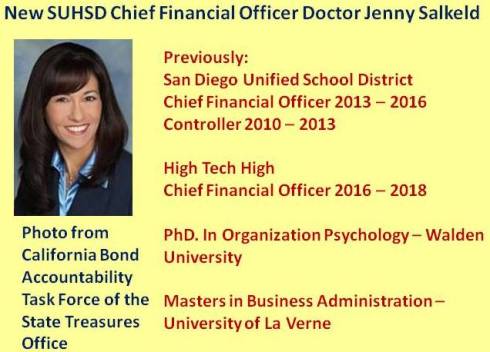
The newly hired Chief Financial Officer of Sweetwater Union High School District (SUHSD), Jenny Salkeld, discovered a significant problem with the budget she inherited. She presented her findings to the Sweetwater leadership team in early September which forwarded her report onto the County Office of Education (COE). The SUHSD board also called in all bargaining units to suspend contract negotiations and inform them of the budgetary uncertainties. Sensationalism and subterfuge became the new reality in Chula Vista, California.
“On June 25, the school board approved a budget for this school year that assumed the district had spent $328 million in unrestricted funding last school year and had $17 million in reserves going into this school year. In September, Salkeld presented a report showing that the district actually had spent $20 million more than that and started this school year with a negative reserve balance of $4 million.
“On top of spending more than previously estimated, the district received $6 million less in one-time state funding than it had expected.”
After receiving Sweetwater’s alert about the accounting errors, the COE officially disapproved the 2018-19 budget the district had submitted. The reasons for disapproving the budget were the reasons Salkeld had reported. The county’s CONTINUE READING: Sweetwater Schools Financial Problems Became Political Cudgel | tultican
The Network for Public Education welcomes four outstanding leaders to our NPE Board
Network for Public Education President, Diane Ravitch, is proud to announce that four accomplished leaders and supporters of public education have been elected to three year terms on the NPE Board of Directors.
Lavelle Jones was born and raised in Jersey City, New Jersey where she attended public schools. She received her Bachelor of Arts degree from Wellesley College and her Juris Doctorate from Seton Hall Law School. She is retired from the New Jersey Bar.
Lavelle worked for Colgate-Palmolive Company where she developed the company’s minority and women-owned business program, created global strategies for professional services and led global teams. The National Network Journal listed Lavelle as one of the most influential black women in business. She was also a two-time recipient of the Harlem YMCA Black Achievers in Industry award.
Since her retirement, Lavelle has applied her skills, as a volunteer, in support of her favorite causes: the well-being of older Americans, the education and safety of children and the preservation of wildlife. She joined AARP as a volunteer in 2007 and currently serves as AARP New Jersey State President. She also serves on the Board of Directors of the Allen-Shaw Foundation, a private charity devoted to the education of children in the nation of Jamaica. Since 2014, Lavelle has served NPE as the volunteer national conference coordinator.
Denisha Jones is the Director of Teacher Education and an Assistant Professor in the School of Education at Trinity Washington University. Dr. Jones began her career in education as a kindergarten teacher in D.C. after earning her Bachelor of Arts in early childhood education from the University of the District of Columbia. She also worked as a preschool director before spending the last 14 years in teacher education.
Determined to be a more effective advocate in the fight against school privatization, she began law school and graduated with her J.D. in May 2018. She has been a board member and administrator for the Badass Teachers Association (BATs), Inc., and currently, she is the interim Assistant Executive Director for BATs; she is chairwoman of the National Advisory Board for the Public Education Defense Fund and she serves on the advisory board of Defending the Early Years.
Her research interests include developing critical consciousness in pre-service teachers, organizing activist research projects that challenge the privatization of public education, and leveraging the intersection of public policy, social movement lawyering, and critical social justice education to dismantle the neoliberal assault on public education.
James Harvey has served as the executive director of the National Superintendents Roundtable since 2007. The Roundtable, an invitational membership organization, is dedicated to progressive leadership in support of just and humane schools.
A native of Ireland, Harvey attended elementary and secondary schools in Ireland and London and completed his high school education at a public school in Pennsylvania. He is the author or co-author of dozens of articles and five books on education and education policy. He served in the Carter administration as an education lobbyist and on the staff of the Committee on Education and Labor of the U.S. House of Representatives.
His doctoral work at Seattle University examined both the National Assessment of Educational Progress (NAEP) and American school performance in an international context and was published by the Roundtable and the Horace Mann League in 2015 and 2018 as The Iceberg Effect and How High the Bar? He serves on the Steering Committee of the Urban Superintendents Academy sponsored by AASA and Howard University and on the board of the Horace Mann League.
Roxana Marachi is Education Chair of the San José / Silicon Valley NAACP and an Associate Professor of Education at San José State University where she teaches courses in Educational Psychology and Educational Leadership. She received her PhD in Education and Psychology at the University of Michigan in 2003, where she studied the impacts of learning environments on student motivation and behavior in schools.
Marachi served as co-chair of the Safe Schools and Communities Subcommittee of the American Educational Research Association from 2009-2012, and is currently investigating research-to-practice gaps in the implementation of policies related to high-stakes testing, privatization, and the technologization of teaching and learning. Marachi was the recipient of the 2015 Justice Award from Californians for Justice and the 2015 Freedom Fighter Award from the San José / Silicon Valley NAACP, and is actively involved in local, state, and national efforts to strengthen and protect public education.
These four outstanding leaders and friends of public schools join Diane Ravitch, Anthony Cody, Phyllis Bush, Yohuru Williams, Leonie Haimson and Julian Vasquez Heilig as members of the Board of Directors of NPE.
The teachers of Los Angeles are poised to strike for better public schools for their city’s children
It is likely that the teachers of Los Angeles, California represented by UTLA will strike beginning tomorrow. If they do, it will be about more than salaries. Teacher demands include smaller class sizes, as well as more counselors, librarians and nurses in schools. They are demanding funding for community schools and less testing. They are demanding an end to disruptive and humiliating random searches of students in their schools.
You can show your support for the teachers of Los Angeles by wearing red on Thursday, January 10. Take your picture and then post it on social media. The Alliance to Reclaim our Schools, Los Angeles branch (ROSLA), has established a Solidarity Fund. If the teachers do strike tomorrow, you can make a donation here. Funds will be used by ROSLA to raise public awareness and support the strike. The Network for Public Education welcomes four outstanding leaders to our NPE Board - Network For Public Education