Latest News and Comment from Education

Wednesday, December 26, 2018

SPOTLIGHT BLOG OF THE WEEK: JAN RESSEGER BLOG (janresseger.wordpress.com)


SPOTLIGHT BLOG OF THE WEEK: JAN RESSEGER BLOG (janresseger.wordpress.com)


DEC 14

What If Policymakers Stopped Condemning Poor People and Considered their Real Needs and Circumstances?

Merry Christmas and Good Wishes for the Season! This blog will take a holiday break. Look for a new post early in the new year. In 2012, Mike Rose published Back to School: Why Everyone Deserves a Second Chance at Education , a book about the potential of community colleges to help people discover their interests, widen their experiences, and perhaps change the direction of their lives. He begins

DEC 13

New Federal Case Launched in Rhode Island to Establish Educational Equity as a Federally Protected Right

If you think about it, you’ll remember that for more than forty years, school equity cases have been filed under the education clauses of the 50 state constitutions. That’s because, in a 1973 decision, San Antonio v. Rodriguez , the Warren Burger, U.S. Supreme Court decided that, because education is not mentioned in the U.S. Constitution, education is not protected as a fundamental right under t

DEC 12

Alliance to Reclaim Our Schools Tells New Congress: Fully Fund Title I and IDEA

In his new book, Educational Inequality and School Finance, the Rutgers University school finance expert Bruce Baker carefully refutes some long-running and persistent myths about the funding of public education—Eric Hanushek’s claim that money doesn’t really make any difference when it comes to raising student achievement, for example, and the contention that public schools’ expenditures have sk

DEC 11

New from the National Education Policy Center: “How School Privatization Opens the Door for Discrimination”

Last week this blog explored some of the ways the expansion of school choice ends up creating injustice and inequality . The National Education Policy Center just published a new report, How School Privatization Opens the Door for Discrimination , in which Julie Mead of the University of Wisconsin and Suzanne Eckes of Indiana University further investigate one particular aspect of the same topic:

DEC 07

More Education News from Chicago: WBEZ Publishes the Troubling History of Chicago’s Public School Closures

It is quite a week for education news from Chicago. Yesterday this blog covered the first teachers’ strike at a charter school network, UNO-Acero Charter Schools in Chicago. Today’s post considers nearly two decades of closures of traditional neighborhood schools in Chicago. Chicago’s closure of so-called “failing” schools began in 2002. Two years later, Chicago’s technocratic model of test-based

DEC 06

Chicago Teachers at 15-School Acero Charter Chain Strike: First Walkout at a Unionized Charter School Network

In the first walkout at a U.S. charter school network, 500 teachers at Chicago’s Acero (formerly UNO) charter school chain went on strike Tuesday. Acero Charter Schools’ teachers are represented by the Chicago Teachers Union. While teachers in a number of Chicago charter schools had formed their own ChiACTS union, at the end of last January, ChiACTS merged with the 28,000 member Chicago Teachers

DEC 05

Why School Choice Ends Up Creating Injustice and Inequality

In his new book, Educational Inequality and School Finance: Why Money Matters for America’s Students , school funding expert, Bruce Baker critiques the rapid expansion of charter schools for siphoning off dollars from state and local public school budgets. Baker also addresses the philosophical contention frequently offered to justify the rapid expansion of school choice—that justice can be defin

DEC 04

Dogged Advocates for Justice Protest Ohio State School Takeovers of Youngstown, Lorain, and East Cleveland

After January, John Kasich will no longer be governor of Ohio. House Bill 70, the law that paved the way for the Youngstown—and now Lorain and East Cleveland—school takeovers is the biggest stain on his legacy. In gerrymandered Ohio, with huge legislative Republican majorities after the November 2018 election—62 Republicans and 37 Democrats in the Ohio House and 24 Republicans and 9 Democrats in

NOV 30

DeVos Again Protects For-Profit Colleges and Federal Loan Servicing Contractor at Expense of Vulnerable Students

Betsy DeVos once announced: “Government really sucks.” She doesn’t like government regulation, and she prefers to free up the marketplace. One of the best places to observe her penchant for deregulation is in higher education, where she has regularly done everything she can to protect the investors in for-profit colleges and trade schools, where she has tried to step back from protecting students

NOV 29

Faith in High Stakes Testing Fades, Even Among the Corporate School Reformers

After a recent twenty-fifth anniversary conference at the Center on Reinventing Public Education at the University of Washington, Bothell—a Gates funded education-reformer think tank, Chalkbeat ‘s Matt Barnum summarized presentations by a number of speakers who demonstrate growing skepticism about the high-stakes, standardized testing regime that has dominated American public education for over a

NOV 21

Truly Public Schools Must Form Engaged Citizens and Then Engage Those Citizens in Shaping School Policy

This blog will take a week long Thanksgiving break. Look for a new post on November 29. Good wishes for Thanksgiving! In its October 2018 issue, Phi Delta Kappan magazine features a pair of articles that, from two entirely different perspectives, trace declining civic engagement around public education to the philosophy at the heart of the 2001 No Child Left Behind Act. In Preparation for Capable

NOV 20

DeVos Proposes Controversial Rewrite of Rules for Investigating Campus Sexual Assault

Last Friday, Education Secretary Betsy DeVos released—for a 60-day public comment period—new rules for how schools that receive federal dollars must handle allegations of sexual assault. The Washington Post ‘s Laura Meckler explains : “The rules stem from a 1972 law known as Title IX that bars sex discrimination at schools that receive federal funding. Most of the attention is on higher education

NOV 16

Northwestern University Economist Uses Data to Prove Students’ Test Scores Fail to Measure Quality Teaching

Mike Rose, a UCLA education professor, understands a lot about teaching. In his extensive writing about education, Rose explains good teaching with precision and insight. Rose culminated a four year visit to excellent classrooms across the United States with the publication of the story of those teachers in Possible Lives . He has also written widely about what good teachers do and what ought to

NOV 15

Bruce Baker’s New Book on School Finance Develops a Scathing Critique of Charter School Expansion

Rutgers University school finance professor, Bruce Baker’s new book, Educational Inequality and School Finance: Why Money Matters for America’s Students , covers the basics—how school finance formulas are supposed to work to ensure that funding for schools is adequate, equitable, and stable. Baker also carefully refutes some persistent myths—Eric Hanushek’s claim that money doesn’t really make a

NOV 14

Is America’s Romance with Charter Schools Fading Despite Gobs of Political Money from Its Promoters?

Last week’s election produced a couple of significant indicators that the public may be growing weary of charter schools. At the same time the public seems increasingly aware that adequately funded public schools may be a better way 


Wednesday, December 19, 2018

BIG EDUCATION APE WILL BE OFF FOR THE NEXT SEVERAL DAYS CELEBRATING THE HOLIDAYS HAPPY SOLSTICE EVERYONE

Winter solstice: Why pagans celebrate the shortest day of the year (a day late)


BIG EDUCATION APE WILL BE OFF FOR THE NEXT SEVERAL DAYS 
CELEBRATING THE HOLIDAYS

HAPPY SOLSTICE EVERYONE


Winter solstice: Why pagans celebrate the shortest day of the year (a day late)
Image result for HAPPY winter solstice SURFING


The December solstice happens at the same instant for everyone, everywhere on Earth – and this year the winter solstice occurs on Friday December 21st 22:23 GMT in the Northern Hemisphere.
The winter solstice happens every year when the Sun reaches its most southerly declination of -23.5 degrees. In other words, it is when the North Pole is tilted farthest away from the Sun, delivering the fewest hours of sunlight of the year.
The Sun is directly overhead of the Tropic of Capricorn in the Southern Hemisphere during the December solstice and is closer to the horizon than at any other time in the year, meaning shorter days and longer nights.
The shortest day of the year lasts for 7 hours 49 minutes and 41 seconds in Britain, which is 8 hours, 49 minutes shorter than the June Solstice. As such, Thursday December 20th is the longest night of the year with the sun not rising until 08:03 GMT on Friday morning.
The day after the winter solstice marks the beginning of lengthening days, leading up to the summer solstice in June.
In the Southern Hemisphere, the opposite is true. Dawn comes early, and dusk comes late. The sun is high and the shortest noontime shadow of the year happens there. In the Southern Hemisphere, people will experience their longest day and shortest night.

Does the winter solstice always occur on December 21st?

While it more often than not falls on December 21st, the exact time of the solstice varies each year. In the Northern hemisphere the winter solstice is the shortest day of the year, because it is tilted away from the sun, and receives the least amount of sunlight on that day.
However, the earliest sunset does not occur on the solstice, because of the slight discrepancy between 'solar time' and the clocks we use.
The shortest day of the year often falls on December 21st, but the modern calendar of 365 days a year - with an extra day every four years - does not correspond exactly to the solar year of 365.2422 days.
The solstice can happen on December 20, 21, 22 or 23, though December 20 or 23 solstices are rare.
The last December 23 solstice was in 1903 and will not happen again until 2303.

What does 'solstice' mean?

The term 'solstice' derives from the Latin word 'solstitium', meaning 'Sun standing still'. On this day the Sun seems to stand still at the Tropic of Capricorn and then reverses its direction as it reaches its southernmost position as seen from the Earth.
Some prefer the more teutonic term 'sunturn' to descibe the event.

Is the solstice the first day of winter?

The answer might vary depending on who you ask. There are two types of winter: astronomical and meteorological.
Astronomical winter typically begins on December 21st, with the winter solstice, and ends on March 19th. Meteorological winter always begins on December 1st and ends on February 28th (February 29th during leap years).
While astronomical winters are determined by the Earth's orbit around the sun, meteorological winters are the three calendar months with the lowest average temperatures.
The Met Office tend to use the meteorological definition of the seasons.

Stonehenge and the solstice

Stonehenge, the prehistoric monument located in Wiltshire, is carefully aligned on a sight-line that points to the winter solstice sunset (opposed to New Grange, which points to the winter solstice sunrise, and the Goseck circle, which is aligned to both the sunset and sunrise).
Archaeologists believe it was constructed from 3000 BC to 2000 BC and it is thought that the winter solstice was actually more important to the people who constructed Stonehenge than the Summer solstice.
The winter solstice was a time when cattle was slaughtered (so the animals would not have to be fed during the winter) and the majority of wine and beer was finally fermented.
The only other megalithic monuments in the British Isles which clearly align with the sun are Newgrange in County Meath, Ireland and Maeshowe situated on Mainland, Orkney, Scotland. Both famously face the winter solstice sunrise.
You can also see the solstice sunrise around the world; this website shows Winter solstice: Why pagans celebrate the shortest day of the year (a day late)


Image result for winter solstice dance animated gif

DeVos' Solution to Mass School Shootings? Scrap the Rules Designed to End Discrimination Against Students of Color

DeVos' Solution to Mass School Shootings? Scrap the Rules Designed to End Discrimination Against Students of Color

DeVos' Solution to Mass School Shootings? Scrap the Rules Designed to End Discrimination Against Students of Color
"The Trump administration's response to school shootings is to make it easier (again) to suspend black kids."

Update:
The highly anticipated Final Report (pdf) from the Federal Commission on School Safety, led by Education Secretary Betsy DeVos, was released Tuesday—and includes a long-rumored recommendation that is alarming civil rights advocates: to rescind Obama-era policies crafted to end racial disparities in school disciplinary practices.
Formed after 17 people were gunned down at a Florida high school in February, the commission "took a horrendous year of school shooting tragedies and produced a report with a smorgasbord of recommendations—some of which we have championed for years—aimed at making our schools safer," said American Federation of Teachers president Randi Weingarten. "Unfortunately, the report doesn't address the root causes of the gun violence epidemic: too many guns in our communities and not enough investment in addressing the social-emotional health of our kids."
"But most curious and disappointing is the report's use of the tragedy at Marjory Stoneman Douglas High School to push an anti-civil rights agenda that won't keep schools safe," she added. Noting that the Obama-era measures "intended to help prevent the disproportionate suspension and expulsion of students of color, students with disabilities, and LGBTQ youth," she also pointed out that the Stoneman Douglas shooter "had in fact been expelled and reported to law enforcement; rescinding discipline guidance and kicking kids out of school doesn't prevent school shootings."
The Education Law Center, in a statement, said, "Claims that federal measures to address racial and disability disparities have caused lax discipline and triggered a wave of school violence are simply inaccurate and dishonest." The center concluded that the commission's recommendation to rescind the anti-discrimination measures sends a message that the Trump administration "does not care about children pushed out of school and does not care if schools discriminate."
Earlier:
A school safety commission formed after 17 people were murdered at a high school in Parkland, Florida in February plans to formally recommend that the Trump administration rescind "groundbreaking" Obama-era policies that aimed to prevent discrimination against students of color, according to the New York Times.
Expected to be officially announced in a joint letter by the Education and Justice CONTINUE READING: DeVos' Solution to Mass School Shootings? Scrap the Rules Designed to End Discrimination Against Students of Color

The 'dirty secret' about educational innovation - The Hechinger Report

The 'dirty secret' about educational innovation - The Hechinger Report

The ‘dirty secret’ about educational innovation
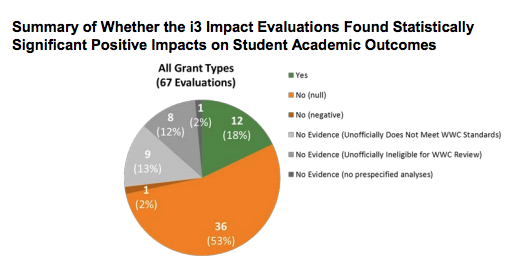
A 2018 federal report found that only 18 percent of the innovations funded by the Education Department lifted student achievement
As part of the federal recovery effort to boost the economy after the 2008 recession, the U.S. Education Department suddenly had a big pot of money to give away to “innovations” in education. Since then, more than $1.5 billion has been spent on almost 200 ideas because Congress continued to appropriate funds even after the recession ended.  Big chunks went to building new KIPP charter schools and training thousands of new Teach for America recruits to become teachers. Other funds made it possible for lesser known programs in reading, writing, math and science instruction to reach classrooms around the country. Many of the grant projects involved technology, sometimes delivering lessons or material over the internet. One “innovation” was to help teachers select good apps for their students. Another was for a novel way to evaluate teachers.
In order to obtain the grants, recipients had to determine if their ideas were effective by tracking test scores. Results are in for the first wave of 67 programs, representing roughly $700 million of the innovation grants and it doesn’t look promising.
Only 12 of the 67 innovations, or 18 percent, were found to have any positive impact on student achievement, according to a report published earlier in 2018. Some of these positive impacts were very tiny but as long as the students who received the “innovative treatment” posted larger test score gains than a comparison group of students who were taught as usual, it counted.
“It’s only a handful,” said Barbara Goodson, a researcher at Abt Associates Inc., a research and consulting firm that was hired to analyze the results of the Investing in Innovation (i3) Fund for the Department of Education. “It’s discouraging to everybody. We are desperate to find what works. Here was a program that was supposed to identify promising models. People are disappointed that we didn’t CONTINUE READING: The 'dirty secret' about educational innovation - The Hechinger Report


Disability Advocates Concerned By Plan To Axe School Discipline Guidance - Disability Scoop

Disability Advocates Concerned By Plan To Axe School Discipline Guidance - Disability Scoop

Disability Advocates Concerned By Plan To Axe School Discipline Guidance


A Trump administration school safety commission is recommending that federal officials rescind Obama-era guidance aimed at ensuring that minorities and students with disabilities aren’t unfairly disciplined.
In a 180-page report released Tuesday, the Federal Commission on School Safety said that the 2014 guidance issued jointly by the U.S. Department of Education and the Department of Justice should be abandoned.
The guidance outlined how schools should work to ensure that discipline isn’t administered in a way that disproportionately affects students from certain groups, noting that federal law prohibits “discriminatory discipline” based on race, disability and other factors.
The recommendation this week comes from a panel established by President Donald Trump following the shooting in February at Marjory Stoneman Douglas High School in Parkland, Fla. The commission, chaired by Secretary of Education Betsy DeVos, was tasked with recommending steps to improve school safety.At the time, the Obama administration highlighted statistics showing that kids in special education represented just 12 percent of students across the country, but accounted for about 20 percent of suspensions and expulsions and almost a quarter of school-related arrests.
“The commission is deeply troubled that the guidance, while well-intentioned, may have paradoxically contributed to making schools less safe,” the commission said in its report. “Significant concerns also remain regarding the legal framework upon which the guidance is based. These concerns, together with the repeated concerns expressed by many that disciplinary decisions are best left in the hands of classroom teachers and administrators, CONTINUE READING: Disability Advocates Concerned By Plan To Axe School Discipline Guidance - Disability Scoop