Latest News and Comment from Education

Saturday, November 17, 2018

Majority of Americans now led by governors with proven record of championing public education - Education Votes

Majority of Americans now led by governors with proven record of championing public education - Education Votes

Majority of Americans now led by governors with proven record of championing public education


By Tim Walker
Education was a top tier issue in the 2018 mid-term elections across the nation. It’s prominence in the Wisconsin governor’s race was such that incumbent Scott Walker campaigned as a champion of public education. For Wisconsin educator and parents, this was an outlandish sight given Walker’ notorious and unmistakable record of slashing the state’s education budget.
Wisconsin voters had a better choice in Tony Evers, the state superintendent of education and former teacher. Evers said he was running for governor “because I am goddamn sick and tired of Scott Walker gutting our public schools, insulting our hard-working educators, and destroying higher education in Wisconsin.” Not only has Evers proposed an increase in school funding of $1.4 billion over two years, but has also called for a phase-out of the state’s school voucher program.
It was close but Evers emerged victorious, defeating Walker’s bid for a third term. “We have a partner who’s willing to listen to us, and we need to be there to provide the kind of advice and support that he will need to lead this state,” said Wisconsin Education Association Council president Ron Martin.
Although the Wisconsin gubernatorial race attracted national attention, Evers was not the only staunchly pro-public education candidate elected governor in 2018. Far from it. Champions of public schools ran up an impressive string of victories – many in states whose schools had been weakened by reckless budget cuts and expansion of unaccountable charter schools and private school voucher programs.
Gavin Newsom in California, Jared Polis in Colorado, Brad Little in Idaho, JB Pritzker in Illinois, Laura Kelly in Kansas, Gretchen Whitmer in Michigan, Tim Walz in Minnesota, Steve Sisolak in Nevada, Michelle Lujan Grisham in New Mexico, Janet Mills in Maine, and Ned Lamont in Continue reading: Majority of Americans now led by governors with proven record of championing public education - Education Votes


Why is There a Racial Achievement Gap? | gadflyonthewallblog

Why is There a Racial Achievement Gap? | gadflyonthewallblog

Why is There a Racial Achievement Gap?

Sometimes the most racist aspects of a society are right there in front of you, but no one seems to notice.
 It’s a term used to describe the fact that black and Latino students don’t do as well academically as white students.
Why does it even exist?
Why do students of color in the United States achieve less than their white peers?
As of 2018, they had the lowest mean score of any racial group on the Scholastic Aptitude Test (SAT).
And it’s been like that for more than half a century.
In 1964, a Department of Education report found that the average black high school senior scored below 87% of white seniors (in the 13 percentile). Fifty years later, the National Assessment of Educational Progress (NAEP) found that black seniors had narrowed the gap until they were merely behind 81% of white seniors (scoring in the 19th percentile).
So what does that mean?
It’s a question that has haunted our education system for more than a century.
And the various answers that have been offered to explain it often reveal more about our society than they do about black and Latino children.

CLAIM 1: People of color are just genetically inferior

I know. This sounds glaringly racist.
And it is.
Yet this was the favorite answer for the achievement gap at the start of Continue reading: Why is There a Racial Achievement Gap? | gadflyonthewallblog


Friday, November 16, 2018

SCHOOLS AND SUICIDES | The Merrow Report

SCHOOLS AND SUICIDES | The Merrow Report

SCHOOLS AND SUICIDES

Please allow me to lead with two very disturbing stories, the first about a 9-year-old boy in Denver, the second about a 9-year-old girl in Birmingham, Alabama:
DENVER — Leia Pierce shuffled out the front door on Tuesday. Her son, Jamel Myles, 9, had killed himself last week, and she was still struggling with the basics. Eating. Sleeping. “I took a shower, but I put the same clothes back on,” she said, staring at the ground. “I need him back.”
Jamel, a fourth grader at Joe Shoemaker Elementary School in Denver, hanged himself in his bedroom last Thursday, according to the county coroner, and his death has plunged a mother into despair and a community into disbelief.
Ms. Pierce says her son committed suicide after a year in which he and his older sister were bullied frequently at school. Over the summer, he had told his mother he was gay. Now, she is angry at the school, which she believes should have done more to stop the taunts and insults.
Will Jones, a spokesman for Denver Public Schools, said administrators planned to conduct a thorough review of the case. “We are deeply committed to our students’ well-being,” he said in a statement.


Jamel’s death comes amid a startling rise in youth suicides, part of a larger public health crisis that has unfolded over a generation: Even as access to mental health care has expanded, the suicide rate in the United States has risen 25 percent since 1999. Middle schoolers are now just as likely to die from suicide as they are from traffic accidents. 

BIRMINGHAM:  “The parents of a 9-year-old Alabama girl who hanged herself say a combination of bullying and her ADHD  medications was to blame.  Madison “Maddie” Continue reading: SCHOOLS AND SUICIDES | The Merrow Report

NEW! Chi-Town Educator and Community-Based Activism: Confronting a Legacy of Education Privatization in the Nation’s Windy City | Cloaking Inequity

NEW! Chi-Town Educator and Community-Based Activism: Confronting a Legacy of Education Privatization in the Nation’s Windy City | Cloaking Inequity

NEW! CHI-TOWN EDUCATOR AND COMMUNITY-BASED ACTIVISM: CONFRONTING A LEGACY OF EDUCATION PRIVATIZATION IN THE NATION’S WINDY CITY


Our new piece is included in a special issue entitled “The Illinois Problem.” Here’s what the editors have to say about the new issue in their introduction:
The Illinois Problem as taken up in the pages that follow, conveys theoretical, practical, and pragmatic concerns for today’s socio-political context—concerns that direct us to see, understand, and act in ways that address the problem itself. The theoretical position that the Illinois Problem conveys and utilizes for its analysis is that the current conflated political basis for deciding policy discourages a concern for building and maintaining a healthy public within a democracy. Rather, current socio-political understanding “encourages a morality that is economic; a social perspective that is individualist; a politics that is aesthetically patriotic; and, an economic understanding this is merciless” (Heybach & Sheffield, 2014, p. 71). This theoretical lens, we believe (as depressing as it certainly is), allows us to see actual practical policy intent in the face of both neoliberal and neoconservative forces coalescing toward a similar end—an end which leaves little room for widespread human flourishing. In terms of its practical import, this vision allows us to see the actual intent of specific policies and practices explored in this theme issue.
What I really like about this new piece is that Dr. Jameson Brewer and I wrote it collaboratively with Jitu Brown, a Chicago community organizer, and Michelle Gunderson, a classroom teacher and union activist. So often academics go into spaces to talk about community-based efforts, but fail to collaborate with and empower local voices. Without futhere ado, I give you Chi-Town Educator and Community-Based Activism: Confronting a Legacy of Education Privatization in the Nation’s Windy City
Chi-Town Educator and Community-Based Activism: Confronting a Legacy of Education Privatization in the Nation’s Windy City
T. Jameson Brewer, Julian Vasquez Heilig, Michelle Strater Gunderson, & Jitu Brown
Abstract: The predominance of research and data examining public education privatization in Chicago indicate that there are few financial savings, decreased student achievement, increased racial inequality, increased class size, and increased violence. Considering these outcomes, educators and community-based stakeholders have not remained silent in the face of this apparent injustice. In this paper, we examine teacher and community- based activism in Chicago situated amongst the local and broader reform efforts to which they fight against. We focus on strategies Continue reading: NEW! Chi-Town Educator and Community-Based Activism: Confronting a Legacy of Education Privatization in the Nation’s Windy City | Cloaking Inequity


Howard Fuller’s growing movement to expand black-controlled schools

Howard Fuller’s growing movement to expand black-controlled schools

Segregated schools are still the norm. Howard Fuller is fine with that
A longtime advocate for black-controlled schools in Milwaukee found an unlikely home among conservatives pushing school choice


MILWAUKEE, Wis. — At age 77, Howard Fuller strides along Center Street with the loping gait of a former standout basketball player while recalling the vibrant community of black homeowners and entrepreneurs that used to define this once-bustling stretch of Milwaukee’s North Side. “We had businesses and nice homes all around this area,” says Fuller, who grew up here.

A block dominated by houses with peeling paint and patched shingles gives way to the massive dull-brick facade of North Division High School, Fuller’s alma mater. The former Milwaukee schools superintendent and longtime school choice advocate pauses. “It’s hurtful to see what’s not happening here with these kids,” he says.
The school used to be a source of pride for the city’s black community, a stepping stone to middle-class achievement as its graduates went on to become doctors, businesspeople and win election to Congress. In 2016 not a single child at “North,” as locals call it, tested proficient in math according to the state’s education department.
Enrollment has declined from roughly 1,400 students in 1996 to about 350 students today, says the school’s principal, Keith Carrington. In a state that sends one out of every eight black men to prison, the highest rate in the country, this neighborhood bears a disproportionate brunt of the mass incarceration policy, with more African-American men from here locked up than from any other zip code in Milwaukee County.
“Where North is now is part of a conscious effort to sabotage black education,” Fuller says. He acknowledges that there are “well-meaning people in the building … teachers and administrators who have the kids’ best interests at heart.” But he also sees in the school’s decline a long history of white leaders, conservative and liberal, repeatedly asking black families to accept failure for their children.

NPE Conference 2018: Is the Corporate Reform Goliath Truly Dead? - Living in Dialogue

NPE Conference 2018: Is the Corporate Reform Goliath Truly Dead? - Living in Dialogue

NPE Conference 2018: Is the Corporate Reform Goliath Truly Dead? -

By John Thompson.

Part One of Two.
The theme of the Network for Public Education’s fifth annual conference was that corporate reformers have lost the “David versus Goliath” battle over public education. We public school supporters have defeated the privatization campaign known as corporate school reform. Goliath must know that his mega-bucks haven’t improved student performance but he keeps dumping backpacks full of cash into chosen schools. Hubris can explain some, but not all, of the continued subsidies that keep corporate school reform from collapsing.
As Diane Ravitch explains, Goliath claimed to be “the savior of poor black and brown children ‘trapped in failing schools.’” And for years, Goliath had used that propaganda meme while winning political battle after political battle. A mighty coalition, which had been built on the infrastructure laid by ALEC, the Koch brothers, and other anti-government interest groups, was able to unite neoliberals, edu-philanthropists, and the Obama administration in an effort to blow up neighborhood public schools.

Even as the political Goliath was defeating enemies, he failed completely in terms of real world education practice. Goliath tried charters, vouchers, testing, union-busting, and “value-added” evaluations to undermine the professional autonomy of teachers, and more. In my experience, however, their expensive mandates took low-performing inner city schools and made them much worse, as they also damaged schools that had previously been successful. Although I continually communicate with all types of people, it’s been years since I have talked with someone in the classroom who denies that corporate school reform, at best, created a mess.
Ravitch explains how “Goliath has run out of promises. He is now revealed as the ugly face of a lot of billionaires who don’t want to pay to educate children.” The only goal he met was to cut spending on education and lower taxes, and the public “eventually realized that Goliath pulled a trick on him.” So, “there is no ‘reform movement.’” The Billionaires Boys Club continues to fight for unchallengable power.
Goliath’s promises have been discredited. But his minions continue on, “like zombies, because the money is good.” Often, their followers don’t see any choice but to stick with Goliath’s army; after all, the traditional education system (and sometimes education journalism) has been bulldozed, meaning that the only Continue reading: NPE Conference 2018: Is the Corporate Reform Goliath Truly Dead? - Living in Dialogue


Thursday, November 15, 2018

Nellie Bowles: In America’s Schools, the Rich Get Teachers, the Poor Get Computers | Diane Ravitch's blog

Nellie Bowles: In America’s Schools, the Rich Get Teachers, the Poor Get Computers | Diane Ravitch's blog

Nellie Bowles: In America’s Schools, the Rich Get Teachers, the Poor Get Computers


This is a terrific article by Nellie Bowles in the New York Times about the “digital divide.” Amazing that the newspaper of record printed three articles on the same day by the same author, all warning us about the dangers of screen addiction. Remember when public officials worried that rich kids had more access to technology than poor kids? Now, it turns out that students in affluent schools get small classes and experienced teachers, while kids in underfunded schools get technology. Not what was expected.
The parents in Overland Park, Kan., were fed up. They wanted their children off screens, but they needed strength in numbers. First, because no one wants their kid to be the lone weird one without a phone. And second, because taking the phone away from a middle schooler is actually very, very tough.
“We start the meetings by saying, ‘This is hard, we’re in a new frontier, but who is going to help us?’” said Krista Boan, who is leading a Kansas City-based program called START, which stands for Stand Together And Rethink Technology. “We can’t call our moms about this one.”
For the last six months, at night in school libraries across Overland Park, a suburb of Kansas City, Mo., about 150 parents have been meeting to talk about one thing: how to get their children off screens.
It wasn’t long ago that the worry was that rich students would have access to the internet earlier, gaining tech skills and creating Continue reading: Nellie Bowles: In America’s Schools, the Rich Get Teachers, the Poor Get Computers | Diane Ravitch's blog

IPS Community Coalition victory is proof that ordinary citizens can defeat big money - Network For Public Education

IPS Community Coalition victory is proof that ordinary citizens can defeat big money - Network For Public Education

IPS Community Coalition victory is proof that ordinary citizens can defeat big money


Sending a clear message that the community is fed up with corporate reform, voters in Indianapolis ousted two incumbents on the Indianapolis Public School (IPS) Board, replacing them with opponents of the district’s corporate reform agenda.
First-time candidates Taria Slack and Susan Collins were backed by the IPS Community Coalition (the Indianapolis AROS Chapter) and the local teachers union and ran against incumbents backed by Stand for Children and the Mind Trust, a corporate reform institute. Slack and Collins are vowing to pressure the IPS administration to improve transparency, genuine community collaboration and engagement, and hold the administration accountable.
Indianapolis schools have been under persistent attack by corporate reformers over the past decade, with increasing numbers of charters and public school closings. The district—under the tutelage of the Mind Trust—has also created so-called “Innovation Schools,” which are IPS schools that are handed over to a charter management organization. Innovation Schools have complete autonomy, a school board that is not elected by the public, and receive public funds. Additionally, this structure allows charters under the IPS umbrella to take advantage of district-provided services such as transportation and special education services at no cost.
This victory is proof that ordinary citizens can defeat big money. People power trumps money power. IPS Community Coalition is organized, prepared, and ready to reclaim our schools.
IPS Community Coalition victory is proof that ordinary citizens can defeat big money - Network For Public Education

Bruce Baker’s New Book on School Finance Develops a Scathing Critique of Charter School Expansion | janresseger

Bruce Baker’s New Book on School Finance Develops a Scathing Critique of Charter School Expansion | janresseger

Bruce Baker’s New Book on School Finance Develops a Scathing Critique of Charter School Expansion


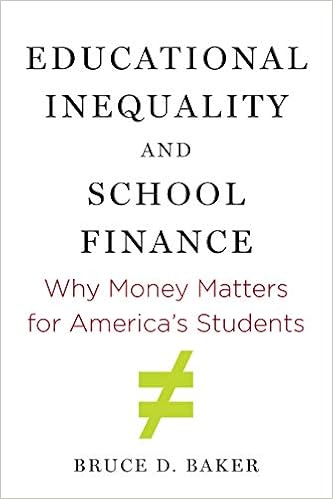
Rutgers University school finance professor, Bruce Baker’s new book, Educational Inequality and School Finance: Why Money Matters for America’s Students, covers the basics—how school finance formulas are supposed to work to ensure that funding for schools is adequate, equitable, and stable.
Baker also carefully refutes some persistent myths—Eric Hanushek’s claim that money doesn’t really make a difference when it comes to raising student achievement, for example, and the contention that public schools’ expenditures have skyrocketed over the decades while achievement as measured by test scores has remained flat.
Baker does an excellent job of demonstrating that far more will be needed for our society appropriately to support school districts segregated not only by race, but also by poverty. The final sections of the book are a little technical. They explain the construction of a more equitable system that would drive enough funding to come closer to what is really needed in school districts serving concentrations of children in poverty.
Baker’s book is especially important for updating a discussion of basic school finance theory to account for today’s realities.  He shows, for example, how the Great Recession undermined adequate and equitable funding of public schools despite that states had formulas in place that were supposed to have protected children and their teachers: “The sharp economic downturn following the collapse of the housing market in 2007-08, and persisting through about 2011, provided state and federal elected officials a pulpit from which to argue that our public school systems must learn how to do more with less… Meanwhile, governors on both sides of the aisle, facing tight budgets and the end of federal aid that had been distributed to temporarily plug state budget holes, ramped up their rhetoric for even deeper cuts to education spending… Notably, the attack on public school funding was driven largely by preferences for conservative tax policies at a time when state budgets experienced unprecedented drops in income and sales tax revenue.” (p. 4)
And for the first time in a school finance book, Baker explores the impact of two decades of Continue reading: Bruce Baker’s New Book on School Finance Develops a Scathing Critique of Charter School Expansion | janresseger
Educational Inequality and School Finance: Why Money Matters for America's Students: Bruce D. Baker: 9781682532423: Amazon.com: Books - https://www.amazon.com/Educational-Inequality-School-Finance-Americas/dp/1682532429


Idaho Teachers/Staff Dressed as Border Wall and Mexicans Reinstated, Principal Remains Suspended | deutsch29

Idaho Teachers/Staff Dressed as Border Wall and Mexicans Reinstated, Principal Remains Suspended | deutsch29

Idaho Teachers/Staff Dressed as Border Wall and Mexicans Reinstated, Principal Remains Suspended


The 14 Middleton (Idaho) teachers and staff who were placed on paid leave after dressing as the border wall and Mexicans on Halloween purportedly for an after-school “team building exercise” have been released to return to their jobs.
However, the school’s principal remains under investigation.
Middleton Schools superintendent John Middleton offered the following November 07, 2018, press release.
Middleton School District Release
November 7, 2018
Dear Parents, Staff and Community,
The Middleton School District’s internal investigation with teachers and elementary aides who were on administrative leave on November 5th and 6th is complete. Our focus is now one of healing with an opportunity for all of us to grow together as a community. Today we began the re-entry process with training on cultural sensitivity and correspondence with parents, the staff and community. The entire Middleton School District staff is also receiving similar cultural sensitivity training today.
It is important to note that after the district’s review, it has been validated that there is nothing more than love and commitment in the hearts of these teachers and aides. The educators involved chose the profession to work with and educate ALL students and we are confident in their abilities to provide an effective learning environment for every student in the building. It is also noteworthy that the few threats that were made via telephone or on social media were made from out of town and out of state. Police have dealt with these swiftly and none were found to be credible.
We will welcome our teachers and aides back into their classrooms in the Continue reading: Idaho Teachers/Staff Dressed as Border Wall and Mexicans Reinstated, Principal Remains Suspended | deutsch29

CURMUDGUCATION: Anti-Test, Pro-Computer

CURMUDGUCATION: Anti-Test, Pro-Computer

Anti-Test, Pro-Computer


Chalkbeat today notes the growing trend of reformster discontent with the Big Standardized Test, a thread which apparently emerged at the latest soiree thrown by the Center for Reinventing Public Education, a group that has pushed ed reform for years.

But intentionally or not, Matt Barnum  also captured part of what is driving this shift.

Some members of the Thinky Tank set (with Jay Greene in the forefront) have been noticing that test results don't seem to really mean anything. But there's another reform group that is sour on testing:

The way we’re doing [assessment] now — that is so time-, age-, grade-based — is really constraining for those innovators that are developing models that will support all kids.

That quote comes from Susan Patrick of The International Association for K-12 Online Learning  (iNACOL), an organization whose bread and butter is tech based education, and which has thrown itself whole-heartedly behind Competency Based Education and Personalized [sic] Learning. Their opposition to the BS Test is signaled by Patrick's quote. If they are going to sell a system that lets students learn whatever whenever at whatever speed they wish, they need to remove the issue if a giant standardized test at the end f the ear.


In other words, the old approach to ed reform is cramping the style of reform 2.0. The 2.0 version is pointed firmly at the unbundling of education so that stdents can acquire their competencies and proficiencies and badges wherever and whenever and from whomever. This shift has the double advantage of a sort of ju-jitsu move-- people who are busy running away from the BS Test can be ushered straight into the Competency Based Proficiency Personalized tent. Reform 1.0 has become a marketing tool for Reform 2.0

It's worth noting that even some of the reformsters themselves haven't caught on yet. The repeated complaints about testing at the event drew this bemused quote from Sandy Kress, one of the creators of No Child Left Behind and therefor one of the fathers of the test-centered education Continue reading: 
CURMUDGUCATION: Anti-Test, Pro-Computer


Wednesday, November 14, 2018

School shootings have fueled a $2.7 billion school safety industry. What makes kids safer? - Washington Post

School shootings have fueled a $2.7 billion school safety industry. What makes kids safer? - Washington Post

Armored school doors, bulletproof whiteboards and secret snipers

Billions are being spent to protect children from school shootings.

Does any of it work?

Image result for Armored school doors, bulletproof whiteboards and secret snipers Billions are being spent to protect children from school shootings.
he expo had finally begun, and now hundreds of school administrators streamed into a sprawling, chandeliered ballroom where entrepreneurs awaited, each eager to explain why their product, above all others, was the one worth buying.
Waiters in white button-downs poured glasses of chardonnay and served meatballs wrapped with bacon. In one corner, guests posed with colorful boas and silly hats at a photo booth as a band played Jimmy Buffett covers to the rhythm of a steel drum. For a moment, the festive summer scene, in a hotel 10 miles from Walt Disney World, masked what had brought them all there.
This was the thriving business of campus safety, an industry fueled by an overwhelmingly American form of violence: school shootings.
At one booth, two gray-haired men were selling a 300-pound ballistic whiteboard — adorned with adorable animal illustrations and pocked with five bullet holes — that cost more than $2,900.
Image result for Armored school doors, bulletproof whiteboards school shootings.
“What we want to do is just to give the kids, the teachers, a chance,” one of them said.
“So they can buy a few minutes,” the other added.
Elsewhere at the July conference, vendors peddled tourniquets and pepper-ball guns, facial-recognition software and a security proposal that would turn former Special Operations officers into undercover teachers. Threaded into every pitch, just five months after a Parkland, Fla., massacre, was the implication that their product or service would make students safer — that, if purchased, it might save a life.
What few of the salespeople could offer, however, was proof.
Although school security has grown into a $2.7 billion market — an estimate that does not account for the billions more spent on armed campus police officers — little research has been done on which safety measures do and do not protect students from gun violence. Earlier this fall, The Washington Post sent surveys to every school in its database that had endured a shooting of some kind since the 2012 killings of 20 first-graders in Newtown, Conn., which prompted a surge of security spending by districts across the country. Continue reading: School shootings have fueled a $2.7 billion school safety industry. What makes kids safer? - Washington Post

Is America’s Romance with Charter Schools Fading Despite Gobs of Political Money from Its Promoters? | janresseger

Is America’s Romance with Charter Schools Fading Despite Gobs of Political Money from Its Promoters? | janresseger

Is America’s Romance with Charter Schools Fading Despite Gobs of Political Money from Its Promoters?


Last week’s election produced a couple of significant indicators that the public may be growing weary of charter schools.  At the same time the public seems increasingly aware that adequately funded public schools may be a better way to help the children our society has left behind.  This is despite an enormous political investment by wealthy investors in the future of the charter school movement.
Consider the race for California Superintendent of Public Instruction. Last month for The InterceptRachel M. Cohen explained what this highly contentious, non-partisan race between charter proponent Marshall Tuck and his opponent Tony Thurmond has really been all about: “The California charter school lobby is testing its influence in the race for Superintendent of Public Instruction, turning an election for a somewhat obscure statewide position into a notably expensive battle.  More than $50 million has flown into the contest between two Democrats for a nonpartisan office with little statutory power.  For perspective, this is more money raised than in any U.S. House race this cycle and most Senate races, not to mention every other race in California, save for the governor’s. The race, largely understood as a proxy war for the future of California charter schools, is the second attempt by the state’s charter school lobby to demonstrate its influence…. The candidates, Marshall Tuck and Tony Thurmond, both insist that the race is about far more than charters, which currently enroll 10 percent of the state’s 6.2 million public school students, though they admit they hold different visions for the publicly funded, privately managed schools. That’s something their funders also acutely recognize.”
On election night, Marshall Tuck, the former president of Green Dot Charters and an advocate for expanding California’s already huge charter sector, was ahead by 86,000 votes. But as mail-in and absentee ballot have been counted, Thurmond has progressively caught up. By Saturday night, EdSource reported, Marshall Tuck was still ahead by 38,251 out of 6,934,591 votes counted by that time. However, by yesterday morning, the California Secretary of State was reporting Tony Thurmond had pulled ahead with a 3,500 vote lead. By last evening, each candidate had cornered roughly 50 percent of the vote, with a tiny 1,808 vote margin for Continue reading: Is America’s Romance with Charter Schools Fading Despite Gobs of Political Money from Its Promoters? | janresseger

Tuesday, November 13, 2018

Ignore the charter school think-tank crowd - CommonWealth Magazine

Ignore the charter school think-tank crowd - CommonWealth Magazine

Ignore the charter school think-tank crowd

We don’t need and can't afford charter school expansion in New Bedford


YOU ARE AN EDUCATION RESEARCHER sent to discover best practices in urban schools so that you can replicate them to create results for more kids—kids who you believe are trapped in mediocre schools. You look at three exemplar schools to scale up:
School A has 336 students and rates in the state’s 85th accountability percentile, a measure now used to aggregate a school’s performance on MCAS relative to other schools in the state. This school made 95 percent improvement toward its own goals, such as increasing the percentage of students who score advanced or proficient on statewide exams, or improving attendance rates. Remarkably, 46 percent of this school’s students have a first language other than English, and 75 percent are considered economically disadvantaged. The school has been named a School of Recognition by the state, among only 50 others.
School B has 730 students and rates in the state’s 59th accountability percentile and made 83 percent improvement toward its targets. The school is home to specialized classrooms designed to serve students with severe behavioral and developmental delays, and 27 percent of the school’s students have disabilities, 44 percent are economically disadvantaged, and 21 percent have a first language other than English.
School C has 413 students and rates in the state’s 38th accountability percentile and made 47 percent improvement toward its targets. At the school, 23 percent of the students have a first language other than English, and 58 percent come from economically disadvantaged backgrounds.
If you had to make the call on which school to expand by 300 percent – to double- or triple-down on – I suspect you would favor schools A and B, New Bedford district public schools Congdon and Pulaski, respectively, over School C, Alma del Mar Charter School, the school actually proposing such an extraordinary expansion.
The New Bedford district public schools have a plethora of higher performing schools. Not just Pulaski and Congdon, but 10 of New Bedford’s elementary schools finished higher in accountability ranking than Alma del Mar, more than half of the city’s primary schools. On improvement toward targets, 18 of the district’s 23 schools exceed Alma’s 47 percent improvement rate. And among those performing worse than Alma? The city’s other two charters: Global Learning and City on a Hill. The district educates a higher percentage of English language learners, students with disabilities, and economically disadvantaged students and has schools soaring past Alma nonetheless.
Why siphon from the most successful of New Bedford’s schools, which outperform charters with Continue reading: Ignore the charter school think-tank crowd - CommonWealth Magazine