Latest News and Comment from Education

Saturday, November 3, 2018

Thurmond vs Tuck and how FAKE Democrats are fooling voters with help from Alt-Right Billionaires | Crazy Normal - the Classroom ExposƩ

Thurmond vs Tuck and how FAKE Democrats are fooling voters with help from Alt-Right Billionaires | Crazy Normal - the Classroom ExposƩ

Thurmond vs Tuck and how FAKE Democrats are fooling voters with help from Alt-Right Billionaires


Politico.com reported on November 1, five days before the 2018 election, “In the race to be California’s top educator, charter schools ally Marshall Tuck registered a substantial 12-point lead (48 percent to 36 percent) over state Assemblyman Tony Thurmond, as Tuck takes his second shot at the position. …
“The state superintendent race has attracted the most outside spending of any statewide contest, some $35 million: Teachers unions have showed up big for Thurmond, while rival EdVoice — whose campaign warchest is stocked by a small cast of individuals that includes Bill Bloomfield, Arthur Rock, Eli Broad, Richard Riordan and Jim Walton — have poured it on for Tuck. Both sides are saturating the airwaves; illustrating the stakes, the California Democratic Party just launched a $2.3 million ad blitz for Thurmond, and Sen. Kamala Harris appeared in a new pro-Thurmond.”
If that isn’t enough to point out the FAKE Democrat, maybe this will. At the State Democratic Convention, who did the Democrats in the audience boo off the stage? The Washington Post answered that question: “Both men are registered Democrats, but Tuck has the support of many Republicans. With the state Democratic Party supporting Thurmond, Tuck was booed off the stage at the California Democratic Party convention earlier this year.”


When was the last time a Democratic candidate was support by Republicans?

Back in 2015, the Alt-Right, Bill Bloomfield, Arthur Rock, Eli Broad, Richard Riordan and Jim Walton, et all. Poured it on for another fake Democrat by the name of Steve Glazer, and The Mercury News asked, “Will the ‘real Democrat’ please stand up?”
“They support Democratic touchstone issues such as environmentalism, gun control, gay marriage and abortion rights. But they’re often seen as party pariahs for espousing ideas like rolling back public workers’ pensions, Continue reading: Thurmond vs Tuck and how FAKE Democrats are fooling voters with help from Alt-Right Billionaires | Crazy Normal - the Classroom ExposĆ©


Political Issues In Public Education - A Guide For Beginners | Blue Cereal Education

Political Issues In Public Education - A Guide For Beginners | Blue Cereal Education

Political Issues In Public Education - A Guide For Beginners

It’s election time again, and – in some places, at least – education-related disputes are once again all over social media and the local news. Given that it’s rare for such a traditional, local issue to break through our current national insanity, some of you might be wondering just what it is all these teachers keep whining about and why no one can presumably fix what seem to be pretty basic concerns.
None of these are intended as comprehensive or especially detailed, nor will they apply in every local variation of every argument. My hope, however, is that you’ll find them useful as a starting place for further research if you discover you care about those specifics, or as enough information to decipher those who ARE worked up and insist on talking about this stuff over and over and over and over…
Why are so many teachers opposed to testing? What’s wrong with accountability?
It can sometimes be difficult to narrow down exactly what it is states and taxpayers want public education to accomplish (not to mention the things we intrinsically value as educators). Prepare children for college, prepare them for the workforce, prepare them to be happy, personally fulfilled adults, teach them to be useful citizens of a voting republic, teach them character and personal responsibility, teach them to read, to think, to care, to problem-solve, to adapt, and give them grit, hope, respect for authority, and a deep personal sense of security and meaning in a fallen world.
Oh, and algebra – they need to know algebra.
Of these (and there are often more, depending on who’s in the state legislature that Continue reading: Political Issues In Public Education - A Guide For Beginners | Blue Cereal Education

John Thompson: Insights on the Origins of “A Nation at Risk”: A Conversation with James Harvey and John Merrow | Diane Ravitch's blog

John Thompson: Insights on the Origins of “A Nation at Risk”: A Conversation with James Harvey and John Merrow | Diane Ravitch's blog

John Thompson: Insights on the Origins of “A Nation at Risk”: A Conversation with James Harvey and John Merrow


John Thompson, retired teacher and historian in Oklahoma, shares his thoughts about the Network for Public Education Conference in Indianapolis. He begins by trying to wrap his brain around my provocative claim that “We are winning.” After I received his post, I explained to him that everything the Reformers have tried has failed. Every promise they have made has been broken. They have run American education for a decade or a generation, depending on when you start counting, and they have nothing to show for it. I contend there is no “reform movement.” There is instead a significant number of incredibly rich men and women playing with the lives of others. The Billionaire Boys Club, plus Alice Walton, Laurene Powell Jobs, and a few other women. This is no social movement. A genuine movement has grassroots. The Reformers have none; they have only paid staff. If the money dried up, the “reform movement” would disappear. It has no troops. None. Genuine movements are built by dedicated, passionate volunteers. That’s what we have.
Thompson writes:


The Network for Public Education’s fifth annual conference was awesome. It will take me awhile to wrestle with the information about the “David versus Goliath” battle which is leading to the defeat of corporate school reform. But I will start by thinking through the lessons learned from retired PBS education reporter John Merrow and Jim Harvey, who was a senior staff member of the National Commission on Excellence in Education and the principle author of “A Nation at Risk.” Harvey is now executive director of the National Superintendents Roundtable.
Merrow explained that charters are producing “a scandal a day.” Using the type of turn of a phrase for which he is well known, Merrow said that charters have had “too much attention but not enough scrutiny.” He says that some mom and pop charters are excellent, but online charters should be outlawed. Then he punched holes in the charter-advocates’ claim that rigorous accountability systems could minimize the downsides of charters.
Merrow says that one reason why it isn’t really possible to scrutinize the costs of charters is that there is no longer a real difference between for-profit and nonprofit charters. Choice has created a system of “buyer beware.”


Harvey added that journalists have been accused of cherry-picking charter scandal reports but “there are so many cherries.” Then he Continue reading: John Thompson: Insights on the Origins of “A Nation at Risk”: A Conversation with James Harvey and John Merrow | Diane Ravitch's blog


CURMUDGUCATION: Is School Choice At Odds With Community?

CURMUDGUCATION: Is School Choice At Odds With Community?

Is School Choice At Odds With Community?

A couple weeks back, Amy Lueck in the Atlantic took a look at how public high schools shaped communities in this country, depicting a relationship between school and community that certainly still looks familiar to those of us who live in ruralish areas where among grown-up adults, "Which high school did you go to" is still a legitimate conversational item and nothing much happens on autumnal Friday nights because football.

Lueck also took a moment to suggest that school choice is a threat to the sense of community that US high schools have fostered for a century or so. As you might expect, some reform types took exception.

Drawing the reformster rebuttal short straw at Fordham Institute was Brandon Wright, who took to the Fordham blog to say, "Oh, pshaw!" I can't say that I found it very convincing.

But she’s wrong in believing that working to give children and parents more options “reflects a distrust of education as a communal goal, not just an individual one.” Lueck erred in accusing school choice of “dismantling” this model. Proponents are not “leaving the public high school for greener pastures,” and the realization of our goals would not be an “abandonment of the American high school” or “the democratic project of the ‘common school’ that helped shape the American city.”


None of these points are his best choice for arguments. I don't know that choice reflects a distrust of community goals versus individual ones, but it certainly values individual choices over community goals. "Why should I sacrifice my child to your public school?" is a common refrain among reform parents. I don't even think it's a terribly unreasonable one, though it is more compelling from something other than white parents using choice as a means of escaping Those People's Children. But choice is, of course, all about making the best choice for your own child, community be damned. That doesn't make you evil, but it does represent a shift in the relationship with the community school.


And proponents are, of course, leaving for greener pastures. That's exactly the whole point of years Continue reading: 
CURMUDGUCATION: Is School Choice At Odds With Community?


Friday, November 2, 2018

The World Mourns for Jews After Pittsburgh’s Synagogue Shooting. What About Other Targets of Hate? | gadflyonthewallblog

The World Mourns for Jews After Pittsburgh’s Synagogue Shooting. What About Other Targets of Hate? | gadflyonthewallblog

The World Mourns for Jews After Pittsburgh’s Synagogue Shooting. What About Other Targets of Hate?


When a white supremacist killed 11 people and wounded 6 others at a Pittsburgh synagogue last weekend, the world took notice.
Candlelight vigils were held nationwide – including in Boston, Houston, Washington D.C., Philadelphia, New Orleans, Atlanta, Chicago, New York City and Los Angeles.
host of international leaders from the Pope to Canadian Prime Minister Justin Trudeau to German Chancellor Angela Merkel expressed outrage, sadness and solidarity.
I’ll admit that as a native Pittsburgher and person of Jewish descent, it touched me deeply.
For a moment, it seemed like the whole world had stopped spinning and from every corner of the globe people were with us in our tragedy.
But at the same time, it was troubling.
Chin110118RallyAgainstAntisemitismMet5


CURMUDGUCATION: Failing Brown v. Board of Education

CURMUDGUCATION: Failing Brown v. Board of Education

Failing Brown v. Board of Education


If you're not regularly exposed to the problem, you might think that finding the ways in which non-white non-wealthy students are shortchanged would require deep and nuanced research. As it turns out, finding the ways in which education fails to serve those students requires no more careful research than finding the nose on the front of your face.

The Journey For Justice Alliance is based in Chicago, but it's an alliance of grassroots community, youth, and parent-led organizations in 24 cities across the country. They are working and organizing for community-driven alternatives to the privatization of and dismantling of public school systems. They're the folks behind the #WeChoose movement  (as in "we choose education equity, not the illusion of school choice." Look at their member groups and you'll find honest-to-goodness community grass roots organizations, not just one more astroturf group funded by Gates, Walton, et al. Their director, Jitu Brown, is one of the most powerful speakers for education and equity it has ever been my pleasure to hear.


Last spring they issued a report-- "Failing Brown v. Board"-- that looks at the gap between the schools that serve primarily wealthy white families and those that serve non-wealthy families of color. Their findings are not encouraging.

The fact is, public schools in Black and Latino communities are not “failing.” They have been failed. More accurately, these schools have been sabotaged for years by policy-makers who fail to fully fund them, by ideologues who choose to experiment with them, by “entrepreneurs” who choose to extract public taxpayer dollars from education systems for their own pockets. 

The report also rejects the notion that money doesn't matter, or that somehow the children and their families are responsible. And they know what successful, fully-resourced schools look like

They offer a culturally relevant, engaging and challenging curriculum, smaller class sizes, more experienced teachers, wrap-around emotional and academic supports, a student-centered school climate and meaningful parent and community engagement. These are the hallmarks of what Journey for Justice calls sustainable community schools. 

J4J performed a fairly simple piece of research-- looking at course offerings in various schools Continue reading: 
CURMUDGUCATION: Failing Brown v. Board of Education


Values that Express Our Idea of Public Education: The Values that Should Steady Us in this Tumultuous Week | janresseger

Values that Express Our Idea of Public Education: The Values that Should Steady Us in this Tumultuous Week | janresseger

Values that Express Our Idea of Public Education: The Values that Should Steady Us in this Tumultuous Week


This blog, which usually posts Tuesday, Wednesday, Thursday, and Friday, will post on neither election day nor the next morning. Look for a new post on Thursday, November 8.
We have been surrounded by hate crimes this week—in Kentucky and in Pittsburgh and in the bombs mailed to politicians and George Soros. And we are being barraged in the media by the story of migrants coming north to find sanctuary from violence—desperate people who will now be met by thousands of soldiers sent to the border to protect us from these “outsiders.” By contrast, over the centuries, a consensus has continued to grow about our public schools’ inclusive mission—to serve all children in settings that are physically and emotionally safe.
As a foil for what we are watching, hearing and reading in the press, here are some simple principles from experts who have considered the purpose of public education. These statements describe values which I believe most Americans continue to expect our public schools to model.
As you prepare to vote next Tuesday I hope you will steady yourself by reflecting on some of the values the writers quoted here describe.
On the Purpose of Public Education
From Benjamin Barber in An Aristocracy of Everyone: “This book admits no dichotomy between democracy and excellence, for the true democratic premise encompasses excellence: the acquired virtues and skills necessary to living freely, living democratically, and living well.  It assumes that every human being, given half a chance, is capable of the self-government that is his or her natural right, and thus capable of acquiring the judgment, foresight, and knowledge that self-government demands. Not everyone can master string physics or string quartets, but everyone can master the conduct of his or her own life. Everyone can become a free and self-governing adult… Education need not begin with equally adept students, because education is itself the equalizer. Equality is achieved not by handicapping the swiftest, but by assuring the less advantaged a comparable opportunity.  ‘Comparable’ here does not mean identical… Schooling is what allows math washouts to appreciate the contributions of math whizzes—and may one day help persuade them to allocate tax revenues for basic scientific research… The fundamental assumption of democratic life is not that we are all automatically capable of living both freely and responsibly, but that we are all potentially susceptible to education for freedom and responsibility. Democracy is less the enabler of education than education is the enabler of democracy.” (pp. 13-14)
From Mike Rose in Lives on the Boundary: “The economic motive has always been a significant factor in the spread of mass education in the United States, and as someone from Continue reading: Values that Express Our Idea of Public Education: The Values that Should Steady Us in this Tumultuous Week | janresseger


Unanswered Questions in the Race for California State Superintendent of Public Instruction

Unanswered Questions in the Race for California State Superintendent of Public Instruction

Unanswered Questions in the Race for California State Superintendent of Public Instruction


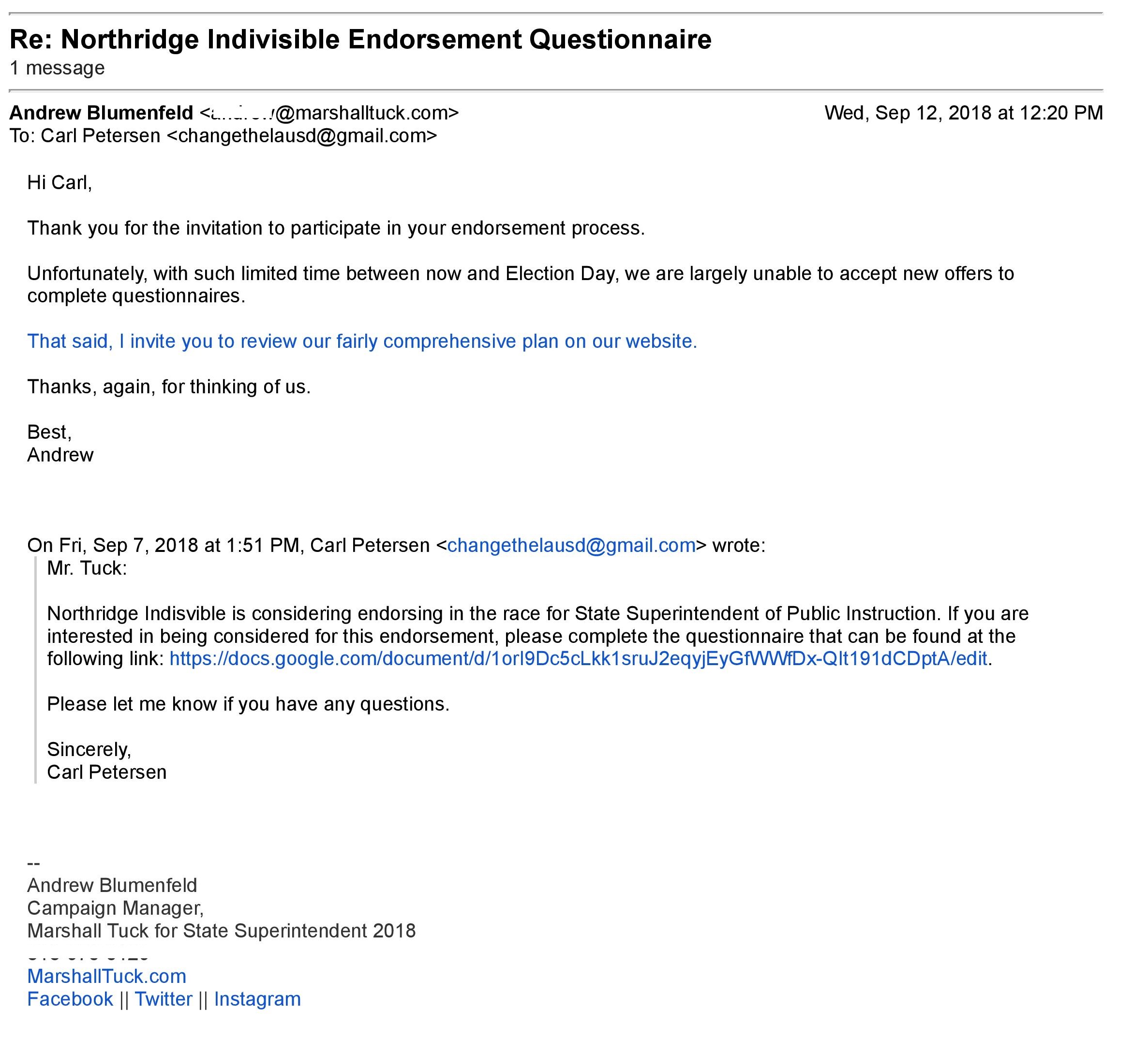
We are largely unable to accept new offers to complete questionnaires”
– Marshall Tuck Campaign
The California Charter School Association and their allies have provided Marshall Tuck with enough cash to flood the airwaves with misleading ads, but with less than a week to go before the election, a whopping 16% of the electorate are still undecided or will not vote on the question of who will become the next California State Superintendent of Public Instruction. This should not be unexpected in a race where the goal has been to obscure the facts in favor of creating fear. It is a favorite tactic of the charter school industry.

Part of Tuck’s strategy is to only appear in controlled environments where he will not have to reveal too much about his history, his supporters or the strategy to privatize our public school system. When asked questions directly, he simply refuses to answer them. He claims to be a progressive Democrat but is receiving the majority of this support from Republicans and appears on slate mailings alongside Gubernatorial candidate John Cox. When the progressive organization, Northridge Indivisible, sent him an endorsement questionnaire in September, his campaign replied that they were “largely unable to accept new offers to complete questionnaires.” His opponent, Tony Thurmond did respond and received the endorsement.
Tuck worships at the Betsy DeVos altar of imagined school-choice, even if it results in a system of separate and unequal education. Given that he wants us to believe that Continue reading: Unanswered Questions in the Race for California State Superintendent of Public Instruction
Image result for Unanswered Questions in the Race for California State Superintendent of Public Instruction

Thursday, November 1, 2018

ACLU of Northern California Executive Director to EdVoice: Stop Misleading Voters | ACLU of Northern CA

ACLU of Northern California Executive Director to EdVoice: Stop Misleading Voters | ACLU of Northern CA

ACLU of Northern California Executive Director to EdVoice: Stop Misleading Voters


The Education Wave That Began In West Virginia May Change Politics For The Nation

The Education Wave That Began In West Virginia May Change Politics For The Nation

The Education Wave That Began In West Virginia May Change Politics For The Nation


Whether Democrats take back the House in the midterm elections may come down to races like the one in West Virginia’s third Congressional District.
“Richard Ojeda has taken a district that Trump won by almost 50 points … and turned into a toss-up,” writes Bill Scher for Politico. The article includes Ojeda in a list of 15 candidates that will not only determine control of the House and Senate, but also signal “how the party tries to oust President Trump” in 2020.
“If Democrats want to reclaim white working-class Trump voters in West Virginia, Ojeda may be their best hope to do so,” writes Elia Nilsen for Vox, “His … challenge is to persuade the Trump-loving voters of his district to send him to Congress as a Democrat.”
But if races like the one in West Virginia’s third Congressional District determine the direction of politics in the country, the fight over education will have a lot to do with it.
‘The Political Face’ of the Education Wave

Ojeda (you pronounce the “j”), a much-tattooed Iraqi war veteran who appeared in Michael Moore’s recent documentary, state senator of the district that includes counties that sparked the statewide teacher strike earlier this year that shut down schools in all 55 counties. His prominent support of the teachers made him the “the political face” of the strike, reported the New York Times .
The teachers eventually forced the legislature to fix the state employee’s health-insurance plan, raise public workers’ salaries, halt an expansion of charter schools, kill a proposal to eliminate seniority, and scuttle a bill that would take away the rights of unions to deduct dues through Continue reading: The Education Wave That Began In West Virginia May Change Politics For The Nation


What Should We Really Learn From New Orleans After the Storm? A Q&A With NEPC Fellow Bruce Baker | National Education Policy Center

What Should We Really Learn From New
Orleans After the Storm? A Q&A With NEPC Fellow Bruce Baker | National Education Policy Center

What Should We Really Learn From New Orleans After the Storm? A Q&A With NEPC Fellow Bruce Baker


NEPC Fellow Bruce Baker discusses his critique of a recent policy brief that attributed positive outcomes to market-based reforms introduced in New Orleans in the wake of Hurricane Katrina.


What Should We Really Learn From New Orleans After the Storm? A Q&A With NEPC Fellow Bruce Baker | National Education Policy Center

Lawsuit Accuses Betsy DeVos And Her Deputies Of Being Motivated By Sexism | HuffPost

Lawsuit Accuses Betsy DeVos And Her Deputies Of Being Motivated By Sexism | HuffPost

Lawsuit Accuses Betsy DeVos And Her Deputies Of Being Motivated By Sexism
The lawsuit says that the education secretary’s decision to scrap Obama-era rules governing sexual assault on campus was based on bias and stereotypes.


A new filing in a lawsuit against the Trump administration accuses Secretary of Education Betsy DeVos and a top deputy of being motivated in part by sexism in their policy decisions.
The lawsuit, originally filed in January, challenged DeVos’ elimination of Obama-era Title IX guidance on how sexual assault cases are handled on campus. But an amended complaint submitted Wednesday says that DeVos’ decision was influenced by discriminatory and stereotyped views of women. 
DeVos scrapped the Title IX guidance in September 2017, issuing her own interim guidance on the subject. Her version lowered the standard of evidence used in campus sexual assault cases. At the time, DeVos said that the Obama administration’s directive was an example of federal overreach. 
But plaintiffs in the filing say DeVos and her deputies had more nefarious motivations, and they use new Freedom of Information Act records as evidence. The records indicate that Department of Education leaders had solicited input from groups and academics who push inflated and widely discredited statistics regarding the prevalence of false rape allegations. A National Sexual Violence Resource Center study found that false reports Continue reading: Lawsuit Accuses Betsy DeVos And Her Deputies Of Being Motivated By Sexism | HuffPost

What’s Wrong with America’s Schools? David Berliner Blames America’s Failure to Eradicate Child Poverty | janresseger

What’s Wrong with America’s Schools? David Berliner Blames America’s Failure to Eradicate Child Poverty | janresseger

What’s Wrong with America’s Schools? David Berliner Blames America’s Failure to Eradicate Child Poverty


Despite lots of evidence about why we shouldn’t use test scores as a measure of school quality, for nearly twenty years, government programs like No Child Left Behind and Race to the Top have taught people to judge public schools by their standardized test scores. Last week the Washington Post‘s Valerie Strauss published an in-depth reflection by David Berliner on what standardized test scores really measure. David Berliner is an expert, a Regents’ professor emeritus at Arizona State University, former president of the American Educational Research Association, and former dean of the College of Education at Arizona State.
Berliner is blunt in his analysis: “(T)he big problems of American education are not in America’s schools. So, reforming the schools, as Jean Anyon once said, is like trying to clean the air on one side of a screen door. It cannot be done!  It’s neither this nation’s teachers nor its curriculum that impede the achievement of our children. The roots of America’s educational problems are in the numbers of Americans who live in poverty. America’s educational problems are predominantly in the numbers of kids and their families who are homeless; whose families have no access to Medicaid or other medical services. These are often families to whom low-birth-weight babies are frequently born, leading to many more children needing special education… Our educational problems have their roots in families where food insecurity or hunger is a regular occurrence, or where those with increased lead levels in their bloodstream get no treatments before arriving at a school’s doorsteps. Our problems also stem from the harsh incarceration laws that break up families instead of counseling them and trying to keep them together. And our problems relate to harsh immigration policies that keep millions of families frightened to seek out better lives for themselves and their children…  Although demographics may not be destiny for an individual, it is the best predictor of a school’s outcomes—independent of that school’s teachers, administrators and curriculum.”  (Emphasis in the original.)
Many of the greatest in-school factors that affect test scores, Berliner believes, are in the drastic funding cuts across the states that last spring’s walkouts by teachers brought to our attention: “Yes, of course, there are in-school problems that need fixing, such as the re-employment of all the social workers, nurses, counselors and school psychologists lost after Continue reading:  What’s Wrong with America’s Schools? David Berliner Blames America’s Failure to Eradicate Child Poverty | janresseger


Wednesday, October 31, 2018

Confronting Inequity and Structural Racism by Building Community Schools | Schott Foundation for Public Education

Confronting Inequity and Structural Racism by Building Community Schools | Schott Foundation for Public Education

Confronting Inequity and Structural Racism by Building Community Schools

The last few decades of disinvestment and privatization have devastated public schools across the country, especially those in poor and distressed neighborhoods and communities of color. But we shouldn’t simply try to roll back the clock: long before the present crisis many schools were already failing the children who needed an opportunity to learn the most.
Out of that failure a growing movement of parents, youth, educators and community advocates are charting a better path forward: community schools. The community schools model holds at its core both research-proven methods and hard-won local insight from community members about what is most needed locally, which is what makes it a powerful evidence-based equity strategy!
As shown in our Loving Cities Index, barriers to a student’s success can be found both inside schools and far beyond the schoolhouse gate. Using whole-child wraparound supports — like health and dental clinics, mentoring, and counseling — community schools become hubs of activity and progress in the neighborhoods around them. And through collaboration with community based organizations, businesses and colleges to offer students real-world projects that make learning more relevant and engaging, they build connections that can open the door to future opportunities.
Many towns and cities across the country are already implementing a community schools strategy, and many more are planning to. For example, Journey for Justice, a national alliance of grassroots community, youth, and parent-led organizations, is looking to create 10,000 sustainable, strong, neighborhood community schools! The Partnership for the Future of Learning recently released a “Community Schools Playbook,” a comprehensive step-by-step guide for those looking to promote and build community schools.  It’s the first of its kind guide with tools that you can pick up and get started with today.
This lively webinar covered community schools both in theory and practice.

How Teachers Might Save Arizona Schools from the Kochs | OurFuture.org by People's Action

How Teachers Might Save Arizona Schools from the Kochs | OurFuture.org by People's Action

How Teachers Might Save Arizona Schools from the Kochs

“A change in education is Arizona’s No. 1 issue,” Garcia said in a televised debate. “It is my strength, it is Ducey’s weakness, and it’s going to be the difference.” (Photo: Victoria Pickering/flickr/cc)
The moment Beth Lewis realized the powerful political forces she was up against was when she was seated in the gallery of the Arizona House watching Republican legislators, one-by-one, fall into line to support a new bill she and her fellow teachers had come to the capitol to oppose. Republican Governor Doug Ducey and others “working the bill” on the floor took any wavering members into a back room for a “conversation,” while lobbyists in the wings nodded and hand-signaled with lawmakers to track the bill’s progress. When the bill’s handlers agreed a vote was in order, it passed easily. Then, “it was like a party,” Lewis recalls, with lawmakers high-fiving each other and lobbyists shaking hands and backslapping. “It was sickening,” she says. “I realized our state legislators weren’t at all interested in representing the people.”
The bill, which the State Senate also passed and the governor quickly signed, opened up education savings accounts, called Empowerment Scholarship Accounts, to all of the state’s 1.1 million students. The new accounts, previously restricted to students with special needs and students attending schools receiving a grade of D or F on the state’s school report card, would provide $4,400 a year, 90 percent of the amount of money the state would typically send a district for enrolling a student, for a family to spend as they wish on their children’s education. Students with disabilities and poor students would receive more money than other students.
For parents to receive the money, on a debit card, they must agree not to enroll their children in a public school—essentially giving up their children’s right to a free public education. Other than that, the program has few regulations and there’s little oversight in how public Continue reading: How Teachers Might Save Arizona Schools from the Kochs | OurFuture.org by People's Action
Ć¢€œA change in education is ArizonaĆ¢€™s No. 1 issue,Ć¢€ Garcia said in a televised debate. Ć¢€œIt is my strength, it is DuceyĆ¢€™s weakness, and itĆ¢€™s going to be the difference.Ć¢€ (Photo: Victoria Pickering/flickr/cc)