Latest News and Comment from Education

Monday, October 29, 2018

Submission: Marshall Tuck’s track record proves him unfit as state superintendent candidate | Daily Bruin

Submission: Marshall Tuck’s track record proves him unfit as state superintendent candidate | Daily Bruin

Submission: Marshall Tuck’s track record proves him unfit as state superintendent candidate


Business banker Marshall Tuck is running for California superintendent of public instruction again. He’s backed by ideologically charged billionaires – several of whom supported reactionary measures like 2008’s Proposition 8, which would have banned gay marriage in California. With Tuck having nearly unlimited funding, voters will be deluged with his messaging. There’ll be plenty of unsubstantiated claims that he ran successful schools.
Those ads won’t reveal the truth about Tuck’s record. There’ll be no mention that, when he ran the Green Dot Public Schools, one of his high schools “achieved” the dubious distinction of back-to-back years of zero students scoring proficient on the mathematics portion of the California State University entrance examination. There won’t be discussion of how, under Tuck, one Partnership for Los Angeles Schools’ high school went five years without achieving even 20 percent of students scoring proficient on either the mathematics or the English portion of those same CSU exams.
Five years.
These awful proficiency rates were reflected in SAT scores as well. Under Tuck’s watch, the schools he managed were year after year among the lowest scorers on the SAT in Los Angeles.
Tuck’s record of terrible academic results isn’t his only issue that will be obscured as election season ramps up. His abject treatment of students of color is something he works hard to hide, in a fashion similar to his contemporary counterparts Tom Horne and John Huppenthal, former state superintendents of public instruction at Arizona.
Using their positions of authority, Tuck, Horne and Huppenthal closed down popular and 

Public school fees go largely unchecked in Louisiana, prompting reform proposals | Education | theadvocate.com

Public school fees go largely unchecked in Louisiana, prompting reform proposals | Education | theadvocate.com

Public school fees go largely unchecked in Louisiana, prompting reform proposals


Ursula Clark-Holmes, who has three children attending public schools in Baton Rouge, is beset by so many student fees that she even offered to offset the charges by volunteering at the schools.
"I can't afford these school fees," said Clark-Holmes, who husband died recently. "I literally can't."
She is not alone.
In a state where two out of three public school students live in low-income homes, fees for homeroom, ID's, lockers, PE uniforms, parking and technology have sparked controversy for more than two years.
Parents and others contend that what schools routinely charge parents, including up to $300 for some courses, has reached a breaking point.
"If you don't pay your fees she can't do this, she can't do this," Clark-Holmes said of children being denied school activities.
"How are you going to penalize a child for what the parents cannot pay?" she asked.
Mike Faulk, executive director of the Louisiana Association of School Superintendents, said school districts need to make changes before state lawmakers order them.
"What we are trying to do is encourage superintendents to look at the issues, to look at what is going on in their school systems, to develop policies and to be transparent about fees and stuff prior to anything being mandated by the Legislature," said Faulk, former superintendent for the Central school system.
Under current rules, principals, superintendents and school boards enjoy near unchecked authority when it comes to imposing fees on students.
While 27 states regulate fees, state laws in Louisiana barely touch the topic.
Roughly a dozen school districts and schools imposed student fees totaling nearly $3 million for the financial year that ended June 30, 2016, according to the latest state tally.
That includes the Ascension Parish School District, $932,920; Lafayette, Continue reading: Public school fees go largely unchecked in Louisiana, prompting reform proposals | Education | theadvocate.com
Big Education Ape: Charter school kept two homeless children out of class for a month because they didn’t have uniforms | The Lens - http://bigeducationape.blogspot.com/2017/06/charter-school-kept-two-homeless.html


Seattle Schools Community Forum: Washington State Charter School Law Upheld

Seattle Schools Community Forum: Washington State Charter School Law Upheld

Washington State Charter School Law Upheld


On October 26, 2018, in a split decision, the Washington State Supreme Court ruled that the charter school law created by the Legislature, after a voter initiative was thrown out in 2012, is valid under our state's constitution.  Here's the ruling.

As someone who has never supported charter schools in Washington State, I wasn't pleased with the news but it also didn't surprise me.  Interestingly, one judge, Justice Barbara Madsen was clearly not buying it that the law makes charter schools legal.  From KUOW:


In one of the dissents, Justice Barbara Madsen said that the Charter School Act included too many exceptions on public control of charter schools.

"The Act creates a parallel public school system that provides a general education, serves all students, and uses public funds, but lacks local voter control or oversight," Madsen wrote.
The Court said - as they did in the first ruling against the initiative that brought them into being - that they were not ruling on efficacy of charters but on whether their existence violated our state constitution.

What does surprise me is that the ruling leaves open some fairly interesting issues that the Legislature will have to grapple with, some which could undermine charter schools.  I need to consult a lawyer on some of these issues but even reading as a layperson, I see problems for charters.
Issues:


- Charters limit the ability of their employees to organize ONLY at their school. 

 The majority of the justices saw this as unfair because it would be such a small group (and the strength of collective bargaining is in numbers). They said that Continue reading: 
Seattle Schools Community Forum: Washington State Charter School Law Upheld


Betsy DeVos’ Family Gives $2 Million to Far-Right Candidates | Diane Ravitch's blog

Betsy DeVos’ Family Gives $2 Million to Far-Right Candidates | Diane Ravitch's blog

Betsy DeVos’ Family Gives $2 Million to Far-Right Candidates


During her confirmation hearings, Betsy DeVos pledged not to make political contributions while she was Secretary of Education.
But, knowing her penchant for parsing words, we may now assume that she was not covering the political donations of her family, which continue.
This latest review of political donations by Ulrich Boser and Perpetual Baffour of the Center for American Progress shows that the DeVos family gave $2 Million to far-right candidates.
My hunch is that they gave far more than $2 million, through Dark Money PACs that do not disclose the names of their donors.

The report finds:
“Even by the loose standards of U.S. campaign finance laws—and President Donald Trump’s blatant corruption—the donations by the family members of a Cabinet official have been brazen. In February 2018, Richard DeVos, Secretary DeVos’ father-in-law, gave $1 million to the Freedom Partners Action Fund—a political action fund that has long been associated with far-right causes. Over the past year, the DeVos family has also given $350,000 to the Republican Congressional Leadership Fund and another $400,000 to the Republican National Committee.
“The DeVoses have also donated to specific candidates for federal and state office. Wisconsin’s far-right firebrand, Gov. Scott Walker (R), for example, has received more than $635,000 over the past decade from the DeVos family—including $30,000 in 2018. Bill Schuette, Michigan’s continue reading: Betsy DeVos’ Family Gives $2 Million to Far-Right Candidates | Diane Ravitch's blog


Six Reasons Not To Get Excited About The New SAT Scores

Six Reasons Not To Get Excited About The New SAT Scores

Six Reasons Not To Get Excited About The New SAT Scores

Today's big-- well, not big. Medium-sized, maybe--news comes from the College Board, which announced that both participation and scores are up, as well as the percentage of college-ready students. Here's why you can comfortably not care.
It's 8 Points
The average score "jumped" from 1060 to 1068. That's 0.7%. If your child retook the test in hopes of a higher score, and that's all they squeaked out, nobody would be trading high fives.
It's An Average (And It's Not News)
If Michael Jordan comes to stay with my family, the average number of points scored in an NBA game goes up dramatically for my household. Nevertheless, the number of points I've scored in an NBA game remains zero.
In fact, the SAT score has always been subject to the make-up of the group taking the test. For years, while folks were chicken littling about dropping SAT scores, what was actually happening was that more and more low-scoring students were taking the test. Meanwhile, each sub-group was actually improving their scores, even as the low-growing sub-groups increased in number. Averages are a lousy way to Continue reading: Six Reasons Not To Get Excited About The New SAT Scores

Choosing Democracy: Teachers Respond to Hate

Choosing Democracy: Teachers Respond to Hate

Teachers Respond to Hate


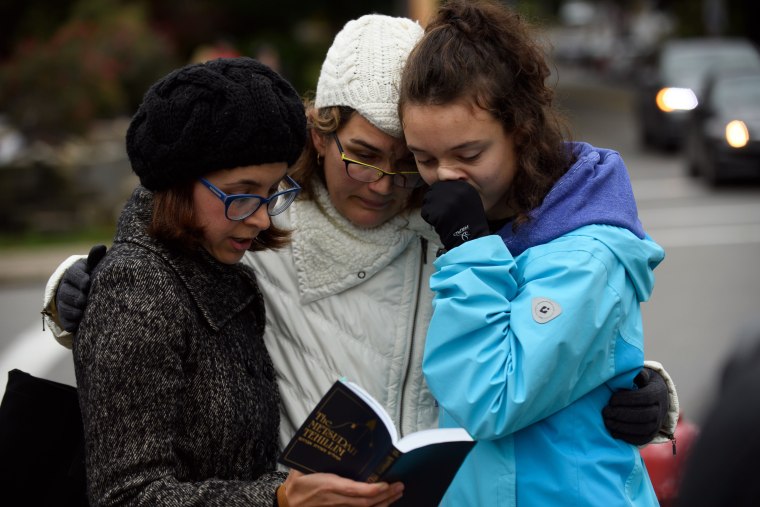
As I stood at a vigil at Temple Emanuel in New York City today to honor the Tree of Life synagogue victims, I couldn’t stop thinking about how hate has become a fact of life in our country.

Hateful rhetoric and words of incitement have fueled heinous acts of violence across our nation over the past week: pipe bombs mailed to elected officials and the media, a racially motivated shooting at a Kroger grocery store after a failed church attack, and, yesterday, the most deadly anti-Semitic attack in our nation’s history. Political violence that once seemed unimaginable now seems inevitable—the result of hate being normalized and divisions stoked by those in power. This is a moment of crisis for our communities that we have not experienced in decades.

We are in pain, but our pain can’t immobilize us; we must act, and that starts with voting on Nov. 6.

On Tuesday night, one week before the midterm election, we’re holding a telephone town hall, with partners including MoveOn, the NAACP and other progressive groups, about what’s happened in the last week and what we’re doing about it. Sign up here, and we’ll make sure you’re on the call.

The sad truth is that no matter how much we plead for Donald Trump to change, he won’t. He can’t. He’s so caught up in his quest for praise and power that he seems incapable of reflection on, much yet empathy for, what’s happened to America during his tenure and his role in enabling such division and polarization. Despite these three terrible acts in the last week, at the hands of assailants who self-identify as anti-immigrant, anti-Semitic, racist white supremacists who have embraced Trump’s words and deeds, the president is still using the same tactics and exacerbating the same shameful divisions.


And since we know he won’t change, we must act.

We must act to disarm hate, not arm more people. We must act as educators and activists, and do everything possible to combat this surge of hatred and violence in America. We must act by voting, and by doing all we can to get out the vote through our calls; our texts; our emails; our conversations with family, friends and co-workers; and, yes, our knocks on doors. The most important thing we can do right now—to promote our values and make this the best it can be—is to vote. Nov. 6 is our opportunity to vote for sanity and change.

In the days since the pipe bombs, the president has already resumed criticizing those who were targeted. A man targeted two black people at a grocery store, killing them because of the color of their skin. And yesterday an anti-Semite with a gun murdered 11 people.

You have a way to combat the pain you feel over these events—by voting for candidates who will be a check on Trump; by voting for decency and fairness, and against cruelty and prejudice.

It’s on us, collectively, to put a check on Trump and hate. We can do that by voting on Nov. 6.

Join the call on Tuesday, and we’ll discuss how we make sure we serve as a check on this hate.

Randi Weingarten,
AFT President

P.S.: Our Share My Lesson website has free resources for parents, educators and anyone looking for ways to productively combat anti-Semitism and hate.


Choosing Democracy: Teachers Respond to Hate


Research evidence on bullying prevention at odds with what schools are doing - The Hechinger Report

Research evidence on bullying prevention at odds with what schools are doing - The Hechinger Report

Research evidence on bullying prevention at odds with what schools are doing
Punishing the bullies doesn't really help, researchers say. But what does work?


In September 2018, I wrote about the so-called “Trump effect” on bullying in schools, citing a study that found higher bullying rates in GOP districts after the 2016 presidential election. But that piece raised an important question: what should schools do to address and prevent bullying?

The scientific evidence on what works is complicated.
There’s a whole cottage industry of consultants selling anti-bullying programs to schools but academic researchers say there is no proof they work. There are some small studies with positive results. But when reputable researchers study efforts to expand these strategies across schools among many students and compare bullying rates with those at schools that didn’t receive the intervention, there tends not to be a difference. For example, this 2007 review of anti-bullying programs found “little discernible effect on youth participants.”
“A lot of us know the dirty secret that these [bullying-prevention] programs don’t work out in the real world,” said Ron Avi Astor, an educational psychologist at the University of Southern California and an expert in bullying prevention. “All of us talk about it.”
Meanwhile, researchers notice that schools often address bullying in ways that are counter productive. Jonathan Cohen, a psychologist and an adjunct professor at Teachers College, Columbia University, is currently working on a paper about the gap between anti-bullying policies and the scientific evidence on bullying. He found that state policies typically encourage schools to focus on identifying bullies and punishing them. Often a student who is misbehaving and treating another student badly is sent to the principal’s office and punished with a suspension or an expulsion, Cohen said.
“That flies in the face of twenty-some years of empirical researchthat shows punishing kids is unhelpful,” said Cohen.
Instead, he argues that schools should combine consequences for bullies with mediation, counseling or a learning experience. “Not all, but characteristically, the students who fall into the profile of a Continue reading: Research evidence on bullying prevention at odds with what schools are doing - The Hechinger Report


Sunday, October 28, 2018

CURMUDGUCATION: ICYMI: Scary Time of Year Edition (10/28)

CURMUDGUCATION: ICYMI: Scary Time of Year Edition (10/28)

ICYMI: Scary Time of Year Edition (10/28)


Just a few things to catch up on. Remember, sharing is caring.

Documenting Maine's Failure To Implement Proficiency Based Education

Maine tried to turn the whole state into proof of concept for PBL/CBE. Things didn't work out. Here are some of the details.

Maine Went All in on Proficiency Based Learning The Rolled It Back

Matt Barnum at Chalkbeat also took a look at Maine's failure. Just in case you want to see the same disaster from a different angle

Putting Public Back Into Public Accountability

An answer to the question, "Well, if we don't grade schools on test scores, how will we know if they're any good?"

Kentucky Pension Crisis

How those wacky hedge fund guys took a state's pension program to the cleaners.

Puerto Rico Recovery

More disaster capitalism on parade.

Georgetown Law Students Objects To Exam Software

So what if your school said that in order to take exams, you had to load some of their software on your own computer.

Hack Education Weekly News

Audrey Watters does a weekly roundup of education news, just in case you don't get enough to do from me.

A Buttload of YouTube Education Money

YouTube has decided to sink a ton of money into educational videos. Please, may some go to the Honest Trailers people.

PA Keystone Exam: The Monster We Refuse To Let Die

Steven Singer looks at the latest development in Big Standardized Test.

Here's Hoping That The Myth of the Bad Teacher Is Finally Laid To Rest

Could we have finally reached the end of the search for the fabled Bad Teacher? It's pretty to think so.

How High Schools Shaped American Cities 

Amy Lueck has an interesting look at how schools are tied to community, and how school choice threatens both.

Will the Save Our Schools Movement Propel a Change Election

Ruth Coniff at The Progressive takes a look at what's going on in the resistance and how it might affect the election

DeBlasio School Renewal

In what should come as a surprise to nobody, NYC's Renewal School turnaround plan flopped-- and some students were left to experience the flopping first hand.

Snake Oil, Charter Schools, and Disingenuous Debates 

A local op-ed in the Johnson City Press is a blunt response to charter supporters.

The Digital Gap Between Rich and Poor Kids Is Not What We Expected 

Nellie Bowles in the NYT says that one group will be taught by humans, and one by screens. Take a wild guess at which is which.


cLICK FOR MORE from CURMUDGUCTION


Dahlia Lithwick: Who Is Responsible for the Epidemic of Hate Crimes? | Diane Ravitch's blog

Dahlia Lithwick: Who Is Responsible for the Epidemic of Hate Crimes? | Diane Ravitch's blog

Dahlia Lithwick: Who Is Responsible for the Epidemic of Hate Crimes?


We have been told over and over that we are not to take this President literally, or seriously, or jokingly, or truthfully, even though he daily shows his supporters who he is, and they not only believe in him, they quite literally believe him. For too long we have been trapped in a cycle of figuring out how to talk about a president who is neither truthful nor presidential, who cheerfully labels Democrats as “evil” and gleefully leads chants about locking up the very people who were the recipients of bombs at their homes. How does one even begin to explain to one’s children what it means that the president denounces violence and division as he foments both, on an hourly basis? Perhaps we can look to Florida for a tip. Last week the state’s gubernatorial candidate Andrew Gillum said that because Neo Nazis and white supremacists were supporting and campaigning for and contributing to his opponent Ron DeSantis, perhaps it was time to stop talking about causation entirely. “I’m not calling Mr. DeSantis a racist,” he said. “I’m simply saying the racists believe he’s a racist.”
The formulation is useful because it reframes a pointless debate about what leaders’ dog whistles really mean into a debate about what their followers end up believing. If what is said no longer matters, we can perhaps still evaluate what is heard. In the current ontological meltdown, there is no point in debating what leaders actually mean—they are affirmatively telling us that they lie constantly—but what we can and should focus on is what kind of people they ask their followers to be. Do they ask their adherents and admirers to see the best in others? Do they ask them to find common ground?


In the last week we have encountered two actual killers and one aspiring killer who believed their president when he said that caravans of murderous foreigners are approaching, and who believed that what their president wants is to have those caravans halted by force. They believed their president when he said that the media is hurting America and they believe their president wants to stop the media from doing that journalism by physical force. In the last week, we have seen that when the president Continue reading: Dahlia Lithwick: Who Is Responsible for the Epidemic of Hate Crimes? | Diane Ravitch's blog

The names. – Fred Klonsky

The names. – Fred Klonsky
Pittsburgh Synagogue Shooting Victims Identified 

Image result for Pittsburgh synagogue


Fundraiser by Shay Khatiri : Tree of Life Shooting’s Victims - https://www.gofundme.com/tree-of-life-synagogue-shooting on @gofundme


Despite US Fixation on Testing, ACT Results Slip; ACT Board Doing Just Fine | deutsch29

Despite US Fixation on Testing, ACT Results Slip; ACT Board Doing Just Fine | deutsch29

Despite US Fixation on Testing, ACT Results Slip; ACT Board Doing Just Fine


On October 17, 2018, ACT released a report, “Condition of College and Career Readiness 2018.”
Beginning with the passage of No Child Left Behind (NCLB) in January 2002, standardized testing has increasingly been the central focus of public education, with nationally-normed tests such as the ACT becoming the raison d’etre for secondary schools.
ACT acknowledges as much:
Over the past decade, ACT has experienced unprecedented growth in the number of students tested as well as growth in partnerships with states, districts, and high schools.
The test scores are supposed to be forever rising. However, that is not how it works; despite the ever-narrowing of public education to both covert and overt test prep, testing, and retesting, those scores will plateau, and all of that test-centrism will yield diminishing returns.
Consider this summary info ACT’s 2018 report:
Performance of 2018 Graduates
  • Slightly fewer ACT-tested graduates were ready for college coursework this year than last year. The percentage of students meeting at least three of the ACT College Readiness Benchmarks in the four core subject areas was 38% for the 2018 US high school graduating class, down from 39% last year but the same as in 2016.
  • A higher percentage of students this year than in recent years fell to the bottom of the preparedness scale, showing little or no readiness for Continue reading: 
  • Despite US Fixation on Testing, ACT Results Slip; ACT Board Doing Just Fine | deutsch29


Saturday, October 27, 2018

The Pittsburgh Community is Stronger Than the Synagogue Shooter’s Hate | gadflyonthewallblog

The Pittsburgh Community is Stronger Than the Synagogue Shooter’s Hate | gadflyonthewallblog

The Pittsburgh Community is Stronger Than the Synagogue Shooter’s Hate
43579727_10156281113318860_8423220729121603584_n


There’s a popular yard sign in the Squirrel Hill neighborhood of Pittsburgh.
In bands of green and blue and yellow, it projects the same message in Spanish, English and Arabic:
“No matter where you are from, we’re glad you’re our neighbor.”
If the community had a motto, I think that might be it.
Though known for its high concentration of Jewish residents, the Pennsylvania locale is a multicultural crossroads.
That may have made it a target today when a shooter entered the Tree of Life Synagogue.
Though the alleged culprit has been captured, details are still being uncovered. The death toll has yet to be tallied.
Unconfirmed reports state that he shouted “All Jews must die,” before opening fire.
But I don’t believe that the Jewish community was his only target.
Or more precisely – it wasn’t just the Jewish part – it was the community that had grown up around it.
I know Squirrel Hill well.
I live close by. I grew up on those streets. I’ve been to services at that synagogue. I have family who are members.
Thankfully it seems that no one related to me was there this morning. But when Continue reading: The Pittsburgh Community is Stronger Than the Synagogue Shooter’s Hate | gadflyonthewallblog


Fundraiser by Shay Khatiri : Tree of Life Shooting’s Victims -https://www.gofundme.com/tree-of-life-synagogue-shooting on @gofundme


CURMUDGUCATION: A Teacher's Opinion and the Classroom Door

CURMUDGUCATION: A Teacher's Opinion and the Classroom Door

A Teacher's Opinion and the Classroom Door


Twice this week the issue of teachers and their opinions cropped up, first in David Berliner's thoughtful piece at The Answer Sheet and again in Robert Pondiscio's reaction to a math teacher's tweet about the Kavanaugh hearings. Berliner was not wrong in answering student questions about how he would use his vote, and Pondiscio is not wrong to point out that a teacher's First Amendment rights are surprisingly limited inside a classroom.

I've thought about this issue a great deal in my career, my thinking propelled by three factors:

1) I had teachers in high school who spent time trying to tell us what to think, and I hated it.

2) For most of my career, I have taught American literature, and you can't teach about the literature without talking about the culture it's rooted in, and you can't talk about American culture without talking about religion, race and gender.

3) My teaching of writing has always been rooted in getting students to express themselves, and that's hard to do with a classroom policy of "Only some ideas are okay to express."

So as a way of working through all this one more time, let me walk through what that meant in a classroom, and how it was challenged in my last years of teaching.

My students over the decades heard some version of the following many, many times:

Okay. Before we start on these notes and discussion, I'll remind you that I'm not advocating this and I'm not attacking it. My job is not to tell you to agree with these people or to disagree with these people-- but my job is to convey to you as clearly as I can what they believed about how the world works. 

And that was a prelude to laying out Puritan beliefs and Romanticism and Realism. In answer to questions ("How could the Puritans belief that material things didn't matter but that material things were a sign of God's favor?") my answers were prefaced with "I think they would give this as an answer..." And I committed to representing each set of beliefs as true-to-the-originals as I could, making sure I neither highlighted the problems inherent in them nor ignored them. It is not an easy Continue reading: 
CURMUDGUCATION: A Teacher's Opinion and the Classroom Door


NYC Public School Parents: A growing class divide in education: small class size vs. computerized learning; how Silicon valley is very aware that the ed tech they're foisting on our schools is dangerous to kids

NYC Public School Parents: A growing class divide in education: small class size vs. computerized learning; how Silicon valley is very aware that the ed tech they're foisting on our schools is dangerous to kids
A growing class divide in education: small class size vs. computerized learning


Three articles in today’s NY Times well worth reading, with some excerpts below, explore the growing class divide between the private schools for rich children where real personalized learning is provided via small classes and computers are rarely used, as opposed to schools for middle class and poor kids, where ed tech is all the rage, pushed by corporate interests and fauxlanthropists like Gates and Zuckerberg.

For those who want to see the presentation we did at last weekend’s NPE conference on this issue, including a video and power point, check out Outsourcing the classroom to machine learning & ed tech; why parents should resist. 

Is the explosion of ed tech in the classroom a massive hoax or a dangerous experiment on kids?  Offer your comments below.

“I am convinced the devil lives in our phones.”
SAN FRANCISCO — The people who are closest to a thing are often the most wary of it. Technologists know how phones really work, and many have decided they don’t want their own children anywhere near them.
A wariness that has been slowly brewing is turning into a regionwide consensus: The benefits of screens as a learning tool are overblown, and the risks for addiction and stunting development seem high. … Athena Chavarria, who worked as an executive assistant at Facebook and is now at Mark Zuckerberg’s philanthropic arm, the Chan Zuckerberg Continue reading: NYC Public School Parents: A growing class divide in education: small class size vs. computerized learning; how Silicon valley is very aware that the ed tech they're foisting on our schools is dangerous to kids

Sacramento Unified School District Budget Update - The Result of 20 Years of Corporate Education Reform - Please Vote for People Who Really Support Public Schools

Budget Update
Sacramento Unified School District Budget Update 
The Result of 20 Years of Corporate Education Reform
 Please Vote for People Who Really Support Public Schools


Dear Community Member,

Last night our Board of Education voted to continue working with our local Sacramento County Superintendent, fiscal advisor and labor partners to address the district’s budget deficit. Voting to continue working locally and waive the formation of a Budget Review Committee that would be handled at the state level, allows the district and stakeholders to continue working together at the local level to address the budget deficit and chart a course toward financial sustainability.

Click here to view the budget update presentation at yesterday’s Board meeting.

The district will now continue working collaboratively with all partners and the County Superintendent to meet a December 14, 2018 first interim report and balanced budget deadline. The district has also started working with the state’s Fiscal Crisis & Management Assistance Team (FCMAT) on a fiscal health analysis of the district that FCMAT is anticipated to complete this December.

We will continue to keep you updated on the latest news and information related to our budget situation. For more information including responses to frequently asked questions, please visit our Budget Review Process web page. Thank you for your patience as we work through this process.

Budget Update


NPE Action - Political Endorsements - http://npeaction.org/ on @NPEaction