Latest News and Comment from Education

Wednesday, October 10, 2018

How School Choice in Michigan Accelerates Student Mobility, Stresses Educators, and Undermines Education | janresseger

How School Choice in Michigan Accelerates Student Mobility, Stresses Educators, and Undermines Education | janresseger

How School Choice in Michigan Accelerates Student Mobility, Stresses Educators, and Undermines Education


Yesterday this blog examined how two school choice policies in Michigan—the rapid expansion of charter school choice and cross-district open enrollment that allows students to leave their school district and enroll in a nearby school district—are together undermining the fiscal viability of Michigan’s public school districts. Here, thanks to a collaboration between ChalkbeatBridge Magazine, and the Detroit Free Press is the story of how these very same policies are undermining teaching and learning in the Detroit Public Schools.
Reporters Erin Einhorn and Chastity Pratt Dawsey describe how cross-district and charter school choice are accelerating student churn as children change schools again and again.  In Detroit, the subject of the article, student mobility is also exacerbated by homelessness and foreclosure and other challenges posed by extreme poverty across the school population. But there is an additional factor: Detroit is part of a network of so-called “portfolio school districts” which are managed as though they are part of a business portfolio—establish choice; then phase out the bad investments and try something new and let families enforce accountability as they move with their feet.  According to the new report on student mobility in Detroit, school choice has resulted over the years in “nearly 200 school closures” as students tried out other possibilities.

Nikolai Vitti, Detroit’s school superintendent, explains: “You can’t create trust between a student and parent and a school when you have this constant disruption… It’s hard to hold teachers accountable to performance if children are not consistently in their classrooms. We are going to set teachers, schools, and principals up for failure if we don’t acknowledge that.”
Einhorn and Dawsey describe a very complicated problem: “In Detroit, there are many reasons why schools are in crisis. There are overcrowded classrooms and buildings in poor condition. There are children experiencing trauma at home unable to find a quiet place—or a reason—to do their homework.  But spend time in almost any Detroit school, and educators Continue reading: How School Choice in Michigan Accelerates Student Mobility, Stresses Educators, and Undermines Education | janresseger

Tuesday, October 9, 2018

DeVos Ally, New Leader of For-Profit K12 Inc. Promises to Clean Up Its Shoddy Record | Diane Ravitch's blog

DeVos Ally, New Leader of For-Profit K12 Inc. Promises to Clean Up Its Shoddy Record | Diane Ravitch's blog

DeVos Ally, New Leader of For-Profit K12 Inc. Promises to Clean Up Its Shoddy Record


Over the years, it has become obvious that virtual charter schools are a sham. ECOT in Ohio was a spectacular failure, which made millions for its for-profit owner (“the ECOT man”) but cost taxpayers over a billion dollars that should have gone to public schools. The founder of the Pennsylvania Cyber Charter School is now in jail, convicted of stealing millions of dollars, but convicted only of tax evasion, not embezzlement. June Brown, who operated K12 Inc. schools in Pennsylvania, avoided conviction because of her advanced age (she kept the money).

K12 Inc. is perhaps the biggest of the shams because it has the most students. It is listed on the New York Stock Exchange. It makes handsome profits, but its students drop out at a high rate and get low test scores on state tests. The NCAA stripped 24 of the virtual K12 Inc. schools of accreditation a few years back after it discovered that students were often taking the K12 Inc. tests without bothering to first sit for instruction. NCAA officials saw tests that included “true-false” questions, and observed that students could take the test again if they failed. Any number of K12 Inc. virtual schools have been engaged in fraudulent practices that led to fines or even jail sentences for their operators.

K12 Inc. has been repeatedly criticized for the poor performance of its students. They start behind and they don’t catch up. See here. See here. See here. See here.
K12 Inc. originated with Ron Packard, who was paid $5 million a year to Continue reading: DeVos Ally, New Leader of For-Profit K12 Inc. Promises to Clean Up Its Shoddy Record | Diane Ravitch's blog


Maker Movements Should NOT Endanger School Libraries, Librarians, and Reading

Maker Movements Should NOT Endanger School Libraries, Librarians, and Reading

Maker Movements Should NOT Endanger School Libraries, Librarians, and Reading


To call yourself a librarian, you need to have that training and to be certified. If you replace a certified librarian with someone who’s just an expert in technology, you’re losing half of the role that school libraries are supposed to be serving.
You still need someone who is a champion of reading.
~Leslie Preddy, president of the American Association of School Librarians discussing Makerspaces. Kansas City Star. June 26, 2016,
School libraries are where students have access to books. Librarians assist students with reading, research, and a variety of language and reading activities. Children learning to read can find a book on any topic in the library.
We know that schools with excellent libraries have students that do better than those with insufficient or no libraries. From Phi Delta Kappan:
Data from more than 34 statewide studies suggest that students tend to earn better standardized test scores in schools that have strong library programs. Further, when administrators, teachers, and librarians themselves rated the importance and frequency of various library practices associated with student learning, their ratings Continue reading: Maker Movements Should NOT Endanger School Libraries, Librarians, and Reading


How Can School Choice Destroy the Public Schools in Your Community? | janresseger

How Can School Choice Destroy the Public Schools in Your Community? | janresseger

How Can School Choice Destroy the Public Schools in Your Community?


In his column last week for the Education Opportunity Network, Jeff Bryant examines a scary question: Can school choice create the conditions that entirely shut down a community’s public school system?  Bryant reports on Michigan where school choice laws permitting inter-district open enrollment and unregulated expansion of charter schools conspire with the state’s school finance system to undermine the stability of the state’s public school districts.
“In Michigan, the intense competition for students is taking bigger bites out of student enrollments in some of the state’s largest districts.  In Flint, where there are 14,325 public-school students living in the district, 39 percent attend charters and 32 percent are enrolled in another district—meaning the district loses 71 percent of its students.  In Pontiac, with 10,985 public-school students living in the district, 36 percent attend charters and 29 percent travel to other districts, leaving local schools with only 35 percent of the community’s students.  In Detroit, the state’s largest school district with nearly 104,000 students, 58 percent of them leave the district schools to attend charters (48 percent) or cross district borders (10 percent) to attend schools elsewhere.  How low can student enrollments go before a school district becomes financially unsustainable?”
Bryant explains the thinking of school choice promoters: “The thinking behind a market-based approach to education is that when the funding follows the student, school districts vying across district lines to get their enrollments high for ‘count day,’ feel more intense pressure to provide services with greater financial efficiency.  Adding charter schools, which in Michigan are allowed to start up wherever they want, without regard to the financial impact on district schools, brings into the mix an unregulated agent that can introduce even more financial efficiency into the system, the theory goes.” (Emphasis is mine.)  Then Bryant interviews Continue reading: How Can School Choice Destroy the Public Schools in Your Community? | janresseger


American Academy of Pediatrics Suggests “Prescriptions for Play” for Children Ages Two Years and Younger | deutsch29
American Academy of Pediatrics Suggests “Prescriptions for Play” for Children Ages Two Years and Younger | deutsch29

American Academy of Pediatrics Suggests “Prescriptions for Play” for Children Ages Two Years and Younger


In August 2018, the American Academy of Pediatrics (AAP) published a paper that includes a “prescription for play” for children ages 2 years and younger.
For those who are unsure what “play” might be, AAP offers the following general definition:
The definition of play is elusive. However, there is a growing consensus that it is an activity that is intrinsically motivated, entails active engagement, and results in joyful discovery. Play is voluntary and often has no extrinsic goals; it is fun and often spontaneous. Children are often seen actively engaged in and passionately engrossed in play; this builds executive functioning skills and contributes to school readiness (bored children will not learn well). Play often creates an imaginative private reality, contains elements of make believe, and is nonliteral.
The paper, entitled, “The Power of Play: A Pediatric Role in Enhancing Development in Young Children,” actually includes the suggestion for pediatricians to defend play by formally prescribing it as part of the child’s wellness visit:
Just as pediatricians support Reach Out and Read, encourage playful learning for parents and infants by writing a “prescription for play” at every well-child visit in the first 2 years of life.
Below is a summary of the takeaways from the paper, which is not restricted to children two years and younger, including confronting “more digital distractions,” and “facilitating the child’s intrinsic motivation through play rather than extrinsic motivations, such as test scores”:

Conclusions


Monday, October 8, 2018

DeVos company implicated in new report on fishy communications between Trump Organization and Russian bank

DeVos company implicated in new report on fishy communications between Trump Organization and Russian bank

DeVos company implicated in new report on fishy communications between Trump Organization and Russian bank

Cybersecurity experts found evidence of suspicious communications between a Trump Organization computer and a Russian bank in the summer of 2016 — and they also noticed a link to Betsy DeVos and her family.
The researchers set out to find whether Russian hackers had also targeted Republicans after news broke about the Democratic National Committee hacks, and their investigation surprised them, reported The New Yorker.
The group found Alfa Bank computers were repeatedly looking up the address of a Trump server located in Lititz, Pennsylvania, nearly every day in the summer of 2016 — and computer scientists who examined the contacts believe they were intentional attempts at human communication.
“The timing of the communication was not random, and it wasn’t regular-periodic,” said one researcher, identified only as Paul. “It was a better match for human activity.”
Alfa Bank looked up the Trump Organization’s domain more than two thousand times more than 2,000 times between May and September 2016.
Only one other entity — Spectrum Health — reached out to the Trump Organization’s domain with any frequency during that same period.
The Grand Rapids, Michigan-based company is closely linked to the DeVos family — Richard DeVos, Jr., husband of Education Secretary Betsy DeVos, is chairman of the board and named one of its hospitals after his mother.
Image result for spectrum health michigan devos
The education secretary’s brother, Erik Prince, has been investigated by special counsel Continue reading: DeVos company implicated in new report on fishy communications between Trump Organization and Russian bank

A $1 billion Gates Foundation-backed education initiative failed to help students — here’s how the foundation's next $450 million project will look - Business Insider Nordic

A $1 billion Gates Foundation-backed education initiative failed to help students — here’s how the foundation's next $450 million project will look - Business Insider Nordic

A $1 billion Gates Foundation-backed education initiative failed to help students 
— here’s how the foundation's next $450 million project will look

  • The Bill and Melinda Gates Foundation spent more than $200 million on a teacher effectiveness initiative, and an independent assessment found that the program failed to help students.
  • Now the Gates Foundation is trying a new approach: supporting local organizations that work directly with teachers and principals.
  • Professors who specialize in education told Business Insider that the new initiative's focus on local groups is a step in the right direction.
  • However, experts noted the Gates Foundation is funding some of the same groups as before, and one professor said many of the new projects are vague and broad in scope.
In 2009, the Bill and Melinda Gates Foundation launched an ambitious project to improve teacher effectiveness among certain primary and secondary schools in California, Florida, Tennessee, and Pennsylvania.
The goal was to reform teacher evaluations. More effective teachers, the foundation predicted, would improve student achievement, raise graduation rates, and help low-income and minority students get into college.

About $1 billion went into the Intensive Partnerships for Effective Teaching initiative, with the Gates Foundation itself pouring over $200 million into a group of school districts and charter school networks in the four states.
The initiative, designed to last seven years, ended in 2016. This year, the Rand Corporation released a report concluding the program had failed to dramatically improve student achievement or graduation rates. Bill Gates himself noted the initiative's poor results in a speech last fall, saying his Continue reading: A $1 billion Gates Foundation-backed education initiative failed to help students — here’s how the foundation's next $450 million project will look - Business Insider Nordic


Marshall Tuck: The Republicans’ Trojan Horse

Marshall Tuck: The Republicans’ Trojan Horse

Marshall Tuck: The Republicans’ Trojan Horse


In last week’s column, I wrote that “the future of public education and the heart and soul of progressive California” were at stake in the Superintendent of Public Instruction race.  What makes this race so important is that it represents an attempt by moneyed interests and forces on the right to play in Democratic politics through the use of stealth and dishonesty.  Indeed, if you like the way the Lincoln Club intervenes in and tries to upset the Democratic apple cart in races here in San Diego, you’ll love how the right is trying to game California’s Democratic voters in this contest.
It’s so bad, that the state party came out with this extraordinary assertion last May leading up to the primary in response to Tuck’s refusal to disavow his Republican allies:
Tony Thurmond has won the overwhelming support of Democrats for Superintendent of Public Instruction because he champions our progressive values. Marshall Tuck’s support is limited to ultra-wealthy billionaires and right-wing thugs like Newt Gingrich and John Cox, who we see next to him in the latest independent mailer that Tuck has tacitly endorsed. It doesn’t matter how many pictures of President Obama he sends out to voters. We hear both sides of his mouth, and we know the conservative agenda he is part of.
Democrats must be 100 percent clear on this: Gingrich, DeVos and Trump have outlandish education Continue reading: Marshall Tuck: The Republicans’ Trojan Horse


Many schools in the US can teach whatever they want. It turns out that they teach lies - Muchas escuelas de EEUU pueden enseƱar lo que quieran. Resulta que enseƱan mentiras

Muchas escuelas de EEUU pueden enseƱar lo que quieran. Resulta que enseƱan mentiras

Many schools in the US can teach whatever they want. It turns out that they teach lies
The schools with programs of bonuses to the parents, for which the secretary of Education Betsy DeVos advocates, teach creationism, racism and sexism.


PORTLAND, Oregon (USA). - It was the last hours of the morning in an artistic cafe. The smell of coffee and baked goods sweetened the air. Ashley Bishop was sitting at a table, remembering a time when she had been taught that the majority of secular American society was worthy of contempt.
Having grown up in private evangelical Christian schools, Bishop saw the world in a polarized way, good and evil, heaven and hell. He had been taught that dancing was sin, that homosexuals were pedophiles and that mental illness was a function of satanic influence. The teachers in their schools spoke of slavery as black immigration and the instructors described the ecologists as "hippy witches."
Bishop's family moved from one place to another while she was little, but they always enrolled her in evangelical schools.
So when Bishop left school in 2003 and entered the real world at age 17, she felt like she was an alien who was landing for the first time on planet Earth. Having been separated from the dominant society, she was unable to manage the labor market and develop secular friendships. And, since he lacked shared cultural and historical references, he spent most of the twenties hiding in his room with an overwhelming social anxiety.
He had been taught that dancing was sin, that homosexuals were pedophiles and that mental illness was a function of satanic influence.
Now, at 31, he has become everything he was once taught to hate. He shares an apartment Continue reading: Muchas escuelas de EEUU pueden enseƱar lo que quieran. Resulta que enseƱan mentiras
Muchas escuelas de EEUU pueden enseƱar lo que quieran. Resulta que enseƱan mentiras
Los colegios con programas de bonos a los padres, por las que aboga la secretaria de Educación Betsy DeVos, imparten creacionismo, racismo y sexismo.

PORTLAND, Oregón (EE UU). ― Eran las Ćŗltimas horas de la maƱana en un cafĆ© artĆ­stico. El olor del cafĆ© y los productos horneados endulzaban el aire. Ashley Bishop estaba sentada frente a una mesa, recordando una Ć©poca en la que le habĆ­an enseƱado que la mayorĆ­a de la sociedad secular estadounidense era merecedora de desprecio.
Al haber crecido en escuelas cristianas evangélicas privadas, Bishop veía el mundo de una forma polarizada, el bien y el mal, el cielo y el infierno. Le habían enseñado que bailar era pecado, que los homosexuales eran pederastas y que la enfermedad mental era una función de la influencia satÔnica. Los maestros de sus escuelas hablaban de la esclavitud como la inmigración negra y los instructores calificaban a los ecologistas como "brujas hippies".
La familia de Bishop se trasladó de un lugar a otro mientras ella era pequeña, pero siempre la matriculaban en escuelas evangélicas.
Así que cuando Bishop dejó la escuela en 2003 y entró en el mundo real a los 17 años, se sintió como si fuera una extraterrestre que aterrizaba por primera vez en el planeta Tierra. Al haber sido separada de la sociedad dominante, se vio incapaz de manejar el mercado de trabajo y desarrollar amistades seculares. Y, puesto que carecía de referencias culturales e históricas compartidas, pasó la mayor parte de la década de los veinte años escondida en su habitación con una agobiante ansiedad social.
Le habían enseñado que bailar era pecado, que los homosexuales eran pederastas y que la enfermedad mental era una función de la influencia satÔnica.
Ahora, a los 31, se ha convertido en todo lo que una vez le enseñaron a odiar. Comparte un apartamento con su novia, con la que lleva dos años. Va a terapia y toma medicamentos para la depresión, un problema que nace, en parte, de su asfixiante educación.
Con el paso de los años, algunas de las escuelas a las que Bishop asistió siguen siendo, en gran parte, como entonces, pero otras han cambiado de forma significativa: a diferencia de Sigue leyendo:Muchas escuelas de EEUU pueden enseñar lo que quieran. Resulta que enseñan mentiras

Staggering amounts of outside money raised in SPI race :: K-12 Daily

Staggering amounts of outside money raised in SPI race :: K-12 Daily :: The Essential Resource for Superintendents and the Cabinet

Staggering amounts of outside money raised in SPI race


(Calif.) Charter school supporters backing Marshall Tuck for state superintendent of public instruction have raised nearly $10 million since the beginning of July for independent spending during the closing weeks of the campaign.
The outside money, combined with another $1.2 million that donors gave Tuck’s campaign itself over the summer, gives the former charter school administrator a significant financial advantage over his opponent, Tony Thurmond, currently a member of the state Assembly representing the Richmond area.
So far, independent committees favoring Thurmond have brought in only about $2.5 million. That could change quickly, however, because his primary outside support comes from the California Teachers Association, which has among the biggest political war chests in the state.
The two candidates have themselves raised a similar amount of money since the close of the primary in June, when Tuck narrowly defeated Thurmond by less than 2 percent or about 87,000 votes.
Tuck has brought in close to $1.3 million since July, while Thurmond has raised about $800,000 during the same period.
The big influence of outside money was not unexpected given the determination both sides have exhibited not only in the June primary, but also the last time the office was up for election in 2014.
Four years ago, when Tuck faced off against Tom Torlakson, the incumbent, independent committees on both sides spent close to $5 million.
Torlakson, who also enjoyed the support of CTA, won that election by about 4 percentage points.
In June, supporters of Tuck spent close to $9 million on independent expenditures; meanwhile, those supporting Thurmond, spent another $4 million.
The vigor that both sides continue to put into capturing the office is surprising given the fact that in California, the state superintendent actually has very little direct authority over the state education system. The governor and legislative leaders control spending decisions through the budget process, Continue reading: Staggering amounts of outside money raised in SPI race :: K-12 Daily :: The Essential Resource for Superintendents and the Cabinet

Image result for Tony Thurmond as Superintendent of Public Instruction

A Plan to Improve California's Public Schools

Tony Thurmond for State Superintendent of Public Instruction -https://www.tonythurmond.com/
Image result for Right Wing, Anti-Gay Marshall Tuck

The Fundamental Right to Education Education Law Prof Blog

Education Law Prof Blog

The Fundamental Right to Education


In my last article, The Constitutional Compromise to Guarantee Education, I examined the period immediately leading up to and following the Fourteenth Amendment and found that the ratification of the 14th Amendment and southern state's education clauses in the constitutions were inextricably intertwined.  Quite simply, rewriting their constitutions and providing for public education was a condition of readmission to the Union, as was the ratification of the 14th Amendment.  In other words, without constitutional guarantees of education, southern states never reenter the Union.  And without southern votes for the 14th Amendment, the amendment never becomes part of the constitution.  Thus,  I argue that one cannot understand the rights of state citizenship that the 14th Amendment secured, nor the meaning of a republican form of government, without examining those state constitutions. 
Our legal lexicon, at least as far as I know it, does not have a word to capture what occurred.  For lack of a better term, I call these events a constitutional compromise.  None of the major constitutional exercises of power, nor the constitutional revisions that emerge, would have occurred without the others.  My conclusion is that, whatever we call it, the federal constitution did, as a matter of fact, guarantee access to public education.  The article then moves on to the arguably tougher question of figuring out what, if any limits, the constitutional compromise places on states in their delivery of education.
After finishing that research and having time to further reflect on it, I began to question how exactly a modern court would deal with this history.  There is no constitutional compromise doctrine, no republic form of government standard, no development of the rights of state citizenship.  So I began to dig further and came upon yet additional problems and concerns.  The foremost is that those who enacted the 14th Amendment thought about rights far differently than us.  Their thoughts on how best to protect those rights was also far different.  The main effect and purpose of the 14th Amendment was not to grant courts authority, but to give Congress authority.  With the 14th Amendment, Congress's prior civil rights legislation would be on strong footing and Congress could pass far more.  In short, the primary protection for life, liberty, property, due process, equal protection, and Continue reading: Education Law Prof Blog
Related image


Facing the Trilemma of Classroom “Data Walls” | Larry Cuban on School Reform and Classroom Practice

Facing the Trilemma of Classroom “Data Walls” | Larry Cuban on School Reform and Classroom Practice

Facing the Trilemma of Classroom “Data Walls”

Image result for Data Walls

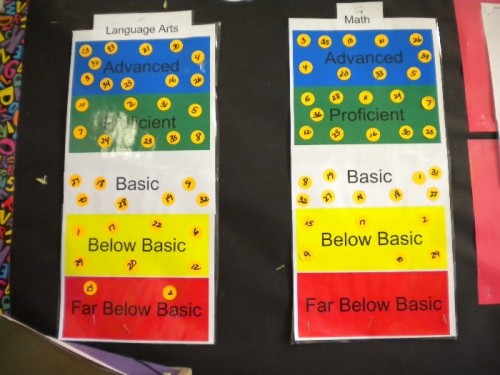
Over the past few years I have visited many classrooms. In elementary schools, I have seen pasted on a wall or cork board, “data walls” that look like these:
21efa15c6a81bcac8dd070eaa6377bd0.jpg


aHR0cDovL25tdXNkLWNhLnNjaG9vbGxvb3AuY29tL3VpbWcvaW1hZ2UvMTI2NDg2MjA0MDg0My8xMjIwNzEwMjU4MjgyLzEyNjcyODAyNzg4NTRfd25wNzAwLmpwZw==.jpg
Usually, students have numbers or aliases assigned to mask their identity. Of course, most students find out who is who.
Whether to use these “data walls” to spur individual students to improve their academic performance or have data displays for the entire class without individuals being noted or not have them at all in a classroom but use individual and class data only among teachers or school leadership teams has been debated in blogs, media, and journals for the past decade (see herehere, here, and here).
With the onset of the mantra “data driven instruction” largely stemming from the accountability features of the federal law, No Child Left Behind (2002), school boards, superintendents, principals, and teachers have heard time and again the importance of gathering, analyzing, and using test data school-wide to improve instruction and in classrooms for students to plan individual strategies. Let’s call that “retail” data.
“Wholesale” data are school-by-school and district numbers that are aggregated  and sent to administrators, teachers, and parents. Those data may (or may not) become a basis for policy changes.
The focus on test scores since the early 1980s–remember A Nation at Riskreport–has given critics the argument that NCLB further narrowed both Continue reading: Facing the Trilemma of Classroom “Data Walls” | Larry Cuban on School Reform and Classroom Practice