Latest News and Comment from Education

Saturday, August 25, 2018

L.A. charter school closes due to low enrollment; campus was in network co-founded by Ref Rodriguez

L.A. charter school closes due to low enrollment; campus was in network co-founded by Ref Rodriguez

L.A. charter school closes due to low enrollment; campus was in network co-founded by Ref Rodriguez


On the fourth day of its second school year, an Eagle Rock charter school closed its doors this week, leaving parents and students disappointed, angry and tearful — and bucking the usual narrative of ceaseless charter growth.
PUC iPrep Charter Academy had dual-language programs in English and either Spanish or Mandarin — the sort of offerings that are usually popular. But it was in an area with too many good school options, and it enrolled too few students.
It may or may not have been a factor that the school was part of Partnerships to Uplift Communities, the group of charter schools co-founded by Ref Rodriguez, who resigned from the Los Angeles Board of Education in July after pleading guilty to criminal charges related to his campaign for office.

The school aimed to enroll 275 students this year, although the organization told parents it would try to make things work with 200. But by Wednesday, it had only 114 students — and PUC’s board voted to shut it down.
“The last thing we wanted to do was disappoint the families who had chosen this school, but we can’t run the school without a certain number of students,” said Naush Boghossian, the school group’s spokeswoman. “It would have been impossible to continue to enlist high-quality staff and provide the kinds of programs that the kids and their families deserve.”


Parents arrive Thursday morning at PUC iPrep Charter Academy to find the school suddenly closed due to low enrollment.
Parents arrive Thursday morning at PUC iPrep Charter Academy to find the school suddenly closed due to low enrollment. (KTLA)
 
The PUC school — which served students in kindergarten through second grade and in grades 6-8 — is the second charter to close in Eagle Rock in the last several months. That other school also was in a school network that got some bad publicity, which may have affected recruitment efforts. Then again, the neighborhood has become saturated with public schools, and the other school also cited low enrollment.
There is no limit on how many independent charter schools can open for business. And there’s no question that their rapid growth has contributed mightily to steady enrollment decline in Los Angeles Unified, exacerbating financial problems in the nation’s second- Continue reading: L.A. charter school closes due to low enrollment; campus was in network co-founded by Ref Rodriguez


Friday, August 24, 2018

California Legislature Approves McCarty Measure to Ban For-Profit Charter Schools | East County Today

California Legislature Approves McCarty Measure to Ban For-Profit Charter Schools | East County Today
California Legislature Approves McCarty Measure to Ban For-Profit Charter Schools


Image result for For-Profit Charter Schools


SACRAMENTO, CA – The California State Legislature Thursday approved AB 406 by Assemblymember Kevin McCarty (D-Sacramento), which would prohibit for-profit corporations from managing and operating charter schools in the Golden State. This bipartisan measure was approved by the State Senate on a 28 to 7 vote and by the State Assembly on a 49 to 15 vote.
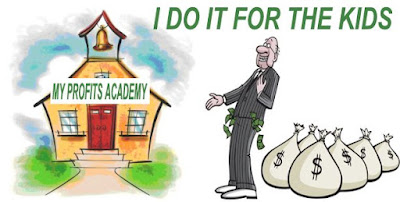
Throughout the United States, a number of corporations are seeking to privatize public education as an untapped market for increasing corporate profits. A disturbing trend in this effort to privatize our public schools has been in the charter school arena.  These corporations take public taxpayer dollars and use a percentage of those dollars for corporate profits and excessive salaries for their executives with little or no transparency and accountability – taking taxpayer money away from students.
In California, 34 charter schools run by for-profit corporations serve over 25,000 students and divert millions of dollars annually away from public schools and into the pockets of corporate investors.
“The privatization of public education must end,” said Assemblymember Kevin McCarty. “Passage of AB 406 puts student success ahead of corporate profits and affirms California’s belief that public tax dollars should be spent to increase student success in the classroom, not to increase corporate wealth the boardroom. This is an historic day in California and I respectfully encourage Governor Brown to sign AB 406 into law.”
The Legislature’s passage of AB 406 created a unique coalition, rarely seen in education policy where the California Federation of Teachers (CFT), representing thousands of public school teachers and the California Charter School Association (CCSA), representing charter schools both supported AB 406.
“Assembly Bill 406 will prohibit for-profit corporations from creating and managing charter schools in California, thus stopping the practice of diverting public dollars away from students for corporate profits with little to no accountability or transparency,” said Joshua Pechthalt, President of the CFT.  “The State of California has clearly shown that these for-profit education management organizations are ripping off taxpayers, misleading parents Continue reading: California Legislature Approves McCarty Measure to Ban For-Profit Charter Schools | East County Today


'Radical Cram School' is Sesame Street for the Resistance

'Radical Cram School' is Sesame Street for the Resistance
'RADICAL CRAM SCHOOL' IS SESAME STREET FOR THE RESISTANCE
Kristina Wong's kid-centric web series is badass and adorable.


How do we keep girls of color from internalizing the racist and misogynistic rhetoric amplified by the election of a presidential bully? How do we empower them to embrace their identities and become allies to other social movements? Forget Kumon. Your kid needs Radical Cram School.

Radical Cram School is a new web series that seeks answer to these questions through humor and fun. Hosted by comedian Kristina Wong, the unscripted six-episode series features Asian American kids, ages 7-11, eight of who identify as girls and one who identifies as gender fluid. Kristina and the kids play games, put on a puppet show and sing the blues to explore topics such as structural racism, misogyny, identity and bullying. 

Grounded in academic research and crafted with comedy, Radical Cram School aims to spark the kinds of conversations not happenindg in school to explore topics such as structural racism, misogyny, feminism, gender identity, income inequality, and how to practice self-expression to transform negative experiences. 

While the subject matter skews mature, the kids' unscripted reactions are hilarious and heartwarming. All six episodes of Radical Cram School are now available on YouTube. Check it out:


The idea for Radical Cram School came when co-producer Theodore Chao, a professor of Education at Ohio State University, realized his 9-year-old daughter Liberty and her friends were internalizing the racist and Continue reading: 'Radical Cram School' is Sesame Street for the Resistance


Do New School Report Cards Reveal Something Worth Knowing or Are They Just Statistical Magic?

Education Law Prof Blog

Do New School Report Cards Reveal Something Worth Knowing or Are They Just Statistical Magic?


Texas has released its statewide grading of public schools, using a grading scale of A to F.  The grades would appear to be a reflection of school poverty levels than anything else.   The Texas Tribune’s analysis shows that “No school district with a rate of low-income students lower than 30 percent received an overall rating of C, D or F.”  And as the level of poor students in the schools increase, the letter grades become more variable, but the clear trend is that letter grades substantially decline.  Almost the entire cluster of Cs, Ds, and Fs is with schools with poverty rates in excess of 50%.Texas
This data poses crucial questions and possibilities.  First, is the variability in letter grades among high poverty schools an indication that the system really is distinguishing between higher and lower quality schools.  Second, do schools have any way to predict, understand, and respond to their overall poor performance?  If they don’t, this system is no better than the statically teacher evaluation systems that state leaders claimed would magically transform the teaching profession, but which were shown to be pretty much pointless, if not harmful, within just a few years. 
Third, even if schools understand these results, do those at the bottom end actually have the resources they need to make change.  As research increasingly shows, money does, in fact, matter to student outcomes and it matters a lot.  Unfortunately, Texas schools are way short on it.  Recent school finance litigation has shown how Texas has been dramatically underfunding its education system.  The largest scale snapshot shows school funding is down roughly 16% in real dollar terms in Texas since 2008.
The whole system, however, might be nothing more than voodoo magic.  States adopted their new rating systems pursuant to the Every Student Succeeds Act.  And as I emphasize in Abandoning the Federal Role in Education,
under the ESSA, states have enormous flexibility in the amount of weight they assign to particular tests and to student achievement factors overall. Not only does this flexibility permit an individual state to minimize the weight it assigns, but it also allows every state to do something different.  One state might make student proficiency tests the dominant measure of student achievement while another state uses student growth.    And regardless of the approach a state takes, states can assign significantly different weights to tests and other student achievement measures. A state might, for instance, assign test results 95 percent in their accountability metric and any number of non-test factors 5 percent or less collectively.  Another state might assign test results 60 percent in its accountability metric while assigning 40 percent to softer factors, such as student engagement, teacher engagement, and school climate.  With a number of options, states will have the ability to manipulate their accountability systems so as to produce desired outcomes. 
None of the foregoing means to suggest that testing is an effective means to promote equal education opportunity or that some optimum weight should be afforded to test results. The point here is that the ESSA maintains the NCLB’s notion that there is merit to testing and accountability, but undermines its own premise. If testing and accountability are plausible tools for achieving equality, leaving states’ testing regimes to random variability undermines equality. Rather than tracking a single proficiency standard as in the NCLB, the ESSA affords disadvantaged students educational opportunities that more closely track the approach of their home state rather than any mandate in statute. In this respect, the ESSA does little to continue the Elementary and Secondary Education Act’s historic mission to promote improvements in academic achievement for disadvantaged students."
It seems to me the overarching problem is that we don’t really know if the system is a statistical sleight of hand, a reflection of inadequate funding, or a reflection of socio-economic segregation (which is the biggest driver of student achievement).  And if we don’t know that, then these report cards cannot really tell us anything worth knowing—even if the underlying data and method is right on target.  In other words, transparency is worth its Continue reading: Education Law Prof Blog


HOW NJ BOOSTS PROFITS FOR CHARTER SCHOOL DEVELOPERS |

HOW NJ BOOSTS PROFITS FOR CHARTER SCHOOL DEVELOPERS |

HOW NJ BOOSTS PROFITS FOR CHARTER SCHOOL DEVELOPERS


The collapse of Newark’s Lady Liberty Academy Charter School hurt  the nearly 500 inner-city children who attended the privately-run, publicly-funded school–but the debacle also exposed a reckless  financing scheme used by former Gov. Chris Christie to help political allies in the charter school movement.
The scheme–known as “conduit bonds”– is so complicated even the spokeswoman for the New Jersey Economic Development Authority (NJEDA), the agency that devised it,  conceded she doesn’t understand it.
But the scheme’s fiscally unhinged methods are easy to describe: The Republican Christie administration loaned $10 million to a private real estate estate developer.  The developer–BWP School  Partners LLC of  Metuchen–formed a partnership with a trouble-plagued but politically connected charter school, Lady Liberty Academy, to create a new facility at the site of a closed religious school in the Vailsburg section of Newark.
BWP–a for profit spin-off of a non-profit called Build With Purpose–promised to pay the $10 million  from the state back to the state with the funds generated by the annual rent it charged to Lady Liberty. In 2016, the annual rent reached more than $871,000.
That’s $871,000 in public money that would otherwise have gone to Newark’s resource-starved public schools.
The money kept rolling in despite clear indications the school was in academic trouble. A Rutgers report in 2003 warned of “challenges.”  The school was twice put on academic probation by the state.   Despite the red flags, Christie loaned the money to Lady Liberty and its private real estate developer partner.
Now that the school has been closed by the state under a new political administration, the money for rent is no longer available–not to the school and not to BWP, a company headed by Brian Keenan of Metuchen. And not to the state that loaned it out.
The disaster gets even gets worse:  The Christie scheme, explained in a detailed Continue reading: HOW NJ BOOSTS PROFITS FOR CHARTER SCHOOL DEVELOPERS |


Thursday, August 23, 2018

Randi Weingarten : DeVos wants to turn government into 'arms dealer for schools' | TheHill

Teachers union boss: DeVos wants to turn government into 'arms dealer for schools' | TheHill
Teachers union boss: DeVos wants to turn government into 'arms dealer for schools'


A teachers union president on Thursday said Education Secretary Betsy DeVos wants to turn the government “into an arms dealer for schools” after a New York Times report said that DeVos is considering a plan to let states use federal funds to purchase guns for schools.
American Federation of Teachers president Randi Weingarten said in a statement that considering using resources to supply schools with more guns “is beyond the recklessness we believed she was willing to pursue” and accused DeVos of wanting to turn schools into “armed fortresses.”
“Instead of after-school programs or counselors, programs that are critical for creating safe and welcoming schools and addressing the mental health needs of kids, DeVos wants to turn schools into armed fortresses and make kids and educators less safe,” she said. “She wants to turn the U.S. government into an arms dealer for schools. That’s insane.”
The Times reported Wednesday night that DeVos is considering whether to allow states to use federal money to buy guns for schools under the Student Support and Academic Enrichment grant program. Sources told the Times that the Education Department would approve the gun purchases with the goal of improving school safety.
Weingarten said in her statement Thursday that “even responsible gun owners have spoken out to say this is a dangerous plan.”
“Does Betsy DeVos want a kindergarten teacher interacting with her students with a holstered gun on her hip? She needs to stop acting as the lobbyist for the NRA and start acting in the interests of children, parents and the educators she has a duty to serve and protect as education secretary,” she said.
Teachers union boss: DeVos wants to turn government into 'arms dealer for schools' | TheHill


Building Community Schools Systems - Center for American Progress

Building Community Schools Systems - Center for American Progress

Building Community Schools Systems

Removing Barriers to Success in U.S. Public Schools

Image result for Community Schools
“Making every school a community school has to be our collective vision. This has to be the rule rather than the exception.”1
— Former U.S. Secretary of Education Arne Duncan, New York City, October 22, 2009

Introduction and summary

If the United States is ever to fulfill its promise of full equality for all citizens, its public schools need to work for all children. In the information age economy, the benefits of postsecondary educational attainment on lifetime earnings are higher than ever before.2 However, family poverty status remains the best indicator of educational attainment, and as of 2013, the majority of public school students live in or near poverty.3 U.S. public schools must improve how they serve low-income students and communities.
The community schools strategy rethinks public schools in order to provide children in low-income communities with a high-quality education. It centers public schools as hubs for communities and combines a rigorous, relevant educational program with extended learning opportunities, family and community engagement, and an infusion of social services. There are roughly 5,000 community schools in the United States today, and a social return on investment study indicated that every $1 invested in community schools affiliated with Children’s Aid in New York City delivers an additional $12 to $15 in social value. This value refers to additional revenues generated and costs avoided, as well as qualitative impact such as the value of specific programming.4
Many community schools are operated at the individual school level, often with the assistance of intermediary nonprofit organizations but with little school district involvement. However, in order to educate students in low-income communities at high levels, school districts should and can play a larger role in coordinating and supporting community schools. The community schools strategy offers districts serving low-income communities a way to overcome structural obstacles that make it more difficult to give children a high-quality education; these include poor access to physical and mental health services as well as to meaningful enrichment opportunities. District engagement can strengthen individual schools and, perhaps even more importantly, help bring this promising strategy to scale.
Leaders of large school systems are recognizing this opportunity. In 2010, then-Oakland, California, Superintendent Tony Smith announced that Oakland would transition to a full community schools district. It was one of the largest school districts to do so. About four years later, New York City Mayor Bill de Blasio followed suit, committing to the creation of 100 community schools across the city.5 Overall, there are 215 community schools in New York City today.6
Indeed, in order for the community schools strategy to truly be an integral part of the nation’s school system, state governments must drive this work. New York’s 2016-17 enacted budget created a $100 million set-aside within the state’s funding formula for community schools programming in 225 school districts identified as “high-need.”7 In order to support a community schools strategy, the statewide commission charged with updating Maryland’s school finance system recommended that the state consider the number of students living in poverty when funding school districts.8 But perhaps the growth achieved by students in Kentucky best demonstrates how an aspect of the community schools strategy can be integral to educational progress. The state’s 1990 education reform law required schools serving low-income communities to have family resource and youth services centers (FRYSC), which help remove nonacademic barriers to learning. Today, Kentucky has 820 FRYSCs operating in 1,166 schools and serving 612,741 students. According to an index that combines multiple educational attainment and achievement factors, Kentucky improved its national ranking from 48th in 1990 to 33rd in 2011.9
A community schools strategy is both reasonable and feasible for school district leaders to adopt. This report details the evolution of community schools initiatives, which are increasing in number and are being led by school districts. It first explains how concentrated poverty affects the student populations of high-poverty schools in very low-income neighborhoods. The report then describes the community schools strategy, before looking at the examples of three case studies: Union Public Schools in Oklahoma, Oakland Unified School District in California, and Hartford Public Schools in Connecticut. These school districts have built and sustained community schools initiatives from the bottom-up, giving students in low-income communities the high-quality education they need to be successful. The report concludes by discussing policy recommendations that district leaders looking to implement a community schools approach should keep in mind. Ultimately, however, state governments must lead in making the community schools strategy a reality for all schools that serve low-income students. 

Concentrated poverty poses challenges for public schools

Concentrated poverty exerts powerful constraints on access to opportunity and upward mobility. Neighborhoods of concentrated poverty—often defined as areas where at least 40 percent of residents are low income—contend with high rates of unemployment, population turnover, and housing instability.10 In the aftermath of the recent recession, and amid rising income inequality, more Americans—and more American children—live in areas of concentrated poverty. The number of high-poverty census tracts has increased 50 percent since 2000, and 11 million people live in census tracts where at least 40 percent of their neighbors are low income.11 Concentrated poverty fuels racial inequality in the United States, as blacks and Latinos are more likely to live in neighborhoods of concentrated poverty than white people.12
Working in isolation, schools cannot overcome the effects of concentrated poverty. Sociologists studying neighborhood context measured the effects of four neighborhood factors: presence of residents with professional jobs, residential stability, economic deprivation, and community demographics. They found that the presence of middle-class, professional residents in a neighborhood was a stronger predictor of student achievement than students’ effort at school or their family’s choice to enroll them in a private K-12 school.13
Another study examined the math test scores of 10 million middle school students by census tract. It found that as poverty Continue reading: Building Community Schools Systems - Center for American Progress
Image result for Community Schools

Wednesday, August 22, 2018

It's time to address the hidden agenda of school dress codes

It's time to address the hidden agenda of school dress codes

It’s time to address the hidden agenda of school dress codes


Dress code policies have always been prevalent in schools. Normally, what children can and cannot wear in schools is explicitly noted in school policies or implicitly implied by broader cultural and societal norms.
The issue of the vast and sometimes exhaustive list of dress code policies of what cannot be worn has not had any resolution across localities and countries.
The problem with trying to develop a set of guidelines for school dress code policies is that the implementation or restriction of dress is just not about the clothes that kids wear. Dress code policies are mired in larger contested debates that have to do with gender identity, race and sexuality, reflective of a broader public discourse .
How school educators and policymakers set parameters of dress in schools creates a highly emotional and volatile debate with little consensus or resolution.
Most obviously, the nature of many dress code violations interconnects to issues of gender and sexual identity. The vast majority of cases have targeted girls and LGBTQ youth on the basis that what one might wear reveals too much — that it’s sexually suggestive, distracting for other students or offensive to the local and cultural norms of the community.

Shaming

Those who are not part of the “norm,” particularly those children whose self-identity goes beyond traditional gender types, are more susceptible to stricter dress code infractions than those policies that privilege the status quo. Similarly, girls have taken the brunt of dress codes.
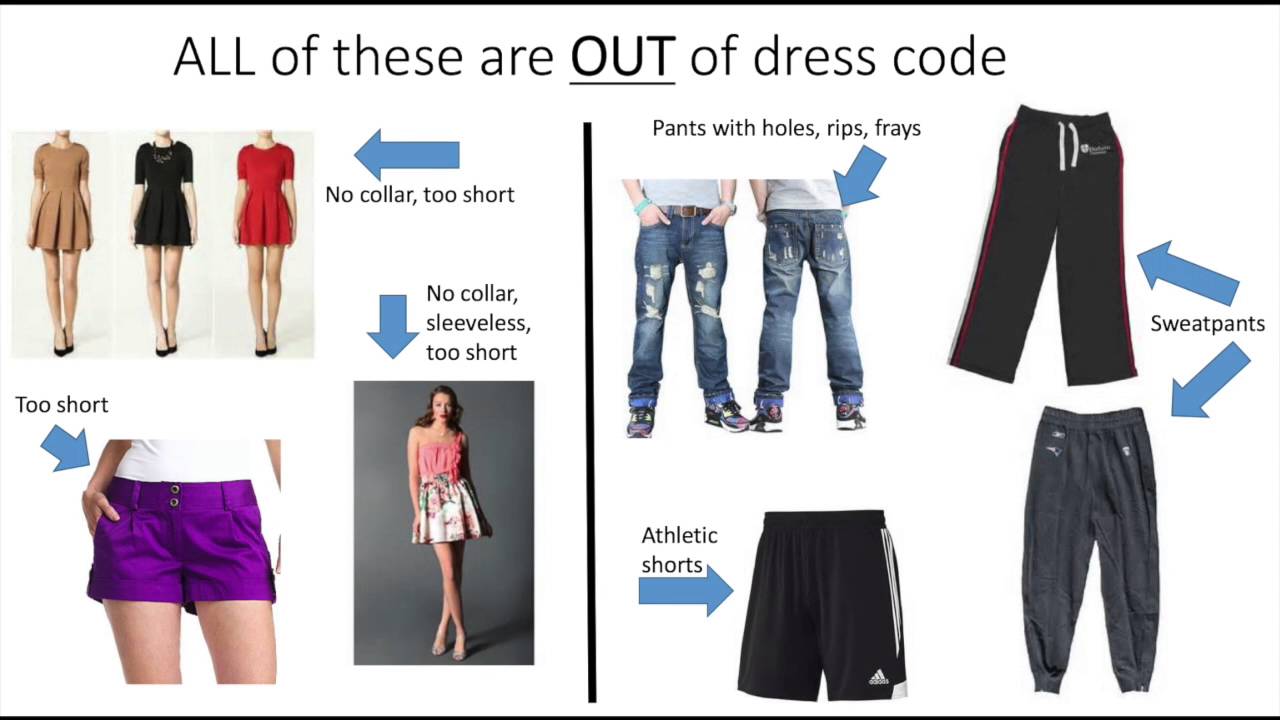
Tank tops, spaghetti straps, bare shoulders, cleavage or no cleavage, shorts that are too short, midriff, shirts/pants regulations are indicative of the multiple infractions that shame girls. The list is exhaustive.
The infractions for noncompliance exacerbate the shaming of girls’ self-perception of their worth. And yet it points to the basic assumption that girls’ bodies are shameful — something that is to be covered, evaluated or objectified.
And when their bodies are not covered, it supposedly sends a clear message that girls are at fault should something wrongful be done to them; they somehow deserved such a fate.
This narrative, whether intended or not, plays to the broader social movements beyond simply that of dress codes. Dress code policies mask broader issues such as one’s right to their own bodies.
Dress codes minimize the increasing public outcries over sexual harassment and assault that have been made so public with the explosion of the #MeToo movement. Conversations around issues of systemic racism or discrimination are also further cloaked.
Forms of dress may be curtailed in schools when they challenge dominant religious views. When schools or boards ban particular types of religious dress, a clear and real danger of undermining religious minorities exists. They may feel a broader form of systemic discrimination lurking behind this ban.
Image result for school dress codes


Creating inclusive, body-positive dress codes

If schools are going to remove this shackle of the perpetual dress code wars in schools, let educators and policymakers call it for what it is – a diversion behind the more significant Continue reading: It's time to address the hidden agenda of school dress codes

Betsy DeVos to Create Permanent Underclass With Rollback of For-Profit College Rules - Rewire.News

Betsy DeVos to Create Permanent Underclass With Rollback of For-Profit College Rules - Rewire.News

Betsy DeVos to Create Permanent Underclass With Rollback of For-Profit College Rules
Make no mistake, these efforts are being driven by greed, plain and simple.


Betsy DeVos gets a lot of notice for her terrible anti-trans stances and her lessening of protections for victims of campus assault. Less reported is how she is also making moves to create a perpetually indebted and undereducated underclass. It’s a quieter way of undermining education in America, but it’s no less dangerous: the propping up of for-profit colleges that fail to provide a meaningful education but do a great job at taking student money and rolling back Obama-era protections for borrowers duped by those colleges.
At the same time, the Trump administration is working on other fronts to ensure that higher education is undermined by a profit motive. The president’s son-in-law Jared Kushner is now apparently overseeing a White House special office dealing with higher education.
Make no mistake, these efforts are being driven by greed, plain and simple. And, like with other policies under the Trump administration, these changes will have a negative disparate impact on people of color—and veterans.
Earlier this month, Education Secretary DeVos scrapped an Obama-era regulation that required for-profit schools to prove that their students were able to get actual decent-paying jobs after their course of study. Known as the “gainful employment” rule, for-profit colleges fought it every step of the way, including multiple lawsuits. The rule packed quite a punch: Schools that were doing nothing but saddling students with debt could see their federal funding revoked.

Federal funding is vital to the for-profit college scheme. It takes public dollars and diverts them to private companies and leaves students on the hook. Roughly 200 for-profit colleges get almost all their funding from the federal government. They’re also a large percentage of the schools that failed the requirements of the gainful employment rule.
The worst of the for-profit schools get students in the door by falsely claiming they have very high rates of post-school employment. Corinthian Colleges famously claimed placement rates as high as 92 percent for one of their accounting programs in Florida when the rate of placement was actually 12 percent. (And lest you think that was limited to that program, they also claimed an 85 percent placement rate for a medical assistant program in Los Angeles when the actual rate of placement was zero.) Under Obama, the federal government fined Corinthian $30 million for that fake job data, while the Consumer Financial Protection Bureau sued them for using those same imaginary placement rates to get students to take out expensive private loans as well.
If these for-profit schools had to follow the gainful employment rule as instituted under Obama, they’d stand to lose $5.3 billion in federal funding over the next ten years. Now, that money will continue to flow to for-profit schools regardless of whether they’re deceiving students or are genuinely able to place students in the jobs for which they are ostensibly trained.
Under the Obama administration, students also at least had a possibility of some recourse if they were Continue reading: Betsy DeVos to Create Permanent Underclass With Rollback of For-Profit College Rules - Rewire.News

Tuesday, August 21, 2018

Study: Minorities Labeled Learning Disabled Because of Social Inequalities | Education News | US News

Study: Minorities Labeled Learning Disabled Because of Social Inequalities | Education News | US News

Study: Minorities Labeled Learning Disabled Because of Social Inequalities
Researchers believe that socioeconomic inequalities contribute to racial minorities being classified as learning disabled.
Related image

THE HIGH NUMBER OF racial minorities placed in special education for learning disabilities is largely because of social injustices separate from schools, not racially biased educators, according to a new study.

The study by Portland State University published in The Sociological Quarter used a statistical method to compare kids with comparable academic levels and socioeconomic status and found that racial minorities are actually less likely than white children to be labeled as having a learning disability, according to a press release from the university.

Dara Shifrer, lead author of the study and sociology professor in the university's College of Liberal Arts and Sciences, believes a student's socioeconomic status is a strong indicator of academic performance, which is often used to diagnose learning disabilities. Because African-American and Hispanic students are often at a socioeconomic disadvantage compared to white students, they may not perform as well, leading to a learning disabled diagnosis.

However, according to the study, classifying the lack of achievement as a disability "fails to address the social causes behind the achievement gap." The study also states that misguided classifications can occur because of language differences and immigration history.

Wrongly placing racial minorities in special education is a problem because there is no evidence that special education improves a student's outcome. However, a disability label stigmatizes students and can limit future opportunities, researchers say.

Study: Minorities Labeled Learning Disabled Because of Social Inequalities | Education News | US News


Related image

OPINION: Good teachers use the N-word

OPINION: Good teachers use the N-word

OPINION: Good teachers use the N-word

But it's how they use it that makes all the difference
Omarosa Manigault Newman, the senior White House staffer turned author, said recently during her book tour that she had heard a tape of President Donald Trump using the N-word during his time on the reality show The Apprentice. Trump denied the existence of any such tape, tweeting, “I don’t have that word in my vocabulary and never have. She made it up.”
Whether such a tape exists or not, would such a recording tell us anything we don’t already know? We already have plenty of evidence of the president’s bigotry and racism. From his taking out a one-page ad in The New York Times to call for the death penalty for the Central Park Five in 1989 before they were eventually exonerated, to his equating of torch-toting neo-Nazis and Confederate sympathizers with anti-racist protesters in Charlottesville last year, and instituting a travel ban for those from certain Muslim-majority nations, and proposing a border wall with Mexico, and his gross labeling of Mexican immigrants as rapists and murderers (I could go on), his actions have betrayed his words. It’s a safe assumption that he has used the word before.

The day after Manigault Newman’s revelation, on the comedy news program The Daily Show, correspondent Roy Wood Jr. eloquently and hilariously explained the situation using muscular movie star Dwayne “The Rock” Johnson, saying, “I don’t need footage of the Rock in the gym to know if he works out!”
Likewise, we don’t need tapes to know Trump — or other past presidents for that matter — used the word; we have public policy to show it. Government-backed slavery, redlining that kept black people from getting low-interest loans and a three-strikes policing policy that led to the mass incarceration of black people speak volumes about what federal leaders believed, and said, behind closed doors. Nevertheless, if a tape surfaces of Trump using the N-word, how should teachers respond to the media storm that would surely follow?
To be clear, educators hear and use the N-word everyday. They say it as a slur, or a term of endearment, or they teach it within the text of assigned readings. Students spew it in the hallways, on the way to and from school, on buses and in sports practice. It proliferates in pop culture: in music, in movies and in slang. It’s so ubiquitous that Continue reading: OPINION: Good teachers use the N-word


Image result for the N-word

Dana Goldstein: How Do You Get Better Schools? Take the State to Court, More Advocates Say - The New York Times

How Do You Get Better Schools? Take the State to Court, More Advocates Say - The New York Times

How Do You Get Better Schools? Take the State to Court, More Advocates Say


By his own account, Alejandro Cruz-Guzman’s five children have received a good education at public schools in St. Paul. His two oldest daughters are starting careers in finance and teaching. Another daughter, a high-school student, plans to become a doctor.

But their success, Mr. Cruz-Guzman said, flows partly from the fact that he and his wife fought for their children to attend racially integrated schools outside their neighborhood. Their two youngest children take a bus 30 minutes each way to Murray Middle School, where the student population is about one-third white, one-third black, 16 percent Asian and 9 percent Latino.

“I wanted to have my kids exposed to different cultures and learn from different people,” said Mr. Cruz-Guzman, who owns a small flooring company and is an immigrant from Mexico. When his two oldest children briefly attended a charter school that was close to 100 percent Latino, he said he had realized, “We are limiting our kids to one community.”

Now Mr. Cruz-Guzman is the lead plaintiff in a lawsuit saying that Minnesota knowingly allowed towns and cities to set policies and zoning boundaries that led to segregated schools, lowering test scores and graduation rates for low-income and nonwhite children. Last month, the state’s Supreme Court ruled the suit could move forward, in a decision advocates across the country hailed as important.

The case is part of a wave of lawsuits over the quality of schools in more than a half-dozen states. The suits could serve as road maps for advocates in other states amid a nationwide teachers’ movement and a push in some state legislatures for more school funding.

The legal complaints have different areas of focus — from school funding to segregation to literacy — but all of them argue that the states are violating their constitutions by denying children a quality education.

Such lawsuits were filed in past decades, but the recent cases show a renewed energy for using the courts to fight for better education, and they may signal an end to a period when many courts, after the last recession, seemed unwilling to require states to spend more money on schools.

“The courthouse doors are in effect open again,” said David Sciarra, executive director of the Education Law Center, which has argued school funding cases in New Jersey and has filed amicus briefs in several of the current cases. “What we’re seeing are the beginnings of a broader conversation about what the right to an education should look like.”

Advocates are focused on state courts because of roadblocks at the federal level: A 1973 Supreme Court decision found that unequal school funding was not a violation of the United States Constitution, which does not Continue Reading: How Do You Get Better Schools? Take the State to Court, More Advocates Say - The New York Times