Latest News and Comment from Education

Monday, May 7, 2018

ECOT used for-profit companies to hide source of attack-ad money, Yost says

ECOT used for-profit companies to hide source of attack-ad money, Yost says:

ECOT used for-profit companies to hide source of attack-ad money, Yost says

Using private companies owned by Electronic Classroom of Tomorrow school founder Bill Lager, plus a media-production company run by his daughter, ECOT tried to hide the source of payment for nearly $250,000 worth of TV attack ads aimed at the Ohio Department of Education.
That is the conclusion reached by the office of state Auditor Dave Yost, who, in a draft finding for recovery obtained by The Dispatch, lays out details of a plan designed to avoid the appearance that ECOT illegally used taxpayer money to pay for political ads.
As a result, Yost is ordering a pair of Lager’s ECOT-affiliated for-profit companies, Altair Learning Management and IQ Innovations, along with Third Wave Communications, where Lager’s daughter Jessica Harris is an owner, to repay ECOT a total of nearly $250,000 for illegally spent public money.
ECOT, formerly the state’s largest charter school, was closed in January. The recovered money would go into a fund that is under the control of an interim master who was appointed by a Franklin County judge; the fund is to be used to continue paying the school’s obligations. The companies can formally respond to the finding this week.
>> Join the conversation at Facebook.com/dispatchpolitics and connect with us on Twitter @OhioPoliticsNow
ECOT and the Department of Education engaged in warfare in the courts and a public relations campaign last year after the department found that the online school was unable to verify about 60 percent of its reported enrollment, based largely on the duration of computer log-ins showing that students didn’t meet state-minimum hours of instruction. The state ordered ECOT to repay the state $60 million.
As part of its strategy, ECOT took to the airwaves, launching a string of television ads attacking the Department of Education, urging it to keep ECOT open and accusing it of wanting to end school choice and not caring about ECOT students. Lager is a major contributor to Republican campaigns.
Although charter schools can legally run ads in an effort to recruit students, no public school — charter or traditional — is allowed to spend taxpayer money on political-type ads, including levy campaigns.
On June 13, according to the auditor’s report, Midwest Communications & Media sent ECOT an invoice in the amount of $249,962 related to the placement of the political ads.
Two weeks later, when contacted by The Dispatch, then-ECOT spokesman Neil Clark confirmed that the ads were paid for with public money. He argued that the school had a right to use those funds for “any activity that they believe can lead to making ODE change its current position or affect the General Assembly to try to change ODE.”
The same day that story appeared in the paper, Yost sent ECOT a letter demanding that the school cease using taxpayer money on such ads.
Four days after the story and letter, according to the report, Melissa Vasil, director of operations for Altair, the school’s for-profit management company, sent an email to Amy Davis, marketing coordinator with IQ Innovations, the school’s software provider. Again, Lager owns both companies.
Vasil told Davis to have Third Wave Communications — a company that shares a street address and family ties with IQ — pay the $249,962 invoice. That same day, bank records show that Third Wave made the payment, which, Yost’s office noted, was a departure from the payment practice in the first half of 2017.
“Third Wave Communications had no apparent reason to pay a large sum of money for this and only these advertisements,” the report said, noting that prior Midwest invoices were sent to ECOT for payment.
Since June 2016, ECOT had been paying Third Wave $45,000 per month, plus $4,950 per additional video, as detailed by the contract. Those consulting payments made up a significant portion of Third Wave’s available cash to pay Midwest Communications, and there is no evidence that a third party ever reimbursed Third Wave for the payment, the report said.
“The only reasonable understanding of this process is that it was designed to disguise the use of public money to pay for the non-public purpose of the lobbying ad,” the report said.
Yost is expected to release a new financial audit of ECOT soon.
 ECOT used for-profit companies to hide source of attack-ad money, Yost says:


Sunday, May 6, 2018

Diane Ravitch and the education debate | My View | santafenewmexican.com

Diane Ravitch and the education debate | My View | santafenewmexican.com:

Diane Ravitch and the education debate


Thank you to the Lannan Foundation for bringing Diane Ravitch to address our community on the challenges that she sees to strengthen our public education system to best serve children (“Author assails state of education in N.M.,” April 16). Obviously our community values public education, as the Lensic Performing Arts Center was packed for the presentation.
We appreciate Ravitch’s clear message that poverty compromises learning and that federal and state mandates that require excessive testing can be punitive. We welcome her strong advocacy for supporting and recognizing teachers, and her emphasis on child-centered learning. We agree that we need to be aware of some corporations’ agendas to privatize our public education system; and that the present agenda of the U.S. Department of Education is to fund the expansion of public charter schools, thereby diminishing funding of traditional public schools. We lament, along with Ravitch, that the testing industry drives and profits from excessive testing, to the detriment of quality education. Best practice requires only occasional testing, and only to diagnose how a child needs to be supported. Best practice then provides additional support for that child.
However, we do not agree with Ravitch that a solution is to do away with national standards. The standards provide a common point of reference for children, families, teachers, principals and school administrators as a student moves from state to state, system to system, and from school to school.
In addressing the Santa Fe audience, Dr. Ravitch may have been unaware that our community strives to address the issues of poverty daily through the work of the Santa Fe Public Schools Student Wellness Division; the Adelante Program, serving 1,700 homeless children and their families yearly; and through partnership with the nonprofit organization Communities in Schools, linking children to wrap-around services related to their health and well-being. While inadequately funded, our school system has struggled to budget for school counselors, nurses and school security. Each week The Food Depot provides backpacks full of food to school children and their families.
We as a community need to support and collaborate with SFPS to expand and implement effective strategies to address poverty and lift student achievement. The Interfaith Coalition for Public Education joins others in recruiting and placing tutors in classrooms, coaching teachers, providing teacher workshops, advocating for increased funding and accountability, and orchestrating education forums to inform the public. We, along with other entities in Santa Fe work collectively in the Birth to Career (now Opportunities Santa Fe) collaborative to maximize support for our children.
Ravitch and many others point to best practices in Finland and other nations as models for New Mexico. We agree that the prenatal years are critical for developing the initial capacity for learning. But our national and state policies have never adequately addressed or funded universal prenatal health care, paid family leave, home visitation for expecting and new mothers, and universal public school pre-K. In our society, teachers do not yet have the status in pay and respect of corporate CEOs, doctors, lawyers, entertainers and athletes. Until we dedicate public funds to rigorous teacher education, high-quality classroom and teacher support and abundant teacher salaries, teachers will continue to be demoralized as they fight for bare necessities. This is inexcusable; we as voters and taxpayers need to demand legislation that will put teacher-honoring policies into effect.
Thank you, Dr. Ravitch, for stirring our thinking and helping us to recognize the important work in progress in our city. There is work enough for all of us to put power into effective strategies that benefit our children and community.
K. Elise Packard, Ph.D., is a learning consultant and co-founder of the Interfaith Coalition for Public Education. She lives in Santa Fe.Diane Ravitch and the education debate | My View | santafenewmexican.com:

Don’t let charter schools cloud the race for Brown’s successor. Vote Newsom or Chian | The Sacramento Bee

California primary: Newsom or Chiang are top two for governor | The Sacramento Bee:

Don’t let charter schools cloud the race for Brown’s successor. Vote Newsom or Chiang
20160209_HA_Gavin_Newsom0093


Gov. Jerry Brown is a hard act to follow. No California governor has served longer, or more consequentially.
In the past eight years alone – his second stint in the office – the state has gone from a $27 billion budget deficit to a $6 billion surplus. Unemployment has fallen from 12.2 percent to 4.3 percent, a record. Along the way, Brown has realigned the state’s criminal justice system, overhauled public school finance, licensed more than a million undocumented drivers, put the state at the forefront of addressing climate change and taught Californians a little Latin.
Whoever succeeds him will not only have to pick up where he left off on those issues, but also maintain his defense of California against Trump administration assaults on our environment, trade, diversity and tolerant values. Not to mention our many in-state challenges – affordable housing, health care, underfunded public employee pensions, higher education, water policy and so on. Oh, and the near-term likelihood of a downturn in the state economy.
So voters have their work cut out on June 5 in culling two candidates from a field of more than two dozen contenders. A few prospects are prepared, but let us stipulate: None are Jerry Brown.
The best-equipped candidate for the economy to come – state Treasurer John Chiang – is running an anemic campaign and is probably terminally underfunded. The best-financed and most experienced candidates – former Los Angeles Mayor Antonio Villaraigosa and Lt. Gov. Gavin Newsom – have, in their personal lives, made unnerving and public errors in judgment.
More immediately, there are the great gobs of money from billionaire charter school advocates going to independent expenditure campaigns backing Villaraigosa. Though Newsom, too, has his billionaires – hello, Silicon Valley – the charter movement has direct Continue Reading: California primary: Newsom or Chiang are top two for governor | The Sacramento Bee:


Friday, May 4, 2018

America’s Youth Under Fire - Center for American Progress

America’s Youth Under Fire - Center for American Progress:

America’s Youth Under Fire
The Devastating Impact of Gun Violence on Young People
Image result for The Devastating Impact of Gun Violence on Young People

Introduction and summary

On February 14, 2018, 14 students and three staff members were murdered at Marjory Stoneman Douglas High School in Parkland, Florida, by a single shooter armed with an assault rifle. This horrific massacre galvanized the nation’s attention to the issue of gun violence, particularly as it affects young people in this country. However, the scope of gun violence as it affects America’s youth is much vaster than this most recent mass shooting. Gunfire has officially overtaken car accidents as one of the leading killers of young people in the United States.1 As of publication time, since the beginning of 2018, 820 teens ages 12 to 17 have been killed or injured with a gun.2 As mass shootings become more common and more deadly, a staggering 57 percent of teenagers now fear a school shooting.3
 The epidemic of gun violence against America’s youth is more than just a disturbing data point. For each bullet fired, there are multiple stories of lives changed forever. When he was just 6 years old, Missouri State Rep. Bruce Franks Jr. saw his brother shot in front of their neighbor’s home.4Nevada activist Mariam El-Haj witnessed the shooting of her mother by her estranged father, who then turned the gun on Mariam.5 Oregon youth mentor Jes Phillip’s siblings have all had close calls—she has three younger sisters who were present at the Reynolds High School shooting in Troutdale, Oregon, and two bullets landed next to her brother’s bed when they came through her family’s apartment wall during a neighborhood shooting.6 Nineteen- year-old student Eli Saldana, a member of the Native American community living in Chicago, was shot on his walk home from work.


These stories of gun violence are all too common among young Americans. The United States’ gun violence epidemic disproportionately ravages young people, particularly young people of color. In short, gun violence is shattering a generation.
Young people are not simply victims of gun violence in this country, they are among the leading voices calling for change to the nation’s weak gun laws and deadly gun culture. Organizers of the Black Lives Matter movement; survivors of the Parkland shooting; youth organizers working in cities hardest hit by gun violence, such as Chicago, Baltimore, and St. Louis, have all lent their voices to an increasingly loud call to action.
These young people do not just want to reform gun laws—they are also demanding that the issue of gun violence be examined as part of a complex and intersectional web of issues that also include community disinvestment, criminal justice reform, and policing. They are advocating not only for solutions to make schools safer from mass shootings but also for holistic and intersectional solutions that will help make all communities safer.
This report breaks down how gun violence is affecting young people, and how young activists are rising to build an intersectional movement working for solutions. It examines the specific impact of gun violence on young people and considers both how young people as a collective are disproportionately affected and how different communities of young people share different aspects of the burden of this violence. This report also highlights examples of young people leading the advocacy efforts around this issue and discusses a number of policy solutions that are crucial to reducing gun violence, reforming the criminal justice system, improving police-community relations, and encouraging reinvestment in impacted communities.
Image result for Impact of gun violence on young people

Impact of gun violence on young people: A national overview

Young people make up a very small percentage of all deaths in the United States each year. Consider 2016: That year, more than 2.7 million people in the United States died, with the top-three leading causes of death being heart disease, cancer, and unintentional injuries.7 Of these 2.7 million deaths, only 2.2 percent were individuals between the ages of 15 and 29.8However, looking only at deaths caused by gunfire, the picture changes dramatically. Young people in this age range Continue reading: America’s Youth Under Fire - Center for American Progress:


Game Changer? Just Maybe. Why Gates' Move Into Anti-Poverty Work Is a Big Deal — Inside Philanthropy

Game Changer? Just Maybe. Why Gates' Move Into Anti-Poverty Work Is a Big Deal — Inside Philanthropy:

Game Changer? Just Maybe. Why Gates' Move Into Anti-Poverty Work Is a Big Deal


The Gates Foundation is getting into anti-poverty work in the United States in a big way with a four-year, $158 million initiative. The move is a significant departure from the foundation’s past domestic endeavors, which focused almost exclusively on education. 
Though the initiative represents a pivot, Gates’ commitment to education played a major role in pushing the foundation in this direction, CEO Sue Desmond-Hellmann told Inside Philanthropy
“We got into this space because of all the years we worked in education,” Desmond-Hellmann said. “Education leaders told us that to give students the best chance at success, we would have to engage with the problems that face students outside the classroom.”
Jane Waldfogel, a Columbia University professor who wrote Too Many Children Left Behind, is among those experts who've long been arguing for a broader approach to improving student outcomes. Her research supports a link between what happens outside school and kids’ success in the classroom.
“The U.S. has very large achievement gaps between children from low- and high-income families—large relative to what they were historically and also large relative to the gaps in other countries,” Waldfogel said. “We also know that a substantial portion of these achievement gaps is due to factors outside of school.” 
Gaps that exist before kids start school tend to widen once they arrive, she said. “Although, of course, schools have a critical role to play in reducing achievement gaps, there is also a critical role for policies to help level the playing field outside of school.” 
For years, poverty has been one of the most polarizing issues in education. Reformers pushing for more choice and accountability have insisted that poor kids could make big gains if they just had better schools and teachers, and said that defenders of the status quo too often used poverty to excuse failing education systems. Progressives, in turn, charged that the school reform movement had unrealistic expectations for low-income students and was failing to reckon with deep structural inequities in U.S. society. 
Traditionally, the Gates Foundation has been a leader of reform funders focused strictly on schools. But as Bill Gates himself has acknowledged, after years of often disappointing results from its K-12 work, the foundation is finally broadening its approach to look at factors outside the classroom. 
The new initiative has some education experts on the left enjoying a moment of vindication. “I have said repeatedly that the foundation should focus on the root cause of low test scores, which is poverty,” said NYU professor Diane Ravitch, an education historian and one of Gates' harshest critics. “So I am very pleased that the foundation is taking an important step in this direction.” 
This move, moreover, comes after a recent pivot by the Gates Foundation on its K-12 work to back locally Game Changer? Just Maybe. Why Gates' Move Into Anti-Poverty Work Is a Big Deal — Inside Philanthropy:

Gates Foundation Pledges $158 Million to Fight Poverty in U.S. – Next City - https://nextcity.org/daily/entry/gates-foundation-pledges-158-million-to-fight-poverty-in-u.s via @NextCityOrg


Thursday, May 3, 2018

Teachers union gains a foothold in L.A.'s largest charter school group

Teachers union gains a foothold in L.A.'s largest charter school group:

Teachers union gains a foothold in L.A.'s largest charter school group

For years, the possibility of organizing the employees of the largest charter school group in Los Angeles was an elusive goal for the teachers union. Efforts launched in 2015 sputtered out during an extended and expensive legal back-and-forth.
But on Wednesday, the movement appeared to get its momentum back.
Teachers at three charter schools operated by the Alliance College-Ready Public Schools network submitted paperwork to form a union and begin bargaining collectively. Though they make up a fraction of Alliance's total employees — the network runs 25 schools across L.A. — their actions represented a partial victory in the union's campaign to organize charter schools.

"These three schools, with more than 100 educators, are the first to file. Others in the 25-school charter chain are expected to follow," a spokesman for the union, United Teachers Los Angeles, wrote in a statement.
In a statement, Catherine Suitor, Alliance's chief advancement officer, said the group had "been made aware that some staff" at three schools had submitted cards to form a bargaining unit. She pointed out that Alliance has "more than 700 dedicated educators" at its schools.
"As always, we remain committed to making sure that all of [our] educator voices are heard and counted as this process moves forward," she said.
Attempts to unionize the Alliance schools began in earnest in 2015, when nearly 70 employees sent the group's administrators a letter asking to be allowed to organize without fear of retaliation. Alliance's leaders suggested they would not interfere.
But that early civility gave way to a series of disputes over whether UTLA organizers were being overly aggressive — as Alliance claimed — and whether Alliance's leaders were intimidating employees interested in joining — as the union maintained.
At one point, UTLA officials accused the charter group of using public funds to pay for lawyers and public relations consultants to fight off the unionizing effort. But a state audit later cleared Alliance of wrongdoing. It found that while Alliance had spent nearly $1 million to fend off the organizing push, it had raised the money from private donors and benefited from another $2 million in pro bono legal work.
UTLA officials said a "clear majority" of teachers and counselors at three Alliance schools submitted cards to the California Public Employment Relations Board on Wednesday morning, authorizing UTLA as their union. The schools are: Alliance College-Ready Middle Academy 5 in Lincoln Heights, Alliance Gertz-Ressler/Richard Merkin 6-12 Complex in downtown L.A., and Alliance Judy Ivie Burton Technology High School in South L.A.
"One of the reasons we made the decision to pursue this strategy was to kind of model for  Continue reading: Teachers union gains a foothold in L.A.'s largest charter school group:

Oklahoma teacher of the year shocked Betsy DeVos 'redefines' private schools as part of public education system | Education | tulsaworld.com

Oklahoma teacher of the year shocked Betsy DeVos 'redefines' private schools as part of public education system | Education | tulsaworld.com:

Oklahoma teacher of the year shocked Betsy DeVos 'redefines' private schools as part of public education system

Image result for private schools
Education Secretary Betsy DeVos met privately with the nation’s top teachers Monday and asked them to talk about the obstacles they face in doing their jobs. At least one of those teachers told DeVos that some of her policies are hurting public education.
“We have a problem where public money is siphoned off from the public schools and given to children who are going to charter and private schools,” Oklahoma Teacher of the Year Jon Hazell said.
DeVos’s response shocked him, he said.
“She immediately answered that it was her goal to redefine what education is and that she wants to call all of it public education,” said Hazell, a Durant High School science teacher.
Hazell was among 50 teachers who were in Washington representing their states as teachers of the year. The visit from DeVos was a surprise.

Wednesday, May 2, 2018

New L.A. schools chief Beutner pledges to learn and to take action

New L.A. schools chief Beutner pledges to learn and to take action:

New L.A. schools chief Beutner pledges to learn and to take action
New L.A. schools Supt. Austin Beutner proved on Wednesday that he's a quick learner despite lacking a background in education. Like a stream of public officials before him, he appeared at an important event — his first speech and news conference — in front of a group of students, who served as a photogenic backdrop.
His message — that he would put students first — was nothing original but he pledged to push cooperatively but unflinchingly to improve the district's academic performance and stabilize its finances.
Details to come.
Beutner, a former investment banker who made a fortune on Wall Street, offered no specifics on how he would deal with the district's gravest academic and fiscal challenges or its stalled negotiations with the teachers union.
Union representatives on Wednesday came out battling, saying his selection was a sign that L.A. Unified's leadership is steering the nation's second-largest school system in the wrong direction.
The Board of Education selected Beutner by a 5-2 vote on Tuesday, passing over interim Supt. Vivian Ekchian, who has spent her career in the L.A. Unified School District, rising from teacher to senior management.
"To state the obvious, I'm an unconventional choice, unconventional by lots of measures," Beutner, a former deputy mayor and L.A. Times publisher, said in prepared remarks at Belmont High School. "But the district is at a crossroads. We face some tough issues. But I believe we can move forward together and address these issues to unlock the enormous  Continue reading: New L.A. schools chief Beutner pledges to learn and to take action:


Cathie Black debacle just the latest in a long line of miscues by education reformers - NY Daily News - http://www.nydailynews.com/opinion/greenman-cathie-black-reformers-failed-test-article-1.114418 via nydailynews


Big Education Ape: Billionaire Blunders: Appointing Education Chiefs Who Know Little about Public Schools | Larry Cuban on School Reform and Classroom Practice - http://bigeducationape.blogspot.com/2017/02/billionaire-blunders-appointing.html

Cathie Black

Cathie Black and the privatisation of education | Daniel Denvir | Education | The Guardian - https://www.theguardian.com/commentisfree/cifamerica/2011/apr/07/schools-school-funding on @guardian

Cathie Black, the new chancellor of New York City schools calls herself a born saleswoman

Cathie Black, the new chancellor of New York City schools calls herself a born saleswoman - NY Daily News - http://www.nydailynews.com/new-york/education/cathie-black-new-chancellor-new-york-city-schools-calls-born-saleswoman-article-1.451260 via nydailynews


BROOKINGS: Charter school growth puts fiscal pressure on traditional public schools

Charter school growth puts fiscal pressure on traditional public schools:

Charter school growth puts fiscal pressure on traditional public schools

Image result for Charter school growth puts fiscal pressure on traditional public schools

Policy debates about the net effects of charter schools on students and on the delivery of K-12 education are ongoing and remain highly contentious. 

In a recent paper, we contribute to the policy discussion by drawing attention to the fiscal externalities of charter schools, a finance topic that deserves more attention in the overall discussion. Fiscal externalities are the additional burden that charter schools place on the budgets of traditional school districts, and we find evidence that they are consequential in North Carolina.


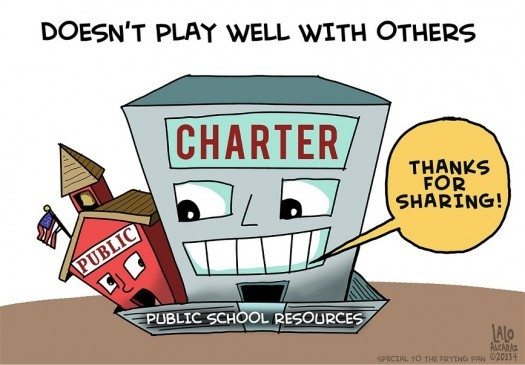
Although such burdens may manifest themselves in higher local tax burdens, the more likely outcome is reduced spending per pupil on educational services–and hence lower educational quality–for students who remain in the district’s traditional public schools. The presence of charter schools typically means that some of the funding that would otherwise have been available to the local school district is diverted to the charter schools. For example, assume that the funding arrangements are such that if 10 percent of a district’s students shift to a charter school, the district loses 10 percent of its revenue. The main problem is that the district cannot simply reduce its costs by 10 percent because some of its costs are fixed, especially in the short run. As a result, unless the district is able to offset the lost revenue with higher local tax revenue, it must cut its spending on variable inputs, such as teachers, by more than 10 percent.

EVIDENCE FROM NEW YORK AND NORTH CAROLINA

In drawing attention to these fiscal externalities, we follow the lead of scholars Robert Bifulco and Randall Reback, who measured the adverse fiscal impacts of charter schools in two New York districts, Albany and Buffalo. They correctly point out that estimated magnitudes depend on state and local funding arrangements, and require explicit assumptions about how readily local districts can modify their spending patterns in response to revenue losses, as well about the proportion of charter students who otherwise would have attended private schools.
Our study goes beyond theirs in several ways, including applying the analysis to one medium-sized urban district and five non-urban districts in North Carolina. Attending to effects in these smaller districts is useful given the spread of charter schools beyond the large urban districts where charters have been most common.
In North Carolina, the state is the sole authorizer of charter schools and its authorizing legislation specifies that charter schools are to be funded at the same per-pupil rate as the public schools in the district where the students live. Funding for these purposes includes state funding which accounts for about 65 percent of statewide funding, and local supplemental funding which differs by district based largely on the wealth of the local county.
We collected financial data on school spending from six districts around the state to conduct the analysis. We selected Durham, N.C., (a county district with a traditional public school enrollment of 33,000 students) as our urban district because of: its relatively large share of charter school students (15 percent); its high local funding; and the explicit concerns of district policymakers that charters are adversely affecting the district’s ability to serve its students, many of whom are economically disadvantaged. We selected five illustrative non-urban districts based on their growing shares of charter school enrollments, and our success in obtaining the detailed local expenditure data needed for the analysis.


MEASURING FISCAL EXTERNALITIES

Estimating fiscal burdens in an art, not a science. Central to the analysis is categorizing local district expenditures into one of two categories. Variable costs–such as spending on teachers–represent those that can be cut back relatively easily with a change in the number of students. Conversely, fixed costs – such as those on administration and facilities–represent long-term funding commitments and are much harder to adjust in the short run.
For the simplest models, we assume that the district can reduce its variable spending on line with the loss of students and that fixed costs cannot be adjusted at all. In fact, however, the district will not be able to adjust its variable spending in this way if the students who shift to charter schools are spread across schools and grades. Hence, we also calculate short-run fiscal burdens that assume some stickiness in variable spending. For some of our estimates, we also vary the treatment of fixed costs by assuming that even in the relatively short run, the introduction of charter schools may allow a Continue Reading: Charter school growth puts fiscal pressure on traditional public schools:

Tuesday, May 1, 2018

New LAUSD superintendent Austin Beutner isn't an educator. Here's what we know about how he thinks about schools. | 89.3 KPCC

New LAUSD superintendent Austin Beutner isn't an educator. Here's what we know about how he thinks about schools. | 89.3 KPCC:

New LAUSD superintendent Austin Beutner isn't an educator. Here's what we know about how he thinks about schools.


Austin Beutner is a former investment banker with no history working as an educator. But the newly appointed superintendent of the Los Angeles Unified School District he does have a history with the school system – one that gives clues about how he might direct the education of the more than half a million students the district serves.

THE BACKSTORY

LAUSD board members voted Tuesday to offer a three-year contract to Beutner.
It's the biggest civic project yet for Beutner, who has spent much of the last decade deeply involved in the civic life of Los Angeles. He served as the city's deputy mayor from 2010 to 2011 and then spent just over a year as publisher and chief executive of the Los Angeles Times. In 2012, he founded a non-profit organization that provides children with free eye exams and glasses that has worked closely with LAUSD.
Beutner has been scrutinizing the district's finances and operations since 2017. That's when he began co-chairing a task force of civic leaders advising the school board on accelerating the pace of change. 
In late 2016, Beutner had breakfast with board member Richard Vladovic. At the time, former superintendent Michelle King was struggling to gain the board's support for her Strategic Plan. The plan called for raising the district's graduation rate to 100 percent, increasing school choice for parents and reducing absenteeism. But board members were frustrated and were pushing King to get more specific
Beutner saw a disconnect.
“Every kid graduating and perfect attendance … that’s interesting and those are laudatory goals," he later recalled telling Vladovic in an interview with KPCC. "But this is something different, in my view, than a plan.”
That breakfast led to a meeting with Superintendent King herself. And Beutner pitched an idea: how about a task force of civic leaders from outside LAUSD?  The Strategic Plan had already outlined some goals; a task force could recommend some strategies to meet those goals. King agreed.

WHAT HAPPENED NEXT

Beutner recruited 12 other leaders from local foundations, philanthropies, non-profits, advocacy organizations and academia for the task force. They began meeting in May 2017.
By December, they had concluded that more than 80,000 students were chronically absent the previous school year, costing the district about $20 million in revenues. The group also released its first set of recommendations, outlining several pilot Continue reading: New LAUSD superintendent Austin Beutner isn't an educator. Here's what we know about how he thinks about schools. | 89.3 KPCC: